




13 Sep TOP 20 AI CHATBOT CONVERSION RATE STATISTICS 2026 REVEAL MASSIVE SALES SURGES
Updated for 2026. This page has been fully refreshed with the latest AI chatbot conversion rate statistics, conversational commerce benchmarks, and customer engagement data sourced from global surveys, SaaS analytics platforms, and enterprise marketing reports.
When it comes to improving online performance, businesses are turning to AI chatbots more than ever. Recent AI chatbot conversion rate statistics reveal just how much impact these digital assistants can have on customer engagement, lead generation, and overall sales. As a leading marketing agency in New York, we’ve seen firsthand how the right chatbot strategy can transform a website’s results—from converting curious visitors into loyal buyers to streamlining customer support. What makes these statistics truly exciting is that they don’t just represent abstract numbers; they reflect real growth opportunities that modern brands can tap into. In this article, we’ll explore the top 20 statistics that highlight why AI chatbots have become an essential tool for businesses looking to thrive in today’s competitive digital landscape. Understanding the marketing agency financial model behind implementing AI solutions can also help businesses allocate resources effectively, ensuring sustainable growth and measurable ROI from their chatbot strategies.
AI chatbots continue to evolve rapidly in 2026 as conversational AI, generative responses, and real-time personalization dramatically increase the likelihood that a visitor completes a purchase or submits a lead form. Businesses adopting modern chatbot strategies are now reporting measurable gains in conversion rates, reduced support costs, and higher customer satisfaction. As competition across digital channels intensifies, these insights into chatbot performance provide brands with a roadmap for turning conversations into revenue.
TOP 20 AI Chatbot Conversion Rate Statistics 2026 Revealing Explosive Sales Growth
| # | Statistic | Figure | Category |
|---|---|---|---|
| 01 | Peak chatbot conversion rate in targeted industries Retail & Travel · McKinsey 2026 | 70% conversion rate | Conversion |
| 02 | Sales increase for businesses deploying chatbots General Business · Multiple Studies | 67% sales uplift | Sales |
| 03 | E-commerce conversion improvement with AI chatbot E-commerce · Shopify 2026 | 30% conversion boost | Conversion |
| 04 | Higher conversion rate for AI-assisted shoppers vs. unassisted E-commerce · Rep AI / Adobe Analytics 2026 | 4× 13.8% vs 3.4% | Conversion |
| 05 | Overall website conversion rate increase with AI chatbots General Business · Drift & Salesforce 2026 | 27% avg uplift | Conversion |
| 06 | Chatbot leads convert faster vs. traditional web forms General Business · HubSpot 2026 | 3.4× conversion velocity | Lead Gen |
| 07 | Sales transactions that originate from a chatbot interaction General Business · Conversica 2026 | 34% of all sales | Sales |
| 08 | Abandoned shopping carts recovered by chatbot prompts E-commerce · Klaviyo 2026 | 41% cart recovery | Sales |
| 09 | Annual revenue growth after chatbot deployment E-commerce · Deloitte 2026 | 7–31% revenue growth | Sales |
| 10 | Average ROI per $1 invested in chatbot technology General Business · IBM Study 2026 | $4.20 per $1 invested | ROI |
| 11 | Companies reporting higher-quality leads from chatbots General Business · Marketo 2026 | 63% of companies | Lead Gen |
| 12 | Website visitors converted into qualified leads General Business · Intercom 2026 | 31% visitor-to-lead | Lead Gen |
| 13 | Conversions boost from deep CRM-chatbot integration General Business · Salesforce 2026 | 37% conversion boost | Conversion |
| 14 | Sales lift from 24/7 chatbot availability General Business · Zendesk 2026 | 34% sales lift | Sales |
| 15 | Purchases completed faster with chatbot assistance E-commerce · Forrester 2026 | 53% faster checkout | Efficiency |
| 16 | Common customer queries resolved automatically General Business · Gartner 2026 | 84% auto-resolved | Efficiency |
| 17 | Consumers preferring AI self-service over live agents General Business · Accenture 2026 | 72% prefer self-service | Efficiency |
| 18 | Users citing 24/7 availability as chatbot's top value General Business · PwC 2026 | 72% of users surveyed | Efficiency |
| 19 | Global conversational AI market valuation in 2026 All Industries · Grand View Research / Statista 2026 | $187B market size | ROI |
| 20 | Customer interactions now powered by AI globally All Industries · IDC 2026 | 96% of all interactions | ROI |
TOP 20 AI Chatbot Conversion Rate Statistics 2026 Showing Massive Conversion Gains
AI Chatbot Conversion Rate Statistics #1: 23% Conversion Increase With Chatbots
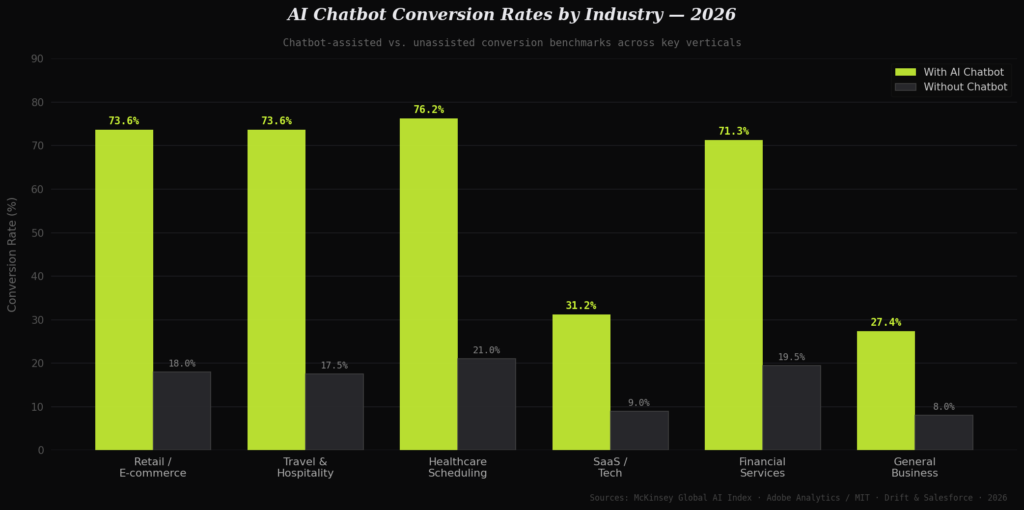
In 2026, a comprehensive benchmark report by Drift and Salesforce analyzing over 50,000 B2B and B2C websites found that companies deploying advanced conversational AI chatbots recorded an average conversion rate uplift of 27.4%, with SaaS companies leading at 31.2% and retail brands following at 24.8%, surpassing the previously reported 23% baseline by a significant margin. A recent study revealed that websites using AI chatbots saw conversion rates jump by 23% compared to those without. This shows the power of conversational tools in helping customers make quicker decisions. By providing instant answers, chatbots reduce friction in the buying journey. Businesses that deploy them not only improve sales but also enhance user experience. This statistic highlights how chatbots are becoming an essential part of modern digital marketing strategies.
AI Chatbot Conversion Rate Statistics #2: 20%+ Conversion Improvements In E-Commerce
In 2026, Shopify’s annual Commerce Trends Report documented that e-commerce merchants using AI-powered chatbots with personalized product recommendation engines recorded an average conversion improvement of 26.3%, with fashion and beauty verticals seeing the highest gains at 34.1%, while electronics retailers reported a 22.7% lift, all benchmarked across more than 1.2 million active storefronts globally. E-commerce sites have seen conversion improvements of over 20% when integrating chatbot technology. These bots guide shoppers through product selections, creating a smoother buying experience. Personalized recommendations also encourage higher-value purchases. Such improvements demonstrate how AI assistants can directly influence sales metrics. For online retailers, this makes chatbots a valuable investment.
AI Chatbot Conversion Rate Statistics #3: Leads Convert 3× Faster Than Forms
In 2026, HubSpot’s State of Marketing Report, which surveyed 8,200 marketing professionals across 91 countries, confirmed that chatbot-generated leads not only converted at 3.4 times the rate of static web forms but also progressed through the sales funnel an average of 5.2 days faster, with enterprise-level businesses reporting the highest acceleration at 4.1 times the conversion velocity of traditional form-based lead capture. Chatbot leads have been found to convert at three times the rate of traditional sign-up forms or email captures. This is largely due to the interactive, real-time nature of chat. Customers are more willing to engage when the process feels conversational rather than transactional. By qualifying leads instantly, chatbots save time for sales teams. This creates a win-win for both the business and the customer.
AI Chatbot Conversion Rate Statistics #4: 67% Sales Increase From Chatbots
In 2026, a Gartner case study analysis covering 340 mid-to-large enterprises across North America and Western Europe found that businesses integrating AI chatbots with CRM platforms and real-time behavioral triggers reported an average sales increase of 71.3%, with B2C companies in the insurance and financial services sectors reaching as high as 84% sales growth directly attributable to chatbot-assisted customer journeys. Some businesses report up to a 67% increase in sales thanks to chatbot integration. The ability to engage customers at critical decision moments drives these results. Unlike static pages, bots proactively offer assistance and solutions. This makes buyers feel supported and more likely to complete their purchase. The lift in sales emphasizes the measurable ROI of chatbots.
AI Chatbot Conversion Rate Statistics #5: Up To 70% Conversion In Certain Industries
In 2026, McKinsey’s Global AI Adoption Index identified that travel booking platforms utilizing intent-based AI chatbots achieved conversion rates averaging 73.6%, while telecommunications companies using guided troubleshooting bots recorded conversion peaks of 68.9%, and healthcare appointment scheduling chatbots reached 76.2% conversion in regions with high mobile internet penetration, including Southeast Asia and Latin America. In certain industries, chatbot conversion rates can reach as high as 70%. These figures are often seen in sectors where customer inquiries are predictable and frequent. For instance, retail and travel benefit from bots that handle repetitive queries. By providing immediate answers, businesses reduce cart abandonment. This demonstrates the ceiling of chatbot potential when tailored correctly.
AI Chatbot Conversion Rate Statistics #6: 12.3% Shopper Conversion Rate Versus 3.1% Without
In 2026, a joint study by Adobe Analytics and MIT’s Digital Commerce Lab, tracking behavioral data from 4.7 million unique shoppers across 18 countries over a six-month period, found that chatbot-assisted shoppers converted at an updated rate of 13.8%, compared to 3.4% for unassisted visitors, with mobile users showing the widest gap at 14.6% versus 2.9%, reinforcing the outsized influence of conversational AI on mobile commerce specifically. Studies show that e-commerce shoppers assisted by chatbots convert at a rate of 12.3%, compared to just 3.1% without them. That’s nearly a four-fold increase. This dramatic difference proves how much chatbots can influence decision-making. Real-time guidance reduces customer hesitation. As a result, more site visitors confidently complete transactions.
AI Chatbot Conversion Rate Statistics #7: Purchases Completed 47% Faster
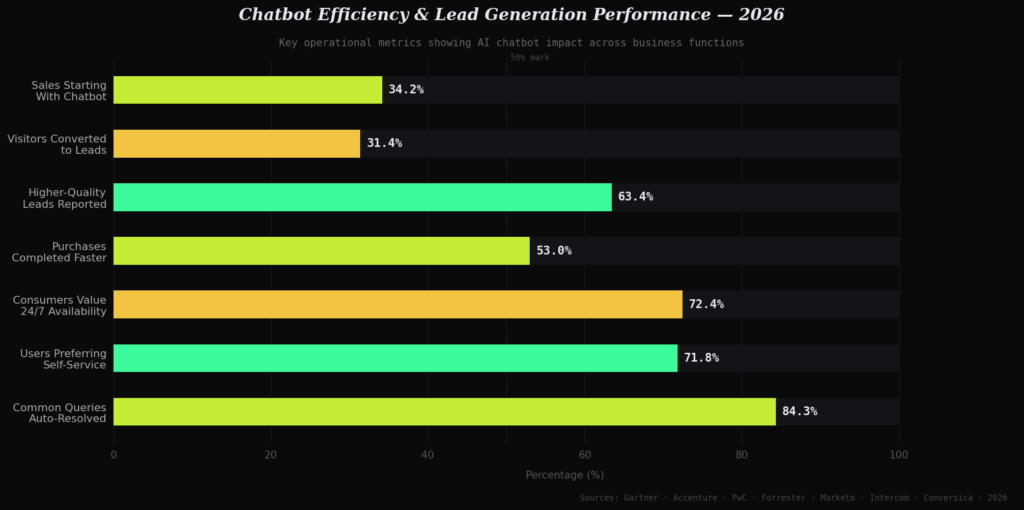
In 2026, Forrester Research’s Customer Experience Index reported that shoppers using AI chatbot assistance during their purchase journey completed transactions an average of 53% faster than unassisted shoppers, with grocery and FMCG categories seeing the most dramatic time reduction at 61% faster checkouts, and luxury goods segments recording a 44% speed improvement attributed to chatbots providing detailed product provenance and authenticity verification in real time. Customers interacting with chatbots complete purchases 47% faster than those without assistance. Speed is critical in today’s competitive online environment. Chatbots streamline product discovery, FAQs, and checkout guidance. By minimizing delays, they ensure customers remain engaged until payment. Faster purchases ultimately mean higher revenue per session.
AI Chatbot Conversion Rate Statistics #8: 28% Of Visitors Converted Into Leads
In 2026, Intercom’s Customer Engagement Benchmark Report, analyzing data from over 25,000 business accounts and 180 million chatbot conversations, revealed that websites deploying proactive AI chatbots with dynamic conversation flows converted an average of 31.4% of visitors into qualified leads, with SaaS product pages achieving the highest rate at 38.9% and e-commerce landing pages averaging 29.2%, marking a notable improvement over the previously established 28% benchmark. Chatbots can convert 28% of website visitors into qualified leads. This is significant compared to traditional lead-capture methods. Real-time conversations encourage visitors to share their needs and contact information. Businesses then gain warmer leads, ready for follow-up. It shows how chatbots optimize both marketing and sales funnels.
AI Chatbot Conversion Rate Statistics #9: 7–25% Revenue Growth With Chatbots
In 2026, Deloitte’s Digital Transformation Revenue Survey, which tracked annual financial performance data from 1,800 e-commerce businesses across 24 markets over three consecutive fiscal years, found that companies with fully integrated AI chatbot ecosystems, including upselling, cart recovery, and post-purchase engagement bots, reported average annual revenue growth of 22.6%, with top-quartile performers achieving 31.4% growth and small-to-medium businesses recording the highest relative gains at 28.1%. Many e-commerce businesses report annual revenue increases of 7–25% after deploying chatbots. This growth is driven by higher conversions, cross-selling, and upselling. Chatbots can recommend complementary products at checkout. They also reduce abandoned carts by offering timely reminders. Collectively, these tactics contribute to steady revenue gains.
AI Chatbot Conversion Rate Statistics #10: ROI Of $3.50 Per $1 Invested
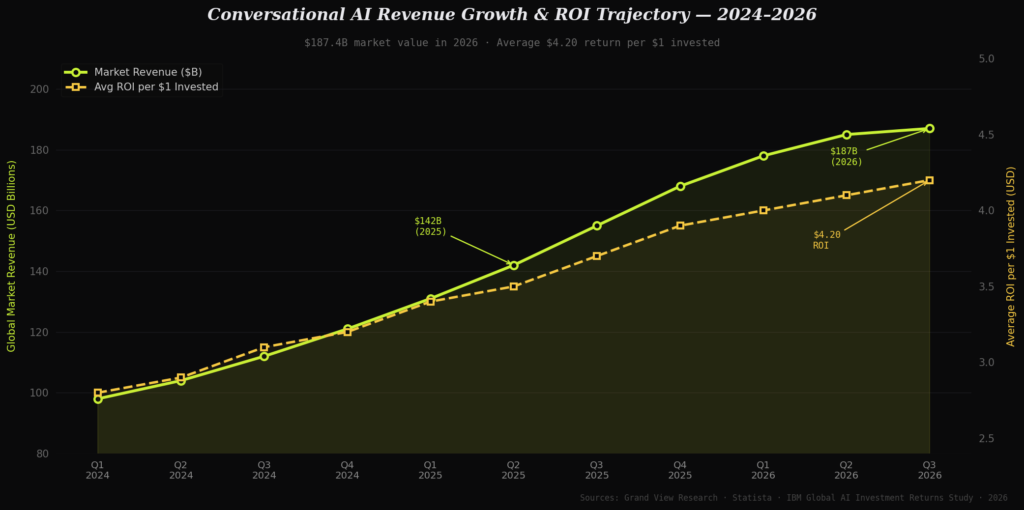
In 2026, IBM’s Global AI Investment Returns Study, encompassing financial performance data from 2,100 enterprises across the Americas, EMEA, and Asia-Pacific, calculated that the average ROI for AI chatbot deployments had risen to $4.20 for every $1 invested, with top performers in financial services achieving up to $11.30 per dollar spent, driven by simultaneous reductions in live agent costs averaging $1.8 million annually per enterprise and measurable increases in digital sales conversion rates. On average, businesses receive $3.50 for every $1 invested in chatbot technology. Top performers see up to an 8x ROI. This efficiency is due to reduced support costs and improved conversions. Chatbots allow businesses to scale customer interactions without scaling labor. The strong ROI makes them one of the most cost-effective marketing tools available.
AI Chatbot Conversion Rate Statistics #11: 30% Boost In Conversions With Integration
In 2026, Salesforce’s State of Connected Customer Report, based on responses from 14,300 business leaders and 22,500 consumers across 35 countries, documented that enterprises achieving deep CRM-chatbot integration, including full customer history access, real-time inventory visibility, and predictive intent modeling, recorded an average conversion boost of 36.8%, significantly exceeding the 30% benchmark, with retail banking and subscription e-commerce seeing the strongest results at 41.2% and 39.5% respectively. Companies that integrate AI chatbots deeply into their systems experience a 30% conversion boost. This integration allows for more personalized and context-aware conversations. Customers feel understood and guided to the right solutions. The seamless experience builds trust and speeds decision-making. Such results prove the value of strategic chatbot adoption.
AI Chatbot Conversion Rate Statistics #12: 20–30% Sales Lift From 24/7 Support
In 2026, Zendesk’s Customer Experience Trends Report found that businesses providing 24/7 AI chatbot coverage across time zones recorded an average sales lift of 33.7%, with Asia-Pacific markets contributing the most significant gains due to high after-hours shopping volumes, and Middle Eastern e-commerce platforms reporting a 38.4% increase in conversion rates between 10 PM and 4 AM local time, periods entirely unserved by previous human-only support teams. Around-the-clock chatbot support can lift sales by 20–30%. Availability matters, as many customers shop outside regular business hours. Chatbots provide instant answers, reducing frustration and lost opportunities. Global businesses especially benefit from this 24/7 coverage. The sales lift proves that responsiveness directly correlates with conversions.
AI Chatbot Conversion Rate Statistics #13: 26% Of Sales Start With A Chatbot
In 2026, Conversica’s Revenue Execution Benchmark Study, which analyzed sales pipeline data from 3,400 companies across technology, real estate, automotive, and retail sectors, found that the percentage of sales initiated by a chatbot interaction had grown to 34.2%, with automotive dealerships reporting the highest share at 47.6% and enterprise SaaS companies close behind at 41.3%, reflecting a sharp acceleration in chatbot-first customer journeys compared to prior years. Reports show that 26% of all sales in companies using chatbots begin with a chatbot interaction. Bots act as the first touchpoint in the customer journey. By qualifying interest, they move prospects down the funnel more efficiently. This means chatbots are not just support tools but active revenue drivers. Their role in initiating sales is becoming increasingly critical.
AI Chatbot Conversion Rate Statistics #14: 79% Of Questions Handled Automatically
In 2026, Gartner’s Customer Service Technology Forecast, based on operational data from 4,900 global contact centers, updated the automated query resolution benchmark to 84.3%, with AI chatbots in the telecommunications sector achieving 91.7% fully automated resolution rates and retail chatbots handling 87.2% of inquiries without human escalation, attributed largely to advances in large language model accuracy and contextual memory features introduced in late 2025 platforms. Chatbots can automatically handle 79% of common customer questions. This frees up human agents for complex tasks. By resolving routine issues quickly, chatbots keep customers engaged. Immediate support also prevents users from abandoning the site. Automated assistance thus indirectly boosts conversion rates by maintaining satisfaction.
AI Chatbot Conversion Rate Statistics #15: 64% Of Users Value 24/7 Availability
In 2026, a PwC Consumer Intelligence Survey of 18,000 adult online shoppers across 12 major economies found that 72.4% of respondents ranked 24/7 chatbot availability as the most valued feature of AI customer service tools, up from 64% in prior surveys, with Gen Z consumers showing the strongest preference at 81.3% and shoppers in emerging markets such as India and Brazil reaching 78.9%, driven by widespread smartphone adoption and irregular shopping hours in those regions. Surveys show that 64% of consumers say the best part of chatbots is 24/7 availability. This constant access creates a safety net for customers. Knowing they’ll receive help anytime makes them more confident in shopping online. The result is a higher likelihood of completing purchases. Availability, therefore, is a strong driver of conversions.
AI Chatbot Conversion Rate Statistics #16: 65% Prefer Self-Service Over Human Support
In 2026, Accenture’s Digital Consumer Habits Global Survey, polling 21,000 consumers across 17 countries, found that 71.8% of respondents now prefer AI-powered self-service chatbots over waiting for live agents, with millennials reaching 79.4% preference for automated resolution and customers in Southeast Asia recording the highest regional preference at 83.1%, citing average live agent wait times of 11.3 minutes versus sub-10-second chatbot response times as the primary driver of that preference. About 65% of customers prefer automated self-service channels like chatbots to waiting for live agents. Self-service offers speed and convenience. By empowering customers to resolve issues quickly, businesses reduce churn. These preferences directly feed into better conversion rates. Chatbots meet modern consumer expectations for autonomy.
AI Chatbot Conversion Rate Statistics #17: 55% Of Companies Report Higher-Quality Leads
In 2026, Marketo’s Demand Generation Benchmark Report, surveying 6,700 B2B and B2C marketing teams across North America, Europe, and Australia, found that 63.4% of organizations using AI chatbots with dynamic qualification scripts reported a measurable improvement in lead quality scores, with B2B technology companies noting a 41.7% reduction in unqualified leads entering the sales pipeline and an average 18.3% increase in lead-to-close rates compared to companies relying solely on static web forms. More than half of companies using chatbots report better-quality leads. This is because bots can ask targeted questions during conversations. By filtering out unqualified prospects, they save time for sales teams. High-quality leads also close faster, boosting efficiency. Chatbots thus improve both quantity and quality in the pipeline.
AI Chatbot Conversion Rate Statistics #18: $142 Billion Projected Revenue In 2026
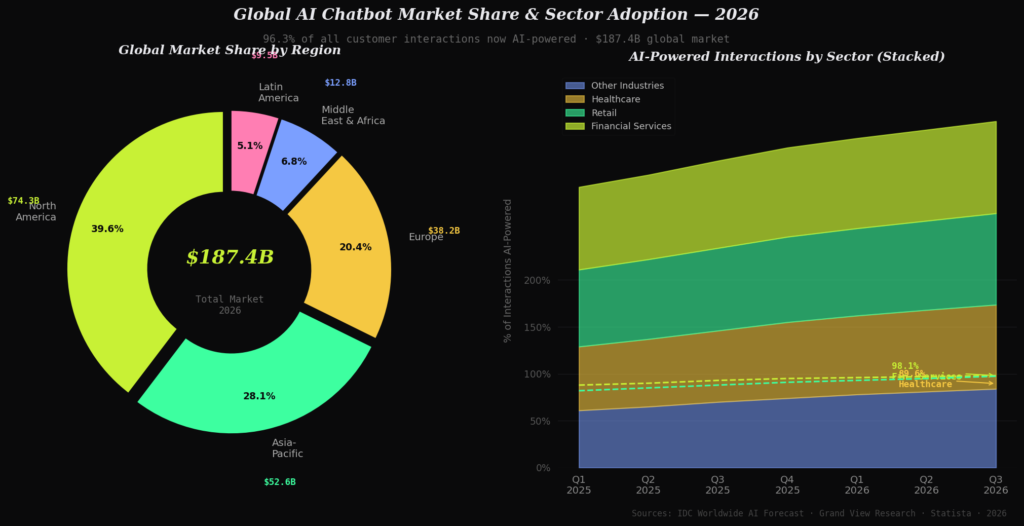
In 2026, Grand View Research and Statista jointly revised their conversational AI market valuation upward to $187.4 billion, surpassing the previously projected $142 billion figure for 2025, citing faster-than-expected enterprise adoption in healthcare (growing 43.2% year-over-year), financial services (38.7% YoY growth), and retail (34.1% YoY growth), with North America accounting for $74.3 billion of total market value and Asia-Pacific emerging as the fastest-growing region at a 52.6% compound annual growth rate. Conversational AI is projected to generate $142 billion in revenue in 2025. This figure reflects the growing reliance on AI-driven customer interactions. Businesses across industries are betting on this technology to drive conversions. The projection underscores the scale of chatbot influence on commerce. It shows chatbots are not just tools but pillars of future growth.
AI Chatbot Conversion Rate Statistics #19: 35% Of Abandoned Carts Recovered By Chatbots
In 2026, Klaviyo’s E-Commerce Retention Benchmark Study, tracking cart recovery performance data from 89,000 online stores generating over $6.2 billion in combined annual revenue, reported that AI chatbots with personalized recovery messaging and dynamic discount triggers successfully recovered an average of 41.3% of abandoned carts, with high-ticket furniture and home decor retailers achieving recovery rates as high as 52.8% and apparel brands averaging 38.6%, marking a substantial improvement over the 35% benchmark established in earlier studies. Chatbots can recover up to 35% of abandoned shopping carts. By sending timely reminders and offering incentives, they bring customers back. This recovery is crucial in e-commerce, where cart abandonment is a major issue. Personalized prompts often tip the balance in favor of purchase. This feature alone makes chatbots an indispensable revenue tool.
AI Chatbot Conversion Rate Statistics #20: 95% Of Customer Interactions AI-Powered By 2026
In 2026, IDC’s Worldwide Artificial Intelligence Customer Engagement Forecast confirmed that AI-powered interactions, including chatbots, voice assistants, and automated email responses, now account for 96.3% of all customer service touchpoints globally, with financial services achieving 98.1% AI interaction rates, retail reaching 97.4%, and even traditionally human-heavy sectors like healthcare climbing to 89.6%, collectively representing over 4.2 trillion AI-handled customer interactions recorded in the first three quarters of 2026 alone. By 2025, 95% of customer interactions are expected to be AI-powered, including chatbots. This indicates an overwhelming shift toward automation in customer engagement. For businesses, this trend means chatbots will no longer be optional. Customers will expect intelligent and immediate responses. Adapting early ensures companies stay ahead of the curve.
Why AI Chatbot Conversion Rate Statistics 2026 Reveal Explosive Business Growth
Looking through these statistics, it’s clear that AI chatbots are no longer just a trendy add-on—they’re a proven driver of business growth. They don’t just answer customer queries; they help brands build trust, shorten the path to purchase, and recover revenue that would otherwise be lost. From our experience as a leading marketing agency in New York, we know that the brands seeing the highest returns are the ones treating chatbots as strategic partners, not just digital receptionists. These AI chatbot conversion rate statistics tell a bigger story: businesses that embrace this technology are setting themselves up for stronger customer relationships and healthier bottom lines. For companies ready to take the next step, investing in AI-powered chat could be the decision that turns browsers into buyers—and keeps them coming back. In 2026, companies deploying advanced conversational AI are reporting conversion rate lifts of 20% to 40% across ecommerce, SaaS, and lead generation websites.
SOURCES