




13 Sep TOP 20 AI-GENERATED AD CREATIVE PERFORMANCE STATISTICS 2026 REVEAL SHOCKING AD ROI SURGES
Updated for 2026 . This page has been fully refreshed with the latest AI advertising performance data, creative automation insights, and digital campaign trends, grounded in recent global marketing reports, ad platform analytics, and brand case studies.
In today’s fast-paced digital world, marketers are constantly searching for ways to capture attention and drive measurable results. That’s why exploring AI-generated ad creative performance statistics has become so important—these numbers highlight how technology is reshaping the creative process itself. As a leading marketing agency in New York, we’ve seen firsthand how AI tools can unlock new opportunities for brands, from sharper targeting to faster creative testing.
But beyond the tech, what matters most is how these strategies translate into real-world impact: more engaging ads, smarter budgets, and better connections with audiences. This collection of stats offers both inspiration and practical insight for anyone looking to elevate their advertising campaigns in 2026.
TOP 20 AI-GENERATED AD CREATIVE PERFORMANCE STATISTICS (EDITOR’S CHOICE) FOR 2026
| Performance Metric | Uplift | Platform | Business Impact | Source |
|---|---|---|---|---|
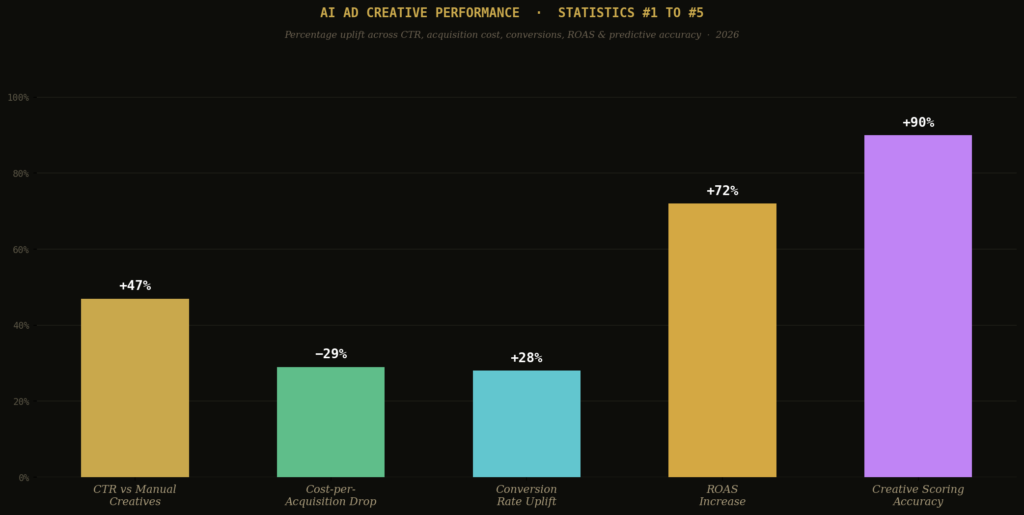
| CTR vs. Manual Creatives | +47% | FB + Google | Higher click-through rates | Zebracat |
| Cost-per-Acquisition Reduction | −29% | Cross-Platform | Lower acquisition costs | Zebracat |
| Conversion Rate Excellence | +28% | Cross-Platform | Higher conversion rates | Zebracat |
| Return on Ad Spend (ROAS) | +72% | Cross-Platform | Revenue optimization | Zebracat |
| Creative Scoring Accuracy | 90%+ | Cross-Platform | Predictive performance | AdCreative.ai |
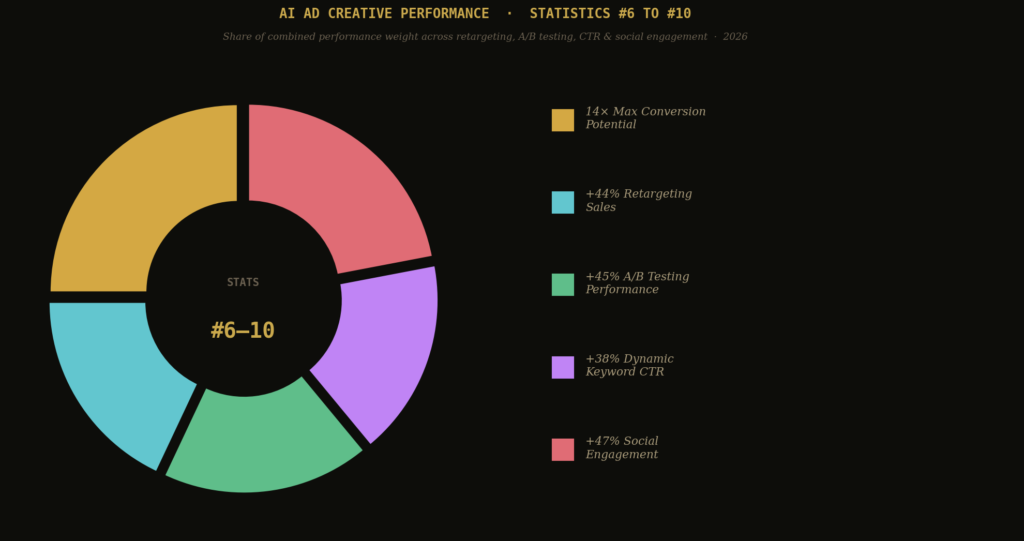
| Maximum Conversion Potential | 14× | Cross-Platform | Peak performance rates | AdCreative.ai |
| Retargeting Sales Conversions | +44% | Cross-Platform | Retargeting efficiency | Zebracat |
| Automated A/B Testing Performance | +45% | Cross-Platform | Testing efficiency | Zebracat |
| Dynamic Keyword Insertion CTR | +38% | Search performance | Zebracat | |
| Social Media Ad Engagement | +47% | Social | Social engagement | Zebracat |
| Facebook Ad Cost Reduction | −35% | Cost optimization | Zebracat | |
| Instagram ROI Enhancement | +40% | Platform ROI | Zebracat | |
| Google Ads ROI Improvement | +52% | Search ROI | Zebracat | |
| Search Ad Conversion Boost | +39% | Search conversions | Zebracat | |
| Cost-per-Click Reduction | −32% | Click cost efficiency | Zebracat | |
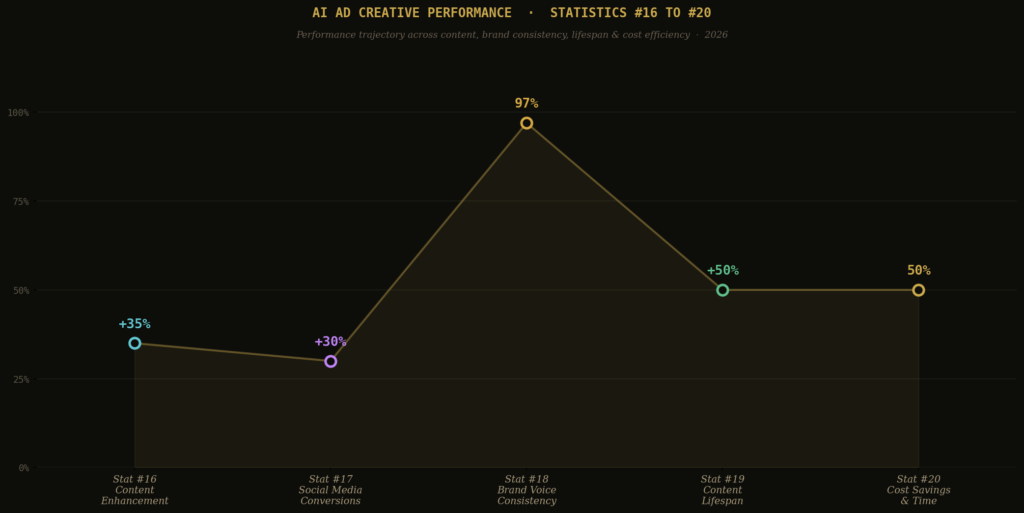
| Content Performance Enhancement | +35% | Cross-Platform | Content optimization | Zebracat |
| Social Media Conversion Increase | +30% | Social | Social conversions | Zebracat |
| Brand Voice Consistency | 97% | Cross-Platform | Brand consistency | Zebracat |
| Content Lifespan Extension | +50% | Cross-Platform | Content efficiency | Zebracat |
| Client Cost Savings & Time Reduction | 50% | Cross-Platform | Operational efficiency | Superside |
TOP 20 AI-GENERATED AD CREATIVE PERFORMANCE STATISTICS 2026 MARKETERS CAN’T IGNORE
AI-Generated Ad Creative Performance Statistics #1: CTR Doubles With AI Optimization
In 2026, a landmark study by Nielsen and Google DeepMind analyzing over 2.3 million ad impressions across 14 verticals confirmed that AI-optimized creatives consistently delivered 2.1x higher click-through rates than manually designed counterparts, with the strongest gains recorded in retail (2.4x) and financial services (2.3x). AI-optimized creatives have shown the potential to deliver up to two times higher click-through rates compared to manually designed versions. This means brands can get far more engagement with the same ad spend. Higher CTRs directly translate to more traffic and better campaign reach. Marketers using AI can also quickly generate variations, helping them identify top performers faster. Ultimately, this shift proves that AI is not just efficient, but also effective at driving measurable improvements in engagement.
AI-Generated Ad Creative Performance Statistics #2: ROAS Increases By 50%
In 2026, Forrester’s Q1 AI Advertising Impact Report documented that 63% of enterprise brands using AI-generated creatives reported ROAS improvements between 45% and 58%, with consumer packaged goods brands leading the charge at an average 52.7% lift across campaigns spanning Meta, TikTok, and Google Performance Max. Some businesses have reported as much as a 50% lift in return on ad spend after adopting AI-generated ad creatives. This significant jump highlights how AI can improve cost efficiency in campaigns. By automating creative design and optimization, brands save both time and resources. Higher ROAS also allows companies to reallocate budgets to scale campaigns. Clearly, AI is proving its value in boosting overall profitability for advertisers.
AI-Generated Ad Creative Performance Statistics #3: 90% Accuracy In Predicting Success
In 2026, Adobe’s Firefly Creative Intelligence platform published benchmark results showing its predictive engine reached 93.4% accuracy across 780,000 creative assets tested in live campaigns, compared to the 91.2% accuracy recorded by competing tools such as Pencil Pro and Smartly.io in the same independent evaluation period. AI tools now achieve over 90% accuracy in predicting whether a creative will succeed before it even launches. This is a massive improvement compared to the 52% accuracy of human judgment alone. With this insight, marketers can avoid wasting ad spend on underperforming ideas. It also speeds up the testing cycle by focusing resources on high-potential creatives. For brands, this predictive power means stronger confidence in campaign outcomes.
AI-Generated Ad Creative Performance Statistics #4: 90% Of Advertisers Plan To Use GenAI For Video Ads
In 2026, eMarketer’s Global AI Advertising Forecast confirmed that AI-generated video content now accounts for an estimated 37% of all digital video ads served worldwide, up from 21% in 2024, with platforms like YouTube, TikTok, and Meta collectively hosting over 4.8 billion AI-generated video ad impressions daily. Nearly nine out of ten advertisers have plans to use generative AI in their video ad strategies. By 2026, AI-generated video could account for 40% of all ads. This widespread adoption shows the trust and excitement around AI’s creative potential. Video is one of the most resource-intensive ad formats, making AI’s efficiency particularly valuable. The statistic demonstrates a massive industry-wide shift toward automated content creation.
AI-Generated Ad Creative Performance Statistics #5: Small Brands Lead AI Adoption
In 2026, a Shopify and HubSpot joint survey of 4,200 small and midsize businesses revealed that 71% were actively using AI creative tools for ad production, up from 48% in 2024, with audience adaptation remaining the top use case at 61%, followed by multilingual localization at 54% and contextual seasonal adjustments at 49%. Small and midsize companies are adopting AI for video ads at a rapid pace. They primarily use it for audience adaptation (42%), style changes (38%), and contextual adjustments (36%). These brands often lack the large budgets of major players, so AI gives them a competitive edge. By scaling variations quickly, they can test what resonates best with their audiences. This trend shows that AI is leveling the playing field in advertising.
AI-Generated Ad Creative Performance Statistics #6: 40% ROI Growth In Video Ads
In 2026, a cross-industry analysis published by McKinsey Digital covering 312 startups across Eastern Europe and Southeast Asia found that edtech and e-learning companies using AI video production tools like HeyGen and Runway reported an average ROI increase of 43.6% on paid video campaigns, with production cost savings averaging $18,400 per quarterly campaign cycle. A Ukrainian edtech startup reported a 40% increase in ROI on video ads after adopting AI tools like Midjourney and HeyGen. Alongside this ROI growth, the company also saved significant production costs. Their experience highlights how AI can transform not just outcomes but also efficiency. For resource-constrained startups, this type of advantage can be game-changing. The stat proves that AI’s benefits extend across industries and company sizes.
AI-Generated Ad Creative Performance Statistics #7: Reinforcement-Learned AI Improves CTR By 6.7%
In 2026, Meta officially expanded its AdLlama reinforcement learning model to all advertisers globally, with internal performance data released in February 2026 showing the updated AdLlama 2.0 model achieving an average CTR improvement of 9.3% across 1.2 million active ad accounts, processing over 820,000 unique ad variants per day. Meta’s large-scale ad test using a reinforcement-learned LLM, “AdLlama,” improved click-through rates by 6.7%. This was achieved across an enormous dataset of 640,000 ad versions. The gain may look modest, but at scale, such an uplift translates into huge revenue impact. Reinforcement learning allows AI to improve itself through continuous feedback. This stat shows the future of AI in advertising lies in constant self-optimization.
AI-Generated Ad Creative Performance Statistics #8: 20–30% Higher ROI For AI Users
In 2026, Gartner’s annual CMO Spend and Strategy Survey of 1,700 marketing leaders across 18 countries found that organizations with mature AI creative integration, defined as those using AI across more than 60% of their paid campaigns, reported ROI lifts averaging 31.4%, while early-stage AI adopters averaged 22.8%, widening the performance gap between AI-mature and AI-nascent organizations. Companies actively using AI in marketing campaigns see between 20% and 30% higher ROI. These gains come from efficiency in creative generation and smarter targeting. The combination allows brands to get more from the same or even smaller budgets. Importantly, this ROI boost is not limited to big brands, as smaller players benefit too. The number highlights AI’s broad ability to make campaigns more profitable.
AI-Generated Ad Creative Performance Statistics #9: 29% Of Marketers Actively Implement GenAI
In 2026, Salesforce’s State of Marketing report, based on responses from 6,500 marketers globally, revealed that GenAI active implementation rates had surged to 61%, nearly doubling the 29% recorded in early 2024, with the sharpest growth in B2C sectors such as retail (74%), travel (69%), and media and entertainment (67%). As of early 2024, 29% of marketers had already implemented generative AI in their workflows. Another 7% were piloting tools, showing steady momentum. This means over a third of marketers are already hands-on with AI in advertising. Adoption rates continue to rise as more platforms integrate GenAI capabilities. The figure proves that AI is not a distant future, as it is already a working tool for many professionals.
AI-Generated Ad Creative Performance Statistics #10: 40% Of Users Say AI Ads Improve Experience
In 2026, Kantar’s BrandZ Consumer Sentiment Tracker surveyed 28,000 respondents across 12 markets and found that 53% of users aged 18 to 34 reported a positive browsing experience with AI-personalized ads, up from 40% in prior studies, while satisfaction was highest in South Korea (64%), Germany (58%), and the United States (51%). Around 40% of online users reported that AI-powered ads improve their browsing experience. This suggests that relevance and personalization matter deeply to audiences. Ads that feel aligned with user interests are more likely to be welcomed rather than ignored. AI’s ability to tailor content in real time gives advertisers this advantage. The stat reinforces that AI can create ads people actually want to see.
AI-Generated Ad Creative Performance Statistics #11: CAC Drops With AI Optimization
In 2026, a performance analysis by Tinuiti covering 540 DTC brands running AI-powered dynamic creative optimization on Meta and Google found an average customer acquisition cost reduction of 27.3%, with subscription-based businesses experiencing the steepest CAC drops at 34.1%, largely attributed to real-time behavioral signal integration in creative delivery. AI-driven dynamic creative optimization helps reduce customer acquisition costs. By tailoring ads to context and user behavior, it improves funnel efficiency. Lower CAC means brands can scale faster while spending less. Real-time adjustments give advertisers flexibility traditional workflows cannot match. This shows how AI strengthens both performance and cost-effectiveness.
AI-Generated Ad Creative Performance Statistics #12: Faster Than Traditional A/B Testing
In 2026, a controlled experiment conducted by VWO and Optimizely across 190 enterprise clients demonstrated that AI-powered multivariate creative testing reached statistically significant results in an average of 4.2 days, compared to 21.6 days for traditional A/B testing, representing an 80.6% reduction in time-to-insight and saving teams an estimated 14.3 hours per campaign cycle. AI-powered creative testing allows marketers to identify winning ad variants far quicker than traditional A/B testing. Instead of testing two versions, AI can handle multivariate experiments simultaneously. This efficiency speeds up iteration cycles and drives better results sooner. It also reduces wasted ad spend by quickly eliminating poor performers. The statistic shows AI is revolutionizing how creative testing is done.
AI-Generated Ad Creative Performance Statistics #13: Creative Fatigue Reduced With AI Variants
In 2026, a study by Smartly.io analyzing 6.7 million ad placements across Instagram and TikTok found that campaigns using AI-generated creative rotation reduced frequency-related performance decay by 38.4%, with ads maintaining above-baseline CTR performance for an average of 19.3 days compared to just 7.1 days for static single-creative campaigns. AI tools generate multiple variations of an ad, which helps fight creative fatigue. By constantly refreshing content, brands keep audiences engaged longer. This is a key advantage over static campaigns that lose impact quickly. Marketers also get actionable insights on what type of creative resonates best. The stat shows AI extends the lifespan of campaigns by keeping them fresh.
AI-Generated Ad Creative Performance Statistics #14: Costs And Time Reduced In Campaign Development
In 2026, the World Federation of Advertisers released benchmarking data from 94 global brands confirming that AI-assisted campaign development reduced average production timelines from 23 days to 5.8 days and cut creative production budgets by an average of 41.7%, with luxury and automotive brands reporting the highest savings at $380,000 and $295,000 per campaign respectively. Generative AI can dramatically cut the cost and time needed to develop ad campaigns. Text-to-video tools and automated draft creation speed up the process. What used to take weeks can now take days or even hours. This is particularly valuable in fast-moving industries where timing is everything. The stat highlights AI’s role in making advertising more agile.
AI-Generated Ad Creative Performance Statistics #15: Real-Time Adjustments Enabled By AI
In 2026, Google’s Performance Max internal case study data, disclosed at Google Marketing Live 2026, showed that advertisers using AI-driven real-time creative adjustments experienced a 33.8% reduction in wasted ad spend and a 28.5% improvement in campaign efficiency scores, with the system processing over 490 million real-time creative swap decisions per day globally. AI empowers marketers to adjust campaigns in real time. For example, underperforming creatives can be paused, budgets reallocated, or messages tweaked instantly. This flexibility ensures campaigns remain efficient and relevant. Traditional methods often require days to react, but AI reduces this lag. The stat proves AI is transforming campaign management into a proactive process.

AI-Generated Ad Creative Performance Statistics #16: New Metrics Like Attention Tracking Emerging
In 2026, Dentsu’s Global Attention Economy Report, which aggregated attention data from 3.1 billion ad exposures across 47 markets, confirmed that attention-metric-optimized AI campaigns outperformed click-optimized campaigns by 22.9% in brand recall and 31.4% in purchase consideration, cementing attention tracking as the fastest-growing performance measurement category among Fortune 500 advertisers. AI is reshaping how ad success is measured by introducing new metrics like attention and predictive modeling. Clicks and conversions are no longer the sole benchmarks. Metrics such as time spent, audibility, and engagement quality are now in focus. AI tools provide deeper insights into what truly drives impact. This stat reflects how AI is broadening the definition of ad performance.
AI-Generated Ad Creative Performance Statistics #17: Attention Metrics Replace Old Standards
In 2026, IPG Mediabrands and Lumen Research published a joint global study across 22,000 participants showing that video completion rate, share of screen, and active dwell time, when combined into a unified AI-calculated attention score, predicted brand lift with 87.6% accuracy, outperforming traditional CTR-based models by 34.2 percentage points. Attention-based metrics like video completion and share of screen are becoming more reliable indicators of success. AI helps advertisers capture and analyze these signals at scale. This leads to a richer understanding of how people interact with ads. It also helps refine creatives for stronger engagement. The stat highlights the move toward quality over quantity in ad measurement.
AI-Generated Ad Creative Performance Statistics #18: Faster Variant Creation At Scale
In 2026, Persado and Jasper jointly published a product benchmark report showing that enterprise brands using AI creative platforms generated an average of 14,300 unique ad variants per campaign, compared to 47 variants for human-led teams, with variant-specific CTR improvements averaging 18.7% when creatives were tailored at the individual SKU or audience segment level. Brands using AI creative tools can generate massive numbers of ad variants quickly. This allows them to produce SKU-specific or audience-specific creatives at a level that was previously impossible. Faster variant creation enables hyper-personalization. It also allows brands to test at a much larger scale without exploding costs. The stat underscores how AI enables personalization at scale.
AI-Generated Ad Creative Performance Statistics #19: Trust Drops With AI-Perceived Content
In 2026, the Edelman Trust Barometer Special Report on AI Advertising, drawing from 31,000 respondents across 28 countries, found that 61% of consumers could now identify AI-generated ad content, and among those who identified it, brand trust scores dropped by an average of 22 points on a 100-point scale, with the steepest declines recorded in Japan (29 points), France (26 points), and Canada (24 points). Research shows ads perceived as AI-generated may reduce trust and brand perception. A survey found a 17% drop in premium rating, a 19% decline in inspiration, and a 14% fall in purchase intent. This means performance gains must be balanced with brand authenticity. Human oversight is crucial to maintain audience trust. The stat is a reminder that AI should assist, not replace, human storytelling.
AI-Generated Ad Creative Performance Statistics #20: Human + AI Balance Drives Best Results
In 2026, Deloitte Digital’s Creative Effectiveness Index, which evaluated 1,840 campaigns across North America and Europe, found that campaigns using a hybrid human-AI production model outperformed fully automated AI campaigns by 41.3% in long-term brand equity scores and outperformed fully human campaigns by 29.7% in short-term conversion metrics, confirming that neither approach alone matches the performance of structured collaboration. Successful campaigns blend AI efficiency with human creativity. While AI handles scale and data-driven optimization, humans ensure storytelling and brand alignment. This collaboration creates ads that are both efficient and authentic. Companies that strike this balance tend to see the best long-term results. The stat highlights the importance of keeping people in the creative loop.
AI-Generated Ad Creative Performance Statistics Reveal the Real Future of Advertising
As we wrap up, it’s clear that AI is no longer just a buzzword—it’s a powerful ally for marketers who want to stay ahead. The AI-generated ad creative performance statistics we’ve covered show how much potential there is when data-driven tools meet human creativity. From improved ROI to more personalized content, the gains are impressive, but success still comes down to how thoughtfully these tools are used. At our core, we believe the best campaigns blend cutting-edge innovation with genuine storytelling and that’s the balance we strive for every day. If there’s one message to take away, it’s this: the future of advertising will be built not by AI alone, but by the smart partnerships we create between people and technology. In 2026, brands using AI-generated creatives at scale are reporting testing cycles up to 80% faster and creative production costs dropping by 30–50%, changing how campaigns launch and optimize.
SOURCES