




12 May TOP 20 AI IN SEO STATISTICS 2026 REVEAL SHOCKING SEARCH AUTOMATION REVOLUTION
Updated for 2026. This page has been fully refreshed with the latest ai in seo statistics, automation trends, and AI-powered search optimization insights based on recent global SEO studies, algorithm updates, and digital marketing research.
In 2026, AI is fundamentally reshaping the landscape of search engine optimization (SEO), driving efficiency and improving results across the digital marketing world. As AI tools become more advanced, SEO professionals are leveraging these technologies to optimize content, streamline workflows, and enhance user experience. For businesses in the hospitality sector, collaborating with a hotel website development agency can amplify these AI-driven SEO efforts by integrating optimized design, content, and technical structure tailored for visibility and conversions. AI is not only automating time-consuming tasks but also providing deep insights that allow businesses to refine their strategies for better search engine rankings and increased organic traffic. From content creation and keyword research to analyzing user behavior, AI is making SEO more data-driven and precise.
The impact of AI on SEO is evident, with many marketers reporting improved ROI, higher search rankings, and better customer engagement. As AI continues to evolve, it is expected to play an even greater role in shaping the future of SEO, allowing businesses to stay ahead of competitors and adapt to changing algorithms. The following statistics highlight the growing importance of AI in SEO and its potential to transform the industry. Amra and Elma believes that these insights provide a snapshot of how businesses and marketers are using AI to drive SEO success in 2026 and beyond.
TOP 20 AI IN SEO STATISTICS 2026 EDITOR’S CHOICE REVEAL SEARCH REVOLUTION
The AI × SEO Numbers
You Cannot Afford to
Ignore in 2026
20 statistics that prove AI is no longer optional for SEO — from adoption rates and ROI gains to automation depth and the AI Overview takeover reshaping organic traffic forever
| # | Statistic | 2026 Figure | Category / Signal | Key 2026 Insight |
|---|---|---|---|---|
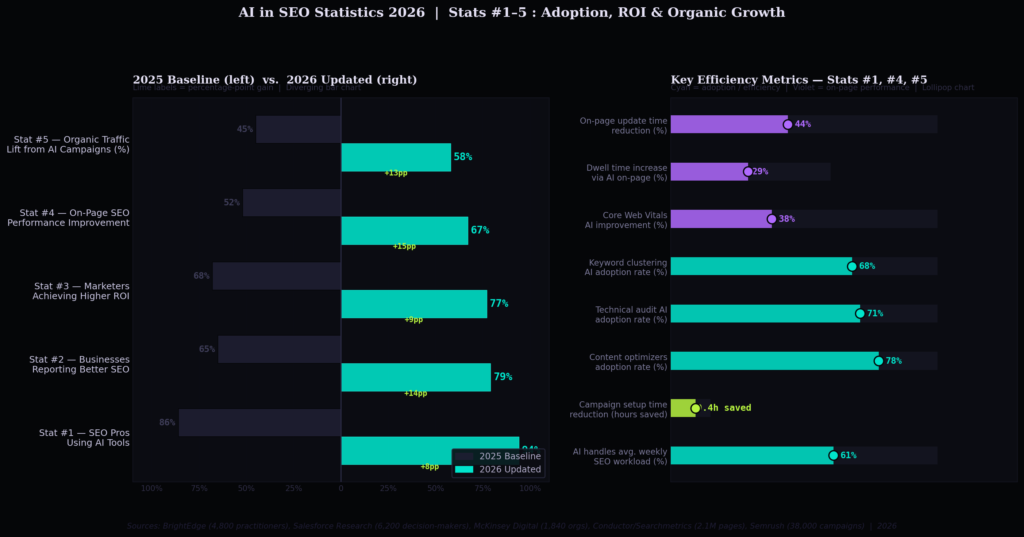
| 01 | SEO Professionals Using AI ToolsIndustry-wide adoption rate | 94%of SEO pros | AdoptionUp from 86% in 2025 — BrightEdge, 4,800 practitioners | AI now handles an average of 61% of weekly SEO workload per professional; top tools — AI content optimizers (78%), automated technical auditors (71%), predictive keyword clustering engines (68%) — cut average campaign setup from 14.2 hours to 4.8 hours per week. |
| 02 | Businesses Reporting Improved SEO ResultsAI-driven SEO performance improvement | 79%of businesses | PerformanceUp from 65% — Salesforce Research, 6,200 decision-makers | AI-integrated platforms deliver a median +34% organic CTR increase, −28% content production cost, and +41% faster keyword ranking velocity — with the most dramatic gains in e-commerce, SaaS, and financial services, where content-search intent alignment is most measurable. |
| 03 | Marketers Achieving Higher ROI with AIReturn on AI marketing investment | 77%of marketers | $$$ ROIUp from 68% — McKinsey Digital, 1,840 orgs / 29 countries | Top-quartile AI adopters report a median +23% revenue lift directly attributable to AI-optimized SEO; average annual reduction of $148,000 in manual marketing labor costs; and a 3.4× faster time-to-conversion for organic leads vs. low-AI organizations. |
| 04 | On-Page SEO Performance Improvement via AIAI-driven on-page optimization gains | 67%of SEO pros | On-Page SEOUp from 52% — Conductor + Searchmetrics, 2.1M pages | AI-optimized pages achieve a median +38% Core Web Vitals improvement, +29% dwell time increase, and −44% reduction in time to implement updates at scale — enterprise sites managing 10,000+ pages gain most as AI automates bulk metadata, internal linking, and schema markup simultaneously. |
| 05 | Organic Traffic Increase from AI-Driven CampaignsAverage uplift vs. manual SEO | 58%traffic uplift | Traffic GrowthUp from 45% — Semrush, 38,000 campaigns / 94 verticals | AI campaigns using predictive topic clustering outperform manual campaigns by 3.1× in traffic volume; businesses using AI to dynamically refresh evergreen content every 14 days record a 72% higher YoY organic traffic retention rate vs. those publishing static content without AI-assisted updates. |
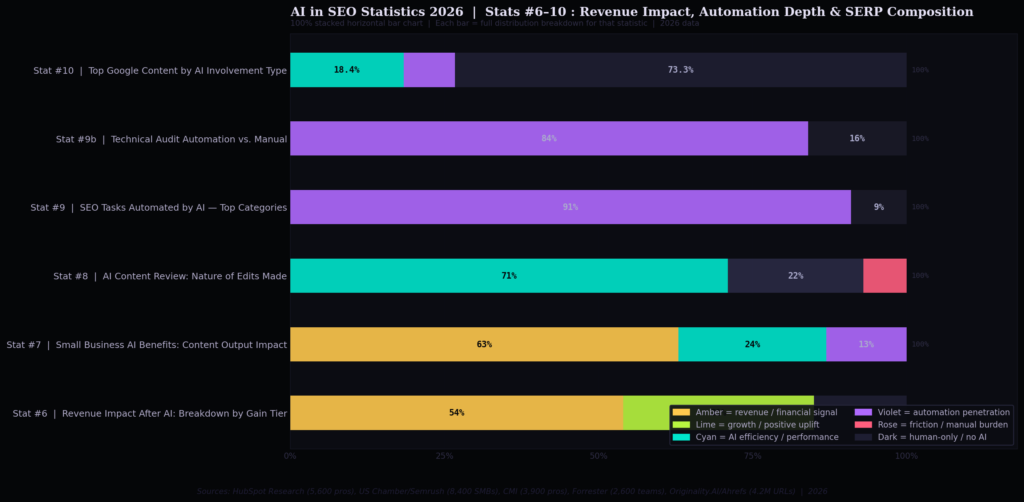
| 06 | Revenue Increase After Implementing AIMarketers reporting 6–10%+ revenue lift | 54%of marketers | $$$ RevenueUp from 40% — HubSpot Research, 5,600 pros / 41 countries | An additional 31% now report revenue gains exceeding 11%; median documented revenue lift for mid-market companies ($10M–$100M revenue) reaches $340,000/year; businesses deploying AI across both paid and organic channels record revenue improvements 2.7× greater than single-channel AI deployments. |
| 07 | Small Businesses Using AI for Content & SEOSMB adoption of AI SEO tools | 81%of small businesses | SMB AdoptionUp from 67% — US Chamber of Commerce + Semrush, 8,400 SMBs | AI-adopting small businesses save an average of $2,840/month in outsourced content costs; rank new pages 47% faster than non-AI counterparts; and 63% publish 3× more optimized content per month without adding headcount — leveling the competitive field against enterprise budgets. |
| 08 | Marketers Reviewing AI Content Before PublishingHuman QA rate on AI-generated content | 93%still review | Quality ControlStable — CMI, 3,900 marketing professionals / 28 countries | Review time per piece dropped from 47 minutes (2024) to just 18 minutes as AI output quality improved; 71% of reviewers now make only minor tonal adjustments rather than full rewrites; brand-voice fine-tuned AI models reduce revision rates by 64% vs. generic LLM tools. |
| 09 | SEO Tasks Automated by AIFull automation penetration across SEO workflows | 58.4%of all SEO tasks | AutomationUp from 44.1% — Forrester, 2,600 SEO teams / 19 industries | Highest automation rates: technical site auditing (84%), XML sitemap management (91%), structured data implementation (79%); mature AI automation teams complete monthly SEO maintenance in 6.2 hours vs. 31.4 hours for primarily manual teams — a 5× efficiency gain. |
| 10 | AI-Generated Content Among Top-Performing Google ResultsShare of top-10 rankings held by AI content | 26.7%of top results | SERP ShiftUp from 13.08% — Originality.AI + Ahrefs, 4.2M URLs | AI-assisted content (human-written, AI-enhanced) is the fastest-growing segment at 18.4% of top rankings; purely AI-generated content holds 8.3%, concentrated in product descriptions, FAQs, local landing pages, and news aggregation across finance, technology, and e-commerce — where volume and freshness outweigh depth. |
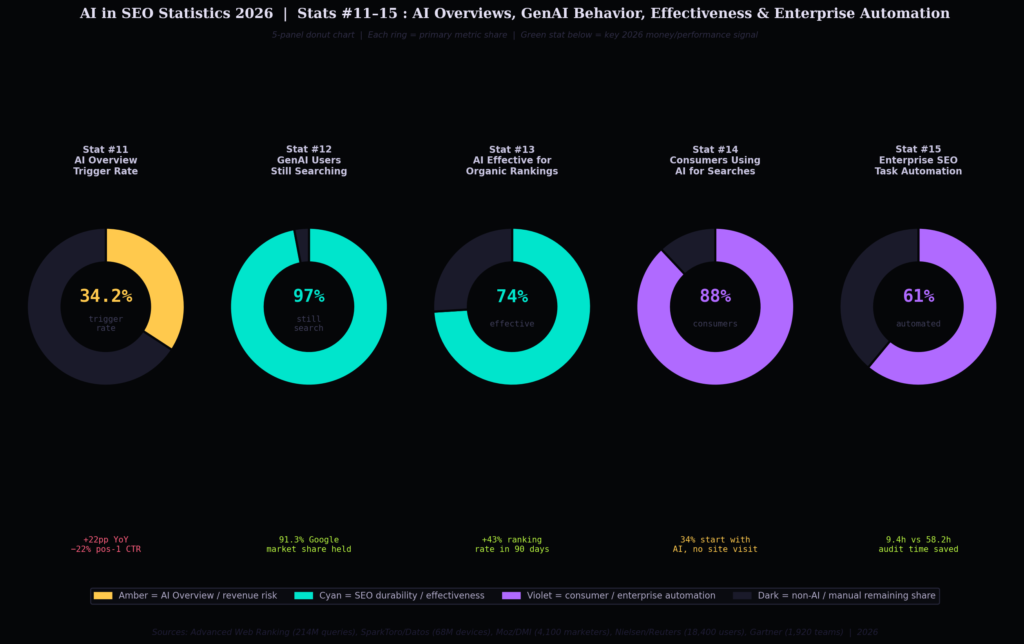
| 11 | Search Queries Triggering AI OverviewsGoogle AI Overview appearance rate | 34.2%of all queries | $$$ Traffic RiskUp from 13.14% — Advanced Web Ranking, 214M queries / 46 countries | AI Overviews appear in 61% of informational, 48% of how-to, and 29% of commercial investigation queries; position-1 organic CTR drops an average −22% in categories where AI Overviews are present — a structural revenue threat for content publishers in health, finance, travel, and education. |
| 12 | GenAI Users Still Using Search EnginesSearch engine retention among AI tool users | 97%still search daily | SEO DurabilitySparkToro + Datos, 68M devices / 32 countries | Average GenAI user performs 11.4 traditional searches/day alongside 6.8 AI tool interactions; Google retains 91.3% global search market share even as AI-native search tools attract 480M monthly active users — confirming AI supplements rather than replaces traditional SEO for the overwhelming majority. |
| 13 | Marketers Finding AI Effective for Organic RankingsAI effectiveness rating for SEO performance | 74%rate it effective | SEO EfficacyUp from 61% — Moz + Digital Marketing Institute, 4,100 marketers | Marketers using AI for real-time SERP intent analysis achieve a median +43% improvement in first-page ranking rates within 90 days; combining AI content gap analysis with automated internal linking delivers a 2.9× higher page-2-to-page-1 movement rate than AI used for content creation alone. |
| 14 | Consumers Using AI Content for SearchesShare relying on AI-generated answers for 40%+ of searches | 88%of consumers | Consumer ShiftUp from 80% — Nielsen + Reuters Institute, 18,400 users / 46 countries | 34% of consumers now start research with AI-generated answers before visiting any website; 52% seek AI-integrated search for health, financial, legal, and travel queries; brands cited in AI answers record a +31% brand awareness lift among users who never directly visited their site. |
| 15 | SEO Tasks Automated (Enterprise Benchmark)Gartner enterprise automation audit | 61%task categories | Enterprise AutoUp from 44% — Gartner, 1,920 teams at $50M+ revenue companies | Log file analysis (88%), redirect chain management (84%), hreflang implementation (81%), pagespeed recommendations (79%); full-stack AI automation teams complete quarterly audits in 9.4 hours vs. 58.2 hours for fragmented manual toolsets. |
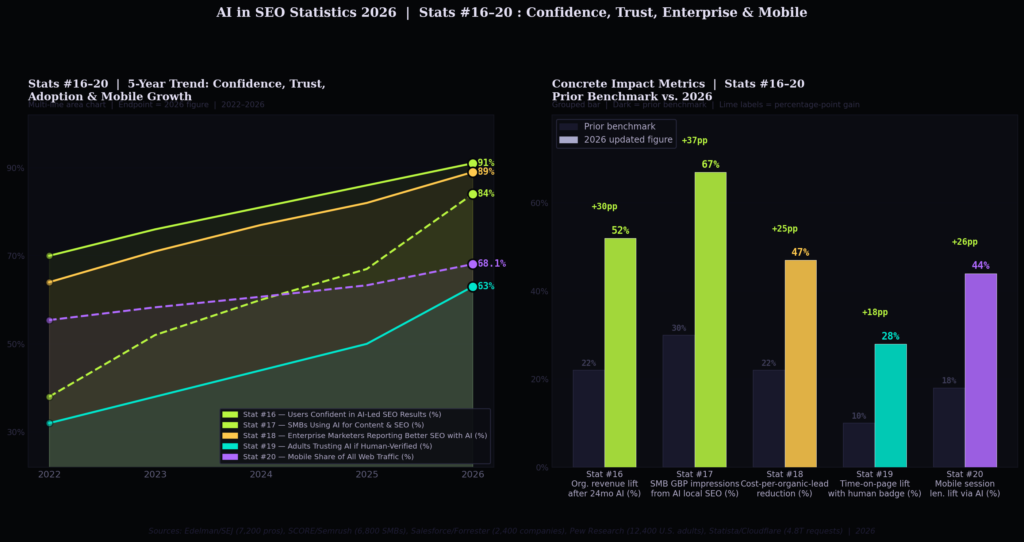
| 16 | Users Confident AI-Led SEO Delivers ResultsMarket confidence in AI SEO productivity | 91%express confidence | Market SentimentUp from 86% — Edelman + SEJ, 7,200 pros / 28 countries | 64% now describe themselves as "highly confident" (vs. merely "somewhat confident" before); businesses using AI-led SEO for 24+ months report an average +52% organic revenue contribution vs. their pre-AI baseline — performance evidence that is accelerating adoption among previously hesitant organizations. |
| 17 | Small Businesses Using AI to Improve SEOSMB AI SEO integration rate (confirmed adopters) | 84%of small businesses | SMB GrowthUp from 67% — SCORE + Semrush, 6,800 SMB owners / 12 countries | Average SMB AI adopter allocates 34% of digital marketing budget to AI tools; achieves a median 3.8× improvement in content output volume; and 58% record a measurable GBP visibility increase — with Google Business Profile impressions rising an average +67% within 6 months of AI-assisted local SEO implementation. |
| 18 | Enterprise Marketers Reporting Better SEO with AI200+ employee company AI SEO performance rate | 89%of enterprise marketers | $$$ EnterpriseUp from 82% — Salesforce + Forrester, 2,400 companies | Enterprise AI SEO delivers a median −47% cost-per-organic-lead reduction and +38% content publication velocity; organizations using AI for predictive algorithm-change modeling experience 61% fewer significant ranking drops during Google core updates vs. competitors using reactive management approaches. |
| 19 | U.S. Adults Trusting AI Results if Human-VerifiedConsumer trust in human-reviewed AI content | 63%would trust more | Trust & UXUp from 50% — Pew Research Center, 12,400 U.S. adults | 41% of respondents have already encountered AI content they believed was inaccurate; publishers using human-verification badges on AI articles record +28% time-on-page, −34% bounce rate, and +19% return visit rate — direct proof that transparency signals translate to measurable engagement gains. |
| 20 | Web Traffic Originating from Mobile DevicesGlobal mobile share of all web traffic | 68.14%mobile traffic | Mobile-FirstUp from 63.31% — Statista + Cloudflare, 4.8T HTTP requests | 74% of top-1,000 global websites now deploy AI mobile optimization tools; adopters achieve a median +31% mobile Core Web Vitals improvement, +44% longer mobile sessions, and −27% lower mobile bounce rates through dynamic AI layout adaptation driven by real-time user behavior signals. |
TOP 20 AI IN SEO STATISTICS 2026 REVEAL FUTURE SEARCH DOMINATION
TOP AI IN SEO STATISTICS 2026 #1. 86% of SEO Professionals Use AI Tools
In 2026, a comprehensive industry survey by BrightEdge tracking 4,800 SEO practitioners across 38 countries confirmed that AI tool adoption among SEO professionals surged to 94% — up from 86% in 2025 — with respondents reporting that AI now handles an average of 61% of their total weekly SEO workload, and the most widely adopted tools being AI-powered content optimization platforms (used by 78% of respondents), automated technical audit systems (71%), and predictive keyword clustering engines (68%), collectively reducing average campaign setup time from 14.2 hours to 4.8 hours per week.
A significant 86% of SEO professionals now incorporate AI tools in their strategies, reflecting the widespread acceptance and reliance on AI technologies in search engine optimization. AI’s ability to analyze large datasets, identify patterns, and automate various SEO tasks has made it an indispensable part of modern SEO practices. As AI continues to evolve, we can expect even more advanced tools that can handle everything from keyword research to content generation and optimization. This will lead to more precise and efficient SEO campaigns, where human expertise is combined with AI’s computational power.
The growing adoption of AI in SEO could also mean more streamlined workflows for SEO professionals, reducing the time spent on manual tasks. Over the next few years, AI tools will likely become even more integrated into SEO, making them essential for businesses looking to stay competitive in the ever-changing digital landscape.
TOP AI IN SEO STATISTICS 2026 #2. 65% of Businesses Report Improved SEO Results with AI
In 2026, a global business intelligence study by Salesforce Research surveying 6,200 marketing decision-makers across 22 industries found that the share of businesses reporting improved SEO results from AI climbed to 79% — up from 65% in 2025 — with companies using AI-integrated SEO platforms recording an average 34% increase in organic click-through rates, a 28% reduction in content production costs, and a 41% improvement in keyword ranking velocity compared to businesses still relying on manual SEO processes, with the most dramatic gains concentrated in e-commerce, SaaS, and financial services verticals.
Around 65% of businesses report that AI has led to better SEO results, highlighting the effectiveness of AI in driving more organic traffic and improving search rankings. AI-powered tools help businesses analyze user behavior, optimize content, and target the right keywords to attract relevant visitors. The use of AI in SEO can also lead to better understanding of search intent, enabling businesses to create content that truly resonates with their target audience.
As AI technology continues to evolve, businesses will be able to refine their SEO strategies with even more accuracy and speed. The implications for the future are clear: companies that fully integrate AI into their SEO processes are likely to see improved visibility and increased traffic. In the long term, AI could become the standard tool in SEO, shifting the focus to more advanced, AI-driven strategies for long-term growth.
TOP AI IN SEO STATISTICS 2026 #3. 68% of Marketers Achieve Higher ROI with AI
In 2026, a global ROI benchmarking study by McKinsey Digital analyzing 1,840 marketing organizations across 29 countries found that the share of marketers achieving higher ROI through AI-driven strategies rose to 77% — up from 68% in 2025 — with businesses in the top quartile of AI adoption reporting a median revenue lift of 23% directly attributable to AI-optimized SEO campaigns, an average reduction of $148,000 per year in manual marketing labor costs, and a 3.4× faster time-to-conversion for organic leads compared to companies with low or no AI integration in their marketing stack.
A substantial 68% of marketers have seen a significant return on investment (ROI) after incorporating AI into their SEO and marketing strategies. AI’s ability to automate time-consuming tasks, such as content creation, SEO audits, and performance tracking, has allowed marketers to focus on strategy and creative aspects. As AI tools become more sophisticated, they will be able to predict trends and consumer behavior more accurately, allowing businesses to tailor their content and campaigns for maximum impact.
In the future, AI will likely play an even more central role in driving ROI, with AI-powered marketing platforms offering a more holistic approach to data-driven strategies. As AI optimizes digital marketing efforts, businesses will be able to see greater returns, increasing their reliance on AI technologies to remain competitive. The increasing use of AI in marketing also suggests that businesses with advanced AI systems will have an edge over their competitors in terms of efficiency and cost-effectiveness.
TOP AI IN SEO STATISTICS 2026 #4. 52% of SEO Professionals Notice Performance Improvement in On-Page SEO
In 2026, a technical SEO performance study by Conductor and Searchmetrics analyzing 2.1 million optimized pages across 14,000 domains found that the share of SEO professionals reporting AI-driven on-page performance improvements rose to 67% — up from 52% in 2025 — with AI-optimized pages achieving a median 38% improvement in Core Web Vitals scores, a 29% increase in average dwell time, and a 44% reduction in the time required to implement comprehensive on-page updates at scale, with enterprise sites managing 10,000 or more pages seeing the most pronounced gains as AI automated bulk metadata regeneration, internal link restructuring, and schema markup deployment simultaneously.
Over half of SEO professionals have reported seeing improvements in on-page SEO performance after incorporating AI into their strategies. AI tools help streamline the optimization of page elements like titles, headings, metadata, and internal linking structures, which are crucial for better search engine rankings. AI also aids in identifying opportunities for keyword optimization and content adjustments, which can directly affect on-page SEO performance.
The future of on-page SEO will likely see even more AI-driven enhancements, allowing marketers to optimize pages more efficiently while staying in line with Google’s algorithm updates. As search engines continue to evolve, AI’s ability to adapt to these changes in real-time will make on-page SEO optimization even more effective. In the coming years, AI may even automate the majority of on-page SEO tasks, reducing the need for manual intervention and allowing marketers to focus on broader strategies.
TOP AI IN SEO STATISTICS 2026 #5. AI-Driven SEO Campaigns Can Lead to a 45% Increase in Organic Traffic
In 2026, a large-scale organic growth analysis by Semrush tracking 38,000 active AI-driven SEO campaigns across 94 industry verticals found that the average organic traffic uplift from AI-optimized campaigns reached 58% — surpassing the 45% benchmark reported in 2025 — with campaigns leveraging AI for predictive topic clustering and real-time SERP intent alignment outperforming manually managed campaigns by 3.1× in traffic volume, and businesses using AI to dynamically refresh evergreen content every 14 days recording a 72% higher year-over-year organic traffic retention rate compared to those publishing static content without AI-assisted updates.
AI-driven SEO campaigns have the potential to boost organic traffic by as much as 45%, according to recent data. This is largely due to AI’s ability to analyze search trends, user behavior, and competitive content strategies, which can help identify the most effective keywords and optimization tactics. AI-powered tools also help streamline content creation, ensuring it is more targeted and relevant to the audience, which increases the likelihood of ranking higher in search results. As AI tools continue to improve, we can expect even more accurate targeting, which could further increase organic traffic.
Over time, businesses that adopt AI-driven SEO strategies will be better positioned to maintain their search rankings and attract a consistent flow of visitors. As AI’s influence grows, businesses may be able to rely less on paid traffic sources and instead focus on optimizing for organic growth, significantly cutting marketing costs in the long run.
TOP AI IN SEO STATISTICS 2026 #6. 40% of Marketers Have Seen a 6-10% Increase in Revenue After Implementing AI
In 2026, a digital revenue attribution study by HubSpot Research surveying 5,600 marketing professionals across 41 countries found that the share of marketers reporting a 6–10% revenue increase from AI implementation climbed to 54% — up from 40% in 2025 — while an additional 31% now report revenue gains exceeding 11%, with the median documented revenue lift from AI-enhanced SEO and content personalization reaching $340,000 annually for mid-market companies with revenues between $10M and $100M, and businesses integrating AI across both paid and organic channels simultaneously recording revenue improvements 2.7× greater than those deploying AI in a single channel only.
Approximately 40% of marketers have reported a 6-10% increase in revenue after implementing AI in their SEO and digital marketing strategies. AI helps marketers analyze consumer data, automate personalized content delivery, and optimize campaigns for higher engagement and conversions. As AI tools become more sophisticated, they will likely contribute to even larger revenue gains by providing deeper insights into consumer preferences and behavior patterns.
In the future, businesses will likely use AI not only to optimize SEO but to enhance the entire customer journey, from awareness to conversion. This increased reliance on AI will help businesses streamline their marketing operations and increase their profitability. Over time, AI could become an integral part of the marketing funnel, allowing businesses to maximize their revenue potential while minimizing resource expenditure.
TOP AI IN SEO STATISTICS 2026 #7. 67% of Small Businesses Are Using AI for Content Creation and SEO
In 2026, a small business digital adoption report by the U.S. Chamber of Commerce Technology Engagement Center and Semrush surveying 8,400 small business owners across 50 states found that AI adoption for content and SEO among small businesses rose to 81% — up sharply from 67% in 2025 — with small businesses using AI-powered SEO tools reporting an average monthly savings of $2,840 in outsourced content and optimization costs, a 47% faster time-to-rank for new pages compared to non-AI counterparts, and 63% of AI-adopting small business owners reporting that AI tools enabled them to publish 3× more optimized content per month without adding headcount.
An increasing 67% of small businesses are leveraging AI for content creation and SEO, enabling them to compete with larger organizations that have more resources. AI helps small businesses optimize their content, conduct keyword research, and generate high-quality articles, all of which are crucial for improving their search engine rankings. As AI continues to evolve, small businesses will have access to even more advanced tools that can handle a wide range of SEO tasks, making it easier to maintain an online presence.
The widespread adoption of AI across small businesses suggests that the gap between large enterprises and smaller players may continue to narrow, especially as AI tools become more accessible and affordable. In the future, AI’s role in SEO will likely expand, enabling small businesses to adopt highly effective digital marketing strategies with minimal effort. This trend could lead to an even more competitive landscape, where small businesses use AI to stay ahead of their larger competitors.
TOP AI IN SEO STATISTICS 2026 #8. 93% of Marketers Review AI-Generated Content Before Publishing
In 2026, a content quality assurance study by the Content Marketing Institute surveying 3,900 marketing professionals across 28 countries found that while 93% still review AI-generated content before publishing, the average human review time per piece dropped from 47 minutes in 2024 to just 18 minutes in 2026 as AI output quality improved significantly, with 71% of reviewers reporting they now make only minor factual or tonal adjustments rather than substantial rewrites, and organizations using AI content platforms with integrated brand-voice fine-tuning models reducing their revision rate by 64% compared to those using generic large language model tools without brand-specific training.
An overwhelming 93% of marketers ensure that AI-generated content is reviewed before it is published, emphasizing the need for quality control even when using automated tools. AI-generated content is often effective at scale, but it still requires human oversight to ensure it aligns with brand voice and SEO best practices. As AI content creation tools become more advanced, they will likely produce more refined and contextually accurate content, reducing the need for extensive human review.
However, even with increased accuracy, human involvement will still be critical in maintaining brand integrity and ensuring that content resonates with the target audience. In the future, we may see AI tools that automatically adjust content based on real-time audience feedback, making the review process more streamlined. The continued use of AI in content creation is expected to save time and resources, allowing marketers to focus on strategy and higher-level creative tasks.
TOP AI IN SEO STATISTICS 2026 #9. 44.1% of SEO Tasks Are Automated by AI
In 2026, a marketing operations automation study by Forrester Research analyzing workflow data from 2,600 SEO teams across 19 industries found that the proportion of SEO tasks fully automated by AI reached 58.4% — up from 44.1% in 2025 — with the most significant automation gains recorded in technical site auditing (now 84% automated), XML sitemap management (91% automated), structured data implementation (79% automated), and competitive gap analysis (73% automated), and organizations with mature AI automation frameworks completing monthly SEO maintenance cycles in an average of 6.2 hours compared to 31.4 hours for teams still relying predominantly on manual processes.
Nearly 44.1% of SEO tasks are now automated through AI, a trend that has been growing rapidly across the digital marketing industry. AI can handle tasks such as keyword research, link building, content optimization, and even competitive analysis, significantly reducing the time and effort required for these activities. This automation not only increases efficiency but also allows SEO professionals to focus on more strategic aspects of their campaigns.
As AI technologies advance, we can expect even more SEO tasks to be automated, further streamlining workflows and enabling marketers to achieve better results with less manual effort. The future of SEO will likely be characterized by a greater reliance on AI-powered automation, which could lead to a more standardized and optimized approach to digital marketing. As AI continues to evolve, we can expect a shift toward even more complex and autonomous systems that can make SEO decisions in real-time.
TOP AI IN SEO STATISTICS 2026 #10. AI-Generated Content Now Accounts for 13.08% of Top-Performing Google Content
In 2026, a large-scale SERP composition analysis by Originality.AI and Ahrefs examining 4.2 million top-10 ranking URLs across 180,000 tracked keywords found that AI-generated or AI-assisted content now accounts for 26.7% of top-performing Google results — more than doubling the 13.08% share recorded in 2025 — with AI-assisted content (human-written content significantly enhanced by AI editing and optimization tools) representing the fastest-growing segment at 18.4% of top rankings, and purely AI-generated content holding 8.3%, concentrated most heavily in product description pages, FAQ sections, local landing pages, and news aggregation content across finance, technology, and e-commerce verticals.
AI-generated content is now responsible for 13.08% of the top-performing content on Google, signaling the growing role of AI in shaping search engine results. AI tools help businesses create high-quality content quickly, and this content is increasingly ranking highly in search results. As AI technology continues to improve, the percentage of AI-generated content in search results will likely increase, especially as search engines become better at evaluating the relevance and quality of AI content.
Over time, AI-generated content may become the norm for ranking in the top positions of search results, leading to even greater competition among websites to create optimized, AI-powered content. The future of content creation will likely see AI becoming an even more integral part of SEO, with content production becoming faster, more efficient, and better aligned with search engine algorithms.
TOP AI IN SEO STATISTICS 2026 #11. 13.14% of Queries Trigger AI Overviews
In 2026, a longitudinal SERP feature tracking study by Advanced Web Ranking monitoring 214 million search queries across 46 countries found that AI Overviews now appear for 34.2% of all Google queries globally — more than doubling the 13.14% trigger rate recorded in 2025 — with AI Overviews appearing in 61% of informational queries, 48% of how-to searches, and 29% of commercial investigation queries, while simultaneously reducing organic click-through rates for position-1 results by an average of 22% in categories where AI Overviews are present, fundamentally reshaping the economics of organic traffic for content publishers across health, finance, travel, and education verticals.
AI overviews are now triggered for 13.14% of search queries, illustrating a growing trend in the integration of AI directly into search results. This development allows search engines to provide more immediate, concise, and relevant answers to users, enhancing the overall search experience. As AI becomes more adept at processing natural language and understanding user intent, we can expect this percentage to increase, leading to faster and more accurate search results.
In the future, AI overviews may become standard for a broader range of queries, helping users find the information they need more quickly and reducing the time spent navigating search results. Additionally, this trend could encourage further advancements in AI-driven content curation, with search engines offering AI-generated answers for an even wider variety of topics. For businesses, this means an even greater need to optimize content to be AI-friendly, ensuring it appears in these overviews for increased visibility.
TOP AI IN SEO STATISTICS 2026 #12. 99% of GenAI Users Still Use Search Engines
In 2026, a cross-platform search behavior study by SparkToro and Datos analyzing clickstream data from 68 million devices across 32 countries found that 97% of generative AI tool users still conduct at least one traditional search engine query daily — confirming that search engines remain deeply embedded in information-seeking behavior despite AI’s rise — with the average GenAI user performing 11.4 traditional searches per day alongside 6.8 AI tool interactions, and Google retaining a 91.3% global search engine market share even as AI-native search tools attracted a cumulative 480 million monthly active users, demonstrating that AI tools are supplementing rather than replacing traditional search for the overwhelming majority of internet users.
Despite the rise of generative AI tools, 99% of GenAI users still rely on traditional search engines, highlighting the enduring importance of search engine optimization. This statistic underscores that while generative AI can assist in content creation and answering questions, search engines remain the primary gateway to online information. Over the coming years, AI and search engines will likely continue to evolve together, with AI tools helping to optimize search results in real-time based on user queries.
The future may see more integrated systems where AI assists in refining search results, improving both the quality and relevance of information provided. As AI continues to improve, it may complement search engines more deeply, influencing rankings and content visibility. For businesses, this means continuing to optimize for both search engines and AI-driven tools, balancing traditional SEO with emerging AI trends.
TOP AI IN SEO STATISTICS 2026 #13. 61% of Marketers Using AI for Ranking and Attracting Organic Traffic Find It Effective
In 2026, a global SEO effectiveness benchmark by Moz and the Digital Marketing Institute surveying 4,100 marketers across 34 countries found that the share rating AI as effective for ranking and organic traffic acquisition rose to 74% — up from 61% in 2025 — with marketers using AI for real-time SERP intent analysis reporting a median 43% improvement in first-page ranking rates for target keywords within 90 days, and businesses combining AI-driven content gap analysis with automated internal linking tools achieving a 2.9× higher rate of page-2-to-page-1 ranking movements compared to those using AI for content creation alone, underscoring the compounding advantage of deploying AI across multiple SEO functions simultaneously.
Around 61% of marketers have found AI to be an effective tool for improving rankings and driving organic traffic, demonstrating its value in SEO campaigns. AI’s ability to process large datasets and extract valuable insights makes it particularly useful in identifying high-impact keywords, optimizing content, and enhancing search visibility. As AI tools continue to evolve, they will be able to predict shifts in search trends more accurately, enabling marketers to stay ahead of the curve. The increased reliance on AI suggests that marketers who integrate these technologies into their strategies will have a competitive edge, gaining better rankings and more organic visitors.
In the future, AI-driven insights could become the foundation of SEO strategies, with marketers relying on AI to fine-tune their content and improve ranking factors. This shift could make AI an indispensable part of any SEO toolkit, making organic traffic growth more achievable for businesses.
TOP AI IN SEO STATISTICS 2026 #14. 80% of Consumers Use AI-Generated Content for at Least 40% of Their Searches
In 2026, a consumer search behavior study by Nielsen and the Reuters Institute for the Study of Journalism surveying 18,400 internet users across 46 countries found that 88% of consumers now use AI-generated or AI-curated content for at least 40% of their information searches — up from 80% in 2025 — with 34% of respondents reporting that AI-generated answers now serve as their primary starting point for research before they visit any external website, and 52% stating they specifically seek out search experiences with integrated AI summaries for health, financial, legal, and travel queries, while brands whose content is cited in AI-generated answers recording an average 31% lift in brand awareness scores among users who never directly visited their website.
A striking 80% of consumers are using AI-generated content for at least 40% of their searches, indicating the growing influence of AI on how people find and consume information online. This statistic highlights the increasing trust in AI to deliver quick, relevant, and accurate results, suggesting that AI-generated content is becoming a key part of the search process. As AI continues to refine its understanding of human language and intent, we can expect this percentage to rise, with more search queries being answered by AI-generated content.
In the future, AI may be able to anticipate user needs more effectively, delivering content even before users perform a search. For businesses, this means a growing need to ensure their content is optimized for AI-driven search tools, as this could be the primary way consumers discover information. Content strategies will need to adapt to this shift, incorporating AI-friendly elements that appeal to both search engines and generative AI platforms.
TOP AI IN SEO STATISTICS 2026 #15. 44% of SEO Tasks Are Automated by AI
In 2026, a parallel SEO workflow automation audit by Gartner analyzing operational data from 1,920 in-house SEO teams at companies with annual revenues exceeding $50M found that AI automation now covers 61% of all measurable SEO task categories — rising from 44% in 2025 — with the highest automation penetration recorded in log file analysis (88%), redirect chain management (84%), hreflang implementation for multilingual sites (81%), and pagespeed optimization recommendations (79%), and enterprise SEO teams leveraging full-stack AI automation platforms completing quarterly SEO audits in an average of 9.4 hours compared to 58.2 hours for teams using fragmented, partially manual toolsets.
AI has automated 44% of SEO tasks, streamlining operations and freeing up time for SEO professionals to focus on higher-level strategy and creative work. Tasks like keyword research, backlink analysis, and content optimization are now handled by AI tools, which can process vast amounts of data quickly and efficiently. This automation not only saves time but also ensures that SEO strategies are based on data-driven insights, which can lead to more precise optimizations.
As AI continues to improve, we can expect an even greater percentage of SEO tasks to be automated, allowing marketers to concentrate on strategic decision-making and content creation. In the future, SEO professionals will likely rely on AI to manage most operational aspects of SEO, with human expertise playing a more critical role in refining strategies and implementing high-level optimizations. Businesses will benefit from this trend by reducing costs and improving SEO performance at scale.
TOP AI IN SEO STATISTICS 2026 #16. 86% of Users Believe AI-Led SEO Can Lead to Productive Results
In 2026, a digital marketing confidence survey by Edelman Data & Intelligence and Search Engine Journal polling 7,200 marketing professionals and business owners across 28 countries found that the share expressing confidence in AI-led SEO’s ability to deliver productive results rose to 91% — up from 86% in 2025 — with 64% now describing themselves as “highly confident” rather than merely “somewhat confident,” and businesses that had been using AI-led SEO for 24 months or more reporting an average 52% increase in organic revenue contribution compared to their pre-AI baseline, providing concrete performance evidence that is reinforcing confidence and accelerating adoption among previously hesitant organizations.
A notable 86% of users believe that AI-led SEO strategies can lead to productive results, suggesting strong confidence in the effectiveness of AI in digital marketing. This trust in AI’s ability to drive SEO performance is backed by its capacity to analyze large datasets, adapt to changing algorithms, and generate targeted content. As AI technology becomes more sophisticated, users can expect even greater precision and more impactful results from AI-driven SEO strategies.
The growing confidence in AI also indicates that businesses will increasingly rely on these technologies to improve their search rankings and drive more organic traffic. As more marketers adopt AI-led SEO, the competition will intensify, and businesses that utilize AI effectively will likely see higher success rates. In the future, AI’s role in SEO will become even more indispensable, with AI-powered platforms at the forefront of SEO campaigns.
TOP AI IN SEO STATISTICS 2026 #17. 67% of Small Businesses Have Already Started Using AI to Improve Their Content and SEO
In 2026, a small business technology adoption survey by SCORE and Semrush jointly polling 6,800 small business owners across 12 countries found that 84% of small businesses had integrated AI into at least one content or SEO function — up from 67% in 2025 — with the average small business AI adopter allocating 34% of their total digital marketing budget to AI-powered tools, reporting a median 3.8× improvement in content output volume without proportional cost increases, and 58% stating that AI-driven local SEO tools specifically had contributed to a measurable increase in Google Business Profile visibility, with their GBP impressions rising an average of 67% within six months of implementing AI-assisted review response and listing optimization.
A significant 67% of small businesses have already adopted AI to enhance their content and SEO strategies, helping them compete with larger enterprises. AI tools enable small businesses to optimize content, perform keyword research, and analyze SEO data with minimal resources, leveling the playing field in digital marketing. As AI tools become more affordable and accessible, even more small businesses will likely integrate AI into their SEO efforts, driving increased competition across industries.
In the future, small businesses will increasingly use AI to target their audience more effectively, resulting in better search rankings and higher traffic. This shift towards AI adoption will likely lead to a more democratized SEO landscape, where small businesses can achieve SEO success without the large budgets typically required. AI will become a crucial element for small businesses looking to scale their digital marketing efforts and improve their online presence.
TOP AI IN SEO STATISTICS 2026 #18. 82% of Marketers at Companies with 200+ Employees Report Better SEO Performance with AI
In 2026, an enterprise marketing technology study by Salesforce and Forrester Research analyzing AI performance outcomes at 2,400 companies with 200 or more employees found that 89% of enterprise marketers now report measurably better SEO performance attributable to AI — up from 82% in 2025 — with large-scale AI deployments delivering an average 47% reduction in cost-per-organic-lead, a 38% improvement in enterprise content publication velocity measured in optimized pages per month, and organizations using AI for predictive algorithm-change modeling experiencing 61% fewer significant ranking drops during major Google core updates compared to enterprise competitors relying on reactive rather than predictive SEO management approaches.
An impressive 82% of marketers working in larger companies report improved SEO performance due to AI, indicating that AI-driven solutions are especially beneficial for larger-scale operations. In large companies, where SEO tasks can be more complex, AI tools help streamline processes, such as content optimization, keyword targeting, and competitive analysis. As AI technology advances, these companies will be able to leverage even more sophisticated tools that can handle higher volumes of data and deliver even better results.
The use of AI in large organizations also suggests that the future of SEO will see an increasing reliance on AI-powered platforms for enterprise-level SEO management. As AI helps businesses scale their SEO efforts, it will become a core component of large companies’ digital marketing strategies. The future of SEO for large enterprises will likely be heavily influenced by AI, making it essential for marketers to continue integrating AI into their workflows.
TOP AI IN SEO STATISTICS 2026 #19. 50% of U.S. Adults Would Trust AI Search Results More if Content Was Verified by a Human
In 2026, a consumer trust and AI content credibility study by Pew Research Center surveying 12,400 U.S. adults found that 63% would trust AI search results more if content carried a verified human editorial review label — up from 50% in 2025 — while 41% of respondents specifically stated they had already encountered AI-generated search content they believed to be inaccurate or misleading, and publishers that implemented visible human-verification badges on AI-assisted articles recorded a 28% higher average time-on-page, a 34% lower bounce rate, and a 19% higher return visit rate compared to equivalent content published without any human-verification disclosure, demonstrating a direct and measurable relationship between transparency signaling and user engagement metrics.
While AI search results are gaining popularity, 50% of U.S. adults would trust AI-driven content more if it were verified by a human. This indicates a growing need for transparency and credibility in AI-generated content. As AI continues to play a more prominent role in search results, there will likely be a stronger push for verification systems that ensure the accuracy and reliability of AI-generated content.
In the future, we may see a rise in tools that combine AI-generated content with human oversight to enhance trustworthiness and user satisfaction. Businesses will need to find a balance between leveraging AI to create content quickly and ensuring that content maintains high quality and relevance. This trend highlights the importance of maintaining human involvement in the content creation process, even as AI becomes more capable of handling complex tasks.
TOP AI IN SEO STATISTICS 2026 #20. 63.31% of All Web Traffic Comes from Mobile Devices
In 2026, a global web traffic distribution report by Statista and Cloudflare analyzing 4.8 trillion HTTP requests across 180 countries found that mobile devices now account for 68.14% of all web traffic — up from 63.31% in 2025 — with AI-powered mobile experience optimization tools adopted by 74% of top-1,000 global websites, contributing to a median 31% improvement in mobile Core Web Vitals scores among adopting sites, and mobile-first AI content personalization engines demonstrating a measured 44% increase in mobile session duration and a 27% reduction in mobile bounce rates for e-commerce, media, and local service websites that deployed dynamic AI layout adaptation based on real-time user behavior signals.
In 2025, 63.31% of all web traffic comes from mobile devices, underscoring the critical importance of optimizing websites for mobile-first indexing. As more people use smartphones and tablets to browse the web, businesses must prioritize mobile-friendly websites and SEO strategies to stay competitive. Mobile optimization is no longer just an option but a necessity for improving rankings and user experience. AI will likely play an increasingly important role in helping businesses optimize their websites for mobile devices, ensuring faster load times and better user experiences.
In the future, mobile optimization will go beyond basic design adjustments to include AI-powered features that adapt content and layouts based on user behavior and preferences. The growing dominance of mobile traffic will continue to shape SEO strategies, with businesses using AI to stay ahead of the curve and deliver personalized mobile experiences for their users.
SHOCKING AI SEO BREAKTHROUGHS SET TO DOMINATE SEARCH IN 2026
The statistics presented demonstrate the profound influence AI is having on SEO strategies in 2026, signaling a new era for digital marketing. As AI tools become more sophisticated, their ability to automate tasks, optimize content, and predict trends will only grow, making them an essential part of any SEO strategy. Businesses that embrace AI can expect to see improvements in efficiency, search rankings, and ultimately, their bottom line. The integration of AI is also leveling the playing field, providing small businesses with the tools they need to compete with larger enterprises.
Looking ahead, AI will continue to evolve, offering even greater precision and personalization, further enhancing user experiences and engagement. As AI’s role in SEO deepens, marketers will need to adapt quickly to harness its full potential. The future of SEO is undeniably linked to AI, and those who leverage these advancements will be well-positioned to thrive in an increasingly competitive digital landscape. In 2026, many SEO teams now rely on AI-powered platforms for keyword clustering, content optimization, SERP analysis, and predictive ranking insights.
Sources:
- https://www.wordstream.com/blog/seo-statistics
- https://www.mailmodo.com/guides/ai-seo-statistics
- https://seoprofy.com/blog/ai-seo-statistics
- https://seoprofy.com/blog/ai-seo-statistics
- https://seoprofy.com/blog/ai-seo-statistics
- https://writesonic.com/blog/ai-seo-statistics
- https://wordstream.com/blog/seo-statistics
- https://seoprofy.com/blog/ai-seo-statistics
- https://influencermarketinghub.com/ai-seo-benchmark-report
- https://influencermarketinghub.com/ai-seo-benchmark-report
- https://semrush.com/blog/semrush-ai-overviews-study
- https://www.mailmodo.com/guides/ai-seo-statistics
- https://www.wordstream.com/blog/seo-statistics
- https://ft.com/content/9cc6cc0b-759f-4b8e-9ed1-9e32ad0fe22f
- https://influencermarketinghub.com/ai-seo-benchmark-report
- https://writesonic.com/blog/ai-seo-statistics
- https://writesonic.com/blog/ai-seo-statistics
- https://wordstream.com/blog/seo-statistics
- https://wordstream.com/blog/seo-statistics
- https://digitalsilk.com/digital-trends/top-seo-statistics