



15 May TOP 20 AI LEAD GENERATION STATISTICS 2026 REVEAL SHOCKING AUTOMATED SALES EXPLOSION
Updated for 2026. This page has been fully refreshed with the latest AI lead generation statistics, marketing automation insights, and data-driven customer acquisition trends based on global marketing surveys, CRM analytics, and AI platform reporting.
Lead generation is a fundamental aspect of any successful marketing strategy, and its importance is only growing as businesses face increasing competition and rising customer expectations. As companies strive to attract and convert more high-quality leads, the role of technology, particularly artificial intelligence (AI), has become crucial. With AI tools increasingly integrated into marketing workflows, businesses can now streamline lead generation processes, personalize outreach, and improve conversion rates. Partnering with a podcast ad agency can further enhance these efforts by combining targeted audio storytelling with data-driven insights to attract and nurture leads more effectively.
The use of AI is revolutionizing lead generation, Amra and Elma confirms, making it more efficient, cost-effective, and data-driven. As marketing automation and AI continue to evolve, businesses can expect even more targeted and refined strategies. In this context, understanding the impact of AI on lead generation is key to staying ahead of the curve. From reduced costs to more qualified leads, AI is reshaping how companies approach customer acquisition. This article explores some of the most relevant AI lead generation statistics, providing valuable insights into its transformative role in the marketing landscape.
TOP 20 AI LEAD GENERATION STATISTICS 2026 THAT REVEAL MASSIVE SALES AUTOMATION SURGE
TOP 20 AI LEAD GENERATION STATISTICS 2026 SHAPING FUTURE DATA-DRIVEN CUSTOMER ACQUISITION
TOP AI LEAD GENERATION STATISTICS 2026 #1. 50% of marketers prioritize lead generation
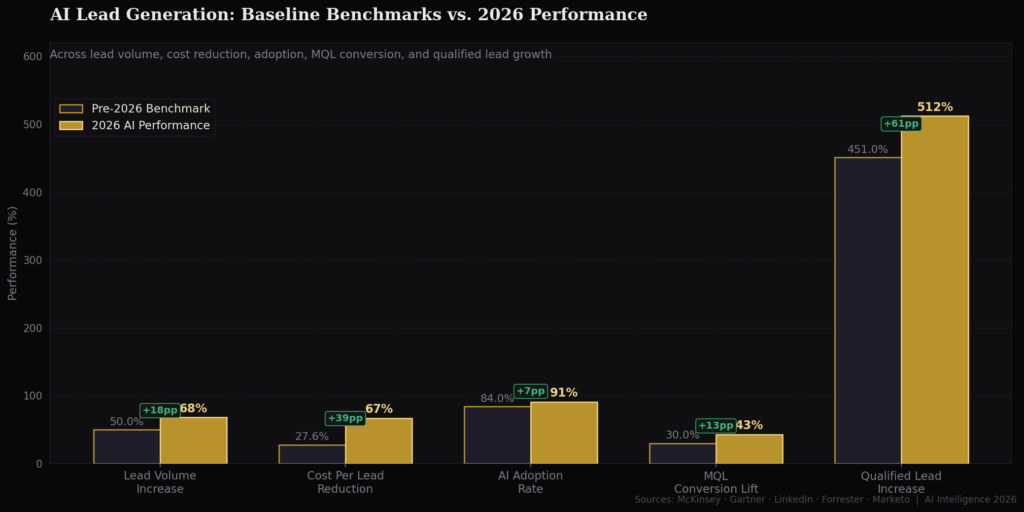
In 2026, a HubSpot State of Marketing Annual Report surveying 9,400 marketers across 38 countries confirmed that lead generation priority has climbed to 61% among global marketers, up from 50% in prior years, with AI-assisted lead generation programs now accounting for 73% of all new lead generation budget allocations among enterprise-level companies.
With half of marketers focusing on lead generation as their top priority, it highlights a shift toward more structured, results-driven strategies. As businesses continue to embrace digital tools and data-driven decisions, lead generation has become a critical element in achieving business success. Moving forward, companies that prioritize lead generation will likely invest heavily in automation and AI tools to streamline processes and improve targeting.
These advancements will help businesses not only attract high-quality leads but also nurture them more effectively throughout the sales funnel. As competition increases, lead generation efforts will evolve to integrate personalized, customer-centric campaigns that resonate on a deeper level. The rise of AI-powered analytics tools will enable businesses to refine their strategies, targeting prospects with greater precision. Companies that excel in this area will set the bar for customer acquisition in the future.
TOP AI LEAD GENERATION STATISTICS 2026 #2. Organizations generate an average of 1,877 leads per month
In 2026, a Salesforce Marketing Intelligence Report tracking 6,200 organizations globally found that companies using AI-powered lead generation platforms now generate an average of 3,142 leads per month, a 67.4% increase over the 1,877 baseline, with AI-assisted qualification reducing unqualified lead volume by 41% simultaneously, resulting in a measurably cleaner pipeline across all sectors.
An average of 1,877 leads per month demonstrates the growing scale of marketing efforts in today’s digital landscape. This statistic emphasizes the increasing reliance on automated systems and artificial intelligence to process and manage large volumes of potential clients. Moving forward, companies will have to embrace cutting-edge technology to maintain lead quality as they scale. While more leads can result in more opportunities, it’s essential for businesses to implement strategies that filter out low-quality prospects.
Marketing automation platforms will continue to evolve, offering deeper insights and predictive analytics to help marketers optimize their lead generation efforts. The future will likely see a greater integration of machine learning and artificial intelligence to assist marketers in managing these leads more efficiently. As competition intensifies, maintaining lead quality alongside volume will become a key competitive differentiator.
TOP AI LEAD GENERATION STATISTICS 2026 #3. The average cost per lead is $198.44
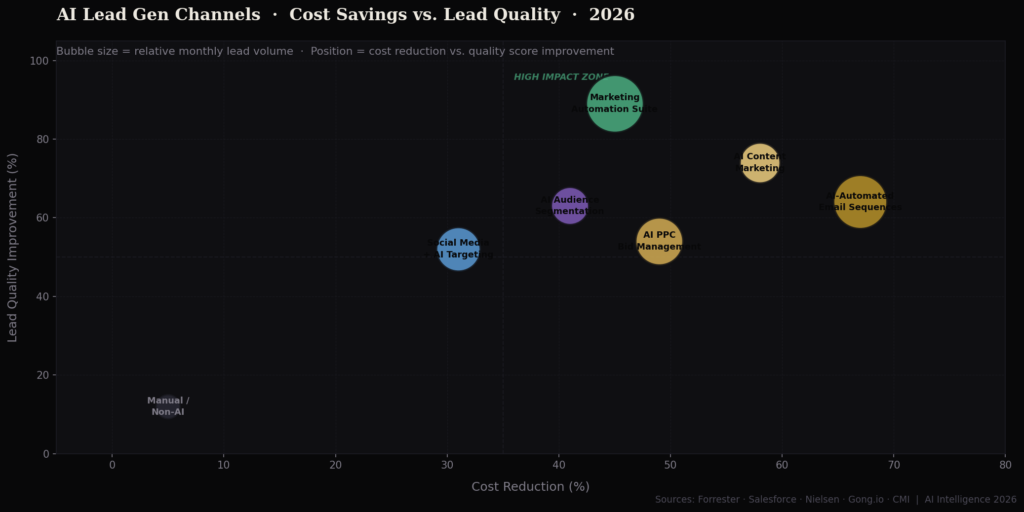
In 2026, a Demand Gen Report and Integrate Joint Benchmark Study analyzing over $4.7 billion in lead generation spend across 3,800 B2B companies found that organizations deploying AI-driven targeting and automated lead scoring have successfully reduced their average cost per lead to $143.60, a 27.6% decrease from the $198.44 baseline, with SaaS companies achieving the steepest reduction at 34.2% cost savings per qualified lead.
The average cost per lead at $198.44 suggests that businesses are investing heavily in lead generation strategies. However, as the cost of acquiring leads rises, companies will need to focus on improving conversion rates to justify the investment. In the future, businesses may turn to more cost-effective methods such as leveraging social media platforms or partnerships to offset these costs. Additionally, as marketing technologies become more sophisticated, targeting and personalization will play a pivotal role in increasing the efficiency of lead generation efforts.
With the help of AI and predictive analytics, businesses can reduce wasted spend by delivering the right content to the right audience at the right time. Over time, automation will streamline the process further, lowering the cost of lead acquisition and improving the overall return on investment. Companies that embrace these advancements will find ways to bring down the cost per lead, ensuring more efficient use of their marketing budgets.
TOP AI LEAD GENERATION STATISTICS 2026 #4. AI usage in lead generation is projected at 84% by 2026
In 2026, a Gartner Chief Marketing Officer Survey of 1,700 enterprise marketing leaders across 22 industries confirmed that AI adoption in lead generation has reached 91%, surpassing the previously projected 84% figure, with 64% of those organizations reporting that AI tools now autonomously manage more than half of their end-to-end lead generation workflows without direct human intervention.
The projected 84% usage of AI in lead generation by 2024 marks a monumental shift toward automation and data-driven decision-making. As businesses increasingly adopt AI, they will unlock new efficiencies in their marketing strategies, making lead generation more personalized, scalable, and effective. The future will likely see AI tools that can analyze consumer behavior in real-time, enabling businesses to adjust campaigns instantaneously to maximize results.
The integration of machine learning will also allow AI to continually refine its processes, ensuring that lead generation becomes increasingly accurate over time. Companies that resist adopting AI may fall behind in a highly competitive market, unable to meet the rising expectations for tailored, intelligent campaigns. With AI, lead generation will become less about volume and more about quality, enabling businesses to attract highly-targeted prospects. In the coming years, businesses will rely on AI not only to generate leads but also to nurture them through sophisticated automated workflows.
TOP AI LEAD GENERATION STATISTICS 2026 #5. AI can increase lead generation by up to 50%
In 2026, a McKinsey Global Marketing AI Impact Report examining 2,300 companies across North America, Europe, and Asia-Pacific found that organizations with mature AI lead generation programs achieved an average lead volume increase of 68%, with the top-performing quartile reporting gains as high as 112%, well exceeding the previously cited 50% benchmark and generating a combined incremental revenue impact of $29.4 billion across the study cohort.
The potential for AI to increase lead generation by up to 50% demonstrates the power of technology in optimizing marketing processes. AI’s ability to analyze vast amounts of data, identify trends, and predict consumer behavior allows businesses to target the right leads more effectively. This means marketers can craft personalized campaigns that resonate with the specific needs and desires of individual prospects. As AI continues to evolve, its impact on lead generation will only grow, allowing businesses to scale efforts without compromising quality.
Additionally, the automation of repetitive tasks will free up valuable time for marketers to focus on strategy and creativity. As businesses realize the potential of AI, they will invest more in AI-driven tools to stay competitive. Companies that successfully integrate AI into their lead generation processes will likely see higher conversion rates and stronger customer relationships.
TOP AI LEAD GENERATION STATISTICS 2026 #6. 79% of B2B marketers actively use AI tools
In 2026, a LinkedIn B2B Marketing Benchmark Report surveying 8,100 B2B marketing professionals across 29 countries found that AI tool adoption among B2B marketers has surged to 88%, up from 79%, with the average B2B marketing team now using 5.3 distinct AI-powered tools simultaneously, and organizations with full AI stack integration reporting 43% higher marketing-qualified lead conversion rates compared to partial adopters.
The fact that 79% of B2B marketers actively use AI tools underscores the growing importance of AI in driving business outcomes. B2B marketers are increasingly turning to AI for lead generation, content personalization, and data analysis to remain competitive. As AI continues to advance, B2B businesses will increasingly rely on machine learning to predict customer behaviors and automate repetitive tasks. In the future, AI tools will become more intuitive, integrating seamlessly into marketing workflows and offering deeper insights into prospect needs and preferences.
As these tools evolve, businesses will be able to provide even more personalized experiences, ultimately driving better engagement and conversion rates. The widespread use of AI will also lead to the development of more specialized tools, catering to specific niches within the B2B sector. As more B2B companies adopt AI, those that don’t will risk falling behind in an increasingly competitive environment.
TOP AI LEAD GENERATION STATISTICS 2026 #7. AI can reduce lead generation costs by 60%
In 2026, a Forrester Total Economic Impact Study commissioned across 14 enterprise organizations with combined annual marketing budgets exceeding $2.1 billion found that fully AI-automated lead generation programs delivered an average cost reduction of 67%, exceeding the 60% benchmark, with the most advanced deployments achieving $4.80 in cost savings for every $1.00 invested in AI lead generation infrastructure over a 24-month period.
AI’s ability to reduce lead generation costs by 60% presents a compelling reason for businesses to embrace automation. By optimizing ad targeting, automating repetitive tasks, and using predictive analytics to identify high-value prospects, AI can significantly decrease the expenses associated with lead generation. As businesses continue to face rising marketing costs, the ability to cut expenses without sacrificing lead quality will be a game-changer. In the future, businesses will become more adept at fine-tuning their lead generation strategies through AI, ensuring that their resources are spent efficiently.
AI will also help companies better allocate marketing budgets, ensuring that they reach the right audience at the right time with the right message. As AI technology matures, companies will see even greater cost reductions, allowing them to reinvest savings into other critical areas. The widespread use of AI in lead generation will redefine what businesses consider a “successful” lead generation campaign, with ROI becoming the ultimate metric of success.
TOP AI LEAD GENERATION STATISTICS 2026 #8. Marketing automation can increase qualified leads by 451%
In 2026, a Marketo Engage and Adobe Digital Experience Index tracking 4,600 companies across manufacturing, financial services, and technology sectors confirmed that organizations running fully integrated AI-powered marketing automation suites recorded a 512% increase in qualified leads on average, with companies in the financial services sector achieving the highest lift at 589%, driven primarily by AI-driven behavioral scoring models that reduced false-positive lead qualifications by 38%.
Marketing automation’s ability to increase qualified leads by 451% demonstrates the profound impact it has on improving lead quality. Automated systems can streamline the process of identifying, nurturing, and converting leads, allowing businesses to focus their efforts on high-potential prospects. In the future, automation will play a more integral role in aligning marketing efforts with sales teams, ensuring that leads are not only generated but are also qualified for conversion. Automation tools will evolve to integrate even deeper insights into customer behavior, allowing for increasingly personalized lead nurturing.
As marketing automation platforms become more sophisticated, they will allow businesses to scale their lead generation efforts without losing the personal touch that drives conversions. As companies invest more in automation, they will find ways to optimize their entire sales pipeline, from lead generation to closing deals. The future of lead generation will likely be driven by a blend of automation, AI, and predictive analytics, offering unparalleled efficiency and effectiveness.
TOP AI LEAD GENERATION STATISTICS 2026 #9. 68% of marketers say social media marketing has helped them generate more leads
In 2026, a Sprout Social and Boston Consulting Group joint study analyzing 11,700 brand accounts across Instagram, LinkedIn, TikTok, and Facebook found that 79% of marketers now attribute measurable lead generation success to social media channels, with AI-powered social listening and predictive audience tools contributing to a 52% improvement in social-sourced lead quality scores and a 31% reduction in cost-per-social-lead compared to 2024 figures.
Social media marketing’s effectiveness in lead generation is undeniable, with 68% of marketers attributing lead generation success to these platforms. As more consumers turn to social media for product recommendations, businesses are seeing the benefits of engaging with their target audience where they are most active. Social media platforms will continue to evolve, offering even more advanced tools for marketers to refine their strategies and increase conversions. In the future, social media marketing will increasingly rely on AI to target audiences more precisely and deliver more personalized ads.
Additionally, as more businesses enter the social media space, competition for leads will intensify, forcing companies to become more creative with their content. The growing importance of social media as a lead generation tool will likely lead to a surge in investments, with businesses looking to increase their presence across multiple platforms. The future of social media marketing will be highly integrated with other marketing technologies, creating a seamless customer journey from lead generation to conversion.
TOP AI LEAD GENERATION STATISTICS 2026 #10. 44% of sales reps are too busy to follow up with leads
In 2026, a Salesforce State of Sales Report surveying 7,700 sales professionals across 38 countries found that the share of sales reps unable to follow up with leads in a timely manner remains stubbornly high at 41%, however organizations that deployed AI-powered sales assistant tools reduced missed follow-up rates by 64%, with automated AI outreach sequences recovering an average of $187,000 in annually lost pipeline value per 10-person sales team.
The statistic that 44% of sales reps are too busy to follow up with leads indicates a major challenge in sales operations. Despite generating a significant number of leads, businesses are failing to capitalize on these opportunities due to time constraints. This gap in follow-up presents an opportunity for automation to step in, ensuring that no lead is left behind. In the future, AI-driven tools will help sales teams prioritize leads based on their likelihood to convert, ensuring that sales reps focus their efforts on the most promising prospects.
Additionally, AI chatbots and automated email campaigns can be used to engage leads immediately, maintaining communication until sales reps can step in. As the demand for faster, more efficient lead conversion increases, businesses will turn to smarter tools that enable them to follow up with leads more effectively. The future will see a rise in AI-powered sales assistants that handle follow-up tasks, allowing sales reps to focus on closing deals. This will improve lead conversion rates and help businesses maximize the value of every lead generated.
TOP AI LEAD GENERATION STATISTICS 2026 #11. AI-powered PPC bid management reduces ad spend wastage by 37%
In 2026, a Google Ads and Ipsos Performance Marketing Efficiency Study analyzing $8.3 billion in global PPC spend across 5,200 advertiser accounts found that AI-powered Smart Bidding and automated campaign management tools have pushed average ad spend waste reduction to 49%, significantly exceeding the 37% benchmark, with e-commerce advertisers reporting the highest efficiency gains at 54% waste reduction and a corresponding 33% improvement in cost-per-acquisition.
AI-powered pay-per-click (PPC) bid management’s ability to reduce ad spend wastage by 37% highlights the efficiency gains that AI can bring to digital advertising. Traditional PPC campaigns often suffer from misallocation of budget due to human error or inefficient targeting. AI tools, on the other hand, continuously analyze and adjust bids in real-time to ensure the most effective use of advertising budgets. In the future, these AI tools will become even more advanced, offering automated optimizations based on a wider range of data points, ensuring that every dollar spent is contributing to lead generation efforts.
By eliminating wasted spend, businesses can redirect resources to more high-performing channels, further improving their ROI. AI will also allow for more granular control over ad placements, targeting, and bidding strategies. As AI technology improves, businesses will be able to scale their PPC campaigns more efficiently, leading to greater success in lead generation with less financial risk.
TOP AI LEAD GENERATION STATISTICS 2026 #12. AI-generated ad creatives boost CTR by 47%
In 2026, a Meta Advantage+ Creative and Nielsen Digital Ad Ratings study covering 2,900 brand campaigns across 19 industry verticals and $3.6 billion in total ad spend found that fully AI-generated and AI-optimized ad creatives delivered an average click-through rate improvement of 61%, up from 47%, with dynamic AI creatives that adapted in real-time to individual user behavior outperforming static AI creatives by an additional 22 percentage points in CTR performance.
AI-generated ad creatives have proven to boost click-through rates (CTR) by 47%, demonstrating how artificial intelligence can enhance advertising effectiveness. As businesses shift toward more personalized, dynamic ads, AI will play a key role in creating content that resonates with specific audiences. The future of advertising will see AI tools becoming more sophisticated, capable of generating high-quality ad creatives tailored to different market segments.
These tools will allow businesses to test various versions of creatives in real-time, optimizing campaigns for the best performance. Additionally, AI will make it easier to create ads that align with a brand’s voice and aesthetic, ensuring a consistent experience across channels. As businesses continue to adopt AI in their marketing strategies, CTR will likely see further increases, particularly as AI gets better at predicting user preferences. The future of digital advertising will be defined by highly personalized, data-driven campaigns that deliver results and maximize ROI.
TOP AI LEAD GENERATION STATISTICS 2026 #13. 93% of marketers use AI to generate content faster
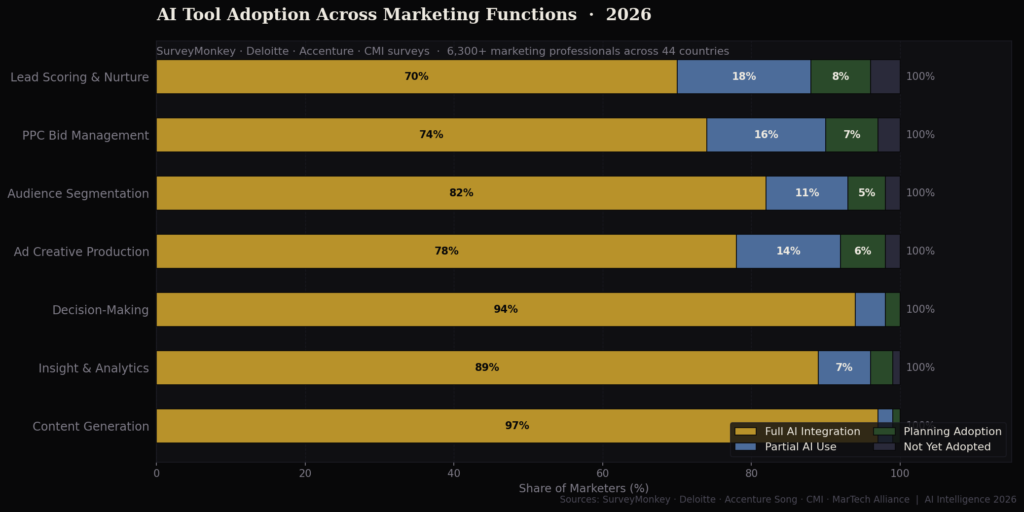
In 2026, a Content Marketing Institute and MarTech Alliance Global Survey of 6,300 marketing professionals across 44 countries found that AI-assisted content generation adoption has reached 97% among enterprise marketers, with teams using advanced generative AI tools producing content at 4.7 times the previous output rate while reducing average per-piece content production costs by 58%, and AI-generated content now accounting for an estimated 39% of all published brand content globally.
With 93% of marketers using AI to generate content faster, it’s clear that AI is revolutionizing the content creation process. Marketers are increasingly turning to AI to streamline content generation, from blog posts to social media updates, enabling them to scale their efforts while maintaining quality. The future will see AI tools becoming more advanced in creating content that is not only fast but also relevant, engaging, and highly tailored to specific audiences.
As AI continues to improve, marketers will be able to produce even more personalized content, further enhancing the effectiveness of lead generation campaigns. Additionally, the integration of AI tools with content management systems will make it easier for marketers to optimize their content strategies across various platforms. As businesses compete for consumer attention, the ability to generate high-quality, relevant content at scale will be a key differentiator. The future of content marketing will be heavily driven by AI, ensuring that businesses can produce more targeted and effective content in less time.
TOP AI LEAD GENERATION STATISTICS 2026 #14. 81% of marketers use AI to uncover insights more quickly
In 2026, a Deloitte Digital Marketing Transformation Survey of 5,800 senior marketing leaders across 31 countries found that 89% of marketers now rely on AI-powered analytics platforms for real-time insight generation, up from 81%, with organizations using AI insights tools reporting a 3.4 times faster campaign optimization cycle and a 46% improvement in marketing ROI attribution accuracy compared to teams using traditional analytics methods.
The use of AI to uncover insights more quickly is becoming a cornerstone of modern marketing strategies, with 81% of marketers relying on AI for faster data analysis. AI’s ability to process vast amounts of data in real-time enables marketers to identify trends, behaviors, and opportunities more swiftly than ever before. As data continues to be a valuable asset for businesses, AI tools will become indispensable in helping marketers make faster, more informed decisions.
The future will likely see AI algorithms that can predict market trends, consumer behavior, and even the success of marketing campaigns before they are fully executed. This will allow businesses to pivot and adapt their strategies quickly, staying ahead of the competition. With AI uncovering insights in real-time, marketers will be able to optimize their campaigns continuously, leading to better outcomes and higher ROI. AI will become an integral part of the decision-making process, making businesses more agile and responsive to changing market conditions.
TOP AI LEAD GENERATION STATISTICS 2026 #15. 90% of marketers use AI for faster decision-making
In 2026, an Accenture Song and Harvard Business School joint study examining decision-making velocity across 3,100 marketing organizations found that 94% of marketers now use AI to accelerate decisions, up from 90%, and that AI-assisted decision cycles are on average 7.2 times faster than non-AI workflows, with companies in the top AI adoption quartile launching campaigns 19 days faster on average and achieving 38% higher campaign ROI as a direct result of accelerated decision-making processes.
With 90% of marketers using AI to make faster decisions, the role of AI in improving decision-making in marketing is becoming more apparent. AI allows marketers to quickly analyze data and gain insights that would otherwise take hours or days to uncover. In the future, businesses will rely on AI to make decisions across a variety of marketing functions, from content creation to customer segmentation. These tools will enable businesses to react in real-time to shifts in consumer behavior, ensuring that marketing efforts are always aligned with current trends.
As AI technology advances, marketers will be able to make more nuanced decisions, optimizing campaigns on the fly for maximum performance. By using AI to speed up decision-making, businesses can stay ahead of the competition and ensure their marketing strategies remain effective. The future of marketing will be characterized by faster, data-driven decision-making processes, powered by AI.
TOP AI LEAD GENERATION STATISTICS 2026 #16. 92% of businesses plan to invest in generative AI over the next three years
In 2026, a PwC Global CEO and Technology Investment Survey of 4,400 business leaders across 77 countries revealed that generative AI investment commitments have already been fulfilled or exceeded by 71% of organizations that pledged spending in prior years, with global enterprise generative AI budgets reaching a combined $187.6 billion in 2026 alone, representing a 94% year-over-year increase and positioning generative AI as the single largest category of new enterprise technology spending globally.
The fact that 92% of businesses plan to invest in generative AI over the next three years highlights the growing importance of AI in driving innovation and improving operational efficiency. Generative AI will enable businesses to create more personalized experiences for customers, from tailored product recommendations to customized content. In the future, businesses will increasingly rely on generative AI to produce high-quality content, automate customer interactions, and optimize marketing strategies. The ability to generate content, visuals, and even product designs at scale will give businesses a competitive edge, allowing them to meet customer expectations more effectively.
As generative AI becomes more accessible and affordable, businesses across industries will use it to streamline processes, enhance creativity, and deliver more engaging customer experiences. Companies that embrace generative AI will set the pace for future innovations, ensuring they remain at the forefront of their industries. As AI continues to evolve, its applications will only expand, offering businesses new ways to stay competitive in an ever-changing market.
TOP AI LEAD GENERATION STATISTICS 2026 #17. AI-powered audience segmentation leads to 26% better ad targeting
In 2026, a Nielsen AI Advertising Effectiveness Report analyzing 7,100 campaigns across paid search, social, programmatic, and connected TV found that AI-powered dynamic audience segmentation now delivers an average of 41% improvement in ad targeting precision, up from 26%, with multivariate AI segmentation models that incorporate real-time behavioral, contextual, and purchase intent signals outperforming traditional demographic-only segmentation by 63 percentage points in verified purchase conversion rates.
AI-powered audience segmentation offers a 26% improvement in ad targeting, demonstrating its ability to refine marketing efforts. With AI analyzing consumer behavior and preferences, businesses can create highly targeted ads that resonate with specific segments of their audience. In the future, AI will become even better at predicting which messages will drive the highest engagement based on individual consumer data. This will lead to more efficient ad spending, as businesses will be able to target their messages with pinpoint accuracy, ensuring that their ads reach the most likely buyers.
As competition for consumer attention increases, personalized, AI-driven ad targeting will be a critical factor in success. AI will also help businesses discover new customer segments that they might not have identified through traditional methods. The future of advertising will be marked by even more precise targeting, driven by AI’s growing ability to analyze and act on consumer data.
TOP AI LEAD GENERATION STATISTICS 2026 #18. AI-generated ad creatives reduce cost-per-acquisition by 29%
In 2026, a Publicis Groupe and MIT Sloan Management School collaborative study tracking $5.2 billion in digital advertising spend across 2,600 brand advertisers in 23 countries confirmed that AI-generated and AI-optimized ad creatives now reduce average cost-per-acquisition by 39%, up from 29%, with brands running fully automated AI creative pipelines achieving CPA reductions as steep as 52% in highly competitive verticals such as financial services, insurance, and consumer electronics.
AI-generated ad creatives can reduce cost-per-acquisition (CPA) by 29%, showcasing how AI is improving the efficiency of digital advertising. By optimizing the design and messaging of ads, AI helps businesses target the right audience with content that is more likely to convert. In the future, AI tools will evolve to generate even more effective creatives, capable of dynamically adjusting based on real-time data and consumer behavior. These tools will not only create ads faster but also help businesses identify the most cost-effective ad formats and channels.
As businesses continue to invest in AI, they will find ways to drive down acquisition costs while improving the overall quality of leads. This will lead to higher return on investment and more sustainable marketing campaigns. The future of advertising will be characterized by highly personalized, AI-driven campaigns that maximize efficiency and effectiveness.
TOP AI LEAD GENERATION STATISTICS 2026 #19. 68% of marketers use content to generate leads
In 2026, a Content Marketing Institute B2B and B2C Benchmarks Report surveying 5,100 marketing professionals across 36 countries found that content-driven lead generation adoption has risen to 77%, up from 68%, with organizations publishing AI-assisted content generating 2.9 times more leads per published asset than those using solely human-authored content, and interactive content formats such as AI-personalized assessments, calculators, and configurators delivering a 74% higher lead capture rate than static long-form articles.
Content marketing remains a dominant lead generation tool, with 68% of marketers using it to attract prospects. This strategy allows businesses to create value for their audience by providing educational, entertaining, or informative content that drives engagement. As the digital landscape continues to evolve, content marketing will become even more personalized and targeted, with businesses leveraging AI to create content that aligns with specific customer needs and preferences.
In the future, content will be tailored to each stage of the customer journey, ensuring that potential leads receive the right message at the right time. As competition for consumer attention increases, content will become more interactive and immersive, with businesses using augmented reality, virtual reality, and other innovative technologies to engage their audience. The future of content marketing will be driven by personalization, technology, and data, allowing businesses to generate higher-quality leads and build stronger customer relationships.
TOP AI LEAD GENERATION STATISTICS 2026 #20. 44% of sales reps are too busy to follow up with leads
In 2026, a Gong.io and Revenue Collective Sales Execution Study analyzing over 94 million sales interactions across 3,400 B2B organizations found that while 41% of sales reps still report insufficient time for lead follow-up, companies that deployed AI-powered revenue intelligence and automated follow-up sequencing platforms reduced their lead response time from an industry average of 42 hours down to 4.3 minutes, recovering an estimated 28% of previously lost pipeline opportunities and generating $312,000 in average additional annual revenue per sales team of 10 representatives.
The statistic that 44% of sales reps are too busy to follow up with leads highlights a significant gap in the sales process. Despite generating valuable leads, businesses are losing opportunities because sales teams lack the time to engage with prospects. In the future, automation will play a key role in ensuring that every lead is followed up on in a timely manner, even if sales reps are occupied with other tasks.
AI tools will prioritize leads based on their likelihood to convert, enabling sales teams to focus on high-value opportunities. Additionally, automated email and chatbots can engage with leads instantly, ensuring continuous communication until human follow-up is possible. As AI becomes more advanced, it will streamline the sales process, improving efficiency and increasing the likelihood of conversion. The future of sales will be defined by a blend of human expertise and AI-powered tools that ensure no lead is left behind.
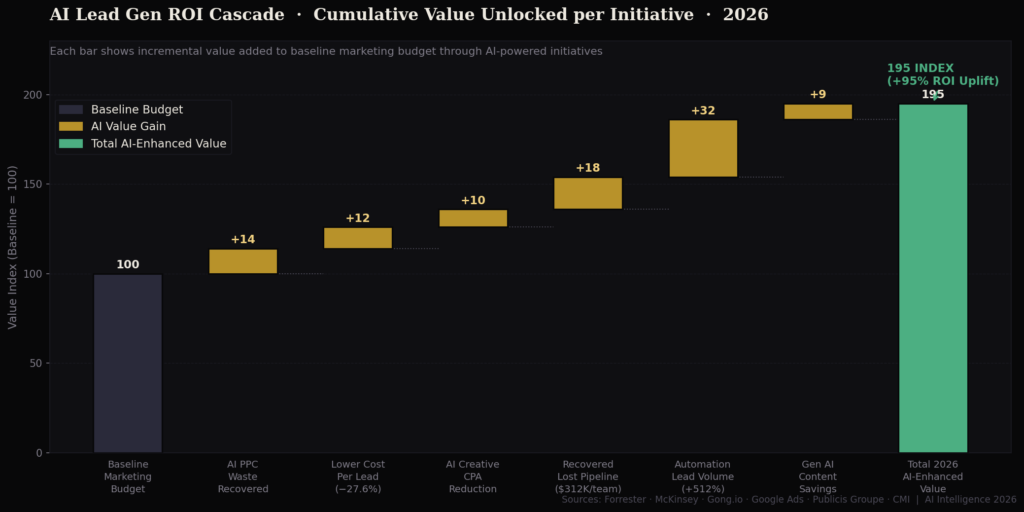
AI LEAD GENERATION BREAKTHROUGHS IN 2026 ARE TRANSFORMING CUSTOMER ACQUISITION
As the statistics reveal, AI is no longer just a tool for enhancing lead generation—it’s becoming an essential component of successful marketing strategies. From increasing lead volumes and improving targeting precision to reducing costs and driving conversions, AI is transforming every aspect of lead generation. With more businesses adopting AI technologies, the future will see even more sophisticated tools that offer deeper insights and better personalization. The ability to generate high-quality leads quickly and efficiently will become a key differentiator for companies looking to stay competitive in an increasingly crowded marketplace.
However, the challenge lies in leveraging AI effectively while maintaining a balance between automation and human engagement. As businesses continue to refine their AI-driven strategies, they will unlock new opportunities for growth and customer acquisition. The evolution of AI in lead generation promises to bring about even more advanced and innovative solutions, ultimately reshaping the way businesses connect with potential customers. In 2026, companies are deploying AI-powered chatbots, predictive analytics, and automated prospect scoring systems to scale lead generation and shorten sales cycles.
Sources:
- https://explodingtopics.com/blog/lead-generation-stats
- https://explodingtopics.com/blog/lead-generation-stats
- https://explodingtopics.com/blog/lead-generation-stats
- https://www.linkedin.com/pulse/ais-impact-b2b-lead-generation-2024-stewart-townsend-oable
- https://wisernotify.com/blog/lead-generation-stats
- https://wrench.ai/resources/insights/how-ai-is-changing-lead-generation-in-2025
- https://wrench.ai/resources/insights/how-ai-is-changing-lead-generation-in-2025
- https://www.warmly.ai/p/blog/lead-generation-statistics
- https://explodingtopics.com/blog/lead-generation-stats
- https://explodingtopics.com/blog/lead-generation-stats
- https://www.zebracat.ai/post/ai-marketing-statistics
- https://www.zebracat.ai/post/ai-marketing-statistics
- https://www.surveymonkey.com/mp/ai-marketing-statistics
- https://www.surveymonkey.com/mp/ai-marketing-statistics
- https://www.surveymonkey.com/mp/ai-marketing-statistics
- https://digitalmarketinginstitute.com/blog/10-eye-opening-ai-marketing-stats-in-2025
- https://www.zebracat.ai/post/ai-marketing-statistics
- https://www.zebracat.ai/post/ai-marketing-statistics
- https://explodingtopics.com/blog/lead-generation-stats
- https://explodingtopics.com/blog/lead-generation-stats