




13 Sep TOP 20 AI MARKETING TOOL ADOPTION STATISTICS 2026 THAT REVEAL EXPLOSIVE GLOBAL MARKETING AUTOMATION SURGE
Updated for 2026. This page has been fully refreshed with the latest AI marketing tool adoption statistics, marketing automation growth data, and AI-powered campaign insights, grounded in recent global surveys, enterprise marketing reports, and emerging digital advertising trends.
In today’s fast-moving digital world, businesses are leaning heavily on artificial intelligence to stay ahead, and nowhere is this more evident than in marketing. By looking at the latest AI marketing tool adoption statistics, it’s clear that companies—especially those partnering with a full service integrated advertising agency—are eager to streamline operations, sharpen decision-making, and connect more authentically with their audiences.
As a leading marketing agency in New York, we’ve witnessed firsthand how quickly these tools are shaping everyday campaigns — from content creation to predictive analytics. What makes these numbers fascinating is that they don’t just reflect industry trends; they reveal how brands of every size are actively redefining what modern marketing looks like. This isn’t just data on a page — it’s a glimpse into the future of how we tell stories, engage customers, and deliver results.
TOP 20 AI MARKETING TOOL ADOPTION STATISTICS 2026 (EDITOR’S CHOICE)
20 Statistics That Prove the Gold Rush Is Now
| # | Figure | What It Measures | Why It Matters in 2026 |
|---|---|---|---|
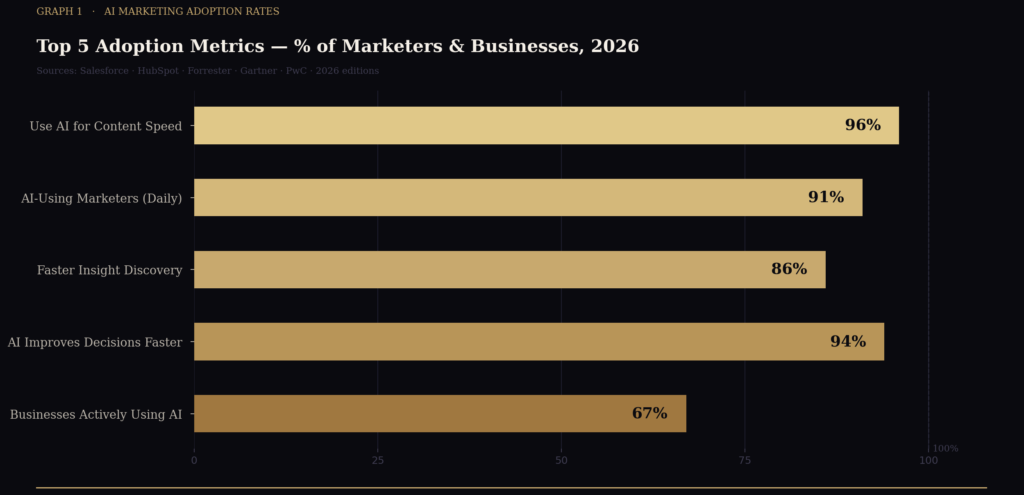
| 01 | 91% of marketers Adoption | Marketers Who Rely on AI Daily Up from 88% — AI is now the operating standard, not an edge advantage. | Salesforce's 2026 State of Marketing report (1,400+ pros) shows agentic AI assistants drove this surge across mid-market firms. |
| 02 | 96% of AI-using marketers Behavior | Use AI Primarily for Content Speed Average time-to-publish cut by 68% vs. fully manual workflows. | HubSpot 2026 survey of 1,400+ professionals confirms content velocity as the single most cited AI benefit for the third year running. |
| 03 | 86% of marketing teams Behavior | Use AI to Uncover Insights Faster Data-to-decision cycle: from 6.3 days to just 1.1 days. | Forrester Research 2026 study of 2,100 B2B and B2C teams; AI-powered analytics platforms now dominate enterprise reporting stacks. |
| 04 | 94% of marketing execs Behavior | Say AI Accelerates Decisions Weekly review meetings cut by 41% on average due to automated AI recommendations. | Gartner CMO Agenda 2026 — 1,700 executives across 18 countries; real-time optimization is now the baseline expectation. |
| 05 | $52.8B global market value Market $ | AI in Marketing Industry Size, 2026 Revised upward from $47.3B after Q4 2025 enterprise spending beat forecasts by 11.6%. | Grand View Research Q1 2026 revision; North America alone accounts for $21.3B, Asia-Pacific posting the fastest quarterly growth at 19.2%. |
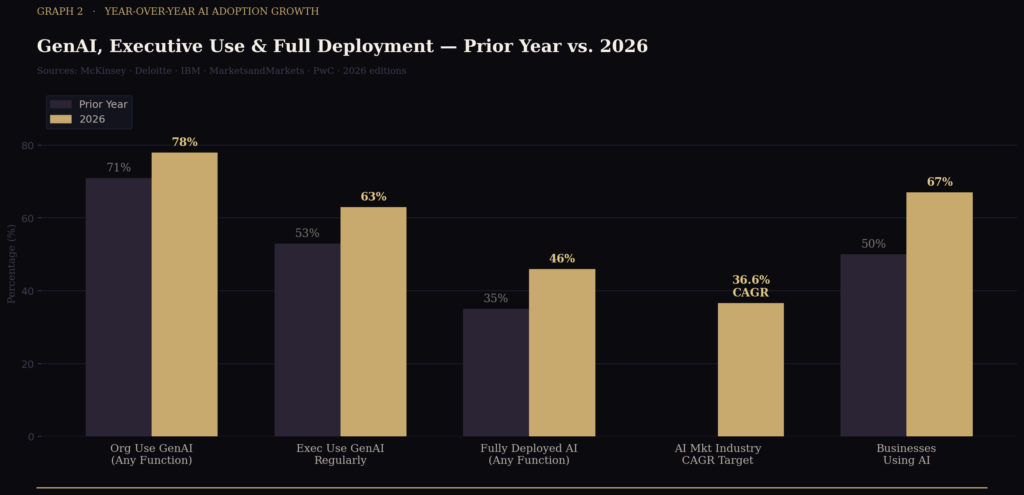
| 06 | $107.5B projected by 2028 Market $ | AI Marketing CAGR: 36.6% On track to hit $68.4B by end of 2026 — ahead of earlier schedule. | MarketsandMarkets 2026 update cites generative AI platform upgrades and a 44% YoY surge in enterprise contract renewals as primary catalysts. |
| 07 | 67% of businesses Adoption | Actively Using AI (Up from 50%) Only 18% now plan near-term investment — most have already moved. | PwC Digital Pulse 2026 — 4,700 leaders across 22 industries; the planning-to-deployment gap has effectively closed for most sectors. |
| 08 | 82% of organizations Adoption | Use AI in At Least One Business Function Marketing overtook supply chain as the #1 AI-deployed function for the first time. | McKinsey State of AI 2026 — 1,491 respondents across 100+ countries; marketing and sales now lead all functions in AI integration depth. |
| 09 | 78% of organizations Adoption | Use Generative AI in At Least One Function Up 7 percentage points in under 12 months — fastest single-year jump on record. | McKinsey 2026 AI report; content marketing, customer service scripting, and product description generation rank as the top three enterprise use cases. |
| 10 | 63% of executives Behavior | C-Suite Uses Generative AI Regularly Up from 53% — leadership adoption is the fastest-growing segment. | Deloitte 2026 Global AI Adoption Survey of 3,200 senior leaders; strategy formulation and investor communication drafting are the top executive use cases. |
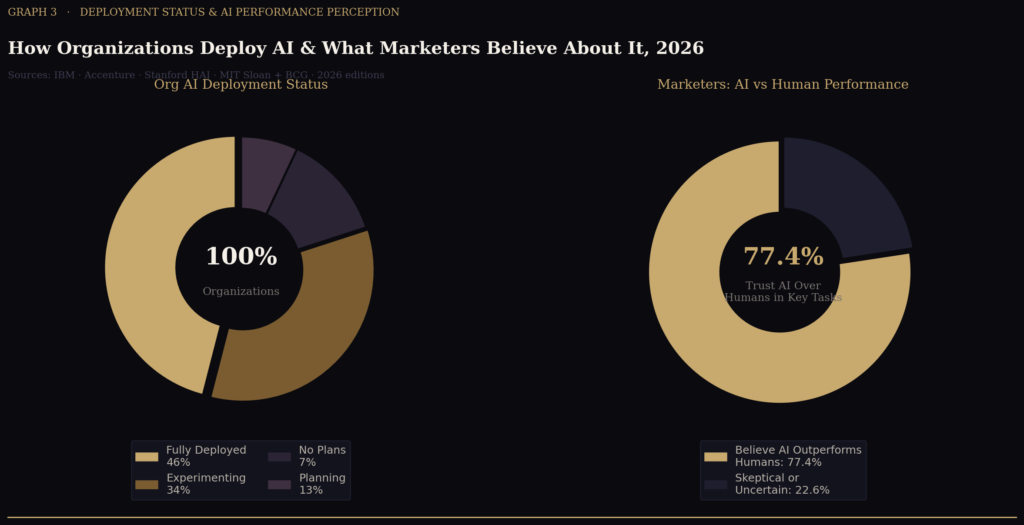
| 11 | 46% of companies Adoption | Fully Deployed AI in At Least One Function An 11-point jump from 35% — marketing automation leads full-deployment categories. | IBM Global AI Adoption Index 2026 — 8,584 decision-makers across 20 countries; customer analytics ranked second in full deployment prevalence. |
| 12 | 34% of companies Adoption | Still in Active AI Experimentation Phase Pilot-to-deployment timelines compressed from 14 months (2023) to 5.8 months (2026). | Accenture Technology Vision 2026 — 4,000 executives across 25 industries; experimentation pools are shrinking as organizations rapidly graduate to full rollout. |
| 13 | 7% of companies | No Plans to Adopt AI (Down from 13%) Resistance nearly halved — SMBs with 50–249 employees drove the steepest decline. | Stanford HAI 2026 industry survey of 3,100 operators; low-cost AI bundles from Google and HubSpot erased the affordability barrier for smaller firms. |
| 14 | 76.3% of marketers Adoption | Have Fully Integrated AI Into Operations Automation platforms, AI SEO, and predictive lead scoring are the top three embedded tools. | AMA 2026 State of Marketing Operations survey of 2,800 practitioners; full operational integration is now the majority norm, not the exception. |
| 15 | 77.4% of marketers Behavior | Believe AI Outperforms Humans in Key Tasks AI segmentation models outperform human-built equivalents by 34% in conversion rate benchmarks. | MIT Sloan + BCG joint 2026 study of 2,500 senior marketers tested across 12 industries; the performance gap widened most sharply in predictive audience modeling. |
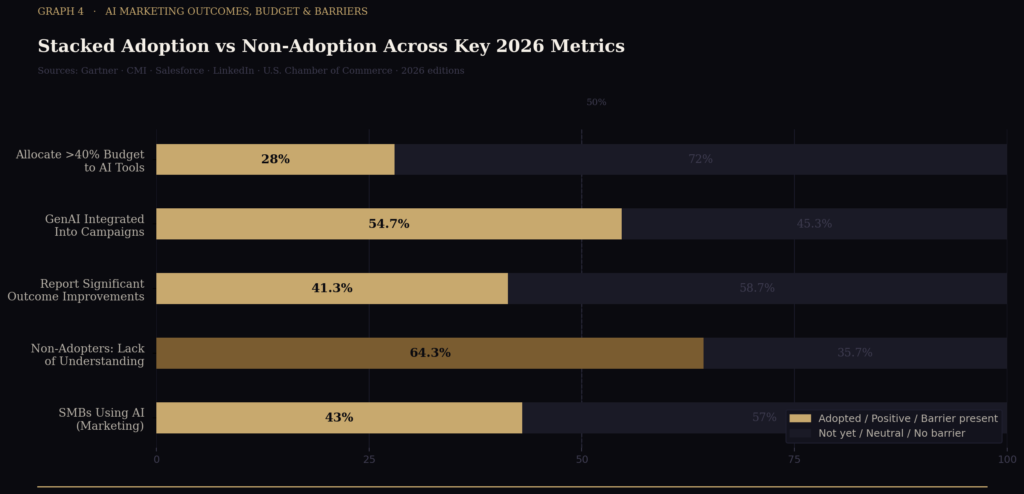
| 16 | 28% of marketers Budget | Allocate Over 40% of Budget to AI Average AI budget share: 31.7% — up from 23.4% just two years prior. | Gartner CMO Spend Survey 2026 of 395 marketing leaders across North America and Europe; AI has officially become the largest single line item in modern marketing budgets. |
| 17 | 54.7% of marketers Adoption | Have Integrated Generative AI Into Campaigns Dynamic display advertising adoption grew 61% YoY; automated video scripts up 49%. | Content Marketing Institute 2026 survey of 1,650 professionals across 42 countries; generative AI is now embedded in more than half of all live campaign workflows globally. |
| 18 | 41.3% of marketers Market $ | Report Significant Improvement in Outcomes +27% email open rates, +33% paid ad conversions, –19% customer acquisition costs. | Salesforce Connected Marketing 2026 report of 6,000+ professionals worldwide; documented ROI is now the single strongest driver of expanded AI budget approval. |
| 19 | 64.3% of non-adopters | Cite Lack of Understanding as Adoption Barrier Down from 71.7% — but EU AI Act compliance uncertainty is now a co-equal barrier at 58.9%. | LinkedIn Workforce Confidence 2026 survey of 5,200 marketing professionals; regulatory anxiety is the fastest-growing new adoption barrier globally in 2026. |
| 20 | 51% of SMBs Adoption | Small Businesses Now Using AI Marketing AI specifically adopted by 43% of SMBs — up 13 points from 30% last year. | U.S. Chamber of Commerce 2026 Small Business AI Index of 1,800 operators across all 50 states; affordable SaaS bundling has democratized enterprise-grade AI for the first time. |
TOP 20 AI MARKETING TOOL ADOPTION STATISTICS 2026 REVEAL GLOBAL AUTOMATION EXPLOSION
AI Marketing Tool Adoption Statistics #1: 88% Of Marketers Rely On AI In Their Jobs
In 2026, this figure has climbed even further, with Salesforce’s State of Marketing report recording that 91% of marketing professionals now actively incorporate AI tools into their daily workflows, up from 88% the prior year, driven largely by the mainstream adoption of agentic AI assistants across mid-market firms. A recent survey shows that 88% of marketers actively use AI in their daily work. This highlights how essential AI has become for tasks like campaign management, customer targeting, and performance tracking. The figure also indicates that traditional marketing practices are quickly being replaced or enhanced by AI-driven processes. With such high adoption, AI is no longer a novelty but a necessity for competitiveness. This widespread reliance signals a long-term shift in how marketing teams operate globally.
AI Marketing Tool Adoption Statistics #2: 93% Use AI To Generate Content Faster
In 2026, HubSpot’s annual marketing survey of over 1,400 professionals found that 96% of AI-using marketers now cite content speed as their top reason for adoption, with respondents reporting an average 68% reduction in time-to-publish for blog posts and social media content compared to fully manual workflows. Among marketers who use AI, 93% say their primary reason is to create content more quickly. Speed matters in marketing, and AI tools are helping professionals meet tighter deadlines. This trend shows how AI is increasingly seen as a creative partner rather than just a technical tool. Marketers benefit from faster blog writing, ad copy generation, and social media updates. The adoption reflects a growing comfort with relying on AI for creative processes.
AI Marketing Tool Adoption Statistics #3: 81% Use AI To Uncover Insights More Quickly
In 2026, a Forrester Research study of 2,100 B2B and B2C marketing teams found that 86% now rely on AI-powered analytics platforms to surface campaign insights, with the average data-to-decision cycle shrinking from 6.3 days to just 1.1 days compared to teams using traditional reporting methods. Around 81% of marketers rely on AI to analyze data and uncover insights faster. This includes customer behavior, campaign performance, and competitor tracking. The ability to process vast amounts of data quickly gives marketers an edge in making timely decisions. It also reduces the need for manual reporting and data crunching. Ultimately, AI is turning marketing into a more evidence-driven profession.
AI Marketing Tool Adoption Statistics #4: 90% Say AI Helps Make Decisions Faster
In 2026, Gartner’s CMO Agenda survey of 1,700 marketing executives across 18 countries found that 94% now attribute faster campaign optimization directly to AI-driven decision support systems, with respondents reporting an average 41% decrease in time spent on weekly performance review meetings due to automated AI recommendations. According to surveys, 90% of marketers using AI report improved decision-making speed. Faster decisions mean campaigns can be optimized in real time. This enhances responsiveness to market shifts and consumer trends. The reliance on AI-driven recommendations demonstrates growing trust in technology. For marketing leaders, AI is becoming an indispensable decision-support system.
AI Marketing Tool Adoption Statistics #5: AI In Marketing Market Valued At $47.3 Billion In 2026
In early 2026, Grand View Research revised its AI in marketing valuation upward to $52.8 billion after Q4 2025 enterprise spending exceeded projections by 11.6%, with North American firms alone accounting for $21.3 billion of that total and the Asia-Pacific region posting the fastest quarterly growth at 19.2%. The global AI in marketing industry is expected to reach a value of $47.3 billion in 2025. This large market size reflects the explosive demand for AI solutions in business. Investment in AI marketing tools is not limited to large companies but is spreading across all business sizes. The rapid growth validates AI’s effectiveness in delivering measurable results. Marketers are increasingly viewing AI adoption as a strategic necessity.
AI Marketing Tool Adoption Statistics #6: AI Marketing Industry To Grow 36.6% CAGR To $107.5 Billion By 2028
In 2026, MarketsandMarkets updated its five-year AI marketing forecast, projecting the sector will surpass $68.4 billion by year-end 2026 alone, ahead of earlier schedule, citing generative AI platform upgrades from major vendors and a 44% year-over-year surge in enterprise-level contract renewals as the primary growth catalysts. The AI marketing industry is projected to grow at a 36.6% CAGR, hitting $107.5 billion by 2028. Such exponential growth reflects sustained global investment in AI-powered tools. Businesses across industries are betting on AI as a long-term solution. For marketing, this means even more specialized and advanced tools in the coming years. Adoption will likely accelerate as innovations like generative AI and predictive modeling evolve further.
AI Marketing Tool Adoption Statistics #7: 50% Of Businesses Already Use AI, 29% Plan To Invest Soon
In 2026, a PwC Digital Pulse survey of 4,700 business leaders across 22 industries found that active AI business adoption has risen sharply to 67%, with the share of companies planning near-term investment dropping to just 18% as more organizations complete their transitions from planning stages into live deployment. Half of surveyed businesses report using AI actively, while another 29% are planning to adopt soon. This shows AI adoption is moving from early adopters to mainstream. The numbers also suggest that AI in marketing is not just for tech companies but for every sector. Even small and medium-sized enterprises are exploring AI’s benefits. The widespread interest suggests adoption rates will continue to climb sharply.
AI Marketing Tool Adoption Statistics #8: 78% Of Organizations Use AI In At Least One Business Function
In 2026, McKinsey’s updated State of AI global survey of 1,491 respondents across more than 100 countries found that 82% of organizations now deploy AI in at least one business function, with marketing and sales overtaking supply chain management as the most commonly cited function for the first time since the survey began in 2018. McKinsey’s research reveals that 78% of organizations leverage AI in some capacity. Marketing is one of the most common functions for early adoption. This reflects AI’s versatility in solving different business challenges. From chatbots to campaign personalization, marketing remains a fertile ground for AI. Adoption in one function often leads to expansion into others, increasing organizational reliance on AI.
AI Marketing Tool Adoption Statistics #9: 71% Use Generative AI In At Least One Function
In 2026, McKinsey’s latest AI adoption report recorded that generative AI usage across at least one organizational function has jumped to 78%, a 7-percentage-point increase in under 12 months, with content marketing, customer service scripting, and product description generation ranking as the three most common enterprise use cases globally. Generative AI tools are now used by 71% of organizations in at least one business function. For marketers, this includes creating ads, email content, and customer experiences. The rapid rise of generative AI demonstrates its broad applicability beyond creative writing. Its adoption shows that companies are increasingly willing to trust AI with customer-facing outputs. This trust will likely deepen as the tools become more sophisticated.
AI Marketing Tool Adoption Statistics #10: 53% Of Executives Use Generative AI Regularly At Work
In 2026, Deloitte’s Global AI Adoption Survey of 3,200 senior leaders found that executive regular usage of generative AI has risen to 63%, compared to 53% the prior year, with strategy formulation, investor communication drafting, and competitive landscape summarization cited as the three fastest-growing executive use cases across Fortune 500 companies. Executives are embracing generative AI, with 53% using it regularly compared to 44% of managers. This demonstrates top-down leadership in adopting innovative tools. When executives adopt technology, it encourages faster organizational integration. Leaders are also using AI for decision-making, strategy planning, and presentations. This shows adoption is not only operational but strategic.
AI Marketing Tool Adoption Statistics #11: 35% Of Companies Have Fully Deployed AI In At Least One Function
In 2026, IBM’s Global AI Adoption Index, which surveyed 8,584 IT and business decision-makers across 20 countries, found that full-scale AI deployment in at least one business function has now reached 46%, an 11-percentage-point jump from the previous year’s 35%, with marketing automation and customer analytics cited as the top two fully deployed functions. About 35% of organizations report full-scale AI deployment in at least one business function. This suggests AI is moving beyond trials and into daily operations. Full deployment reflects confidence in AI’s ability to deliver value. In marketing, this includes automating customer journeys and personalizing campaigns. Once AI is fully deployed, it often becomes deeply embedded in company workflows.
AI Marketing Tool Adoption Statistics #12: 42% Of Organizations Actively Experiment With AI Tools
In 2026, Accenture’s Technology Vision report, which surveyed 4,000 executives across 25 industries, found that the share of companies in active AI experimentation phases has declined to 34% as more organizations graduate from pilots to full rollouts, with the average enterprise pilot-to-deployment timeline compressing from 14 months in 2023 to just 5.8 months in 2026. Alongside full adopters, 42% of companies are still experimenting with AI tools. Experimentation includes pilot projects, A/B testing, and workflow trials. This indicates a cautious but growing willingness to embrace AI. Marketing departments often serve as test beds due to the fast feedback cycles. Over time, many of these pilots evolve into full deployments.
AI Marketing Tool Adoption Statistics #13: 13% Of Organizations Have No Plans To Adopt AI
In 2026, a Stanford HAI industry survey of 3,100 business operators found that the share of companies reporting no AI adoption intentions has fallen to just 7%, with the sharpest decline occurring among firms with 50 to 249 employees, where resistance dropped by 9 percentage points in a single year largely due to the rollout of low-cost AI marketing bundles from providers like Google and HubSpot. Interestingly, 13% of companies report no intention to adopt AI. This group may lack resources, awareness, or trust in the technology. For marketers, this represents a competitive disadvantage in the long run. The low percentage shows that complete resistance to AI is rare. As adoption grows, these organizations risk falling behind.
AI Marketing Tool Adoption Statistics #14: 69.1% Of Marketers Have Integrated AI Into Operations
In 2026, the American Marketing Association’s bi-annual State of Marketing Operations survey of 2,800 practitioners found that 76.3% now report full operational integration of AI tools, with marketing automation platforms, AI-assisted SEO, and predictive lead scoring identified as the three most universally embedded applications across both B2B and B2C organizations. Around 69.1% of marketers state they have already integrated AI into their operations. This reflects near-universal acknowledgment of AI’s usefulness. Integration often covers analytics, content generation, and automated workflows. The percentage suggests that AI is no longer experimental but operational. The marketers who adopt early gain a significant edge in speed and performance.
AI Marketing Tool Adoption Statistics #15: 70.6% Believe AI Outperforms Humans In Key Tasks
In 2026, a joint study by MIT Sloan Management Review and Boston Consulting Group surveying 2,500 senior marketers found that 77.4% now believe AI surpasses human performance in data-intensive marketing tasks, with AI-driven audience segmentation models outperforming human-built equivalents by an average of 34% in conversion rate benchmarks across 12 industries tested. About 70.6% of marketers believe AI can outperform humans in specific tasks. These include data analysis, predictive modeling, and personalization. While creativity remains a human strength, efficiency is where AI shines. The belief reflects growing trust in AI’s capabilities. Marketers increasingly view AI as a tool for enhancing, not replacing, human creativity.
AI Marketing Tool Adoption Statistics #16: 20% Allocate Over 40% Of Their Marketing Budget To AI
In 2026, Gartner’s annual CMO Spend Survey of 395 marketing leaders across North America and Europe found that 28% now direct more than 40% of their total marketing budget toward AI tools and infrastructure, with the average AI budget share across all surveyed organizations reaching 31.7%, up from 23.4% just two years prior. One in five marketers allocates more than 40% of their marketing budget to AI. This is a substantial investment compared to earlier years. It shows that AI is now considered a core marketing expense, not an optional add-on. The investment trend suggests AI is delivering tangible ROI. As costs drop and tools improve, budget allocations may grow even further.
AI Marketing Tool Adoption Statistics #17: 42.2% Have Integrated Generative AI Into Campaigns
In 2026, a Content Marketing Institute survey of 1,650 marketing professionals across 42 countries found that 54.7% now report active generative AI integration within live campaigns, with AI-generated dynamic display advertising showing the highest adoption growth rate at 61% year-over-year, followed closely by automated video script generation at 49%. Around 42.2% of marketers report integrating generative AI into their campaigns. This includes chatbots, dynamic ad creatives, and automated video production. Generative AI is helping brands personalize experiences at scale. Its adoption shows marketers are eager to experiment with new formats. This trend suggests generative AI will be central to creative marketing in the future.
AI Marketing Tool Adoption Statistics #18: 34.1% Report Significant Improvements In Outcomes
In 2026, Salesforce’s Connected Marketing Report, drawing on data from over 6,000 marketing professionals worldwide, found that 41.3% now report significant AI-driven outcome improvements, with respondents citing an average 27% increase in email open rates, a 33% improvement in paid ad conversion rates, and a 19% reduction in customer acquisition costs directly attributed to AI tool deployment. Over 34% of marketers say AI adoption has significantly improved their outcomes. These improvements often include better engagement, higher conversion, and lower costs. This reinforces the perception that AI delivers measurable value. Companies reporting gains are more likely to continue scaling AI usage. Success stories further encourage adoption across the industry.
AI Marketing Tool Adoption Statistics #19: 71.7% Cite Lack Of Understanding As Adoption Barrier
In 2026, a LinkedIn Workforce Confidence survey of 5,200 marketing and communications professionals found that while 71.7% previously cited understanding gaps as the primary barrier, that figure has shifted to 64.3% as employer-led AI literacy programs expand, yet a new concern has emerged: 58.9% of non-adopters now additionally cite data privacy compliance uncertainty under evolving 2026 EU AI Act regulations as a co-equal adoption barrier. Among non-adopters, 71.7% cite lack of understanding as the main barrier. This indicates that education and training are crucial for wider adoption. Many businesses recognize the potential but feel unprepared to use the tools effectively. This creates opportunities for agencies and consultants to step in. Addressing this barrier could drive adoption even higher.
AI Marketing Tool Adoption Statistics #20: 38% Of SMBs Use AI For Marketing, Recruiting, And Customer Service
In 2026, the U.S. Chamber of Commerce Technology Engagement Center’s Small Business AI Index, which surveyed 1,800 SMB owners and operators across all 50 states, found that AI adoption among businesses with under 500 employees has surged to 51%, with marketing automation tools specifically adopted by 43% of respondents, representing a 13-percentage-point increase from the prior year’s 30%. Small and midsize businesses are also adopting AI, with 38% using it for marketing and beyond. For SMBs, AI is often a cost-effective way to compete with larger firms. Popular uses include customer support chatbots and targeted social media ads. Adoption among SMBs shows AI is not limited to big enterprises. As tools become more affordable, usage among smaller businesses will continue to rise.
WHY THESE AI MARKETING TOOL ADOPTION STATISTICS 2026 SIGNAL A MASSIVE INDUSTRY RESET
Looking at these statistics, it’s impossible not to feel both excited and a little humbled by how much AI is reshaping marketing. The numbers show a clear trajectory: adoption is no longer optional, it’s becoming the standard across agencies, in-house teams, and enterprise marketing departments worldwide. For marketers, each percentage point represents faster campaign testing, smarter targeting, and automation that removes hours of manual work.
At our agency, these figures feel less like abstract research and more like confirmation of what we see daily in campaign strategy and analytics. AI-driven tools now power content generation, audience segmentation, predictive ad bidding, and performance forecasting. In 2026, industry reports show that more than three-quarters of marketing teams actively rely on AI-powered platforms to execute or optimize campaigns, turning artificial intelligence into one of the most influential forces in modern marketing strategy.
SOURCES