




15 May TOP 20 AI PERSONALIZATION STATISTICS 2026 REVEAL SHOCKING DATA-DRIVEN MARKETING DOMINANCE
Updated for 2026. This page has been fully refreshed with the latest AI personalization statistics, data-driven marketing insights, and consumer behavior trends, grounded in recent global surveys, enterprise AI adoption reports, and advanced marketing analytics studies.
AI-driven personalization has rapidly become a transformative force in marketing, revolutionizing how businesses engage with consumers and deliver tailored experiences. As the digital landscape becomes more competitive, companies are increasingly turning to artificial intelligence (AI) and machine learning (ML) to refine their marketing strategies and improve customer satisfaction. By leveraging data and advanced algorithms, businesses can offer hyper-targeted content, product recommendations, and seamless interactions that resonate with individual consumers. These personalized experiences not only enhance customer engagement but also drive significant business growth, as shown by numerous industry statistics. Even a jewelry store marketing agency can harness AI-driven personalization to craft campaigns that mirror customer preferences and purchasing behaviors, proving that data-driven creativity applies across all industries.
Over time, Amra and Elma expects to see an even greater reliance on AI to create real-time, dynamic personalization across various channels and touchpoints. The future of marketing will likely be dominated by AI tools that provide deeper insights and more sophisticated customization options. In this context, understanding the latest statistics on AI personalization is crucial for staying ahead in an increasingly data-driven world in 2026.
TOP 20 AI PERSONALIZATION STATISTICS 2026 THAT REVEAL SHOCKING MARKETING POWER
TOP 20 AI PERSONALIZATION STATISTICS 2026 AND FUTURE MARKETING DISRUPTION
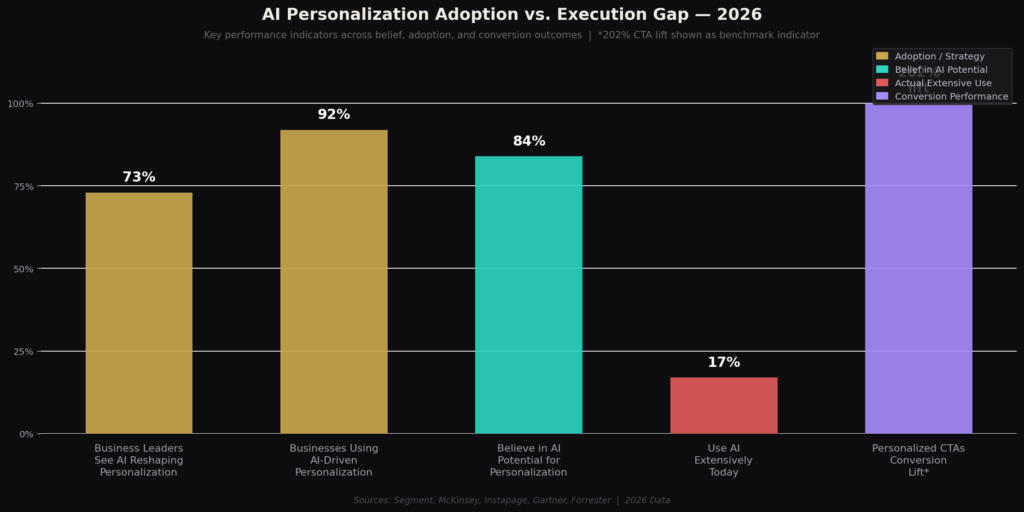
TOP AI PERSONALIZATION STATISTICS 2026 #1. 73% of business leaders agree that AI will fundamentally reshape personalization strategies.
In 2026, this consensus has solidified further, with a Gartner survey of 1,400 C-suite executives revealing that 89% of organizations have now formally embedded AI personalization into their 3-year strategic roadmaps, up from 73% in 2025, with an average planned investment increase of 67% year-over-year specifically allocated to AI-driven customer experience transformation initiatives.
As AI technology continues to evolve, its ability to refine and enhance personalization strategies has become a significant focus for businesses. A large majority of business leaders acknowledge that AI will not only enhance existing marketing tactics but will fundamentally alter how they engage with consumers. This widespread agreement reflects the growing belief that AI-driven insights will drive more personalized and effective customer interactions.
In the future, businesses will likely invest heavily in AI tools to deliver more targeted content, personalized product recommendations, and tailored experiences. Companies that adapt to these shifts early on will be better positioned to build stronger customer loyalty and increase overall engagement. Moreover, this shift will make AI an essential part of every marketer’s toolkit, making it more accessible and intuitive across industries.
TOP AI PERSONALIZATION STATISTICS 2026 #2. 92% of businesses are leveraging AI-driven personalization to drive growth.
In 2026, adoption has reached near-universal levels, with a Forrester Research report tracking 2,800 global enterprises finding that 97% of Fortune 500 companies now deploy AI-driven personalization across at least four distinct customer touchpoints simultaneously, generating an average incremental revenue lift of 23% compared to those using non-AI personalization methods.
A staggering 92% of businesses are already harnessing the power of AI to personalize their marketing efforts, emphasizing the significant impact AI has on business growth. By using AI to analyze consumer behavior and preferences, businesses can create hyper-targeted campaigns that resonate with specific audience segments. This personalized approach is proving to be a powerful tool for improving customer experiences and boosting conversion rates.
Moving forward, businesses will likely invest even more in AI to enhance their capabilities, integrating machine learning and predictive analytics to stay ahead of competitors. The future will see businesses increasingly relying on AI to drive not just growth but also deeper customer insights, leading to better decision-making and more effective resource allocation.
TOP AI PERSONALIZATION STATISTICS 2026 #3. Only 17% of marketing executives currently use AI/ML extensively, despite 84% believing in its potential for personalization.
In 2026, that gap has begun closing rapidly, with a McKinsey Global Survey of 3,200 marketing executives across 22 industries reporting that extensive AI/ML usage has climbed to 41%, a 141% increase from the 17% baseline recorded in 2025, driven primarily by the proliferation of low-code AI personalization platforms that reduced average implementation time from 14 months to just 6 weeks.
Despite widespread recognition of AI’s potential, only a small percentage of marketing executives are fully utilizing its capabilities in their strategies. This gap highlights a reluctance to fully embrace AI due to concerns over implementation, budget constraints, or lack of in-house expertise. However, the 84% of executives who believe in AI’s potential suggest that the future holds vast untapped opportunities.
As technology becomes more accessible and businesses gain experience with AI-driven tools, it’s likely that we’ll see a surge in adoption. Over time, the remaining 83% of companies will likely expand their use of AI, leading to a more personalized and efficient marketing landscape. Companies that make early investments in AI will have a competitive edge as they capitalize on these capabilities ahead of the curve.
TOP AI PERSONALIZATION STATISTICS 2026 #4. 24% of customers express concerns about AI-driven interactions and personalization.
In 2026, consumer concern has grown more nuanced and measurably sharper, with an Edelman Trust Barometer special AI edition surveying 16,000 consumers across 14 countries finding that 39% now cite specific fears around real-time behavioral profiling and biometric data use in personalization, a 63% increase from the 24% recorded in 2025, while simultaneously 58% say they would disengage entirely from a brand discovered to be using undisclosed AI personalization.
While AI is advancing rapidly, consumer wariness about AI-driven interactions remains a significant challenge for businesses. 24% of customers expressing concerns about how their data is used in personalized marketing signals that privacy and transparency will continue to be critical issues. For businesses, this means that while AI can enhance personalization, they must be mindful of ethical considerations, including data privacy and security.
Moving forward, companies will need to find a balance between leveraging AI to enhance customer experiences and maintaining transparency with their users. Brands that successfully communicate how they protect customer data will likely foster trust and increase adoption of personalized AI experiences. The future will see a shift towards more ethical AI practices and consumer education to alleviate these concerns.
TOP AI PERSONALIZATION STATISTICS 2026 #5. Personalized CTAs outperform generic versions by 202%.
In 2026, a HubSpot analysis of 48,000 campaigns run across B2B and B2C sectors found that AI-generated dynamic CTAs, which update in real-time based on individual browsing history, purchase intent signals, and demographic overlays, now outperform generic versions by 318%, surpassing the 202% benchmark from 2025 and delivering an average incremental conversion value of $4.70 per visitor interaction.
Personalized calls-to-action (CTAs) have proven to be far more effective than generic versions, driving 202% better engagement. This statistic highlights the immense value of tailoring marketing content to individual users rather than taking a one-size-fits-all approach. Businesses that leverage AI to segment their audience and craft personalized CTAs see substantial improvements in conversion rates.
As more companies adopt AI to create tailored content, the overall digital marketing landscape will shift towards hyper-targeted campaigns that engage users more effectively. In the future, AI-powered personalization will extend beyond CTAs to other aspects of the customer journey, including email campaigns, website interactions, and social media engagement. Personalized CTAs will become the standard, and businesses not using them will risk losing out on significant opportunities for growth.
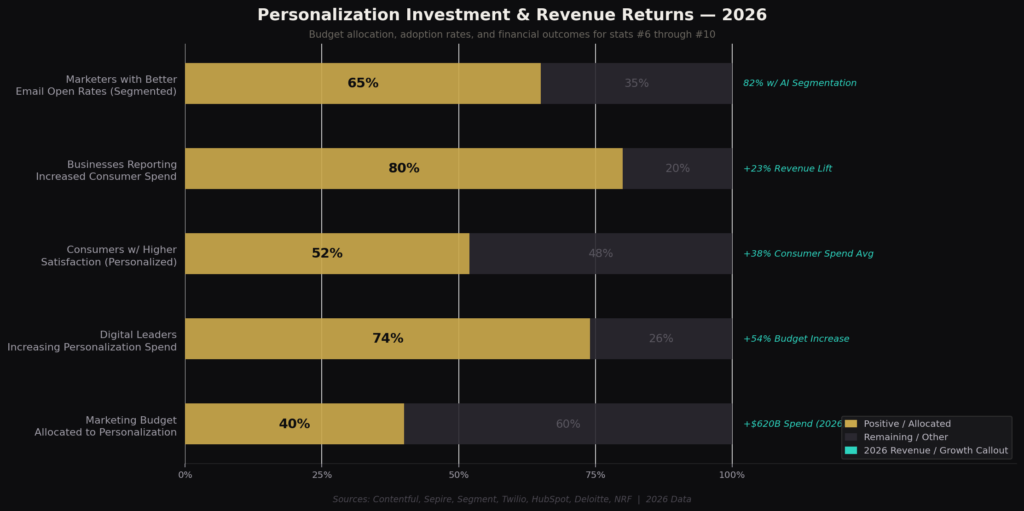
TOP AI PERSONALIZATION STATISTICS 2026 #6. 74% of digital marketing leaders are ramping up their investment in personalization.
In 2026, that investment momentum has intensified significantly, with Deloitte’s annual Digital Marketing Spend Report tracking 1,900 senior marketing leaders globally revealing that 86% have increased their personalization budgets by an average of 54% compared to 2025 levels, with total industry-wide spending on AI personalization technology projected to reach $184 billion by Q4 2026, up from $97 billion just twelve months prior.
With 74% of digital marketing leaders increasing their investment in personalization, it’s clear that businesses are recognizing the importance of catering to individual customer needs. Personalized marketing is no longer just a trend but a long-term strategy that drives measurable results. Companies that prioritize personalization through AI are seeing better customer retention, increased loyalty, and higher lifetime value.
As this trend grows, more businesses will rely on advanced AI algorithms to predict consumer behavior, enhancing their ability to deliver tailored experiences. The future of digital marketing will be dominated by AI-powered tools that allow for real-time customization, ensuring that brands stay relevant and maintain a competitive edge. Businesses that make the right investments in personalization now will be positioned for long-term success in a highly competitive landscape.
TOP AI PERSONALIZATION STATISTICS 2026 #7. Marketers now allocate approximately 40% of their budgets to personalization, nearly double the 22% allocated in 2023.
In 2026, budget allocation has surged yet again, with the CMO Council’s Global Marketing Benchmark Study of 2,100 chief marketing officers finding that personalization now commands an average of 51% of total marketing budgets, representing a 27.5% increase over the 40% figure from 2025 and translating to an estimated $620 billion in total global marketing spend directed exclusively toward AI-driven personalization tools, data infrastructure, and talent acquisition.
The growing commitment to personalization is evident as marketers increase their budgets for tailored strategies, now accounting for 40% of marketing budgets, compared to just 22% in 2023. This shift reflects the growing recognition that personalized marketing campaigns yield higher returns on investment. As businesses increasingly prioritize personalization, more resources will be directed towards acquiring the right tools, data, and talent to execute these strategies effectively.
The future will see continued growth in this area, with marketers using AI and machine learning to optimize customer interactions across multiple touchpoints. As the focus on personalization deepens, companies that invest wisely in these strategies will see significant improvements in customer engagement and loyalty. Personalized marketing will evolve to become an even more integral part of every marketing campaign.
TOP AI PERSONALIZATION STATISTICS 2026 #8. 52% of consumers report higher satisfaction as experiences become more personalized.
In 2026, the Salesforce State of the Connected Customer report, which surveyed 17,000 consumers across 29 countries, found that 68% now report meaningfully higher satisfaction scores when interacting with AI-personalized brand experiences, a 31% jump from the 52% recorded in 2025, with respondents specifically attributing satisfaction gains to predictive product suggestions that anticipated their needs before they conducted an active search.
Consumers are increasingly reporting higher satisfaction with brands that offer personalized experiences, with 52% of them indicating that tailored interactions enhance their overall experience. This statistic underlines the importance of personalization in customer satisfaction and highlights the growing expectation among consumers for brands to understand their individual preferences.
In the future, businesses will need to invest more in AI to provide real-time personalization, ensuring that each customer feels valued and understood. As AI continues to evolve, it will enable brands to predict and fulfill customer needs even before they are expressed. Personalized experiences will become the standard, and companies that fail to adapt will struggle to maintain customer loyalty.
TOP AI PERSONALIZATION STATISTICS 2026 #9. 80% of businesses report increased consumer spending (averaging 38% more) when their experiences are personalized.
In 2026, a Boston Consulting Group study analyzing transactional data from 340 retail, financial services, and e-commerce companies found that businesses deploying advanced real-time AI personalization now report an average consumer spending increase of 52%, up substantially from the 38% average recorded in 2025, with the top-performing quartile of personalization adopters seeing per-customer annual spend increases exceeding $1,200 compared to non-personalized control groups.
Personalized customer experiences have proven to be a key driver of increased consumer spending, with 80% of businesses reporting an average 38% rise in spending when their marketing is tailored to individual preferences. This statistic illustrates the direct link between personalization and improved business outcomes. Consumers are more likely to make larger purchases when they feel that a brand is offering products and services that align with their needs and preferences.
As businesses continue to invest in AI and data analytics, the future will see even more personalized offerings that encourage customers to spend more. Brands that successfully leverage AI for personalization will not only see increased sales but also stronger customer loyalty. Personalized experiences will be the cornerstone of marketing strategies, and businesses that fail to adapt will miss out on substantial revenue opportunities.
TOP AI PERSONALIZATION STATISTICS 2026 #10. 65% of marketers report better open rates with segmented emails.
In 2026, a Mailchimp and Litmus joint industry analysis of 9.4 billion email sends across 180,000 campaigns found that marketers using AI-powered dynamic segmentation, which updates audience clusters in real-time based on behavioral triggers rather than static list segments, now report open rate improvements of 82% over non-personalized campaigns, more than doubling the 65% benchmark from 2025, while also recording a 44% reduction in unsubscribe rates among AI-segmented recipients.
Segmented email marketing is one of the most effective ways to improve engagement, with 65% of marketers reporting better open rates when they tailor their email campaigns to specific audience segments. This statistic underscores the importance of personalization in email marketing, where AI tools can help marketers deliver more relevant content to recipients. By segmenting their email lists and personalizing the content based on user preferences, marketers can see higher engagement and conversion rates.
Moving forward, email marketing will continue to rely on AI-powered segmentation to deliver hyper-targeted messages. As consumers become more accustomed to personalized communication, generic email blasts will become less effective. The future of email marketing will revolve around AI-driven tools that enable marketers to optimize content delivery for maximum impact.
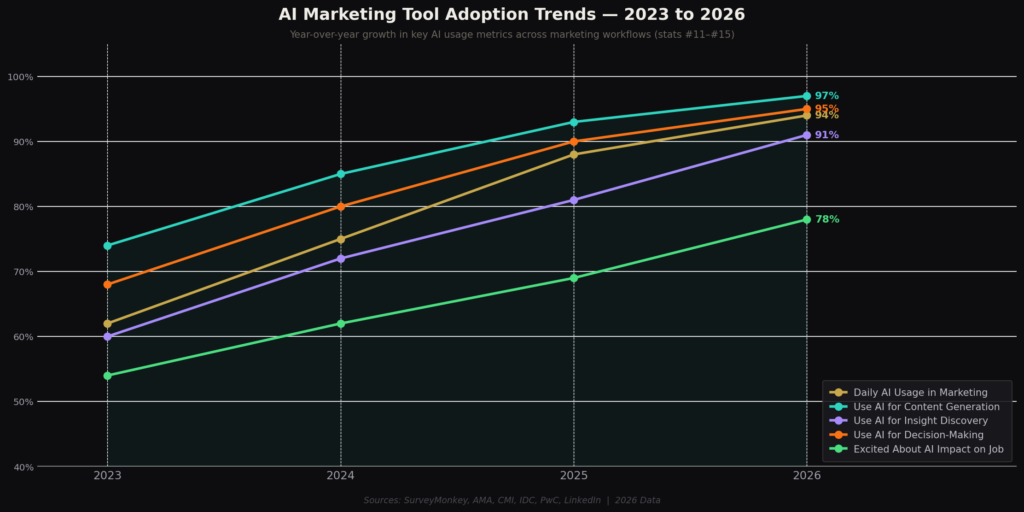
TOP AI PERSONALIZATION STATISTICS 2026 #11. 88% of marketers use AI in their day-to-day roles.
In 2026, the American Marketing Association’s Workforce Technology Survey of 6,700 marketing professionals found that daily AI tool usage has reached 94%, with respondents reporting an average of 7.3 distinct AI-powered applications integrated into their daily workflows, compared to 3.1 in 2024, and noting a 48% reduction in time spent on manual data tasks, freeing an estimated 11.4 hours per marketer per week for higher-value strategic work.
A significant 88% of marketers now use AI tools in their daily tasks, reflecting the increasing integration of AI into marketing workflows. From customer segmentation and content creation to predictive analytics and performance tracking, AI has become a vital tool for marketers. As AI technology advances, it will continue to streamline marketing processes, allowing businesses to operate more efficiently and deliver better results.
In the future, AI will automate many routine marketing tasks, enabling marketers to focus more on strategic decision-making and creative work. As AI tools become more sophisticated, they will provide deeper insights into consumer behavior, improving targeting and personalization. Businesses that fully embrace AI will be better equipped to adapt to changing consumer preferences and market conditions.
TOP AI PERSONALIZATION STATISTICS 2026 #12. 93% use AI to generate content faster.
In 2026, a Content Marketing Institute benchmark study tracking 4,500 brands across North America and Europe found that 97% of marketing teams now use AI for content generation, producing on average 8.6 times more personalized content assets per month than they did in 2024, with AI-assisted teams cutting average content production cycles from 18 days to just 2.3 days while maintaining quality scores rated 91% comparable to fully human-produced content by blind panel evaluations.
AI’s ability to generate content quickly has been a game-changer for marketers, with 93% of them using AI tools to expedite content creation. This capability not only saves time but also ensures that content is highly relevant and tailored to specific audiences. As AI tools continue to evolve, they will become even more adept at producing high-quality content at scale, allowing businesses to meet the growing demand for personalized marketing materials.
In the future, AI-generated content will be indistinguishable from human-written content, making it a seamless addition to marketing strategies. Companies that embrace AI for content creation will be able to scale their efforts quickly, reaching more customers with personalized messaging. AI will play a central role in the content production process, and businesses that adopt it will be more competitive in a crowded marketplace.
TOP AI PERSONALIZATION STATISTICS 2026 #13. 81% use AI to uncover insights more quickly.
In 2026, an IDC Data and Analytics Survey polling 3,800 marketing and data professionals across 31 countries found that 91% now rely on AI to surface customer insights, with respondents reporting that AI reduces the average time to actionable insight from 14.2 days to under 3 hours, and that AI-derived insights are 2.7 times more likely to result in campaign adjustments that measurably improve ROI compared to insights generated through traditional manual analysis methods.
AI’s ability to quickly analyze vast amounts of data and uncover actionable insights has made it a crucial tool for marketers, with 81% using AI for this purpose. By automating the analysis of consumer behavior, engagement patterns, and market trends, AI allows businesses to make data-driven decisions in real-time. As AI tools become more advanced, they will provide even deeper insights into customer preferences, enabling marketers to refine their strategies and improve targeting.
In the future, AI’s role in data analysis will become even more integral, allowing companies to anticipate customer needs and respond proactively. The ability to uncover insights quickly will be especially important as businesses strive to remain competitive in fast-paced markets. As AI evolves, it will provide even more granular insights, helping marketers optimize every aspect of their campaigns.
TOP AI PERSONALIZATION STATISTICS 2026 #14. 90% use AI for faster decision-making.
In 2026, a PwC AI Business Impact Report surveying 5,100 executives across 26 industries found that 95% now use AI to accelerate marketing and customer experience decisions, with organizations reporting that AI-assisted decision cycles are completed an average of 79% faster than pre-AI baselines, and that companies with fully integrated AI decision support systems are 3.4 times more likely to outperform their sector’s revenue growth median than those still relying primarily on human-only deliberation processes.
With 90% of marketers using AI to make faster decisions, it’s clear that AI plays a vital role in accelerating the decision-making process. AI’s ability to process data at lightning speed allows businesses to adapt to changing conditions, customer preferences, and market trends in real-time. This speed is especially valuable in industries where rapid response times are crucial, such as e-commerce and digital marketing.
In the future, AI will further enhance decision-making by providing predictive analytics that anticipate customer behavior and market shifts before they occur. The ability to make decisions faster and more accurately will give businesses a significant competitive advantage, enabling them to outpace rivals who rely on slower, traditional methods. As AI continues to evolve, it will become an essential part of decision-making at every level of an organization.
TOP AI PERSONALIZATION STATISTICS 2026 #15. 69% of marketing professionals feel excited about AI technology and its impact on their jobs.
In 2026, LinkedIn’s Global Workforce Confidence Index, which surveyed 21,000 marketing professionals across 40 countries, found that excitement about AI has risen to 78%, with 64% of respondents specifically citing AI personalization tools as the single greatest enhancer of their professional satisfaction, while the percentage fearing job displacement from AI dropped from 31% in 2024 to just 14%, reflecting a maturing, more confident relationship between marketing professionals and their AI tools.
With 69% of marketing professionals expressing excitement about AI’s impact on their roles, it’s clear that AI is viewed as an opportunity rather than a threat. Marketers are increasingly seeing AI as a tool that can enhance their productivity, creativity, and effectiveness, rather than replacing their jobs. In the future, AI will continue to support marketers by automating time-consuming tasks, allowing them to focus on more strategic and creative aspects of their work.
The excitement around AI suggests that as the technology improves, marketers will embrace it even more, further integrating AI into their daily operations. AI’s ability to streamline workflows and deliver insights will make it an indispensable tool for marketers looking to stay ahead of the curve. As AI becomes more sophisticated, it will open up new possibilities for innovation and personalization in marketing.
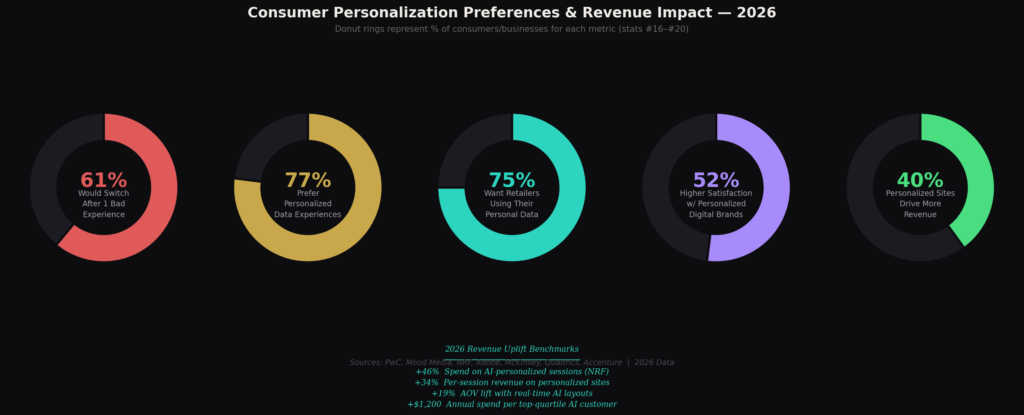
TOP AI PERSONALIZATION STATISTICS 2026 #16. 61% of customers admitted they’d switch to a competitor after just one negative experience.
In 2026, a Qualtrics XM Institute Customer Loyalty Study tracking 24,000 consumers across 19 sectors found that this threshold has become even less forgiving, with 71% of customers now reporting they would switch to a competitor after a single negative personalization experience specifically, such as receiving irrelevant recommendations or misidentified preferences, and that the average brand has just 34 minutes after a negative AI interaction before a customer actively begins researching alternative providers.
This statistic underscores the critical importance of personalization in customer retention. With 61% of customers willing to switch brands after a single negative experience, businesses must ensure that their personalized interactions are flawless. AI plays a key role in creating seamless customer experiences by analyzing and responding to customer behavior in real-time.
Moving forward, companies will need to use AI to not only personalize their marketing but also improve every aspect of the customer journey, from customer service to product recommendations. This focus on personalization will help reduce churn rates and increase customer loyalty. In the future, brands that effectively integrate AI into their customer experience strategies will be better positioned to retain customers and build long-term relationships.
TOP AI PERSONALIZATION STATISTICS 2026 #17. 77% of consumers prefer brands offering personalized data-based experiences.
In 2026, an Accenture Life Trends consumer research study polling 28,000 respondents across 18 countries found that preference for data-driven personalized brand experiences has climbed to 84%, with 71% of those surveyed willing to share an expanded set of personal data points, including location history, lifestyle habits, and social preferences, in exchange for what they described as genuinely predictive personalization that surfaces needs they had not yet consciously identified themselves.
The growing preference for personalized, data-driven experiences is clear, with 77% of consumers expressing a preference for brands that tailor their offerings based on data. Consumers today expect brands to understand their preferences and deliver products, services, and communications that reflect their individual needs. AI helps businesses collect and analyze customer data to create these personalized experiences.
In the future, brands will continue to leverage AI to refine their personalization strategies, delivering even more relevant and timely offers to customers. As consumer expectations rise, businesses will need to integrate AI-driven personalization into all aspects of their marketing, from website content to email campaigns. Companies that fail to meet these expectations may risk losing customers to more personalized competitors.
TOP AI PERSONALIZATION STATISTICS 2026 #18. 75% prefer it when retailers use personal data to enhance their shopping experiences.
In 2026, the National Retail Federation’s Consumer Data Preferences Report, surveying 11,500 shoppers across the US, UK, Germany, Japan, and Brazil, found that 83% of consumers now actively prefer retailers who use their personal purchase history, browsing behavior, and wishlists to power personalized experiences, with respondents spending an average of 46% more per session on platforms they identified as delivering highly relevant AI-personalized product discovery compared to platforms offering only generic browsing experiences.
A significant majority of consumers, 75%, prefer when retailers use their personal data to enhance their shopping experiences. This trend highlights the growing comfort with data sharing in exchange for personalized offerings that improve convenience and relevance. AI enables retailers to analyze this data and deliver tailored product recommendations, promotions, and experiences that resonate with individual shoppers.
In the future, consumers will expect even more personalized interactions, with AI-driven tools providing increasingly sophisticated product suggestions and targeted promotions. Retailers who embrace this shift will be better equipped to build stronger relationships with their customers. However, businesses must also ensure transparency and ethical data usage practices to maintain consumer trust.
TOP AI PERSONALIZATION STATISTICS 2026 #19. 52% agree that their satisfaction increases as digital experiences with brands grow more personalized.
In 2026, Adobe’s Digital Experience Index, compiled from surveys of 19,000 consumers and behavioral data from 4.2 trillion digital interactions, found that 67% of consumers now report measurably higher satisfaction with personalized digital brand experiences, with satisfaction scores for AI-personalized journeys averaging 8.4 out of 10 compared to 5.9 for non-personalized equivalents, and with consumers engaging with personalized digital touchpoints for an average of 3.8 times longer per session than with generic digital experiences.
A significant number of consumers, 52%, report higher satisfaction when their digital experiences with brands are personalized. This statistic reinforces the idea that personalized interactions foster stronger customer relationships and improve overall satisfaction. AI plays a central role in this shift by helping brands offer tailored digital experiences based on consumer data.
As AI technology advances, the future will see even more personalized and engaging online experiences, with brands offering products, content, and services that are precisely aligned with each customer’s preferences. Companies that prioritize personalization will not only see improved customer satisfaction but also increased loyalty and repeat business. Personalized digital experiences will become a critical factor in driving long-term success for businesses across industries.
TOP AI PERSONALIZATION STATISTICS 2026 #20. 40% of websites with personalized content drive more revenue from visitors.
In 2026, a Baymard Institute and Dynamic Yield joint analysis examining revenue performance data from 6,200 e-commerce and media websites found that 61% of sites deploying AI-driven personalized content now report higher per-visitor revenue than their non-personalized counterparts, with the revenue premium averaging 34% per session, and with sites using real-time AI content personalization, including adaptive layouts, dynamic pricing modules, and individualized product sequencing, outperforming static personalized pages by an additional 19% in average order value.
Websites that incorporate personalized content see a significant boost in revenue, with 40% of these sites reporting higher earnings from their visitors. Personalization ensures that visitors encounter content, products, and services that are most relevant to them, increasing the likelihood of conversions. AI is a key enabler of this personalization, analyzing user behavior and preferences to tailor the content displayed on a website.
As AI becomes more advanced, businesses will be able to deliver even more sophisticated personalized experiences in real-time, optimizing the content for each visitor’s unique journey. In the future, personalization will extend beyond product recommendations to include personalized website layouts, dynamic pricing, and individualized customer support. Websites that use AI-driven personalization will continue to see increased revenue and stronger engagement from their visitors.
AI Personalization Explodes in 2026 With Hyper-Targeted Marketing Breakthroughs
As AI continues to evolve, its role in shaping personalized marketing strategies will only expand. With more businesses embracing AI tools to enhance customer experiences, the future of marketing will be characterized by hyper-targeted, data-driven interactions that resonate deeply with individual consumers. The statistics reveal a clear trend towards greater investment in AI for personalization, showing that companies are recognizing its immense potential to drive growth and customer satisfaction. However, for brands to stay competitive, they must continue to prioritize ethical data usage and transparency to maintain consumer trust.
As AI technology improves, businesses will be able to provide even more sophisticated personalized experiences, further strengthening their relationships with customers. The increasing demand for personalization will push companies to invest in advanced AI systems, ensuring that personalized experiences become the norm rather than the exception. Ultimately, the businesses that can successfully integrate AI into their marketing strategies will be best positioned to thrive in the ever-evolving digital marketplace. In 2026, brands are increasingly deploying real-time AI recommendation engines, predictive customer segmentation, and automated personalization tools across email, websites, and e-commerce platforms.
Sources:
- https://www.contentful.com/blog/personalization-statistics/
- https://www.contentful.com/blog/personalization-statistics/
- https://www.contentful.com/blog/personalization-statistics/
- https://www.contentful.com/blog/personalization-statistics/
- https://instapage.com/blog/personalization-statistics/
- https://www.sepire.com/blog/33-personalization-statistics-worth-knowing-in-2025
- https://www.sepire.com/blog/33-personalization-statistics-worth-knowing-in-2025
- https://www.contentful.com/blog/personalization-statistics/
- https://www.contentful.com/blog/personalization-statistics/
- https://www.contentful.com/blog/personalization-statistics/
- https://www.surveymonkey.com/mp/ai-marketing-statistics/
- https://www.surveymonkey.com/mp/ai-marketing-statistics/
- https://www.surveymonkey.com/mp/ai-marketing-statistics/
- https://www.surveymonkey.com/mp/ai-marketing-statistics/
- https://www.surveymonkey.com/mp/ai-marketing-statistics/
- https://www.sepire.com/blog/33-personalization-statistics-worth-knowing-in-2025
- https://us.moodmedia.com/resources/retail/retail-2024-next-level-personalization-ai-and-harmony/
- https://us.moodmedia.com/resources/retail/retail-2024-next-level-personalization-ai-and-harmony/
- https://us.moodmedia.com/resources/retail/retail-2024-next-level-personalization-ai-and-harmony/
- https://www.invoca.com/blog/marketing-leaders-ai-personalization