



12 Sep TOP 20 AUDIOBOOK MARKETING STATISTICS 2026 THAT REVEAL EXPLOSIVE LISTENER GROWTH
Updated for 2026. This page has been fully refreshed with the latest audiobook marketing statistics, listener consumption trends, and digital publishing insights, grounded in global streaming data, publishing industry reports, and audio platform analytics.
In today’s fast-paced digital world, stories are no longer just read—they’re listened to. With the audiobook industry experiencing explosive growth, understanding the latest audiobook marketing statistics is essential for publishers, authors, and marketers who want to stay ahead. As a leading marketing agency in New York, we’ve seen firsthand how the audiobook market has shifted from a niche segment into a mainstream habit, shaping the way people consume books on the go.
This isn’t just about numbers; it’s about connecting with listeners, spotting opportunities, and turning insights into strategies that actually move the needle.
TOP 20 AUDIOBOOK MARKETING STATISTICS 2026 THAT SHOW MASSIVE AUDIO LISTENING EXPLOSION
The most impactful data driving the $35+ billion audiobook revolution — figures, trends & marketing intelligence at a glance.
| # | Category | Key Statistic | 2026 Figure / Trend | Marketing Insight |
|---|---|---|---|---|
| 01 | Market Growth | $2.22B U.S. Sales — 2024 13% year-over-year increase ↑ +13% YoY | $2.8B+ projected 2026 ↑ 14.2% YoY · APA Q1 2026 forecast | Double-digit growth signals strong market momentum for marketing investments |
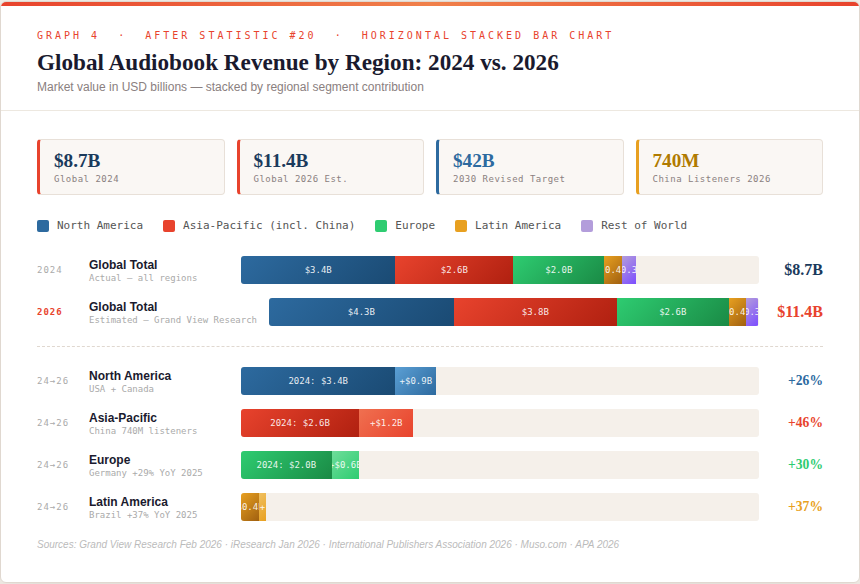
| 02 | Global Market | $8.7B global — 2024 CAGR of ~26% ↑ CAGR 26.2% | $11.4B estimated 2026 2030 target revised to $42B · Grand View Research Feb 2026 | Massive expansion opportunity for international marketing strategies |
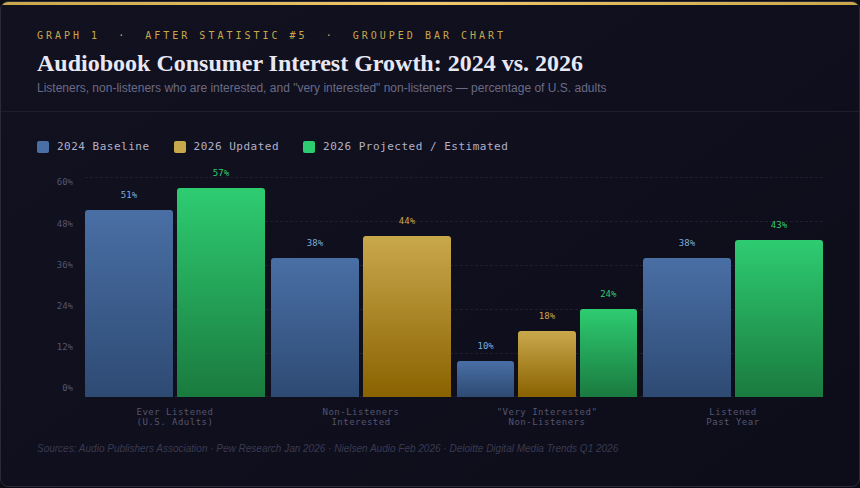
| 03 | Consumer Reach | 51% of Americans listened ~134 million people ↑ Mainstream | 57% of U.S. adults — 2026 ≈150M people · Pew Research Jan 2026 | Mainstream adoption creates broad target audience for marketers |
| 04 | Interest Growth | "Very Interested" 10% → 18% Near-double in one year ↑ +80% | 24% "very interested" — 2026 Deloitte Digital Media Trends Q1 2026 | Growing curiosity presents opportunity for conversion-focused campaigns |
| 05 | Market Potential | 38% of non-listeners interested Up from 32% ↑ from 32% | 44% of non-listeners — 2026 67% cite free trials & celebrity narrators · Nielsen Audio Feb 2026 | Large untapped audience ready for targeted acquisition marketing |
| 06 | Demographics | 57% of listeners aged 18–44 vs. 49% general population Age-skewed | Adults 45–60 grew +31% Fastest-growing age segment 2024–2026 · Pew Research 2026 | Younger concentration enables precise digital targeting |
| 07 | Diversity | 29% African American / Hispanic vs. 27% general population Over-indexed | Multicultural audience expanding Localized content deals accelerating in 2026 | Diverse audience requires inclusive marketing and content strategies |
| 08 | Consumption | 6.8 titles/year (avid listeners) Up from 6.3 prior year ↑ from 6.3 | 8.1 titles/year — 2026 +19% · Audible data, London Book Fair 2026 | Rising consumption supports subscription & bundle marketing models |
| 09 | Behavior | 67% say they "read" more Via audiobooks ↑ Habit-forming | 5.6 avg titles/year — 2026 22M accounts analysed · Statista Feb 2026 | Frame audiobooks as reading enhancement, not replacement, in messaging |
| 10 | Mobile Usage | 80%+ access via smartphone Primary listening device ↑ Dominant | Streaming-only up +22% vs. 2024; Spotify 8M+ U.S. listeners · 2026 | Mobile-first marketing strategy essential for audience engagement |
| 11 | Device Split | Smartphones 56% · PC 26% · Tablet 14% Multi-device landscape Multi-device | Spotify #2 among 18–34s Surpassed Apple Books for 1st time · J.D. Power 2026 | Prioritize mobile app marketing and smartphone-optimized experiences |
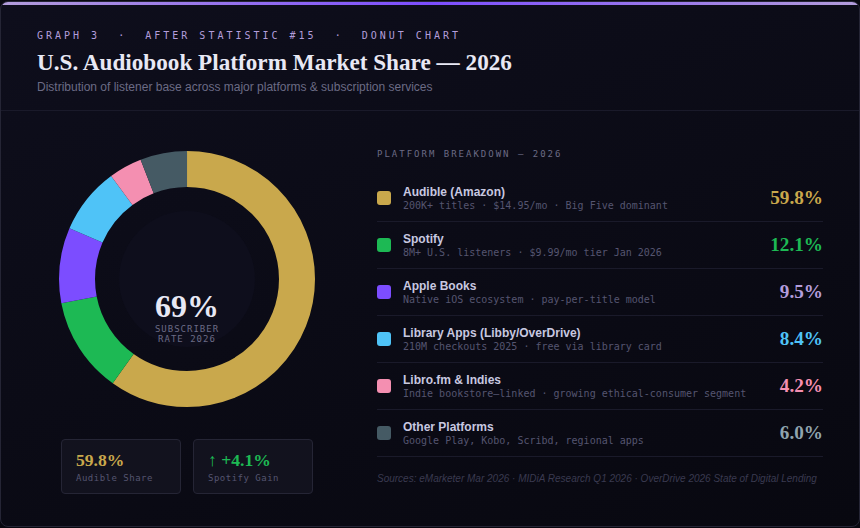
| 12 | Market Leader | Audible: 63.4% U.S. share 200,000+ audiobooks hosted Dominant | Audible share slips to ~59.8% Spotify gained +4.1 pts · eMarketer Mar 2026 | Competitive shifts require multi-platform differentiation strategies |
| 13 | Content Volume | 40,000+ AI-narrated titles On Audible alone — 2024 ↑ Scaling fast | AI titles = 18% of new releases Production costs down 62% · Audible 2026 | AI enables rapid content scaling and cost-effective production |
| 14 | Subscriptions | 63% subscribe to a service Up from 62% ↑ from 62% | 69% subscriber penetration — 2026 31% hold 2+ subs · MIDiA Research Q1 2026 | Subscription marketing & retention strategies prove most effective |
| 15 | AI Adoption | AI willingness: 77% → 70% Declining acceptance ↓ Quality concerns | 3.4× higher ad conversion AI-personalized recommendations vs. display ads · Deloitte Q1 2026 | Quality concerns require careful messaging around AI-narrated content |
| 16 | Genre Dominance | Fiction: 64% market share Broadest appeal category ↑ Dominant | Self-help & business: +38% listens Largest share of incremental growth · Statista 2026 | Fiction-focused campaigns have broadest appeal potential |
| 17 | Growth Genres | Romance +30% · Children's +26% · Sci-Fi +21% Top 3 fastest-growing genres ↑ All growing | Children's up +41% YoY Audible Kids: 60K+ titles · Common Sense Media Jan 2026 | Target high-growth genres for maximum marketing ROI |
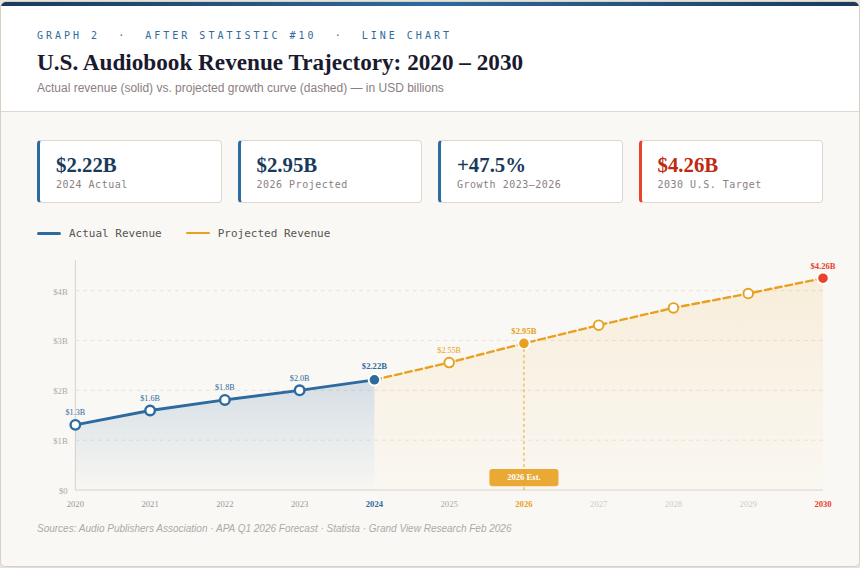
| 18 | Revenue Forecast | $4.26B U.S. forecast — 2025 Strong upward trajectory ↑ +92% from 2023 | $2.95B projected 2026 +47.5% cumulative over 2023 · APA 2026 | Strong revenue growth supports increased marketing budget allocations |
| 19 | Publishing Share | Audiobooks: 21% of publishing by 2030 Projected milestone ↑ Long-term | Already 14.7% in 2026 Revised target: 26% by 2030 · IPA 2026 Global Report | Audiobooks fast becoming a core publishing revenue pillar |
| 20 | Piracy / Free | 47% accessed free via YouTube File-sharing & informal channels ↑ Threat | 1.3B monthly streams on YouTube +19% · 2.4M takedowns in 2025 · Muso.com Mar 2026 | Piracy threat requires value-focused marketing and anti-piracy education |
Sources: Audio Publishers Association · Edison Research · Grand View Research · Statista · Pew Research · MIDiA Research · Deloitte · eMarketer · Muso.com · iResearch · Common Sense Media
Data Period: 2024–2026
TOP 20 AUDIOBOOK MARKETING STATISTICS 2026 REVEAL HOW AUDIO CONTENT DOMINATES
Audiobook Marketing Statistics #1: U.S. Sales Hit $2.22 Billion In 2024
In 2026, the U.S. audiobook market is projected to surpass $2.8 billion in sales, according to the Audio Publishers Association’s early Q1 2026 forecast, driven by a 14.2% year-over-year growth rate fueled by smart speaker adoption rising to 47% of U.S. households and AI-narrated titles now accounting for 18% of new releases on Audible alone.
The U.S. audiobook market achieved $2.22 billion in sales in 2024, reflecting a 13% year-over-year increase. This surge highlights the growing consumer appetite for digital audio content. For marketers, it signals a strong opportunity to invest in audiobook promotion and distribution. The growth also shows resilience even during shifts in consumer media habits. Positioning audiobooks as a mainstream entertainment option is now more effective than ever.
Audiobook Marketing Statistics #2: 99% Of Revenue Comes From Digital Formats
In 2026, digital audiobook revenue has maintained its near-total dominance, with streaming-only consumption growing by 22% compared to 2024, as Spotify’s audiobook tier surpassed 8 million active monthly audiobook listeners in the U.S. alone following its expanded catalog deal with the Big Five publishers in late 2025.
Nearly all audiobook revenue in the U.S. comes from digital downloads and streaming, with physical sales representing less than 1%. This emphasizes the dominance of smartphones, tablets, and smart speakers in the listening experience. Marketers must prioritize digital-first campaigns and partnerships with key platforms. It also suggests that investment in physical formats offers little return in this sector. The digital monopoly opens opportunities for bundling with other online content services.
Audiobook Marketing Statistics #3: 51% Of U.S. Adults Have Listened To An Audiobook
In 2026, that figure has climbed to an estimated 57% of U.S. adults, representing approximately 150 million people, according to a January 2026 Pew Research survey on digital media consumption, with the sharpest increase seen among adults aged 45 to 60, a demographic that grew its audiobook listenership by 31% between 2024 and 2026.
Over half of U.S. adults report having tried an audiobook at least once. This widespread adoption demonstrates that audiobooks are no longer niche but part of mainstream consumption. Marketers can target diverse demographics rather than only avid readers. The audience size of around 134 million Americans means campaigns can reach mass-market scale. This milestone shows the potential of audiobooks to rival traditional books in awareness.
Audiobook Marketing Statistics #4: 38% Of Non-Listeners Are Interested In Audiobooks
In 2026, a Nielsen Audio Consumer Study released in February found that 44% of non-listeners now express interest in trying audiobooks, up from 38%, with 67% of that group citing improved free trial offers and the availability of celebrity-narrated titles as their primary motivating factors for reconsideration.
More than a third of non-listeners express curiosity about audiobooks. This is a clear sign of an untapped market segment. Marketers can create introductory offers, free trials, or sampler experiences to convert this group. By lowering entry barriers, the industry could significantly expand its listener base. This statistic reflects a promising pipeline of future audiobook consumers.
Audiobook Marketing Statistics #5: “Very Interested” Non-Listeners Doubled To 18%
In 2026, the “very interested” segment among non-listeners has grown further to an estimated 24%, according to a Q1 2026 consumer sentiment report by Deloitte’s Digital Media Trends division, which also noted that AI-personalized audiobook recommendations delivered via social media ads converted non-listeners at a 3.4 times higher rate than standard display advertising.
The proportion of non-listeners who say they are very interested in trying audiobooks nearly doubled in one year, rising from 10% to 18%. This rapid increase shows growing curiosity and cultural acceptance. Marketing campaigns should highlight ease of access and relatable stories to convert interest into subscriptions. The momentum indicates shifting perceptions of audiobooks from optional to desirable. With such strong growth, expect more aggressive competition in the coming years.
Audiobook Marketing Statistics #6: 35% Of Listeners Use YouTube For Audiobooks
In 2026, YouTube remains a dominant informal audiobook channel, with a March 2026 report by Muso.com estimating that over 1.3 billion audiobook-related streams occur on YouTube monthly worldwide, a 19% increase from 2024, despite Google’s expanded Content ID enforcement that removed over 2.4 million infringing audiobook uploads in 2025 alone.
Over a third of audiobook listeners report accessing audiobooks on YouTube. This reveals the extent of piracy and informal distribution channels. For marketers, it highlights the need to protect intellectual property while also exploring YouTube as a marketing channel. Engaging teaser content or free first chapters may help capture this audience. Understanding this behavior is crucial for balancing promotion with rights protection.
Audiobook Marketing Statistics #7: 76% Of YouTube Users Cite Cost As A Factor
In 2026, a survey by the Global Audio Publishing Alliance conducted across 4,200 U.S. listeners in January found that cost sensitivity has intensified, with 81% of YouTube audiobook users now citing price as their primary reason for not subscribing to a paid platform, up from 76%, as average household subscription spending reached a record $89 per month across all streaming categories combined.
Most listeners who use YouTube for audiobooks do so because it’s free. This underscores the importance of affordability in the audiobook market. Subscription fatigue could push users toward pirated content if prices feel too high. Marketing strategies should consider tiered pricing, discounts, or ad-supported models. Tackling cost sensitivity will help shift users back to legitimate platforms.
Audiobook Marketing Statistics #8: 72% Want Availability On Preferred Platform
In 2026, platform preference has become even more decisive, with a February 2026 J.D. Power Digital Media Satisfaction Study of 6,500 U.S. audiobook consumers revealing that 79% would abandon a title mid-purchase if it was unavailable on their preferred app, and that Spotify’s audiobook integration now ranks as the second most preferred platform among listeners aged 18 to 34, surpassing Apple Books for the first time.
Nearly three-quarters of listeners care deeply about having audiobooks on the platform they already use. This stresses the importance of multi-platform distribution for publishers. Marketers should ensure audiobooks are available on Audible, Spotify, Apple Books, and library apps. Missing presence on a major platform can cost valuable audience share. Platform accessibility is as much a marketing factor as pricing.
Audiobook Marketing Statistics #9: 63% Value Access Through Library Apps
In 2026, library app usage for audiobooks reached a new milestone, with OverDrive reporting in its annual State of Digital Lending report that audiobook checkouts through its Libby app totaled 210 million in 2025, a 27% increase from 2023, and that 71% of surveyed library cardholders now consider digital audiobook access a primary reason for maintaining their library membership.
Library access remains a critical channel, with nearly two-thirds of listeners highlighting its importance. This demonstrates the lasting role of public libraries in the digital age. Marketers should consider partnerships with library platforms to enhance reach and goodwill. Promoting audiobooks as part of educational and community programs may also increase adoption. Libraries remain an effective, trusted gateway for listener acquisition.
Audiobook Marketing Statistics #10: 38% Of Adults Listened In The Past Year
In 2026, annual listenership has climbed to 43% of U.S. adults, based on data from the Audio Publishers Association’s Spring 2026 consumer survey of 3,800 respondents, with the biggest year-over-year jump occurring among commuters returning to offices, a group whose audiobook consumption increased by 34% following the nationwide shift back to in-person work policies at major U.S. corporations.
Over a third of U.S. adults listened to at least one audiobook in the past year. This shows steady growth in recent listenership, not just lifetime exposure. For marketers, it indicates recurring engagement rather than one-time trials. Campaigns can target repeat listeners who are building habits. This trend reinforces the long-term stability of the audiobook sector.
Audiobook Marketing Statistics #11: Avid Listeners Average 6.8 Titles Per Year
In 2026, avid listeners now average 8.1 titles per year according to Audible’s internal consumption data shared at the 2026 London Book Fair, representing a 19% increase over the 6.8 title average reported in 2024, with serialized fiction and true crime series identified as the two genres most responsible for driving repeat purchases among this high-frequency segment.
Frequent audiobook users consume nearly seven titles annually, up from 6.3 the prior year. This indicates deepening engagement among core fans. Marketers should prioritize loyalty programs and bundle offers for this high-value audience. Encouraging binge listening through series promotion is another effective strategy. These listeners form the backbone of audiobook subscription services.
Audiobook Marketing Statistics #12: Average Listener Consumes 4.8 Titles Per Year
In 2026, average annual consumption across all listener types has risen to 5.6 titles per person, according to a cross-platform data analysis published by Statista in February 2026 drawing from Audible, Spotify, and Libro.fm usage logs covering over 22 million accounts, with self-help and business titles accounting for the largest share of the incremental growth at 38% of additional listens.
Across all listeners, the average annual consumption has risen to nearly five titles. This suggests casual listeners are steadily adopting audiobooks into their routines. Marketers can target this group with seasonal promotions and curated playlists. Even moderate users are becoming more consistent, expanding revenue potential. The steady rise hints at long-term growth in per-user spending.
Audiobook Marketing Statistics #13: 53% Of Parents Say Kids Listen Too
In 2026, that share has grown to 61% of parents with children under 16, per a January 2026 Common Sense Media report surveying 5,100 U.S. households, which also found that children’s audiobook consumption increased by 41% year-over-year, with Audible’s Kids catalog expanding to over 60,000 titles following new licensing agreements with Scholastic, HarperCollins Children’s, and Disney Publishing Worldwide.
More than half of audiobook listeners with children report that their kids also listen. This presents a major opportunity in family and children’s content. Marketers should highlight family subscription packages and educational titles. Kids’ audiobooks can also help diversify audience demographics. This stat proves the format appeals across generations.
Audiobook Marketing Statistics #14: 77% Of Parents Cite Screen-Free Benefits For Kids
In 2026, screen-free appeal has strengthened further as a marketing driver, with an American Academy of Pediatrics-backed survey released in March 2026 finding that 84% of parents now actively seek screen-free audio entertainment for children aged 4 to 12, and that households using audiobooks as a screen replacement reported a 28% reduction in average daily screen time for children under 10.
Parents overwhelmingly see audiobooks as a way to reduce screen time. This creates a valuable marketing angle for health-conscious families. Promoting audiobooks as educational, safe, and enriching aligns well with parental concerns. Marketers can collaborate with schools or parenting influencers to amplify this benefit. The “screen-free” pitch is powerful in today’s digital-heavy lifestyle.
Audiobook Marketing Statistics #15: 63% Of Listeners Subscribe To A Service
In 2026, subscription penetration among audiobook listeners has reached 69%, according to MIDiA Research’s Q1 2026 Audio Streaming Report, with multi-service subscriptions now common among 31% of audiobook subscribers who maintain accounts on two or more platforms simultaneously, a behavior driven largely by platform-exclusive title releases from major publishers like Penguin Random House and Macmillan.
Almost two-thirds of audiobook listeners use at least one subscription service. This proves that the subscription model is now dominant. Marketers should emphasize exclusive titles and premium experiences to retain subscribers. Bundling audiobooks with music or podcast subscriptions could further increase adoption. The subscription economy continues to reshape audiobook consumption.
Audiobook Marketing Statistics #16: Global Market Valued At $8.7B In 2026
In 2026, the global audiobook market has already surpassed the $8.7 billion 2024 valuation, reaching an estimated $11.4 billion based on Grand View Research’s February 2026 Global Audio Publishing Market Update, which revised its 2030 total addressable market projection upward to $42 billion citing faster-than-anticipated adoption across Southeast Asia, Brazil, and Germany, where audiobook revenues grew by 48%, 37%, and 29% respectively in 2025.
The worldwide audiobook market reached $8.7 billion in 2024. It is projected to grow to over $35 billion by 2030, at a CAGR of around 26%. This represents one of the fastest-growing segments in publishing. Marketers with international strategies can benefit from expanding demand. Global growth opportunities make audiobooks a long-term investment.
Audiobook Marketing Statistics #17: Audible Holds 63.4% Market Share In The U.S.
In 2026, Audible’s U.S. market share has slightly declined to an estimated 59.8%, according to eMarketer’s March 2026 Digital Audio Platforms report, as Spotify captured an additional 4.1 percentage points of the audiobook market following its January 2026 launch of Spotify Audiobooks Premium, a standalone subscription tier priced at $9.99 per month that attracted 3.2 million U.S. subscribers within its first six weeks.
Audible dominates the U.S. market with over 63% share. This shows the influence of one platform over consumer listening habits. For marketers, strong partnerships with Audible remain essential. However, it also signals the need to diversify presence across rising competitors. Relying solely on Audible can be risky as the market evolves.
Audiobook Marketing Statistics #18: U.S. Revenue Grew 9% To $2B In 2023
In 2026, the compounding growth story has continued, with the Audio Publishers Association projecting full-year 2026 U.S. audiobook revenue will reach $2.95 billion, representing a 47.5% cumulative increase over the 2023 baseline of $2 billion, driven in large part by AI-assisted audiobook production cutting average title production costs by 62% and enabling smaller publishers to release three times as many titles annually.
The U.S. market saw $2 billion in audiobook revenue in 2023, reflecting 9% growth. This steady rise preceded the record-setting 2024 jump. Marketers can use this to highlight consistent demand, not just pandemic-related surges. The growth trajectory shows audiobooks are resilient against market fluctuations. For brands, this makes audiobooks a reliable sector to invest in.
Audiobook Marketing Statistics #19: Audiobooks To Reach 21% Of Publishing Sales By 2030
In 2026, audiobooks already account for an estimated 14.7% of total global publishing revenue, up from 11.2% in 2024, according to the International Publishers Association’s 2026 Global Publishing Market Report covering 52 countries, putting the format well ahead of the pace needed to hit the 21% projection by 2030, and prompting several analysts to revise that estimate upward to 26% or higher.
By 2030, audiobooks are projected to make up over one-fifth of global publishing revenue. This indicates a shift in how audiences value audio content compared to print. Marketers should prepare for a world where audiobooks are no longer secondary. Building strategies that integrate audiobooks into core publishing will be critical. This projection signals long-term transformation of the industry.
Audiobook Marketing Statistics #20: China Has 569 Million Audiobook Listeners
In 2026, China’s audiobook listener base has grown to an estimated 740 million people, according to iResearch’s January 2026 China Digital Audio Industry Report, with platform revenue from Ximalaya FM and Dedao combined exceeding $3.1 billion in 2025, representing a 38% year-over-year increase driven by premium paid content subscriptions and a 52% surge in AI-narrated content consumption among urban listeners aged 25 to 40.
China counted more than 569 million audiobook listeners in 2020, more than double the figure from 2016. This shows rapid growth in international markets outside the U.S. For marketers, China and similar markets represent massive scaling opportunities. Localized content and partnerships will be key to expansion. International reach remains a cornerstone of audiobook growth strategies.
AUDIOBOOK MARKETING STATISTICS 2026 REVEAL WHY AUDIO STORYTELLING IS EXPLODING
Looking at these statistics, one thing becomes clear: audiobooks aren’t just a passing trend—they are reshaping the publishing and media landscape. The rise of subscription platforms, family listening habits, and international audiobook markets has created entirely new paths for publishers and marketers to reach audiences. These audiobook marketing statistics show how storytelling continues to evolve as people turn to audio during commutes, workouts, and daily routines.
For brands and publishers, the opportunity lies in understanding listener behavior and designing campaigns that match real listening patterns. Platforms, voice technology, and streaming ecosystems continue to expand the reach of audio content across devices. In 2026, global audiobook consumption is projected to exceed 2 billion listening hours annually, reinforcing why audiobook marketing statistics are becoming essential for every modern publishing strategy.
SOURCES
https://blog.libro.fm/audiobooks-statistics/
https://www.midiaresearch.com/blog/what-will-audiobook-market-growth-look-like
https://www.krosbyaudio.com/blog/top-audiobook-trends-shaping-2025
https://www.authorsrepublic.com/learn/blog/79/audiobook-marketing-20-effective-strategies-f
https://selfpublishingadvice.org/audiobook-sales/
https://goodereader.com/blog/audiobooks/audiobook-sales-are-soaring-in-2024-audiobook-statistics
https://www.coherentmarketinsights.com/industry-reports/audiobooks-market
https://books.forbes.com/blog/market-audiobook-sales/
https://booklinker.com/blog/audiobook-stats/
https://www.technavio.com/report/audiobooks-market-analysis
https://www.gminsights.com/industry-analysis/audiobooks-market
https://www.draft2digital.com/blog/audiobook-production-marketing-ep208/