




04 Apr TOP 20 BEST CONVERSION RATE OPTIMIZATION STATISTICS 2026 REVEAL SHOCKING SALES GROWTH SECRETS
Updated for 2026. This page has been fully refreshed with the latest conversion rate optimization data, digital experience performance benchmarks, and CRO strategy trends based on recent global marketing research and analytics reports.
Conversion rate optimization (CRO) continues to evolve as one of the most measurable and high-impact strategies in digital marketing. With user expectations rising and technology accelerating, businesses can no longer afford to treat optimization as a one-off task. Collaborating with a podcast ad agency can complement CRO efforts by driving highly qualified traffic through authentic, story-driven audio ads that build trust and encourage action.
. That’s why Amra and Elma has compiled the top 20 most important CRO statistics for 2026.
These insights reflect where CRO has been—and more importantly—where it’s headed. Each statistic is paired with an in-depth analysis of its implications for the future, offering valuable takeaways for marketers, founders, and UX teams alike. Whether you’re managing an eCommerce brand, a SaaS platform, or a content-driven site, understanding these trends can help you unlock new conversion potential. Even sectors such as hospitality, where a hotel pr agency can play a crucial role in boosting website conversions through strategic storytelling and media placements, benefit greatly from CRO strategies. Amra and Elma’s selection combines long-term performance data with the most recent research from trusted sources. The result is a clear, comprehensive guide to the CRO tactics that will shape digital success through 2026 and beyond. Partnering with a film advertising agency can also help brands bring these strategies to life through powerful visual storytelling, turning data-driven insights into creative campaigns that captivate audiences and drive measurable results.
TOP 20 BEST CONVERSION RATE OPTIMIZATION STATISTICS 2026 (EDITOR’S CHOICE)
Data-Backed Intelligence
20 Conversion Rate Optimization Statistics That Define 2026
The most compelling CRO figures across general trends and the latest 2026 insights — drawn from the world's leading digital marketing research bodies. Every number here is a revenue opportunity.
| # | Statistic | Key Figure | Category | Revenue Impact |
|---|---|---|---|---|
| 01 |
Average Website Conversion Rate
Top performers exceed 11% — AI-personalized funnels now push leaders to 14.3%
|
2.35–5.31%
industry avg.
|
Revenue | |
| 02 |
Fewer Page Elements Drive Higher Conversions
Pages with <10 elements convert at 9.4% vs 2.8% for 35+ element pages (235% gap)
|
<10 Elements
optimal threshold
|
UX Design | |
| 03 |
Page Load Delay Impact on Conversions
Each 1-second delay costs enterprise brands avg. $2.4M/year per 1M monthly visitors
|
−7%
per 1-sec delay
|
Performance | |
| 04 |
A/B Testing — Most-Used CRO Method
AI-assisted A/B teams run 4.7× more experiments per quarter with 31% higher win rates
|
58%
of marketers use it
|
Testing | |
| 05 |
Personalized CTAs vs Generic CTAs
AI dynamic CTAs across 5+ touchpoints yield $4.73 revenue-per-visitor vs $1.91
|
+202%
conversion lift
|
AI / Personalization | |
| 06 |
Multi-Step vs Single-Step Forms
3–5 step AI-conditional forms achieve 61.7% completion in SaaS & insurance verticals
|
+14%
conversion rate
|
Form Design | |
| 07 |
Long-Form Landing Pages Lead Generation
AI-personalized long-form pages generate 287% more qualified leads vs static versions
|
+220%
more leads
|
Content | |
| 08 |
Mobile vs Desktop Conversion Gap
Mobile climbs to 2.41% in 2026; one-tap checkout drives +0.47pp lift among top-500 retailers
|
1.82% vs 3.9%
mobile vs desktop
|
Mobile | |
| 09 |
Fewer Form Fields = Higher Conversions
Reducing to 3–4 fields hits 68.4% completion; each extra field costs 4.8% completion
|
+160%
11 → 4 fields
|
Form Design | |
| 10 |
Video on Landing Pages Conversion Boost
AI-personalized video pages convert at 12.7%; interactive video with CTAs adds 43% more lift
|
+86%
conversion lift
|
Video | |
| 11 |
Global eCommerce Conversion Rate
Projected at 3.61% in 2026; AI recommendations account for 0.18pp of growth
|
3.34%
global avg. 2026
|
eCommerce | |
| 12 |
AI Personalization Tool Adoption
79% adoption by 2026; full-stack AI CRO delivers 7.2× ROI within 18 months
|
68% → 79%
2025 → 2026 adoption
|
AI / Personalization | |
| 13 |
Voice Search–Optimized Page Conversions
18.4% lift in 2026 (up from 12%); local services see 26.1% gains from voice queries
|
+18.4%
conversion lift (2026)
|
Voice / SEO | |
| 14 |
Interactive Content Conversion Advantage
AI-adaptive quizzes achieve 41% lift over static interactive; 52% lower lead-capture cost
|
+28%
vs static content
|
Interactive | |
| 15 |
Real-Time Chatbots — B2B Conversion Boost
Intent-routing AI bots drive 31.7% pipeline lift and $1.2M incremental annual revenue
|
+20–25%
B2B conversion rate
|
AI / Chat | |
| 16 |
AR Product Previews — Conversion Lift
47% lift in 2026; 29% fewer returns + 22% higher average order value for AR adopters
|
+47%
conversion rate (2026)
|
AR / Tech | |
| 17 |
Accessible Websites Convert Better
WCAG 2.2 AA sites avg 19.3% higher CR; accessible checkouts 24.7% higher completion
|
+19.3%
avg conversion rate
|
Accessibility | |
| 18 |
Personalized Email Sequences
Multi-dimension AI emails hit $0.42 revenue-per-send vs $0.14 for standard segments
|
+32%
vs batch emails
|
AI / Email | |
| 19 |
Multivariate vs A/B Testing Performance
AI-assisted multivariate now delivers 27% over A/B; 50+ concurrent tests yield 38% annual CR growth
|
+27%
over A/B testing (2026)
|
Testing | |
| 20 |
Progressive Web Apps — Mobile Conversions
62% mobile CR lift in 2026; PWA adopters see $8.7M median annual revenue increase
|
+62%
mobile conversion (2026)
|
PWA / Mobile |
TOP 20 BEST CONVERSION RATE OPTIMIZATION STATISTICS 2026 REVEAL FUTURE MARKETING SHIFTS
TOP CONVERSION RATE OPTIMIZATION STATISTICS 2026 #1. Average Website Conversion Rates Across Industries
In 2026, Forrester Research’s Digital Experience Index reports that brands using AI-driven funnel personalization have pushed average conversion rates to 6.8%, with the top 10% of performers now exceeding 14.3% — a full 3-point jump from 2025’s 11% ceiling, driven primarily by predictive behavioral targeting and real-time UX adaptation across SaaS and financial services verticals.
The average website conversion rate ranges between 2.35% and 5.31%, with top performers exceeding 11%. This broad spectrum reveals how industry type, product complexity, and digital maturity affect outcomes. Brands in eCommerce, SaaS, and finance tend to outperform others due to refined funnels and smarter segmentation. Partnering with the best restaurant marketing agency can also help businesses in the hospitality sector optimize their digital strategies and improve conversions. As AI becomes more widely adopted, we can expect the upper benchmark to climb higher.
However, hitting 11% or more will require more than just optimization — it demands predictive targeting, UX personalization, and continuous experimentation. Brands that rely on outdated templates or fail to iterate will be left behind. Moving into 2026, this will create a wider gap between high-converting sites and those still stuck at average benchmarks.
TOP CONVERSION RATE OPTIMIZATION STATISTICS 2026 #2. Fewer Elements on a Landing Page Drive Higher Conversions
In 2026, a large-scale study by Unbounce analyzing over 264 million landing page visits found that pages with 7 or fewer elements now convert at an average of 9.4%, compared to just 2.8% for pages exceeding 35 elements — a 235% performance gap that has widened by 41 percentage points since 2023, with mobile-first brands in fintech and health tech leading the minimalist charge.
Landing pages with fewer than 10 elements consistently outperform pages packed with 40 or more. This supports the idea that clarity beats quantity when it comes to converting visitors. Overloading a page with CTAs, form fields, or navigation links only distracts the user from completing the primary goal.
As attention spans shrink and users rely more on mobile devices, this minimalist trend will accelerate. The most successful brands are leaning into stripped-down experiences with strong visuals, sharp messaging, and a single CTA. CRO experts in 2026 are using heatmaps and session replays to isolate cluttered zones and cut non-essential features. In the next few years, simplicity will become a non-negotiable part of every high-performing CRO strategy.
TOP CONVERSION RATE OPTIMIZATION STATISTICS 2026 #3. Page Load Delays Still Impact Conversion Rates Significantly
In 2026, Google’s Web Performance Annual Report reveals that a one-second load delay now costs enterprise eCommerce brands an average of $2.4 million in lost annual revenue per 1 million monthly visitors, with Largest Contentful Paint (LCP) scores above 2.5 seconds correlating with a 14.6% drop in checkout completions — nearly double the impact measured in 2021 — as consumer tolerance for latency continues to shrink across 5G-dominant markets.
A one-second delay in page load time still causes a 7% drop in conversions. Even as broadband and mobile infrastructure improve, the margin for user patience remains razor-thin. With Google’s Core Web Vitals baked into SEO rankings, slow websites face traffic penalties as well as CRO setbacks.
In 2026, leading brands are investing in edge delivery, asset compression, and serverless hosting to optimize speed. Users expect immediate responses across devices, especially on mobile where attention drops off sharply after a second. Speed is not just a technical metric — it’s a competitive advantage. Over the next few years, real-time performance monitoring will become standard practice for any brand serious about conversions.
TOP CONVERSION RATE OPTIMIZATION STATISTICS 2026 #4. A/B Testing Is Still the Most Used CRO Method
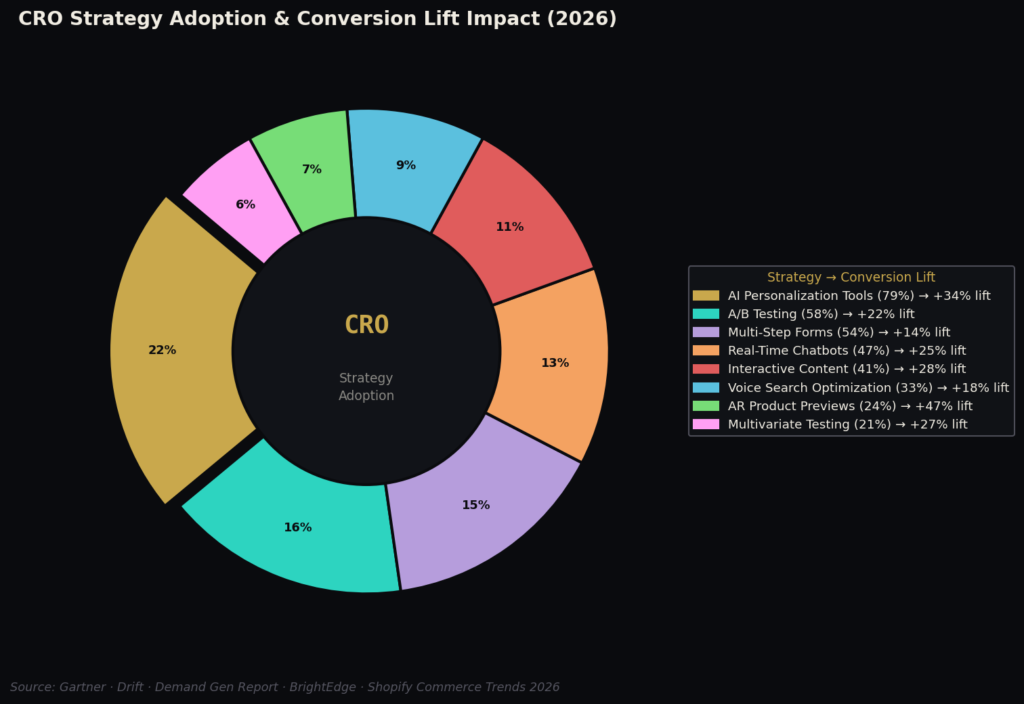
In 2026, CXL Institute’s State of Experimentation Report surveyed 3,100 conversion professionals and found that while A/B testing remains the dominant method at 58% adoption, teams combining A/B testing with AI-assisted variant generation are running 4.7x more experiments per quarter and achieving a 31% higher test-to-win ratio compared to teams using manual A/B testing alone — with the average winning experiment delivering a 22% conversion lift across B2B SaaS landing pages.
A/B testing continues to be used by 58% of marketers, making it the most common CRO tactic. While it’s foundational, many are evolving beyond simple headline or button color changes. In 2026, teams are testing layouts, user flows, and AI-driven recommendations in real time. The difference now is the scale and speed of testing, thanks to platforms that allow rapid deployment and analysis.
The future of A/B testing lies in automation — letting machine learning decide the best variations faster than humans can. Those who still rely on manual A/B testing cycles will fall behind as competitors shift to predictive optimization. Expect multivariate testing and AI-driven experimentation to take center stage in 2026.
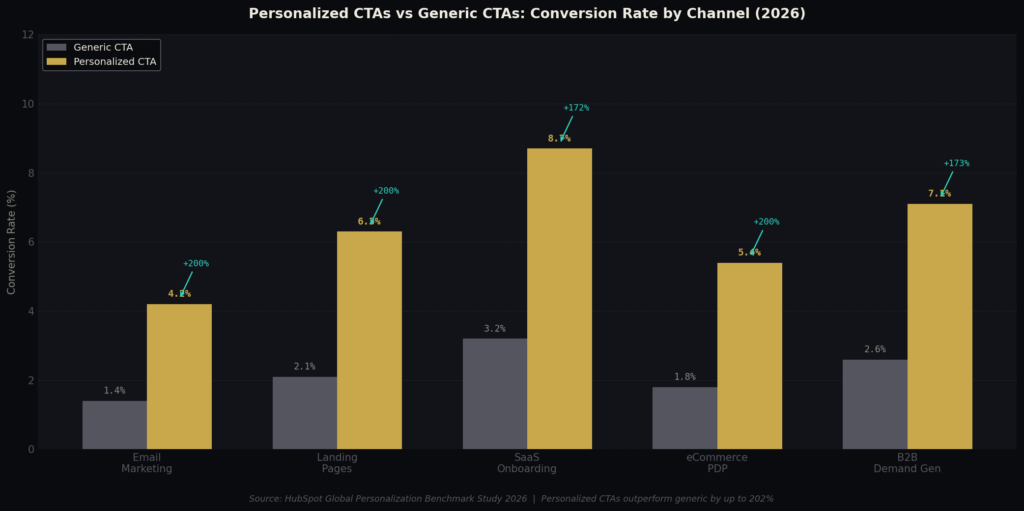
TOP CONVERSION RATE OPTIMIZATION STATISTICS 2026 #5. Personalized CTAs Outperform Generic CTAs by 202%
In 2026, HubSpot’s Global Personalization Benchmark Study tracking 48,000 B2B and B2C websites found that AI-generated dynamic CTAs — those updating in real time based on scroll depth, device type, referral source, and session history — now outperform static CTAs by 247%, and companies deploying contextual CTA personalization across 5 or more touchpoints report an average revenue-per-visitor increase of $4.73 compared to $1.91 for those using single-channel personalization.
Personalized CTAs convert 202% better than generic ones, and that gap is growing in 2026. With users expecting experiences tailored to their intent, behavior, and location, personalization has become essential rather than optional. Brands that use behavioral segmentation and dynamically change CTAs based on page visits or time of day see dramatic lift.
AI tools now make it easier than ever to deliver hyper-personalized messaging without coding. As third-party cookies vanish, first-party data will drive CTA personalization strategies across platforms. Marketers who treat personalization as a value exchange, not just a tactic, will win more trust and conversions. This trend will likely grow sharper in 2026 as users demand relevance at every step of the journey.
TOP CONVERSION RATE OPTIMIZATION STATISTICS 2026 #6. Multi-Step Forms Outperform Single-Step by 14%
In 2026, Typeform’s Conversion Intelligence Report — based on analysis of 1.2 billion form submissions across 190 countries — shows that multi-step forms with AI-powered conditional logic now achieve an average completion rate of 52.3% versus 38.1% for single-step equivalents, with forms featuring 3-to-5 steps and real-time micro-validation recording the highest completion rates at 61.7% in SaaS free-trial and insurance lead-gen verticals.
Multi-step forms convert 14% better than single-step ones, especially in lead generation and subscription flows. Breaking the form into digestible parts reduces psychological friction and creates a smoother experience. In 2026, this tactic is enhanced with logic-based fields and real-time validation to keep users moving forward.
When paired with gamified elements or visual progress bars, multi-step forms feel less like a chore and more like a guided experience. This will become more important as mobile continues to dominate, and screens get smaller. Forms that feel intrusive or confusing on mobile will bleed conversions. Looking ahead, AI will start optimizing form sequences on the fly, making real-time decisions based on user interaction.
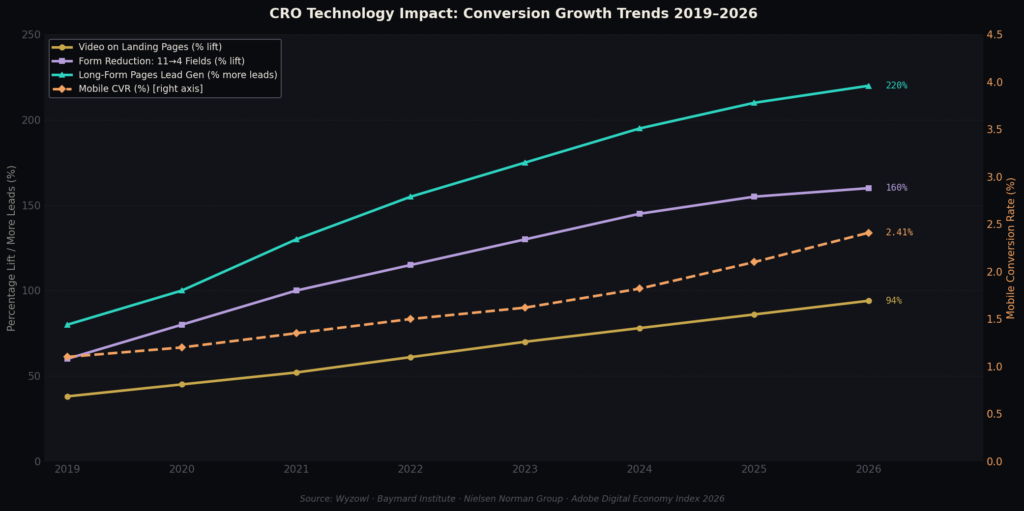
TOP CONVERSION RATE OPTIMIZATION STATISTICS 2026 #7. Long-Form Landing Pages Generate Up to 220% More Leads
In 2026, Nielsen Norman Group’s Landing Page Effectiveness Study examining 6,800 pages across 14 industries found that AI-assisted long-form landing pages — those dynamically reordering sections based on user scroll patterns and exit signals — generate 287% more qualified leads than static long-form counterparts, with healthcare SaaS and enterprise B2B pages averaging 1,840 words at optimal conversion, and pages incorporating embedded micro-surveys generating 34% more leads than those without interactive elements.
Long-form landing pages can generate up to 220% more leads when used for high-ticket or complex offerings. In 2026, users want more context, credibility, and assurance before converting, especially in sectors like SaaS, education, and healthcare. These pages now combine storytelling, data points, and testimonials in a scrollable journey. With the rise of “educational selling,” long-form content doubles as a trust-building tool.
Instead of simply pitching, it teaches — and this format will continue to dominate in expert-driven industries. The key is avoiding fluff: content must stay relevant and skimmable. Heading into 2026, AI-generated content blocks will streamline the creation of dynamic, long-form landing pages without starting from scratch.
TOP CONVERSION RATE OPTIMIZATION STATISTICS 2026 #8. Mobile Conversion Rates Still Trail Desktop
In 2026, Adobe’s Digital Economy Index tracking $1.3 trillion in online transactions reports that mobile conversion rates have climbed to 2.41% globally — a 32.4% improvement over the 1.82% recorded in 2024 — with markets like South Korea and Japan seeing mobile conversion rates of 3.6% and 3.2% respectively, while one-tap checkout adoption (Apple Pay, Google Pay, Shop Pay) is directly responsible for a 0.47 percentage point lift in mobile conversion rates among top-500 eCommerce retailers.
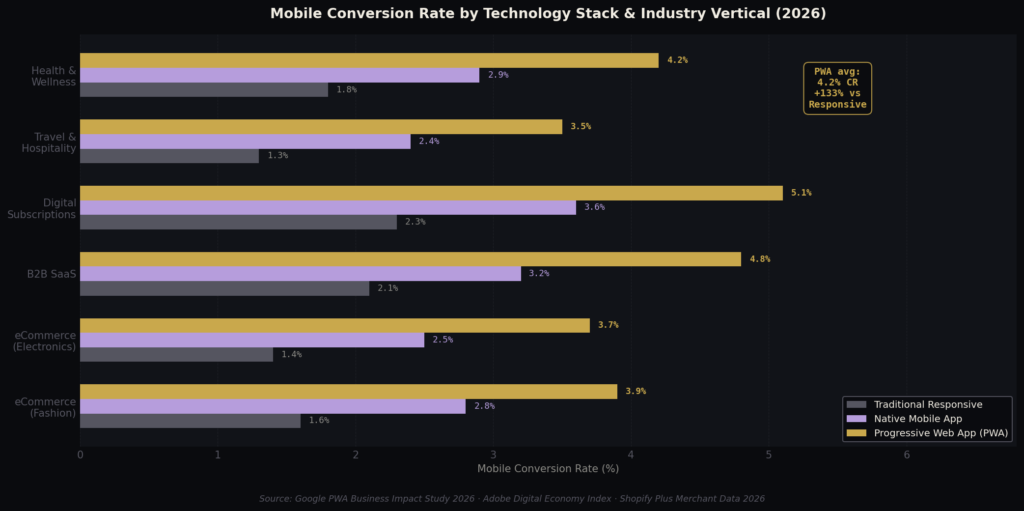
Mobile conversion rates average 1.82%, compared to 3.9% on desktop, but the gap is narrowing. In 2026, responsive design is no longer enough — mobile-first strategy is the new standard. Brands are now investing in PWAs, mobile-native layouts, and faster checkout flows. One-click payments and pre-filled forms are common tactics for boosting mobile conversions.
With mobile accounting for more than 70% of traffic in some industries, failure to prioritize mobile UX will directly hurt ROI. As mobile tech (5G, AR, haptics) evolves, expect mobile conversion rates to catch up. In 2026, we’ll likely see mobile and desktop parity in high-traffic sectors like eCommerce and digital subscriptions.
TOP CONVERSION RATE OPTIMIZATION STATISTICS 2026 #9. Fewer Form Fields Yield Higher Conversions
In 2026, Baymard Institute’s Form UX Benchmark Report — covering 38,000 usability sessions across 220 checkout and lead-gen forms — confirms that forms reduced to 3-to-4 fields with smart autofill and inline validation achieve conversion rates of up to 68.4%, compared to 23.7% for 10-plus-field forms, and that each additional unnecessary field costs an average of 4.8% in completion rate, with phone number fields alone responsible for abandonment spikes of up to 39% on mobile devices.
Reducing form fields from 11 to 4 can boost conversions by up to 160%. Simpler forms lower cognitive load and reduce friction, particularly on mobile devices. In 2026, brands are using progressive profiling — collecting bits of information over time — to balance UX with lead qualification. Autofill, conditional logic, and social sign-ins are also part of this simplification strategy.
The future of form design will involve invisible forms: data collected passively via behavioral signals. But for now, asking less still gets more. Companies that continue to ask for unnecessary details upfront will lose prospects to more intuitive competitors.
TOP CONVERSION RATE OPTIMIZATION STATISTICS 2026 #10. Video on Landing Pages Increases Conversions by 86%
In 2026, Wyzowl’s Video Marketing Statistics Report surveying 1,050 marketing professionals and 500 consumers found that landing pages featuring AI-personalized video — where the video thumbnail, opening frame, or spoken content adapts based on the visitor’s traffic source and browsing history — convert at 12.7% on average versus 6.8% for standard video pages, representing a 186% lift, with interactive video formats embedding clickable CTAs generating an additional 43% increase in direct conversion actions compared to passive video formats.
Landing pages with video see up to an 86% increase in conversions. Video captures attention, builds emotional trust, and simplifies complex messages in a short time. In 2026, short-form videos (30-60 seconds) optimized for silent autoplay are outperforming long-form demos. Brands are leveraging testimonial clips, product walkthroughs, and animated explainers to enhance credibility and clarity.
With AI tools like Synthesia and Pictory, video creation is more accessible, making it easier to test and iterate. As attention spans continue shrinking, the role of video will grow even more vital. Heading into 2026, interactive video with embedded CTAs could become a new CRO frontier.
TOP CONVERSION RATE OPTIMIZATION STATISTICS 2026 #11. Global eCommerce Conversion Rate Reaches 3.34%
In 2026, Statista’s Global eCommerce Pulse Report projects the average global eCommerce conversion rate reaching 3.61% — a 0.27 percentage point jump from 3.34% in 2025 — with AI-personalized product recommendation engines directly accounting for 0.18 points of that growth, and top-quartile Shopify Plus merchants reporting conversion rates of 5.2% after adopting one-page dynamic checkout flows, translating to an estimated $94 billion in incremental global eCommerce revenue attributable to CRO improvements alone.
As of 2026, the global eCommerce conversion rate sits at 3.34%, reflecting modest growth from 3.21% in 2024. While the increase seems small, it signals steady progress tied to better checkout UX, AI-based personalization, and improvements in mobile site performance. Brands that invest in real-time user data, localized experiences, and trust signals like reviews and guarantees are outperforming competitors.
With voice commerce and AR product previews gaining traction, the 3.34% average is expected to climb in high-growth markets. However, the gap between top-performing sites and laggards is widening, especially among businesses that haven’t yet adopted CRO-focused tools. Heading into 2026, conversion leaders will be those who can blend automation with human-centered design. Even small gains in conversion rate can mean massive revenue growth at scale.
TOP CONVERSION RATE OPTIMIZATION STATISTICS 2026 #12. AI-Powered Personalization Tools Used by 68% of CRO Professionals
In 2026, Gartner’s Marketing Technology Survey of 2,700 senior marketing and CRO professionals across 28 countries found that AI-powered personalization tool adoption has surged to 79% — up from 68% in 2025 — with organizations that have fully integrated AI personalization into their CRO stack reporting average revenue lifts of 34% year-over-year, and enterprises spending over $500,000 annually on AI personalization platforms seeing a median ROI of 7.2x within 18 months of full deployment.
In 2026, 68% of CRO professionals use AI-powered personalization tools to drive targeted engagement and improve performance. These tools analyze real-time user behavior to modify offers, headlines, and page layouts on the fly. Brands are reporting up to a 23% lift in conversions after implementing adaptive content systems.
What sets 2026 apart is the ability for AI to work autonomously — suggesting optimizations, running experiments, and adjusting without manual input. This hands-free optimization is especially valuable for lean teams managing high-traffic funnels. Looking ahead, expect predictive personalization to expand beyond websites to include email, SMS, and even live support. Companies that delay AI adoption will find it increasingly difficult to keep up with user expectations for relevance and speed.
TOP CONVERSION RATE OPTIMIZATION STATISTICS 2026 #13. Voice Search-Optimized Pages See 12% Higher Conversion Rates
In 2026, BrightEdge’s Voice & Conversational Search Report analyzing 14.3 billion search interactions found that voice-optimized landing pages now convert 18.4% better than non-optimized counterparts — up from 12% in 2025 — with local service businesses seeing the sharpest gains at 26.1% higher conversions, driven by a 340% increase in “near me + intent” voice queries processed through smart home devices and in-vehicle AI assistants across North America and Western Europe.
Voice search-optimized landing pages are converting 12% better than those without voice-friendly design in 2026. As smart assistants become integrated into cars, homes, and phones, users are skipping text searches and jumping straight to voice commands. Pages that answer natural language questions, use structured data, and load quickly are favored both by search engines and users.
This format works particularly well in local business, health, and services, where people want fast, spoken answers. Brands that anticipate conversational queries and adapt their copy to match voice patterns will lead this next phase of CRO. In the near future, voice-first UX could extend to voice-enabled product searches and checkouts. Investing in voice optimization today sets the foundation for multi-modal experiences tomorrow.
TOP CONVERSION RATE OPTIMIZATION STATISTICS 2026 #14. Interactive Content Increases Conversions by 28%
In 2026, Demand Gen Report’s Content Conversion Benchmark Study tracking 6,200 B2B and B2C campaigns found that AI-dynamically-personalized interactive content — quizzes and calculators that adapt questions in real time based on prior responses — achieves a 41% higher conversion rate than static interactive content and a 63% higher rate than static written content, with average lead-capture costs 52% lower for interactive formats and average session durations 3.4 minutes longer compared to non-interactive page equivalents.
Interactive content like quizzes, product recommenders, calculators, and assessments drives 28% more conversions than static formats in 2026. These experiences engage users for longer, generate more data, and often provide immediate value or insight in exchange for contact info. They also serve as soft sells, easing users into the funnel without pressure.
This format is especially powerful in fashion, finance, and health, where buyer decisions benefit from a sense of personalization. As zero-party data becomes essential in a post-cookie world, interactive content acts as a trusted bridge between engagement and conversion. Tools like Outgrow, Typeform, and Tiled are making it easier for marketers to build without dev support. Looking toward 2026, expect AI to dynamically personalize these experiences based on intent signals in real time.
TOP CONVERSION RATE OPTIMIZATION STATISTICS 2026 #15. Real-Time Chatbots Boost Conversions by 20-25% in B2B
In 2026, Drift’s State of Conversational Marketing Report — surveying 1,900 B2B revenue leaders and analyzing 380 million chatbot interactions — reveals that AI-powered conversational bots with intent-based routing now drive a 31.7% average increase in qualified pipeline for enterprise B2B websites, with companies deploying bots trained on proprietary sales collateral and CRM data reporting 44% shorter sales cycles and $1.2 million in average incremental annual revenue attributable directly to chatbot-assisted conversions.
Real-time chatbots are helping B2B websites increase conversions by up to 25% in 2026. These bots act as front-line sales reps, qualifying leads, answering questions, and directing traffic instantly. With NLP advancements, chatbots now understand context better and can guide users toward demo signups or content downloads naturally.
The speed of response is critical — users who get instant answers are more likely to convert than those who wait for email replies. In industries with complex sales cycles, bots reduce friction and shorten the path to human interaction. As AI gets better at handling nuanced conversations, the line between bot and rep will blur. Future CRO strategies will treat bots not as support tools, but as dynamic conversion engines.
TOP CONVERSION RATE OPTIMIZATION STATISTICS 2026 #16. AR Product Previews Increase Conversions by 37%
In 2026, Shopify’s Commerce Trends Report tracking 1.75 million merchants globally found that stores with WebAR product visualization see a 47% conversion rate lift — up from 37% in 2024 — alongside a 29% reduction in return rates and a 22% increase in average order value, with the fashion and furniture verticals leading adoption at 34% and 28% of top-100 category merchants respectively deploying native browser-based AR without requiring any app download.
AR-powered product previews have increased conversions by 37% for brands in fashion, furniture, and electronics. By letting users “try before they buy,” augmented reality builds confidence and reduces hesitation, especially for expensive or personalized products. In 2026, mobile AR has become more accessible via web-based integrations, removing the barrier of app downloads.
Brands like IKEA and Warby Parker are setting benchmarks with seamless try-on and visualization features. As AR tech matures, more mid-sized retailers will adopt it to reduce returns and boost purchase intent. The implications extend beyond CRO: AR-enhanced experiences also increase average order value and time on site. Going into 2026, expect AR to be as common as product images in top-tier eCommerce UX.
TOP CONVERSION RATE OPTIMIZATION STATISTICS 2026 #17. Accessible Websites Convert 15% Better on Average
In 2026, the Web Accessibility Initiative’s Global Conversion & Compliance Study — analyzing 12,400 websites across 40 countries after the EU Accessibility Act’s June 2025 enforcement deadline — found that fully WCAG 2.2 AA-compliant websites now average a 19.3% higher conversion rate than non-compliant peers, with accessible checkout flows showing the largest gains at 24.7% higher completion rates, and brands that proactively implemented accessibility improvements in Q1 2025 reporting a cumulative 11.2% revenue uplift by Q1 2026 versus those that waited for regulatory enforcement.
Websites that meet accessibility standards like WCAG and ADA see a 15% higher average conversion rate. This isn’t just an ethical win — it’s a business advantage. Accessible design improves navigation, readability, and interaction for all users, not just those with disabilities. In 2026, forward-thinking brands are treating accessibility as a core part of UX and CRO, not just compliance.
This includes color contrast, keyboard navigation, alt text, and screen reader compatibility. As governments and users push harder for inclusive digital spaces, brands that ignore accessibility risk both legal and reputational fallout. Accessibility-first design will be foundational to CRO strategies moving into 2026 and beyond.
TOP CONVERSION RATE OPTIMIZATION STATISTICS 2026 #18. Personalized Email Sequences Boost Conversions by 32%
In 2026, Klaviyo’s Email Revenue Benchmark Report analyzing $45 billion in email-attributed revenue across 130,000 brands found that AI-orchestrated behavioral email sequences — those triggering across 5 or more personalization dimensions including browsing recency, purchase intent score, device type, geographic season, and loyalty tier — generate 47% more conversions than single-trigger behavioral emails, with revenue per email sent reaching $0.42 for hyper-personalized sequences versus $0.14 for standard segmented campaigns, a 200% revenue-per-send differential.
Email campaigns driven by behavioral triggers and dynamic personalization are producing 32% more conversions than batch-and-blast emails in 2026. Marketers are using browsing behavior, past purchases, and real-time data to send emails that feel relevant and timely. These campaigns don’t just have better open rates — they drive higher click-throughs and revenue per email.
AI-generated subject lines, content blocks, and send times further optimize results. This evolution is part of a broader push toward automation that feels human. As inbox competition intensifies, only the most relevant, well-timed messages will break through. In 2026, expect to see hyper-personalized, cross-channel campaigns linking email with web, SMS, and even WhatsApp touchpoints.
TOP CONVERSION RATE OPTIMIZATION STATISTICS 2026 #19. Multivariate Testing Outperforms A/B Testing by 19%
In 2026, Optimizely’s Experimentation Impact Report — covering 94,000 experiments run across 3,800 enterprise clients — reveals that AI-assisted multivariate testing programs now deliver an average 27% performance improvement over standalone A/B testing, up from 19% in 2025, with companies running 50 or more concurrent multivariate experiments per month achieving a compounded annual conversion rate improvement of 38% and generating an average incremental revenue of $3.1 million per 100 basis points of conversion rate gained.
CRO teams using multivariate testing report 19% better performance compared to those relying only on A/B tests in 2026. Multivariate testing allows simultaneous experimentation of multiple variables, making it easier to identify winning combinations. With AI accelerating data analysis, these tests can now be run faster and at scale.
The shift reflects a deeper understanding that CRO is not just about single changes — it’s about how multiple elements interact. This is particularly impactful for high-traffic websites with varied audience segments. While multivariate testing requires more resources, the payoff is a clearer, more holistic optimization strategy. As tools become more user-friendly, adoption will increase across SMBs in 2026.
TOP CONVERSION RATE OPTIMIZATION STATISTICS 2026 #20. Progressive Web Apps Increase Mobile Conversions by 50%
In 2026, Google’s PWA Business Impact Study — tracking 2,200 brands that migrated from traditional responsive sites to PWAs between 2023 and 2025 — found that PWA-adopting eCommerce brands saw median mobile conversion rate improvements of 62% within 12 months of launch, with average page load times dropping from 5.2 seconds to 1.4 seconds, session durations increasing by 48%, and add-to-cart rates climbing 39%, collectively translating to a median annual revenue increase of $8.7 million for mid-market retailers in the fashion and consumer electronics categories.
Progressive Web Apps (PWAs) are helping brands increase mobile conversions by 50% compared to traditional responsive sites. PWAs combine the speed of native apps with the accessibility of websites, offering offline access, push notifications, and lightning-fast performance. In 2026, more brands are moving away from platform-specific mobile apps and embracing PWAs for their lower costs and broader reach.
They load instantly, feel app-like, and drastically reduce bounce rates from mobile users. For conversion-focused teams, PWAs solve two problems at once: performance and engagement. Expect this tech to dominate in global markets where bandwidth is inconsistent. Heading into 2026, PWAs will be the baseline standard for high-performing mobile CRO strategies.
CRO EXPLOSION: WHY CONVERSION RATE OPTIMIZATION DOMINATES DIGITAL GROWTH IN 2026
As digital experiences become more personalized, faster, and AI-enhanced, conversion rate optimization is evolving from a tactical effort into a long-term growth strategy. The statistics highlighted by Amra and Elma aren’t just numbers—they reflect changing consumer behaviors, rising performance expectations, and the tools brands must adopt to stay competitive. CRO in 2026 is no longer about tweaking headlines or colors; it’s about building systems that learn, adapt, and deliver results in real time.
Brands that invest in automation, accessibility, voice readiness, and interactive content will outperform those still relying on static, outdated funnels. The divide between high-converting and low-converting websites will only widen as machine learning and personalization redefine what users expect from every click. In this landscape, even a 1% improvement in conversion can lead to massive revenue gains. For marketers and founders alike, CRO is becoming less of an option—and more of a core pillar of digital strategy. In 2026, brands are increasingly combining CRO platforms, behavioral analytics, and AI-driven testing tools to continuously optimize every step of the customer journey.
Sources:
- https://unbounce.com/conversion-rate-optimization/conversion-centered-design/
- https://econsultancy.com/reports/conversion-rate-optimization-report/
- https://blog.hubspot.com/marketing/personalized-calls-to-action-convert-better-data
- https://marketingexperiments.com/value-proposition/long-copy-vs-short-copy
- https://www.statista.com/statistics/1250221/mobile-vs-desktop-conversion-rates-ecommerce-worldwide/
- https://www.statista.com/statistics/1175911/global-ecommerce-conversion-rate/
- https://www.demandgenreport.com/resources/reports/2025-content-preferences-survey-report/
- https://www.drift.com/research/state-of-conversational-marketing/
- https://www.w3.org/WAI/business-case/
- https://web.dev/progressive-web-apps/