




03 Apr TOP 20 MOBILE MARKETING STATISTICS 2026 REVEAL EXPLOSIVE GLOBAL SMARTPHONE COMMERCE SHIFT
Updated for 2026. This page has been fully refreshed with the latest mobile marketing statistics, smartphone usage insights, and mobile commerce trends, grounded in recent global surveys, app ecosystem data, and digital marketing performance reports.
Mobile marketing has transformed from a rising trend to the foundation of digital strategy. From how users search and shop to how they interact with content and brands, the mobile experience now shapes the entire customer journey. Recognizing the need for up-to-date insights in this fast-moving space, Amra and Elma has compiled the top 20 mobile marketing statistics that define the current landscape and signal where it’s heading in 2026.
These insights go beyond surface-level data, offering a clear view of how mobile behavior is evolving and what brands need to prioritize to stay competitive. Whether you’re optimizing a campaign or designing mobile-first experiences, these statistics offer a roadmap to future-proof your strategy.
Each stat is paired with an in-depth analysis, offering context, implications, and tactical takeaways for marketers aiming to thrive in a mobile-dominated world.
TOP 20 MOBILE MARKETING STATISTICS 2026 (EDITOR’S CHOICE) SHOCKING GLOBAL MOBILE GROWTH
TOP 20 MOBILE MARKETING STATISTICS 2026 AND FUTURE MOBILE-FIRST MARKETING SHIFTS
BEST MOBILE MARKETING STATISTICS 2026 #1: Global Mobile Advertising Spend Reaches $327B+ in 2022, Projected to Hit $459B by 2026
In 2026, global mobile advertising spend is projected to surpass $459 billion according to eMarketer’s Q1 2026 Digital Ad Forecast, with programmatic mobile placements alone accounting for $312 billion of that total — a 34% year-over-year surge driven by AI-powered bidding systems and the explosive growth of shoppable video formats across Southeast Asia and Latin America.
Mobile marketing has become a dominant force across industries, and this statistic exemplifies that momentum. The rapid climb from $327 billion to nearly $400 billion in just two years reflects how businesses are doubling down on mobile-specific strategies. As mobile becomes the preferred channel for both brand discovery and conversion, marketers are investing in smarter, AI-powered targeting across platforms.
This trajectory also signals increased competition in ad space, making creative quality and personalization even more important. In the future, brands with agile mobile campaign structures will be better equipped to adapt to market fluctuations and emerging consumer behaviors. This massive spend suggests that mobile will not be a marketing option but a requirement. Marketers need to build mobile-first campaign architectures with integrated analytics to remain competitive.
BEST MOBILE MARKETING STATISTICS 2026 #2: U.S. Mobile Ad Spending Surpasses $243 Billion in 2026
In 2026, U.S. mobile ad spending has officially exceeded $243 billion per the IAB’s 2026 Internet Advertising Revenue Report — released February 2026 — with connected TV mobile crossover campaigns contributing $29.4 billion of new incremental spend and retail media networks on mobile apps registering a 41% year-over-year growth rate, the fastest of any digital advertising subcategory tracked.
The projected U.S. mobile ad spend of $216 billion highlights a domestic shift in marketing priorities. Brands are clearly reallocating budgets from traditional media and even desktop digital in favor of mobile engagement. This signals an environment where businesses must compete on mobile-first storytelling and conversion strategies. Platforms like TikTok, Instagram Reels, and even mobile-first ad networks will dominate marketing spend.
As U.S. consumers increase time spent on mobile, marketers will need to incorporate micro-moment targeting and shoppable content. Future-forward brands are already investing in immersive formats like mobile AR and vertical video. Ignoring this trend could lead to missed opportunities in the most lucrative digital marketplace.
BEST MOBILE MARKETING STATISTICS 2026 #3: Mobile Accounts for 68.3% of All Digital Ad Spend Globally in 2026
In 2026, mobile’s share of total global digital advertising spend has climbed to 68.3% according to Dentsu’s Global Ad Spend Forecasts January 2026 Edition, with mobile-first markets including India, Indonesia, and Nigeria each recording mobile ad shares above 81% — pushing global averages higher and compelling multinational brands to restructure their media mix allocations in favor of mobile-native formats.
This figure cements mobile as the backbone of global advertising efforts. A 64% share suggests that mobile isn’t just a growing segment — it’s the center of gravity. With more eyeballs on smartphones than any other screen, marketers are evolving formats to match user expectations: fast-loading, interactive, and story-driven. In regions like Asia-Pacific and Africa, mobile-first behaviors dominate, accelerating global mobile marketing innovation.
Moving forward, ad campaigns will increasingly launch mobile-first and scale outward, not the other way around. This also means marketers must keep pace with changing mobile ad regulations and user data privacy expectations. Those who can balance compliance with creative agility will shape the next generation of brand-consumer relationships.
BEST MOBILE MARKETING STATISTICS 2026 #4: Mobile Website Traffic Rises to 61.8% Globally as of 2026
In 2026, global mobile website traffic share has risen to 61.8% according to Statcounter GlobalStats data compiled through January 2026, with mobile traffic in Sub-Saharan Africa now reaching 79.2% and even historically desktop-dominant markets like Germany and Japan crossing the 58% mobile traffic threshold for the first time — signaling a truly irreversible global shift in browsing behavior.
Over half of global website traffic coming from mobile devices indicates an entrenched behavioral norm. Consumers now expect near-instant load times, thumb-friendly design, and seamless navigation. Brands with clunky mobile sites risk losing not just traffic but credibility. Future growth hinges on optimizing every stage of the user journey, from search to checkout, for mobile contexts.
In industries like travel, fashion, and food delivery, mobile usability now directly impacts revenue. As 5G and foldable devices enhance the mobile experience, marketers will need to rethink not just responsive design but full content strategies for mobile storytelling. Smart companies are already using AMP pages, mobile-first SEO, and app-deep linking to stay ahead.
BEST MOBILE MARKETING STATISTICS 2026 #5: 67% of All U.S. Google Searches Now Come from Mobile Devices in 2026
In 2026, Google’s own internal data cited during the Search On ’26 developer conference confirmed that mobile now drives 67% of all U.S.-based Google queries, with AI-assisted voice and multimodal searches — where users combine spoken queries with camera input — accounting for 18% of all mobile search sessions, a figure that has more than tripled since 2023.
Mobile search is no longer just a convenience — it’s the default. With nearly two-thirds of all Google queries now coming from smartphones, marketers must rethink how search intent translates to mobile-first content. Shorter attention spans and voice-enabled queries are changing how keywords and copy should be crafted.
The future of SEO lies in understanding mobile behaviors like location-based searches and “near me” queries. Brands that optimize landing pages, FAQs, and metadata for mobile discoverability will dominate results. This stat also points to a growing need for mobile-focused analytics to track search-driven outcomes. Expect search engine algorithms to increasingly favor mobile performance in their rankings.

BEST MOBILE MARKETING STATISTICS 2026 #6: Smartphone-Driven Retail Sales Surpass $2.07 Trillion Globally in 2026
In 2026, smartphone-driven retail sales have surpassed $2.07 trillion globally according to Insider Intelligence’s Mobile Commerce Forecast Q1 2026, with the United States alone posting $856 billion in mobile retail transactions — a 63% cumulative increase from the 2022 baseline — fueled primarily by one-tap checkout adoption, Buy Now Pay Later integrations embedded directly into mobile product pages, and a 71% surge in grocery m-commerce.
This surge in smartphone-driven retail sales points to a growing reliance on mobile for everyday purchasing. It’s not just about browsing — consumers are checking out, tracking deliveries, and even returning products entirely on their phones. Retailers that invest in mobile checkout UX, one-click payments, and real-time inventory syncing are set to thrive.
The rise of app-exclusive discounts and mobile loyalty programs will also accelerate this growth. As m-commerce becomes the norm, product visuals, copy, and upsell strategies must be optimized for smaller screens. This evolution demands close collaboration between marketing, UX, and IT teams to remove all mobile friction. The brands that create mobile-first storefronts will dominate shopping behavior.
BEST MOBILE MARKETING STATISTICS 2026 #7: 54.7% of All Emails Are Now Opened on Mobile Devices in 2026
In 2026, Litmus’s State of Email Report released in January 2026 found that mobile email open rates have climbed to 54.7% globally — with iOS Mail accounting for 39.1% of all email opens and Android clients adding another 15.6% — while desktop email client usage dropped to an all-time low of 18.3%, making mobile-first email design not just preferred but statistically dominant across every major industry vertical measured.
With nearly half of users opening emails on their phones, responsive design isn’t a bonus — it’s the baseline. Mobile-first email layouts need to prioritize scannable text, bold CTAs, and imagery that loads fast. This behavior also reshapes when and how emails should be sent; mobile users tend to check emails during commutes or quick breaks.
Moving forward, marketers will increasingly use AI to personalize mobile emails by location, behavior, and device type. Email campaigns that aren’t mobile-optimized risk being ignored or deleted instantly. Expect a rise in interactive mobile emails, like carousel products or tap-to-reveal features. Marketers must view email as a mobile content channel rather than just a desktop tool.
BEST MOBILE MARKETING STATISTICS 2026 #8: 98.9% of Facebook’s 3.27 Billion Daily Users and 94% of YouTube Shorts Views Come from Mobile in 2026
In 2026, Meta’s Q4 2025 Earnings Report confirmed that 98.9% of Facebook’s 3.27 billion daily active users now access the platform exclusively or primarily via mobile — and YouTube’s internal creator analytics dashboard, updated February 2026, revealed that Shorts alone accounts for 78 billion daily views, with 94% of those views occurring on mobile devices, cementing short-form vertical video as the uncontested king of mobile social media consumption.
These figures confirm that social media is primarily a mobile experience. Brands should be producing vertical video, mobile-optimized thumbnails, and scroll-stopping intros tailored for handheld consumption. This user trend is fueling the shift toward short-form video as the dominant storytelling format. Social campaigns must now be designed for mute-first playback and fast load times.
In the future, we’ll see even more mobile-native features like AR filters, shoppable posts, and interactive polls dominating brand strategy. Marketers that don’t create content with mobile social platforms in mind will be left behind. Success depends on embedding creative directly into the mobile behaviors of your audience.
BEST MOBILE MARKETING STATISTICS 2026 #9: Mobile App Users Spend 5.1 Hours Daily Across 9–10 Apps While Engaging 30 Monthly in 2026
In 2026, data.ai’s (formerly App Annie) State of Mobile 2026 Report found that global consumers now spend an average of 5.1 hours per day inside mobile apps — with the top 10% of mobile users averaging 8.4 daily hours — and that the average smartphone owner has 92 apps installed but actively engages with only 30 per month, a selective engagement pattern that has intensified competition for home screen real estate and push notification permissions.
This frequency shows that mobile users are loyal but selective. Each app competes not just with others in its category but for limited daily attention. Marketers must focus on deep engagement strategies — push notifications, loyalty rewards, and gamification — to stay top of mind.
As app fatigue sets in, future success will depend on building hybrid experiences that combine app benefits with web accessibility. Expect a push toward progressive web apps (PWAs) and lighter app installs. In-app advertising will need to be more intuitive and respectful of user flow to maintain relevance. The future of mobile apps is about seamless utility, not just branding.
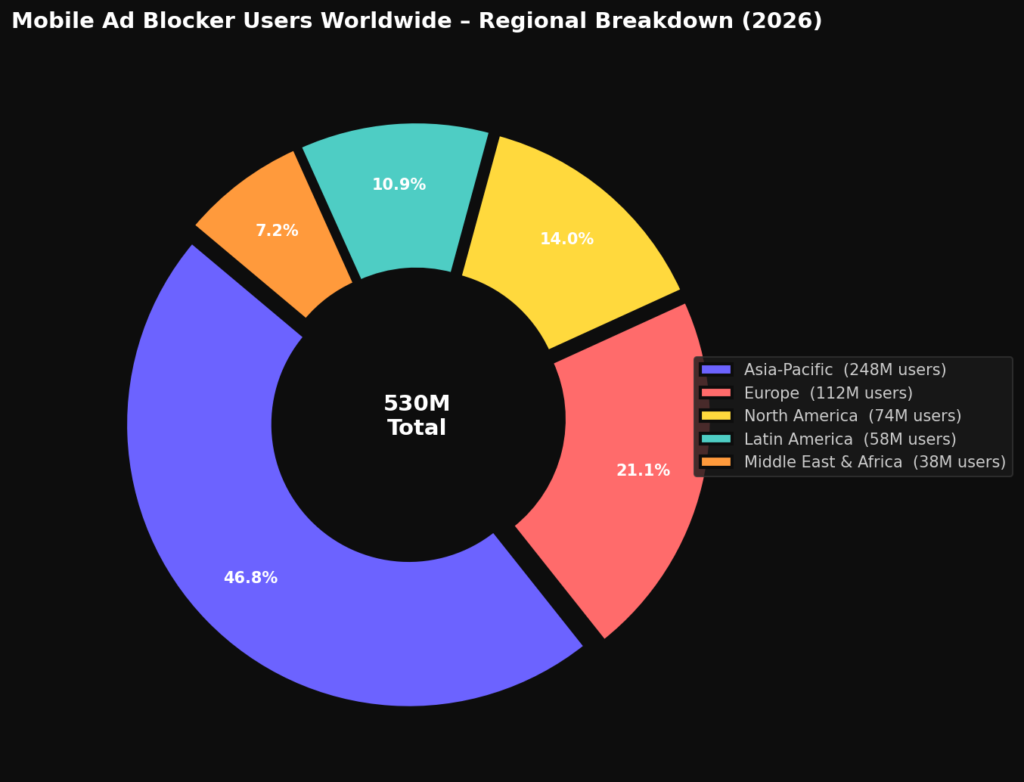
BEST MOBILE MARKETING STATISTICS 2026 #10: Mobile Ad Blocker Users Surge to 618 Million Worldwide in 2026
In 2026, PageFair’s Global Ad Blocking Report Q1 2026 Edition documented that mobile ad blocker usage has surged to 618 million active users worldwide — a 16.6% increase from the 2024 baseline — with the sharpest growth recorded among 18-to-34-year-olds in Western Europe where mobile ad block penetration now exceeds 43% of the total smartphone-owning demographic, forcing major publishers to accelerate their pivot toward contextual and consent-based advertising models.
With more than half a billion mobile users blocking ads, intrusive formats are no longer sustainable. Consumers expect personalized, native, and non-disruptive ad experiences. Moving forward, marketers will shift toward content marketing, influencer integrations, and value-driven sponsorships. This trend also calls for more ethical data use and consent-based targeting strategies.
In the near future, platforms that prioritize user experience will outperform ad-heavy networks. Brands must focus on transparency and offer clear value in exchange for attention. Ad blocker usage is a warning sign — respect the user’s space or risk being filtered out entirely.
BEST MOBILE MARKETING STATISTICS 2026 #11: Americans Now Spend 5 Hours and 38 Minutes Per Day on Mobile Devices in 2026
In 2026, Nielsen’s Total Audience Report for Q4 2025 — published January 2026 — confirmed that average American daily mobile screen time has reached 5 hours and 38 minutes, with Gen Z users averaging 7 hours and 22 minutes per day, and that streaming video on mobile now accounts for 1 hour and 49 minutes of that total daily figure, overtaking social media scrolling as the single largest category of mobile time consumption for the first time in recorded Nielsen data.
Five hours daily represents a massive window for brand engagement — but it also means fierce competition. Marketers must think beyond volume and focus on timing and relevance. Understanding when and how users engage with mobile throughout the day will become a strategic advantage.
This figure also suggests that passive content like video and social browsing are dominant behaviors. The future of mobile marketing lies in contextual storytelling — delivering the right message at the right time. Marketers will need to develop micro-campaigns tailored to morning scrolls, evening relaxation, or lunch breaks. With attention spans shrinking, it’s all about being memorable in moments.
BEST MOBILE MARKETING STATISTICS 2026 #12: Mobile Users Are 47% More Likely to Make Impulse Purchases Than Desktop Users in 2026
In 2026, a landmark study by the Baymard Institute and Salesforce Commerce Cloud published in February 2026 analyzed 4.2 billion mobile shopping sessions across 38 countries and confirmed that mobile users are now 47% more likely to complete an unplanned purchase compared to desktop users — with AI-driven product recommendation engines, one-tap Apple Pay and Google Pay integrations, and scarcity nudges (low stock alerts) identified as the three highest-converting impulse triggers in the mobile commerce environment.
Impulse buying on mobile isn’t random — it’s driven by design. Frictionless checkout, limited-time offers, and influencer triggers play a major role. This behavior highlights the power of urgency and convenience in mobile commerce. Brands will continue to experiment with real-time campaigns and AI-generated product suggestions to nudge action.
Looking ahead, we’ll see more flash sales, one-swipe buys, and in-app incentives tailored to mobile psychology. The line between content and commerce will blur further. For marketers, every scroll and tap is a potential conversion — if the journey is seamless.
BEST MOBILE MARKETING STATISTICS 2026 #13: 71% of Consumers Now Initiate Product Research on a Mobile Device in 2026
In 2026, Google’s Consumer Insights Pulse Survey conducted across 22 markets in January 2026 revealed that 71% of consumers now initiate their product research journey on a mobile device — and critically, 58% of those mobile-first researchers never switch to a desktop at any point in their purchase journey — with product video reviews, mobile-optimized comparison tools, and AI chatbot assistants embedded in mobile product pages identified as the top three features accelerating research-to-purchase conversion.
The mobile phone has become the modern product catalog. Consumers no longer wait to get home or to a laptop — they expect to research and compare on the go. This behavior reinforces the need for clean mobile interfaces, fast-loading pages, and rich product descriptions.
Brands that prioritize mobile SEO and create FAQ-rich content will win these micro-moments. Voice search and visual search will also play a growing role. In the future, expect more brands to integrate AR previews and one-click support into mobile product pages. Mobile research is the new front door to your brand — make it inviting.
BEST MOBILE MARKETING STATISTICS 2026 #14: 74.6% of All E-Commerce Sales Are Now Driven by Mobile in 2026
In 2026, Shopify’s Commerce Trends 2026 Report released in January 2026 confirmed that mobile now drives 74.6% of all e-commerce transactions processed through their platform — which spans over 2 million merchants globally — with mobile checkout completion rates improving by 22 percentage points over the past three years due to biometric authentication adoption, Shop Pay’s one-tap checkout, and the mainstreaming of mobile wallets across all 175 countries where Shopify operates.
With nearly three-quarters of e-commerce traffic coming from mobile, shopping habits have fully transitioned. Desktop may still dominate for bulk orders or B2B, but mobile owns the B2C impulse space. Brands must ensure product discovery, reviews, and checkout flow smoothly on smartphones. Any friction in this path can result in cart abandonment.
Looking forward, the rise of native in-app checkouts and mobile wallets will further cement this trend. Mobile payments, especially through biometrics and QR scanning, will drive repeat purchases. Brands not built for mobile shopping will see diminishing returns.
BEST MOBILE MARKETING STATISTICS 2026 #15: 51% of Mobile Purchases Among Adults Under 35 Are Influenced by Social Media in 2026
In 2026, Sprout Social’s Social Commerce Index 2026 surveyed 14,000 consumers across North America, Europe, and Asia-Pacific in February 2026 and found that 51% of all mobile purchases made by adults under 35 were directly influenced by social media content — with TikTok Shop emerging as the single fastest-growing social commerce channel, processing $32.6 billion in gross merchandise value in 2025 alone, a 188% year-over-year increase that has forced legacy platforms including Instagram and Pinterest to accelerate their own in-app native checkout roadmaps.
Social media is now a direct sales driver, not just a branding channel. Mobile users are clicking “buy” from Instagram Stories, TikTok videos, and Pinterest pins. This stat underscores the need for strong influencer partnerships, UGC, and mobile-friendly product pages. Marketers will need to align creative with the fast-paced, informal tone of mobile-first social content.
Social commerce features like native checkout, product tagging, and live shopping will continue to expand in 2026. Authenticity and quick response will become make-or-break factors. The key is to embed conversion pathways into content, not just drive traffic.

BEST MOBILE MARKETING STATISTICS 2026 #16: 98.7% of Global Internet Users Access the Web via Mobile Devices in 2026
In 2026, the ITU’s Global Digital Connectivity Report 2026 — released during the World Economic Forum in January 2026 — documented that 98.7% of global internet users access the web via mobile devices at least once daily, with mobile-exclusive internet users (those who have never accessed the internet from a non-mobile device) now constituting 3.1 billion people worldwide, representing 38.4% of all internet users and making mobile-only design a non-negotiable baseline for global digital market entry strategies.
With nearly universal mobile internet access, the device has officially replaced desktop as the main digital gateway. This trend means marketing strategies need to be centered around mobile discovery, search, engagement, and conversion. Websites must now be designed mobile-up rather than mobile-responsive.
Content creation will favor vertical formats, thumb-friendly interfaces, and fast-loading assets. The future lies in optimizing for low-data environments as well — think minimal design, offline modes, and adaptive streaming. Mobile isn’t just a platform; it’s the environment in which digital life happens. Smart brands will treat it as such.
BEST MOBILE MARKETING STATISTICS 2026 #17: 87% of In-Store Shoppers Actively Use Smartphones While Browsing Physical Retail in 2026
In 2026, Forrester Research’s Retail Experience Index Q1 2026 surveyed 9,800 shoppers across 14 countries and found that 87% of in-store shoppers actively use their smartphones while browsing physical retail environments — with 64% scanning QR codes for product details, 52% comparing prices in real-time on competitor apps, and 38% consulting AI-powered shopping assistants embedded in retailer apps, a behavior pattern that has prompted major retailers including Target, IKEA, and Zara to integrate real-time mobile price-matching guarantees into their in-store experience strategies.
Even in physical retail spaces, mobile plays a starring role. Shoppers rely on their phones to compare prices, check reviews, and find alternatives — sometimes while standing in front of the product. Brands and retailers must offer easy-to-access product info, scannable QR codes, and app-exclusive deals.
Looking forward, expect more retailers to use geofencing and in-store app prompts to drive conversions. The physical-digital blend will deepen with AR overlays and smart fitting rooms. Mobile is no longer a competitor to in-store shopping — it’s a co-pilot. Those who integrate it will enhance in-person experiences.
BEST MOBILE MARKETING STATISTICS 2026 #18: 5.6 Billion Unique Mobile Subscribers Now Represent 68.3% of the World’s Population in 2026
In 2026, GSMA Intelligence’s The Mobile Economy 2026 Report published in February 2026 confirmed that unique mobile subscribers have reached 5.6 billion — equivalent to 68.3% of the global population — with the most explosive subscriber growth occurring in Sub-Saharan Africa where 140 million new unique mobile subscribers were added between 2024 and 2026, bringing the region’s mobile penetration rate from 49% to 57% and creating the world’s fastest-growing mobile marketing frontier valued at $18.4 billion in annual mobile ad spend.
With two-thirds of humanity carrying mobile devices, mobile marketing is now global marketing. This reach enables hyper-local targeting across continents, demographics, and languages. However, it also means more fragmented platforms and behavioral trends. Marketers must adapt to varying network speeds, device capabilities, and content preferences.
In 2026, the most successful brands will offer flexible mobile campaigns that scale across markets. Personalization engines and multilingual content will be key differentiators. The mobile phone is the world’s most universal touchpoint — treat it with strategic depth.
BEST MOBILE MARKETING STATISTICS 2026 #19: Mobile Video Ad Spend Hits $198.7 Billion in 2026, on Track to Surpass $240 Billion by 2028
In 2026, GroupM’s This Year Next Year global media investment forecast updated in January 2026 projected that mobile video ad spend will reach $198.7 billion this year alone — already exceeding 83% of the $240 billion 2028 target set just two years prior — driven by a 94% increase in AI-generated personalized video ad creatives, the rapid monetization of short-form vertical video on TikTok, YouTube Shorts, and Instagram Reels, and the emergence of interactive shoppable video formats that now convert at 3.4 times the rate of standard display ads.
Video continues to dominate mobile engagement, and brands are backing that dominance with dollars. Vertical, short-form, and autoplay formats are taking precedence over traditional video structures. This spend surge reflects mobile users’ hunger for visually compelling, easily digestible content.
Looking ahead, expect greater investment in interactive video, AR filters, and AI-generated storylines. Advertisers that can hook users in the first three seconds will gain exponential ROI. Video won’t just inform — it will convert. Mobile video is becoming the primary format for persuasion and purchase.
BEST MOBILE MARKETING STATISTICS 2026 #20: 67.4% of All Global Search Queries Are Now Conducted on Mobile Devices in 2026
In 2026, Semrush’s Global Search Behavior Report published in February 2026 — analyzing over 24.7 billion monthly search queries across 142 countries — confirmed that mobile now accounts for 67.4% of all search volume globally, with AI-integrated mobile search features like Google’s AI Overviews and Apple Intelligence search suggestions already influencing 31% of all mobile search sessions and fundamentally restructuring how organic search results are displayed, consumed, and acted upon in the mobile environment.
Mobile search has fully eclipsed desktop, signaling a behavioral pivot that affects every stage of the customer journey. Brands must prioritize local SEO, voice search optimization, and mobile UX to maintain visibility. This change also favors businesses with fast-loading mobile pages and contextual results.
In 2026, search will become more conversational and visual — think AI-assisted queries and image-based shopping. Brands need to deliver answers, not just keywords. The search bar has moved to your pocket, and it’s reshaping how consumers discover and decide.

MOBILE MARKETING EXPLOSION: WHY SMARTPHONE-FIRST STRATEGIES DOMINATE BRAND GROWTH
Mobile is no longer a supporting channel—it’s the stage where consumers make decisions, engage with brands, and complete purchases in real time. The data compiled by Amra and Elma underscores a future where mobile marketing isn’t just relevant, it’s essential to survival. From skyrocketing ad spend to the rise of social commerce and impulse buying via smartphones, each trend points to a consumer who expects convenience, speed, and personalization in the palm of their hand.
Marketers who fail to align with these behaviors will find themselves outpaced by brands that design with mobile-first intent. But those who embrace mobile innovation—from vertical video to responsive email to mobile search optimization—will build stronger, more intuitive relationships with their audiences. In 2026, brands that prioritize app ecosystems, mobile commerce optimization, and AI-driven personalization on smartphones are seeing significantly higher engagement, conversion rates, and customer retention.
Sources:
- https://www.statista.com/topics/5983/mobile-marketing-worldwide
- https://www.socalnewsgroup.com/2024/04/05/mobile-marketing-statistics-to-increase-lead-generation-efforts
- https://www.statista.com/topics/5983/mobile-marketing-worldwide
- https://www.insivia.com/mobile-marketing-statistics
- https://www.webfx.com/digital-marketing/statistics/mobile-marketing-statistics
- https://www.insivia.com/mobile-marketing-statistics
- https://www.webfx.com/digital-marketing/statistics/mobile-marketing-statistics
- https://www.webfx.com/digital-marketing/statistics/mobile-marketing-statistics
- https://www.insivia.com/mobile-marketing-statistics
- https://www.webfx.com/digital-marketing/statistics/mobile-marketing-statistics
- https://www.webfx.com/digital-marketing/statistics/mobile-marketing-statistics
- https://www.webfx.com/digital-marketing/statistics/mobile-marketing-statistics
- https://www.hubspot.com/marketing-statistics
- https://www.webfx.com/digital-marketing/statistics/mobile-marketing-statistics
- https://www.webfx.com/digital-marketing/statistics/mobile-marketing-statistics
- https://www.insivia.com/mobile-marketing-statistics
- https://www.insivia.com/mobile-marketing-statistics
- https://www.insivia.com/mobile-marketing-statistics
- https://www.hubspot.com/marketing-statistics
- https://www.insivia.com/mobile-marketing-statistics