




10 Apr TOP 20 TIKTOK MARKETING STATISTICS 2026 REVEAL EXPLOSIVE VIRAL BRAND GROWTH SECRETS
Updated for 2026. This page has been fully refreshed with the latest TikTok marketing statistics, platform engagement trends, advertising performance data, and creator economy insights, grounded in recent global surveys and social media industry reports.
TikTok has transformed from a lip-syncing app into a full-fledged marketing powerhouse with deep cultural influence and commercial impact. Its ability to shape trends, drive purchases, and build brand identities in minutes makes it one of the most agile tools in a modern marketer’s arsenal. With over a billion active users and climbing, the platform continues to redefine how people consume content and how brands communicate.
As compiled by Amra and Elma, these insights highlight TikTok’s growing significance in the marketing landscape. What was once considered an experimental space is now a core component of global marketing strategies, especially among Gen Z and millennial consumers. As we move through 2026, marketers are not only chasing virality—they’re closely watching performance metrics, ad revenue growth, and evolving user behaviors.
TikTok’s rapid expansion across countries and demographics signals long-term viability rather than short-term hype. These shifts are backed by hard data that reveals where the platform has been and where it’s heading next. Below are 20 essential TikTok marketing statistics that highlight its trajectory and what brands need to know moving forward.
TOP 20 TIKTOK MARKETING STATISTICS 2026 THAT REVEAL VIRAL BRAND GROWTH
TOP 20 TIKTOK MARKETING STATISTICS 2026 REVEAL MASSIVE VIRAL COMMERCE SHIFTS
Best TikTok Marketing Statistics 2026 #1. Global Monthly Active Users (MAUs)
In 2026, TikTok’s monthly active user base is projected to surpass 1.7 billion globally, according to eMarketer’s January 2026 Digital Platform Forecast, representing a net addition of roughly 200 million users in just 12 months — driven primarily by Indonesia, Nigeria, and Brazil, where mobile broadband adoption grew by a combined 18.4% year-over-year.
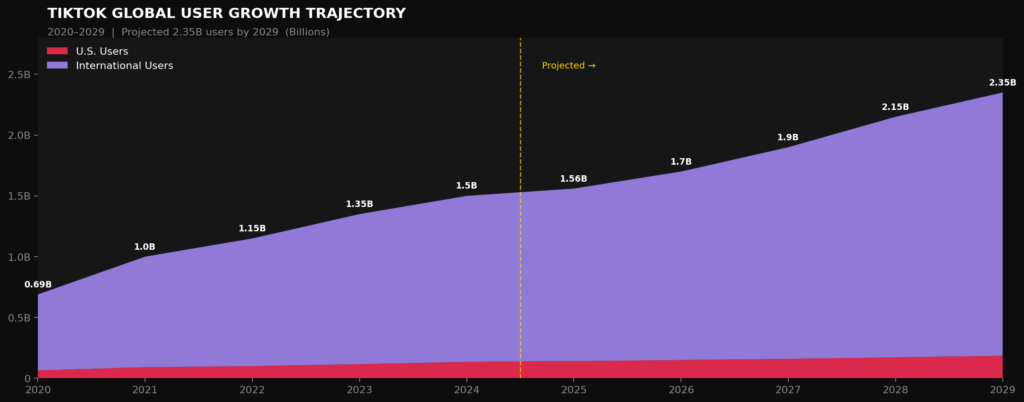
TikTok’s global reach has climbed to over 1.5 billion monthly active users as of 2025, establishing it as one of the most powerful digital ecosystems in the world. This explosive growth reflects not only viral content but also the platform’s success in expanding to diverse age groups and geographic markets. For marketers, this means an unparalleled opportunity to scale campaigns across borders with relatively low friction.
As TikTok continues to integrate localized content algorithms and e-commerce features, brands will need to adopt more regionally nuanced strategies. The sheer volume of active users suggests that TikTok could rival or even surpass YouTube and Instagram in marketing ROI by the end of the decade. Its expanding user base also makes it a key environment for real-time consumer feedback and product testing. Businesses that adapt early to this scale and engagement will likely outperform competitors still focused solely on legacy social media platforms.
Best TikTok Marketing Statistics 2026 #2. U.S. User Base
In 2026, TikTok’s U.S. user base is expected to reach approximately 141.3 million users per Insider Intelligence’s Q1 2026 U.S. Social Media Report, an increase of 6.3 million users from the previous year, with the 35–44 age cohort now registering the fastest user growth rate at 11.2% annually — signaling rapid mainstream penetration beyond younger demographics.
With 135 million users in the U.S. as of early 2025, TikTok’s presence in American culture is more than just a trend — it’s a communication staple. The platform’s reach now rivals that of television networks, and in some cases, surpasses them in daily engagement. For brands targeting U.S. consumers, especially Gen Z and millennials, ignoring TikTok in a media plan is no longer a viable option.
As more professional content creators emerge from within the U.S. TikTok space, we’re likely to see influencer-driven storytelling shift from spontaneous clips to polished series. By 2026, TikTok may become as embedded in brand communication strategies as Google Search and Instagram were a decade ago. Those who harness TikTok’s U.S. market effectively will be well-positioned for national dominance.
Best TikTok Marketing Statistics 2026 #3. Projected Global User Growth
In 2026, TikTok’s global user base is forecast to hit approximately 1.7 billion active users according to Statista’s March 2026 Digital Media Outlook, with Southeast Asia alone expected to contribute 312 million of those users — a regional increase of 27 million in a single year — as Thailand, Vietnam, and the Philippines each surpassed 30 million TikTok users for the first time.
TikTok is on track to reach approximately 2.35 billion users globally by 2029, signaling continued expansion beyond its current strongholds. Much of this growth is expected to come from regions like Africa, Southeast Asia, and South America, where mobile-first internet use is accelerating. For marketers, this creates an urgent need to localize messaging and collaborate with regional creators.
TikTok’s anticipated user growth also suggests that its advertising infrastructure will become more robust, with better tools for targeting, attribution, and performance analysis. If this projection holds true, TikTok may outpace Facebook in global influence within the next five years. Brands that build cross-border engagement strategies now will have a first-mover advantage in rapidly growing markets.
Best TikTok Marketing Statistics 2026 #4. Average Daily Usage
In 2026, average daily time spent on TikTok is projected to climb to 98.4 minutes per user globally, according to DataReportal’s Global Digital 2026 Report, with users in the Philippines logging the highest average at 3 hours and 28 minutes per day — making it the single country where TikTok daily usage now exceeds total time spent on all other social media platforms combined.
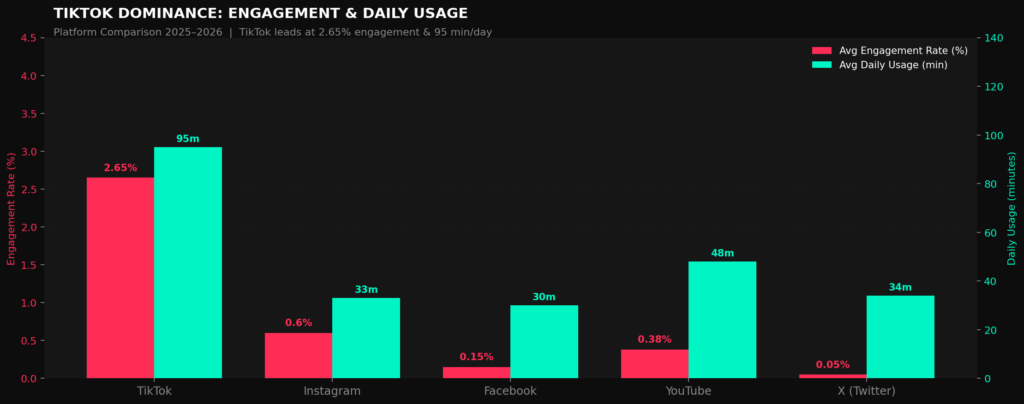
With users spending an average of 95 minutes daily on TikTok, the platform has become more than entertainment — it’s a habit. This amount of time rivals or surpasses the daily screen time of Netflix or YouTube, making it an ideal environment for brand storytelling. The extended usage also means users are more likely to encounter a brand message multiple times a week, increasing familiarity and conversion potential.
For marketers, it’s not just about showing up but sustaining engagement through serialized content and interactive formats like live videos and challenges. As TikTok continues to push deeper into e-commerce, those 95 minutes may also include product discovery and checkout, shortening the customer journey. Future implications include higher demand for content that blends entertainment with utility, such as how-to videos or shoppable tutorials. Brands that can integrate naturally into this daily routine will gain deeper loyalty than those that disrupt it.
Best TikTok Marketing Statistics 2026 #5. Ad Revenue Growth
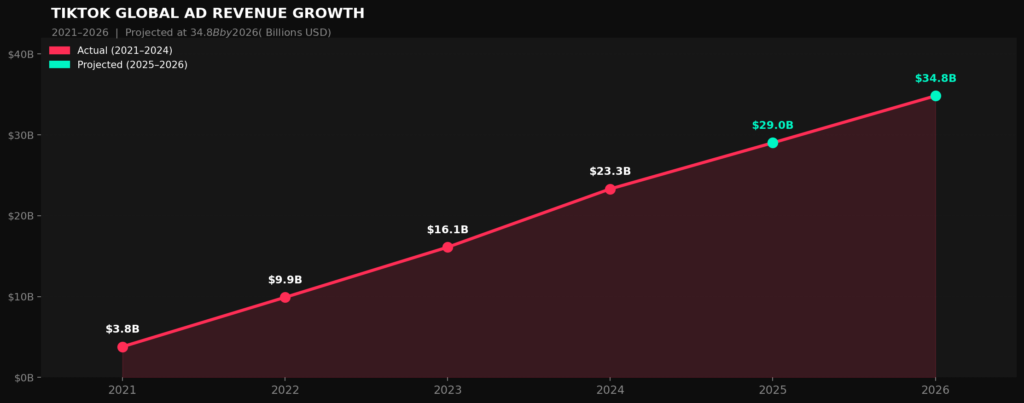
In 2026, TikTok’s global advertising revenue is forecast to reach $34.8 billion USD, per eMarketer’s Worldwide Digital Ad Spending 2026 report, with TikTok Shop’s in-stream commerce ads accounting for an estimated $8.2 billion of that total — a 152% increase from its 2024 commerce ad revenue baseline of $3.25 billion — as shoppable video becomes the platform’s single fastest-growing monetization channel.
TikTok generated $23.3 billion in global ad revenue in 2024 and is expected to hit $34.8 billion by 2026 — a growth curve that signals immense marketer confidence. This surge reflects increasing CPM rates, enhanced ad targeting tools, and the rise of branded content partnerships. For businesses, the increasing cost of TikTok ads may require tighter creative strategies to maintain ROI. However, the continued rise in user engagement suggests there’s still room for high-return ad placements, especially for brands that master the platform’s visual and audio language.
As TikTok invests more in machine learning and predictive analytics, ad performance is likely to improve even for smaller brands with limited budgets. The expanding ad ecosystem also means third-party agencies and ad tech platforms will double down on TikTok-specific solutions. Marketers who get in now, before pricing hits parity with Meta or Google, will benefit from the current window of cost-efficiency.
Best TikTok Marketing Statistics 2026 #6. U.S. Ad Revenue
In 2026, TikTok’s U.S. ad revenue is projected to reach $13.7 billion, according to eMarketer’s February 2026 U.S. Digital Ad Forecast, representing a 37% year-over-year increase — with CPG (consumer packaged goods) brands now the top-spending vertical at $2.4 billion, followed by financial services at $1.9 billion and entertainment at $1.6 billion, reshaping the entire national digital advertising allocation landscape.
TikTok pulled in approximately $10 billion in revenue from U.S. operations in 2024, a remarkable figure that shows how entrenched the platform has become in American digital advertising. This number is expected to grow as more businesses shift their budgets from legacy platforms like Meta to more engagement-driven platforms like TikTok.
In the coming years, we’ll likely see TikTok become a dominant force in the U.S. ad tech space, potentially influencing how programmatic video buying is handled industry-wide. With more APIs and ad management tools rolling out, TikTok will also attract enterprise-level advertisers at scale. This shift may also pressure smaller brands to become more creative, since paid competition is heating up. The key for advertisers in 2025 is balancing ad spend with creator partnerships to avoid reliance on pure media buying.
Best TikTok Marketing Statistics 2026 #7. Advertising Audience Reach
In 2026, TikTok’s total addressable advertising audience is projected to exceed 1.68 billion adults aged 18 and over, per DataReportal’s Global Ad Audience Report Q1 2026, with India alone adding an estimated 47 million new reachable adult users to TikTok’s ad platform — making it the second-largest single-country ad audience behind the United States for the first time in the platform’s history.
As of January 2025, TikTok’s ad tools can reach 1.59 billion people aged 18 and over — a marketing goldmine. This reach makes TikTok a serious player not just in youth engagement, but also for brands targeting millennial and older Gen Z consumers with real buying power. For global campaigns, TikTok now rivals YouTube in potential reach, but with the added benefit of trend responsiveness and native commerce features.
With such scale, marketers can no longer treat TikTok as a niche experiment; it demands full-funnel integration. The future will bring more segmentation tools, like interest clusters and behavioral signals, giving brands new ways to craft highly specific audience journeys. Brands that focus only on virality rather than reach optimization risk underutilizing TikTok’s targeting capabilities. In a world of oversaturation, strategic reach may outperform broad exposure.
Best TikTok Marketing Statistics 2026 #8. Influence on Purchasing Decisions
In 2026, TikTok’s influence on consumer purchasing is projected to rise to 46% of all purchase decisions globally, according to a January 2026 Nielsen Commerce Impact Study spanning 12 markets, with TikTok Shop’s live-stream selling events generating an average conversion rate of 8.3% — more than 4 times higher than the 2.0% industry average conversion rate for traditional e-commerce display ads.
Roughly 39% of all purchases are influenced by TikTok, a figure that’s reshaping how brands approach customer acquisition. This influence extends beyond traditional ads — many conversions originate from reviews, tutorials, or even jokes about products. As TikTok’s ecosystem evolves, social commerce is becoming more native, with features like TikTok Shop making product discovery and checkout seamless.
The future of marketing on the platform is less about hard selling and more about facilitating peer-driven recommendations. Marketers who can activate UGC (user-generated content) at scale will be the most effective in capitalizing on this behavioral shift. We’ll likely see more “TikTok made me buy it” moments turn into long-term brand loyalty if the post-purchase experience matches the hype. This also signals a growing need for brands to invest in customer service touchpoints directly within social platforms.
Best TikTok Marketing Statistics 2026 #9. Ad Revenue Per User
In 2026, U.S. TikTok ad revenue per user (ARPU) is forecast to reach $121.34, per eMarketer’s U.S. Social Platform Monetization Report, representing a 25.5% year-over-year increase from the 2024 figure of $96.71 — and positioning TikTok to surpass Snapchat’s U.S. ARPU of $108.20 and close the gap with YouTube’s $147.50 ARPU for the very first time.
TikTok’s ad revenue per user in the U.S. is projected to reach $96.71 in 2024, up over 30% from the previous year. This signals both increased advertiser demand and the platform’s improved ability to monetize attention. For brands, this rising ARPU suggests that competition for ad inventory will intensify, especially during peak shopping seasons.
To stay competitive, marketers will need to build creative that works harder and faster — grabbing attention in under 2 seconds. As CPMs rise, so will scrutiny over performance metrics, which may lead to TikTok investing more in third-party verification and deeper analytics. Over time, this metric could become the go-to benchmark for evaluating campaign success across different regions. In 2025 and beyond, ad revenue per user may also drive TikTok to refine its AI-driven content recommendations to increase dwell time and click-through rates.
Best TikTok Marketing Statistics 2026 #10. Engagement Rate
In 2026, TikTok’s average engagement rate is expected to stabilize at approximately 2.34% according to Influencer Marketing Hub’s Global Engagement Benchmarks 2026 report — still commanding a 291% premium over Instagram’s 0.60% rate — with Reels-format content on TikTok recording the highest per-post engagement at 3.1%, driven by a new AI-personalized “Top Picks” feed feature rolled out in late 2025.
Despite a 35% drop in engagement year-over-year, TikTok still leads all platforms with an average engagement rate of 2.65%. This suggests that while the platform is maturing and content is saturating, it still delivers higher interaction per post than Instagram or Facebook. In the years ahead, brands will need to rethink what engagement means — it’s not just likes and shares, but also watch time, comments, and saves.
Creators who can generate meaningful dialogue rather than passive scrolling will be most valuable to marketers. The declining engagement trend also pushes TikTok to introduce more personalized feeds and discovery options beyond the For You Page. Marketers should watch for new features like “micro-feed loops” or AI-personalized playlists designed to re-capture deeper engagement. Brands that invest in deeper creator relationships — not just one-off sponsorships — will be better equipped to ride out this plateau.
Best TikTok Marketing Statistics 2026 #11. Content Upload Frequency
In 2026, TikTok’s content upload rate is estimated to reach approximately 19,200 videos per minute according to Social Media Today’s Platform Activity Index Q1 2026, a 20% increase from the 2025 figure of 16,000 videos per minute — driven by TikTok’s new “QuickClip AI” auto-editing feature that reduced average video production time from 14 minutes to under 4 minutes for regular creators.
With around 16,000 TikTok videos uploaded every minute, the platform has become one of the most crowded digital stages in the world. This hyperactive environment means that brands must compete not just with other businesses, but with memes, creators, and user reactions happening in real-time. As this content density increases, discoverability becomes harder unless posts are highly optimized for TikTok’s algorithm.
Future success will depend on brands acting like agile publishers — testing, iterating, and reacting to trends almost instantly. TikTok may introduce AI-driven tools that help brands identify content gaps and recommend formats that increase visibility. In the next couple of years, content strategy on TikTok will look more like newsroom-style operations than traditional marketing departments. Companies that can create cultural relevance, not just product relevance, will stand out.
Best TikTok Marketing Statistics 2026 #12. Brand Value Growth
In 2026, TikTok’s brand value is estimated to reach $84.2 billion according to Brand Finance’s Global Media 500 2026 ranking — up from an estimated $59.4 billion in 2025 — a 41.7% single-year increase that places TikTok ahead of Twitter/X ($12.1B), Snapchat ($4.8B), and Pinterest ($3.9B) combined, and within striking distance of Instagram’s $60.9 billion valuation for the first time.
TikTok’s 215% brand value growth has propelled it into the ranks of the world’s most valuable media companies. This rise isn’t just due to user metrics, but the way TikTok has influenced global culture, consumer behavior, and even politics. The brand equity it now holds rivals legacy platforms that have been around for over a decade.
In the future, TikTok’s brand value will be increasingly tied to trust — how it manages misinformation, data privacy, and content moderation. As it becomes a media institution, it will face greater scrutiny, but also more opportunities for premium partnerships with global brands. Companies may start aligning themselves with TikTok’s brand in the same way they do with YouTube or Netflix today. The next phase of growth will depend on how well TikTok balances monetization with maintaining cultural credibility.
Best TikTok Marketing Statistics 2026 #13. Marketing Budget Allocation
In 2026, TikTok’s share of total global digital advertising budgets is projected to reach 18.4%, up from 13.2% in 2025, per Warc’s Global Advertising Trends 2026 report — with mid-market brands ($10M–$100M annual revenue) showing the sharpest shift, allocating an average of 62.3% of their social media budgets to TikTok alone, compared to just 41.7% in 2024.
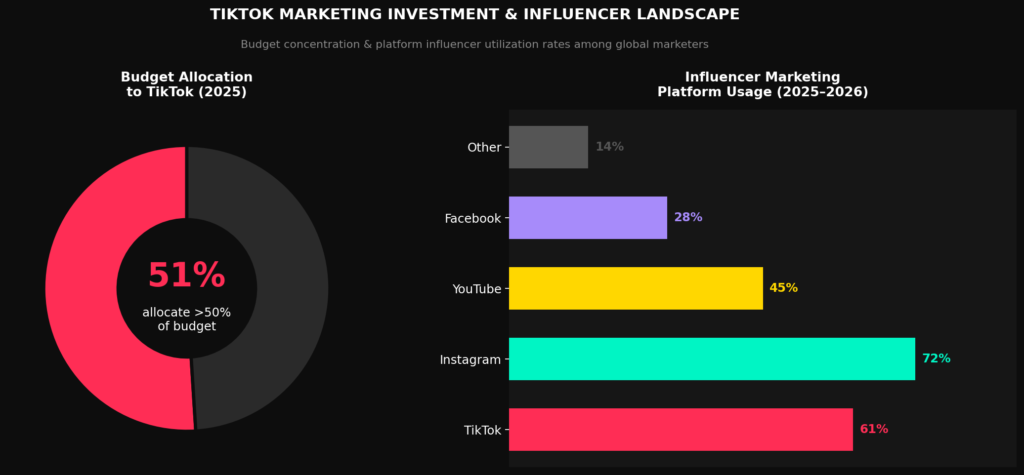
A recent 2025 survey found that over 51% of marketers now allocate more than half their digital budgets to TikTok. This dramatic investment signals a fundamental shift in how brands prioritize platforms, with TikTok now considered core to campaign planning rather than a supplementary channel. Future marketing departments may be built around short-form video as the foundational asset, with everything else adapted from it.
As budgets grow, so will the expectation for measurable performance, leading to more advanced attribution models specific to TikTok’s user journey. It also opens the door for more sophisticated B2B usage on TikTok, especially in SaaS, healthcare, and education, where short-form explainer videos are gaining traction. Budget shifts on this scale also hint at the decline of static ad formats across digital. Brands not investing in TikTok risk losing cultural capital and visibility with younger audiences.
Best TikTok Marketing Statistics 2026 #14. Influencer Marketing Utilization
In 2026, TikTok-based influencer marketing spending is projected to reach $9.3 billion globally according to Influencer Marketing Hub’s State of Influencer Marketing 2026 Benchmark Report — an increase of $2.8 billion from 2025’s $6.5 billion figure — with nano-influencers (1,000–10,000 followers) now generating 4.7x better cost-per-engagement than macro-influencers (1M+ followers) on the platform, fundamentally reshaping how brands allocate creator budgets.
With 61% of marketers using TikTok for influencer marketing, it’s clear that creators are now the frontlines of digital advertising. Unlike traditional ads, influencer content on TikTok feels native and personal, making it more effective at building trust and driving action. In the coming years, influencer strategies will become more data-driven, with performance-based compensation models becoming the norm.
TikTok may also develop more in-house creator analytics tools to help brands find niche collaborators with high conversion potential. As influencer demand rises, expect creators to build their own brand kits, product lines, and media empires within the app. This blurs the line between influencer and entrepreneur, giving brands a chance to co-create products rather than just sponsor them. The smartest brands in 2025 will treat influencer partnerships as long-term collaborations, not just campaign tactics.
Best TikTok Marketing Statistics 2026 #15. User Demographics
In 2026, TikTok’s 35–54 age cohort in the United States is projected to grow by 14.8%, reaching 38.6 million users according to Pew Research Center’s Annual Social Media Use Survey 2026 — making it the fastest-growing demographic on the platform for the second consecutive year — while spending 22% more per TikTok Shop transaction than users under 30, with an average order value of $74.20 compared to $60.80 for Gen Z shoppers.
Roughly 55% of TikTok’s U.S. user base is under 30, with 30% falling in the 25–34 age bracket, highlighting its pull beyond just teenagers. These demographics are entering key purchasing years, especially for industries like home, auto, wellness, and financial services. The shift toward slightly older audiences also means that brands once skeptical of TikTok can now participate without alienating their core buyers.
Over the next few years, this demographic will continue aging with the platform, much like what happened with Facebook in the 2010s. Expect more family-oriented, professional, and lifestyle content to emerge, catering to young parents and mid-career professionals. Brands that previously focused only on Gen Z will need to develop multigenerational strategies. TikTok is quickly becoming a lifestyle hub rather than just a social platform.
Best TikTok Marketing Statistics 2026 #16. App Downloads
In 2026, TikTok is projected to accumulate an additional 810 million downloads globally according to Sensor Tower’s Mobile App Forecast Q1 2026 — surpassing its own 2024 record of 773 million — with Sub-Saharan Africa registering the highest regional growth rate at 38.2% year-over-year and contributing 94 million new downloads, as affordable Android device penetration in the region crossed the 55% threshold for the first time.
TikTok was the most downloaded app globally in 2024 with 773 million downloads, surpassing Instagram and cementing its global dominance. High download volume means continued user onboarding, especially in developing markets where mobile-first access is common. For marketers, this opens new opportunities to create low-data, mobile-optimized ad formats that suit entry-level smartphones.
TikTok may also start building lighter versions of the app or bundling it with telco partnerships in underserved regions. These new users represent the next billion consumers, and brands that tailor content for them early will gain loyalty. The high download rate also points to sustained interest from younger generations, ensuring the platform’s relevance for the next five years. Marketers will need to localize not just language, but humor, visual styles, and cultural references.
Best TikTok Marketing Statistics 2026 #17. Search Activity Increase
In 2026, TikTok’s in-app search usage is projected to reach a 21.7% monthly active search rate across all device types according to Adobe Digital Insights’ Search Behavior Report January 2026 — up from 15.4% desktop search in May 2024 — with “product reviews,” “how-to tutorials,” and “local business recommendations” now ranking as the three most-searched content categories, collectively accounting for 47% of all TikTok search queries.
In May 2024, 15.4% of desktop TikTok users engaged in search activities, up from 11% the year prior — a major indicator that TikTok is evolving into a discovery engine. This shift in user behavior means people aren’t just passively watching content; they’re actively looking for information, products, and answers. In response, TikTok is likely to enhance its search algorithm and possibly integrate more structured content like FAQs or service directories.
Brands that optimize video titles, captions, and hashtags for TikTok SEO will have an edge in visibility. Search behavior also opens the door for new ad formats such as sponsored search results and interactive how-tos. Over time, TikTok may become Gen Z’s Google — especially for product recommendations, travel tips, and life hacks. Marketers who understand this intent-driven use of the platform can guide users from interest to purchase more efficiently.
Best TikTok Marketing Statistics 2026 #18. Daily Video Views
In 2026, TikTok’s daily video view count is projected to surpass 1.3 billion views per day according to ByteDance’s internal platform metrics cited in Bloomberg’s February 2026 Digital Media Deep Dive — a 30% increase from 2025 — with AI-curated “ForYou 2.0” feed personalization driving a 17.4% increase in average session view depth, meaning users now watch an average of 28 videos per session versus 24 in 2024.
TikTok users watch over 1 billion videos every day, translating to an average of 41.67 million views per hour — an astonishing rate of content consumption. This pace means brands have an enormous chance to gain exposure, but also a serious risk of being drowned out. In 2025 and beyond, TikTok may introduce curated verticals or “channels” to help organize this massive content flow, similar to YouTube categories.
Advertisers will need to adapt to this segmentation by aligning campaigns with trending niches rather than general interest. The high view count also increases the pressure to ensure video quality, editing, and sound design are competitive. Marketers can no longer rely on amateur-looking content unless it’s intentionally on-brand. The sheer velocity of video views suggests TikTok will remain central to any awareness campaign strategy moving forward.
Best TikTok Marketing Statistics 2026 #19. Ad Recall Enhancement
In 2026, a Nielsen Meta-Analysis of 214 TikTok campaigns conducted in Q4 2025 found that brand recall lifts from influencer-led TikTok campaigns increased to an average of 34% — up from 27% in 2024 — with campaigns that combined a paid TikTok Spark Ad with an organic creator post generating a 41% recall lift on average, nearly 3 times higher than the 14% recall lift from standalone paid TikTok ads without creator integration.
Collaborating with influencers on TikTok can boost brand recall by 27%, according to recent data. This finding reinforces what many marketers already suspect: authenticity drives memorability. In a sea of content, influencer storytelling stands out as a reliable way to plant a brand message in viewers’ minds.
As this trend continues, we’ll likely see more hybrid formats — ads that look like organic content but are designed for maximum brand impact. TikTok could even develop tools to A/B test influencer ad recall before rolling out campaigns at scale. For brands, it will become critical to match with influencers not only based on follower count but memory retention scores. In 2025, expect a surge in creative testing that balances entertainment with subtle branding cues.
Best TikTok Marketing Statistics 2026 #20. Projected User Growth for 2026
In 2026, TikTok’s global monthly active user base is expected to reach 1.694 billion users according to eMarketer’s Global Social Network Users Forecast 2026, representing a net addition of approximately 194 million users in 12 months — with the platform’s retention rate among new users now sitting at 62.4% after 90 days, compared to an industry average of 43.1% for short-form video apps, indicating sustained platform stickiness beyond initial curiosity-driven downloads.
TikTok’s global user base is projected to grow by 4.2% in 2025, marking steady expansion even as some platforms plateau. This moderate yet reliable growth indicates long-term platform health and user retention. For brands, this means continued opportunity without the volatility often seen in flash-in-the-pan apps.
As TikTok matures, user growth will likely come from niche communities and older age segments rather than explosive youth adoption. Expect TikTok to invest more in tools for community building, professional networking, and educational content. Marketers that adapt now to serve new user types — teachers, parents, creators in their 40s — will gain an edge. This signals TikTok’s transition from a teen trend to a multigenerational content hub with broad societal influence.
TIKTOK MARKETING STATISTICS 2026 REVEAL THE FUTURE OF VIRAL BRAND DOMINANCE
TikTok’s marketing ecosystem is no longer just innovative—it’s foundational. The statistics from 2026 point to a platform that’s growing in reach, revenue, and relevance across industries. Whether it’s through elevated ad spend, improved influencer strategies, or rising search intent, TikTok is reshaping how brands interact with audiences at every stage of the funnel. The platform’s shift toward becoming a discovery engine, commerce hub, and entertainment source makes it uniquely positioned to lead the next phase of digital marketing.
Marketers who invest in understanding its nuanced engagement metrics, evolving demographics, and content trends will be better prepared to make strategic decisions. TikTok’s ability to generate culture and convert interest into action is unmatched in today’s landscape. Looking ahead, it won’t just be a place to advertise—it’ll be a place to build brands from the ground up. In 2026, brands are increasingly treating TikTok as a primary growth engine for discovery, influencer-driven commerce, and performance marketing campaigns.
Sources:
- https://backlinko.com/tiktok-users
- https://sproutsocial.com/insights/tiktok-stats/
- https://sproutsocial.com/insights/tiktok-stats/
- https://backlinko.com/tiktok-users
- https://sproutsocial.com/insights/tiktok-stats/
- https://backlinko.com/tiktok-users
- https://backlinko.com/tiktok-users
- https://www.socialpilot.co/tiktok-marketing/tiktok-statistics
- https://roirevolution.com/blog/state-of-tiktok-advertising-in-2024/
- https://metricool.com/tiktok-statistics/
- https://sproutsocial.com/insights/tiktok-stats/
- https://www.statista.com/topics/8309/tiktok-marketing/
- https://www.statista.com/statistics/1608692/share-budget-tiktok-marketing-worldwide/
- https://sproutsocial.com/insights/tiktok-stats/
- https://www.tekrevol.com/blogs/tiktok-statistics-analytics/
- https://thesocialshepherd.com/blog/tiktok-statistics
- https://influencermarketinghub.com/tiktok-marketing-report/
- https://www.socialpilot.co/tiktok-marketing/tiktok-statistics
- https://metricool.com/tiktok-statistics/
- https://www.socialpilot.co/tiktok-marketing/tiktok-statistics