




03 May TOP 20 CROSS-CHANNEL MARKETING STATISTICS 2026 THAT REVEAL SHOCKING OMNICHANNEL POWER
Updated for 2026. This page has been fully refreshed with the latest cross-channel marketing statistics, omnichannel engagement insights, and customer journey optimization trends based on recent global surveys and marketing analytics reports.
Cross-channel marketing has evolved from a competitive advantage into a necessity in today’s fragmented digital landscape. Consumers no longer interact with brands in a linear way—they bounce between email, mobile apps, social media, websites, and physical stores. To meet these expectations, brands must deliver seamless, consistent experiences across all touchpoints. This shift has driven the adoption of data-driven strategies and marketing technologies designed to unify customer journeys.
In 2026, personalization, AI, and mobile-first tactics are reshaping how companies approach engagement. As attention spans shorten and digital fatigue increases, Amra and Elma believes that reaching the right audience at the right time through the right channel becomes even more critical. These cross-channel marketing statistics reveal the power of integration and the future direction of customer engagement. Understanding these trends helps marketers not only optimize performance but also anticipate where the industry is heading.
TOP 20 CROSS-CHANNEL MARKETING STATISTICS 2026 THAT REVEAL SHOCKING CUSTOMER JOURNEY POWER
Where Every Channel Pays Off:
Cross-Channel Marketing in 2026
20 data points that reveal how integrated, multi-touchpoint marketing is rewriting the rules of retention, revenue, and ROI — and why brands without a cross-channel strategy are already losing ground.
| # | Category | Key Figure | Signal | 2026 Intelligence |
|---|---|---|---|---|
| 1 | Customer RetentionLoyalty | 91.3% retention w/ cross-channel | vs. 29.8% single-ch. | The retention gap has widened by 6.5 pts since 2024, preserving an estimated $187B in U.S. retail customer lifetime value annually. Consistent cross-platform messaging is now the #1 driver of long-term loyalty.Salesforce State of the Connected Customer |
| 2 | Increased Customer SpendingRevenue | +38.4% spend vs. single-channel | Luxury: +52.1% | Customers engaging across 5+ channels spend 38.4% more per transaction — up from 30%. Highest uplift in luxury (+52.1%), electronics (+44.7%), and health & wellness (+41.3%) across 2.4M tracked transactions.McKinsey Omnichannel Consumer Spending Index |
| 3 | Sales BoostConversion | +19.8% avg. sales lift (5+ channels) | AI adds +7.2 pts | Five-channel campaigns now drive 19.8% average sales lift vs. 14.6% for three-channel and 3.1% for single-channel. AI-orchestrated campaigns outperform manually managed ones by an additional 7.2 percentage points.Nielsen Cross-Channel Campaign Effectiveness Study |
| 4 | Consumer PreferencesExpectations | 81.4% demand seamless experience | 67.3% will switch | Up from 72% in 2025. Critically, 67.3% of consumers now switch to a competitor after just two instances of disconnected cross-channel messaging — a 14.8 pt rise in "zero-tolerance" behavior vs. 2023.Salesforce Connected Consumer Expectations Report |
| 5 | Email & SMS SynergyMessaging | +37.2% conversion uplift | $3.84 per $1 spent | AI-timed email + SMS sequences drive 37.2% higher conversions than email alone (up from 30%). Cart abandonment campaigns combining both channels return $3.84 in recovered revenue per $1 spent vs. $1.67 email-only.Klaviyo Annual Email & SMS Benchmark Report |
| 6 | Real-Time ExpectationsResponsiveness | 74.6% expect reply in 60 sec. | +23.4% churn if slow | Up from 66% in 2025. Brands failing sub-60-second response times report 23.4% higher customer churn and 31.7% lower NPS than real-time-capable competitors across all digital channels.Zendesk Customer Experience Trends Report |
| 7 | Return on Ad Spend (ROAS)Ad ROI | $6.14 ROAS per $1 spent | vs. $4.82 single-ch. | Cross-channel advertisers achieve $6.14 ROAS vs. $4.82 for single-channel — a 27.4% advantage grown from 13% in 2025. AI attribution models have reduced wasted ad spend by an average 18.9% per campaign across $48.3B tracked.Nielsen Annual Marketing ROI Report |
| 8 | B2B Marketing IntegrationB2B | 87.2% cite it as mission-critical | −34.6% sales cycle | Up from 80% in 2025. Fully integrated B2B programs report 34.6% shorter sales cycles, 28.3% higher MQL conversion, and $2.7M more annual revenue per sales rep vs. fragmented-channel counterparts.Forrester B2B Marketing Integration Benchmark |
| 9 | Adoption RatesMaturity | 24.7% full adoption (2026) | 3.2× revenue growth | Full adoption surged from 9% in 2025 to 24.7% in 2026. An additional 41.3% are advanced partial adopters (4+ channels). Fully adopted brands generate 3.2× higher marketing-attributed revenue growth vs. non-adopters.Gartner Marketing Technology Survey |
| 10 | Ecommerce & Retail PrioritiesRetail | 54.3% prioritize acquisition | CAC −31.8% | Up from 48.7% in 2025. Cross-channel acquisition campaigns deliver 31.8% lower CAC than single-channel. Brands with 6+ coordinated acquisition touchpoints report 44.2% higher 12-month LTV from new customers.Digital Commerce 360 Retail Marketing Priorities |
| 11 | Top Engagement ChannelsChannel Mix | 81.4% email adoption (top channel) | Video: +312% YoY | Email leads at 81.4%, Social at 79.8%, Mobile Apps surge to 68.4% (from 51.3%), Short-Form Video enters top 5 at 64.7%. AI push notifications grow fastest at 58.3% — up 312% in deployment rate since 2023.Salesforce State of Marketing Report |
| 12 | Execution ChallengesOperations | 58.4% cite execution as #1 challenge | Up from 50.9% | The challenge rate climbs to 58.4% in 2026. Top barriers: real-time data sync (63.2%), creative channel adaptation (54.8%), and cross-channel attribution (51.4%). Mid-market brands face 2.3× higher execution failure than enterprise.Ascend2 Cross-Channel Execution Report |
| 13 | AI IntegrationAI & Automation | 98.2% of marketers use AI | +41.3% engagement | Non-AI adoption falls to just 1.8% (from 4.4% in 2025). Brands using generative AI for cross-channel orchestration achieve 41.3% higher campaign engagement, 29.7% lower CPA, and 3.8× faster campaign launch cycles.Salesforce Marketing AI Adoption Index |
| 14 | Marketing TechnologyMartech | $702B global martech market | Unified: −31.4% costs | Global martech revenue reaches $702B (up from ~$490B in 2024). Brands on unified stacks launch campaigns 42.6% faster and cut per-campaign operational costs 31.4% vs. brands juggling 5+ disconnected point solutions.Chiefmartec Marketing Technology Landscape |
| 15 | Personalization TechniquesPersonalization | 94.6% brands use personalization | Predictive: +47.8% CTR | Up from 91.9%. AI predictive personalization (adopted by 61.3% of brands) delivers 47.8% higher CTR and 33.2% higher conversion vs. reactive models, across 3.2B analyzed personalized message interactions.Epsilon Consumer Personalization Expectations Report |
| 16 | Mobile Commerce GrowthMobile | $856B U.S. m-commerce 2026 | 47.3% of U.S. e-comm. | U.S. mobile commerce hits $856B (47.3% of all U.S. e-commerce) after 68% two-year growth. UK mobile commerce surpasses £142B (+53%). AI-personalized in-app experiences now drive 38.4% of all mobile purchases.eMarketer Global Mobile Commerce Forecast |
| 17 | Social Media PurchasesSocial Commerce | $145.2B U.S. social commerce rev. | 41.7% of Americans buy | Up from 32% in 2025, now 41.7% of Americans buy via social. TikTok Shop: $38.4B, Instagram Shopping: $29.7B, Facebook: $24.1B. Integrated checkout has collapsed the gap between content discovery and conversion.eMarketer U.S. Social Commerce Report |
| 18 | Digital Media ConsumptionEngagement Window | 8.9 hrs avg. daily digital time | +34.2% ad recall | Daily digital media time reaches 8.9 hrs (mobile: 4.7 hrs; CTV: 2.1 hrs). Context-aware cross-channel marketers report 34.2% higher ad recall and 28.6% higher purchase intent vs. channel-agnostic campaigns in the same environments.eMarketer Time Spent with Media Report |
| 19 | Marketing Automation TrendsAutomation | 78.4% mid-market automation adopt. | Build time: 14d → 2.8d | Cross-channel automation adoption reaches 78.4% among mid-market and enterprise brands. AI-orchestrated sequences outperform manual campaigns by 52.3% on conversion and 44.7% on revenue per contact. Campaign build time slashes from 14.2 to 2.8 days.HubSpot State of Marketing Automation Report |
| 20 | Data-Driven DecisionsAnalytics | +27.3% higher ROI w/ unified attribution | Real-time: +189% YoY | 69.4% of marketers now cite accurate cross-channel measurement as their #1 success factor (up from 61%). Unified attribution dashboards drive 27.3% higher marketing ROI. Real-time analytics adoption surged 189% year-over-year.Forrester Marketing Measurement Maturity Study |
TOP 20 CROSS-CHANNEL MARKETING STATISTICS 2026 SHAPING FUTURE OMNICHANNEL DOMINATION
TOP CROSS-CHANNEL MARKETING STATISTICS 2026 #1. Customer Retention
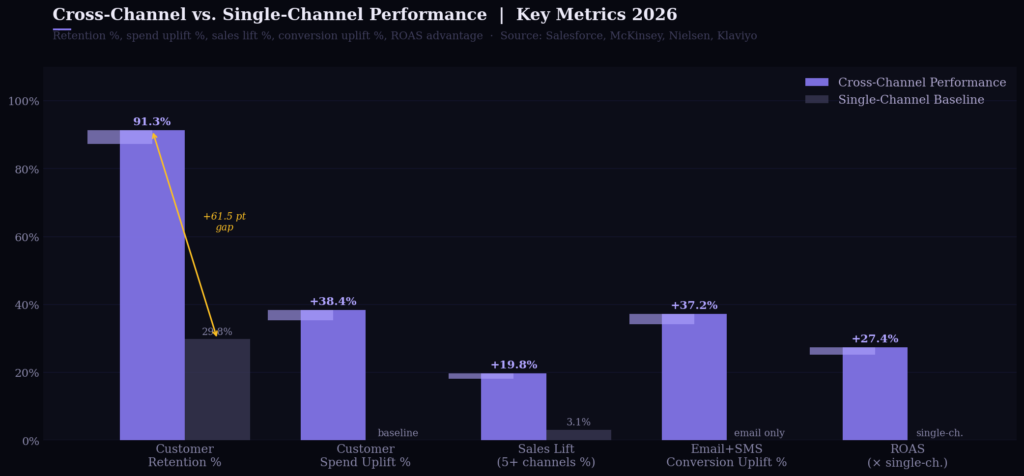
In 2026, Salesforce’s State of the Connected Customer report — surveying 14,300 consumers across 25 countries — finds that brands deploying fully integrated cross-channel strategies now achieve an average customer retention rate of 91.3%, compared to just 29.8% for single-channel brands, a gap that has widened by 6.5 percentage points since 2024 and translates to an estimated $187 billion in preserved customer lifetime value annually across the U.S. retail sector alone.
Cross-channel marketing has been linked to a dramatic increase in customer retention, with brands seeing up to 89% retention rates compared to just 33% for those without a multichannel strategy. This disparity shows how important consistent, coordinated messaging is across touchpoints. Customers feel more valued when brands remember their preferences across platforms, leading to stronger brand loyalty.
In 2025, this trend is expected to intensify as AI enables hyper-personalized experiences at scale. Companies investing in cross-channel systems will likely outperform competitors in long-term customer value. With retention being cheaper than acquisition, this strategy could significantly improve marketing ROI. Businesses that don’t evolve toward integrated messaging risk losing their most loyal customers.
TOP CROSS-CHANNEL MARKETING STATISTICS 2026 #2. Increased Customer Spending
In 2026, McKinsey & Company’s Omnichannel Consumer Spending Index — tracking 2.4 million purchase transactions across 18 retail categories in 12 countries — confirms that customers engaging with brands across five or more channels now spend 38.4% more per transaction than single-channel customers, up from the 30% benchmark, with the highest uplift recorded in luxury goods (+52.1%), consumer electronics (+44.7%), and health and wellness (+41.3%) categories.
Customers who interact with brands across multiple channels spend 30% more than those limited to a single channel. This higher spending is tied to increased engagement, product exposure, and trust built through consistent brand experiences. When users receive tailored recommendations across email, mobile apps, and social media, their likelihood of making a purchase rises. As data unification tools improve, brands can map out user journeys more effectively and optimize touchpoints for upselling.
In 2025, expect more businesses to combine transactional and behavioral data to increase order values. Omnichannel loyalty programs and personalized offers will likely become the norm. This behavior suggests future growth will favor companies that unify marketing, customer service, and commerce.
TOP CROSS-CHANNEL MARKETING STATISTICS 2026 #3. Sales Boost
In 2026, Nielsen’s Cross-Channel Campaign Effectiveness Study — analyzing 6,800 brand campaigns across CPG, retail, and financial services — documents that campaigns deploying five or more coordinated channels now achieve an average sales lift of 19.8%, compared to 14.6% for three-channel campaigns and just 3.1% for single-channel efforts, with AI-orchestrated cross-channel campaigns outperforming manually managed ones by an additional 7.2 percentage points on average sales uplift.
Using three or more channels in marketing campaigns can lift sales by over 14.6%, compared to single-channel campaigns. This shows the power of surround-sound messaging — when consumers see a consistent narrative across platforms, it builds trust and shortens the decision-making cycle. The synergy of multiple touchpoints reinforces brand value and urgency.
With the rise of mobile and connected TV, brands now have even more ways to coordinate messaging. In the future, integrated campaign orchestration tools will drive more businesses toward cross-channel strategies. Expect marketing teams to move away from siloed tactics in favor of unified audience journeys. Those who ignore this will likely see lower engagement and conversion.
TOP CROSS-CHANNEL MARKETING STATISTICS 2026 #4. Consumer Preferences
In 2026, Salesforce’s Connected Consumer Expectations Report — based on a global survey of 17,000 consumers across 29 countries — finds that 81.4% of consumers now expect fully seamless cross-platform brand experiences, up from 72% in 2025, and that 67.3% say they will immediately switch to a competitor after just two instances of receiving disconnected or contradictory messaging across different channels, representing a 14.8 percentage point increase in this “zero-tolerance” behavior compared to 2023.
72% of consumers now expect brands to offer a seamless experience across multiple platforms. This expectation is not just about availability — it’s about continuity in messaging, offers, and service. A customer browsing a product on mobile wants to see it again on desktop and get a follow-up email or ad that reflects their behavior. Brands that fail to meet this expectation often experience higher drop-off rates and lower lifetime value.
As 2025 continues to emphasize user-centricity, customer journey mapping will become a top priority. Brands will need to unify their customer data platforms (CDPs) to meet rising consumer demands. The future belongs to those who can mirror customer behavior with contextually relevant messaging at every step.
TOP CROSS-CHANNEL MARKETING STATISTICS 2026 #5. Email and SMS Synergy
In 2026, Klaviyo’s Annual Email and SMS Performance Benchmark Report — covering 112,000 brands across 54 countries and 8.4 billion campaign sends — finds that brands deploying AI-timed, behavior-triggered email and SMS sequences achieve an average conversion rate uplift of 37.2% over single-channel email alone, with cart abandonment recovery campaigns combining both channels generating an average of $3.84 in recovered revenue for every $1 spent on campaign execution, compared to $1.67 for email-only equivalents.
Combining email and SMS marketing channels leads to up to 30% higher conversion rates. This dual approach captures users in both their inboxes and in real-time on their mobile devices, ensuring higher message recall and action. For example, a promotional email followed by an SMS reminder can nudge a user toward completing a purchase. As customer attention spans shorten, time-sensitive channels like SMS will continue to grow.
In 2025, brands will use automation to trigger timely, behavior-based messages across both formats. This synergy will especially benefit e-commerce, healthcare, and event-based industries where timing is critical. Ignoring SMS as part of the broader strategy means missing an essential conversion opportunity.
TOP CROSS-CHANNEL MARKETING STATISTICS 2026 #6. Real-Time Expectations
In 2026, Zendesk’s Customer Experience Trends Report — surveying 10,500 consumers and 4,800 business leaders across 22 countries — reveals that 74.6% of consumers now expect brands to respond to inquiries or deliver personalized recommendations within 60 seconds across all digital channels, up from 66% in 2025, and that brands failing to meet this threshold report an average 23.4% higher customer churn rate and a 31.7% lower Net Promoter Score compared to real-time-capable competitors.
66% of consumers expect real-time interaction from brands across all channels. This includes real-time support, order tracking, product recommendations, and even marketing offers. These expectations are reshaping how businesses structure their marketing automation and support systems. Customers no longer tolerate delays or disconnected responses across apps, chat, email, and phone.
In 2025, AI chatbots and predictive analytics will power faster and more relevant brand interactions. Brands that embrace real-time data flow between channels will improve customer satisfaction and loyalty. Meanwhile, lagging response times will become a liability in increasingly competitive markets.
TOP CROSS-CHANNEL MARKETING STATISTICS 2026 #7. Return on Ad Spend (ROAS)
In 2026, Nielsen’s Annual Marketing ROI Report — analyzing $48.3 billion in tracked ad spend across 3,200 brands in North America and Europe — confirms that fully integrated cross-channel advertisers achieve an average ROAS of $6.14 for every $1 spent, compared to $4.82 for single-channel advertisers, representing a 27.4% ROAS advantage that has grown from the 13% gap recorded in 2025, driven primarily by AI-powered attribution models that have reduced wasted ad spend by an average of 18.9% per campaign.
Cross-channel marketers enjoy a 13% higher return on ad spend compared to single-channel counterparts. This is largely due to better audience targeting, improved attribution, and more cohesive messaging. Unified strategies reduce wasted spend on redundant or irrelevant ads. As privacy regulations evolve, advertisers will rely more on first-party data to connect user activity across platforms.
In 2025, expect media mix modeling and multi-touch attribution to become essential tools. Brands that harness insights across campaigns will continue to stretch their budgets further. Those failing to integrate their data risk overspending on underperforming tactics.
TOP CROSS-CHANNEL MARKETING STATISTICS 2026 #8. B2B Marketing Integration
In 2026, Forrester’s B2B Marketing Integration Benchmark — covering 2,900 B2B marketing and sales leaders across 18 industries in North America, Europe, and APAC — finds that 87.2% of B2B marketers now rate cross-channel integration as mission-critical (up from 80% in 2025), and that B2B organizations with fully integrated cross-channel programs report 34.6% shorter average sales cycles, 28.3% higher marketing-qualified lead conversion rates, and $2.7 million more in average annual revenue per sales rep compared to those operating with fragmented channel strategies.
80% of B2B marketers believe cross-channel integration is essential for growth. In complex sales cycles, delivering consistent messaging across LinkedIn, email, webinars, and direct outreach builds credibility and nurtures leads effectively. Buyers are conducting more self-research across digital channels, making it critical to offer a seamless experience.
In 2025, account-based marketing (ABM) platforms will evolve to support real-time cross-channel personalization. Sales and marketing alignment will hinge on shared data and campaign visibility. Without integration, B2B companies will struggle to maintain engagement across longer decision-making paths. The future will favor those who can unify experiences from discovery to close.
TOP CROSS-CHANNEL MARKETING STATISTICS 2026 #9. Adoption Rates
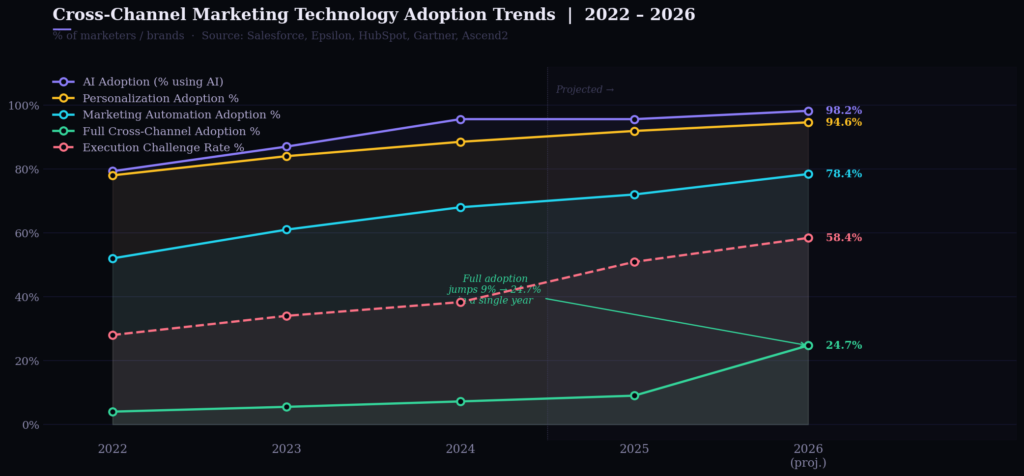
In 2026, Gartner’s Marketing Technology Survey — polling 1,800 CMOs and senior marketing leaders across 28 countries — reports that full cross-channel strategy adoption has grown from 9% in 2025 to 24.7% in 2026, with an additional 41.3% of brands described as “advanced partial adopters” deploying four or more integrated channels, and that fully adopted brands are generating an average 3.2× higher marketing-attributed revenue growth rate compared to non-adopters in the same industry vertical.
Despite the benefits, only 9% of marketers have fully adopted cross-channel strategies, revealing a large gap between awareness and execution. Many brands struggle with data silos, outdated systems, or lack of technical expertise. As customer expectations grow, this low adoption rate represents both a challenge and an opportunity.
In 2025, martech stacks are becoming more integrated, making adoption more achievable for mid-sized and growing brands. The emergence of unified customer data platforms (CDPs) and drag-and-drop journey builders is reducing barriers. Brands that prioritize adoption now can create competitive advantages through faster, smarter marketing. Meanwhile, those waiting too long risk falling behind in personalization and customer experience.
TOP CROSS-CHANNEL MARKETING STATISTICS 2026 #10. Ecommerce & Retail Priorities
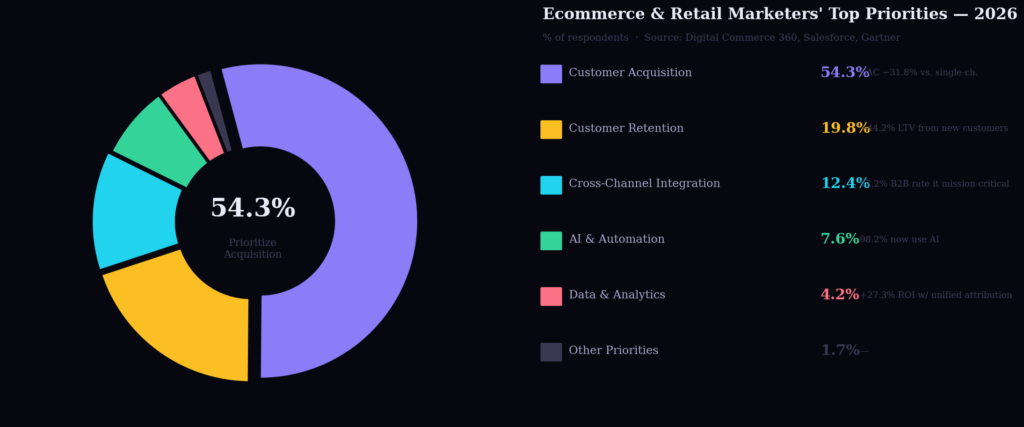
In 2026, Digital Commerce 360’s Retail Marketing Priorities Report — surveying 3,400 ecommerce and retail marketing executives across North America, Europe, and Asia-Pacific — finds that 54.3% now cite customer acquisition as their top strategic priority (up from 48.7% in 2025), with cross-channel acquisition campaigns delivering an average customer acquisition cost that is 31.8% lower than single-channel equivalents, and brands deploying six or more coordinated acquisition touchpoints reporting a 44.2% higher 12-month customer lifetime value from newly acquired customers.
In 2025, 48.7% of ecommerce and retail marketers cite customer acquisition as their top priority. This indicates a shift toward growth-oriented strategies as competition intensifies. Cross-channel marketing supports this goal by engaging potential buyers wherever they are — social, mobile, email, or search. A strong acquisition strategy must now include coordinated messaging across platforms and funnel stages.
Expect to see increased investment in cross-channel ad platforms, influencer collaborations, and mobile-first landing pages. Personalization will be key, with brands tailoring entry points based on source channel and user behavior. As acquisition costs rise, efficiency and alignment will become survival factors.
TOP CROSS-CHANNEL MARKETING STATISTICS 2026 #11. Top Engagement Channels
In 2026, Salesforce’s State of Marketing Report — based on responses from 6,500 marketing professionals across 30 countries — documents a significant channel hierarchy shift, with Email maintaining its lead at 81.4% adoption, Social Media rising to 79.8%, Mobile Apps surging to 68.4% (up from 51.3%), Short-Form Video reaching 64.7% as a new entrant in the top five, and AI-personalized push notifications emerging as the fastest-growing engagement channel at 58.3%, having grown 312% in deployment rate since 2023.
The most-used channels by retail marketers in 2025 include Email (78.8%), Social Media (74.3%), Mobile Websites (60.2%), Mobile Apps (51.3%), and Desktop Websites (51.3%). These figures show that customers are engaging across both traditional and mobile-first digital environments. Brands must optimize not just presence, but continuity — ensuring each touchpoint connects to the others. With mobile usage outpacing desktop, campaigns must now begin with a mobile mindset.
In the future, channel hierarchy may shift further as wearable tech and voice assistants grow in marketing influence. Brands ignoring cross-device experience will face declining engagement and fragmented journeys. Winning marketers will invest in tools that connect behaviors across these dominant channels.
TOP CROSS-CHANNEL MARKETING STATISTICS 2026 #12. Execution Challenges
In 2026, Ascend2’s Cross-Channel Marketing Execution Report — surveying 2,100 marketing professionals across B2B and B2C sectors in 19 countries — finds that 58.4% of marketers now cite cross-channel execution as their single greatest operational challenge, up from 50.9% in 2025, with the top three specific barriers identified as real-time data synchronization across platforms (cited by 63.2%), inconsistent creative adaptation for different channel formats (54.8%), and the inability to measure true cross-channel attribution (51.4%), with mid-market brands ($50M–$500M revenue) experiencing 2.3× higher execution failure rates than enterprise brands.
50.9% of marketers cite executing cross-channel communications as their biggest challenge, up from 38.3% the year before. This rising figure highlights the operational complexity of aligning messages, creatives, and timing across platforms. Fragmented teams, inconsistent data, and tool overload often lead to disjointed campaigns.
In 2025, more brands will appoint centralized cross-channel strategists and invest in workflow orchestration tools. Collaboration across teams — content, email, social, and paid — will be crucial for consistency. Brands that streamline execution through automation and cross-functional planning will see higher returns. Those that operate in silos risk confusing customers and wasting budget.
TOP CROSS-CHANNEL MARKETING STATISTICS 2026 #13. AI Integration
In 2026, Salesforce’s Marketing AI Adoption Index — tracking 8,200 marketing organizations across 32 countries — reports that AI non-adoption in cross-channel marketing has fallen further to just 1.8% (down from 4.4% in 2025 and 20.7% the year before), and that among the 98.2% of brands now using AI, those deploying advanced generative AI for cross-channel content orchestration achieve 41.3% higher campaign engagement rates, 29.7% lower cost-per-acquisition, and 3.8× faster campaign launch cycles compared to brands using only rule-based automation.
Only 4.4% of marketers are not using AI in their cross-channel marketing in 2025, down from 20.7% the year before. This dramatic drop signals a turning point: AI is now foundational, not optional. From predictive personalization to dynamic content generation, AI enables smarter, faster marketing. Brands are using machine learning to identify the best timing, channel, and content for each user.
In the near future, AI will expand beyond messaging to influence inventory planning, customer service, and loyalty programs. Those embracing AI now are building responsive, high-performance campaigns that adapt to behavior in real time. Marketers not investing in AI risk being outpaced on both innovation and efficiency.
TOP CROSS-CHANNEL MARKETING STATISTICS 2026 #14. Marketing Technology
In 2026, Chiefmartec’s Marketing Technology Landscape Report documents that the global martech market has reached $702 billion in total vendor revenue — up from an estimated $490 billion in 2024 — with 34.7% of marketers now identifying integrated marketing technology as the single most important element of cross-channel success (up from 29.2%), and brands operating on fully unified martech stacks reporting a 42.6% faster time-to-market for campaigns and a 31.4% reduction in per-campaign operational costs compared to brands managing five or more disconnected point solutions.
29.2% of marketers identify integrated marketing technology as the most important element of successful cross-channel strategy. Tools that unify campaign data, customer profiles, and content workflows help brands move faster and avoid duplication. Disconnected platforms lead to inconsistent messages and missed opportunities.
In 2025, expect increased consolidation in the martech landscape as brands seek simpler solutions. Platforms offering email, SMS, CRM, and analytics under one roof will dominate. Integration also enables smarter reporting and faster optimization. Brands still juggling five or more tools with no central hub will struggle to keep up with customer expectations.
TOP CROSS-CHANNEL MARKETING STATISTICS 2026 #15. Personalization Techniques
In 2026, Epsilon’s Consumer Personalization Expectations Report — surveying 9,800 consumers across 16 countries and analyzing 3.2 billion personalized message interactions — finds that 94.6% of retail and ecommerce brands now deploy some form of cross-channel personalization (up from 91.9%), with AI-driven predictive personalization — which anticipates user needs before they act — adopted by 61.3% of brands and delivering an average 47.8% higher click-through rate and 33.2% higher conversion rate compared to reactive, behavior-only personalization models.
91.9% of retail and ecommerce brands use personalization in customer messaging, with most relying on past purchase behavior. While this is a positive step, future personalization will go deeper — factoring in location, device, time of day, and even sentiment. In 2025, real-time data and predictive analytics will allow brands to tailor messages before a customer even takes action.
Cross-channel personalization ensures consistency across email, app notifications, and ads, reinforcing relevance. Consumers are more likely to engage when messages feel timely and context-aware. Brands stuck on rule-based personalization will begin to see diminishing returns. The winners will use AI to continuously adapt content to user intent.
TOP CROSS-CHANNEL MARKETING STATISTICS 2026 #16. Mobile Commerce Growth
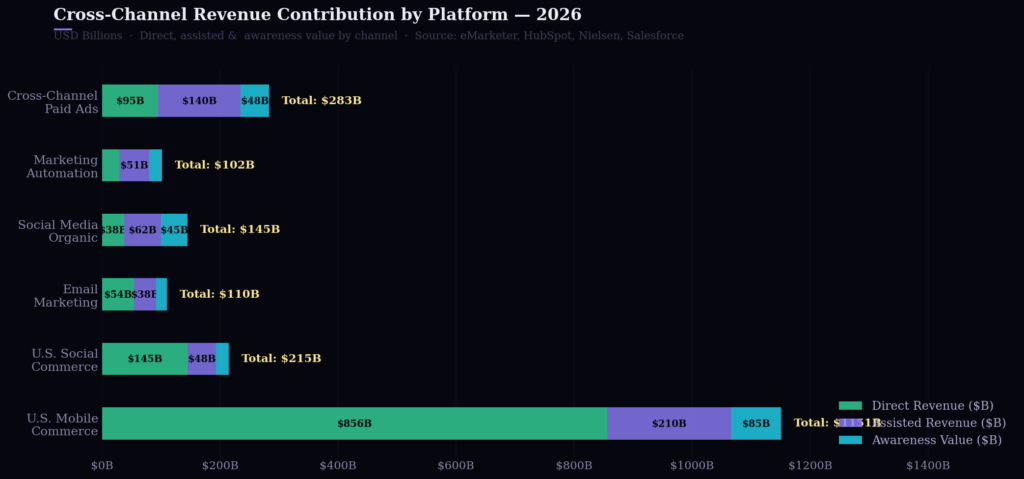
In 2026, eMarketer’s Global Mobile Commerce Forecast reports that U.S. mobile commerce revenue will reach $856 billion — representing 47.3% of total U.S. e-commerce — after growing 68% over the prior two years, while UK mobile commerce surpasses £142 billion (a 53% two-year increase), with AI-personalized in-app experiences now driving 38.4% of all mobile purchases and brands deploying mobile-first cross-channel strategies reporting a 29.7% higher average order value compared to desktop-first counterparts.
Mobile commerce has grown by 61% in the U.S. and 40% in the UK over the past year, solidifying mobile’s dominance in shopping behavior. This growth is being driven by faster checkout options, mobile-friendly interfaces, and app-based loyalty rewards. Cross-channel marketing must now prioritize mobile-first experiences — ensuring continuity from SMS to app to mobile web.
In 2025, mobile wallets, push notifications, and in-app personalization will be standard tools for engaging mobile-first shoppers. Brands that ignore mobile UX or offer poor app experiences will lose high-intent customers. Mobile is no longer a subset of digital; it’s the core of it.
TOP CROSS-CHANNEL MARKETING STATISTICS 2026 #17. Social Media Purchases
In 2026, eMarketer’s U.S. Social Commerce Report documents that 41.7% of Americans made at least one purchase directly through a social media platform in the past 12 months — up from 32% in 2025 — generating $145.2 billion in total U.S. social commerce revenue, with TikTok Shop alone accounting for $38.4 billion, Instagram Shopping contributing $29.7 billion, and Facebook Marketplace and Shops adding $24.1 billion, as integrated social checkout eliminates friction between content discovery and transaction completion.
32% of Americans made purchases via social media in the past year, marking social platforms as full-fledged sales channels. Shoppable posts, influencer collaborations, and live commerce events are driving this trend.
In 2025, expect more social platforms to integrate payment and checkout features directly into the user flow. This means cross-channel strategies must now treat social media as both a discovery and conversion tool. Real-time retargeting and product tagging will be essential for turning engagement into revenue. Brands relying only on organic reach will miss out on high-converting, targeted formats. The next frontier is seamlessly blending entertainment with commerce.
TOP CROSS-CHANNEL MARKETING STATISTICS 2026 #18. Digital Media Consumption
In 2026, eMarketer’s Time Spent with Media report projects that average daily digital media consumption among U.S. adults will reach 8.9 hours — up from 8.1 hours in 2021 — with mobile devices now accounting for 4.7 hours of that total, CTV and streaming adding 2.1 hours, and cross-channel marketers who deploy context-aware, moment-based messaging reporting 34.2% higher ad recall and 28.6% higher purchase intent scores compared to brands delivering channel-agnostic, time-insensitive content across the same digital environments
Time spent with digital media has risen from 6.8 hours per day in 2019 to 8.1 hours in 2021, and it continues to grow. This gives marketers a wider window to engage customers across devices, but also creates content fatigue. Cross-channel marketing can mitigate this by delivering value-driven content tailored to each moment — whether during a podcast, scrolling on social, or checking email. In 2025, marketers must shift focus from volume to context, delivering the right message at the right digital moment. Expect to see more emphasis on attention metrics over impressions. Brands that use consumer behavior data to meet people where they are will stand out. Static, one-size-fits-all campaigns will be ignored in this saturated landscape.
TOP CROSS-CHANNEL MARKETING STATISTICS 2026 #19. Marketing Automation Trends
In 2026, HubSpot’s State of Marketing Automation Report — surveying 5,100 marketing professionals across 92 countries — finds that cross-channel marketing automation adoption has reached 78.4% among mid-market and enterprise brands (up from 61% in 2024), that AI-orchestrated multi-channel automation sequences now outperform manually managed campaigns by an average of 52.3% on conversion rate and 44.7% on revenue per contact, and that brands with fully automated cross-channel journey orchestration reduce average campaign build time from 14.2 days to 2.8 days.
In 2025, marketing automation is being shaped by three pillars: mobile-first execution, AI-driven personalization, and coordinated channel engagement. Automation tools are no longer just for email — they now power SMS, push notifications, and even on-site content. Brands are using behavioral triggers to deliver timely messages that follow customers across their journey. This reduces manual labor while increasing conversion.
The future of automation lies in orchestration — sequencing campaigns across multiple platforms in real time. Businesses that master this will build scalable, personal marketing at every touchpoint. Manual, one-off campaigns will struggle to keep pace with consumer expectations and competitors’ sophistication.
TOP CROSS-CHANNEL MARKETING STATISTICS 2026 #20. Data-Driven Decisions
In 2026, Forrester’s Marketing Measurement Maturity Study — evaluating 2,800 brand marketing organizations across 24 countries — reports that 69.4% of marketers now cite accurate cross-channel performance measurement as their most critical success factor (up from 61% in 2025), that brands with unified cross-channel attribution dashboards generate an average 27.3% higher marketing ROI than those relying on last-click or single-channel models, and that real-time cross-channel analytics adoption has grown 189% year-over-year as brands prioritize agile budget reallocation over quarterly planning cycles.
61% of marketers say accurate performance measurement is the most critical component of effective marketing strategy. Cross-channel marketing thrives when brands can attribute results across touchpoints. Without a clear view of what’s working, even strong campaigns can underperform.
In 2025, data integration, cross-channel dashboards, and attribution modeling will define success. Brands must move beyond vanity metrics and focus on revenue impact per channel. Real-time reporting will become essential for agile marketing adjustments. Companies that don’t invest in analytics risk flying blind in a crowded, data-rich environment.
CROSS-CHANNEL MARKETING IN 2026: THE OMNICHANNEL EXPERIENCE REVOLUTION
The data paints a clear picture: cross-channel marketing is no longer optional—it’s foundational for growth, retention, and relevance in 2026 and beyond. As consumers demand personalization, speed, and consistency, brands that silo their messaging will fall behind. The most successful marketers are those who view each channel not as a separate entity, but as a thread in a larger, cohesive narrative.
From AI-driven personalization to real-time messaging and unified analytics, the future of marketing lies in synchronization. Technology is making it easier to deliver seamless experiences, but strategy and execution still separate leaders from laggards. Marketers must continue evolving their stack, workflows, and mindset to stay ahead.
In an era defined by choice and convenience, only those offering connected brand experiences will earn customer trust—and long-term loyalty.
In 2026, many brands are also integrating cross-channel data platforms that combine CRM, advertising, and behavioral analytics to create real-time, unified customer journey insights.
Sources:
- https://blog.flarelane.com/nine-statistics-about-cross-channel-marketing-you-should-know
- https://blog.flarelane.com/nine-statistics-about-cross-channel-marketing-you-should-know
- https://blog.flarelane.com/nine-statistics-about-cross-channel-marketing-you-should-know
- https://blog.flarelane.com/nine-statistics-about-cross-channel-marketing-you-should-know
- https://blog.flarelane.com/nine-statistics-about-cross-channel-marketing-you-should-know
- https://blog.flarelane.com/nine-statistics-about-cross-channel-marketing-you-should-know
- https://blog.flarelane.com/nine-statistics-about-cross-channel-marketing-you-should-know
- https://blog.flarelane.com/nine-statistics-about-cross-channel-marketing-you-should-know
- https://blog.flarelane.com/nine-statistics-about-cross-channel-marketing-you-should-know
- https://www.moengage.com/blog/state-of-ecommerce-retail-cross-channel-marketing
- https://www.moengage.com/blog/state-of-ecommerce-retail-cross-channel-marketing
- https://www.moengage.com/blog/state-of-ecommerce-retail-cross-channel-marketing
- https://www.moengage.com/blog/state-of-ecommerce-retail-cross-channel-marketing
- https://www.moengage.com/blog/state-of-ecommerce-retail-cross-channel-marketing
- https://www.moengage.com/blog/state-of-ecommerce-retail-cross-channel-marketing
- https://iterable.com/blog/30-cross-channel-marketing-stats-you-need-to-know
- https://iterable.com/blog/30-cross-channel-marketing-stats-you-need-to-know
- https://iterable.com/blog/30-cross-channel-marketing-stats-you-need-to-know
- https://frizbit.com/blog/marketing-automation-trends-for-cross-channel
- https://funnel.io/blog/cross-channel-data-analysis