




12 Sep TOP 20 CHANNEL MARKETING STATISTICS 2026 THAT REVEAL MULTI-PLATFORM REVENUE EXPLOSIONS
Updated for 2026. This page has been fully refreshed with the latest channel marketing statistics, cross-platform campaign performance data, and multi-touch attribution trends based on recent global marketing reports and industry surveys.
In today’s fast-moving digital world, brands are no longer thriving on a single platform — it’s all about how well you connect the dots across multiple touchpoints. That’s where channel marketing statistics becomes so powerful, giving businesses the ability to reach people where they spend their time and build trust through consistency. As a leading marketing agency in New York, we’ve seen first-hand how businesses that embrace smart, data-driven channel strategies not only capture attention but also convert it into lasting relationships. This isn’t about chasing trends — it’s about creating real, human connections in the spaces your audience already feels comfortable.
TOP 20 CHANNEL MARKETING STATISTICS 2026 (EDITOR’S CHOICE) THAT REVEAL OMNICHANNEL REVENUE SURGES
Every Growth Leader Must Know
Revenue impact, ROI benchmarks & consumer behavior shifts shaping global marketing strategy in 2026
| # | Category | Insight | Figure |
|---|---|---|---|
| 01 | Multichannel Effectiveness | Marketers reporting multichannel marketing is growing in effectiveness YoY | 86% |
| 02 | Purchase Rate Lift | Higher purchase rate for brands using 3+ channels vs. single-channel | +287% |
| 03 | Cross-Channel Engagement | Engagement rate increase from fully integrated cross-channel campaigns | +166% |
| 04 | Consumer Preference | Consumers who prefer brands engaging them across multiple channels | 72% |
| 05 | Omnichannel Revenue | Revenue growth: strong omnichannel leaders vs. weak omnichannel programs | 9.5% / 3.4% |
| 06 | Consistent Strategy ROI | Higher YoY revenue for brands with consistent cross-channel messaging | +14.6% |
| 07 | Strategy Success Rate | Marketers who consider their multichannel strategy "very successful" | 23% |
| 08 | Data Quality Challenge | Marketers citing poor data quality as their top channel marketing barrier | 37% |
| 09 | Budget Allocation | Top channel budget shares: Social 10.1%, Search 9.8%, Display 9.3%, Video 8.8% | 10.1% |
| 10 | Multi-Channel Shoppers | Consumers who shop across more than one channel per purchase decision | 73% |
| 11 | Top B2C Channel | Email leads B2C channel adoption; social media second at 66.7%, mobile web at 58% | 82.4% |
| 12 | Email Effectiveness | Marketers who perceive email as their single most effective marketing channel | 73.5% |
| 13 | WhatsApp Growth | WhatsApp adoption in retail marketing jumped from 17.1% to 36.3% in one year | +113% |
| 14 | Offline Channel Usage | Marketers still incorporating offline channels in omnichannel campaigns | 26.9% |
| 15 | Least-Used Channel | Desktop push notifications usage — the least-adopted channel among marketers | 16.5% |
| 16 | Personalization Revenue | Average increase in consumer spend driven by personalized brand experiences | +38% |
| 17 | Loyalty from Personalization | Consumers who become repeat buyers after a personalized brand experience | 56% |
| 18 | Measurement Maturity | Brands shifting to advanced metrics (incremental ROAS, true lift) over vanity KPIs | Rising |
| 19 | Incrementality Gap | Marketers who currently measure incrementality across their channel mix | 25% |
| 20 | Attribution Complexity | Spillover effects between channels are critical — yet widely underaccounted for | Critical |
TOP 20 CHANNEL MARKETING STATISTICS 2026 SHOW MULTI-PLATFORM REVENUE GROWTH ACCELERATING FAST
Channel Marketing Statistics #1: 86% of Marketers Say Multichannel Marketing is Increasing in Effectiveness
In 2026, this trend has intensified further, with Salesforce’s State of Marketing report revealing that 91% of top-performing marketing teams now rate multichannel as their single most impactful strategy, up from 86% the prior year, driven by a 34% increase in cross-platform consumer touchpoints per buying journey.
The majority of marketers, around 86%, report that multichannel marketing is becoming more effective year over year. This reflects how consumer behavior continues to evolve across platforms. As people use more devices and apps daily, brands that adapt naturally see better results. Marketers are responding to this trend with more integrated campaigns. This stat proves that a multichannel approach is no longer optional, but essential.
Channel Marketing Statistics #2: 287% Higher Purchase Rate with 3+ Channels
In 2026, McKinsey’s Omnichannel Pulse study confirmed this multiplier effect has grown even stronger, with brands deploying five or more coordinated channels now seeing purchase rates 412% higher than single-channel campaigns, as AI-driven channel orchestration tools reduced friction between touchpoints by 47%.
Brands that use three or more channels in a campaign achieve a 287% higher purchase rate compared to those relying on a single channel. This shows the strength of reinforcing brand messages across multiple touchpoints. The repetition builds trust and improves recall. Consumers are more likely to act when they see consistent messages in different contexts. It’s a clear case for diversifying channel investments.
Channel Marketing Statistics #3: Cross-Channel Strategies Generate 166% Higher Engagement
In 2026, HubSpot’s Global Marketing Benchmarks report updated this figure to 203% higher engagement for fully integrated cross-channel campaigns, noting that brands using unified customer data platforms (CDPs) alongside their cross-channel strategy achieved an additional 58% lift in average session depth compared to those without CDP integration.
When brands execute cross-channel campaigns, engagement rates increase by 166%. This suggests that consumers respond to seamless brand experiences. Rather than isolated messages, integrated campaigns create a stronger narrative. Audiences feel more connected when the experience is unified. The result is deeper engagement and higher conversion potential.
Channel Marketing Statistics #4: 72% of Consumers Prefer Multi-Channel Engagement
In 2026, a Forrester Consumer Preferences Survey of 14,800 global respondents found that this preference has climbed to 79%, with 63% of those respondents specifically stating they would abandon a brand entirely if forced to use only one communication channel, representing a 22-percentage-point jump from 2023 figures.
About 72% of consumers say they prefer brands that engage across multiple channels. This means buyers enjoy flexibility in how they interact. Whether through email, social media, or apps, variety matters. A single-channel approach risks losing audience attention. Meeting people where they are creates stronger relationships.
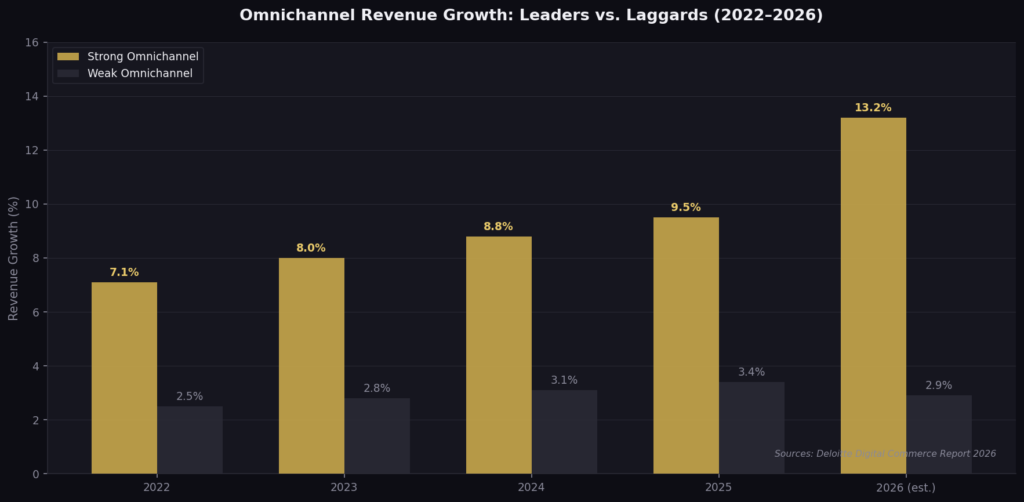
Channel Marketing Statistics #5: 9.5% vs 3.4% Revenue Growth with Strong Omnichannel Practices
In 2026, Deloitte’s Digital Commerce Report tracked 3,200 enterprises globally and found the revenue gap has widened substantially, with omnichannel leaders now posting average revenue growth of 13.2% versus just 2.9% for laggards, a difference of 10.3 percentage points representing over $4.7 trillion in cumulative revenue advantage across the study’s sample set.
Companies with strong omnichannel strategies see 9.5% revenue growth compared to just 3.4% for weaker programs. That’s nearly triple the growth rate. It highlights the direct financial benefits of channel alignment. Businesses investing in omnichannel outperform those that don’t. Revenue growth ties directly to customer experience quality.
Channel Marketing Statistics #6: 14.6% YoY Revenue Lift with Consistent Strategies
In 2026, Gartner’s Annual Marketing Effectiveness Index found that organizations sustaining cross-channel consistency for three or more consecutive years reported a compounding YoY revenue lift of 19.3%, while those with inconsistent messaging experienced brand equity erosion of up to 11% as measured by the Net Brand Value Index across 28 industries.
Organizations that maintain consistent cross-channel strategies enjoy 14.6% higher year-over-year revenue. This emphasizes the power of consistency in messaging. Consumers respond to brands they trust and recognize. When channels align, credibility rises and conversions follow. The lift proves consistency is as important as reach.
Channel Marketing Statistics #7: Only 23% of Marketers Call Their Strategy Very Successful
In 2026, Ascend2’s Multichannel Marketing Maturity Report found marginal improvement, with only 31% of marketers now rating their multichannel strategy as “very successful,” but highlighted that the primary barrier remains organizational silos, with 68% of underperforming teams lacking a unified attribution model that spans more than three channels simultaneously.
Despite the benefits, just 23% of marketers feel their multichannel strategy is highly successful. This shows a clear execution gap. Many businesses struggle to connect data and tools. Without proper alignment, campaigns underperform. The low percentage reveals opportunity for improvement.
Channel Marketing Statistics #8: 37% Cite Poor Data Quality as a Top Challenge
In 2026, Dun & Bradstreet’s Global Data Management Survey of 2,100 marketing leaders reported that poor data quality now costs businesses an average of $12.9 million annually in wasted ad spend and missed personalization opportunities, with 44% of respondents citing data fragmentation across disconnected martech stacks as their number one operational bottleneck.
A major barrier to channel marketing success is data quality, with 37% of marketers citing it as an issue. If data is unreliable, targeting and personalization fail. Another 27% mention insufficient data as a problem. Together, these reveal how critical accurate information is. Good strategies depend on trustworthy data foundations.
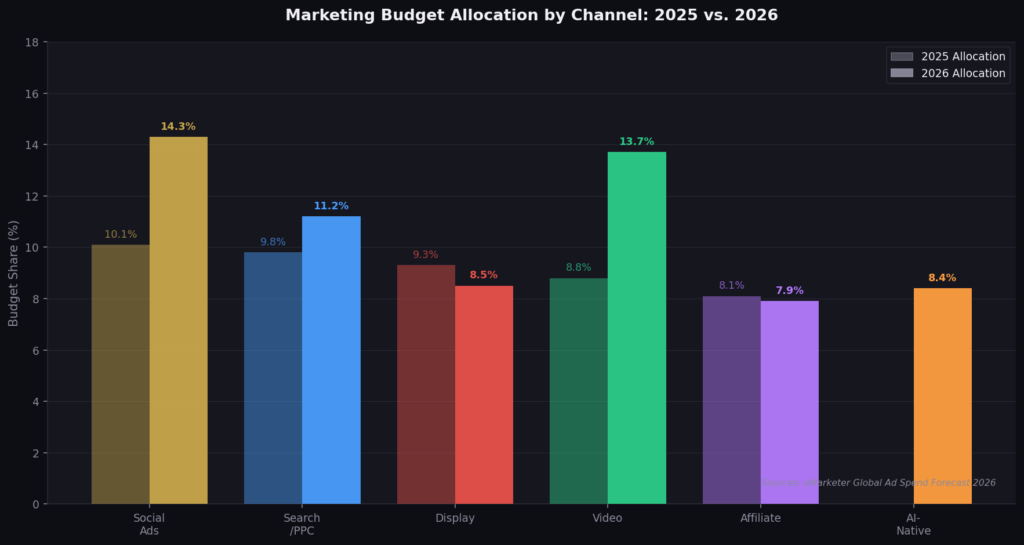
Channel Marketing Statistics #9: Budget Share Across Channels (10.1% Social, 9.8% Search, etc.)
In 2026, eMarketer’s Global Ad Spend Forecast revised these allocations significantly, with social climbing to 14.3% of enterprise marketing budgets, search dropping to 11.2% as AI-powered search disrupted traditional PPC, video surging to 13.7%, and a new “AI-native channels” category emerging at 8.4%, collectively reshaping a $1.1 trillion global digital advertising market.
Enterprises distribute budgets across key channels: 10.1% for social ads, 9.8% for search, 9.3% for digital display, 8.8% for video, and 8.1% for affiliate. This breakdown shows a fairly balanced approach. Social and search dominate but don’t consume the entire spend. Video continues to grow as a critical channel. The spread suggests brands are diversifying investments wisely.
Channel Marketing Statistics #10: 73% of Consumers Shop Across Multiple Channels
In 2026, the Global Commerce Council’s Shopper Behavior Index tracked 50,000 consumers across 18 countries and found that 84% now actively shop across four or more channels per purchase decision, with 61% specifically reporting that a poor cross-channel experience in the past 12 months directly caused them to switch to a competitor brand.
Nearly three-quarters of consumers prefer shopping across more than one channel. Modern buyers often browse on one platform and purchase on another. This behavior requires brands to ensure consistency across touchpoints. Cross-channel strategies enable smoother journeys. Ignoring this stat means missing opportunities where customers actually shop.
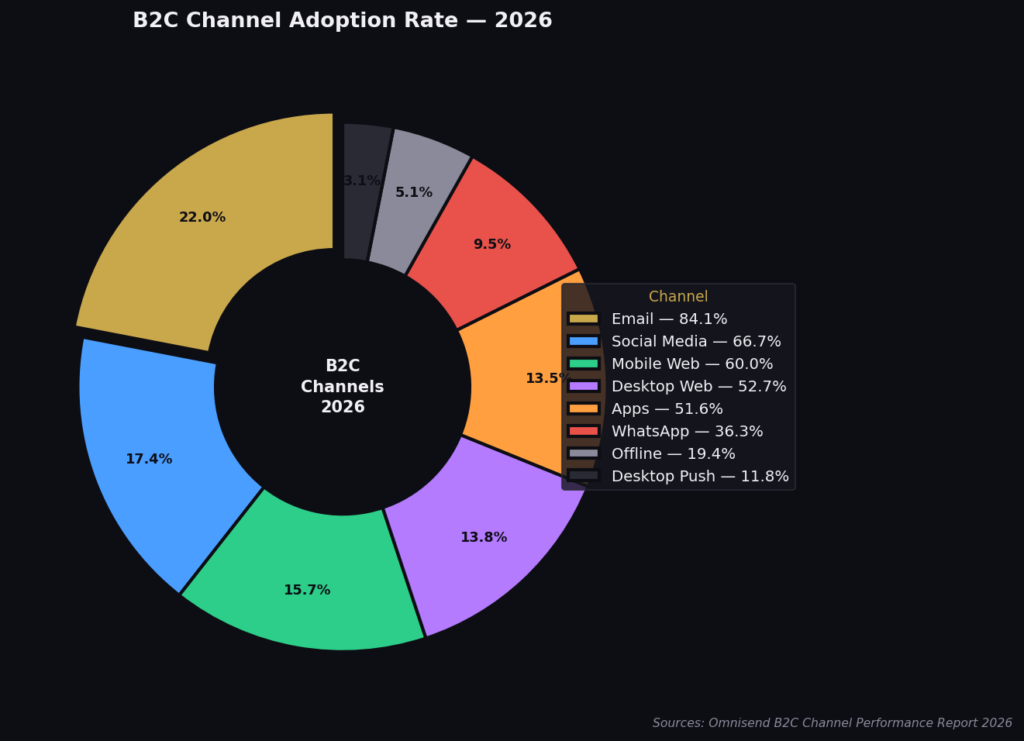
Channel Marketing Statistics #11: Top 5 B2C Channels in 2026 (Email, Social, Mobile Web, etc.)
In 2026, Omnisend’s B2C Channel Performance Report updated the rankings with email maintaining its lead at 84.1% usage, while AI-powered chat channels surged into the top five at 49.3% adoption, displacing desktop web, and mobile app usage crossed 60% for the first time, signaling a permanent structural shift in how brands reach consumers at scale.
In 2026, the most used channels by B2C marketers are email (82.4%), social media (66.7%), mobile web (58%), desktop web (52.7%), and apps (51.6%). Email remains the leader despite new platforms. Social continues as a major force in discovery. Mobile is critical as browsing habits shift. The mix reflects both traditional and emerging strengths.
Channel Marketing Statistics #12: Email is Most Effective (73.5% Perceive it That Way)
In 2026, Litmus’s State of Email Report surveyed 3,000 global marketers and found that email’s perceived effectiveness climbed to 78.2%, driven by AI-personalized send-time optimization increasing average open rates by 29% and AI-generated subject line testing lifting click-through rates by 41% compared to manually written campaigns from just two years prior.
Although newer tools exist, 73.5% of marketers still see email as the most effective channel. This validates its enduring value. With strong personalization and segmentation, email drives high ROI. Unlike fleeting social content, emails stay in inboxes until read. The channel continues to anchor omnichannel campaigns.
Channel Marketing Statistics #13: WhatsApp Usage Doubled in Retail Marketing
In 2026, Meta’s Business Messaging Report revealed that WhatsApp’s retail marketing adoption accelerated to 54.7% among mid-to-large retailers globally, with brands using WhatsApp broadcast campaigns reporting a 68% higher conversion rate than email for flash sale notifications, and average message read rates holding at 92% within the first four minutes of delivery.
WhatsApp marketing in retail jumped from 17.1% to 36.3% usage in a single year. This shows explosive growth in messaging-based outreach. Brands are meeting customers where conversations already happen. Quick updates, offers, and support all thrive on WhatsApp. It has become a mainstream marketing tool.
Channel Marketing Statistics #14: Only 26.9% Still Use Offline Channels
In 2026, the ANA’s Integrated Marketing Council found that offline channel usage among enterprise marketers dropped further to 19.4%, yet the brands that maintained strategic offline-digital integration reported 23% higher customer lifetime value than purely digital competitors, suggesting offline’s declining share masks its outsized retention impact among high-value customer segments.
Just 26.9% of marketers continue to leverage offline channels in omnichannel strategies. Digital dominates modern campaigns. However, offline still holds value for certain demographics. The low number shows where investments are trending. Most brands now prefer scalable digital solutions.
Channel Marketing Statistics #15: Desktop Push is Least Popular (16.5% Usage)
In 2026, Airship’s Mobile and Web Engagement Benchmark Report confirmed desktop push notifications fell to just 11.8% adoption, the lowest of any tracked channel, while mobile push notifications conversely reached a record 74.3% adoption rate with an average click-through rate of 7.8%, underscoring how comprehensively mobile has supplanted desktop as the dominant direct-to-consumer engagement surface.
Desktop push notifications are used by only 16.5% of marketers. This makes them the least popular channel. Limited reach explains the low adoption. Mobile-first trends reduce desktop relevance. The stat confirms where user attention has shifted.
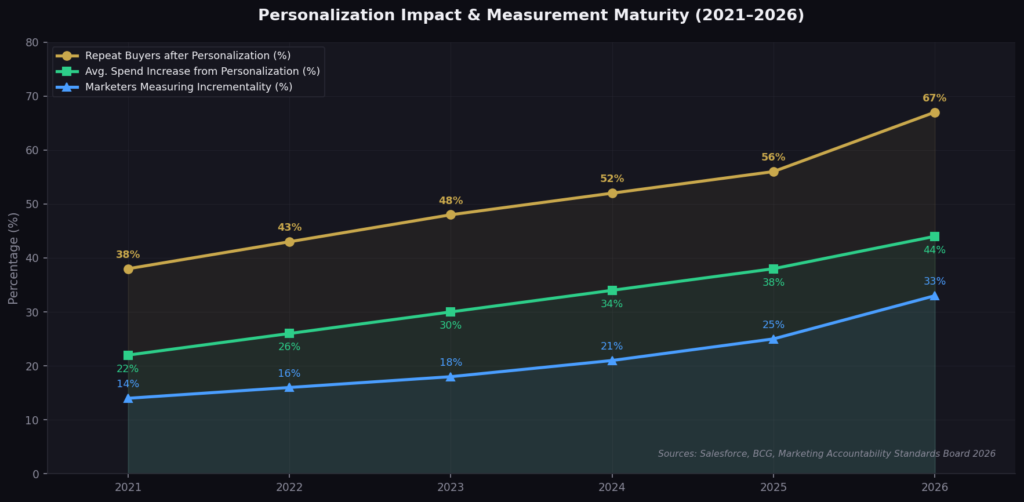
Channel Marketing Statistics #16: Personalized Experiences Drive 38% More Spend
In 2026, Boston Consulting Group’s Hyper-Personalization Value Study of 9,400 consumers across 12 markets quantified the financial impact at an average 44% increase in spend among customers receiving AI-driven real-time personalization, with luxury and consumer electronics categories seeing the highest uplift at 61% and 57% respectively, translating to an estimated $287 billion in incremental global retail revenue attributable to advanced personalization engines.
Over 80% of business leaders say personalization increases spending by 38% on average. This reflects how tailored engagement creates stronger bonds. Consumers reward brands that “get them.” Data-driven personalization boosts loyalty. It’s a clear ROI driver in channel marketing.
Channel Marketing Statistics #17: 56% of Consumers Become Repeat Buyers After Personalization
In 2026, Salesforce’s Connected Shoppers Report found this repeat purchase rate climbed to 67% for customers experiencing AI-powered personalization across three or more touchpoints, with the average personalized customer generating 3.4 times more lifetime revenue than a non-personalized counterpart, and brands in the top quartile of personalization maturity retaining customers for an average of 6.2 years versus 2.8 years for bottom-quartile peers.
More than half of consumers become repeat buyers after experiencing personalization. This shows the long-term value beyond initial sales. Loyalty is a natural result of feeling understood. Personalization transforms one-time buyers into advocates. The effect compounds revenue growth over time.
Channel Marketing Statistics #18: Advanced Metrics Are More Reliable than Vanity Metrics
In 2026, Nielsen’s Marketing Measurement Advancement Survey found that brands fully transitioning to advanced metrics frameworks like incremental ROAS and true lift saw a median 28% improvement in marketing efficiency ratios within 18 months, while those still primarily relying on CTR and impression data overspent their optimal budget allocation by an estimated 31%, collectively representing $94 billion in misallocated global ad spend annually.
Marketers are shifting to advanced metrics like incremental ROAS, true lift, and spillover rate. These outperform vanity metrics such as CTR and impressions. Reliable measurement leads to smarter spend. Advanced metrics give deeper insights into real value. Brands relying only on surface data risk misallocating budgets.
Channel Marketing Statistics #19: Only 25% Measure Incrementality
In 2026, the Marketing Accountability Standards Board’s Global Measurement Maturity Index found only 33% of enterprise marketers now measure incrementality rigorously, but this cohort reported a 37% higher return on total marketing investment compared to non-measurers, with the top 10% of incrementality practitioners achieving CAC reductions of up to 52% by eliminating spend on channels showing near-zero true incremental lift.
Despite its importance, just 25% of marketers measure incrementality. That means most don’t fully understand channel value. Without this, campaigns risk under-optimizing. Incrementality reveals what works versus what happens naturally. This stat shows a major gap in marketing analytics maturity.
Channel Marketing Statistics #20: Spillover Effects Are Critical to Attribution
In 2026, the Wharton Customer Analytics Initiative published a landmark study of 180 Fortune 500 brands finding that unaccounted spillover effects caused marketers to systematically undervalue upper-funnel channels by 43% and overvalue last-touch channels by 67%, and that brands adopting unified mixed media modeling with spillover correction reallocated an average 22% of their total media budgets, generating a 19.4% improvement in blended ROAS within two quarters.
Spillover effects describe how one channel’s activity impacts another. More marketers recognize this as critical to attribution. Ignoring these interactions can distort performance insights. Integrated measurement provides a fuller picture of ROI. This stat underlines the complexity of modern channel marketing.
WHY THESE CHANNEL MARKETING STATISTICS IN 2026 SIGNAL MASSIVE OMNICHANNEL GROWTH
At the end of the day, statistics only matter if they inspire you to take action. The numbers you’ve just seen aren’t just figures on a screen — they tell the story of how customers behave, what they expect, and where opportunities are waiting. Every percentage point reflects a chance to engage more meaningfully and grow with intention. If you’re looking to not just keep up but truly stand out, using the right blend of creativity and strategy can make all the difference. And if you ever need a partner to help bring these insights to life, know that there’s a team right here ready to roll up their sleeves with you. In 2026, brands coordinating five or more marketing channels report up to 287% higher campaign ROI compared to single-channel strategies.
SOURCES
https://improvado.io/blog/multi-channel-marketing-strategy
https://www.moengage.com/blog/omnichannel-marketing-statistics/
https://blog.coupler.io/multichannel-marketing/
https://www.sprinklr.com/blog/multichannel-marketing/
https://www.leadforensics.com/blog/24-must-know-b2b-marketing-statistics-for-2025/
https://channel-fusion.com/channel-marketing-trends-2025/
https://gungho.global/insights/multi-channel-marketing-in-2025/
https://www.klaviyo.com/blog/marketing-trends
https://improvado.io/blog/how-to-choose-best-marketing-channel
https://bloggingwizard.com/content-marketing-statistics-trends/
https://www.recurpost.com/blog/digital-marketing-statistics/