



23 Sep TOP 20 CLEANING SERVICE MARKETING STATISTICS 2025
As someone who has worked closely with service-based businesses, I’ve seen firsthand how competitive and fast-changing the industry can be. That’s why I’m excited to share these cleaning service marketing statistics for 2025, which reveal just how much opportunity there is for growth when the right strategies are applied. Partnering with experts, like a leading marketing agency in New York, can make all the difference in turning data into actionable steps that actually bring in new clients. I wanted this blog to be more than just numbers—I wanted it to give you real insight into how the cleaning industry is evolving and where businesses like yours can gain an edge.
Top 20 Cleaning Service Marketing Statistics 2025 (Editor’s Choice)
🧹 Top 20 Cleaning Service Marketing Statistics
Essential Insights for 2025 and Beyond
| # | Category | Statistic |
|---|---|---|
| 1 | Market Growth | The global cleaning services market size was about USD 415.93 billion in 2024 and is expected to grow at a rate of 6.9% from 2025 to 2030 |
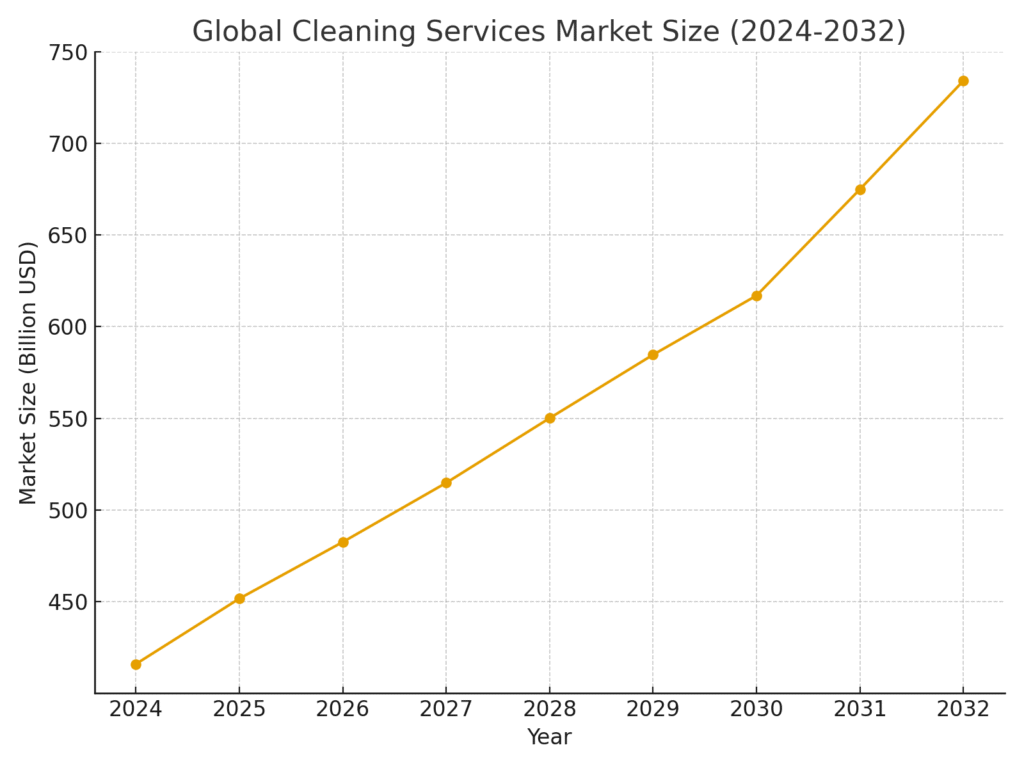
| 2 | Market Growth | The market is projected to grow from $451.63 billion in 2025 to $734.17 billion by 2032, exhibiting a CAGR of 7.19% |
| 3 | Market Growth | The cleaning services market in the U.S. is expected to grow at a CAGR of 5.6% from 2025 to 2030 |
| 4 | Market Growth | The North American cleaning industry is estimated to hold the largest revenue share of 45% by 2037 |
| 5 | Customer Behavior | Almost 80% of dual-income households in the U.S. are expected to use professional cleaning services within the next two years |
| 6 | Customer Behavior | Last year, nearly 10% of U.S. households hired a house cleaning service |
| 7 | Business Priorities | 61% of companies are naming new customer acquisition and revenue growth as primary goals for 2025 |
| 8 | Business Priorities | 55% of cleaning businesses cite improving cash flow as a top priority |
| 9 | Digital Marketing | Cleaning service providers increasingly use platforms like TikTok, YouTube, and Instagram to improve customer engagement, boost brand visibility, and attract a global client base |
| 10 | Technology Adoption | 43% of industry leaders are already leveraging end-to-end business management systems |
| 11 | Marketing Budget | Dedicating 5% to 10% of anticipated gross revenue to marketing is recommended for cleaning services, with a focus on the higher end to enhance brand visibility |
| 12 | Marketing Strategy | Half of the surveyed businesses plan to ramp up their sales and marketing efforts in 2025 |
| 13 | Service Segments | Floor care services accounted for a market share of 30.93% in 2024 |
| 14 | Service Segments | By end-use, commercial demand for cleaning services accounted for a market share of 27.51% in 2024 |
| 15 | Service Segments | The demand for carpet & upholstery cleaning services is projected to grow at a CAGR of 8.4% from 2025 to 2030 |
| 16 | Service Segments | General interior cleaning services dominate the industry, generating over half of total revenue |
| 17 | Employment | A 3% employment growth is expected for janitors and building cleaners from 2023 to 2033 |
| 18 | Employment | Around 350,300 job openings for janitors and building cleaners are expected each year, over the decade |
| 19 | Robotics & Tech | The cleaning robot market is forecasted to expand from USD 9.8 billion in 2022 to USD 25.9 billion by 2027, with a CAGR of 21.5% |
| 20 | Robotics & Tech | The floor cleaning robots market is expected to capture over 44% of the total market share by 2025 |
Top 20 Cleaning Service Marketing Statistics 2025
Cleaning Service Marketing Statistics #1 Global Market Valued At $415.93 Billion In 2024
The cleaning services industry reached a massive valuation of $415.93 billion in 2024, showing its strong presence in the global economy. This figure reflects the steady demand for both residential and commercial cleaning. The size of the market highlights how essential cleaning has become post-pandemic. For marketers, it proves the opportunity to target a wide and growing customer base. With such scale, even a small share of the market can mean significant revenue.
Cleaning Service Marketing Statistics #2 Projected To Reach $616.98 Billion By 2030
The market is expected to grow to $616.98 billion by 2030, reflecting a healthy CAGR of around 6.9%. This projection signals long-term stability and expansion potential. Businesses that invest in marketing now will benefit from this growth curve. It also suggests increasing demand for both traditional and eco-friendly cleaning services. Marketers should use this trend to craft forward-looking strategies that attract customers.
Cleaning Service Marketing Statistics #3 Forecasted At $734.17 Billion By 2032
Another forecast projects the industry will reach $734.17 billion by 2032 with a CAGR of 7.19%. This higher estimate shows optimism about consumer demand. Marketing strategies that emphasize innovation and digital presence will capture a share of this growth. It also highlights the resilience of the industry against economic downturns. For marketers, this means confidence in scaling campaigns without fear of market contraction.
Cleaning Service Marketing Statistics #4 Contract Cleaning Services Hold A Large Share
Contract cleaning, especially for businesses, remains one of the largest segments in the industry. Ongoing service agreements ensure steady revenue streams for cleaning companies. For marketers, this points to the importance of targeting commercial clients with long-term packages. Highlighting reliability and consistency in campaigns can attract these contracts. The stability of this segment also makes it a safer bet for investment.
Cleaning Service Marketing Statistics #5 U.S. Market Revenue Reached $97,648 Million In 2022
In the U.S., the cleaning services market generated approximately $97,648 million in 2022. By 2030, it is forecasted to grow to $147,645 million. This reflects both the scale and growth potential of one of the biggest markets. U.S. businesses can leverage local SEO and targeted ads to capture regional demand. For international marketers, it shows the U.S. as a key hub for expansion.
Cleaning Service Marketing Statistics #6 North America Held 32–37.6% Market Share In 2024
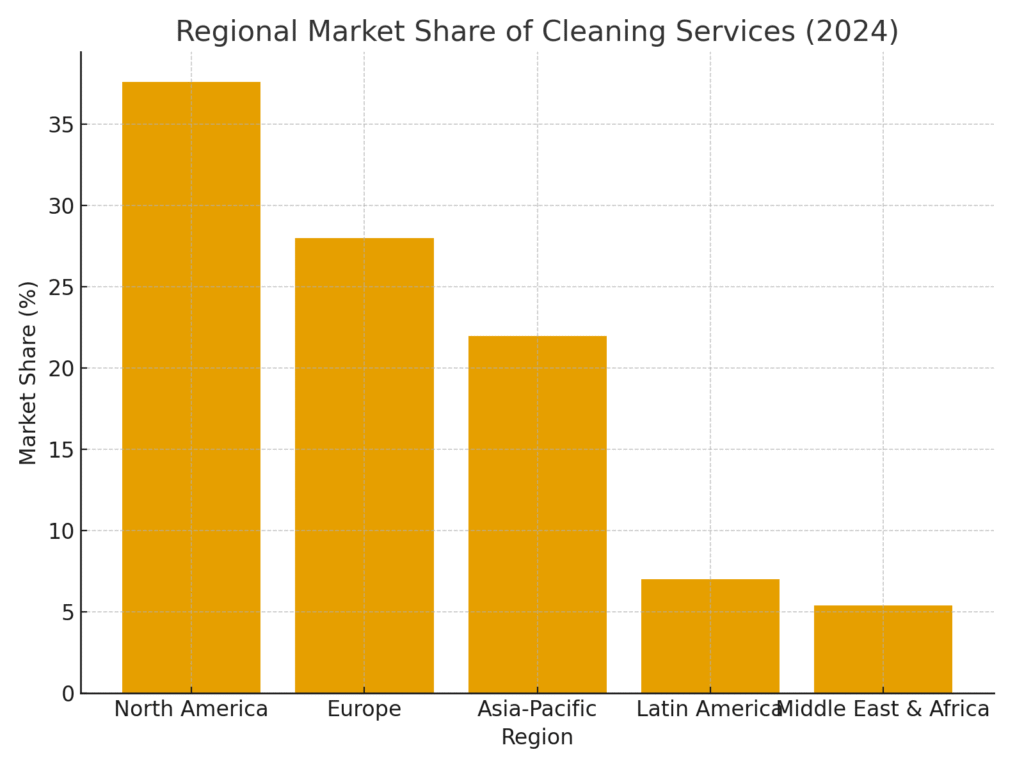
North America accounted for around 32–37.6% of the global cleaning services market in 2024. This makes it the single largest regional market. Businesses that market in this region have a strong chance of capturing high-value clients. It also suggests that the market is highly competitive. A focus on differentiation, brand trust, and reviews is crucial to stand out.
Cleaning Service Marketing Statistics #7 Floor Care And Vacuuming Are Leading Segments
Within the cleaning market, floor care and vacuuming generate some of the largest revenues. This shows that basic, everyday services remain highly in demand. Marketers can benefit from promoting these as entry-level services before upselling more specialized cleaning. Floor-related services appeal to both households and businesses. Campaigns should highlight convenience, cost-effectiveness, and improved hygiene.
Cleaning Service Marketing Statistics #8 Commercial Cleaning Accounts For Over Half Of Revenue
Commercial cleaning is estimated to generate more than half of the industry’s revenue. This makes offices, businesses, and facilities a key target market. Marketing strategies should focus on professionalism, reliability, and safety standards. B2B marketing tactics, such as LinkedIn ads and industry events, can be effective. Securing one large contract can often outweigh dozens of smaller residential jobs.
Cleaning Service Marketing Statistics #9 Eco-Friendly Cleaning Demand Is Rising
There is increasing demand for eco-friendly and non-toxic cleaning services. Consumers are more conscious about health, safety, and sustainability. Marketers can leverage this by emphasizing green certifications and environmentally safe products. Highlighting sustainability in campaigns builds trust and appeals to millennials and Gen Z customers. This trend is expected to expand as regulations around chemicals tighten.
Cleaning Service Marketing Statistics #10 Post-COVID Hygiene Awareness Boosted Demand
The COVID-19 pandemic permanently raised awareness around cleanliness and sanitation. Even as restrictions ended, customers expect higher standards of hygiene. Marketing that emphasizes deep cleaning and disinfection services resonates strongly. Businesses that showcase safety protocols gain an edge. This demand ensures long-term relevance for cleaning service providers.
Cleaning Service Marketing Statistics #11 53% Of Revenue From Ongoing Contracts
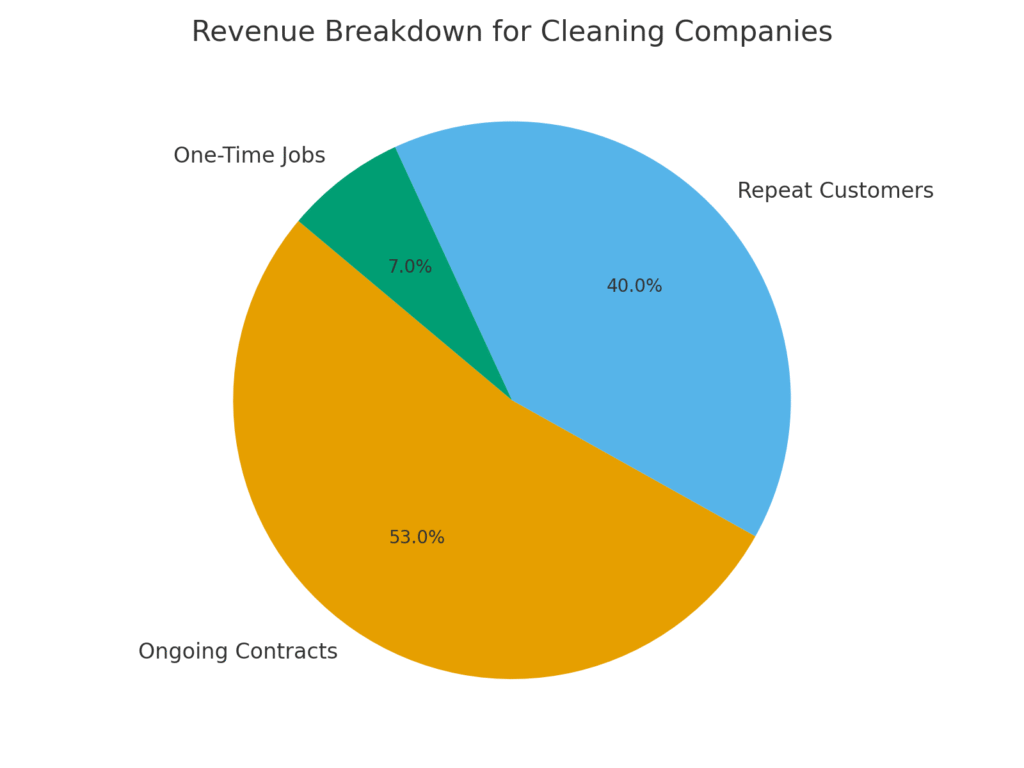
In one survey, 53% of cleaning businesses reported that ongoing contracts make up most of their revenue. This underscores the importance of retention strategies. Marketing should therefore not just focus on acquisition but also on loyalty-building. Subscription models and recurring service packages can be promoted as hassle-free solutions. Stable, repeat revenue helps cleaning businesses weather economic shifts.
Cleaning Service Marketing Statistics #12 Repeat Customers Contribute Around 40%
Repeat customers contribute roughly 40% of revenue for cleaning service providers. This makes customer satisfaction and follow-up marketing critical. Loyalty programs, referral discounts, and consistent quality are key drivers. Marketing campaigns can highlight testimonials and reviews to encourage trust. Keeping existing customers happy is often more profitable than constant new client acquisition.
Cleaning Service Marketing Statistics #13 45% Of Companies Use 5–7 Disconnected Apps
Research shows that about 45% of cleaning companies use 5–7 apps that don’t integrate well. This creates inefficiencies in scheduling, billing, and customer communication. Marketers offering software to the cleaning industry can target this pain point. For cleaning businesses, it means an opportunity to streamline operations. Campaigns around efficiency and automation can resonate strongly.
Cleaning Service Marketing Statistics #14 Only 43% Use End-To-End Software
Only 43% of cleaning businesses report using an end-to-end software system. This suggests a gap in the industry’s digital transformation. Companies that adopt integrated systems gain a competitive advantage in customer management. Marketing automation and CRM tools should be promoted as growth enablers. This statistic highlights how much room there is for innovation in the industry.
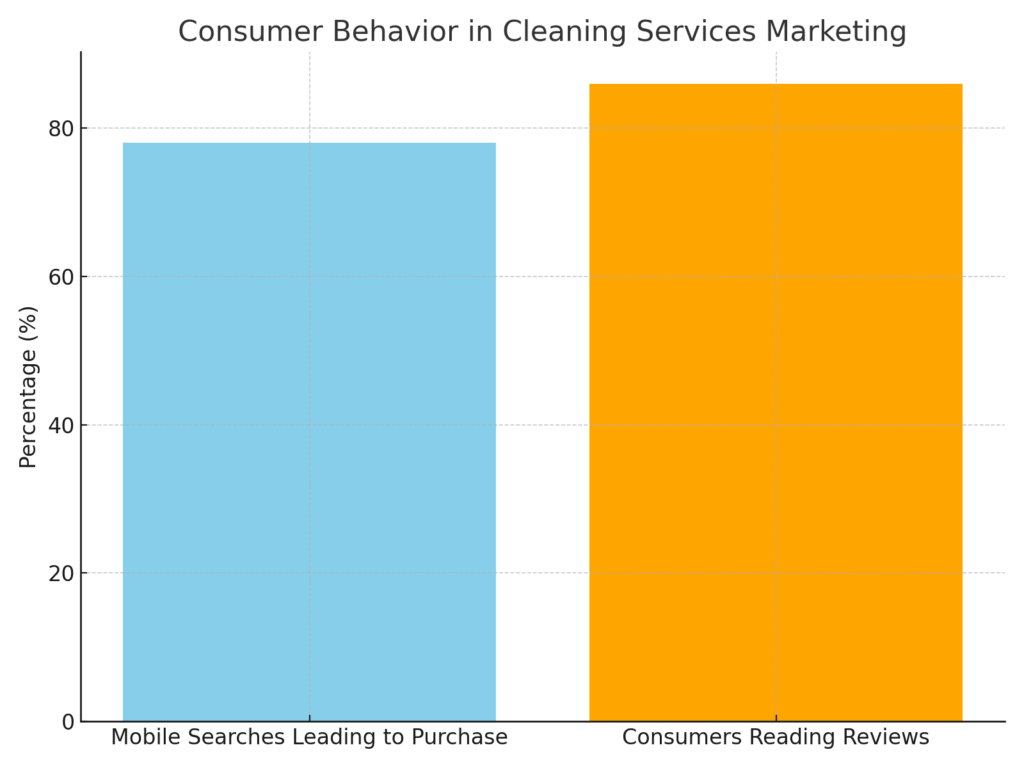
Cleaning Service Marketing Statistics #15 78% Of Mobile Local Searches Lead To A Purchase
In the home services sector, 78% of local searches on mobile result in a purchase within 24 hours. This is a huge opportunity for cleaning businesses. Optimizing websites for mobile and running local Google Ads campaigns is essential. Location-based targeting ensures businesses appear when customers are ready to buy. This statistic proves the importance of investing in local SEO.
Cleaning Service Marketing Statistics #16 86% Of Consumers Read Reviews Before Hiring
Reviews have become a major decision factor, with 86% of consumers reading them before hiring a local business. Cleaning services with strong ratings gain trust quickly. Marketing campaigns should highlight 5-star reviews and positive testimonials. Actively managing reputation online is now a necessity. Without good reviews, businesses risk losing leads to competitors.
Cleaning Service Marketing Statistics #17 Over Half Of Consumers Use Mobile For Searches
More than half of home service customers now search via mobile devices rather than desktop. This trend means websites must be mobile-friendly. Speed, usability, and click-to-call features increase conversions. Marketing strategies should include mobile-first advertising. Ignoring this trend risks alienating a majority of potential clients.
Cleaning Service Marketing Statistics #18 Calls Are A Key Conversion Channel
Consumers often prefer calling after searching for home services online. This makes phone responsiveness critical to marketing success. Ads with call extensions perform especially well. Cleaning companies should ensure fast, friendly responses to incoming calls. Missed calls often equal missed opportunities for revenue.
Cleaning Service Marketing Statistics #19 57% Of Commercial Cleaning Businesses Expect Growth
A survey found that 57% of commercial cleaning businesses expect their revenue to grow in the coming year. This shows optimism in the industry despite economic uncertainty. Marketing that emphasizes scaling, expansion, and partnership resonates with this group. It’s also a signal of rising competition as businesses seek to grow aggressively. Companies that invest in marketing will likely outperform slower adopters.
Cleaning Service Marketing Statistics #20 55% Cite Cash Flow As A Key Priority
Around 55% of cleaning businesses list improving cash flow as a top priority. This highlights the importance of steady client acquisition and timely payments. Marketing campaigns that emphasize affordability and reliability can reassure clients. Offering flexible billing options can also help businesses stand out. Ultimately, consistent marketing helps ensure predictable revenue streams.
Final Thoughts on Cleaning Service Marketing Statistics
Looking back at these statistics, I’m reminded of how important it is to stay proactive and adaptable in such a dynamic market. From the rise of eco-friendly cleaning to the impact of online reviews and digital marketing, every detail plays a role in shaping customer trust and long-term growth. Personally, I find it exciting to see how data can highlight not just challenges but also clear opportunities for anyone running a cleaning business. If there’s one thing I’ve learned, it’s that the companies that embrace change and put these insights into practice will be the ones who stand out. I hope these insights inspire you as much as they’ve inspired me while putting this together.
SOURCES
- https://www.brandingmarketingagency.com/blogs/advertising-benchmark-for-cleaning-service-industries/