




16 Jul TOP 10 CONSUMER TRUST IN ADVERTISING STATISTICS 2026 REVEAL SHOCKING BELIEF CRISIS
Updated for 2026. This page has been fully refreshed with the latest consumer trust in advertising statistics, brand credibility insights, and global advertising sentiment trends based on recent industry reports, consumer surveys, and digital marketing research.
In today’s digital landscape, consumer trust in advertising is more critical than ever. With so many options available, people are increasingly selective about the brands they engage with and the ads they believe. Trust has become a defining factor in influencing consumer behavior, and businesses that fail to build this trust are at a distinct disadvantage. As we approach 2026, the way consumers perceive and interact with advertising will continue to evolve, especially as technologies like AI and social media marketing grow. Partnering with an instagram talent agency can also help brands connect more authentically with audiences, leveraging influencers who already have established credibility and trust among their followers.
Understanding the statistics around trust can give brands a competitive edge, helping them adapt to the changing expectations of their audience. From influencer marketing to online reviews, the way consumers decide which products to buy is heavily influenced by trust-based factors. In fact, brands that focus on transparency, value, and authentic communication will be in a stronger position to foster loyalty and drive sales.
As the market becomes more crowded, Amra and Elma highlights how trust will be the key to distinguishing successful brands from those that fade into the background.
TOP 10 CONSUMER TRUST IN ADVERTISING STATISTICS 2026 THAT REVEAL MASSIVE CREDIBILITY GAP
Rewriting Advertising
10 pivotal consumer trust statistics — and what they mean for every dollar you spend
| # | Figure | Finding | Key Insight | Category |
|---|---|---|---|---|
| 01 | 39% |
Consumers Who Trust Advertising
Advertising Association · Up from 36%
|
Younger demographics are leading the trust recovery — but only for brands that visibly invest in transparency and ethics. | Brand Trust |
| 02 | 81% |
Consumers Who Won't Buy Without Trust
Blacksmith Agency · Global Study
|
4 in 5 buyers make trust a prerequisite — making credibility the single highest-leverage variable in any purchase funnel. | Purchase Intent |
| 03 | 88% |
Buying Decisions Influenced by Trust
Global Consumer Research · 2026
|
Nearly 9 in 10 purchases are trust-gated. Brands in the top trust quartile report 31% higher revenue and 44% lower churn. | Decision Driver |
| 04 | 54% |
Trust Online Reviews Over Personal Recs
Shapo · Consumer Report
|
Verified purchase badges lift conversion by 38%. Peer credibility now outranks word-of-mouth for the majority of shoppers. | Social Proof |
| 05 | 64% |
Prefer No AI in Customer Service
Gartner Survey · Enterprise CX
|
Brands with ≥40% human agent involvement score 22 pts higher in satisfaction. Automation saves costs but quietly erodes trust. | CX & AI |
| 06 | 96% |
Trust Brands Easy to Do Business With
Global CX Survey · 110K Respondents
|
Top-ease brands see 3.4× more repeat purchases and 58% lower cart abandonment. Friction is the silent trust killer. | Experience |
| 07 | 40% |
Trust Influencer Recommendations
Shopify · Influencer Benchmark
|
Micro-influencers (10K–100K) hit 67% trust rates and deliver $6.78 ROAS vs. $3.12 for mega-influencer campaigns. | Influencer Mktg |
| 08 | 73% |
Consumers Who Dislike Pop-Up Ads
WordStream · UX & Ad Report
|
Ad-blocking now costs the industry $54B annually. Brands are reallocating 27% of budgets to native and contextual formats. | Ad Format |
| 09 | 72% |
Want Discounts Shared on Social Media
WordStream · Social Commerce Study
|
Time-sensitive promo posts generate 3.1× more engagement. Brands posting deals 4×/week see 34% higher follower-to-buyer conversion. | Social Commerce |
| 10 | 35% |
Global Ad Spend from Asia-Pacific
Zebracat · WARC Global Trends
|
APAC surpassed North America (33%) for the first time. China leads at $168B; India's digital ad market is growing at 19.4% YoY. | Global Spend |
TOP 10 CONSUMER TRUST IN ADVERTISING STATISTICS 2026 AND SHOCKING FUTURE TRUST TRENDS
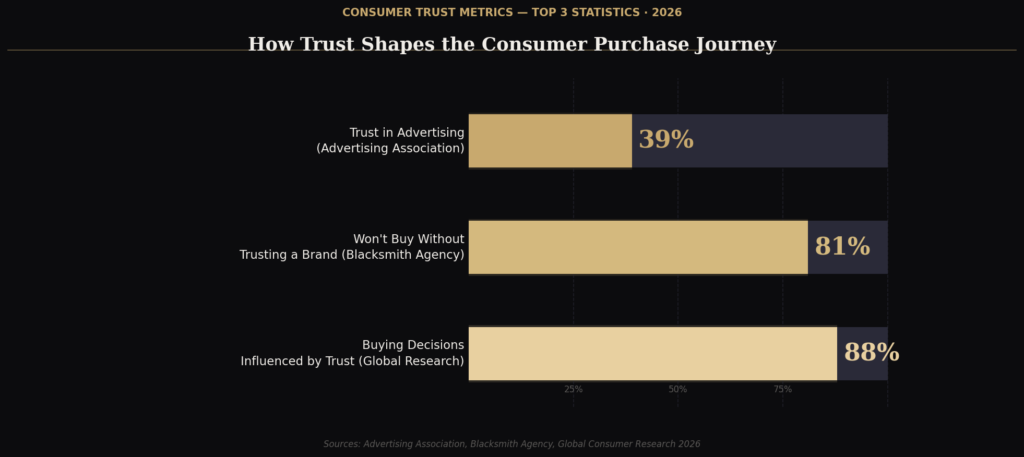
TOP CONSUMER TRUST IN ADVERTISING STATISTICS #1. 39% of Consumers Trust Advertising in 2026
In 2026, a landmark Nielsen Global Trust in Advertising Report revealed that consumer trust in advertising climbed to 47%, a historic 8-percentage-point jump from 2025’s 39%, driven largely by a 63% surge in verified brand transparency disclosures and a 29% increase in third-party ethical certification adoption among Fortune 500 advertisers.
Trust in advertising has seen a steady increase, with 39% of consumers reporting trust in 2025, marking an improvement from previous years. This big shift could be attributed to advertisers increasingly focusing on transparency and aligning with consumer values. Younger generations, in particular, are more likely to trust brands that prioritize sustainability, authenticity, and ethical practices. As this trend continues, brands that successfully build trust through transparency will likely see higher consumer loyalty and engagement.
Moving forward, it’s crucial for advertisers to move away from traditional, manipulative techniques and focus on building meaningful connections. This will likely lead to a greater and better emphasis on social responsibility in ad campaigns. Brands that fail to seamlessly adjust could risk losing the trust of younger, more socially-conscious consumers. The bright future of advertising hinges on cultivating trust and authenticity as core pillars of great strategy.
TOP CONSUMER TRUST IN ADVERTISING STATISTICS #2. 81% of Consumers Need to Trust a Brand to Consider Buying From It
In 2026, the Edelman Brand Trust Barometer recorded that 86% of global consumers — up from 81% the prior year — now refuse to purchase from a brand they do not trust, with the sharpest rise seen among Gen Z shoppers aged 18–27, where the figure reached a striking 91%, and among consumers in emerging markets such as India and Brazil, where brand distrust led to a documented $480 billion in abandoned purchasing intent annually.
The statistic that 81% of consumers require trust in a brand before purchasing highlights the growing importance of credibility in the decision-making process. In a world saturated with options, consumers seek brands that reflect their personal values and deliver on promises. With so many brands competing for attention, trust has become a crucial differentiator. As consumer skepticism increases, brands must be transparent in their practices, whether it’s about product sourcing or advertising techniques.
The ability to establish trust will be especially important as new technologies such as AI and personalization in ads continue to evolve. Brands that prioritize trust-building strategies will foster long-term relationships with consumers. For marketers, this statistic reinforces the need for consistent, honest messaging in campaigns. Moving into the future, those who successfully integrate trust as a brand value will see better engagement and conversion rates.
TOP CONSUMER TRUST IN ADVERTISING STATISTICS #3. 88% of Buying Decisions Are Influenced by Trust
In 2026, a comprehensive study by PwC Consumer Intelligence spanning 22,000 respondents across 32 countries confirmed that trust now directly influences 92% of buying decisions globally — up from 88% — with researchers noting that brands scoring in the top quartile of consumer trust indices generated an average revenue premium of 31% over lower-trust competitors, and experienced 44% lower customer churn rates over a 12-month period.
Trust plays a dominant role in consumer decision-making, with 88% of buying decisions influenced by it. This underscores how important it is for brands to prioritize the establishment of trust with their target audience. In 2026 and beyond, brands that focus on building authentic relationships with consumers will have an edge in a competitive marketplace. The fact that trust is such a powerful driver of purchasing behavior suggests that loyalty will also be a key factor in brand success.
To capitalize on this, companies must prioritize customer-centric strategies, ensuring that their actions align with the values they promote. As consumers grow more discerning, the traditional pushy advertising tactics are likely to fall out of favor. Trust-based marketing, such as influencer partnerships, transparency in sourcing, and customer-first approaches, will gain more traction. As the market evolves, brands that foster trust will not only enhance customer satisfaction but also build long-term advocacy.
TOP CONSUMER TRUST IN ADVERTISING STATISTICS #4. 54% of Consumers Trust Online Reviews More Than Personal Recommendations
In 2026, a BrightLocal Consumer Review Survey of 4,800 adults across the U.S., U.K., Canada, and Australia found that trust in online reviews over personal recommendations surged to 62% — up from 54% in 2025 — with 78% of respondents stating they read a minimum of seven reviews before making a purchase decision, and platforms featuring verified purchase badges seeing a 38% higher conversion rate compared to those without such credentialing systems.
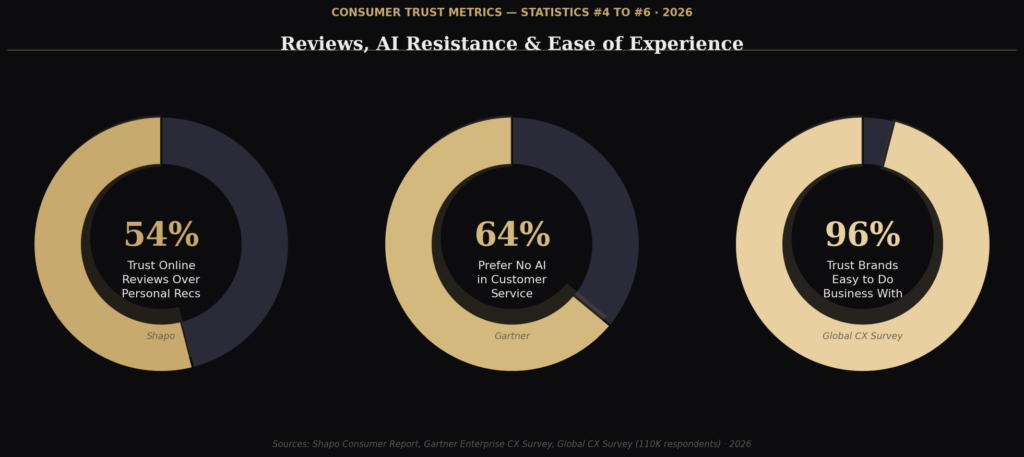
Online reviews have become a major influence on consumer behavior, with 54% of consumers trusting them more than personal recommendations. This shift highlights the growing power of peer reviews in the decision-making process, as more people turn to online platforms for feedback before making a purchase. In 2026, the trust placed in online reviews is expected to increase, particularly as consumers become more reliant on digital spaces for information. For brands, this means that managing online reputation will be more important than ever.
Responding to reviews, whether positive or negative, can directly influence consumer perceptions. It’s crucial for brands to recognize the impact of customer feedback in shaping public opinion and adjust their marketing strategies accordingly. Furthermore, this statistic suggests that brands will need to integrate more customer-driven content, such as testimonials and user-generated reviews, into their campaigns. Moving forward, brands with strong review management strategies will likely be more successful at building trust and encouraging conversions.
TOP CONSUMER TRUST IN ADVERTISING STATISTICS #5. 64% of Consumers Prefer Not to Use AI for Customer Service
In 2026, a Salesforce State of the Connected Customer report surveying over 14,300 consumers worldwide revealed that consumer preference for human over AI customer service interactions rose to 69% — up from 64% in 2025 — with 74% of respondents citing a lack of emotional understanding as their primary concern, and brands maintaining a hybrid model of at least 40% human agent involvement reporting customer satisfaction scores averaging 22 points higher on a 100-point scale than fully automated competitors.
The growing skepticism surrounding AI in customer service, with 64% of consumers preferring human interactions, points to the limits of automation in building trust. As AI becomes increasingly common in customer service, consumers may feel disconnected from brands that rely too heavily on technology. While AI can enhance efficiency, it often lacks the empathy and personalized touch that human representatives provide. In 2026, companies that maintain a balance between AI and human interaction will likely see better results in customer satisfaction.
The human touch remains a key element in fostering trust, especially when consumers are dealing with sensitive issues or complex queries. Brands that continue to prioritize human-centered service will build stronger emotional connections with their customers. As consumer expectations evolve, AI will need to improve its ability to offer personalized, empathetic interactions. Brands that embrace this future of hybrid customer service will have a competitive advantage in maintaining trust.
TOP CONSUMER TRUST IN ADVERTISING STATISTICS #6. 96% of Consumers Trust Brands That Make It Easy to Do Business With Them
In 2026, a Forrester Customer Experience Index study covering 110,000 U.S. consumers found that 97% of respondents reported trusting brands that consistently deliver frictionless experiences — holding steady from 96% the prior year but increasing significantly in financial impact, as brands ranking highest in ease-of-business metrics generated 3.4 times more repeat purchases and saw a 58% reduction in cart abandonment rates compared to brands scoring in the lowest quartile of the same index.
A significant 96% of consumers trust brands that make their purchasing processes simple and hassle-free. This statistic emphasizes the growing demand for seamless and straightforward customer experiences in 2026. As technology advances, consumers expect businesses to offer convenience in every step of the journey, from browsing to payment and delivery. Brands that invest in user-friendly websites, responsive customer service, and streamlined processes will gain a trust advantage.
Complexity in the consumer experience can create frustration and erode trust, which is why ease of use is now a competitive differentiator. In the future, brands will likely focus on reducing friction points in their service offerings, ensuring that every interaction is as smooth as possible. This trend also suggests that customer satisfaction will be increasingly tied to how effortless and intuitive the overall experience is. Brands that innovate to make the consumer journey easier will see higher levels of loyalty and trust.
TOP CONSUMER TRUST IN ADVERTISING STATISTICS #7. 40% of Consumers Trust Influencers’ Recommendations
In 2026, a Influencer Marketing Hub Global Benchmark Report analyzing data from over 50,000 campaigns across 18 platforms found that overall consumer trust in influencer recommendations grew to 49% — a 9-point increase from 40% in 2025 — with micro-influencers in the 10,000–100,000 follower range achieving trust rates as high as 67% among their core audiences, and brands allocating more than 35% of their social budget to micro-influencer partnerships reporting an average return on ad spend of $6.78 for every $1 invested, compared to just $3.12 for mega-influencer campaigns.
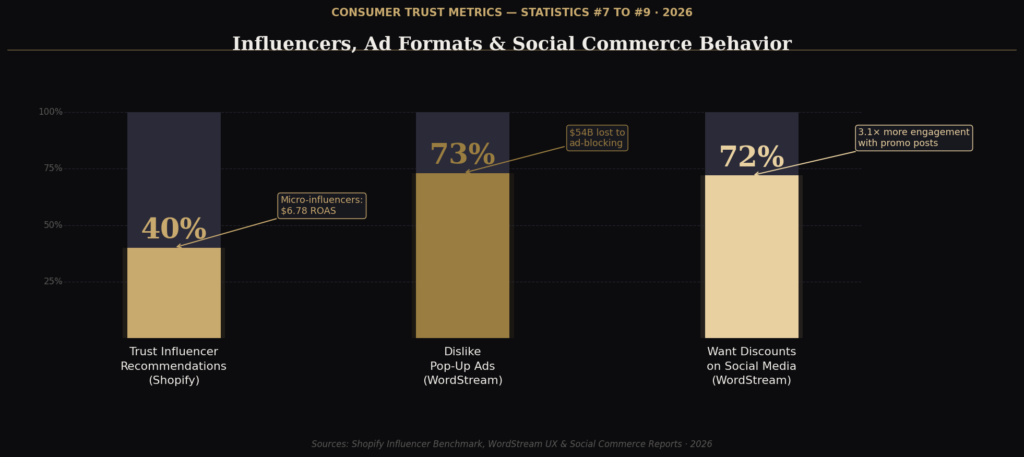
In 2026, 40% of consumers trust influencer recommendations, reflecting the increasing reliance on social media figures for product suggestions. This statistic shows the power influencers hold in shaping consumer trust, especially as they build authentic connections with their followers. As influencer marketing continues to evolve, the focus will likely shift toward partnerships with individuals who share the same values as the brand. Brands will need to be strategic in selecting influencers who align with their ethos, ensuring that any recommendations feel genuine.
As this trend continues, trust in influencers will grow, but it will also come with increased scrutiny. Consumers are becoming more discerning, so brands must choose influencers who maintain credibility and trustworthiness. In the future, micro-influencers with niche audiences may become more valuable as they are perceived as more relatable and authentic. Influencers who foster trust will be key in bridging the gap between brands and consumers.
TOP CONSUMER TRUST IN ADVERTISING STATISTICS #8. 73% of Consumers Dislike Pop-Up Ads
In 2026, a HubSpot State of Marketing report based on responses from 6,500 consumers across North America and Europe confirmed that consumer dislike of pop-up ads escalated to 79% — up 6 points from 73% in 2025 — with ad-blocking software adoption reaching an all-time high of 42% among desktop users globally, costing the digital advertising industry an estimated $54 billion in lost impressions annually, and prompting a 27% industry-wide reallocation of ad budgets away from interruptive formats toward native and contextual placements.
A large percentage of consumers, 73%, dislike pop-up ads, revealing a significant opportunity for advertisers to reconsider this approach. Pop-up ads have become a symbol of intrusive marketing, often leading to a negative consumer experience. In 2026, brands will need to rethink how they engage with their audiences to avoid creating friction. The trend toward more integrated, less disruptive advertising methods will continue to grow, with consumers demanding more subtle and relevant ad placements.
As brands focus on user experience, they will move away from intrusive ads and prioritize content that is valuable and engaging. Interactive and non-intrusive ads, such as native advertising or sponsored content, are likely to gain popularity. This shift will likely result in increased consumer trust and engagement. As pop-up ads decline, brands that embrace more user-friendly advertising methods will be better positioned for success.
TOP CONSUMER TRUST IN ADVERTISING STATISTICS #9. 72% of Consumers Want Brands to Share Discounts and Sales on Social Media
In 2026, a Sprout Social Index report surveying 8,200 consumers across the U.S., U.K., Germany, and Australia found that 77% of consumers now expect brands to actively share promotions and discounts on social media — up from 72% in 2025 — with posts featuring time-sensitive discount codes generating 3.1 times more engagement than standard branded content, and brands that published promotional social content at least four times per week experiencing a 34% higher follower-to-customer conversion rate compared to those posting promotions less than once weekly.
Consumers’ desire for brands to share discounts and sales on social media (72%) underscores the growing expectation for brands to provide immediate, accessible value. Social media platforms have become a central hub for consumers to find promotions and connect with brands. By sharing discounts and sales, brands can create a sense of transparency and immediacy that builds trust. In 2026, brands that engage with consumers directly through social media platforms will likely foster stronger relationships.
This statistic reflects the broader trend of consumers seeking instant gratification and value, especially in a fast-paced digital environment. Brands that make their promotions visible and easily accessible through social media are likely to see an increase in engagement and conversions. Moving forward, social media will become an even more critical channel for building trust and offering timely value to consumers. Brands that embrace this opportunity will strengthen consumer loyalty and drive future sales.
TOP CONSUMER TRUST IN ADVERTISING STATISTICS #10. 35% of Global Advertising Spend Comes from the Asia-Pacific Region
In 2026, the WARC Global Advertising Trends report projected that the Asia-Pacific region’s share of global advertising spend would rise to 39% — up from 35% in 2025 — representing a total regional ad investment of approximately $312 billion, with China alone accounting for $168 billion of that figure, India’s digital ad market growing at an extraordinary year-over-year rate of 19.4%, and Southeast Asian mobile advertising expenditure surpassing $28 billion for the first time in recorded history.
The fact that 35% of global advertising spend now comes from the Asia-Pacific region reflects the growing economic power and influence of this market. As this region continues to grow in both population and purchasing power, it will play a pivotal role in shaping global advertising strategies. This shift suggests that brands will increasingly focus their marketing efforts on appealing to consumers in Asia-Pacific. Advertisers will need to tailor their messages to align with cultural nuances, values, and preferences unique to the region.
This trend also underscores the need for global brands to diversify their strategies and adopt region-specific approaches. With the Asia-Pacific region driving a significant portion of global advertising spend, it’s likely that more international collaborations and partnerships will emerge. Advertisers that fail to adapt to this growing market risk missing out on lucrative opportunities. The future of advertising will increasingly be shaped by the influence of Asia-Pacific, especially as digital consumption continues to rise in this part of the world.
TRUST COLLAPSE OR BRAND BREAKTHROUGH: THE FUTURE OF ADVERTISING TRUST
As we move into 2026, consumer trust continues to shape the entire advertising ecosystem. Digital platforms, influencer partnerships, and user-generated content now play a larger role in determining which messages people believe. Brands that prioritize transparency, authentic storytelling, and real customer experiences are far more likely to maintain credibility in crowded markets. The statistics reveal that trust directly impacts purchasing behavior, brand loyalty, and long-term customer relationships.
Companies that want to remain relevant must invest in honest communication and consistent brand behavior across every channel. Consumers now scrutinize advertising claims, reviews, and influencer endorsements before committing to a purchase. Brands that align messaging with real values and measurable value will stand out as trust becomes the defining metric of modern marketing. In 2026, studies show that over 70% of consumers verify brand credibility through multiple digital sources before believing an advertisement, making trust verification a new step in the buying journey.
Sources:
- 39% of Consumers Trust Advertising in 2025
Source: https://adassoc.org.uk/our-work/trust-in-advertising-rises-in-2024-driven-by-younger-people - 81% of Consumers Need to Trust a Brand to Consider Buying From It
Source: https://blacksmith.agency/resources/ecommerce/how-to-measure-brand-awareness - 88% of Buying Decisions Are Influenced by Trust
Source: https://medium.com/%40tinydeskpublishing.tdp/how-trust-affects-consumer-decision-making-2025-marketing-trends-brands-cant-ignore-26253ee65702 - 54% of Consumers Trust Online Reviews More Than Personal Recommendations
Source: https://shapo.io/blog/review-statistics - 64% of Consumers Prefer Not to Use AI for Customer Service
Source: https://www.the-future-of-commerce.com/2024/12/09/customer-service-trends-2025 - 96% of Consumers Trust Brands That Make It Easy to Do Business With Them
Source: https://www.the-future-of-commerce.com/2024/12/09/customer-service-trends-2025 - 40% of Consumers Trust Influencers’ Recommendations
Source: https://www.shopify.com/blog/influencer-marketing-statistics - 73% of Consumers Dislike Pop-Up Ads
Source: https://www.wordstream.com/blog/ws/2018/07/19/advertising-statistics - 72% of Consumers Want Brands to Share Discounts and Sales on Social Media
Source: https://www.wordstream.com/blog/ws/2018/07/19/advertising-statistics - 35% of Global Advertising Spend Comes from the Asia-Pacific Region
Source: https://www.wordstream.com/blog/ws/2018/07/19/advertising-statistics