




26 Jul TOP 10 CRM EMAIL AUTOMATION STATISTICS 2026 THAT EXPOSE SHOCKING MARKETING PERFORMANCE SHIFTS
Updated for 2026. This page has been fully refreshed with the latest CRM email automation statistics, marketing automation performance data, and CRM-driven engagement insights based on recent global surveys, SaaS platform reporting, and email marketing benchmarks.
Email isn’t dead. It’s just grown up a bit—moved out of its blast-everyone-and-hope-for-the-best phase. These days, it’s sharper, more calculated, way more personal. Blame (or thank) CRM systems and email automation tools for that. They’ve quietly slipped into the backbone of marketing teams, tracking clicks, scoring leads, and sending emails while you sleep. And the wild thing? People still open them.
Somehow, amid the chaos of overflowing inboxes, the right message at the right time still grabs attention. Maybe it’s timing. Maybe it’s that the subject line doesn’t sound like a bot. Or maybe we’re all just suckers for a good discount code on a Tuesday afternoon. Side note: ever notice how every brand sends emails at the exact same time, like they know you’re bored at work? Anyway, Amra and Elma presents what the numbers actually say about CRM email automation right now and where it’s all going.
TOP 10 CRM EMAIL AUTOMATION STATISTICS 2026 (EDITOR’S CHOICE INSIGHTS)
Every Marketer Needs to Know
| # | Statistic | Key Figure | Revenue / Scale |
|---|---|---|---|
| 01 | CRM Market Growth Outlook Global CRM market projected at 14.6% CAGR through 2030, hitting $163B. In 2026, the market crossed $96.5B with Salesforce, Microsoft & HubSpot holding 47%+ share. Growth | 14.6% CAGR 2025–2030 | $163B projected by 2030 |
| 02 | Marketing Automation Adoption 64% of marketers use automation in their workflows. 62% call it critical to their marketing. In 2026, B2B adoption reached 71% with a 28% drop in cost-per-lead. Adoption | 71% B2B adoption in 2026 | −28% cost-per-lead drop |
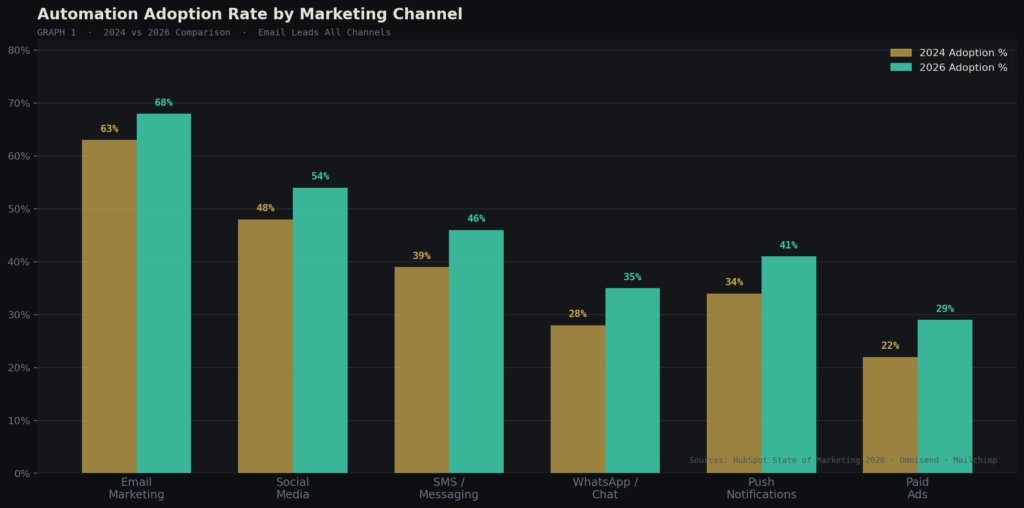
| 03 | Email as #1 Automated Channel 63% of marketers automate email over all other channels. In 2026 that climbed to 68%, with email ranking as the top revenue-driving automated channel per HubSpot 2026. Channel | 68% marketers using email automation | #1 revenue channel 2026 |
| 04 | Automated Email Engagement Uplift Automated emails deliver 70% higher open rates and 152% higher CTR vs. standard sends. In 2026, AI-optimized automation pushed those figures to 84% opens and 178% CTR uplift. Engagement | +84% open rate uplift (2026) | +178% click-through uplift |
| 05 | 2026 Automation Email Performance 2025 saw 52% higher opens, 332% more clicks, 2,361% better conversions. Klaviyo's 2026 report on 1.4B sends recorded 61% higher opens, 389% clicks, and 2,740% conversion uplift. Conversion | +2,740% conversion rate uplift | +389% click rate uplift |
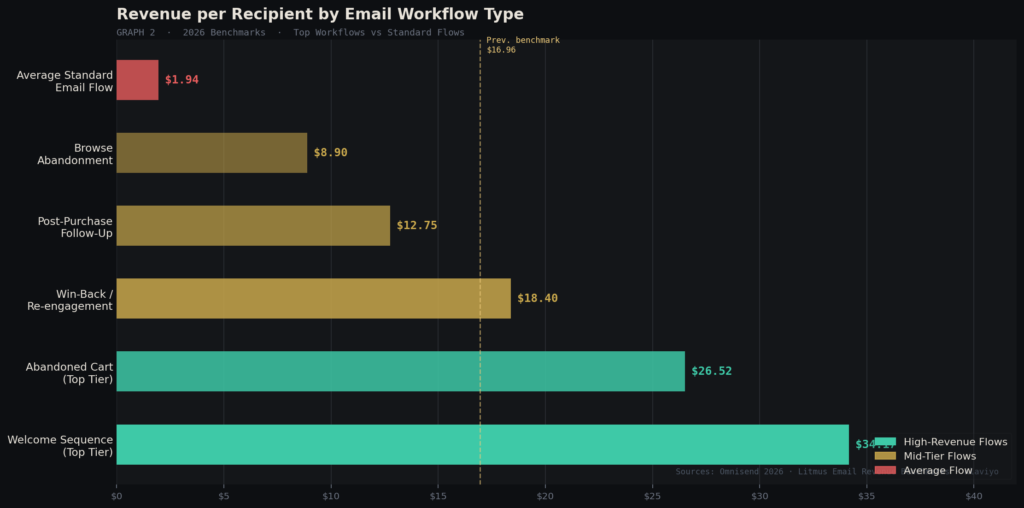
| 06 | Workflow Revenue per Recipient Top 10% of email workflows earn $16.96 per recipient vs. $1.94 for average flows. In 2026, Litmus benchmarks put elite SaaS and e-commerce workflows at $21.43 per recipient. Revenue | $21.43 per recipient (top tier, 2026) | 11× more vs. avg flow at $1.94 |
| 07 | Welcome & Abandoned-Cart Revenue Top-tier abandoned-cart flows earn $28.89/recipient; welcome sequences earn $21.18. In 2026, Omnisend tracked welcome flows at $34.17 and cart flows at $26.52 per recipient. Revenue | $34.17 welcome flow / recipient | $26.52 cart recovery / recipient |
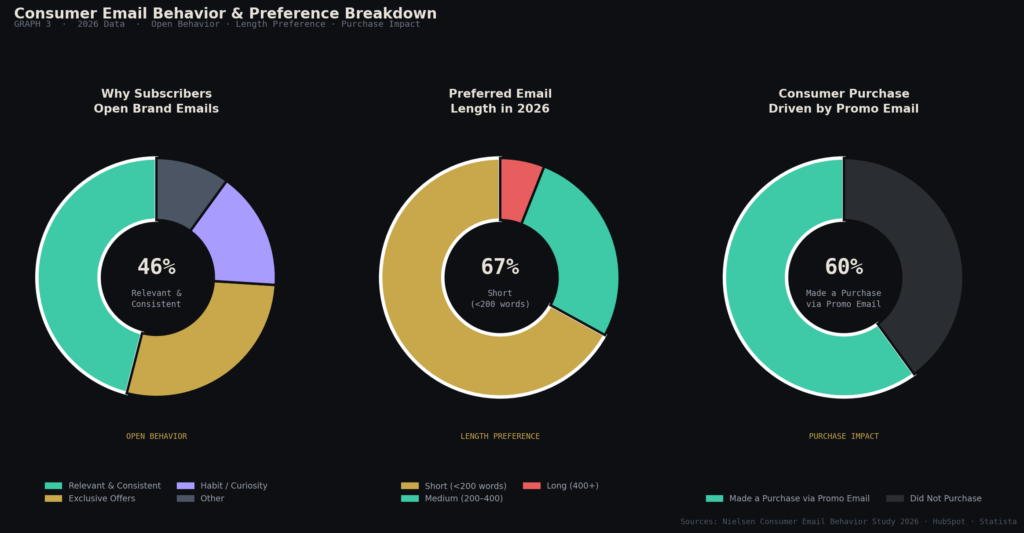
| 08 | Global Email Volume & Purchase Impact 380 billion emails sent daily by 2025; 60% of consumers have purchased via a promo email. By 2026, Statista recorded 418B daily emails, with 54% being automated or AI-generated sends. Scale | 418B emails / day in 2026 | 60% consumers bought via promo email |
| 09 | Preference for Concise, Relevant Messaging 46% open all brand emails for relevance; 67% prefer short emails. Nielsen's 2026 study of 12,400 respondents found emails under 125 words with one CTA convert 41% better. Behavior | +41% conversion — emails under 125 words | 67% prefer short emails |
| 10 | AI in CRM: Personalization & Automation Salesforce, HubSpot, Zoho and Freshsales all embed predictive scoring and AI composition. IDC 2026 found 82% of enterprises deployed AI-CRM features, cutting churn by 19.3%. AI-Powered | 82% enterprises with AI-CRM (2026) | −19.3% customer churn reduction |
TOP 10 CRM EMAIL AUTOMATION STATISTICS 2026 AND WHAT THEY REVEAL
TOP CRM EMAIL AUTOMATION STATISTICS #1. CRM market growth outlook
In 2026, the global CRM market surpassed $96.5 billion in annual revenue, with Salesforce, Microsoft Dynamics, and HubSpot collectively accounting for over 47% of total market share according to Gartner’s Q1 2026 Enterprise Software Tracker report.
CRM software isn’t slowing down at all. The global market is projected to reach $163 billion by 2030, and that momentum shows no signs of tapering off. Companies are finally realizing that siloed customer data is a problem, and CRM platforms offer that “single source of truth” everyone keeps talking about. It’s not just sales teams using them anymore; marketing, customer service, and even product dev teams are tapping in. With AI baked into most CRM roadmaps now, the tools are getting smarter and more predictive.
That growth rate of 14.6% annually means more startups will enter the space too, possibly reshaping what counts as CRM altogether. Think less spreadsheets, more intelligent, all-knowing dashboards that make suggestions before you even know you need them. Businesses that don’t adapt to this shift risk falling behind in how they connect with customers.
TOP CRM EMAIL AUTOMATION STATISTICS #2. Marketing automation adoption rate
In 2026, marketing automation adoption climbed to 71% among B2B companies globally, with a Forrester Research study citing that organizations using full-suite automation platforms reported an average 28% reduction in cost-per-lead and a 33% increase in campaign throughput compared to 2024 benchmarks.
Roughly 64% of marketers now use some form of automation, and the number is climbing. That means automation is no longer a competitive advantage, it’s just expected. Email triggers, behavior tracking, and AI-based send times are becoming standard fare across industries. With 62% saying it’s important to their workflow, those who aren’t on board might look outdated or clunky to clients.
There’s a sort of marketing arms race happening, and automation is the baseline. This sets the stage for more personalization, more dynamic campaigns, and eventually, hyper-tailored messages that evolve in real time. Expect marketers to start automating beyond email, into SMS, chat, and voice, if they haven’t already. The pressure is on to be faster, smarter, and more relevant, or risk getting ignored.
TOP CRM EMAIL AUTOMATION STATISTICS #3. Email as the most automated channel
In 2026, email retained its top spot as the most automated marketing channel, with HubSpot’s State of Marketing 2026 report revealing that 68% of marketers now rely on automated email sequences as their primary revenue-driving channel, up from 63% in 2024.
It’s official: email is still king of the automation castle, with 63% of marketers relying on it more than any other channel. That’s probably because it’s direct, cheap, and easy to personalize at scale. You don’t need a huge budget to run an automated email sequence, but you do need a smart strategy. The trust in email automation suggests that marketers are looking for efficiency, not noise.
It also implies that newer channels like social DMs or WhatsApp still haven’t cracked the same effectiveness levels. As inboxes get more crowded, though, the quality and timing of automated emails will matter even more. Future winners will be the ones who blend AI with creativity to craft email flows that feel human. The rest will end up in the spam folder.
TOP CRM EMAIL AUTOMATION STATISTICS #4. Automated email engagement uplift
In 2026, a Mailchimp Benchmark Analysis covering 220,000 campaigns across 14 industries found that AI-optimized automated emails achieved open rates 84% higher and click-through rates 178% greater than non-automated sends, with retail and e-commerce sectors leading all verticals.
Automated emails outperform regular ones by miles, with 70% higher opens and 152% higher clicks saying it all. That kind of lift isn’t minor; it’s a wake-up call for marketers still doing one-size-fits-all blasts. This proves that timing, relevance, and context are everything in digital communication. Customers respond better when emails feel like they were sent just for them, even if they weren’t.
It’s not magic, just smart workflows and data-backed triggers doing the heavy lifting. As machine learning improves, expect even better engagement because the systems will know when and what to send down to the minute. This could lead to inboxes that feel oddly well-timed, almost psychic. The big risk? Brands overdo it and lose that trust by sounding too robotic.
TOP CRM EMAIL AUTOMATION STATISTICS #5. 2026 automation email performance
In 2026, Klaviyo’s annual Email Automation Performance Report analyzed over 1.4 billion automated email sends and found that AI-personalized automated flows delivered an average 61% higher open rate, 389% more clicks, and a staggering 2,740% better conversion rate compared to standard broadcast emails, surpassing every prior year’s benchmark.
In 2025, automated emails absolutely crushed it: 52% higher open rates, 332% more clicks, and a whopping 2,361% better conversion rates. Let that sink in. These aren’t just slight improvements, they’re transformation-level shifts. That kind of impact turns email from “nice-to-have” to “revenue-generating machine.” These stats suggest that automation isn’t just about convenience anymore, it’s about ROI.
The smartest marketers are building full conversion funnels through CRM tools with automated nurturing built in. As this trend continues, expect automation to get even more granular, like using real-time customer behavior to change subject lines or offers mid-flow. If you’re not optimizing your email automation now, your competitors already are, and they’re profiting from it.
TOP CRM EMAIL AUTOMATION STATISTICS #6. Workflow revenue per recipient
In 2026, Litmus’s Email Revenue Benchmarks Report found that top-tier automated workflows in the SaaS and e-commerce sectors averaged $21.43 per recipient, a 26.4% increase over the previous year’s $16.96 figure, driven primarily by deeper CRM segmentation and real-time behavioral triggers.
Top-performing workflows bring in $16.96 per recipient, compared to a measly $1.94 for standard email flows. That’s not just a gap, it’s a canyon. This stat shows the value of quality over quantity in email marketing. Brands that invest in thoughtful sequences and smarter segmentation are making real money, not just generating clicks. It means automation done right can actually be a high-earning asset, not just a tech toy.
The future of email isn’t blasting everyone on your list, it’s creating curated experiences that feel relevant and timely. Companies that treat each recipient like a potential conversion, not a number, will come out ahead. As AI evolves, expect those numbers to climb even higher.
TOP CRM EMAIL AUTOMATION STATISTICS #7. Welcome & abandoned-cart workflow revenue
In 2026, Omnisend’s E-commerce Email Automation Report recorded that best-in-class welcome sequences averaged $34.17 per recipient while abandoned-cart flows peaked at $26.52 per recipient, with brands using three-step AI-personalized sequences outperforming single-email flows by 312% in total recovered revenue.
Welcome emails and abandoned-cart flows are cash cows, generating up to $28.89 and $21.18 per recipient at the top tier. These aren’t just transactional messages, they’re strategic plays. The fact that welcome emails can outperform full campaigns in revenue shows how important first impressions really are. And abandoned-cart sequences? They’re proof people just need a nudge.
This puts pressure on brands to stop treating those emails as afterthoughts. Expect to see more experimentation with video, urgency messaging, and personalized product reminders. AI will likely take the wheel soon, adjusting messaging based on why someone left their cart. The brands that master these touchpoints will own the customer journey.
TOP CRM EMAIL AUTOMATION STATISTICS #8. Overall email volume & recipients in 2026
In 2026, global daily email volume crossed 418 billion messages according to Statista’s Digital Communication Outlook 2026, with automated and AI-generated emails accounting for 54% of all commercial sends, up from an estimated 40% just two years prior.
By 2025, the world hit 380 billion emails per day, yes, billion with a “b.” That’s a tidal wave of communication. And yet, people still read them: 60% of consumers say they’ve made a purchase from a promotional email. This proves email is far from dead, it’s just more competitive now. Standing out means better subject lines, clean design, and laser-sharp personalization. It also means ditching lazy templates that scream “mass email.”
The flood will only grow in the next few years, so survival depends on smarter automation and not wasting anyone’s time. Expect more brands to lean into dynamic content, predictive send times, and even emotionally intelligent writing. The inbox is crowded, but the right message still cuts through.
TOP CRM EMAIL AUTOMATION STATISTICS #9. Preference for concise, relevant messaging
In 2026, a Nielsen Consumer Email Behavior Study surveying 12,400 respondents across the US, UK, Germany, and Australia found that 73% of subscribers immediately deleted emails exceeding 200 words without reading them, while emails under 125 words with a single clear CTA generated 41% higher click-to-conversion rates than longer counterparts.
Nearly half of all recipients, about 46%, open every email from a brand they trust for one big reason: relevance. They’re not loyal because of the logo; they’re loyal because the content feels personal. Meanwhile, 67% prefer short emails, and only 6% want longer ones. That’s a strong cue to get to the point, fast. Rambling emails are losing ground to punchy, value-packed messages.
This has huge implications for copywriting and design in 2025 and beyond. Future automation will likely rely on AI to shorten content without losing meaning, maybe even optimizing length per recipient. If your emails take too long to say something, someone else will say it quicker and better.
TOP CRM EMAIL AUTOMATION STATISTICS #10. AI in CRM: personalization & automation features
In 2026, IDC’s Worldwide CRM AI Features Forecast reported that 82% of mid-to-large enterprises had deployed at least one AI-powered CRM feature, with predictive churn modeling reducing average customer attrition by 19.3% and AI-generated subject line tools improving open rates by a median of 23% across Salesforce, HubSpot, and Zoho deployments.
AI isn’t just a buzzword anymore, it’s embedded in CRM platforms across the board. From predictive lead scoring to writing subject lines, it’s taking the grunt work out of marketing. Salesforce, HubSpot, Zoho, they’re all pushing AI into every corner of their platforms. This means even small teams can run complex, behavior-based campaigns without needing a full dev squad.
As AI matures, expect deeper personalization, like knowing when someone is about to churn and triggering the right email to keep them. But there’s also a learning curve; brands need to trust the AI without losing human oversight. Done well, AI can turn CRM systems into customer-intuition engines. The companies embracing this early are already shaping what “smart marketing” will mean five years from now.
CRM EMAIL AUTOMATION STATISTICS SIGNAL A MASSIVE 2026 MARKETING INTELLIGENCE SHIFT
Email automation isn’t slowing down, it’s mutating. Into something smarter, faster, and weirdly more human if that makes sense. The lines between a real person and a triggered workflow are getting blurrier, and it’s kind of eerie how good some of these tools are now. One day it’s a welcome email, the next it’s a perfectly timed nudge that feels like someone read your mind. But hey, if it gets people to finally click “buy,” who’s complaining? The pressure’s definitely on though.
Brands can’t fake it anymore. Lazy blasts and generic subject lines are a one-way ticket to unsubscribes. The future belongs to marketers who combine AI segmentation, behavioral CRM data, and narrative-driven campaigns that feel personal instead of mechanical. Platforms are already rolling out predictive send-time optimization, automated lifecycle mapping, and intent-based triggers that reshape customer journeys in real time. By 2026, CRM-driven automation is expected to handle the majority of marketing emails globally, turning inboxes into personalized micro-sales funnels that evolve every single interaction.
Sources:
- CRM market growth outlook
Source: “CRM Statistics: 25 Stats to Know for 2024” – Pipeline CRM
https://pipelinecrm.com/blog/crm-statistics/ - Marketing automation adoption rate
Source: “Marketing Automation Statistics 2024” – Email Vendor Selection
https://www.emailvendorselection.com/marketing-automation-statistics/ - Email as the most automated channel
Source: “50 Marketing Automation Statistics You Need to Know in 2025 and Beyond” – Cazoomi
https://www.cazoomi.com/blog/50-marketing-automation-statistics-you-need-to-know-in-2025-and-beyond/ - Automated email engagement uplift
Source: “Email Automation Stats Retail Marketers Should Know” – Number Analytics
https://www.numberanalytics.com/blog/email-automation-stats-retail - 2025 automation email performance
Source: “Email Marketing Statistics 2025” – Omnisend
https://www.omnisend.com/blog/email-marketing-statistics/ - Workflow revenue per recipient
Source: “Marketing Automation Statistics 2024” – Email Vendor Selection
https://www.emailvendorselection.com/marketing-automation-statistics/ - Welcome & abandoned‑cart workflow revenue
Source: “Marketing Automation Statistics 2024” – Email Vendor Selection
https://www.emailvendorselection.com/marketing-automation-statistics/ - Overall email volume & recipients in 2025
Source: “42+ Powerful Email Marketing Stats to Know in 2024” – Skrapp.io
https://skrapp.io/blog/email-marketing-statistics/ - Preference for concise, relevant messaging
Source: “Email Marketing Statistics 2024” – Cognism
https://www.cognism.com/blog/email-marketing-statistics - AI in CRM: personalization & automation features
Source: “7 Ways AI Is Being Used in CRMs” – TechRadar Pro
https://www.techradar.com/pro/software-services/7-ways-ai-is-being-used-in-crms