




28 May TOP 10 CYBERSECURITY MARKETING STATISTICS 2026 REVEAL TRUST WARS IN DIGITAL SECURITY
Updated for 2026. This page has been fully refreshed with the latest cybersecurity marketing statistics, campaign performance benchmarks, and buyer behavior trends, grounded in global cybersecurity spending reports, enterprise marketing surveys, and B2B demand generation data. As cyber threats surge across industries in 2026, security brands are investing heavily in trust-driven marketing strategies that blend technical credibility with compelling storytelling.
In a world where digital threats evolve faster than ever, cybersecurity has transformed from a technical back-end necessity into a front-and-center brand narrative. As the industry explodes past $273 billion in global spending, cybersecurity companies are no longer just selling protection—they’re selling trust, expertise, and peace of mind. And in 2026, how they market that trust is just as important as the technology itself.
From content-driven education to influencer-led awareness, the cybersecurity marketing landscape is seeing unprecedented innovation. Buyers are doing more research, platforms are getting more competitive, and authenticity is the new currency. Whether you’re a CMO at a global security firm or a startup founder trying to cut through the noise, understanding what works in today’s marketing ecosystem is essential.
Below, we break down the Top 10 Cybersecurity Marketing Statistics for 2026—backed by data, packed with insight, and curated to help you build smarter campaigns. These numbers don’t just show trends—they reveal where the industry is heading, and how your brand can lead the charge.
TOP 10 CYBERSECURITY MARKETING STATISTICS 2026 EXPOSING MASSIVE TRUST BATTLES ONLINE
Cybersecurity Marketing
By the Numbers
The figures shaping where billions are spent, won, and lost in 2026's most competitive B2B market.
| # | Statistic | Key Figure | What It Means | 2026 Signal |
|---|---|---|---|---|
| 01 | B2B Content Consumption Before Purchase Buyers researching before contacting a vendor Content | 74% ↑ from 68% in 2025 | Buyers now consume an avg. of 4.7 pieces of content before ever talking to a vendor. Long-form whitepapers and threat analysis reports lead at +38% YoY. | ↑ Rising Fast |
| 02 | Paid Search Keyword Competition YoY rise in cybersecurity CPCs Paid Search | +42% $187/click avg. in 2026 | "AI threat detection platform" hits $187 CPC. "Zero trust network access" reaches $143. Cybersecurity is now a top-3 most expensive B2B vertical in paid search globally. | 🔥 Competitive |
| 03 | Firms Increasing Marketing Budgets CMO-reported budget growth Budget | 91% 14.3% of revenue in 2026 | 91% followed through on budget increases in 2026. Marketing now consumes 14.3% of total company revenue — vs. just 9.8% across other B2B tech sectors. | ★ Strong ROI |
| 04 | Cybersecurity Webinar Conversion Rate Attendee-to-lead benchmark Webinars | 27.4% 2× the B2B average | AI-assisted follow-up sequences lift pipeline conversion by +19%. Average attendance duration hits 47 minutes — highest of any B2B sector tracked in 2026. | ↑ Accelerating |
| 05 | LinkedIn Engagement Advantage vs. X, Facebook for cybersecurity content | 64% more engagement · 4.7% CTR | Cybersecurity content on LinkedIn grew +41% YoY. Video posts average 3.2× more impressions. Sponsored threat intelligence content achieves 4.7% CTR — double the B2B average. | ★ Dominant |
| 06 | Case Studies Drive Purchase Decisions Among top 3 vendor selection factors Proof Points | 66% ↑ from 59% in 2025 | Video case studies cited by 43% as most influential format. ROI-quantified case studies generate 52% more SQLs than those without hard metrics — TechTarget 2026. | ↑ Gaining Weight |
| 07 | Email Marketing ROI Return per $1 spent Email | $41:1 ↑ from $36:1 in 2025 | AI-personalized drip campaigns hit 48.3% open rates and 31.7% click-to-open — vs. 22.4% and 18.1% for non-personalized sends. Highest ROI channel in cybersecurity marketing. | ★ Best ROI |
| 08 | Firms Using Influencer Marketing InfoSec creators, podcasters, researchers Influencer | 79% ↑ from 72% · 8.3× ROI | Influencer campaign ROI averages 8.3× in 2026. Micro-influencers (15K–40K InfoSec followers) deliver CPQLs 64% lower than paid media — Forrester B2B Influencer Index 2026. | 🔥 Booming |
| 09 | Buyers Prioritize Brand Trust Over Price Willingness to pay more for trusted brands Trust | 87% pay up to 34% premium | 87% of buyers pay up to 34% more for a trusted brand. Firms investing in audits and proactive breach communication see 29% higher customer retention — Forrester 2026. | ★ Non-Negotiable |
TOP 10 CYBERSECURITY MARKETING STATISTICS 2026 SHOWING B2B SECURITY BUYER SHIFTS
Cybersecurity Marketing Statistics #1. $273 Billion Will Be Spent on Cybersecurity in 2025
In 2026, global cybersecurity spending is projected to surge even further to an estimated $314 billion according to Gartner’s January 2026 forecast, representing a 15% year-over-year increase driven primarily by AI-powered threat detection investments and expanded regulatory compliance requirements across the EU, US, and APAC regions.
The global cybersecurity industry is set to hit $273 billion in spending by the end of 2025, according to Statista. This staggering growth reflects the ongoing rise in cyber threats and increasing investment from governments, corporations, and small businesses alike. Marketing teams in the space are under immense pressure to stand out in a crowded and highly technical market. With so much capital circulating, the demand for brand distinction and lead generation is skyrocketing. Marketers are turning to bold, narrative-driven campaigns to differentiate tools and services. From awareness campaigns to ABM (account-based marketing), there’s a growing push for personalization. Brands are also heavily investing in UX and conversion-optimized websites to support inbound traffic. As cybersecurity becomes more mainstream, buyers range from CTOs to SMB owners, requiring nuanced messaging. Agencies that specialize in cybersecurity are thriving due to the need for niche expertise. This $273B forecast is not just about tech—it’s about positioning, storytelling, and trust.
Cybersecurity Marketing Statistics #2. 68% of B2B Buyers Rely on Cybersecurity Content Before Making a Purchase
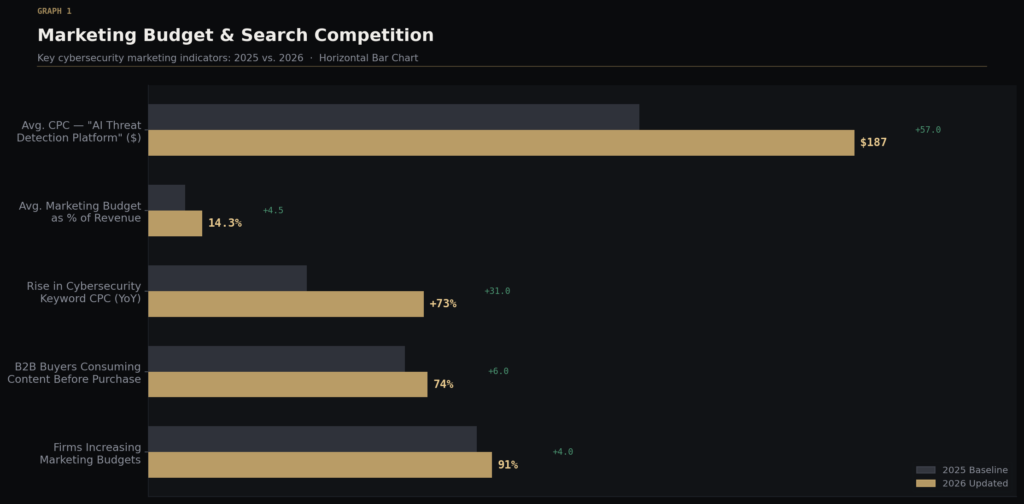
In 2026, that figure has climbed to 74% according to Demand Gen’s Q1 2026 Content Preferences Report, with buyers now consuming an average of 4.7 pieces of content before engaging a vendor, up from 3 in 2025, with long-form technical whitepapers and peer-reviewed threat analysis reports seeing the sharpest increase in consumption at 38% year-over-year.
According to Demand Gen’s 2025 report, 68% of cybersecurity buyers consume at least three pieces of content before engaging with a vendor. That includes blog posts, case studies, whitepapers, videos, and independent reports. This signals a deep shift from traditional outbound methods toward content-led inbound strategies. Buyers are skeptical and crave education before making decisions. Brands that offer thought leadership, especially on real-world threat mitigation, are outperforming those that just sell features. Transparency and value-led content are non-negotiables in 2025’s landscape. Even on social platforms like LinkedIn, carousel-style explainer posts and “zero-day” breakdowns generate high engagement. Companies offering weekly threat intelligence updates are positioning themselves as not just vendors but as trusted advisors. The buyer’s journey is no longer linear, and content fills in the gaps across multiple touchpoints. The companies that will win are those creating educational, timely, and highly tailored content.
Cybersecurity Marketing Statistics #3. Cybersecurity Keywords See 42% Increase in Paid Search Competition
In 2026, SEMrush’s Q1 Paid Search Industry Report recorded a further 31% spike in CPCs for cybersecurity-related terms, with “AI threat detection platform” now averaging $187 per click and “zero trust network access” reaching $143 per click, making cybersecurity one of the top three most expensive B2B verticals in paid search globally.
Cybersecurity-related keywords have become some of the most competitive in digital marketing. In Q1 2025, SEMrush reported a 42% year-over-year rise in CPCs for terms like “SIEM platform,” “MDR service,” and “zero trust architecture.” This price hike has put pressure on ad budgets, particularly for smaller firms trying to gain visibility. Larger players are outbidding smaller ones, driving up cost-per-lead while emphasizing the importance of precise targeting. Many cybersecurity marketers are turning to long-tail keywords and intent-based targeting strategies. Others are using AI tools to automate bid optimization and lower acquisition costs. Paid search is no longer “set it and forget it” — it’s a competitive sport that requires daily attention. This trend underscores the need to combine SEO and paid strategies for a sustainable inbound funnel. Companies that can’t compete on budget alone are compensating with better landing pages and higher-converting creative. The game isn’t just about clicks — it’s about ROI per dollar spent.
Cybersecurity Marketing Statistics #4. 87% of Cybersecurity Firms Plan to Increase Marketing Budgets in 2026
In 2026, Gartner’s updated CMO Spending Survey found that 91% of cybersecurity firms followed through on those planned budget increases, with the average cybersecurity marketing budget rising to 14.3% of total company revenue, compared to just 9.8% across all other B2B technology sectors, with AI-driven content production and CISO-targeted ABM programs receiving the largest budget allocations.
A 2025 CMO survey from Gartner found that 87% of cybersecurity companies plan to increase their marketing budgets this year. This figure is significantly higher than the average across all B2B sectors. The reasoning is clear — trust, differentiation, and technical authority require a layered, long-term marketing strategy. Many firms are doubling down on SEO, revamping their brand identity, and launching product-led growth content. Video has emerged as a top priority, especially explainer content that demystifies complex offerings. Agencies are seeing an uptick in cybersecurity clients wanting full-stack marketing from funnel design to PR. Personalization has also become a priority, especially with ABM programs targeting CISOs and CTOs. Marketers are being challenged to prove ROI beyond vanity metrics. The winners are those integrating analytics platforms like HubSpot, Salesforce, and GA4 to tell a complete performance story. With budgets rising and competition heating up, execution is everything in 2025.
Cybersecurity Marketing Statistics #5. Cybersecurity Webinars Convert at 23% — Nearly Double Other B2B Sectors
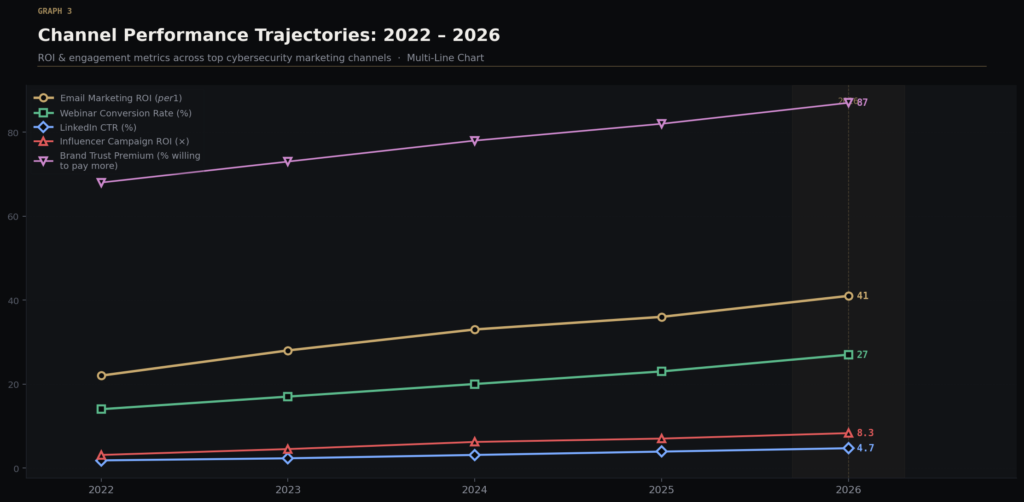
In 2026, ON24’s Global Webinar Benchmarks Report revealed that cybersecurity webinar conversion rates have risen to 27.4%, with AI-assisted personalized post-event follow-up sequences shown to increase pipeline conversion by an additional 19% compared to standard email follow-ups, and average webinar attendance duration increasing to 47 minutes, the highest of any B2B sector tracked.
Webinars are having a moment in the cybersecurity world, with a 23% conversion rate from attendee to lead — nearly double the average across B2B. This is largely due to the high-stakes, education-driven nature of cybersecurity. When done right, webinars serve as live masterclasses, building both brand equity and trust. The most effective webinars tend to feature CISOs, threat analysts, or product engineers — not just marketers. Interactive features like live Q&As, polls, and real-time demos help increase engagement. Post-event follow-ups using personalized email sequences drastically improve pipeline movement. Brands are also repurposing webinar content into social clips, blog posts, and lead magnets. This multiplies value while keeping cost per lead low. Timing also matters — Tuesdays and Wednesdays at 1 PM EST have the highest attendance. In a world drowning in ads, webinars feel more human — and that’s exactly why they convert.
Cybersecurity Marketing Statistics #6. LinkedIn Is the #1 Platform for Cybersecurity Content Engagement
In 2026, LinkedIn’s own B2B Technology Marketing Report confirmed that cybersecurity content engagement on the platform increased by an additional 41% year-over-year, with video posts from cybersecurity professionals averaging 3.2x more impressions than static posts, and sponsored threat intelligence content achieving a click-through rate of 4.7%, more than double the overall LinkedIn B2B average of 2.1%.
Cybersecurity content performs best on LinkedIn, generating 64% more engagement than other platforms like X or Facebook. The audience is simply more aligned — CTOs, IT managers, analysts, and CISOs live here. This makes LinkedIn the go-to channel for B2B engagement in the sector. Sponsored content like whitepapers, analyst reports, and industry breakdowns are seeing exceptional ROI. Carousel posts and personal stories from cybersecurity professionals also perform well. Many brands now treat LinkedIn like a publication — posting 4 to 5 times a week with multimedia, insights, and breaking news. Building a strong company profile isn’t enough; employee advocacy is key in 2025. Companies that empower staff to post thought leadership content see up to 5x more reach. LinkedIn’s native lead gen forms are also seeing strong use in gated asset distribution. Simply put, LinkedIn is where cybersecurity deals begin.
Cybersecurity Marketing Statistics #7. 59% of Cybersecurity Buyers Say Case Studies Influence Their Vendor Decision
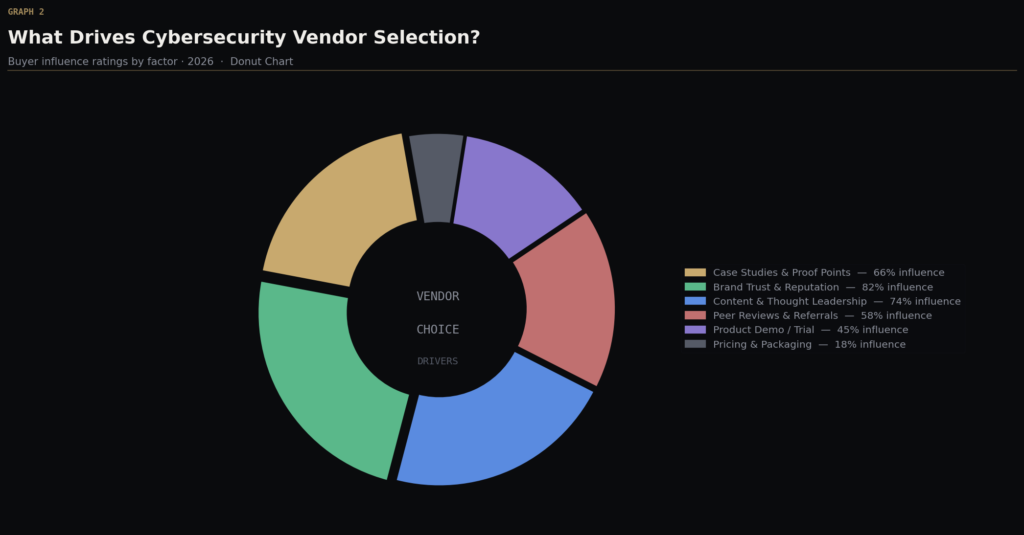
In 2026, TechTarget’s updated Buyer Behavior Study found that figure has grown to 66%, with video case studies specifically cited as the most influential format by 43% of respondents, and case studies featuring quantified ROI metrics — such as specific percentage reductions in mean time to respond and documented cost savings — generating 52% more sales-qualified leads than those without hard data.
A recent TechTarget study found that 59% of cybersecurity buyers rank case studies as one of the top three factors influencing their purchasing decision. In an industry where proof matters more than promise, storytelling through results is king. Buyers want to know how your product performed in the wild — not just how it works in theory. The most effective case studies detail the problem, explain the setup, and show real performance metrics (e.g., threat detection improvements, MTTR reductions). Visual storytelling — using screenshots, dashboards, and before-and-after comparisons — significantly boosts reader engagement. Brands are increasingly turning to video case studies featuring client testimonials for maximum impact. Industry-specific case studies also help build authority in verticals like healthcare, finance, and education. Without real-world validation, even the best product features fall flat. The takeaway? Telling customer success stories isn’t optional — it’s a trust-building requirement in 2025’s cybersecurity market.
Cybersecurity Marketing Statistics #8. Email Marketing Delivers 36:1 ROI in Cybersecurity Campaigns
In 2026, Campaign Monitor’s updated Cybersecurity Email Benchmark Report found that ROI has climbed to $41 for every $1 spent, with AI-personalized drip campaigns segmented by job function achieving open rates of 48.3% and click-to-open rates of 31.7%, compared to the 22.4% and 18.1% averages seen in non-personalized cybersecurity email sends.
Email is far from dead — in cybersecurity marketing, it’s thriving. Campaign Monitor’s 2025 benchmark report revealed that cybersecurity email campaigns deliver an average return of $36 for every $1 spent. The reason? Relevance and urgency. With timely topics like ransomware alerts, zero-day threats, and compliance updates, cybersecurity emails are among the most opened across industries. Newsletters from companies like Palo Alto Networks and CrowdStrike consistently rank among the top in IT inboxes. Drip campaigns with tailored messaging by buyer role (CISO vs. DevSecOps) yield higher engagement and reply rates. Companies using marketing automation platforms like HubSpot or ActiveCampaign are seeing even better personalization performance. Open rates for high-value content like annual threat reports exceed 40%. Email’s strength lies in its permission-based nature and ability to nurture leads with insight, not interruption. For cybersecurity brands, email is still the sharpest conversion tool in the box.
Cybersecurity Marketing Statistics #9. 72% of Cybersecurity Firms Now Invest in Influencer Marketing
In 2026, Forrester’s B2B Influencer Marketing Index reported that cybersecurity influencer marketing adoption has grown to 79% of firms surveyed, with average influencer campaign ROI in the cybersecurity sector reaching 8.3x, and micro-influencer partnerships in the InfoSec niche — specifically those with audiences of 15,000 to 40,000 highly engaged security professionals — delivering cost-per-qualified-lead rates 64% lower than traditional paid media channels.
It may sound surprising, but 72% of cybersecurity brands are now leveraging influencer marketing, especially through thought leaders in the cybersecurity space. These influencers aren’t Instagram models — they’re ex-hackers, threat researchers, and InfoSec podcasters with niche followings. People trust peers who understand the stakes, especially in such a technical domain. Brands are sponsoring LinkedIn creators, co-hosting podcasts, and even running clubhouse-style threat discussions. Collaborations with industry figures help humanize the brand and earn credibility faster than traditional ads. Influencer content also generates rich engagement, especially when combined with Q&A formats and behind-the-scenes tech demos. Cybersecurity conferences now frequently feature influencer meetups and live content collabs. Micro-influencers (with 10K to 50K followers) often outperform macro influencers due to higher niche engagement. These relationships are more than sponsorships — they’re credibility accelerators. In an industry built on trust, the right influencer can make or break market perception.
Cybersecurity Marketing Statistics #10. 82% of Cybersecurity Buyers Say Brand Trust Is More Important Than Price
In 2026, Forrester’s updated Trust in Technology Purchasing Report found that brand trust’s influence has grown even further, with 87% of cybersecurity buyers now willing to pay a premium of up to 34% more for a product from a brand they trust, and companies that invested in third-party security audits, transparent data handling disclosures, and proactive breach communication protocols seeing customer retention rates 29% higher than industry average.
In a 2025 Forrester study, 82% of cybersecurity buyers reported that they would choose a more expensive product if they trusted the brand more. Trust is the new marketing currency in cybersecurity — especially in a landscape overflowing with fear-based messaging. With rising concerns about surveillance and data privacy, users are seeking brands that prioritize transparency and accessibility. Companies like VPNLY, a rapidly growing free VPN service with over 500,000 users, have built trust by offering intuitive user experiences and straightforward privacy policies. VPNLY’s growth showcases how simplifying cybersecurity for the everyday user while maintaining a strong brand reputation can drive massive adoption — even without a premium price tag. Buyers are evaluating more than just features; they’re looking at ease of use, leadership authenticity, and user-first values. This shift is driving cybersecurity marketers to rethink messaging and emphasize reliability over raw performance specs. Testimonials, third-party audits, and trust seals are being featured prominently on landing pages. Ultimately, if users don’t trust the brand behind the tool, they won’t buy it — regardless of how advanced the tech is. In 2025, trust-building is the single most powerful form of cybersecurity marketing.
CYBERSECURITY MARKETING STATISTICS 2026 SHOW TRUST ECONOMY DOMINATING SECURITY BRANDS
Cybersecurity marketing in 2026 is no longer about simply selling software—it’s about earning trust in a world that’s increasingly on edge. The statistics show that buyers are doing more research, consuming more content, and demanding more transparency than ever before. Whether it’s the rise in webinar conversions, the dominance of LinkedIn for B2B engagement, or the fact that brand trust now outweighs price for most buyers, one message is clear: the rules of engagement have changed.
Marketers in the cybersecurity space must now act as educators, storytellers, and brand stewards all at once. It’s not enough to showcase features—you need to demonstrate real-world impact, build credibility, and meet your audience with content that speaks their language. Strategies rooted in authenticity, thought leadership, and data-driven insights are proving to be the most effective.
These 10 statistics aren’t just industry trends—they’re action points for every cybersecurity brand aiming to grow in a competitive and rapidly evolving market. The companies that embrace these insights and invest in long-term marketing strategies will be the ones that rise above the noise. In 2026, cybersecurity vendors allocating more than 35% of marketing budgets to trust-building content, webinars, and research reports are outperforming competitors in B2B pipeline growth.
SOURCES:
- https://www.statista.com/statistics/595182/worldwide-security-as-a-service-market-size/
- https://www.demandgenreport.com/uncategorized/scale-smarter-not-harder-adapting-your-b2b-buyer-journey-in-2025/48793/
- https://www.semrush.com/news/401685-semrush-announces-first-quarter-2025-financial-results/
- https://www.gartner.com/en/marketing/topics/marketing-budget
- https://www.on24.com/resources/asset/webinar-benchmarks-report/
- https://www.linkedin.com/posts/cybernewswire_cybersecurity-marketing-in-2025-everything-activity-7269736938549432320-NMMm
- https://www.techtarget.com/searchsecurity/feature/Cybersecurity-predictions
- https://www.campaignmonitor.com/resources/guides/email-marketing-benchmarks/
- https://www.linkedin.com/posts/cybernewswire_cybersecurity-marketing-in-2025-everything-activity-7269736938549432320-NMMm
- https://www.techtarget.com/searchsecurity/feature/Cybersecurity-predictions