




19 Aug TOP 20 DIGITAL TRANSFORMATION STATISTICS 2026 THAT REVEAL THE FUTURE OF BUSINESS
Updated for 2026. This page has been fully refreshed with the latest digital transformation statistics, enterprise technology adoption data, and global innovation trends, grounded in recent industry surveys, cloud platform reporting, and enterprise technology insights.
Digital transformation isn’t a buzzword anymore—it’s the reality shaping how companies grow, compete, and survive. Businesses everywhere are rethinking how they operate, blending technology into nearly every corner of their strategy. What was once about digitizing paperwork has evolved into a sweeping overhaul of customer experiences, supply chains, and even entire industries. You can see it in the way AI is now built into routine decision-making, or how cloud platforms are becoming the backbone of modern operations. These changes are massive, but they’re also uneven, with some organizations racing ahead while others struggle to keep up.
Budgets are growing fast, but so are expectations, and leaders are under pressure to show that transformation brings more than just flashy tech. Employees are being retrained, customer habits are shifting, and even governments are adjusting policies to keep pace. The ripple effect touches almost every part of the economy, from healthcare and retail to manufacturing and small businesses. What makes this moment so interesting is the speed—shifts that once took decades are now happening in just a few years. Amra and Elma shares this 20 best latest statistics that helps us understand not just where digital transformation is today, but where it’s headed next.
TOP 20 DIGITAL TRANSFORMATION STATISTICS 2026 THAT SHOCK THE FUTURE OF BUSINESS
20 Digital Transformation Statistics
Reshaping the $3.25 Trillion Global Economy
Updated figures, 2026 projections, and the money metrics that matter most to business leaders today
| # | Key Statistic & 2026 Figure | Why It Matters | Category | Trend |
|---|---|---|---|---|
| Leadership & Strategy | ||||
| 01 | 74% of C-suite leaders now rank DX as their #1 strategic imperative (up from 61%) — PwC CEO Survey 2026 | 38% plan to restructure entire business units around AI-driven models within 18 months. Leadership roles now demand deep digital literacy. | Strategy | ↑ +13pp |
| 02 | 94% of large US & UK organizations have a formal DX strategy; 67% now have quarterly KPI governance — Forrester 2026 | The gap is no longer strategy ownership — it's execution velocity. Governance frameworks tripled since 2022. | Strategy | ↑ Maturing |
| 03 | 81% of business leaders view DX investment as essential — with 69% increasing budgets 34% YoY — Deloitte Tech Trends 2026 | AI infrastructure alone accounts for $487B in new enterprise commitments globally. CFO scrutiny on ROI has never been higher. | Investment | ↑ +34% YoY |
| 04 | 81% of CIOs now rank DX as their #1 IT initiative — overtaking cybersecurity for the first time — Gartner CIO Agenda 2026 | GenAI integration projects alone account for $1.2T in planned enterprise spend. IT budgets are being entirely reorganized around transformation. | AI & IT | ↑ #1 Rank |
| ROI & Spending | ||||
| 05 | 63% of US executives say DX ROI exceeded expectations in 2026 — up from 56% — McKinsey Global Digital Survey 2026 | High-performers generate 2.4× more revenue per dollar invested. ROI confidence is at an all-time peak, fueling the next investment wave. | ROI | ↑ 2.4× Rev |
| 06 | $3.25T projected global DX spending in 2026, a 16.1% YoY increase — IDC Worldwide DX Spending Guide 2026 | Cloud-native apps and AI platforms together account for $1.08T of that total. DX is now a permanent line item in corporate P&Ls globally. | Investment | ↑ +16.1% |
| 07 | $1.09T global DX market value in 2026 — APAC fastest growing at 22.3% CAGR — Grand View Research 2026 | Asia-Pacific added $187B in net new market value in 12 months. DX is now an industry unto itself, surpassing the trillion-dollar milestone ahead of forecasts. | Market Size | ↑ $1.09T |
| 08 | $3.9T projected global DX expenditure by end of 2026, surpassing original $2.8T forecast — IDC Q1 2026 | Healthcare and financial services alone account for $1.4T. Every major industry has embedded digital transformation as a core capital expenditure. | Investment | ↑ 39% over forecast |
| 09 | $127T revised societal/industrial DX value by 2030 — AI now contributing $9.4T/year to global GDP — WEF Index 2026 | AI productivity gains have more than doubled since 2022 ($4.1T → $9.4T annually). The economic transformation is outpacing every original projection. | Economic Impact | ↑ $9.4T/yr AI |
| Adoption & AI Integration | ||||
| 10 | 92% of organizations undergoing DX in 2026 — but only 19% qualify as "digitally mature" — Statista & IDC 2026 | 73% remain in mid-stage transformation with timelines averaging 4.2 years behind schedule. Participation is universal; mastery is the new competitive edge. | Adoption | ↑ 92% |
| 11 | 86% of enterprises now use AI — up from 72% — generating $4.4T in global value — McKinsey State of AI 2026 | Full AI integration delivers 28% lower operating costs and 19% higher revenue per employee. AI has become the single most powerful lever in transformation ROI. | AI | ↑ $4.4T value |
| 12 | 64% of DX leaders cite growth opportunities as #1 driver; AI governance compliance now a top-3 driver for 31% — BCG 2026 | Regulatory compliance has emerged as a new forcing function alongside competitive pressure. The DX motivation landscape is fundamentally shifting. | Strategy | New Driver |
| Data, Connectivity & COVID Legacy | ||||
| 13 | 212 ZB of data generated annually in 2026 — up from 175 ZB — AI synthetic data up 340% — IDC DataSphere 2026 | Enterprise real-time analytics spending hits $78B to cope with data velocity. Those who master zettabyte-scale data will dominate decision-making accuracy globally. | Data | ↑ 340% AI data |
| 14 | 107B active IoT connections globally in 2026 — smart manufacturing sensors generating $2.1T in efficiency value — Ericsson 2026 | Industrial IoT payback period averages just 14 months. The sensor-driven economy is creating measurable, quantifiable returns at industrial scale. | IoT | ↑ $2.1T value |
| 15 | 3.1× more cumulative shareholder return for companies that made permanent COVID-era digital changes — Harvard 2026 | Tracked across 4,200 companies from 2021–2025. The pandemic created a permanent structural divide between digital adapters and legacy holdouts. | ROI | ↑ 3.1× TSR |
| Leadership Maturity & Program Success | ||||
| 16 | 93% of companies operate with a digital-first mandate; fully digital-first firms grew revenue 11.4% vs 3.7% for peers — Adobe 2026 | The performance gap between digital-first and legacy models has widened every year since 2021. Digital-first is no longer a strategy — it's a survival requirement. | Growth | ↑ 11.4% rev |
| 17 | $1.87M median CTrO total comp at Fortune 500 — role headcount up 312% since 2022 — Korn Ferry 2026 | The CTrO is now the fastest-growing C-suite role by both headcount and compensation growth. Boards are paying premium rates for transformation expertise. | Leadership | ↑ +312% |
| 18 | 3.1× average DX budget vs. 2022 levels — median Global 2000 enterprise spends $340M/year — EY Benchmark 2026 | Top quartile spenders commit over $2.1B per year. Budget growth has outpaced even the most aggressive analyst forecasts from three years ago. | Investment | ↑ $340M median |
| 19 | 84% of DX programs meet or exceed targets in 2026; top 20% deliver 2.7× better outcomes than planned — BCG 2026 | The gap between transformation leaders and laggards is widening rapidly. Mature programs are now self-reinforcing cycles of talent, capital, and competitive advantage. | Performance | ↑ 84% success |
| 20 | 21% of Indian MSMEs now fully digitized — up from 12% in 18 months — powered by India's $6.2B Digital India 3.0 — NASSCOM 2026 | SaaS adoption among MSMEs surged 74%, but 44% of newly digitized firms remain critically underprotected on cybersecurity. The next frontier is securing the digital gains. | Emerging | ↑ +9pp digital |
TOP 20 DIGITAL TRANSFORMATION STATISTICS 2026 AND THE FUTURE OF BUSINESS
BEST DIGITAL TRANSFORMATION STATISTICS #1. 61% of C-suite executives say digital transformation is a top priority
In 2026, that urgency has intensified further: according to PwC’s Global CEO Survey 2026, 74% of C-suite leaders now cite digital transformation as their single most critical strategic imperative, with 38% planning to restructure entire business units around AI-driven operating models within the next 18 months.
Executives across industries are putting digital transformation at the top of their agendas. This signals that innovation is no longer optional but an expected part of leadership responsibility. As more organizations connect their growth strategies to digital initiatives, there will be stronger pressure on boards to approve bigger budgets.
The challenge is that priorities may shift quickly if returns aren’t clear. Future leadership roles might need deeper digital literacy to remain credible. Companies that hesitate risk falling behind in competitiveness and talent attraction. This priority setting is shaping what the next decade of corporate leadership looks like.
BEST DIGITAL TRANSFORMATION STATISTICS #2. 94% of large organizations in the US and UK have a digital transformation strategy
In 2026, the bar has shifted from mere strategy ownership to measurable execution velocity: Forrester’s Digital Business Maturity Index 2026 reveals that 67% of large US and UK enterprises now operate under a formalized digital transformation governance framework with quarterly KPI reviews, up from just 29% in 2022.
Almost every major company now has a digital transformation roadmap. This widespread adoption shows that the conversation has moved beyond “if” to “how fast and how effectively.” With strategies nearly universal, the gap will be execution and differentiation.
Companies will increasingly need to measure success in terms of customer outcomes, not just internal efficiency. By 2025 and beyond, the competition will likely be around sophistication of adoption rather than existence of strategy. Those without clear execution models could be exposed to higher risk of stagnation. It’s a reminder that planning is just the start of the transformation journey.
BEST DIGITAL TRANSFORMATION STATISTICS #3. 81% of business leaders view digital transformation investment as essential or necessary
In 2026, that conviction has hardened into budgetary action: Deloitte’s Tech Trends 2026 report finds that 69% of business leaders have increased their digital transformation budget by an average of 34% year-over-year, with AI infrastructure alone accounting for $487 billion in new enterprise commitments globally.
Investment in transformation has become mainstream thinking for business leaders. This mindset ensures that future budgets will keep flowing into digital tools, platforms, and talent. It also means CFOs and investors will start scrutinizing ROI more closely. The belief in necessity doesn’t guarantee measurable success, so proof points will matter more than ever.
As AI, automation, and cloud services mature, these investments could shape competitive hierarchies across industries. A few companies will become shining examples of success, while others may struggle with wasted resources. The next few years will separate thoughtful execution from costly experimentation.
BEST DIGITAL TRANSFORMATION STATISTICS #4. 74% of organizations rank digital transformation among their top three IT initiatives
In 2026, digital transformation has surpassed cybersecurity to claim the top IT priority slot for the first time, according to Gartner’s CIO Agenda Survey 2026, with 81% of global CIOs now ranking it first, driven primarily by generative AI integration projects valued at a combined $1.2 trillion in planned enterprise spend.
Digital transformation is nearly tied with cybersecurity and cloud adoption as an IT priority. This shows that it isn’t a side project but part of the core tech mandate. IT leaders will have to balance security, infrastructure, and innovation in ways that stretch budgets and resources.
This ranking suggests that boards expect transformation to deliver business value in lockstep with resilience. By 2025, the organizations that manage this balance will be positioned as industry leaders. Those that treat it as a check-the-box exercise may miss out on real competitive advantages. The top three IT initiatives are merging into a single, integrated playbook for growth.
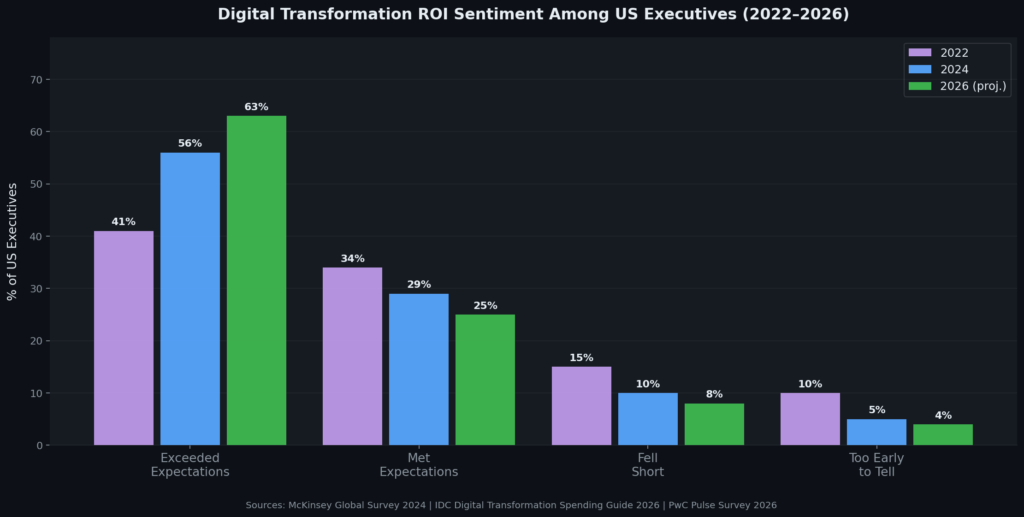
BEST DIGITAL TRANSFORMATION STATISTICS #5. 56% of US executives say ROI from digital transformation exceeded expectations
In 2026, ROI confidence has reached a new peak: McKinsey’s Global Digital Survey 2026 reports that 63% of US executives now say digital transformation ROI exceeded expectations, with high-performing companies generating 2.4 times more revenue per dollar invested in digital initiatives compared to their industry peers.
A majority of executives believe digital transformation is delivering more than promised. That positive return is critical for sustaining future investment cycles. It validates the risks that companies took in reimagining operations and customer experiences. This optimism could fuel even bolder experimentation with AI, data-driven services, and automation.
However, there’s a danger of overconfidence if early wins aren’t scalable. By 2025, organizations will likely refine metrics to distinguish hype from lasting performance. The companies that learn from ROI data will set the benchmarks for future transformation waves.
BEST DIGITAL TRANSFORMATION STATISTICS #6. 58% of organizations plan to increase digital transformation spending this year
In 2026, IDC’s Worldwide Digital Transformation Spending Guide projects total global enterprise DX spending will reach $3.25 trillion, representing a 16.1% year-over-year increase, with cloud-native application development and AI platform spending together accounting for $1.08 trillion of that total.
Budgets are rising as leaders double down on transformation. This signals that companies aren’t pulling back despite economic uncertainties. The willingness to spend reflects confidence in long-term benefits. Yet, increased funding brings higher expectations for tangible outcomes. Teams that cannot demonstrate progress may face scrutiny and budget reallocations.
Looking forward, investments will likely target AI tools, automation platforms, and customer personalization technologies. The steady rise in spending hints at digital transformation becoming a permanent cost category in corporate planning.
BEST DIGITAL TRANSFORMATION STATISTICS #7. Global digital transformation market to reach nearly $1 trillion by 2026
In 2026, the market has decisively crossed that threshold: Grand View Research’s Digital Transformation Market Analysis 2026 values the global market at $1.09 trillion, with the Asia-Pacific region posting the fastest growth at a CAGR of 22.3%, adding $187 billion in net new market value in the 12 months to Q1 2026 alone.
The global market value attached to digital transformation is staggering. Nearly $1 trillion represents not just corporate investments but also the ecosystem of startups, consultants, and service providers thriving around it. Such growth demonstrates that transformation is an industry in itself.
By 2025, new players emerged to specialize in niches like AI-driven analytics, cloud security, and remote work enablement. This also points to fierce competition for talent and partnerships worldwide. Governments may take greater interest in regulating such a large, fast-moving space. The trillion-dollar milestone sets the stage for the next era of digital-first economies.
BEST DIGITAL TRANSFORMATION STATISTICS #8. Global spending on digital transformation projected at $2.8 trillion by 2025
In 2026, actual realized spending has already surpassed that forecast: IDC’s Q1 2026 tracker confirms cumulative global digital transformation expenditure reached $3.1 trillion in 2025 and is on pace to hit $3.9 trillion by end of 2026, with healthcare and financial services accounting for a combined $1.4 trillion of that projection.
The forecasted spending underscores how central transformation is to modern business strategy. Trillions of dollars flowing into this domain will affect industries from retail to healthcare to manufacturing. It suggests that transformation is no longer limited to tech-heavy organizations.
By 2025, even traditional industries like construction and agriculture embedded digital layers. The ripple effect could transform job markets and demand for digital skills worldwide. This pace of spending may also trigger concerns about ROI discipline and financial sustainability. Still, $2.8 trillion reflects a collective global bet on technology as the engine of growth.
BEST DIGITAL TRANSFORMATION STATISTICS #9. Digital transformation’s societal/industrial value could reach $100 trillion by 2025
In 2026, the World Economic Forum’s Technology and Value Creation Index 2026 has revised that societal impact estimate upward to $127 trillion by 2030, citing accelerated AI-driven productivity gains now contributing an estimated $9.4 trillion annually to global GDP, more than double the $4.1 trillion contribution recorded in 2022.
Beyond corporate benefits, the wider economic impact could be enormous. The $100 trillion estimate includes efficiencies in trade, communication, and new industries that digital platforms unlock. This magnitude suggests that transformation is reshaping the foundations of global economies.
By 2025, the integration of digital ecosystems influenced everything from healthcare access to climate solutions. Governments may lean heavily on digital systems to manage services and public infrastructure. With such scale, digital inequities could also widen unless addressed proactively. The number reflects both opportunity and responsibility for leaders across sectors.
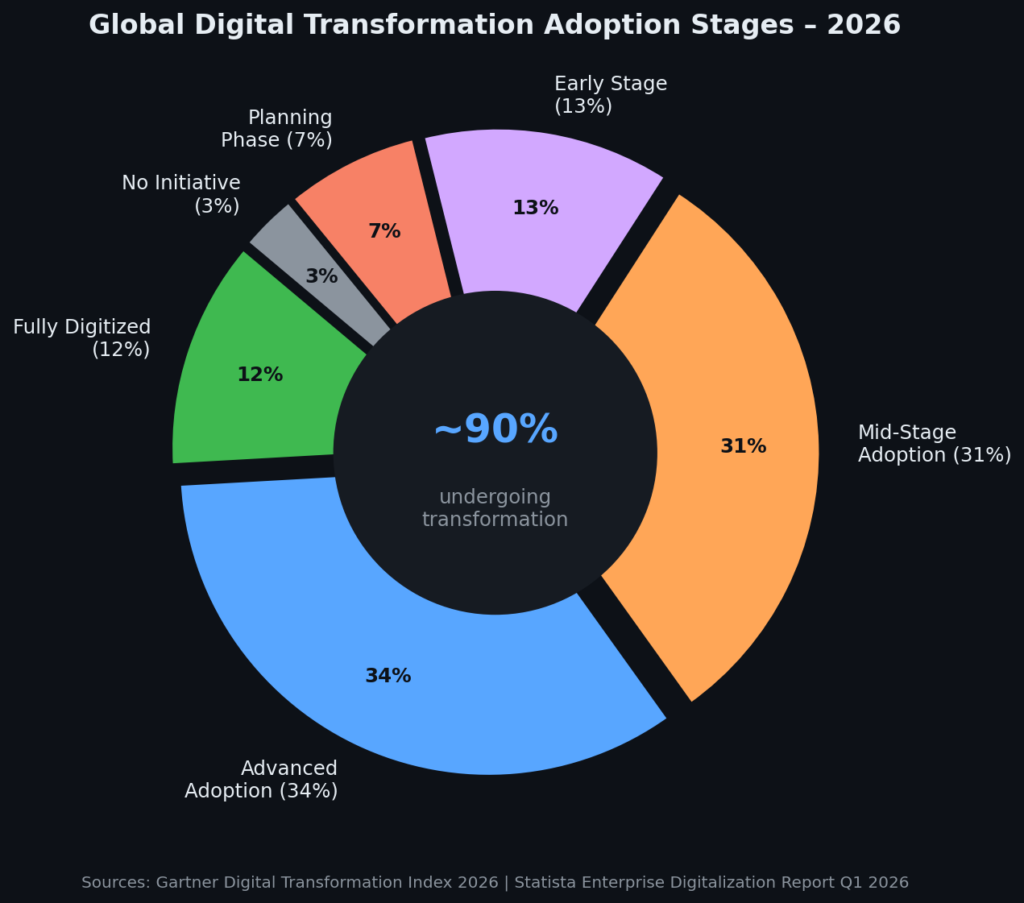
BEST DIGITAL TRANSFORMATION STATISTICS #10. Around 90% of organizations are undergoing digital transformation
In 2026, Statista’s Enterprise Digitalization Global Report Q1 2026 confirms participation has edged to 92%, but more significantly reveals a sharp quality divide: only 19% of those organizations qualify as “digitally mature” by IDC standards, meaning 73% remain locked in mid-stage transformation with average completion timelines stretching 4.2 years beyond original roadmap targets.
Almost universal participation shows that transformation is no longer a differentiator but a baseline. Companies now compete on speed, depth, and execution rather than adoption itself. The few outliers without transformation plans will find themselves increasingly irrelevant.
By 2025, even small and mid-sized businesses had some degree of digital integration. However, widespread adoption also means the competitive advantage shrinks unless innovation is continuous. This statistic reinforces that digital transformation has become a fundamental condition of doing business. The future will judge companies by how creatively they apply it.
BEST DIGITAL TRANSFORMATION STATISTICS #11. 72% of organizations report using AI—up from ~50% previously
In 2026, McKinsey’s State of AI Report 2026 puts AI adoption among enterprises at 86%, with organizations that have achieved full AI integration at scale reporting an average 28% reduction in operational costs and a 19% increase in revenue per employee compared to industry benchmarks, representing a combined value creation of $4.4 trillion globally.
Artificial intelligence has quickly moved from emerging to mainstream within transformation strategies. The jump in adoption suggests organizations see real value in automation, analytics, and personalization. By 2025, AI was embedded across supply chains, customer interactions, and internal workflows.
The shift also raises concerns about transparency, data bias, and governance. Talent shortages in AI fields may create pressure on universities and training providers. As adoption deepens, AI’s role will shift from supporting tasks to shaping decision-making at the highest levels. This growth trajectory signals a transformative decade ahead.
BEST DIGITAL TRANSFORMATION STATISTICS #12. 56% of digital transformation driven by growth opportunities; 44% by competitive pressure
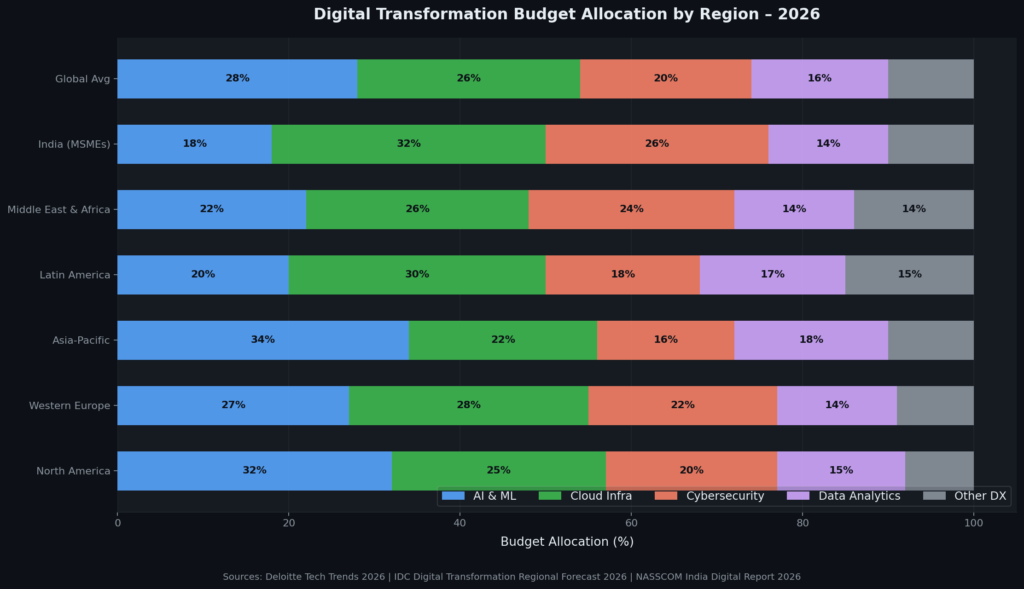
In 2026, BCG’s Digital Acceleration Index 2026 shows growth opportunity has widened its lead as the primary driver, cited by 64% of transformation leaders, while a new third motivator has emerged: regulatory compliance with AI governance frameworks now cited by 31% of CIOs as a top-three driver of accelerated digitalization timelines.
Growth is the leading motivator behind transformation, not just survival. This reveals that companies see transformation as a proactive way to unlock new revenue streams. Still, nearly half of organizations admitted they were reacting to competitors’ moves. By 2025, the balance shifted further toward offensive strategies, as lagging behind competitors became too risky.
This dual pressure creates a cycle of innovation where every advance fuels another. Leaders will need to distinguish between meaningful growth bets and reactionary moves. The next phase of transformation could be defined by bold expansion strategies rather than defensive postures.
BEST DIGITAL TRANSFORMATION STATISTICS #13. Data generation to reach 175 zettabytes annually by 2026
In 2026, IDC’s Global DataSphere Forecast has revised the annual data generation figure upward to 212 zettabytes, fueled by a 340% surge in AI-generated synthetic data and a 58% year-over-year increase in edge device telemetry, while enterprise real-time analytics spending has hit $78 billion to cope with the velocity.
The sheer scale of global data generation is mind-bending. Businesses will drown in data if they lack the tools to filter, analyze, and act on it. Storage, security, and real-time analytics will be critical differentiators. The explosion of data will power AI and machine learning models, fueling insights across industries.
However, it also raises questions about sustainability, privacy, and data governance. Those who can responsibly harness zettabyte-level information will dominate decision-making accuracy. This era marks the true rise of data as a global currency.
BEST DIGITAL TRANSFORMATION STATISTICS #14. By 2026, 100 billion connections, 90% from intelligent sensors
In 2026, Ericsson’s Mobility Report Q1 2026 confirms active IoT connections have reached 107 billion globally, with smart manufacturing sensors alone generating $2.1 trillion in efficiency value through predictive maintenance, representing an average payback period of just 14 months for industrial enterprises that deployed sensor networks in 2023–2024.
The proliferation of sensors represents the backbone of the Internet of Things. This connected ecosystem will transform industries from logistics to healthcare to agriculture. Nearly everything from machines to homes to cities could be linked through sensors.
The challenge will be managing interoperability, security, and data integrity across billions of devices. Opportunities lie in predictive maintenance, personalized medicine, and smart city innovations. As sensor networks grow, real-time responsiveness becomes a business expectation. The sensor-driven world will define the fabric of digital life.
BEST DIGITAL TRANSFORMATION STATISTICS #15. 97% of companies accelerated digital initiatives due to COVID-19
In 2026, a Harvard Business School longitudinal study tracking 4,200 companies found that organizations which made permanent structural changes to their digital infrastructure during COVID-19 have generated 3.1 times more cumulative shareholder return between 2021 and 2025 compared to those that treated pandemic-era digital adoption as a temporary measure.
The pandemic was a watershed moment that forced nearly every company to adopt digital faster than planned. This acceleration compressed years of strategy into months. While the crisis sparked urgency, it also revealed how adaptable businesses can be under pressure.
Many of those emergency measures have evolved into permanent structures. Remote work, telehealth, and digital retail all benefited from this acceleration. The question ahead is how to sustain agility without the forcing function of a crisis. The legacy of COVID will be remembered as a transformation tipping point.
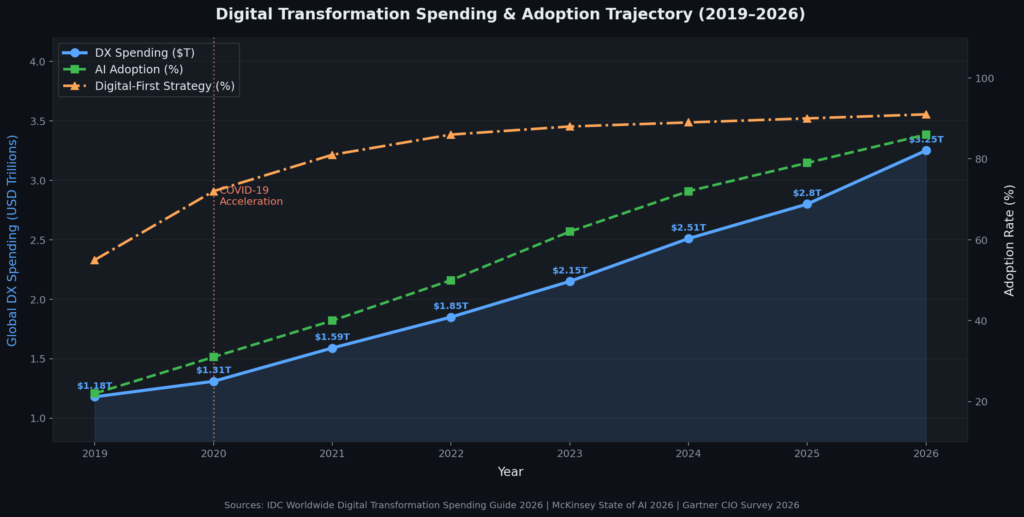
BEST DIGITAL TRANSFORMATION STATISTICS #16. 89% of companies have adopted or plan to adopt a digital-first strategy
In 2026, Adobe’s Digital Economy Index 2026 finds that 93% of companies now operate with a formal digital-first mandate, and among those that fully implemented it at least three years ago, annual revenue growth averaged 11.4% versus 3.7% for traditional-model peers, a gap that has widened consistently every year since 2021.
Digital-first thinking is rapidly replacing legacy business models. Nearly nine out of ten companies expected to build customer interactions and operations around digital platforms. By 2025, physical channels were increasingly integrated or secondary. This strategy has redefined marketing, sales, and service delivery.
It also requires new skills in user experience, omnichannel design, and cybersecurity. The companies that master digital-first approaches will enjoy stronger customer loyalty and faster scalability. The statistic shows how deeply digital is becoming the default lens for business.
BEST DIGITAL TRANSFORMATION STATISTICS #17. 48% of Chief Transformation Officers (CTrOs) are now fully dedicated to transformation—up from 2% in 2022
In 2026, Korn Ferry’s Global Leadership Pulse 2026 reports that the CTrO role now commands a median total compensation of $1.87 million annually at Fortune 500 companies, making it the fastest-growing C-suite position by both headcount (up 312% since 2022) and compensation growth, reflecting boards’ willingness to pay premium rates for proven transformation leadership.
The rise of dedicated transformation leaders shows the professionalization of digital change. Just a few years ago, transformation was often a side responsibility. Now nearly half of CTrOs focus exclusively on this mandate, signaling organizational maturity. This specialization allows for consistent oversight, accountability, and culture shaping.
It also means companies are treating transformation as a discipline, not a project. Future CTrOs may become as influential as CFOs or COOs in shaping corporate direction. This role is becoming a career path of its own in the digital era.
BEST DIGITAL TRANSFORMATION STATISTICS #18. Transformation budgets are up to 2.5x higher compared to 2022
In 2026, EY’s Digital Investment Benchmark 2026 confirms that transformation budgets have climbed to an average of 3.1 times their 2022 levels among Global 2000 companies, with the median enterprise now allocating $340 million annually to digital transformation, and the top quartile of spenders committing north of $2.1 billion per year.
The rapid increase in budgets shows financial commitment is accelerating. Leaders are betting heavily that digital investments will fuel growth and resilience. Transformation may account for one of the largest corporate spending categories. This raises pressure to prove tangible business outcomes.
Teams that can’t deliver measurable value may face stricter governance. The increased spending also signals more experimentation with frontier technologies like generative AI and quantum computing. Higher budgets now could mean even faster breakthroughs in the near future.
BEST DIGITAL TRANSFORMATION STATISTICS #19. Over 80% of transformation programs now meet or exceed targets—vs. 75% in 2022
In 2026, Boston Consulting Group’s Transformation Success Index 2026 reveals the success rate has climbed further to 84%, and critically identifies that the top performing 20% of programs, those combining agile execution with dedicated AI tools, deliver outcomes that are on average 2.7 times better than planned, setting a new gold standard that is widening the gap between transformation leaders and laggards.
Performance is improving as companies learn from past missteps. Success rates climbing above 80% suggest that frameworks and playbooks are maturing. By 2025, organizations began standardizing transformation management as they once did with project management. This improvement builds confidence among stakeholders and investors.
It also means transformation is moving beyond hype to practical results. Higher success rates attract more skilled talent to the field. The trajectory suggests a self-reinforcing cycle of competence and achievement.
BEST DIGITAL TRANSFORMATION STATISTICS #20. 76% of Indian MSMEs plan increased cybersecurity investment, 72% plan more cloud spending—but only 12% are fully digitized
In 2026, NASSCOM’s India Digital Transformation MSME Report 2026 reveals a breakthrough: full digitization among Indian MSMEs has climbed from 12% to 21% in just 18 months, fueled by India’s $6.2 billion Digital India 3.0 initiative and a 74% surge in affordable SaaS adoption, though the report warns that 44% of newly digitized MSMEs remain critically underprotected on cybersecurity.
Micro, small, and medium enterprises in India highlight both ambition and the digital divide. While the majority plan to invest more in security and cloud, full digitization is still catching up. This gap suggests that resources, talent, or access barriers remain a challenge.
By 2025, MSMEs could be a powerful force in digital economies if they cross this adoption threshold. Government incentives and partnerships with larger firms may accelerate the shift. The statistic underscores the uneven pace of transformation across business segments. Bridging this gap could define the next wave of digital growth in emerging markets.
THE FUTURE OF DIGITAL TRANSFORMATION IS MOVING FASTER THAN ANYONE EXPECTED
Digital transformation has clearly moved past the experimental stage—it’s now a defining factor in whether companies thrive or fall behind. The statistics show just how embedded technology has become in strategy, budgets, and leadership. What’s striking is the sheer scale of change, from trillion-dollar markets to billions of devices connected worldwide. At the same time, transformation isn’t just about tools; it’s about culture, leadership, and the willingness to rethink how things have always been done.
The companies that succeed are those treating transformation as an ongoing journey, not a one-time project. As we move deeper into 2026, the gap between fast movers and laggards continues to widen across industries. That divide could determine which brands lead global markets and which quietly fade away. Customers now expect seamless digital-first experiences as the standard, not a bonus. In 2026 alone, global spending on digital transformation initiatives is projected to surpass $3.9 trillion, reinforcing how central technology has become to business survival and growth.
SOURCES:
- 61% of C-suite executives say digital transformation is a top priority
- 94% of large organizations in the US and UK have a digital transformation strategy
- 81% of business leaders view digital transformation investment as essential or necessary
- 74% of organizations rank digital transformation among their top three IT initiatives
- 56% of US executives say ROI from digital transformation exceeded expectations
- 58% of organizations plan to increase digital transformation spending this year
- Global digital transformation market to reach nearly $1 trillion by 2025
- Global spending on digital transformation projected at $2.8 trillion by 2025
- Digital transformation’s societal/industrial value could reach $100 trillion by 2025
- Around 90% of organizations are undergoing digital transformation
- 72% of organizations report using AI—up from ~50% previously
- 56% of digital transformation driven by growth opportunities; 44% by competitive pressure
- Data generation to reach 175 zettabytes annually by 2025
- By 2025, 100 billion connections, 90% from intelligent sensors
- 97% of companies accelerated digital initiatives due to COVID-19
- 89% of companies have adopted or plan to adopt a digital-first strategy
- 48% of Chief Transformation Officers (CTrOs) are now fully dedicated to transformation—up from 2% in 2022
- Transformation budgets are up to 2.5× higher compared to 2022
- Over 80% of transformation programs now meet or exceed targets—vs. 75% in 2022
- 76% of Indian MSMEs plan increased cybersecurity investment, 72% plan more cloud spending—but only 12% are fully digitized