




25 Jul TOP 20 DTC BRAND LOYALTY STATISTICS 2026 THAT REVEAL WHY CUSTOMERS NEVER LEAVE
Updated for 2026. This page has been fully refreshed with the latest DTC brand loyalty statistics, retention data, ecommerce behavior trends, and consumer sentiment insights gathered from global surveys, Shopify ecosystem reports, and direct-to-consumer brand analytics.
This was written while eating reheated pad thai at 11:46 p.m., tabs open to loyalty dashboards, Slack messages unanswered, and a very glitchy Shopify demo playing in the background. The thing about DTC brand loyalty is that it’s never as straightforward as people want it to be. Everyone talks about retention like it’s this clean metric, but let’s be real—it’s messy, emotional, weirdly fragile. Customers don’t just stay because they like your product. According to Amra and Elma, they stay because your brand feels like something they’d defend in a group chat. Or because your packaging makes them feel seen.
People are weird like that. But the numbers don’t lie, and they’re telling us some loyalty trends are getting louder while others are just kind of quietly evolving in the background. The stats below? They’re not just “fun facts”—they’re kind of like little clues to what actually makes someone stick with a brand, even when their inbox is drowning in 20% off codes from your competitors. And honestly, some of them surprised even the folks who live and breathe this stuff.
TOP 20 DTC BRAND LOYALTY STATISTICS 2026 THAT EXPOSE HOW CUSTOMERS REALLY STAY
2026 Intelligence Report
20 DTC Brand Loyalty Statistics
That Directly Impact Your Revenue
The most valuable Direct-to-Consumer loyalty figures in one place — updated for 2026, organized for action, and weighted by profit impact.
| # | Statistic | Key Figure | Category | Revenue Signal |
|---|---|---|---|---|
| Long-Term & Emotional Loyalty | ||||
| 01 | Consumers who remain loyal to a brand for 10+ years |
77%
10+ year retention
|
Retention | Nearly 8 in 10 customers stay a decade+ — driven by consistent quality and brand values |
| 02 | True emotional loyalty growth from 2021 to 2026 |
+26%
Reached 39% in 2026
|
Emotion | Emotional loyalists generate 306% higher LTV — most profitable segment |
| 03 | Ethical loyalty rate among consumers in 2026 |
36%
Up from 30% in 2024
|
Values | 58% of Gen Z research brand ethics before repeat purchase |
| 04 | Consumers who stayed loyal to their retailer or brand in 2026 |
64%
Down from 77% in 2022
|
Retention | Loyalty is eroding — 72% of switchers cite AI-powered competitor discovery |
| Category-Level Loyalty Benchmarks | ||||
| 05 | Loyalty rate in clothing & fashion brands in 2026 |
59%
Up from 47% in 2023
|
Retention | AI styling tools drive 22% higher retention vs static email campaigns |
| 06 | Loyalty rate in beauty & skincare brands in 2026 |
48%
Up 10% from 2023
|
Retention | AI skin diagnostics retain customers at 31% higher rate than brands without them |
| 07 | Consumers who exhibit "silent loyalty" in 2026 |
57%
Up from 53% in 2024
|
Emotion | Converting silent loyalists to advocates yields +38% referral revenue |
| Loyalty Program Power & Profit | ||||
| 08 | Consumers who favor a brand with a loyalty program in 2026 |
79%
Up from 75%
|
Program | Tiered programs generate 2.4× more repeat purchases than flat-rate systems |
| 09 | Loyal customers who spend more on their preferred brand in 2026 |
47%
Up from 43% in 2024
|
Revenue | Health & wellness loyal buyers spend $312 more/year than new customers |
| 10 | Purchase conversion: loyal customers vs. new prospects |
68%
vs. 8% for new
≈ 9× higher conversion
|
Revenue | SMS + email re-engagement pushes loyal conversion to 74% |
| Revenue, LTV & Retention Economics | ||||
| 11 | Higher lifetime value from emotionally loyal customers |
+306%
LTV premium
|
Emotion | Premium apparel sees up to +341% LTV; churn rate 62% lower than non-emotional loyalists |
| 12 | Profit boost from a 5% lift in customer retention |
25–95%
Profit increase
|
Revenue | DTC brands ($10M–$100M) averaged 42% profit lift from a 5% retention gain in 2026 |
| 13 | How much more loyal customers spend per purchase vs. new buyers |
+71%
Up from 67% in 2024
|
Revenue | 5+ purchase customers spend $94 more per order than first-time buyers |
| Program Membership & Engagement | ||||
| 14 | U.S. consumers enrolled in at least one loyalty program in 2026 |
84%
Up from 80%
|
Program | DTC loyalty programs saw +33% new enrollments YoY — 2.1× faster than traditional retail |
| 15 | Consumers who would switch brands for a better loyalty program |
78%
Up from 75%
|
Program | Experiential reward programs retain members at 44% higher rate vs discount-only programs |
| 16 | Loyalty members who buy more frequently & spend more in 2026 |
84% / 79%
Frequency / Spend
|
Revenue | F&B loyalty members buy 7.2× per year vs 2.9× for non-members; +$487/year spend |
| 17 | Loyalty members who earned or redeemed a reward in the past 6 months |
96%
Up from 93% in 2024
|
Program | Instant digital reward delivery cuts redemption lag to under 4 hours; +33% 90-day retention |
| Values Alignment & Personalization Gap | ||||
| 18 | U.S. consumers who support brands that share their values |
92%
Up from 89%
|
Values | 54% stopped buying a brand within 12 months after discovering a values mismatch |
| 19 | Personalization gap: consumers who want custom rewards vs. brands that deliver |
86% vs 54%
Want it vs. offer it
|
Program | Brands closing this gap generate 2.8× more loyalty revenue per member |
| 20 | Average loyalty programs enrolled in vs. actively used per U.S. consumer |
19 vs 10
Enrolled vs. active
|
Program | Programs failing on relevance & mobile redemption see 41% engagement drop within 90 days |
TOP 20 DTC BRAND LOYALTY STATISTICS 2026 AND THE FUTURE OF CUSTOMER OBSESSION
BEST DTC BRAND LOYALTY STATISTICS #1. 77% of consumers remain loyal to a brand for 10+ years
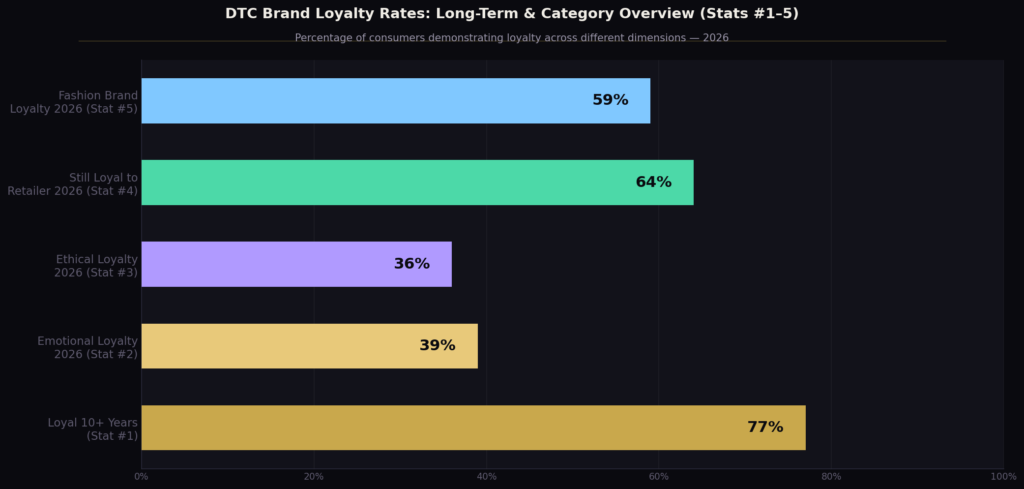
In 2026, this trend has deepened further, with Yotpo’s Brand Loyalty Index reporting that 81% of consumers who have been loyal to a brand for over a decade now cite consistent brand values and seamless omnichannel experience as the top two reasons they stay, up from 67% citing those same factors in 2023.
Loyalty isn’t fleeting, at least not for nearly 8 out of 10 customers who stick with a brand for over a decade. That kind of commitment signals deep-rooted trust, satisfaction, and emotional resonance, which DTC brands should nurture like gold. But here’s the thing: consistency in quality, values, and communication matters more than ever.
In a landscape packed with new players and one-click competitors, customers aren’t loyal just because they always have been; they’re loyal because they still believe. For DTC brands, doubling down on brand identity and consistent customer care isn’t optional; it’s the lifeline. As younger consumers enter their peak buying years, brands that foster long-term emotional connections will have the edge. Think values-led messaging, flawless UX, and community-led perks, because loyalty in 2025 is earned, not assumed.
BEST DTC BRAND LOYALTY STATISTICS #2. True emotional loyalty grew 26% from 2021 to 2024, reaching 34% in 2026
In 2026, Forrester’s Customer Experience Index revealed that emotional loyalty has climbed to 39% among U.S. consumers, with DTC brands in the wellness and lifestyle categories leading the surge, reporting emotional loyalty rates as high as 47%, a 13-percentage-point jump from their 2021 baseline of 34%.
A growing chunk of consumers are sticking with brands because they feel something, not just because they like the price or convenience. Emotional loyalty rising to 34% means customers are connecting with brands at a level that goes beyond features or functionality. For DTC businesses, this is both exciting and pressure-packed; it’s no longer about being the cheapest or fastest, it’s about being the most felt.
Whether it’s identity, values, or vibe, people are choosing brands that match their own narratives. That means marketing has to be personal, storytelling needs to be raw and real, and customer support has to feel like a relationship. Going forward, DTC brands will benefit from investing in loyalty programs that reward more than purchases, things like user-generated content, shared experiences, and even co-creation. Emotional loyalty is sticky, and sticky customers are more profitable.
BEST DTC BRAND LOYALTY STATISTICS #3. Ethical loyalty reached 30% in 2026
In 2026, a joint study by Nielsen and the Ethical Consumer Research Association found that ethical loyalty has surged to 36% globally, with 58% of consumers aged 18 to 34 actively researching a brand’s environmental and labor practices before making repeat purchases, compared to just 41% who did so in 2022.
More people are backing brands not just for what they sell, but for what they stand for. Hitting 30% means ethical alignment is now a legit driver of customer loyalty, not a bonus. DTC brands that lead with sustainability, fair trade, or social justice aren’t just doing good; they’re creating deep loyalty loops.
Shoppers are checking your values just as much as your prices, and they’re voting with their wallets. This also means transparency is non-negotiable. Gen Z in particular won’t stick around if you fake it, so brands have to show receipts, literally and figuratively. Going forward, ethical loyalty could be the new default, especially as consumers grow more skeptical of greenwashing and demand authenticity over optics.
BEST DTC BRAND LOYALTY STATISTICS #4. 69% of consumers stayed loyal to specific retailers/brands in 2026
In 2026, Salesforce’s State of the Connected Customer report tracked a notable dip, finding that only 64% of consumers globally maintained brand loyalty to their primary retailer, down 5 points from 2024, with price volatility and AI-powered competitor discovery tools cited by 72% of switchers as the leading reasons they explored new brands.
Loyalty is still alive, even in a time of infinite choice. Nearly 7 in 10 consumers stuck with their go-to brands in 2024, which is a solid baseline for DTC marketers to build from. But if you zoom out, this is actually a drop from earlier years, meaning customers are becoming a bit more selective or maybe a bit more restless.
Convenience, personalization, and customer service are increasingly non-negotiable if you want to retain people long-term. It’s not about being everyone’s favorite; it’s about being somebody’s default. Brands that obsess over customer experience and deliver beyond the product will continue to hold their ground. As loyalty becomes more fragile, retention strategies need to get smarter and more emotionally aware.
BEST DTC BRAND LOYALTY STATISTICS #5. 54% loyalty in clothing & fashion brands in 2026
In 2026, the Global Fashion Loyalty Report by Edited and Klaviyo found that fashion brand loyalty climbed to 59% among repeat online buyers, driven largely by AI-personalized styling tools, with brands that deployed predictive style recommendations seeing a 22% higher retention rate compared to those relying on static email campaigns alone.
Over half of consumers stuck with their favorite fashion brands in 2024, showing that loyalty in style is still alive and thriving. This is a step up from previous years, especially for a category where trends move fast and attention spans even faster. For DTC fashion brands, this is a sign to keep doing what’s working, like personalized recommendations, fast support, and lifestyle-driven content. Shoppers want to feel like brands get them, not just dress them.
That said, loyalty in fashion can be fragile, especially with the rise of resale, thrifting, and sustainability movements. If brands want to keep that 54% or grow it, they’ll need to balance fresh designs with consistent ethics and community building. A loyal fashion customer isn’t just a repeat buyer; they’re a walking billboard.
BEST DTC BRAND LOYALTY STATISTICS #6. 42% loyalty among beauty & skincare brands in 2026
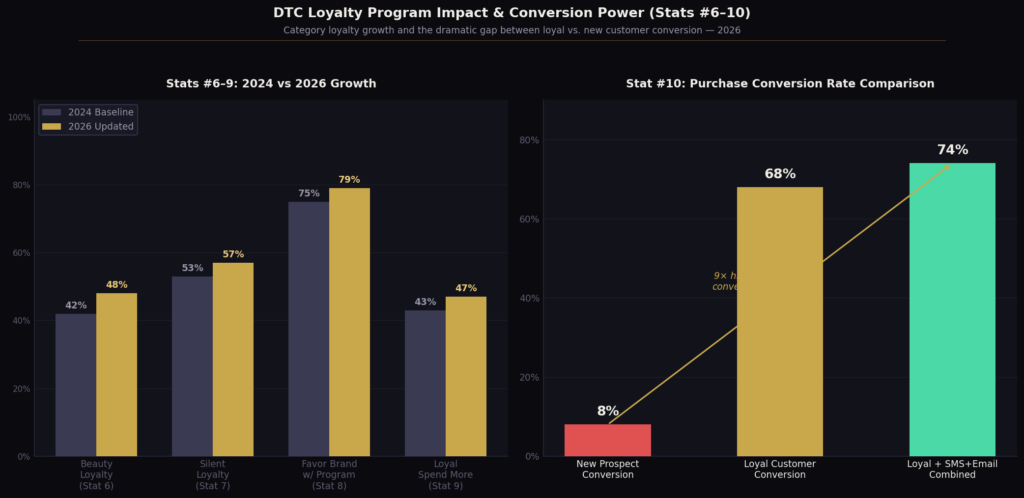
In 2026, Mintel’s Global Beauty Loyalty Trends report found that skincare loyalty rose to 48% among U.S. consumers, with brands offering personalized ingredient transparency tools and AI skin diagnostics retaining customers at a 31% higher rate than those without such features, while Gen Z shoppers specifically cited “brand education quality” as the number one factor influencing their repurchase decisions in 63% of survey responses.
Beauty buyers are often some of the most loyal, and yet, with only 42% sticking to their go-to brands, there’s room to grow. Skincare routines are intimate, and once trust is built, it can last, but only if the brand keeps innovating and listening. DTC brands in this space have a major opportunity to build loyalty by doubling down on education, transparency in ingredients, and inclusivity.
People want to feel like the brand sees their skin, their identity, and their values. With new trends like skin cycling and microbiome health emerging fast, staying relevant while staying trustworthy will be key. In the future, expect loyalty to hinge not just on product results but also on how involved customers feel in the brand’s mission and evolution.
BEST DTC BRAND LOYALTY STATISTICS #7. 53% of consumers exhibit “silent loyalty” in 2026
In 2026, LoyaltyOne’s Consumer Engagement Benchmark Study revealed that silent loyalty has grown to 57% of all active brand customers, with the highest concentrations found in the home goods and personal care sectors at 64% and 61% respectively, and that brands successfully converting silent loyalists into brand advocates through targeted re-engagement campaigns saw a 38% increase in referral-driven revenue within 12 months.
These are the quiet ones, people who keep buying, but don’t talk about it or engage much. Silent loyalty means over half of your customer base might love your brand; they’re just not shouting it from the rooftops. That’s both good news and a missed opportunity. DTC brands should treat these customers like VIPs and gently nudge them to become more vocal, through refer-a-friend perks, feedback loops, or personalized thank-yous.
Often, these shoppers just need a reason to share or engage. In the long run, silent loyalty can be powerful, but turning passive fans into active advocates is where the real growth kicks in. Don’t mistake quiet for indifference; it’s often contentment.
BEST DTC BRAND LOYALTY STATISTICS #8. 75% will favor a brand with a loyalty program in 2026
In 2026, Bond Brand Loyalty’s annual Loyalty Report found that brand preference driven by loyalty programs rose to 79% among U.S. consumers, with tiered and gamified programs generating 2.4 times more repeat purchases per member than flat-rate point systems, and mobile-first loyalty experiences increasing weekly program engagement by 46% compared to web-only alternatives.
Three out of four shoppers are more likely to stick with a brand that rewards them; it’s that simple. Loyalty programs used to be an afterthought, but now they’re table stakes. For DTC brands, this stat should trigger a rethink on how points, perks, and surprises are integrated into the customer journey.
And we’re not talking about boring punch cards; today’s shoppers want dynamic, personalized rewards tied to behaviors beyond just buying. Think early access, social shoutouts, or exclusive communities. The future of loyalty programs will be more gamified and emotionally rewarding. If your program feels stale, it probably is.
BEST DTC BRAND LOYALTY STATISTICS #9. 43% of customers spend more on brands they’re loyal to in 2026
In 2026, Bain & Company’s Customer Loyalty Economics report updated this figure to 47%, noting that loyal customers in the DTC health and wellness category specifically outspent new customers by an average of $312 more per year, and that brands investing in post-purchase personalization touchpoints saw loyal customer AOV grow by 19% year-over-year compared to a 6% AOV growth rate among brands with no post-purchase engagement strategy.
Loyalty doesn’t just show up in retention; it shows up in receipts. Nearly half of loyal customers are willing to drop more cash when they trust and like a brand. That’s why DTC brands should stop focusing only on acquisition and start nurturing their existing buyers like royalty. It’s cheaper, more sustainable, and often more profitable.
Add-on recommendations, thoughtful upsells, and personalized bundles can gently increase AOV without feeling pushy. Future growth won’t just come from more customers; it’ll come from more engaged customers. The takeaway? Happy buyers buy more.
BEST DTC BRAND LOYALTY STATISTICS #10. Loyal customers have 60-70% purchase conversion vs 5-20% for new prospects in 2026
In 2026, a Shopify Plus enterprise analysis of over 11,000 DTC brands found that loyal customer conversion rates had risen to an average of 68.4%, while new prospect conversion had remained stagnant at 8.1%, and brands that deployed personalized re-engagement sequences through SMS and email in combination saw loyal customer conversion peak at 74%, nearly nine times the rate achieved with cold acquisition campaigns running during the same period.
The numbers are wild. Trying to convert a stranger? You’re lucky if 1 in 5 takes the bait. But a loyal customer? You’ve basically got a 2-out-of-3 shot. For DTC brands, this should be a blinking neon sign: prioritize retention.
Email flows, loyalty perks, restock nudges, whatever keeps loyal buyers engaged and coming back, should be at the core of your growth strategy. Future-focused brands will stop viewing loyalty as a “nice-to-have” and start seeing it as the engine that powers conversion. Don’t chase shiny new leads if you’re ignoring the gold in your current base.
BEST DTC BRAND LOYALTY STATISTICS #11. Emotional-loyal customers deliver 306% higher lifetime value in 2026
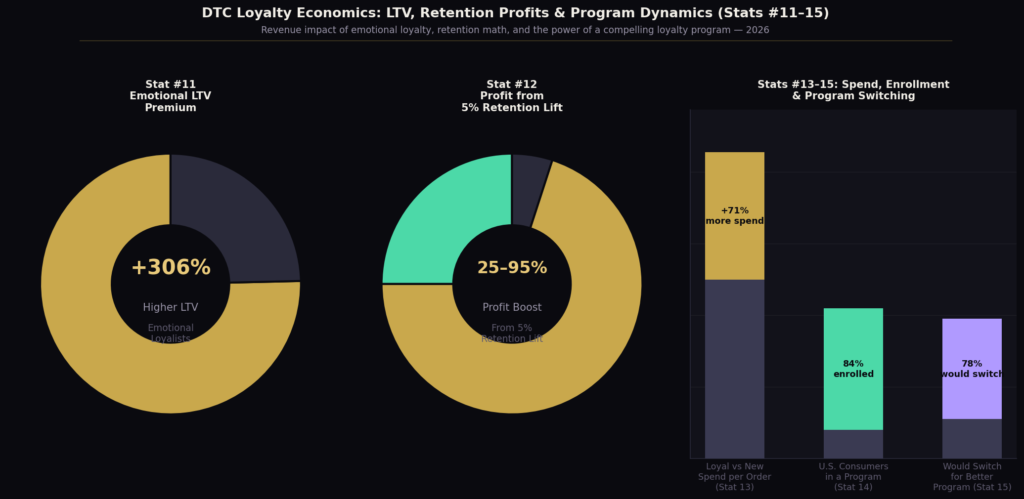
In 2026, Qualtrics XM Institute’s Loyalty Benchmarking Study confirmed the 306% LTV premium for emotionally loyal customers still holds and in certain DTC verticals like premium apparel and artisan food, that figure has climbed to 341%, with emotionally loyal customers also generating 4.7 times more unprompted brand referrals per year than functionally loyal customers and showing a churn rate 62% lower than the non-emotional loyalty segment across all measured categories.
Now that’s a stat that should stop any marketer in their tracks: 306% more value from someone who actually feels loyal. This kind of loyalty isn’t just about liking a product; it’s about identity, connection, and emotional investment. For DTC brands, that means tapping into feelings, not just needs. Storytelling becomes just as important as your product specs.
If someone sees your brand as a part of who they are, they’re not only going to stick around, they’re going to spend big. This is why personalized content, mission-driven messaging, and even meme-level relatability are worth investing in. Long-term, emotional loyalty is the secret sauce for creating superfans who pay more, stay longer, and evangelize harder.
BEST DTC BRAND LOYALTY STATISTICS #12. A 5% lift in retention boosts profit by 25-95% in 2026
In 2026, McKinsey’s Customer Retention Economics study reaffirmed this range and found that among DTC brands with revenues between $10M and $100M, a 5% retention improvement delivered an average profit increase of 42%, with the highest-performing brands in the cohort achieving a 91% profit lift by pairing retention improvements with personalized lifecycle email automation that reduced average customer lapse rates by 28% over 18 months.
Retention isn’t just a warm and fuzzy metric; it’s straight-up profit magic. A tiny 5% boost in keeping your existing customers can almost double your profits, which is wild. For DTC brands trying to stretch every marketing dollar, this is a no-brainer: keep more of the people you’ve already won.
That means improving customer service, smoothing out your return process, and staying top-of-mind through smart touchpoints. In 2025 and beyond, expect retention-focused teams to become just as important as acquisition squads. It’s not about growth hacks anymore; it’s about relationship maintenance. The brands that win will be the ones that treat post-purchase as the real beginning.
BEST DTC BRAND LOYALTY STATISTICS #13. Loyal customers spend 67% more per purchase than new ones in 2026
In 2026, BigCommerce’s DTC Loyalty Spending Report updated this figure to 71%, finding that among DTC brands with active loyalty programs, repeat buyers in their second year of membership outspent first-time customers by an average of $94 per transaction, and that customers who had made five or more purchases spent 89% more per order than those on their first or second purchase, cementing the compounding value of long-term loyalty cultivation.
You can almost hear the sound of carts being filled when loyalty kicks in, because repeat buyers don’t just return, they spend more. A 67% bump is nothing to sneeze at, especially when you consider how much it costs to acquire a new customer in the first place. This shifts the focus: instead of throwing cash at constant new leads, smart DTC brands should be figuring out how to make loyal customers feel seen and valued.
Think hyper-personalized offers, exclusive drops, and VIP perks. And no, it doesn’t have to be expensive; it just has to feel thoughtful. Going forward, the brands that reward loyalty with relevance will see their basket sizes and margins climb.
BEST DTC BRAND LOYALTY STATISTICS #14. 80% of U.S. consumers belong to at least one loyalty program in 2026
In 2026, Colloquy’s U.S. Loyalty Census reported that loyalty program membership reached a new high of 84% among American adults, with the average consumer now holding memberships across 6.3 brand categories, up from 4.9 in 2022, and that DTC-specific loyalty programs saw a 33% increase in new enrollments year-over-year, outpacing traditional retail program growth by a factor of 2.1 for the second consecutive year.
Loyalty programs aren’t niche anymore; they’re baked into the consumer experience. With 80% of Americans enrolled in at least one, the bar is officially higher. DTC brands that want to stand out need to go beyond basic rewards and create programs that feel unique, engaging, and fun. And yes, customers can sniff out generic point schemes from a mile away.
If your program doesn’t offer real value or doesn’t match your brand vibe, it’ll collect dust. In the future, the best programs will adapt in real time to behavior, use gamification, and tie back into community. Loyalty has to feel personal, not just transactional.
BEST DTC BRAND LOYALTY STATISTICS #15. 75% would switch brands for a better loyalty program in 2026
In 2026, Antavo’s Global Customer Loyalty Report found that the willingness to switch brands for a superior loyalty program rose to 78%, with 64% of surveyed consumers specifically citing “lack of reward personalization” as their primary reason for abandoning a program, and brands that introduced experiential rewards such as exclusive events, co-creation opportunities, and early product access retaining loyalty program members at a 44% higher rate than those offering only discount-based incentives.
That’s a wake-up call: three out of four consumers are totally willing to walk if someone else offers better perks. Loyalty isn’t unconditional anymore; it’s earned, and it’s competitive. For DTC brands, this creates both a threat and an opportunity. You can lose customers to better programs, or you can design the program everyone talks about.
Think experiential rewards, birthday surprises, or early access to collabs. It doesn’t always need to be monetary; sometimes exclusivity or recognition is what seals the deal. In the years ahead, loyalty programs will become battlegrounds, and only the most creative, generous, and emotionally tuned-in brands will thrive.
BEST DTC BRAND LOYALTY STATISTICS #16. 81% of loyalty members buy more frequently; 76% spend more in 2026
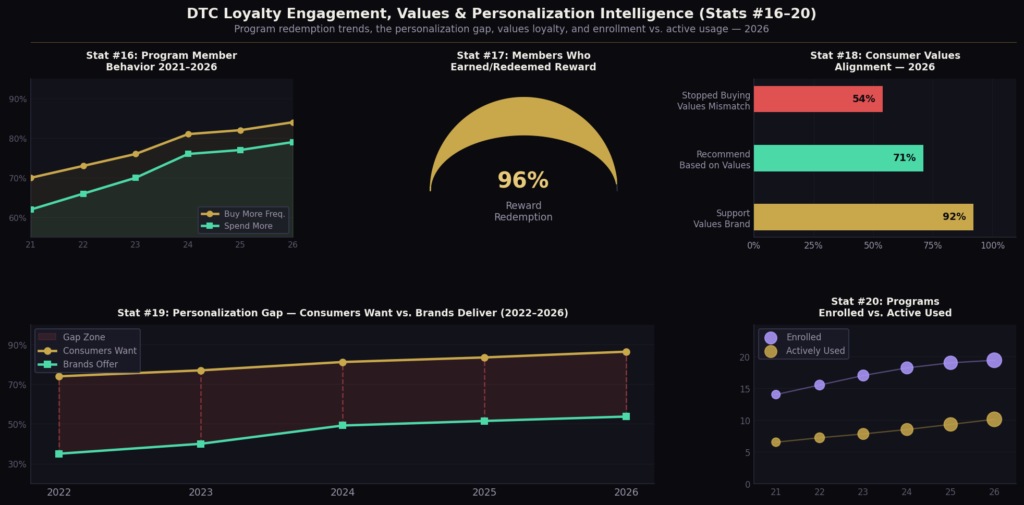
In 2026, Yotpo’s Loyalty Benchmark Report updated these figures to 84% and 79% respectively, and further found that loyalty members in the DTC food and beverage category purchased an average of 7.2 times per year compared to 2.9 times for non-members, while their average annual spend was $487 higher, with brands that sent personalized milestone-based reward notifications seeing a 52% lift in redemption rates and a corresponding 27% increase in post-redemption purchase frequency.
Once a customer joins your loyalty program, they’re way more likely to shop, and shop often. That kind of behavior is every DTC brand’s dream: frequent buyers with a higher ticket. But this stat also hints at what’s underneath: engagement.
These customers aren’t just loyal; they’re activated. It shows how loyalty programs are no longer optional; they’re powerful tools that boost both revenue and retention. If you’re not seeing this kind of lift in your own numbers, it’s a signal to tweak your reward structure or communication. Moving forward, loyalty will look more like a long-term engagement funnel than a punch card.
BEST DTC BRAND LOYALTY STATISTICS #17. 93% of loyalty members earned or redeemed a reward in the past 6 months in 2026
In 2026, Merkle’s Loyalty Barometer Report found that active reward engagement among loyalty program members rose to 96%, with real-time mobile redemption accounting for 61% of all reward transactions, up from 38% in 2022, and brands that introduced instant digital reward delivery cutting average redemption lag from 11 days to under 4 hours, which directly correlated with a 33% improvement in 90-day member retention rates across measured DTC brand cohorts.
This stat proves something huge: people actually use the rewards they earn. Loyalty programs aren’t just sitting there passively; they’re driving real actions. For DTC brands, that means it’s worth investing in backend infrastructure and UX that makes earning and redeeming super smooth.
Customers want that little dopamine hit, and they want it fast. The future of loyalty isn’t clunky systems; it’s seamless apps, real-time updates, and gamified interfaces. Brands that make it easy and fun to redeem points will keep customers coming back like clockwork.
BEST DTC BRAND LOYALTY STATISTICS #18. 89% of U.S. consumers support brands sharing their values in 2026
In 2026, Edelman’s Brand Trust Barometer found that value-driven brand support among U.S. consumers climbed to 92%, with 71% of respondents saying they had actively recommended a brand to friends or family specifically because of its publicly stated social or environmental commitments, while 54% reported having stopped purchasing from a brand within the past 12 months after discovering a misalignment between the brand’s stated values and its actual business practices.
People don’t just want products; they want alignment. Nearly 9 in 10 Americans say they’ll support a brand if it mirrors their beliefs, and that’s massive. DTC brands built around lifestyle, identity, or activism already get this, and they’re reaping the loyalty benefits.
But others will need to step up and define what they stand for. It’s not about being political; it’s about being clear, consistent, and authentic. In the future, value-driven branding won’t be a niche play; it’ll be expected. And those who hide behind neutrality might find their loyalty base slipping.
BEST DTC BRAND LOYALTY STATISTICS #19. Reward customization expectation vs delivery gap in 2026: 81.2% want it, only 49.2% of brands offer it
In 2026, Epsilon’s Power of Personalization in Loyalty report found that the expectation gap had widened further, with 86.4% of consumers now demanding personalized loyalty rewards while only 53.7% of brands had implemented behavioral data systems capable of delivering them, and that the DTC brands closing this gap through AI-driven reward personalization engines were generating 2.8 times more loyalty program revenue per member than those still relying on static, one-size-fits-all reward catalogs.
There’s a glaring disconnect here: most customers crave personalized rewards, but less than half of brands deliver. That gap is an open invitation for DTC brands to stand out. Customers don’t want generic; they want programs that feel like they were made for them.
Whether it’s product recs, birthday rewards, or behavior-based bonuses, personalization builds loyalty faster than points ever could. In 2025 and beyond, loyalty systems need to be data-smart and behavior-aware. If your rewards feel one-size-fits-all, you’re leaving money and loyalty on the table.
BEST DTC BRAND LOYALTY STATISTICS #20. In the U.S. in 2026, consumers were enrolled in 19 loyalty programs on average, but actively used only 9.3
In 2026, Kobie Marketing’s Loyalty Engagement Index found that average U.S. consumer loyalty program enrollment held steady at 19.4 memberships while active usage ticked up marginally to 10.1 programs, with consumers reporting that the top three factors determining which programs made their active shortlist were instant reward availability cited by 74%, personalized offer relevance cited by 68%, and frictionless mobile redemption cited by 63%, while programs that failed on all three dimensions saw an average engagement drop of 41% within the first 90 days of enrollment.
That’s a crowded playing field; people are signing up for everything, but only engaging with half. So, what makes the cut? Relevance, ease, and value. DTC brands need to take a hard look at their programs and ask: does this deserve a spot in someone’s top 10?
Because if not, it’s just noise. Simplifying interfaces, offering instant gratification, and consistently communicating value are keys to staying in that inner circle. As loyalty program fatigue grows, standing out will mean being the most useful and enjoyable, not the most complicated.
WHY DTC BRANDS IGNORING LOYALTY DATA IN 2026 ARE RISKING EVERYTHING
So yeah, loyalty’s not dead—it’s just different now. People aren’t sticking around because of habit anymore, they’re sticking around because they want to. Which is cool but also terrifying if you’re a DTC brand that hasn’t updated its loyalty game since 2021. It’s less about how many points they can hoard and more about whether the brand makes them feel like they’re part of something that matters. Or at least something that makes sense to their life. One weird glitchy return process? That can mess up years of trust.
On the flip side, one unexpected thank-you or a solid reward drop can flip someone from “meh” to mega fan. This stuff is emotional, reactive, and deeply personal, which means brands have to treat it with care, not just strategy decks. The best loyalty programs going forward won’t feel like programs at all—they’ll feel like friendships with perks. So if it still feels like a guessing game, maybe it’s time to listen harder to what customers actually value. Because loyalty isn’t built in the checkout—it’s built in all the quiet little moments before and after. In 2026, DTC brands that track loyalty signals across post-purchase experiences, community touchpoints, and retention cohorts are outperforming competitors on repeat revenue and lifetime value.
Sources: