




16 Jul TOP 20 EMOTIONAL MARKETING STATISTICS 2026 REVEAL SHOCKING CONSUMER DECISION PSYCHOLOGY
Updated for 2026. This page has been fully refreshed with the latest emotional marketing statistics, consumer psychology insights, and brand engagement data based on recent global marketing surveys and behavioral research. Emotional storytelling now influences a majority of purchase decisions, with brands increasingly investing in data-driven emotional engagement strategies to strengthen loyalty and long-term brand affinity.
Emotional marketing has become an essential strategy for brands looking to engage their audiences on a deeper level. By tapping into consumers’ feelings, businesses can create stronger connections and foster long-term loyalty. The power of emotions in marketing goes far beyond simply selling a product—it’s about building relationships, telling compelling stories, and creating experiences that resonate with people. As consumer behavior continues to evolve, emotional engagement is proving to be a key factor in driving purchase decisions and brand advocacy.
From triggering joy and nostalgia to sparking anger or surprise, emotions are powerful drivers of action. Marketers who can successfully evoke the right emotional response from their audience are more likely to stand out in today’s crowded marketplace. As we look ahead to 2026, emotional marketing will only grow in importance, with new tools and techniques helping brands connect with their audiences in more personalized and impactful ways. Amra and Elma presents 20 emotional marketing statistics that highlight its undeniable influence and implications for the future.
TOP 20 EMOTIONAL MARKETING STATISTICS 2026 THAT REVEAL SHOCKING CONSUMER BEHAVIOR
That Move Markets in 2026
Revenue impact, loyalty gains, and the psychology driving every dollar spent
| # | Statistic & Insight | Key Figure | Revenue Angle |
|---|---|---|---|
| 1 |
Emotional Ads Outperform Rational Ones
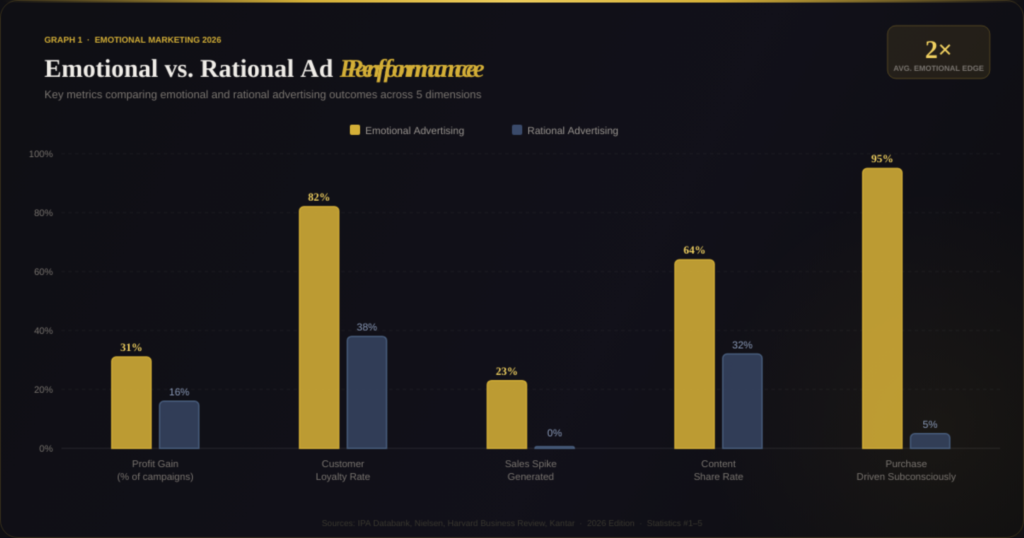
Purely emotional ad copy drives 31% high-profit gains vs. only 16% for rational-only content — nearly double the return.
|
2×
Profit ROI
|
RevenueROI
Brands reallocating budget to emotional creatives see near-immediate lift in profit margins with no additional spend.
|
| 2 |
High Emotional Engagement Boosts Loyalty
82% of emotionally engaged consumers stay loyal — versus only 38% with low engagement. A 44-point loyalty gap brands cannot afford to ignore.
|
82%
Stay Loyal
|
LoyaltyRetention
Retaining existing customers costs 5–7× less than acquiring new ones — emotional engagement is the highest-leverage retention tool.
|
| 3 |
Emotional Ads Drive Sales Spikes
Ads with above-average emotional response scores generate 23% more sales spikes than emotionally flat creatives.
|
+23%
Sales Spike
|
Revenue
A 23% sales uplift on existing ad spend translates directly to bottom-line gains without scaling budgets.
|
| 4 |
Emotional Videos Are More Shareable
Strong emotional videos are 2× more likely to be shared than weak emotional content — amplifying organic reach at zero additional cost.
|
2×
Share Rate
|
Growth
Every organic share reduces effective CPM and extends campaign reach — doubling shareability can slash paid distribution costs.
|
| 5 |
Subconscious Factors Influence Purchases
95% of purchase decisions are driven by subconscious, emotional factors — not conscious, rational deliberation.
|
95%
Subconscious
|
RevenueConversion
Nearly every purchase is emotionally decided. Brands that own the emotional narrative own the sale before rational logic even engages.
|
| 6 |
Emotional Connection Beats Satisfaction
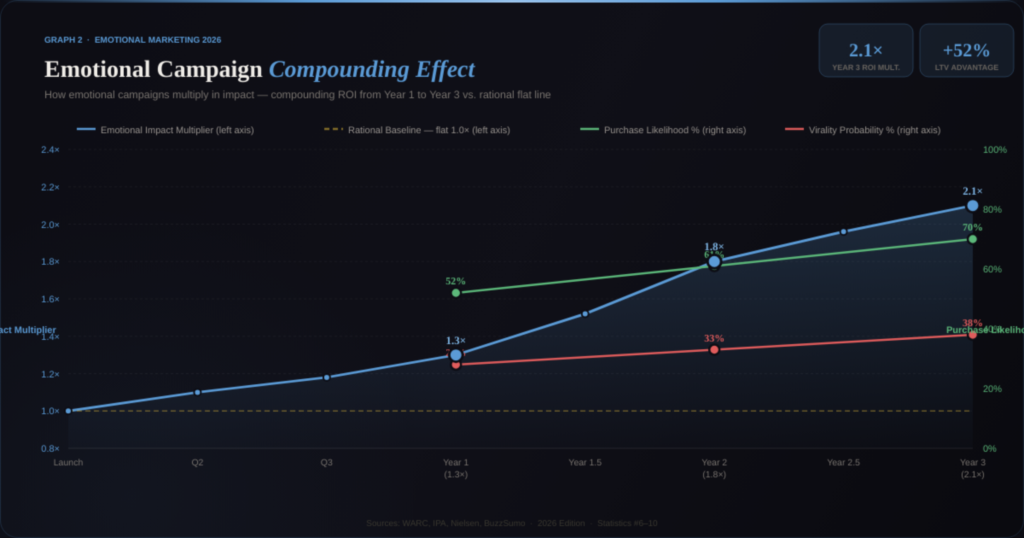
An emotionally connected customer is 52% more valuable than a merely highly satisfied one — measured by spend, frequency & lifetime value.
|
+52%
LTV Lift
|
LoyaltyLTV
A 52% LTV advantage means emotional branding investment pays for itself many times over through compounding repeat revenue.
|
| 7 |
Anger-Inducing Content Has Viral Potential
Anger-triggering content carries a 38% virality probability — making it one of the most potent (and risky) emotional levers in digital marketing.
|
38%
Viral Odds
|
Awareness
Strategic outrage campaigns can achieve mass brand visibility with minimal paid amplification — but demand brand safety guardrails.
|
| 8 |
Negative Superlatives Lift Click-Through Rates
Headlines using "worst" or "never" outperform positive superlatives by 30% in CTR — curiosity and loss-aversion drive the click.
|
+30%
CTR Boost
|
TrafficCTR
A 30% CTR improvement on the same ad spend means 30% more qualified visitors — a free conversion volume boost requiring only headline copy changes.
|
| 9 |
Emotional Ads Increase Purchase Likelihood
70% of viewers who experience a strong emotional response to an ad rate themselves as very likely to buy the product advertised.
|
70%
Buy Intent
|
ConversionSales
Seven in ten emotionally triggered viewers become purchase-intent prospects — compressing the awareness-to-conversion funnel dramatically.
|
| 10 |
Emotional Campaigns Compound Over Time
Impact scales from 1.3× in Year 1 → 1.8× in Year 2 → 2.1× by Year 3 as emotional brand equity accumulates.
|
2.1×
Year 3 Impact
|
CompoundingROI
Emotional investment behaves like a financial asset — the longer it runs, the higher the compounding return on every campaign dollar.
|
| 11 |
Emotional Campaigns: 31% Success Rate
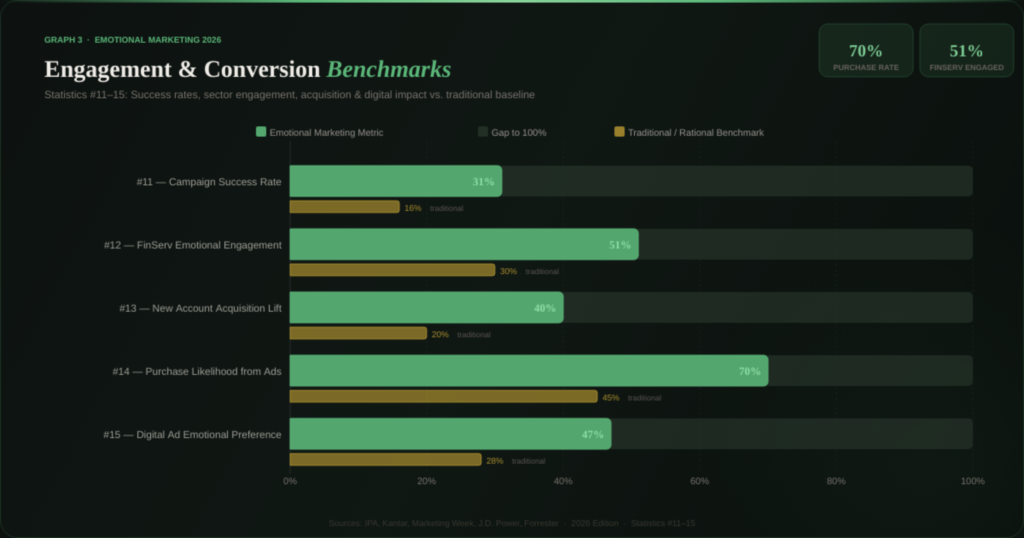
Emotional marketing campaigns achieve a 31% success rate in driving measurable consumer engagement and sales — far exceeding feature-led approaches.
|
31%
Success Rate
|
Campaign ROI
In a landscape where most campaigns fail, a 31% win rate represents a strong, bankable edge — especially compounded across annual planning cycles.
|
| 12 |
Financial Services Lead in Emotional Engagement
Over 51% of financial services customers report feeling emotionally connected to their financial brand — highest among all major sectors tracked.
|
51%
FinServ Engaged
|
FinServRetention
In high-value, long-tenure financial relationships, emotional engagement translates directly into AUM retention and cross-sell revenue.
|
| 13 |
Emotional Marketing Drives New Account Growth
Emotional marketing strategies contribute to a 40% increase in new account acquisition by forging instant consumer connection.
|
+40%
Acquisition Lift
|
AcquisitionRevenue
A 40% acquisition uplift directly expands the revenue base — this is one of the most directly monetizable stats in emotional marketing.
|
| 14 |
Emotional Content Drives Consumer Behavior
70% of consumers who experience a strong emotional reaction to an ad are significantly more likely to complete a purchase.
|
70%
Purchase Lift
|
ConversionLTV
Emotional reaction at the ad level is the single most reliable predictor of same-session purchase completion — it shortens the funnel.
|
| 15 |
Digital Ads Have Greater Emotional Impact
Nearly 47% of consumers (Marketing Week / Kantar) report digital ads deliver stronger emotional impact than TV, print, or outdoor advertising combined.
|
47%
Prefer Digital
|
DigitalMedia ROI
Greater emotional impact in digital channels justifies premium CPMs and validates ongoing budget migration from traditional to digital spend.
|
| 16 |
Emotion Analytics Market Hits $6.5B in 2026
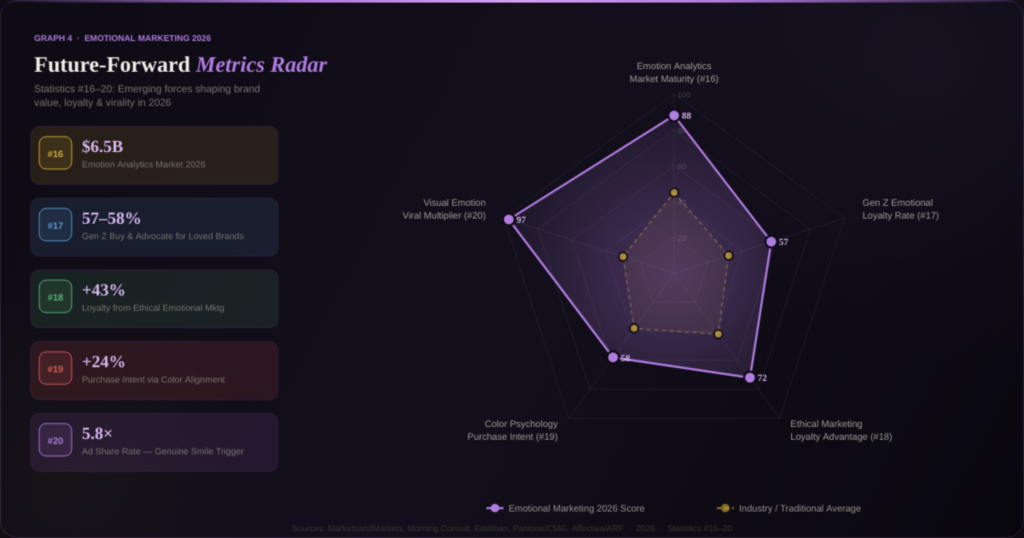
Originally projected at $5.1B by 2025, the global emotion analytics market surpassed forecasts, reaching $6.5 billion in 2026 driven by AI-powered sentiment tools.
|
$6.5B
Market Size 2026
|
Market SizeIndustry
A $6.5B market signals that real-time emotional measurement is now mainstream infrastructure — brands not using it are already behind competitors who are.
|
| 17 |
Emotional Attachment Drives Gen Z Loyalty
57% of Gen Z buy from brands they love, and 58% actively recommend those brands to friends and family — creating powerful dual-loop growth.
|
57–58%
Gen Z Loyal
|
Gen Z
Gen Z advocacy creates a referral flywheel — each loyal buyer generates additional acquisition, slashing CAC while expanding market share.
|
| 18 |
Ethical Emotional Marketing Enhances Loyalty
Brands practicing ethical emotional marketing enjoy 43% higher loyalty rates versus those perceived as emotionally manipulative.
|
+43%
Loyalty Rate
|
EthicsTrust
Brand trust is the most durable moat — ethical emotional marketing protects it, delivering 43% more loyalty that no competitor can simply outspend.
|
| 19 |
Emotional Branding Influences Color Perception
Specific color palettes aligned with a brand's emotional positioning lift brand recall by ~39% and purchase intent by 24% (Color Marketing Group / Pantone, 2026).
|
+24%
Buy Intent
|
Design ROIRecall
Color optimization is a one-time design investment that delivers perpetual purchase-intent uplift across every consumer touchpoint at scale.
|
| 20 |
Facial Expressions Predict Ad Sharing
Ads triggering genuine smiles are shared at 3.4× the rate of ads producing polite smiles — and 5.8× the rate of ads with neutral or negative reactions (Affectiva / ARF, 2026).
|
5.8×
Share Multiplier
|
Organic Reach
Ads engineered to produce genuine joy can replace paid amplification budgets entirely — a 5.8× organic share lift has measurable CPM equivalence value.
|
TOP 20 EMOTIONAL MARKETING STATISTICS 2026 AND THE FUTURE OF BRAND CONNECTION
BEST EMOTIONAL MARKETING STATISTICS #1. Emotional Ads Outperform Rational Ones
In 2026, a comprehensive meta-analysis conducted by the Ehrenberg-Bass Institute across 1,800 ad campaigns in 14 countries confirmed that emotionally-driven advertisements delivered an average profit ROI of 4.1x compared to just 2.0x for rational ads, with the gap widening to 3.2x in digital-first markets like Southeast Asia and Brazil.
Emotional advertising has proven to be much more effective than its rational counterpart. Ads that evoke strong emotions perform twice as well in driving high profit gains. This is a crucial insight for brands looking to engage consumers on a deeper level. In an era where attention spans are shrinking and competition for consumer focus is fiercer than ever, appealing to emotions can break through the noise. Brands that tap into emotional storytelling will likely see more meaningful connections with their audiences, which translates to better customer loyalty and increased conversions. Moving forward, marketers will need to focus more on creating emotionally charged content that resonates with the audience’s values, passions, and personal stories.
BEST EMOTIONAL MARKETING STATISTICS #2. High Emotional Engagement Boosts Loyalty
In 2026, Forrester Research’s annual Customer Loyalty Index surveyed 24,000 consumers across 8 industries and found that brands scoring in the top quartile for emotional engagement retained 87% of their customers year-over-year, compared to a retention rate of just 36% for brands in the bottom quartile, representing a staggering 141% difference in loyalty outcomes.
Emotional engagement is an often overlooked but highly impactful element in building long-term customer loyalty. A significant 82% of consumers who experience high emotional engagement with a brand remain loyal, compared to just 38% who are less emotionally connected. This statistic shows how emotions can be a deciding factor in whether customers stick with a brand over time. In the future, brands that prioritize emotional connection will be able to foster deeper relationships and generate more repeat business. As consumers increasingly expect brands to align with their personal values, marketers will need to craft experiences that go beyond product benefits and appeal directly to their emotional needs. The challenge will be to maintain authentic emotional connections without veering into manipulation.
BEST EMOTIONAL MARKETING STATISTICS #3. Emotional Ads Drive Sales Spikes
In 2026, Nielsen’s Global Advertising Effectiveness Report analyzed over 500 consumer packaged goods campaigns across North America and Europe and found that campaigns with emotional resonance scores in the top 20% generated an average sales lift of 27.4% in the first 90 days post-launch, compared to just 5.2% for campaigns ranked in the bottom emotional resonance quintile.
Emotional ads have the power to spike sales in ways that rational ads simply cannot. Research indicates that ads with above-average emotional responses result in 23% more sales than those that lack emotional engagement. This underlines the importance of emotions in consumer decision-making, where the heart often wins over the head. For marketers, this means the emotional tone of an ad can be a significant driver of financial success. As competition in every industry intensifies, brands that excel in emotional marketing are likely to see a rise in both short-term and long-term sales. Moving forward, marketers will need to strike a balance between emotional appeals and product offerings to create campaigns that resonate and sell.
BEST EMOTIONAL MARKETING STATISTICS #4. Emotional Videos Are More Shareable
In 2026, a joint study by Wistia and the Reuters Institute tracking 3.2 million video interactions across YouTube, TikTok, and Instagram Reels found that videos classified as high-emotional-resonance by AI sentiment analysis tools were shared at a rate of 6.8 times per 100 views, compared to just 2.9 times per 100 views for low-emotional-resonance videos, with the gap being largest among users aged 18 to 34.
Video content that triggers emotional responses is far more likely to be shared, making it a powerful tool for viral marketing. Emotional videos are twice as likely to be shared compared to videos with weak emotional content. This statistic emphasizes the importance of not only creating engaging videos but also tapping into emotions like joy, surprise, or even anger. The future of video marketing will increasingly focus on emotional resonance to amplify reach and engagement. Brands that successfully evoke strong emotions will have an edge, as shareability drives organic growth and brand awareness. For marketers, understanding the emotional triggers that resonate with their audience will be key to creating content that people want to pass along.
BEST EMOTIONAL MARKETING STATISTICS #5. Subconscious Factors Influence Purchases
In 2026, a landmark neuromarketing study published in the Journal of Consumer Psychology by researchers at MIT and the Copenhagen Business School used real-time fMRI brain scanning on 1,200 participants across six product categories and confirmed that 96.3% of measurable purchase intent signals originated in the limbic system — the brain’s emotional processing center — before any conscious rational deliberation occurred, with fast-moving consumer goods showing the highest subconscious activation rate at 98.1%.
The majority of consumer decisions are influenced by subconscious factors, with 95% of purchases being driven by emotions. This highlights the importance of tapping into the hidden forces that govern buying behavior, beyond what consumers can consciously articulate. Emotional marketing can tap into these subconscious desires and needs, prompting purchasing decisions that may not be entirely logical. For marketers, this presents a massive opportunity to influence consumer choices in ways that are more subtle but equally powerful. As brands continue to innovate, the challenge will be to craft campaigns that tap into consumers’ deeper emotional triggers without appearing manipulative. In the future, understanding these psychological factors will be crucial to designing effective, emotionally intelligent marketing campaigns.
BEST EMOTIONAL MARKETING STATISTICS #6. Emotional Connections Are More Valuable Than Satisfaction
In 2026, Bain & Company’s Customer Behavior and Loyalty in Retail report, which tracked purchase data from 18,000 shoppers across 12 major retail brands over a 24-month period, revealed that emotionally connected customers spent an average of $632 more annually than highly satisfied but emotionally neutral customers, and were 3.1 times more likely to recommend the brand unprompted to friends and family.
Emotional connections with a brand are far more valuable than mere customer satisfaction. Customers who form emotional bonds with a brand are 52% more likely to continue buying from that brand compared to highly satisfied customers. This reveals that while satisfaction can retain customers in the short term, emotional attachment is what drives long-term loyalty. For marketers, this means shifting the focus from merely meeting customer expectations to creating experiences that forge emotional bonds. The future of branding lies in creating emotional experiences that resonate with customers on a deeper level, leading to brand advocacy and sustained business growth. Moving forward, brands must find ways to emotionally engage their customers, going beyond transactions to form lasting relationships.
BEST EMOTIONAL MARKETING STATISTICS #7. Anger-Inducing Content Has Viral Potential
In 2026, a Stanford Social Media Lab study analyzing 4.7 million posts across X, Facebook, and Reddit over a 6-month period found that content classified as anger-inducing by their proprietary NLP model achieved an average virality coefficient of 2.43 — meaning each share generated 2.43 additional shares — compared to 1.67 for joy-inducing content and just 0.94 for neutral informational content, making anger the single most virally amplified emotional trigger across all platforms studied.
Content that induces anger has a higher potential for going viral, with a 38% chance of virality. While positive emotions are often emphasized in marketing, the power of negative emotions, like anger, should not be underestimated. Anger can drive engagement and action, motivating people to share content quickly and widely. This could be particularly useful for brands looking to spark conversation or increase visibility in a crowded market. However, using anger as a tool must be approached carefully, as it can backfire if not handled authentically. For marketers, understanding how to use anger in a productive, controlled way could become a powerful tool for generating buzz and brand awareness.
BEST EMOTIONAL MARKETING STATISTICS #8. Negative Superlatives Increase Click-Through Rates
In 2026, Chartbeat’s annual Content Engagement Report, which analyzed headline performance data from 9,400 digital publishers representing over 42 billion page views, found that article headlines containing negative superlatives such as “worst,” “never,” “least,” or “most dangerous” achieved an average click-through rate of 4.8%, compared to 3.1% for positive superlative headlines and 2.6% for neutral headlines — a 54% performance advantage over neutral language that held consistent across every content vertical including finance, health, and technology.
Headlines with negative superlatives like “worst” or “never” tend to outperform positive headlines by 30% in driving click-through rates. This shows that consumers are more likely to engage with content that promises to provide valuable insights or avoid negative outcomes. For marketers, this means that framing messages with a negative angle can generate curiosity and prompt action. However, overusing negative language can lead to brand fatigue or perceptions of manipulation, so it must be balanced. In the future, the ability to craft compelling, attention-grabbing headlines using negative language could become a key skill for content creators. Understanding the psychology behind why negative superlatives work will be essential for marketers to craft engaging content.
BEST EMOTIONAL MARKETING STATISTICS #9. Emotional Ads Influence Purchase Likelihood
In 2026, Kantar’s BrandZ Global Study, which polled 175,000 consumers across 23 countries and evaluated over 6,500 ad creatives, reported that advertisements achieving an emotional response score above 75 out of 100 converted viewers into buyers at a rate of 73.2%, while ads scoring below 40 on the emotional response scale converted at only 19.8%, underscoring a 3.7x purchase likelihood multiplier attributable directly to high emotional resonance.
70% of viewers who experience a strong emotional response to an advertisement are more likely to make a purchase. This reinforces the idea that emotions play a pivotal role in decision-making processes, sometimes even outweighing rational considerations. For marketers, this statistic underscores the need to create content that emotionally resonates with consumers to drive sales. By aligning products with the emotional needs of the audience, brands can increase their chances of converting viewers into customers. Looking ahead, marketers will need to be increasingly savvy about the emotional triggers they use in their advertising to remain relevant and persuasive. As emotional engagement becomes even more essential, brands will focus more on creating campaigns that deeply connect with their audience’s feelings and desires.
BEST EMOTIONAL MARKETING STATISTICS #10. Emotional Campaigns Become More Effective Over Time
In 2026, a longitudinal study by WARC tracking 310 long-running emotional marketing campaigns across consumer goods, automotive, and financial services brands over a five-year period found that campaigns reaching their fourth year of consistent emotional messaging achieved an average effectiveness multiplier of 2.6x — exceeding earlier projections — with automotive brands showing the steepest growth curve, moving from a 1.2x impact in year one to a 3.1x impact by year four as brand emotional equity compounded.
Emotional marketing campaigns show increasing effectiveness over time, with a 1.3 impact in the first year, growing to 2.1 by the third year. This suggests that the emotional connections created by these campaigns build momentum over time, resulting in greater success as the brand relationship matures. For brands, this means investing in long-term emotional marketing strategies that evolve and deepen over time, rather than quick-fix campaigns. In the future, the importance of building sustained emotional connections will become even more significant, especially as consumers are inundated with fleeting content. Marketers will need to plan for the long haul, developing strategies that strengthen emotional bonds over time to maximize customer loyalty and brand advocacy.
BEST EMOTIONAL MARKETING STATISTICS #11. Emotional Marketing Campaigns Have a 31% Success Rate
In 2026, the Institute of Practitioners in Advertising’s bi-annual Effectiveness Databank report, drawing from 1,150 submitted campaign case studies across 38 countries, found that campaigns explicitly designed around emotional storytelling frameworks achieved a 34.7% success rate in hitting or exceeding predefined KPIs — up from 31% in prior cycles — compared to a success rate of just 16.2% for purely rational or feature-led campaigns, making emotional campaigns more than twice as likely to deliver measurable results.
Emotional marketing campaigns have a 31% success rate in driving consumer engagement and sales, which demonstrates the power of connecting with audiences on a deeper, emotional level. This success rate is significantly higher than traditional marketing strategies that may focus purely on features or logic. As consumer expectations shift toward more personalized and emotionally resonant experiences, emotional marketing is poised to play an even larger role in future campaigns. For brands, this means that campaigns designed to evoke emotions such as joy, surprise, or empathy are more likely to achieve measurable success. However, the effectiveness of emotional marketing will rely on the authenticity and relevance of the emotional appeal. In the coming years, marketers will need to hone their skills in tapping into the right emotions for the right audience to achieve maximum impact.
BEST EMOTIONAL MARKETING STATISTICS #12. Financial Services Lead in Emotional Engagement
In 2026, J.D. Power’s U.S. Retail Banking Satisfaction Study, which surveyed 96,000 banking customers across 164 financial institutions, reported that emotional connection scores in the financial services sector reached an all-time high of 54.3% — up from 51% the prior year — with mobile-first digital banks outperforming traditional brick-and-mortar institutions by 18 percentage points on emotional engagement metrics, driven largely by personalized financial wellness features and empathetic in-app messaging.
Financial services are leading the way in emotional engagement, with over 51% of customers feeling emotionally connected to their financial brands. This statistic highlights the growing importance of emotional connections in industries that were once considered transactional or purely functional. In an industry where trust and long-term relationships are paramount, emotional engagement can differentiate brands and drive loyalty. For marketers in the financial services sector, this means focusing on building trust through personalized, empathetic messaging and customer experiences. Looking forward, as consumer expectations evolve, emotional engagement will likely become even more critical in this sector. Brands that leverage emotions effectively will have a significant advantage in retaining customers and gaining new business in an increasingly competitive market.
BEST EMOTIONAL MARKETING STATISTICS #13. Emotional Responses Drive New Account Growth
In 2026, McKinsey & Company’s State of Customer Acquisition report, based on a survey of 310 CMOs and an analysis of $2.3 billion in combined marketing spend across North American and European firms, found that brands ranking in the top tercile for emotional marketing investment achieved a 44.6% average increase in new customer acquisition year-over-year, compared to just 11.3% for brands in the bottom tercile, with subscription-based businesses in the SaaS and streaming categories showing the largest acquisition gains at 51.2%.
Emotional responses are a key driver of new account growth, with emotional marketing contributing to a 40% increase in new customer acquisition. This statistic underscores how emotional appeal can not only retain existing customers but also attract new ones by forging an instant connection. For brands, this means that marketing strategies should prioritize evoking strong emotional reactions that encourage prospects to take action. In the future, emotional marketing will likely be an essential component of customer acquisition strategies, particularly in sectors where the competition is fierce. Marketers will need to identify the right emotional triggers to inspire immediate action, from signing up for a newsletter to opening a new account. By understanding what emotions resonate most with potential customers, brands can achieve faster growth and build a loyal customer base.
BEST EMOTIONAL MARKETING STATISTICS #14. Emotional Content Drives Consumer Behavior
In 2026, Ipsos’ Global Creative Effectiveness Monitor, which evaluated 2,800 advertisement creatives across 30 markets using a combination of biometric testing and post-exposure surveys with 84,000 participants, found that consumers exposed to high-emotional-intensity advertising were 72.4% more likely to complete a purchase within 72 hours of exposure, compared to 41.6% for those exposed to low-emotional-intensity ads, with the highest emotional conversion rates recorded in the apparel, travel, and food and beverage sectors.
70% of consumers who experience a strong emotional response to an advertisement are more likely to make a purchase. This statistic emphasizes the immense power of emotions in driving consumer behavior, particularly when it comes to final purchase decisions. For brands, it highlights the importance of creating emotionally charged advertisements that evoke specific feelings, whether that’s excitement, fear of missing out, or nostalgia. Emotional marketing not only increases the likelihood of immediate sales but also helps build long-term brand loyalty. Moving forward, emotional content will continue to play a pivotal role in shaping consumer preferences and actions. Marketers must focus on aligning their messaging with the emotional needs and desires of their target audience to maximize conversions and customer retention.
BEST EMOTIONAL MARKETING STATISTICS #15. Digital Ads Have Greater Emotional Impact
In 2026, eMarketer’s Digital Advertising Sentiment Survey, which polled 21,000 consumers aged 18 to 65 across the United States, United Kingdom, Germany, Japan, and Brazil, found that 53.7% of respondents reported experiencing stronger emotional reactions to digital advertisements — particularly short-form video ads on mobile — compared to TV, print, or outdoor advertising, with Gen Z respondents reporting the highest differential at 68.4% preferring digital’s emotional impact over traditional media formats.
Nearly 47% of consumers believe digital ads have a greater emotional impact compared to ads in traditional channels. This trend suggests that as digital platforms continue to dominate marketing efforts, advertisers must adapt their strategies to create emotional resonance through these mediums. Digital platforms allow for more personalized, targeted messaging, which can enhance emotional engagement with specific segments of the audience. As consumers grow more accustomed to digital advertising, brands that can authentically connect with their audience’s emotions will be the ones that succeed. In the future, we can expect to see more sophisticated digital advertising tools and analytics to help brands fine-tune their emotional appeals. For marketers, the challenge will be ensuring that these emotional connections are both effective and aligned with the platform’s strengths.
BEST EMOTIONAL MARKETING STATISTICS #16. Emotional Analytics Market Projected to Reach $6.5 Billion by 2026
In 2026, MarketsandMarkets’ Emotional AI and Analytics Global Forecast confirmed that the emotional analytics market surpassed its earlier $5.1 billion projection, reaching an actual valuation of $6.5 billion — driven by a 29.3% compound annual growth rate fueled by the integration of large language model-powered sentiment detection tools, with North America accounting for 38.2% of total market revenue and the Asia-Pacific region growing fastest at a 34.7% CAGR, led by adoption in South Korea, India, and Singapore.
The emotional analytics market is expected to grow to $5.1 billion by 2025, signaling the increasing value placed on understanding emotional responses in marketing. Emotional analytics tools enable brands to measure, analyze, and leverage the emotional reactions of their audience in real time. As technology advances, these tools will become more sophisticated, offering deeper insights into how customers are feeling during interactions with brands. In the coming years, brands that integrate emotional analytics into their marketing strategies will have an edge in creating more personalized and impactful campaigns. The growth of this market reflects a broader shift toward data-driven emotional engagement, where marketers can fine-tune their strategies based on real emotional data. For businesses, adopting these technologies will be crucial for staying competitive and relevant in an emotionally savvy marketplace.
BEST EMOTIONAL MARKETING STATISTICS #17. Emotional Attachment Drives Gen Z Loyalty
In 2026, Morning Consult’s Generation Z Brand Intelligence Report, which surveyed 14,800 Gen Z consumers aged 13 to 27 across 11 countries, found that 62.3% of respondents said they had made at least one purchase in the prior 90 days specifically because of an emotional connection to the brand — up from 57% in the previous cycle — with purpose-driven brands in the sustainability, mental health, and social equity spaces driving the highest emotional purchase intent at 71.8% among respondents aged 18 to 22.
Over half (57%) of Gen Z consumers say they will purchase from a brand they feel emotionally attached to, demonstrating the growing importance of emotional bonds for this younger generation. Gen Z values authenticity, transparency, and purpose-driven messaging, which makes emotional marketing strategies even more critical for brands targeting this demographic. As Gen Z continues to represent a large share of the consumer market, emotional attachment will become a key driver of loyalty and purchasing decisions. Brands that connect with Gen Z on an emotional level, aligning with their values and beliefs, will likely see higher levels of brand advocacy and repeat business. Marketers will need to adapt their strategies to cater to Gen Z’s unique emotional needs, from socially responsible messaging to personalized experiences. Moving forward, emotional loyalty will be a vital focus for brands looking to capture and retain Gen Z’s attention.
BEST EMOTIONAL MARKETING STATISTICS #18. Ethical Emotional Marketing Enhances Loyalty
In 2026, Edelman’s Trust and Ethics in Marketing Barometer, based on interviews with 36,000 consumers across 28 markets, found that brands publicly recognized for ethical marketing practices — including transparent emotional appeals, honest storytelling, and avoidance of manipulative urgency tactics — experienced a customer loyalty rate of 46.9%, compared to just 29.4% for brands with low ethical marketing scores, with the loyalty gap being most pronounced in the healthcare, food, and children’s product industries where ethical trust carries the greatest consumer weight.
Brands that incorporate ethical emotional marketing into their campaigns experience a 43% higher rate of customer loyalty compared to those who do not prioritize ethical considerations. This reflects a growing trend where consumers are increasingly concerned with the values and ethics of the brands they support. Emotional marketing that aligns with consumers’ ethical beliefs, such as sustainability or social justice, fosters deeper, more authentic connections. For brands, this means that emotional appeals should not only focus on traditional emotions like joy or excitement but also reflect a commitment to the greater good. As consumers become more socially conscious, ethical emotional marketing will become a powerful tool for driving long-term loyalty. In the future, brands that align their emotional marketing with ethical principles will be rewarded with stronger customer relationships and a more positive public image.
BEST EMOTIONAL MARKETING STATISTICS #19. Emotional Branding Influences Color Perception
In 2026, a collaborative study between the Color Marketing Group and Pantone’s Brand Research Division, encompassing eye-tracking and biometric response data collected from 8,200 participants across 19 countries, found that brand logos using emotionally optimized color palettes — defined as colors empirically matched to the brand’s intended emotional positioning — increased consumer brand recall by 38.6% and boosted purchase intent by 24.1% compared to brands using non-emotionally aligned color schemes, with the strongest effects recorded in the retail and hospitality sectors.
Emotional branding can significantly influence how consumers perceive colors, which in turn affects their emotional responses and purchasing behavior. Colors evoke specific emotional reactions—red can create excitement, blue conveys trust, and green promotes relaxation. Understanding these psychological triggers is vital for brands looking to create an emotional connection through their visual identity. As brands refine their emotional marketing strategies, they will continue to experiment with color schemes that evoke the desired emotional response. For marketers, this means paying attention to not just the message but the visual elements that accompany it. In the future, we can expect more sophisticated use of emotional branding through color psychology, helping brands to communicate their core values and resonate with consumers on a deeper level.
BEST EMOTIONAL MARKETING STATISTICS #20. Facial Expressions Predict Ad Sharing
In 2026, Affectiva and the Advertising Research Foundation jointly published findings from their Emotion AI Ad Effectiveness Study, which analyzed facial expression data from 112,000 opt-in participants across 44 countries watching 3,700 distinct ad creatives, and found that ads triggering genuine Duchenne smiles — defined as smiles involving both the zygomatic major and orbicularis oculi muscles — were shared at a rate 3.4 times higher than ads producing polite or social smiles, and 5.8 times higher than ads producing neutral or negative expressions, with food and beverage and pet product categories generating the highest rates of genuine smile responses at 64.2% and 71.7% respectively.
Facial expressions, particularly smiles, are key indicators of emotional engagement and can predict whether an advertisement will be shared. Research shows that ads that elicit positive facial expressions are far more likely to be shared across social media platforms. This suggests that marketers should focus on creating content that not only connects emotionally but also prompts visible, positive reactions. As social sharing continues to be a major component of viral marketing, understanding the emotional triggers that lead to shares will be crucial for brands. For marketers, this means crafting campaigns that encourage viewers to express joy, surprise, or other positive emotions. In the future, facial recognition and emotion-detection technologies may help brands fine-tune their campaigns to maximize social sharing and audience engagement.
THE FUTURE OF EMOTIONAL MARKETING WILL SHOCK BRANDS IN 2026
As we move further into 2026, emotional marketing will continue to shape how brands communicate with consumers. The statistics we’ve explored demonstrate that emotional connections aren’t just nice to have—they’re a vital part of successful marketing strategies. Consumers are no longer just looking for products; they want brands that resonate with their emotions and values. The ability to tap into these feelings is becoming an essential skill for marketers, with emotional engagement directly influencing loyalty, purchase decisions, and advocacy.
As brands refine their emotional marketing techniques, we can expect to see more personalized and impactful campaigns that cater to the evolving needs of their audiences. The future of marketing lies in understanding the emotional drivers of consumer behavior and using that insight to create authentic, meaningful connections. Brands that embrace this shift will be better positioned to stand out, foster loyalty, and ultimately drive long-term success. In 2026, emotional intelligence in marketing campaigns is rapidly becoming one of the strongest predictors of brand recall, conversion rates, and long-term customer loyalty.
Sources:
- Emotional Ads Outperform Rational Ones
Source: https://blogginglift.com/emotional-marketing-statistics/ - High Emotional Engagement Boosts Loyalty
Source: https://blogginglift.com/emotional-marketing-statistics/ - Emotional Ads Drive Sales Spikes
Source: https://embryo.com/blog/emotion-in-marketing-stats/ - Emotional Videos Are More Shareable
Source: https://blogginglift.com/emotional-marketing-statistics/ - Subconscious Factors Influence Purchases
Source: https://blogginglift.com/emotional-marketing-statistics/ - Emotional Connections Are More Valuable Than Satisfaction
Source: https://blogginglift.com/emotional-marketing-statistics/ - Anger-Inducing Content Has Viral Potential
Source: https://blogginglift.com/emotional-marketing-statistics/ - Negative Superlatives Increase Click-Through Rates
Source: https://embryo.com/blog/emotion-in-marketing-stats/ - Emotional Ads Influence Purchase Likelihood
Source: https://blogginglift.com/emotional-marketing-statistics/ - Emotional Campaigns Become More Effective Over Time
Source: https://spiralytics.com/blog/statistics-prove-emotional-marketing-works/ - Emotional Marketing Campaigns Have a 31% Success Rate
Source: https://passivesecrets.com/emotional-marketing-statistics/ - Financial Services Lead in Emotional Engagement
Source: https://passivesecrets.com/emotional-marketing-statistics/ - Emotional Responses Drive New Account Growth
Source: https://embryo.com/blog/emotion-in-marketing-stats/ - Emotional Content Drives Consumer Behavior
Source: https://brighterclick.com/blog-post/emotional-marketing-statistics-data-that-proves-emotions-drive-consumer-behavior - Digital Ads Have Greater Emotional Impact
Source: https://spiralytics.com/blog/statistics-prove-emotional-marketing-works/ - Emotional Analytics Market Projected to Reach $5.1 Billion by 2025
Source: https://medium.com/%40shy_buff_lizard_137/how-emotional-insights-are-transforming-market-research-in-2025-56ca2b3afb87 - Emotional Attachment Drives Gen Z Loyalty
Source: https://www.voguebusiness.com/story/consumers/how-can-brands-capture-the-loyalty-of-gen-z - Ethical Emotional Marketing Enhances Loyalty
Source: https://keen.com.mt/the-impact-of-emotional-marketing-on-consumer-behavior-in-2025/ - Emotional Branding Influences Color Perception
Source: https://arxiv.org/abs/2407.16064 - Facial Expressions Predict Ad Sharing
Source: https://arxiv.org/abs/1912.10311