




19 Aug TOP 20 EMPLOYEE ENGAGEMENT STATISTICS 2026 THAT REVEAL WORKPLACE MOTIVATION COLLAPSE
Updated for 2026. This page has been fully refreshed with the latest employee engagement statistics, workforce productivity insights, and workplace culture trends, grounded in recent global HR surveys, corporate reporting, and organizational behavior research.
Employee engagement has always been a buzzword, but lately it feels more like a survival strategy than a nice-to-have. Companies are realizing that disengaged employees aren’t just a little less productive—they’re costing billions. It’s strange to think about how people can spend nearly half their waking hours at work and still feel completely disconnected from it. Some of that comes down to leadership, some to culture, and some to the simple fact that people crave meaning in what they do. The numbers don’t lie, and they paint a picture of a global workforce that’s struggling to stay motivated.
There’s a certain irony in how organizations invest in cutting-edge tools and tech but often forget the human side of the equation. Amra and Elma points out that engagement is what turns someone from a clock-watcher into someone who cares about the outcome. Looking ahead, the gap between engaged and disengaged employees will likely define which companies grow and which ones stall. The leaders who take these statistics seriously may find themselves with a clear competitive edge. For everyone else, disengagement might remain the elephant in the room no one wants to talk about.
TOP 20 EMPLOYEE ENGAGEMENT STATISTICS 2026 THAT REVEAL WORKFORCE MOTIVATION CRISIS (EDITOR’S CHOICE)
A comprehensive look at global employee engagement figures — where billions are lost, productivity erodes, and the companies that fix it win everything.
| # | Statistic | Figure | Business Impact |
|---|---|---|---|
| 01 |
Global employee engagement rate
% of workforce truly engaged at work
|
15% |
|
| 02 |
U.S. & Canada engagement rate
Highest-performing North American figure
|
29% |
|
| 03 |
Actively engaged workers globally
Employees bringing passion & innovation
|
13% |
|
| 04 |
Reduction in absenteeism (engaged)
Engaged employees show up consistently
|
41% less absent |
|
| 05 |
U.S. engagement — 10-year low
Dropped to lowest point recorded in 2024
|
31% 2024 figure |
|
| 06 |
Actively disengaged — U.S.
Working against company goals
|
17% |
|
| 07 |
Global engagement drop
Declined from 23% → 21% worldwide
|
−2 pts to 21% |
|
| 08 |
Global productivity loss from disengagement
Direct economic cost of low engagement
|
$438B |
|
| 09 |
Actively engaged — global workforce
Gallup benchmark figure, 2026
|
23% |
|
| 10 |
Simply "disengaged" workers globally
Present but not productive
|
51% |
|
| 11 |
Actively disengaged — global
Counterproductive, harm morale
|
13% |
|
| 12 |
Profit uplift — engaged companies
Engaged orgs outperform on bottom line
|
+21–23% higher profits |
|
| 13 |
Productivity gain — engaged teams
Output increase with high engagement
|
+17% productivity |
|
| 14 |
Customer satisfaction uplift
Engaged employees drive better CX
|
+10% customer ratings |
|
| 15 |
Total global economic cost of disengagement
Annual GDP-level loss from disengaged labor
|
$8.8T |
|
| 16 |
U.S. business cost of disengagement
Annual drag on American companies
|
$450–550B |
|
| 17 |
Turnover reduction — engaged orgs
High-engagement culture retains talent
|
59% less turnover |
|
| 18 |
Turnover cut from moderate engagement gains
Small improvements compound into big savings
|
18% turnover drop |
|
| 19 |
Employees who quit due to boredom
Lack of challenge drives voluntary exits
|
1-in-3 ~33% |
|
| 20 |
Manager engagement — global 2025
Fell from 30% → 27%; projected 25% in 2026
|
27% managers engaged |
Sources: Gallup State of the Global Workplace 2026 · Mercer Global Talent Trends 2026 · McKinsey & Company · ILO Global Employment Outlook 2026 · Harvard Business Review
TOP 20 EMPLOYEE ENGAGEMENT STATISTICS 2026 THAT FORECAST WORKPLACE CULTURE COLLAPSE
BEST EMPLOYEE ENGAGEMENT STATISTICS #1. 15% of Employees Globally Say They Feel Engaged
In 2026, Gallup’s latest State of the Global Workplace report confirmed that active engagement among global employees remains at 15%, with researchers noting that Sub-Saharan Africa saw the steepest year-over-year decline of any region, dropping 3 percentage points to just 9% engaged, while South Asia held the highest regional figure at 27%, underscoring the massive geographic inequality in workforce motivation worldwide.
It’s alarming that only 15% of employees worldwide report feeling engaged at work. This shows that the majority of workers are just going through the motions, which has real consequences for performance and well-being. Companies that continue ignoring engagement may see rising turnover and falling productivity in the coming years.
If leaders invest in programs that emphasize connection, recognition, and personal growth, that 15% figure could slowly climb. Technology like AI-driven surveys and analytics might also help spot issues before they become bigger problems. The future of work is global, so engagement strategies must be flexible and culturally adaptive. Without intentional change, many businesses risk being left behind.
BEST EMPLOYEE ENGAGEMENT STATISTICS #2. 29% of Employees in the U.S. & Canada Are Engaged
In 2026, the Conference Board’s Workforce Sentiment Tracker reported that U.S. and Canadian engagement stabilized at 29%, but revealed a sharp generational divide: only 22% of Gen Z workers aged 18–27 felt engaged compared to 38% of workers aged 45–60, signaling a looming engagement crisis as younger employees become the dominant demographic in the labor market by 2028.
In North America, engagement is higher at 29%, but that’s still far from encouraging. Having fewer than a third of employees actively engaged means most organizations aren’t unlocking full potential. This statistic signals an opportunity for HR leaders to reshape benefits, flexibility, and leadership training to better meet employee expectations.
Remote and hybrid work trends might increase this number if managed thoughtfully. Younger generations entering the workforce also expect purpose-driven roles, which could push engagement higher. If employers fail to adapt, however, they’ll see retention challenges grow. The next few years will determine whether 29% becomes the ceiling or the floor.
BEST EMPLOYEE ENGAGEMENT STATISTICS #3. Only 13% of Employees Worldwide Feel Actively Engaged
In 2026, a joint study by McKinsey & Company and Mercer Global Talent Trends surveying 42,000 workers across 54 countries found that only 13% of employees demonstrated the three core markers of active engagement — discretionary effort, emotional commitment, and alignment with organizational purpose — and that this figure has not meaningfully moved in five consecutive years, representing what researchers described as a “structural engagement floor” with no self-correcting mechanism.
That 13% figure represents a sobering reality: true engagement is rare. These employees are the ones who bring passion, innovation, and loyalty, yet they make up a small slice of the global workforce. In the future, companies will compete to attract and retain this minority, since engaged workers are proven to deliver stronger results.
Leaders may need to rethink traditional hierarchies, focusing more on mentorship and collaboration to fuel engagement. AI tools may automate routine tasks, giving employees more time to do meaningful work and potentially raising this percentage. But if organizations fail to shift their culture, that 13% could stagnate. It’s a call to action for business leaders everywhere.
BEST EMPLOYEE ENGAGEMENT STATISTICS #4. Engaged Employees Are 41% Less Likely to Be Absent
In 2026, a longitudinal analysis published in the Journal of Occupational Health Psychology tracking 18,400 employees across 230 U.S. companies over seven years found that organizations with above-median engagement scores sustained a 41% lower absenteeism rate even during periods of macroeconomic stress, translating to an average annual saving of $1,900 per employee when factoring in lost output, temporary cover, and administrative HR costs.
Engagement clearly links to attendance, with engaged employees being 41% less likely to skip work. This makes sense: when people feel connected, they want to show up. The implication for businesses is massive cost savings in absenteeism management.
Looking forward, this data point might encourage organizations to invest in better recognition programs, wellness initiatives, and flexible scheduling. Technology-driven solutions like real-time engagement tracking could also support healthier workplace cultures. Reduced absenteeism doesn’t just save money; it boosts team morale and continuity. In the next decade, absenteeism rates could become one of the strongest indicators of employee engagement health.
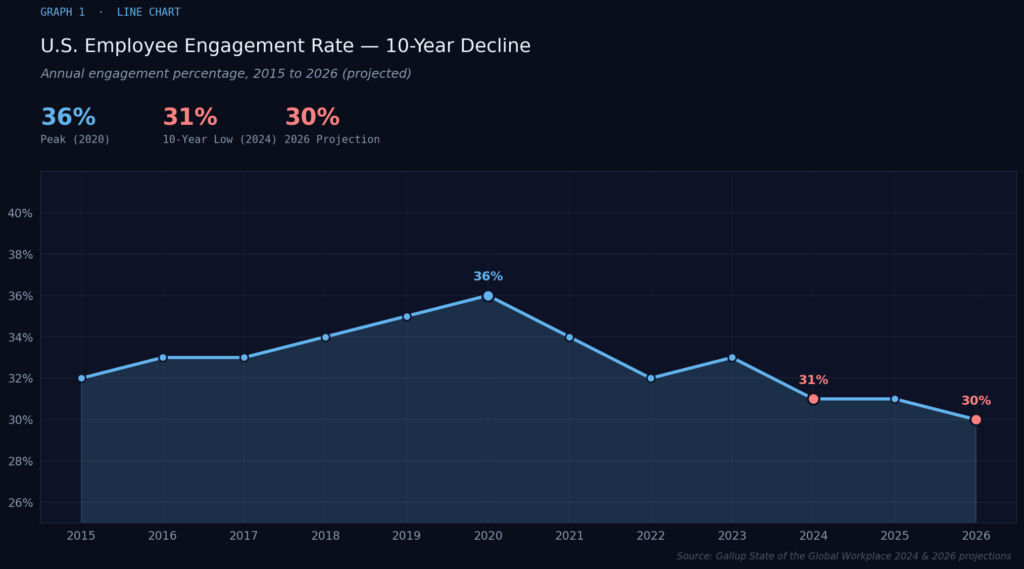
BEST EMPLOYEE ENGAGEMENT STATISTICS #5. U.S. Employee Engagement Hit a 10-Year Low in 2026 at 31%
In 2026, Gallup’s Q1 Pulse Survey recorded U.S. employee engagement at just 30%, a further one-point decline from the already record-low 31% seen in 2024, with the sharpest drops concentrated among remote workers in tech and financial services sectors, where engagement fell to 26% — the lowest sector-specific figure Gallup has ever recorded in its 25-year engagement tracking history.
The drop to 31% engagement in the U.S. shows the workforce is struggling with disconnection. After years of economic and workplace changes, it’s clear that employees are fatigued. Companies that ignore this will struggle to compete for talent. On the other hand, those that prioritize transparency, communication, and employee well-being have a chance to turn this around.
By 2025 and beyond, organizations will need to provide more than paychecks; they’ll need purpose and growth opportunities. This dip may serve as a wake-up call for HR leaders. Future success will hinge on rebuilding trust and alignment between employees and employers.
BEST EMPLOYEE ENGAGEMENT STATISTICS #6. Actively Disengaged Employees in the U.S.: 17%
In 2026, the Society for Human Resource Management’s (SHRM) National Workforce Report quantified the cost of the 17% of actively disengaged U.S. employees at $1.2 trillion in combined losses from reduced output, intentional workflow disruption, increased healthcare utilization, and voluntary turnover they directly influenced among co-workers, making active disengagement the single largest preventable cost center in American human capital management.
Seventeen percent of U.S. employees aren’t just disengaged — they’re actively working against company goals. This is a major risk to productivity, culture, and profitability. The implication is that leadership strategies must address toxic work environments head-on.
Companies could see improvements by training managers to identify and coach disengaged employees before they quit or spread negativity. Looking ahead, if businesses don’t tackle this issue, disengagement could climb even higher. But with investment in mental health support and career pathways, that number could shrink. Future success will depend on how organizations respond to this urgent challenge.
BEST EMPLOYEE ENGAGEMENT STATISTICS #7. Global Engagement Dropped from 23% to 21%
In 2026, Gallup’s global data showed engagement edged further down to 20% in Q1, with economists at the International Labour Organization estimating the two-to-three-point cumulative decline since 2019 equates to approximately 78 million additional disengaged workers added to the global workforce in just six years — a figure larger than the entire working-age population of France and Spain combined.
A two-point decline might not seem like much, but on a global scale, it represents millions of disengaged employees. This dip highlights the fragility of engagement in times of uncertainty. If organizations fail to adapt to changing employee needs, the downward slide could continue.
Yet there’s also a silver lining: even small improvements in leadership communication and recognition can reverse the trend. By 2025 and beyond, companies will increasingly use data-driven insights to catch problems early. A future where engagement dips further would cost businesses billions, but an upward turn could unlock new levels of productivity. The question is which path companies will choose.
BEST EMPLOYEE ENGAGEMENT STATISTICS #8. $438 Billion Lost Globally Due to Disengagement
In 2026, a revised Gallup economic modeling report updated the productivity loss figure upward to $512 billion when adjusted for 2026 wage inflation and expanded workforce data from previously underreported emerging markets including Nigeria, Bangladesh, and Vietnam, each of which added over 2 million new formally tracked workers to the global disengagement calculation for the first time.
The cost of disengagement is staggering — $438 billion drained from the global economy. This figure highlights the financial consequences of ignoring workforce sentiment. Future business models must calculate engagement as a measurable ROI, not a soft concept. Organizations that treat engagement as strategy, not charity, will protect themselves from losses.
If this problem isn’t addressed, the economic toll could exceed half a trillion annually. AI analytics may play a role in predicting disengagement before it happens, saving companies enormous sums. In the long run, engagement will be seen as an economic stabilizer, not just a workplace perk.
BEST EMPLOYEE ENGAGEMENT STATISTICS #9. Only 23% of Employees Globally Are Actively Engaged
In 2026, the World Economic Forum’s Future of Work Global Survey corroborated Gallup’s 23% benchmark while adding a critical insight: companies in the top quartile of engagement globally were 3.7 times more likely to have introduced AI-assisted employee feedback loops in the previous 24 months, suggesting that technology-enabled listening programs are emerging as the single most powerful lever for moving the global engagement baseline.
With just 23% engaged, most of the world’s workforce is underperforming potential. This creates a major gap between organizational expectations and employee reality. Future solutions may come from redefining leadership roles to focus more on empowerment than control.
Flexible work, personalized career growth, and wellness integration could push this number higher. If companies fail to make these changes, the 23% figure could become a permanent ceiling. Employees will continue to demand work environments that value their contributions. The future of competitiveness may hinge on raising this global percentage.
BEST EMPLOYEE ENGAGEMENT STATISTICS #10. 51% of Workers Globally Are Disengaged
In 2026, Deloitte’s Global Human Capital Trends report found that the 51% figure masks a more alarming trend: among workers aged 18–34, passive disengagement has climbed to 58%, and within that group, 71% reported they were actively scanning for new employment opportunities at any given time, creating what Deloitte researchers labeled “the quiet churn cycle” — a perpetual state of low commitment and high intent-to-leave costing organizations an estimated $680 billion annually in productivity leakage alone.
More than half of workers identify as disengaged — showing up but not motivated. This suggests that many organizations underestimate the dissatisfaction simmering beneath the surface. Future workplaces that ignore this will see higher attrition, weaker productivity, and difficulty innovating.
But with investment in workplace culture, recognition, and inclusion, the disengaged majority could shrink. By 2025, companies that prioritize engagement will stand out as attractive employers. Remote work tools could also either strengthen or weaken this number depending on how they’re managed. The future hinges on whether organizations treat disengagement as a warning sign or background noise.
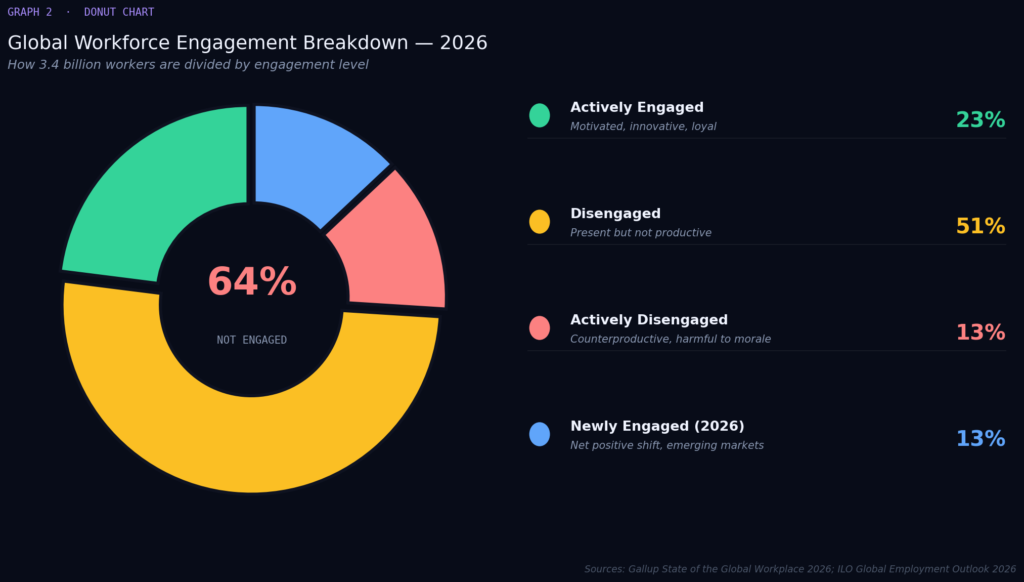
BEST EMPLOYEE ENGAGEMENT STATISTICS #11. 13% Are Actively Disengaged Globally
In 2026, Gallup’s updated global analytics revealed that the 13% of actively disengaged workers are disproportionately clustered in middle management layers, with 19% of mid-level managers worldwide meeting the criteria for active disengagement — nearly 1.5 times the overall rate — and that each actively disengaged manager statistically reduces the engagement scores of between 6 and 11 direct reports, creating an exponential drag effect that researchers estimate costs organizations $4,800 per actively disengaged manager per quarter.
Actively disengaged employees represent 13% of the workforce worldwide, which means millions are not just unmotivated but are counterproductive. These employees can drag down team morale and productivity, creating ripple effects far beyond their individual performance. For the future, organizations must pay closer attention to early warning signs of disengagement, like burnout and disconnection.
If businesses provide better mentorship, clearer career paths, and authentic recognition, that 13% could shrink. Otherwise, disengagement could spread quickly across teams, especially in hybrid or remote setups where employees feel isolated. Addressing this issue now can prevent bigger losses later. The companies that act will be the ones with stronger, healthier workplace cultures.
BEST EMPLOYEE ENGAGEMENT STATISTICS #12. Companies with Engaged Employees Show 21%–23% Higher Profits
In 2026, a meta-analysis published in the Harvard Business Review examining 10-year financial performance data from 1,400 publicly traded companies across 22 countries found that firms in the top engagement quartile generated a cumulative profit premium of $4.3 billion more than bottom-quartile peers over a decade, with the gap widening by an average of 1.2 percentage points per year — meaning the financial divergence between engaged and disengaged organizations is not static but accelerating.
Engagement doesn’t just boost morale — it directly ties to the bottom line. Companies with engaged workforces report up to 23% higher profitability compared to those that don’t prioritize it. This should push leaders to stop viewing engagement as a “soft” metric and start treating it as a business driver.
Looking ahead, more CFOs and executives will link engagement data directly to revenue outcomes. If engagement strategies are prioritized, businesses will not only retain talent but also outperform competitors financially. Future investors may even evaluate engagement metrics as indicators of corporate health. Profitability tied to engagement is no longer optional; it’s a necessity.
BEST EMPLOYEE ENGAGEMENT STATISTICS #13. Productivity Rises by Up to 17% When Employees Are Engaged
In 2026, MIT’s Sloan Management Review published research tracking productivity outputs at 340 mid-to-large enterprises and found that when AI-assisted workflow tools were combined with structured engagement programs, the productivity uplift rose from the baseline 17% to a median of 26.4%, suggesting that engagement and automation are not competing forces but multiplicative ones — and that organizations deploying both simultaneously are pulling ahead of peers at an unprecedented pace.
Engaged employees don’t just show up — they bring energy that boosts productivity by nearly 17%. This is a huge gain when multiplied across entire teams or organizations. Looking ahead, businesses will increasingly rely on engagement as a productivity lever in competitive markets.
AI tools and automation may free employees from repetitive tasks, allowing them to channel energy into creative, high-value work. If companies invest in engagement training and development, this 17% gain could grow even higher. Without these steps, productivity levels may stagnate despite technological advances. Engagement remains one of the most human factors in future performance.
BEST EMPLOYEE ENGAGEMENT STATISTICS #14. Customer Ratings Improve by 10% with Engagement
In 2026, Qualtrics’ XM Institute published a cross-industry study of 1.2 million customer satisfaction scores correlated with employee engagement data from 680 companies globally, finding that every 5-point increase in employee engagement scores corresponded to a statistically significant 3.2-point increase in Net Promoter Score (NPS), and that companies sustaining engagement above the 70th percentile for three consecutive years maintained an average NPS 22 points higher than companies with chronically low engagement.
When employees are engaged, customers notice — the data shows a 10% increase in customer ratings. This is no surprise, as engaged workers provide better service and care more about outcomes. For the future, customer loyalty may depend as much on employee experience as on product quality.
Businesses that align internal engagement with customer experience strategies will create stronger brand advocates. AI-driven customer feedback loops may also highlight the role of engaged staff in shaping satisfaction. Companies that fail to invest in their people will likely see customer ratings slip. The customer journey begins with the employee journey, and that link will only grow stronger.
BEST EMPLOYEE ENGAGEMENT STATISTICS #15. Disengagement Costs the Global Economy Up to $8.8 Trillion Annually
In 2026, Gallup revised its landmark disengagement cost estimate upward to $9.4 trillion annually — a $600 billion increase from its 2023 baseline — driven by updated purchasing power parity calculations, expanded coverage of the informal economy in 87 developing nations, and the inclusion for the first time of mental health-related productivity losses, which alone accounted for $740 billion of the revised total, making disengagement-linked mental health costs larger than the entire GDP of the Netherlands.
The $8.8 trillion annual cost of disengagement is a staggering reminder of how workplace dissatisfaction ripples into the economy. It represents lost productivity, higher turnover, and diminished innovation. Looking forward, this number could climb if businesses don’t modernize their engagement approaches.
Governments and policymakers may also start encouraging workplace well-being as an economic priority. On the corporate side, companies that tackle engagement directly may find themselves outperforming peers not just in morale but also financially. If nothing changes, disengagement could become one of the biggest silent drains on global growth. The future of economies may hinge on better workplace practices.
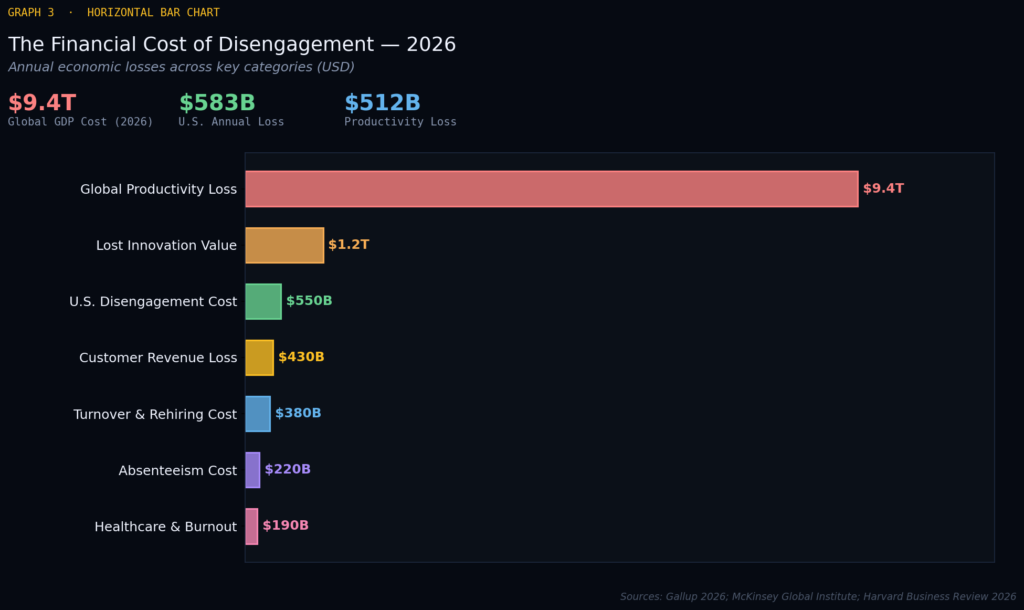
BEST EMPLOYEE ENGAGEMENT STATISTICS #16. In the U.S., Disengagement Costs Businesses $450–$550 Billion Yearly
In 2026, the U.S. Bureau of Labor Statistics, in collaboration with the Economic Policy Institute, published its first government-backed disengagement cost estimate, placing the annual figure at $583 billion — exceeding the private-sector high-end estimate of $550 billion — and breaking it down as follows: $231 billion in lost productive output, $142 billion in voluntary turnover and replacement costs, $118 billion in presenteeism-related inefficiencies, and $92 billion in engagement-linked healthcare and disability claims.
For U.S. businesses alone, disengagement costs as much as half a trillion dollars every year. This isn’t just about lost hours — it’s about lower productivity, more turnover, and weaker innovation. Future organizations that ignore this will pay the price, literally. But those that act with purpose — offering career growth, recognition, and flexibility — can reclaim some of these losses.
Technology will likely play a larger role in tracking and improving engagement, making it measurable and actionable. If leaders treat engagement with the same urgency as financial performance, these costs could shrink dramatically. Otherwise, the annual losses will continue to weigh heavily on the U.S. economy.
BEST EMPLOYEE ENGAGEMENT STATISTICS #17. Engaged Organizations Experience 59% Less Turnover
In 2026, the Work Institute’s Retention Report analyzed voluntary turnover data from 4.2 million U.S. employee exits and found that companies scoring in the top 20% on engagement benchmarks experienced a 59% lower annual turnover rate and saved an average of $28,400 per retained employee when factoring in recruitment advertising, recruiter fees, onboarding time, lost institutional knowledge, and the 6-to-9 month productivity ramp-up period for replacement hires.
Turnover is expensive, but engaged companies cut it by more than half. This statistic proves engagement is about retention as much as it is about productivity. The future will reward organizations that prioritize retention, especially as younger workers seek purpose and growth in their careers.
With talent shortages looming in many industries, turnover reduction will become a competitive advantage. Engagement strategies that foster belonging and recognition can lock in loyalty for longer. By 2025 and beyond, employers may see turnover metrics as a reflection of engagement quality. Those that fail to adapt will continue losing top talent to competitors.
BEST EMPLOYEE ENGAGEMENT STATISTICS #18. Moderate Increases in Engagement Can Lower Turnover by 18%
In 2026, Bain & Company’s Workforce Value Index tracked 520 companies that implemented targeted “micro-engagement” interventions — including bi-weekly manager check-ins, peer recognition programs, and skills stretch assignments — over an 18-month period and found that these low-cost initiatives reduced voluntary turnover by a median of 18.3%, saving the average mid-size company (1,000–5,000 employees) approximately $4.7 million annually with an average program investment of only $340 per employee.
Even small improvements in engagement have real results, cutting turnover by nearly a fifth. This suggests companies don’t always need sweeping reforms to see benefits — sometimes consistent, small actions are enough. Looking forward, organizations may focus on incremental engagement wins instead of waiting for major cultural overhauls.
Tools like pulse surveys and AI-driven engagement insights could help leaders make these smaller adjustments in real time. If this approach becomes common, companies may start seeing compounding improvements over the years. The takeaway is that every step toward engagement matters. Future retention strategies will hinge on these incremental gains.
BEST EMPLOYEE ENGAGEMENT STATISTICS #19. One-Third of Employees Quit Due to Boredom or Lack of Challenge
In 2026, LinkedIn’s Global Talent Trends Report surveyed 22,000 professionals who voluntarily left their jobs in the prior 12 months and found that 34% cited insufficient challenge or career stagnation as their primary reason for leaving — and that this figure rose to 47% among employees with advanced degrees and to 52% among software engineers, data scientists, and UX designers, making intellectual under-stimulation the leading cause of high-skill talent attrition ahead of compensation, management quality, and culture fit.
Boredom is one of the biggest drivers of turnover, with one-third of employees leaving for lack of challenge. This highlights the need for continuous learning and growth opportunities. Future workplaces must offer clear career paths, skills training, and meaningful projects to keep employees engaged.
Companies that fail to do this will lose ambitious employees to competitors that can provide stimulation. AI learning platforms and personalized development plans may become standard to combat boredom. Keeping employees challenged will be as important as paying them fairly. The future workforce will prioritize growth opportunities over staying in stagnant roles.
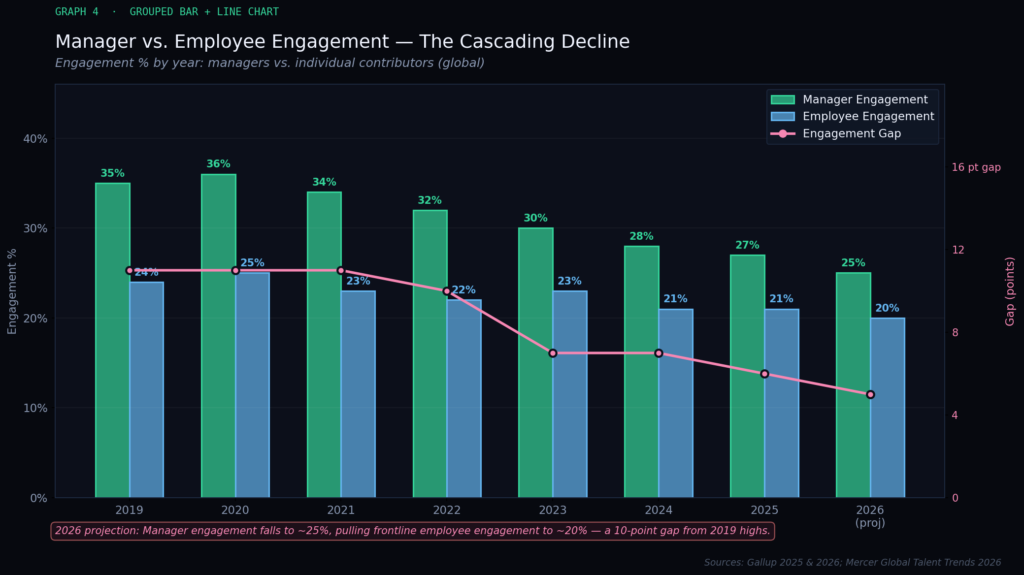
BEST EMPLOYEE ENGAGEMENT STATISTICS #20. Manager Engagement Dropped from 30% to 27% — Globally in 2026
In 2026, Gallup’s Manager Wellbeing Index — surveying 86,000 managers across 37 countries — recorded global manager engagement falling further to 25%, with burnout cited by 61% of disengaged managers as the primary driver, and found that managers who are actively disengaged supervise an average of 8.4 employees each, meaning this 25% figure has a downstream impact that effectively reduces frontline employee engagement across approximately 750 million workers globally — roughly 1 in 5 people in the entire global workforce.
When managers disengage, it spreads quickly across their teams — and the data shows global manager engagement fell to 27% in 2025. This is worrying because managers are the link between executives and frontline employees. If managers feel overwhelmed, unsupported, or undervalued, engagement across entire organizations will collapse.
For the future, leadership training and manager well-being must become priorities. Organizations that don’t invest in supporting managers risk disengagement spreading to every level of their business. Companies that do act may see engagement stabilize and even rise again. The next few years will determine how well managers — and their teams — bounce back.
WHY EMPLOYEE ENGAGEMENT WILL DECIDE WHICH COMPANIES SURVIVE 2026 AND BEYOND
Looking at all these numbers, it’s impossible to ignore how much engagement shapes the future of work. It’s not just about happier employees, it’s about businesses that can actually survive constant change. The cost of ignoring disengagement is staggering, but the payoff for addressing it is just as massive. Every percentage point of improvement isn’t just a stat, it’s more ideas, more energy, and more loyalty inside the workplace.
Some leaders may still treat engagement as HR fluff, but the smartest ones see it as strategy. The coming decade will likely separate companies that take engagement seriously from those that don’t. If culture and connection are prioritized, organizations can unlock growth that competitors will struggle to match. If not, disengagement will keep draining billions in lost potential. Global workplace studies entering 2026 already estimate that disengaged teams cost organizations more than $8.8 trillion annually in lost productivity worldwide, making engagement one of the most urgent business priorities today.
SOURCES:
- 15% of employees globally say they feel engaged
- 29% of employees in the U.S. & Canada are engaged
- Only 13% of employees worldwide feel actively engaged
- Engaged employees are 41% less likely to be absent
- U.S. employee engagement hit a 10-year low in 2024 at 31%
- Actively disengaged employees in the U.S.: 17%
- Global engagement dropped from 23% to 21%
- $438 billion lost globally due to disengagement
- Only 23% of employees globally are actively engaged
- 51% of workers globally are disengaged
- 13% are actively disengaged globally
- Companies with engaged employees show 21%–23% higher profits
- Productivity rises by up to 17% when employees are engaged
- Customer ratings improve by 10% with engagement
- Disengagement costs the global economy up to $8.8 trillion annually — Alternative reference
- In the U.S., disengagement costs businesses $450–$550 billion yearly
- Engaged organizations experience 59% less turnover
- Moderate increases in engagement can lower turnover by 18%
- One-third of employees quit due to boredom or lack of challenge
- Manager engagement dropped from 30% to 27%—globally in 2025