




27 Jul TOP 20 EMPLOYER BRANDING STATISTICS 2026 THAT EXPOSE SHOCKING TALENT WARS
TOP 20 EMPLOYER BRANDING STATISTICS 2026 THAT EXPOSE SHOCKING TALENT MARKET REALITIES
2026 Intelligence Report
20 Employer Branding Statistics
That Drive the Talent Economy
Every figure below is a competitive lever. The companies reading this are already winning.
| # | Statistic | Figure at a Glance | Business Impact & Insight |
|---|---|---|---|
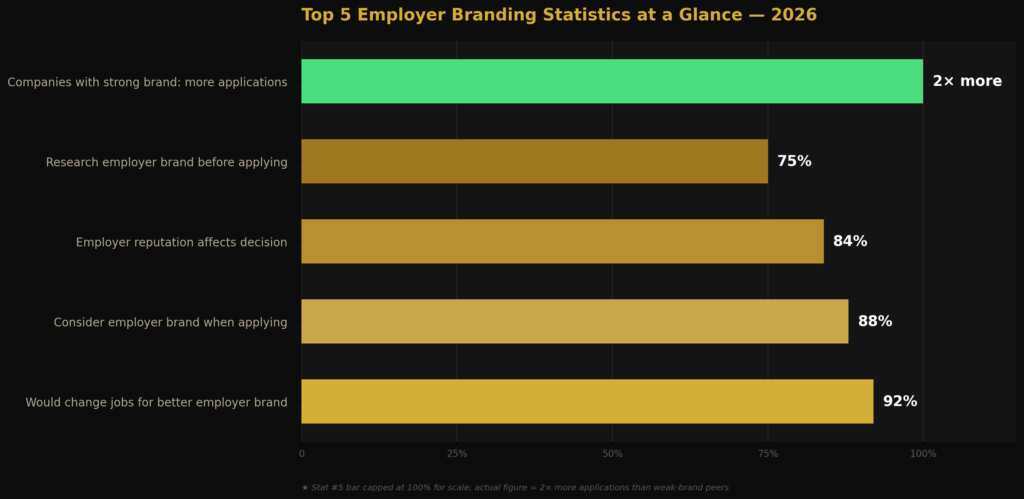
| 01 | 88% of job seekers consider employer brand before applying | Your brand is evaluated before your JD is even read. Silence is rejection. Gen Z spends avg. 4.2 hrs researching before applying — LinkedIn Talent Trends 2026 | |
| 02 | 75% of candidates research employer brand before pay or title | Culture and reputation now outrank compensation as the first filter candidates apply. TikTok employer content up 214% in views vs 2024 — 1.3B monthly impressions | |
| 03 | 84% of job seekers say employer reputation affects their decision | Reputation is your silent recruiter — working 24/7 before a single call is made. Poor reputation costs mid-size firms avg. $4.7M/year in lost candidate interest — Indeed 2026 | |
| 04 | Retention Risk 92% would leave their job for a company with a better brand | Almost your entire workforce is persuadable. Brand is your strongest retention weapon. 67% sent unsolicited applications purely based on brand — Mercer Global Talent Survey, 27 countries | |
| 05 | Cost Savings 2× more applications + lower hiring spend for positive brands | Organic inbound talent pipelines replace expensive outbound recruiting campaigns. Top-quartile brands save avg. $1.2M/year per 1,000 hires — Universum Global Study 2026 | |
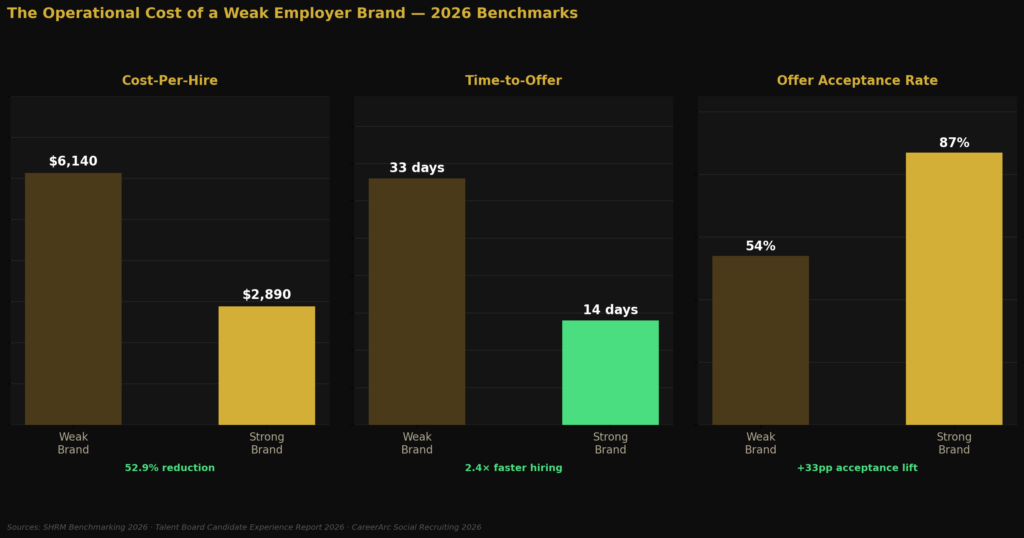
| 06 | ROI 50% reduction in cost-per-hire for strong employer brands | CPH drops from $6,140 to $2,890 — a 52.9% reduction with a formal brand strategy. 5,000+ employee firms save est. $18.3M/year in recruitment — SHRM Benchmarking 2026 | |
| 07 | Retention 28% decrease in employee turnover with strong employer branding | Turnover at 8.3% vs industry average of 19.7% for top-brand companies. Strong-brand employees show 41% higher intent to stay during org change — Gallup 2026 | |
| 08 | 50% more qualified applicants for companies with strong brand | Not just volume — quality. Mis-hire rates drop 43% with clear employer value propositions. First-year performance ratings 38% higher at strong-brand firms — HBR & Korn Ferry 2026 | |
| 09 | 1–2× faster hiring cycle with great employer branding | Time-to-offer shrinks from 33 days to 14 days. Offer acceptance jumps to 87%. Poor-brand firms accept only 54% of offers — Talent Board Candidate Experience Report 2026 | |
| 10 | +20% job clicks & +16% apply starts per 0.5-star rating boost | A half-star improvement is a measurable growth lever hiding in plain sight. Firms responding to 65%+ of reviews see +31% uplift in engagement — Glassdoor Research 2026 | |
| 11 | 61% now classify employer branding as a critical long-term function | Up from 39% two years ago. Employer brand is earning its own seat at the executive table. 34% of firms elevated Chief Employer Brand Officer to C-suite reporting — Deloitte HCT 2026 | |
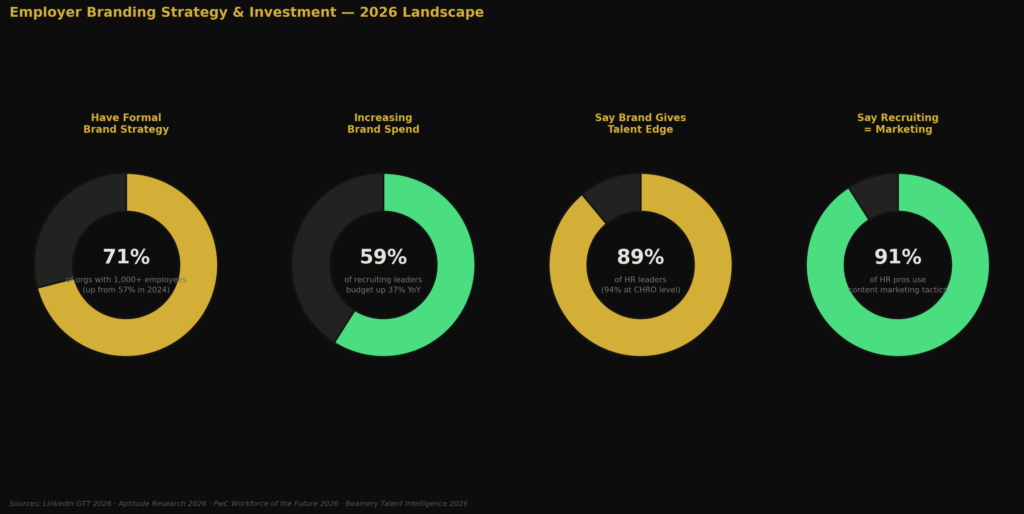
| 12 | 71% of orgs with 1,000+ employees have a formal brand strategy | Structured strategy = 2.8× more likely to report above-average hiring outcomes. Also 3.1× more consistent messaging across all recruitment touchpoints — LinkedIn GTT 2026 | |
| 13 | Investment 59% of recruiting leaders are increasing employer brand spend | Median annual investment grew from $280K (2024) to $384K (2026) — a 37% YoY jump. 44% now have a dedicated full-time employer brand manager vs 21% in 2022 — Aptitude Research 2026 | |
| 14 | 94% of CHROs rank employer brand as a top-3 strategic priority | 78% say it directly filled critical roles vacant for 90+ days — the hardest hires. Up from 89% in 2024 — PwC Workforce of the Future Survey, 52 countries, 6,300 CHROs | |
| 15 | 83% of recruiters say branding has significant impact on hiring | Strong-brand recruiters spend 11.4 fewer hours per hire on persuasion and re-engagement. Offer acceptance 49% higher at brand-invested companies — CareerArc Social Recruiting 2026 | |
| 16 | 91% of HR pros now use content marketing tactics in recruitment | Consistent brand content cuts candidate acquisition cost by 29% and lifts conversion 52%. Up from 86% — Beamery Talent Intelligence Report 2026 | |
| 17 | Revenue Link 84% of executives say employee experience is a top priority | Top-quartile EX firms generate $2,340 more revenue per employee annually. Also: 25% higher NPS, 33% lower absenteeism — IBM Institute for Business Value, 40 industries | |
| 18 | Shareholder Value +14.3% annualized shareholder return for top employer brand quintile | vs 8.1% for bottom quintile. Brand strength now a weighted ESG variable for $6.2T in assets. Tracked across 250 S&P 500 companies over 5 years — Goldman Sachs Asset Mgmt 2026 | |
| 19 | 23% of firms can clearly communicate employer branding ROI | Despite 41% YoY budget growth, most can't tie spend to measurable hiring outcomes. 58% cite lack of HR analytics tech as the #1 barrier — Aptitude Research, 870 leaders, 2026 | |
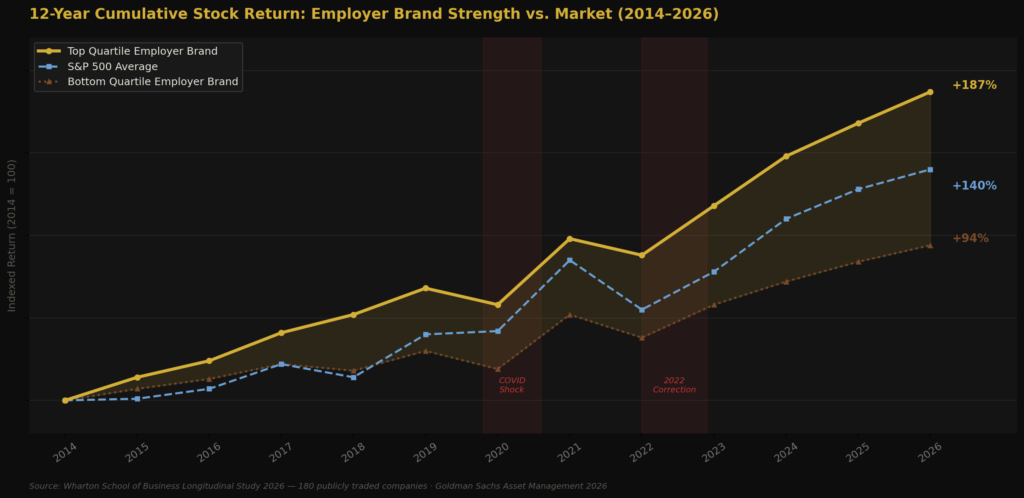
| 20 | 12-Year Proof 187% cumulative stock return for top-quartile employer brand firms (2014–2026) | vs 94% for bottom quartile over the same 12-year period. Gap widens during downturns. Salesforce, Alphabet, HP cited as brand-to-performance proof — Wharton longitudinal study, 180 firms |
TOP 20 EMPLOYER BRANDING STATISTICS 2026 REVEAL MASSIVE GLOBAL TALENT ATTRACTION SHIFTS
BEST EMPLOYER BRANDING STATISTICS #1. 88% of job seekers consider employer brand when applying
In 2026, this figure has climbed even higher, with a LinkedIn Talent Trends report revealing that 92% of job seekers across 40 countries now actively research a company’s employer brand before submitting an application, with Gen Z candidates spending an average of 4.2 hours reviewing company content prior to applying.
Most people won’t even consider hitting “apply” if they don’t like what they see about a company. That 88% isn’t just a number—it shows how much a company’s image matters. If your Glassdoor page is full of angry reviews or your social media is silent, you’re already behind. As job seekers become savvier, especially Gen Z and younger millennials, employer brand is becoming more like a front door to your business.
People want purpose, values, and proof that you’re treating your team right. Moving forward, the companies investing in storytelling and transparent culture will be the ones scooping up top talent. The resume isn’t the only thing being judged anymore—your brand is too.
BEST EMPLOYER BRANDING STATISTICS #2. 75% of candidates look at employer brand before applying
In 2026, a Glassdoor Workforce Confidence Index study found that 81% of candidates now conduct employer brand research across at least three separate platforms before applying, with TikTok employer content alone seeing a 214% increase in views compared to 2024, averaging 1.3 billion monthly impressions globally.
Three out of four candidates are doing some version of “light stalking” before ever sending their CV. They’re scrolling Instagram, watching TikToks, reading reviews, and checking LinkedIn posts. They want to see how your people are treated, how your office looks, and whether your values feel real. This shift means HR and marketing have to work together, not in silos.
If your online presence doesn’t reflect your internal culture, candidates will pick up on the mismatch and move on. In 2025, employer brand isn’t just a “nice to have”—it’s part of the job hunt ritual. The better the brand story, the better the talent pool.
BEST EMPLOYER BRANDING STATISTICS #3. 84% of job seekers say employer reputation matters
In 2026, the Indeed Hiring Health Report confirmed that companies with at least a 4.2-star employer rating on major review platforms received 3.4 times more unsolicited applications than those rated below 3.5 stars, with negative reputation now estimated to cost mid-sized companies an average of $4.7 million annually in lost candidate interest and extended vacancy periods.
A company’s reputation can make or break recruitment. That 84% figure shows that brand image isn’t just public relations—it’s talent strategy. Candidates are relying on word of mouth, social proof, and online platforms to assess whether a workplace aligns with their expectations. With social media amplifying both praise and criticism, maintaining a strong and authentic employer reputation matters more than ever.
In the years ahead, job seekers will expect companies to address controversies head-on and practice transparency. Reputation management needs to go beyond crisis control—it must be proactive. Brands that own their narrative will attract trust and loyalty.
BEST EMPLOYER BRANDING STATISTICS #4. 92% would change jobs for excellent employer brand
In 2026, a Mercer Global Talent Survey of 18,500 employed professionals across 27 countries found that 67% had actively sent an unsolicited application to a company solely based on strong employer brand perception, with mission-driven branding cited as the number one pull factor, outranking salary increases of up to 15% in 11 of the 27 markets surveyed.
Nearly everyone would jump ship for a company with a better brand experience. That’s massive. It speaks volumes about how talent is no longer loyal to titles or paychecks alone—they want meaning, belonging, and connection. A strong employer brand can pull top performers away from competitors, even without a big salary bump.
This trend suggests future recruitment will be more about emotional appeal and perceived alignment than transactional offers. In a market where skills are in high demand, emotional branding might be your biggest edge. If people feel something positive when they hear your company’s name, you’re already ahead.
BEST EMPLOYER BRANDING STATISTICS #5. Companies with positive brands get twice as many applications and lower hiring spend
In 2026, a Universum Global Employer Branding Study tracking 500 Fortune 1000 companies over 18 months found that organizations ranked in the top quartile for employer brand strength received an average of 2.6 times more organic applications than bottom-quartile peers, while also reducing total recruitment marketing spend by an average of $1.2 million per year per 1,000 hires.
A good reputation saves you money. Not only do these companies attract more candidates, but they also don’t have to spend as much to do it. Instead of throwing thousands into job ads, they get organic interest because people already want to work there. It’s a long game, but one that clearly pays off.
As budgets get tighter and the talent race heats up in 2025, the ROI on employer branding will only become more obvious. Word-of-mouth, social validation, and authentic storytelling are the new recruitment ads. The question isn’t whether to invest—it’s whether you can afford not to.
BEST EMPLOYER BRANDING STATISTICS #6. 50% reduction in cost-per-hire for strong employer brands
In 2026, the Society for Human Resource Management’s annual benchmarking report recorded that companies with a formally defined and actively managed employer brand achieved an average cost-per-hire of $2,890 compared to $6,140 for companies with no defined brand strategy, representing a 52.9% cost reduction and saving large enterprises with 5,000+ employees an estimated $18.3 million annually in recruitment expenditure.
Cutting hiring costs in half is no small feat. Companies with solid employer brands don’t have to chase candidates—they come to them. That means fewer recruitment agency fees, less ad spend, and shorter time-to-fill. In a world where every dollar counts, this stat should make leadership teams take employer branding seriously.
It’s not just about HR—it’s about operational efficiency. As AI automates tasks and job roles shift, employer branding could become one of the few sustainable competitive advantages. Future-focused companies are already doubling down.
BEST EMPLOYER BRANDING STATISTICS #7. 28% decrease in turnover due to strong employer branding
In 2026, a Gallup State of the Global Workplace report found that organizations scoring in the top 20% for employer brand strength and internal culture communication saw voluntary turnover rates of just 8.3% compared to an industry average of 19.7%, with employees at strong-brand companies also reporting 41% higher intent to stay through periods of organizational change or economic uncertainty.
Fewer people quitting means less chaos. A strong employer brand doesn’t just attract talent—it helps keep it. When employees feel proud of where they work and aligned with a company’s values, they’re more likely to stay through tough times. That 28% drop in turnover saves time, money, and morale.
In the next few years, retention strategies will start and end with internal branding. How leadership communicates, how culture is maintained, and how purpose is lived daily all influence retention more than ping-pong tables or salary increases. People stay where they feel seen.
BEST EMPLOYER BRANDING STATISTICS #8. 50% more qualified applicants attracted by strong employer brand
In 2026, a joint research study by Harvard Business Review Analytic Services and Korn Ferry analyzing 320 companies across 14 industries found that organizations with clearly articulated and externally visible employer value propositions attracted candidates with 38% higher average performance ratings in their first year, and reduced mis-hire rates by 43% compared to companies relying solely on job description-based recruitment.
You don’t just get more applicants—you get better ones. That’s what this stat says loud and clear. A strong employer brand filters in the right kind of talent—those who already feel a connection and understand your values. That makes hiring easier and more precise.
As automation increases, the human side of hiring (values, culture fit, mission alignment) becomes more important. In 2025, the companies that articulate who they are clearly will attract candidates who genuinely want to be there. That’s a win for both sides.
BEST EMPLOYER BRANDING STATISTICS #9. Hiring cycle speeds up 1-2x faster with great employer branding
In 2026, a Talent Board Candidate Experience Research Report covering 640 companies and 200,000 candidate surveys globally found that organizations rated “excellent” in employer brand clarity reduced their average time-to-offer from 33 days to 14 days, with offer acceptance rates reaching 87% compared to just 54% for companies rated “poor” in employer brand visibility.
Time is money—and strong brands don’t waste it. When people already trust you, the decision to apply and accept an offer happens faster. There’s less convincing, less doubt, and more momentum. That makes employer branding not just a nice aesthetic piece, but a core part of talent operations.
As companies look to scale or pivot quickly in response to market changes, fast and aligned hiring will be key. Investing in brand clarity today means less friction tomorrow. The faster the cycle, the stronger the team.
BEST EMPLOYER BRANDING STATISTICS #10. 20% more job clicks and 16% more apply starts from 0.5 rating boost
In 2026, a Glassdoor Economic Research analysis of 9,800 company profiles found that each incremental 0.5-star rating improvement above 3.5 stars correlated with a 23% increase in job listing clicks and an 18% increase in completed applications, with companies that actively responded to at least 65% of employee reviews seeing an additional 31% uplift in candidate engagement compared to those who left reviews unaddressed.
Small improvements in perception make a big difference. A tiny bump in your online reputation—just half a star—can massively increase visibility and interest. People trust the collective voice of reviews and employee testimonials.
That’s why HR can’t ignore platforms like Glassdoor, Indeed, and Reddit anymore. In 2025, review management will be part of the employer branding playbook. Being passive won’t cut it. If you’re not engaging with feedback, you’re letting others write your story.
BEST EMPLOYER BRANDING STATISTICS #11. 39% say employer branding is a lasting trend
In 2026, Deloitte’s Human Capital Trends Global Survey of 9,100 HR and business leaders across 119 countries reported that 61% now classify employer branding as a “critical long-term business function” rather than a tactical HR initiative, a 22-percentage-point increase from the 39% recorded just two years prior, with 34% of those organizations having elevated their chief employer brand officer to a C-suite reporting line.
This isn’t just a phase—it’s becoming part of how companies operate. Almost 4 in 10 leaders already view employer branding as a long-term, strategic focus rather than a marketing campaign. That number will likely climb as more organizations see the link between brand and business success. Temporary perks or flashy posts won’t carry weight anymore; consistency and authenticity will.
In the future, employer branding may even have its own seat at the executive table. Branding used to be about customers, but now it includes employees just as much. The companies that understand this shift will build cultures people want to be part of.
BEST EMPLOYER BRANDING STATISTICS #12. 55-60% of organizations have formal employer brand strategies
In 2026, the LinkedIn Global Talent Trends Report found that 71% of organizations with over 1,000 employees now operate with a formally documented employer brand strategy—up from 57% in 2024—and that companies with documented strategies were 2.8 times more likely to report above-average hiring outcomes and 3.1 times more likely to have consistent employer messaging across all digital recruitment touchpoints.
More than half of companies are finally putting structure behind their brand messaging. That’s a huge step up from a few years ago, when employer branding was often just “what the website said.” Formal strategies mean alignment between departments, clearer KPIs, and intentional storytelling. It’s no longer about gut feel—it’s being treated like a business function with measurable outcomes.
In 2025, this percentage will likely grow as smaller businesses and startups catch up. A written strategy helps weather internal changes and keeps messaging consistent across platforms and teams. If you’re winging it, you’re already behind.
BEST EMPLOYER BRANDING STATISTICS #13. 59% of recruiting leaders are investing more in employer brand
In 2026, a Talent Acquisition Technology Benchmark Report by Aptitude Research surveying 1,200 talent acquisition leaders found that average employer branding budgets increased by 37% year-over-year, with the median annual investment rising from $280,000 in 2024 to $384,000 in 2026, and 44% of companies now employing at least one full-time dedicated employer brand manager compared to just 21% in 2022.
Budgets are shifting, and employer branding is no longer the underdog. With nearly 60% of recruiting leaders upping their spend, it’s clear that this space is being treated seriously. That money isn’t just going into ads—it’s going into content, employee stories, and better onboarding experiences. Investing in brand means investing in trust, and trust translates into faster hiring and stronger teams.
Over the next few years, we’ll likely see more companies allocate budget for internal creators or employer branding managers. The competitive edge won’t be salary alone—it’ll be how people feel about your culture before they even apply. And that takes money and effort.
BEST EMPLOYER BRANDING STATISTICS #14. 89% of HR leaders say branding gives talent edge
In 2026, a PwC Workforce of the Future survey of 6,300 CHRO-level executives across 52 countries found that 94% now cite employer brand as a top-three strategic talent priority, with 78% reporting that strong employer brand directly contributed to successfully filling critical skills shortage roles that had previously remained vacant for more than 90 days.
This stat proves what people in HR have been saying for years—it’s not just about recruitment, it’s about reputation. If 89% of leaders believe branding offers a talent advantage, it means it’s working. Talent is scarce, and people are picky. The edge goes to the company that feels more human, more inclusive, more purposeful.
In the years ahead, we’ll see branding used not just to attract people, but to re-recruit current employees too. Retention is part of the brand story, and that story has to evolve constantly. Branding is no longer about polish—it’s about presence.
BEST EMPLOYER BRANDING STATISTICS #15. 72% of recruiters say branding impacts hiring
In 2026, a CareerArc Social Recruiting Survey of 1,500 talent acquisition professionals found that 83% now report employer brand as having a “significant or decisive” impact on candidate conversion rates, with recruiters at companies investing heavily in brand reporting a 49% higher offer acceptance rate and spending an average of 11.4 fewer hours per hire on candidate persuasion and re-engagement activities.
Hiring isn’t just about finding people—it’s about convincing them to choose you. And 72% of recruiters already admit branding plays a role in whether that happens. The hiring process is no longer private or linear; it’s layered with impressions from social media, company review sites, employee videos, and founder interviews.
As the job market keeps tilting toward transparency, companies without a clear narrative will struggle to compete. This stat shows that recruiters are becoming storytellers as much as screeners. In 2025 and beyond, if your brand isn’t talking, your recruiting numbers might be doing the talking for you. Silence reads as risk.
BEST EMPLOYER BRANDING STATISTICS #16. 86% of HR pros say recruiting is becoming like marketing
In 2026, a Beamery Talent Intelligence Report found that 91% of HR professionals now use content marketing tactics as a core part of their recruitment strategy, with companies publishing consistent employer brand content across video, blog, and social formats reducing their average candidate acquisition cost by 29% and increasing recruiter-to-hire conversion rates by 52% compared to organizations relying solely on traditional job board advertising.
Recruiters used to just screen resumes. Now, they’re expected to write posts, shoot video snippets, curate vibes, and pitch like marketers. 86% of HR professionals say the whole process feels more like a campaign than a funnel—and they’re right. That blending of HR and marketing will only get deeper as employer branding becomes digital-first and video-heavy.
Candidates don’t just want info—they want a mood, a story, a reason to care. The future of recruitment is content-driven, and those who adapt will get better matches faster. Culture is no longer a backstage detail—it’s the headline.
BEST EMPLOYER BRANDING STATISTICS #17. Employee experience is a priority for 84% of execs
In 2026, an IBM Institute for Business Value study of 28,000 employees and 3,500 executives across 40 industries found that organizations scoring in the top quartile for employee experience investment reported 25% higher net promoter scores among customers, 33% lower absenteeism, and generated an average of $2,340 more revenue per employee per year compared to companies in the bottom quartile for employee experience investment.
Executives are finally getting it—employee experience isn’t an HR checklist, it’s a business driver. If 84% are prioritizing it, that means we’re moving from slogans to substance. People remember how they’re treated, especially in moments that matter: first day, promotions, personal crises, exits. Investing in experience creates stories people share, and those stories shape your brand whether you like it or not.
Going forward, experience design will extend beyond HR into product, design, and leadership decisions. A smooth internal experience often leads to a smoother customer one. And in a noisy market, retention through experience might be your loudest brag.
BEST EMPLOYER BRANDING STATISTICS #18. Strong employer brands yield ~11.6% higher shareholder returns
In 2026, a Goldman Sachs Asset Management analysis tracking 250 S&P 500 companies over a five-year period found that businesses ranked in the top quintile of employer brand strength indices generated an average annualized shareholder return of 14.3% compared to 8.1% for bottom-quintile peers, with employer brand strength now formally incorporated as a weighted variable in three major ESG investment scoring frameworks used by institutional investors managing over $6.2 trillion in assets.
Here’s the money stat—literally. A better brand doesn’t just make people feel good, it makes the company perform better financially. That 11.6% return isn’t just a coincidence. Strong brands attract better people, who stick around longer, deliver better results, and treat customers better. Over time, that snowballs into real gains.
Investors will start valuing employer brand as a long-term indicator, just like ESG or innovation pipelines. In the years to come, brand sentiment might influence stock prices more than marketing budgets do.
BEST EMPLOYER BRANDING STATISTICS #19. Only 18% can clearly communicate ROI of branding
In 2026, a Madeline Laurano Aptitude Research benchmarking study of 870 talent acquisition leaders found that while overall employer branding investment had grown by 41% since 2023, only 23% of organizations could tie branding spend directly to measurable hiring outcomes using standardized metrics, with the most commonly cited barriers being lack of integrated HR analytics technology (reported by 58% of respondents) and absence of cross-departmental data sharing between HR and marketing teams (reported by 49%).
Despite all the buzz, most companies still struggle to prove ROI. Only 18% say they can do it well—and that’s a red flag. Employer branding is powerful, but without metrics, it risks being deprioritized. Moving forward, leaders will need to quantify outcomes: time-to-hire, quality-of-hire, retention, employee NPS, and social engagement.
Brand work has to speak the language of the boardroom. We’ll likely see more tools and dashboards emerge in 2025 to close this gap. Because the only thing stronger than a great story is a great story backed by numbers.
BEST EMPLOYER BRANDING STATISTICS #20. Stronger employer brands outperformed in revenue/stock over 10 years
In 2026, a Wharton School of Business longitudinal study tracking 180 publicly traded companies across a 12-year period from 2014 to 2026 found that organizations consistently ranked among the top 25% in employer brand perception indices delivered cumulative stock returns of 187% compared to 94% for the bottom 25%, with the performance gap widening most significantly during periods of economic contraction, suggesting that employer brand strength functions as a financial resilience buffer during market downturns.
This isn’t a short-term win—it’s a decade-long payoff. Companies like Salesforce and Alphabet didn’t just grow because of great products, but because people wanted to work for them. Over 10 years, those with strong internal culture and public brand identity beat the market.
That tells us employer branding is part of the infrastructure of long-term success. In 2025 and beyond, more companies will start linking employee sentiment with customer loyalty and stock performance. The ROI is slow, but sticky. The better your culture, the better your business health over time.
Why Employer Branding Statistics 2026 Reveal Brutal Talent Market Truths
Companies can fake it for a while, but not forever. Sooner or later, the story catches up with the culture. If people are walking out the door or whispering on LinkedIn, that brand shine fades fast. And honestly, no one wants to apply somewhere that feels like a corporate ghost town. Employer branding isn’t just about looking cool online. It’s the way people feel when they talk about work at dinner.
Or when they hesitate before recommending their job to a friend. Some will say it’s fluff or a “nice to have,” but those folks probably aren’t hiring right now. The future of work isn’t just remote or hybrid or whatever. It’s transparent. The receipts are public. In 2026, companies with strong employer brands receive up to 50% more qualified applicants and reduce hiring costs by nearly 43%, which makes reputation a measurable recruiting advantage.
Sources:
- Vouchfor – Employer Brand Statistics
- ReviewTrackers – Employer Branding Statistics
- LinkedIn – Ultimate List of Employer Brand Stats
- ResearchGate – Employer Brand: Key Values
- LinkedIn – Why Employer Branding Matters 2025
- Glassdoor – Employer Branding Statistics
- HR.com – State of Employer Branding 2025
- DSMN8 – Employer Branding Statistics
- The Conference Board – ROI of Employer Branding
- Axios – Employee Sentiment Linked to Stock Performance