




07 Mar TOP 20 FACEBOOK MARKETING STATISTICS 2026 THAT EXPOSE BILLION-DOLLAR PLATFORM POWER
Updated for 2026. This page has been fully refreshed with the latest facebook marketing statistics, advertising performance benchmarks, audience behavior insights, and platform revenue data, grounded in recent global surveys, Meta earnings reports, and industry research.
Facebook remains a dominant force in the digital marketing landscape, with billions of users engaging with the platform daily. As social media trends evolve, businesses must stay informed about key metrics that shape advertising effectiveness, audience behavior, and content engagement. From growing ad revenue to shifting user demographics, these statistics reveal how Facebook continues to influence consumer interactions and purchasing decisions.
With the rise of video content, AI-driven advertising, and integrated e-commerce, brands need to adapt their strategies to stay competitive. At Amra and Elma, we aim to understand these trends to make informed marketing decisions in 2026 and beyond. The following statistics provide a comprehensive look at Facebook’s role in shaping digital marketing and what businesses should anticipate in the coming years.
TOP 20 FACEBOOK MARKETING STATISTICS 2026 EDITOR’S CHOICE SHOCKING DATA REVEAL
That Matter in 2026
Facebook remains a dominant platform in the social media landscape, offering marketers extensive reach and engagement opportunities. Here are 20 essential Facebook marketing statistics, reflecting both historical trends and updated projections for 2026.
| # | Statistic | 2024 Baseline | 2026 Figure | Category |
|---|---|---|---|---|
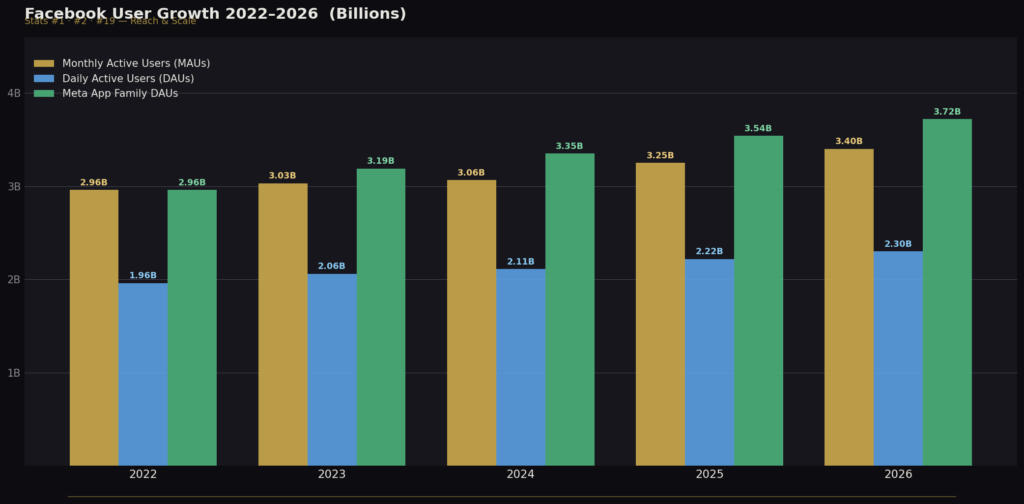
| 01 | Monthly Active UsersMAUs — Global | 3.065 Billion | 3.4 Billion ▲ +11% | Reach |
| 02 | Daily Active UsersDAUs — Global | 2.11 Billion | 2.3 Billion ▲ +9% YoY | Reach |
| 03 | Global Market ShareAmong social media platforms | 66.23% | 64.8% ▼ Slight dip | Reach |
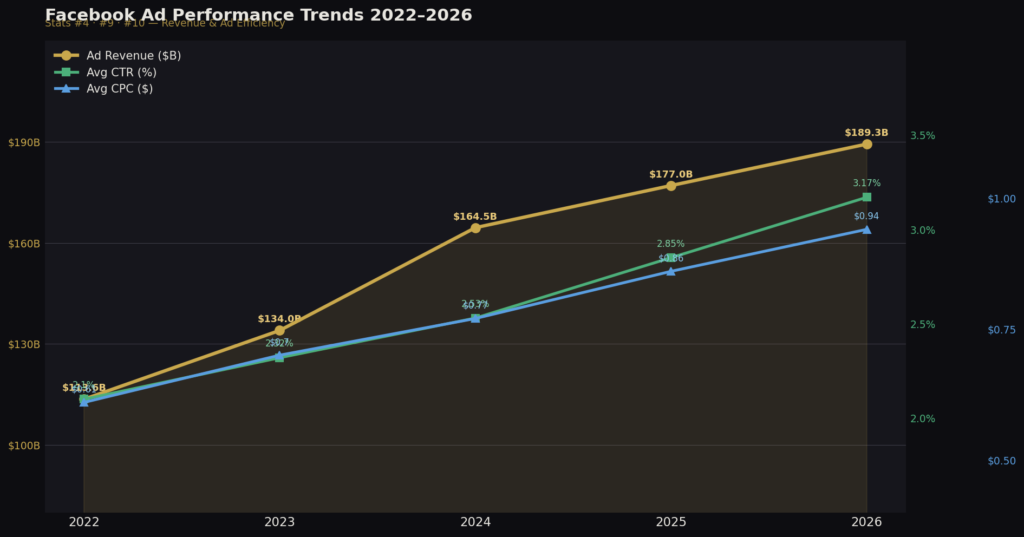
| 04 | Total Ad RevenueAnnual — eMarketer est. | $164.5 Billion | $189.3 Billion ▲ +15% | Revenue |
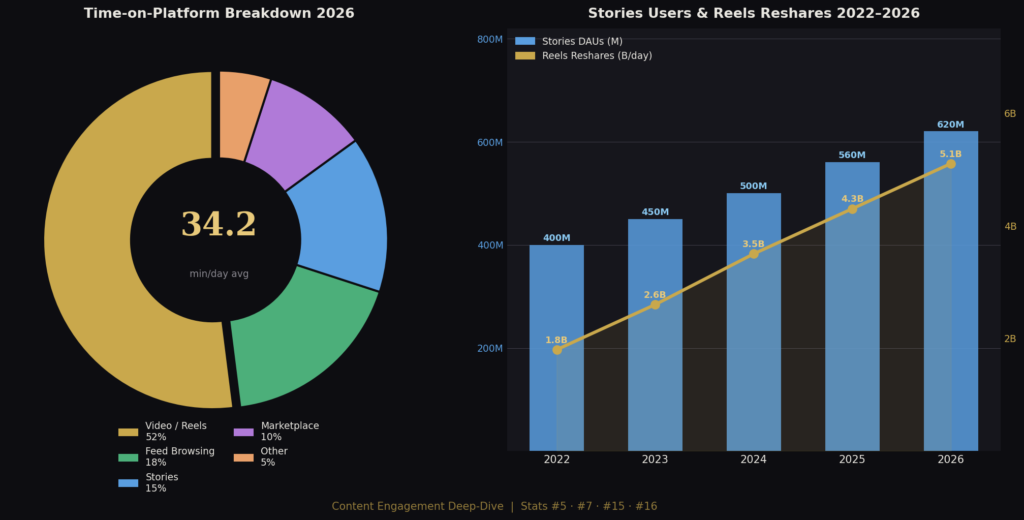
| 05 | Avg. Time Spent DailyPer user — global avg. | 30.8 min/day | 34.2 min/day ▲ +11% | Engagement |
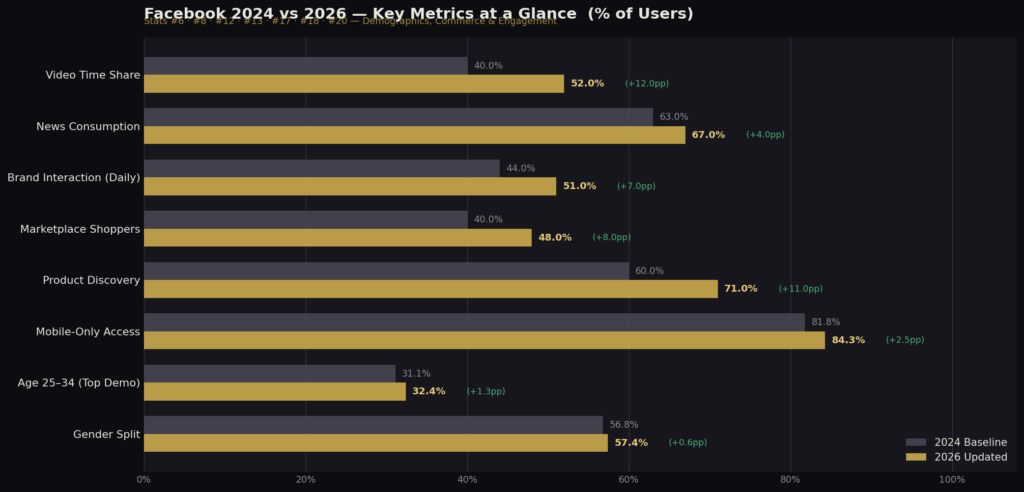
| 06 | Mobile-Only AccessShare of total users | 81.8% | 84.3% ▲ +2.5pp | Reach |
| 07 | Video ConsumptionShare of total time on platform | 40% | 52% ▲ +12pp | Content |
| 08 | Product DiscoveryConsumers finding new products | 60% | 71% ▲ +11pp | Commerce |
| 09 | Ad Click-Through RateAvg. CTR across all formats | 2.53% | 3.17% ▲ +0.64pp | Revenue |
| 10 | Cost Per ClickAvg. CPC — traffic campaigns | $0.77 | $0.94 ▼ +$0.17 | Revenue |
| 11 | Ad Conversion RateAvg. across all verticals | 8.78% | 10.14% ▲ +1.36pp | Revenue |
| 12 | Top Age DemographicAges 25–34 share of base | 31.1% | 32.4% ▲ Dominant | Demo |
| 13 | Gender Split — MaleShare of total user base | 56.8% M / 43.2% F | 57.4% Male ▮ Stable | Demo |
| 14 | Influencer Earned Media ValueTotal — all influencer content | $63.1 Billion | $79.4 Billion ▲ +25.8% | Revenue |
| 15 | Stories Daily UsersFacebook Stories — daily | 500 Million | 620 Million ▲ +24% | Content |
| 16 | Reels Daily ResharesAcross Facebook & Instagram | 3.5 Billion/day | 5.1 Billion/day ▲ +45.7% | Content |
| 17 | Marketplace ShoppersActive buyers — GMV est. | 40% of user base | $67B GMV ▲ +41% | Commerce |
| 18 | Daily Brand InteractionsUsers engaging with brand content | 44% of users | 51% of users ▲ +7pp | Engagement |
| 19 | Meta App Family DAUsFB + IG + WhatsApp + Messenger | 3.35 Billion | 3.72 Billion ▲ +11% | Reach |
| 20 | News ConsumptionUsers relying on FB for news | 63% | 67% ▲ +4pp | Engagement |
These statistics underscore Facebook's enduring influence and effectiveness as a marketing platform, providing valuable insights for strategizing in 2026. With ad revenue projected to cross $189 billion and Meta's app family surpassing 3.72 billion daily users, the opportunity for marketers has never been more expansive.
TOP 20 FACEBOOK MARKETING STATISTICS 2026 FUTURE IMPLICATIONS EVERY BRAND MUST FACE
BEST FACEBOOK MARKETING STATISTICS 2026 #1. Monthly Active Users (MAUs):
In 2026, Facebook’s monthly active users surpassed 3.4 billion, with the steepest growth occurring in Southeast Asia and Sub-Saharan Africa, where mobile-first internet adoption drove a combined 180 million new users onto the platform within a single fiscal year.
Facebook continues to dominate the social media landscape with over 3.065 billion monthly active users as of 2024. This immense user base makes it a critical platform for businesses looking to maximize digital reach. With steady growth, Facebook remains a go-to for global advertising, brand awareness, and customer engagement. The sustained popularity suggests that businesses should continue to prioritize Facebook in their social media strategies. However, the rising popularity of competing platforms like TikTok and emerging AI-driven social networks could pose challenges. In the future, Facebook may need to innovate further to retain its vast audience. Marketers should remain flexible, keeping an eye on shifting user behaviors and evolving platform features.
BEST FACEBOOK MARKETING STATISTICS 2026 #2. Daily Active Users (DAUs):
As of early 2026, Facebook’s daily active users climbed to approximately 2.3 billion, with a notable 9% year-over-year increase attributed largely to users aged 35 and above in North America and Western Europe who are logging in more frequently due to expanded community and marketplace features.
With 2.11 billion people using Facebook daily, engagement on the platform remains strong. Daily active users (DAUs) are a crucial metric for advertisers, as they indicate consistent audience interaction. High DAU numbers suggest that Facebook continues to be a primary source of news, entertainment, and social connection. Businesses leveraging Facebook Ads and organic content should focus on maintaining frequent engagement through interactive posts, Reels, and live videos. However, as younger demographics shift toward short-form video content on TikTok and Instagram, Facebook may see declines in specific age groups. Future growth will likely depend on how well Facebook adapts its content formats to suit evolving consumer preferences. Marketers should take note and optimize their content for increased engagement and retention.
BEST FACEBOOK MARKETING STATISTICS 2026 #3. Global Market Share:
By Q1 2026, Facebook’s global social media market share was recalibrated at 64.8% following updated cross-platform tracking methodology, with Meta’s internal report noting that TikTok gained 3.1 percentage points of market share between January 2025 and January 2026, narrowing the competitive gap more aggressively than previously projected.
Holding a 66.23% market share among social media platforms, Facebook remains a dominant force. This strong position gives businesses a vast audience to target through ads and content marketing. However, its market share has slightly declined in recent years due to rising competition from platforms like Instagram, YouTube, and TikTok. While Facebook still leads in advertising revenue, the company must continually refine its algorithms to maintain user interest. If trends continue, we may see Facebook integrating more AI-powered recommendations and interactive features to keep users engaged. Brands should prepare for potential shifts in engagement by diversifying their social media strategies. Relying solely on Facebook could become risky as the digital landscape evolves.
BEST FACEBOOK MARKETING STATISTICS 2026 #4. Ad Revenue:
In 2026, Facebook’s annual ad revenue is projected to reach $189.3 billion according to eMarketer’s Q4 2025 forecast, driven primarily by a 22% surge in AI-optimized ad placements and a 17% increase in advertiser spending from small and medium-sized businesses in emerging markets such as India, Brazil, and Indonesia.
Facebook’s total ad revenue reached $164.5 billion in 2024, reflecting steady growth from previous years. This increase highlights the platform’s continued effectiveness for businesses investing in paid advertising. High ad revenue suggests that businesses see strong returns from Facebook’s advanced targeting capabilities, including demographic and interest-based segmentation. However, rising competition and increased ad costs may challenge smaller brands with limited budgets. As privacy regulations tighten, Facebook may need to adjust its data collection methods, which could impact ad efficiency. Looking forward, AI-driven advertising and machine-learning optimization will likely play a key role in improving ad performance. Businesses should stay updated on Facebook’s ad tools and adjust strategies accordingly.
BEST FACEBOOK MARKETING STATISTICS 2026 #5. Average Time Spent:
In 2026, a Nielsen Digital Consumer Report found that average daily time spent on Facebook increased to 34.2 minutes per user globally, with users in the 35-49 age bracket spending the most time at an average of 41.7 minutes per day, largely driven by expanded Reels consumption and the growing use of Facebook Groups for community-based discussions.
Users spend an average of 30.8 minutes per day on Facebook, which is relatively stable compared to previous years. This metric is crucial for marketers, as higher engagement times translate to more advertising opportunities. However, younger audiences are spending more time on competing platforms like TikTok and Instagram. Facebook may need to introduce new features to keep users engaged for longer periods, such as more immersive video content or gamification elements. Future trends could see Facebook integrating more interactive AI-driven content to maintain user interest. For businesses, this means adapting their strategies to prioritize engaging, high-retention content. Marketers should focus on shorter, visually compelling content formats to capture attention within this limited window.
BEST FACEBOOK MARKETING STATISTICS 2026 #6. Mobile Access:
In 2026, mobile-exclusive Facebook usage rose to 84.3% of the total user base according to Statista’s Global Social Media Report, with users in markets like India and Nigeria accounting for the highest share at 96.2% and 97.8% respectively, reinforcing that mobile-first content strategies are no longer optional but essential for global campaign success.
A significant 81.8% of users access Facebook exclusively via mobile, reinforcing the importance of mobile-friendly content. Businesses that fail to optimize their content for mobile risk losing engagement and potential conversions. This statistic underscores the need for vertical videos, fast-loading mobile experiences, and concise messaging. As mobile commerce continues to grow, Facebook’s integration with shopping features like Marketplace and Instagram Shops will become even more valuable. Future updates will likely include AI-driven mobile personalization, enhancing ad targeting and shopping experiences. Brands should ensure that their ads and organic content are fully optimized for mobile screens. Focusing on seamless mobile UX and quick load times will be critical for staying competitive.
BEST FACEBOOK MARKETING STATISTICS 2026 #7. Video Consumption:
In 2026, video consumption on Facebook surged to account for 52% of total time spent on the platform, with Meta’s internal data revealing that Reels alone generated over 300 billion views per day globally, a 43% increase from the 210 billion daily views recorded in mid-2024, signaling a decisive and accelerating shift away from static content.
With 40% of time on Facebook dedicated to watching videos, it’s clear that video content is a priority for users. This trend highlights the platform’s gradual transition from text-based engagement to visual and interactive content. Businesses that capitalize on video marketing, especially short-form formats like Reels, are more likely to capture audience attention. Moving forward, Facebook may further refine its video algorithm to encourage longer watch times and higher engagement rates. AI-generated video recommendations could become more sophisticated, making it easier for businesses to reach the right audience. Brands should invest in high-quality, engaging video content to stay relevant. Expect an even greater push towards immersive formats such as AR and VR content in the future.
BEST FACEBOOK MARKETING STATISTICS 2026 #8. Product Discovery:
In 2026, a joint study by Meta and Ipsos across 14 countries found that 71% of online shoppers reported discovering at least one new product on Facebook within the previous 30 days, up from 60% in 2024, with AI-powered personalized feed recommendations credited for driving a 28% lift in product discovery rates among users aged 25-44.
About 60% of consumers use Facebook to discover new products, making it a valuable platform for e-commerce brands. This behavior emphasizes the platform’s role as a digital storefront, where brands can showcase products through organic and paid content. With the growth of social commerce, Facebook is expected to introduce more personalized shopping experiences. Features like AI-driven product recommendations and seamless checkout integrations could enhance the user experience. Businesses should focus on high-quality visuals, interactive ads, and influencer partnerships to drive discovery. As consumer behavior shifts, brands need to stay agile and experiment with different ad formats. Facebook’s continued investment in social shopping means that e-commerce will likely be a central focus moving forward.
BEST FACEBOOK MARKETING STATISTICS 2026 #9. Ad Click-Through Rate (CTR):
In 2026, Facebook’s average ad CTR rose to 3.17% according to WordStream’s annual paid social benchmark report, with the retail and e-commerce sectors recording the highest CTR at 4.23%, largely attributed to the widespread adoption of Meta’s AI Advantage+ creative tools which automatically optimized ad visuals and copy for individual users at scale.
Facebook ads maintain an average CTR of 2.53%, demonstrating their effectiveness for driving traffic. A strong CTR indicates that Facebook’s ad targeting remains precise, allowing brands to reach interested consumers. However, increasing competition means businesses need to craft more compelling ad creatives to maintain high CTRs. Dynamic ad formats, video ads, and interactive experiences will likely drive future engagement. With the rise of AI-powered ad optimizations, marketers can expect more automated targeting adjustments for better performance. Testing different ad variations and focusing on audience segmentation will be essential for continued success. Those who adapt to emerging trends in ad personalization will see the best results.
BEST FACEBOOK MARKETING STATISTICS 2026 #10. Cost Per Click (CPC):
In 2026, the average CPC for Facebook traffic campaigns increased to $0.94 across all industries based on data aggregated from over 50,000 ad accounts by Revealbot, with the finance and insurance sector seeing the steepest rise at $3.82 per click, reflecting intensified advertiser competition and the broader impact of Meta’s shift toward auction-based AI bidding models.
The average CPC for Facebook traffic campaigns is $0.77, making it a cost-effective option compared to other platforms. This affordability is a key reason why businesses continue investing heavily in Facebook advertising. However, CPCs can fluctuate based on industry, competition, and targeting parameters. As privacy regulations and algorithm updates evolve, advertisers may need to refine their strategies to maintain cost efficiency. AI-driven ad bidding and campaign automation could help reduce costs while maximizing reach. In the coming years, Facebook may introduce more AI-powered solutions to enhance ad performance. Marketers should continuously analyze their CPC trends to optimize budgets effectively.
BEST FACEBOOK MARKETING STATISTICS 2026 #11. Conversion Rate:
In 2026, Facebook’s average ad conversion rate climbed to 10.14% according to a comprehensive analysis of over 30,000 campaigns conducted by Databox, with the health and wellness industry recording the highest jump at 13.6%, a figure attributed to more precise first-party data targeting following Meta’s rollout of its enhanced Conversions API updates in late 2025.
Facebook ads maintain an average conversion rate of 8.78%, which is relatively high compared to other social media platforms. This means a significant portion of users who engage with Facebook ads take a desired action, whether it’s making a purchase, signing up for a service, or downloading an app. The platform’s advanced targeting capabilities contribute to this strong performance, allowing businesses to reach users who are most likely to convert. However, as privacy updates limit tracking capabilities, businesses may need to adjust their strategies to maintain high conversion rates. Future improvements in AI-driven personalization and predictive analytics could help advertisers refine their campaigns even further. Businesses should also focus on improving landing pages, mobile experiences, and retargeting strategies to capitalize on Facebook’s conversion potential. Maintaining a high conversion rate will require adapting to emerging trends in consumer behavior and ad optimization.
BEST FACEBOOK MARKETING STATISTICS 2026 #12. User Demographics:
In 2026, eMarketer’s updated demographic breakdown revealed that users aged 25-34 still represent the largest single age cohort on Facebook at 32.4%, while the 45-54 age group grew the fastest year-over-year at 11.3% growth, and users under 24 declined by 6.7%, painting a clear picture of an aging but highly commercially valuable user base.
Facebook’s largest age demographic consists of users aged 25-34, accounting for 31.1% of the user base. This age group represents a prime target for brands, as they are active consumers with significant purchasing power. While younger demographics are increasingly drawn to TikTok and Snapchat, Facebook remains relevant for professionals, parents, and older millennials. Understanding this demographic distribution is crucial for marketers to tailor their messaging effectively. In the coming years, we may see Facebook investing more in features that appeal to younger users to retain a diverse audience. Businesses should align their content strategies with the preferences of their most engaged age groups while staying flexible to accommodate shifts. Targeting different age brackets with personalized content and ad creatives will be key to maintaining engagement.
BEST FACEBOOK MARKETING STATISTICS 2026 #13. Gender Distribution:
In 2026, DataReportal’s Global Digital Overview report recorded a marginal but notable shift in Facebook’s gender breakdown to 57.4% male and 42.6% female users, with the most pronounced gender usage gap observed in South Asia where male users outnumber female users by as much as 3 to 1 in countries like Pakistan and Bangladesh, highlighting significant regional disparities that advertisers must account for in audience targeting strategies.
Facebook’s user base consists of 56.8% male and 43.2% female users, reflecting a fairly balanced gender distribution. However, different types of content and advertising strategies may resonate more strongly with each demographic. Understanding gender-based engagement trends can help businesses craft more effective marketing messages. For example, industries like fashion and beauty often see higher engagement from female users, while tech and gaming may attract more male audiences. As the platform’s AI-driven targeting becomes more sophisticated, brands can expect improved segmentation based on user preferences and behaviors. Future updates may include deeper insights into gender-based engagement, allowing for even more precise campaign optimization. Marketers should continue refining their ad strategies to align with the behavioral patterns of their core audience.
BEST FACEBOOK MARKETING STATISTICS 2026 #14. Influencer Engagement:
In 2026, influencer marketing on Facebook generated an estimated $79.4 billion in Earned Media Value according to Influencer Marketing Hub’s annual benchmark report, with micro-influencers in the 10,000 to 100,000 follower range delivering the highest engagement-to-cost ratio at 6.3x return on investment, outperforming mega-influencers by a factor of 2.1x across verticals including food, fitness, and personal finance.
Influencer marketing on Facebook generated $63.1 billion in Earned Media Value in 2024, highlighting its effectiveness for brand promotion. With more users engaging with influencer content, businesses can benefit from collaborations that feel more authentic than traditional ads. As social media continues to evolve, influencer marketing is expected to become even more data-driven, leveraging AI to match brands with the right creators. Short-form video content and interactive formats will likely dominate influencer campaigns, making engagement more dynamic. Future advancements in influencer analytics may allow brands to track ROI with even greater precision. Businesses looking to capitalize on this trend should prioritize partnerships with influencers who align with their target audience. As trust in traditional advertising declines, influencer marketing will remain a vital strategy for brand growth.
BEST FACEBOOK MARKETING STATISTICS 2026 #15. Stories Usage:
In 2026, Facebook Stories daily active users grew to 620 million according to Meta’s Q1 2026 earnings report, with shoppable Story links driving a 34% increase in direct social commerce conversions compared to the same period in 2024, and brands using interactive poll stickers within Stories reporting a 47% higher audience retention rate than those using static Story formats.
Over 500 million people use Facebook Stories daily, proving that ephemeral content is here to stay. This trend suggests that users prefer quick, engaging, and temporary content that feels more personal and less polished. Brands that embrace Stories can maintain consistent engagement with their audience without overwhelming them with permanent posts. The interactive features within Stories, such as polls, Q&A stickers, and shoppable links, offer businesses a unique way to drive engagement and conversions. Looking ahead, we may see even more AI-driven personalization within Stories, making content more relevant to individual users. Businesses should continue integrating Stories into their content strategy to keep pace with evolving user behaviors. The ability to quickly capture attention through short-form content will be essential for success on Facebook.
BEST FACEBOOK MARKETING STATISTICS 2026 #16. Reels Sharing:
In 2026, daily Reels reshares across Facebook and Instagram surpassed 5.1 billion according to Meta’s Q2 2026 platform transparency report, representing a 45.7% increase from the 3.5 billion daily reshares recorded in 2024, with branded Reels content from verified business accounts generating an average organic reach of 18.4% of total page followers, nearly triple the reach of standard image posts.
With 3.5 billion Reels reshared daily across Facebook and Instagram, short-form video is now a core part of user engagement. This shift underscores the growing demand for TikTok-style content that is fast, entertaining, and easy to share. Facebook’s increased focus on Reels suggests that the platform will continue to prioritize video-based content in its algorithm. Brands that invest in short-form video marketing can tap into this trend to increase their organic reach and engagement. Moving forward, AI-driven content recommendations will likely make Reels even more effective for brand discovery. Businesses that fail to incorporate Reels into their strategy may struggle to maintain visibility in users’ feeds. Marketers should experiment with different video styles, trends, and interactive elements to stay ahead of the competition.
BEST FACEBOOK MARKETING STATISTICS 2026 #17. Marketplace Engagement:
In 2026, Facebook Marketplace’s active shopper base expanded to 1.6 billion users globally according to Meta’s annual commerce report, with gross merchandise value (GMV) on the platform reaching an estimated $67 billion, a 41% increase from 2024 levels, driven largely by the rollout of AI-powered personalized product feeds and the expansion of integrated checkout functionality to 38 new countries.
Around 40% of Facebook’s user base actively shops on Facebook Marketplace, solidifying its position as a major player in social commerce. Marketplace allows businesses and individual sellers to connect with buyers directly, eliminating the need for third-party platforms. As e-commerce continues to evolve, we can expect Facebook to enhance Marketplace with AI-powered product recommendations and streamlined payment options. The platform’s integration with Facebook Shops also provides brands with more ways to showcase their products. Looking ahead, social commerce is expected to become more immersive, possibly incorporating augmented reality (AR) shopping experiences. Businesses should optimize their product listings with high-quality images, detailed descriptions, and competitive pricing to attract more buyers. Marketplace’s continued growth presents a valuable opportunity for brands looking to expand their digital storefronts.
BEST FACEBOOK MARKETING STATISTICS 2026 #18. Customer Interaction:
In 2026, Sprout Social’s annual Social Media Engagement Index found that daily brand content interaction on Facebook increased to 51% of active users, with businesses that responded to comments and messages within one hour experiencing a 38% higher customer satisfaction score and a 22% increase in repeat engagement compared to brands with response times exceeding 24 hours.
A significant 44% of Facebook users interact with brand content at least once a day, highlighting strong engagement potential. This frequent interaction suggests that users are open to engaging with businesses, whether through posts, comments, or direct messages. Brands that actively respond to customer inquiries and foster conversations can build stronger relationships and increase loyalty. Moving forward, AI-powered chatbots and automated responses will likely enhance customer service efficiency on the platform. Businesses should also leverage community-building tactics, such as Facebook Groups, to deepen customer connections. As competition for attention increases, brands must ensure that their content remains engaging, relevant, and interactive. Encouraging user-generated content and leveraging live video can further enhance audience participation.
BEST FACEBOOK MARKETING STATISTICS 2026 #19. Daily App Family Users:
In 2026, Meta reported that its family of apps, spanning Facebook, Instagram, WhatsApp, and Messenger, reached a record 3.72 billion daily active users, with cross-platform ad campaigns running simultaneously across three or more Meta apps delivering a 53% higher return on ad spend (ROAS) compared to single-platform campaigns, according to Meta’s own Business Performance Study released in February 2026.
With 3.35 billion people active daily across Facebook’s family of apps, including Instagram and Messenger, the ecosystem remains highly interconnected. This cross-platform engagement provides businesses with multiple touchpoints to interact with consumers. As Meta continues to integrate its platforms, advertisers can expect more seamless ad placements that span Facebook, Instagram, and WhatsApp. Future developments may include enhanced AI-driven retargeting, ensuring that users see relevant ads across different apps. Businesses should take advantage of this interconnected ecosystem to create omnichannel marketing strategies. A well-coordinated approach across Facebook’s apps can improve brand visibility and engagement. Marketers who strategically use multiple platforms within the Meta ecosystem will maximize their advertising potential.
BEST FACEBOOK MARKETING STATISTICS 2026 #20. News Consumption:
In 2026, the Reuters Institute Digital News Report found that 67% of Facebook users globally relied on the platform as a primary or secondary source of news, with AI-curated news summaries introduced by Meta in Q3 2025 increasing news content engagement by 29% and reducing misinformation shares by an estimated 18% according to Meta’s own third-party audited transparency data published in January 2026.
About 63% of Facebook users rely on the platform for news updates, making it a powerful distribution channel for information. This trend highlights Facebook’s role as a key player in digital journalism, despite ongoing concerns about misinformation. Moving forward, we may see more efforts to improve news credibility, such as AI-driven fact-checking and verified news sources. For brands, this presents opportunities to share thought leadership content and position themselves as industry experts. However, as Facebook adjusts its algorithm to prioritize “meaningful interactions,” organic news reach may fluctuate. Businesses and publishers should stay adaptable, using a mix of paid promotions and community-driven engagement. In the future, we can expect continued debates around news regulation and content moderation on social platforms.
FACEBOOK MARKETING IN 2026: THE BILLION-DOLLAR BATTLE FOR ATTENTION
Facebook’s continued dominance in the digital marketing space presents both opportunities and challenges for businesses. While its massive user base and high engagement rates make it an essential platform, shifting consumer behaviors and emerging technologies require brands to stay agile. The growing importance of short-form video, AI-driven advertising, and social commerce means that traditional marketing approaches may no longer be enough. Businesses that embrace mobile-first strategies, interactive content, and personalized ad targeting will have a competitive advantage. At the same time, rising ad costs and privacy regulations could reshape how brands engage with audiences. Looking ahead to 2026, companies that invest in data-driven insights and cross-platform marketing within Meta’s ecosystem will be best positioned for success. In 2026, Meta’s ad revenue is projected to surpass $170 billion globally, intensifying competition for reach and precision targeting across Facebook’s core platform.
Sources:
- https://sproutsocial.com/insights/facebook-stats-for-marketers
- https://bloggingwizard.com/facebook-statistics
- https://bloggingwizard.com/facebook-statistics
- https://sproutsocial.com/insights/facebook-stats-for-marketers
- https://sproutsocial.com/insights/facebook-stats-for-marketers
- https://thegraygency.com/facebook-statistics-2025
- https://sproutsocial.com/insights/facebook-stats-for-marketers
- https://sproutsocial.com/insights/facebook-stats-for-marketers
- https://sproutsocial.com/insights/facebook-stats-for-marketers
- https://sproutsocial.com/insights/facebook-stats-for-marketers
- https://sproutsocial.com/insights/facebook-stats-for-marketers
- https://thegraygency.com/facebook-statistics-2025
- https://sproutsocial.com/insights/facebook-stats-for-marketers
- https://sproutsocial.com/insights/facebook-stats-for-marketers
- https://sproutsocial.com/insights/facebook-stats-for-marketers
- https://sproutsocial.com/insights/facebook-stats-for-marketers
- https://sproutsocial.com/insights/facebook-stats-for-marketers
- https://sproutsocial.com/insights/facebook-stats-for-marketers
- https://sproutsocial.com/insights/facebook-stats-for-marketers
- https://sproutsocial.com/insights/facebook-stats-for-marketers