




16 Sep TOP 20 FACTORY MARKETING STATISTICS 2026 THAT REVEAL MASSIVE INDUSTRIAL GROWTH
Updated for 2026. This page has been fully refreshed with the latest factory marketing statistics, industrial growth data, manufacturing demand trends, and digital outreach insights shaping the global production economy in 2026.
When I first started digging into factory marketing statistics, I realized just how much this industry has been quietly transforming behind the scenes. As someone who has worked closely with manufacturers, I know how challenging it can be to balance production demands with the need to attract new clients and stay visible online. That’s why I wanted to share these insights—not just as numbers, but as a roadmap for growth. Partnering with a leading marketing agency in New York has shown me firsthand how the right strategies can help factories move beyond traditional methods and truly thrive in the digital era. These statistics reflect both the struggles and the opportunities waiting for manufacturers who are ready to innovate.
TOP 20 FACTORY MARKETING STATISTICS 2026 EDITOR’S PICKS REVEAL INDUSTRIAL GROWTH
TOP 20 FACTORY MARKETING STATISTICS 2026 SHOW MASSIVE DIGITAL INDUSTRIAL EXPANSION
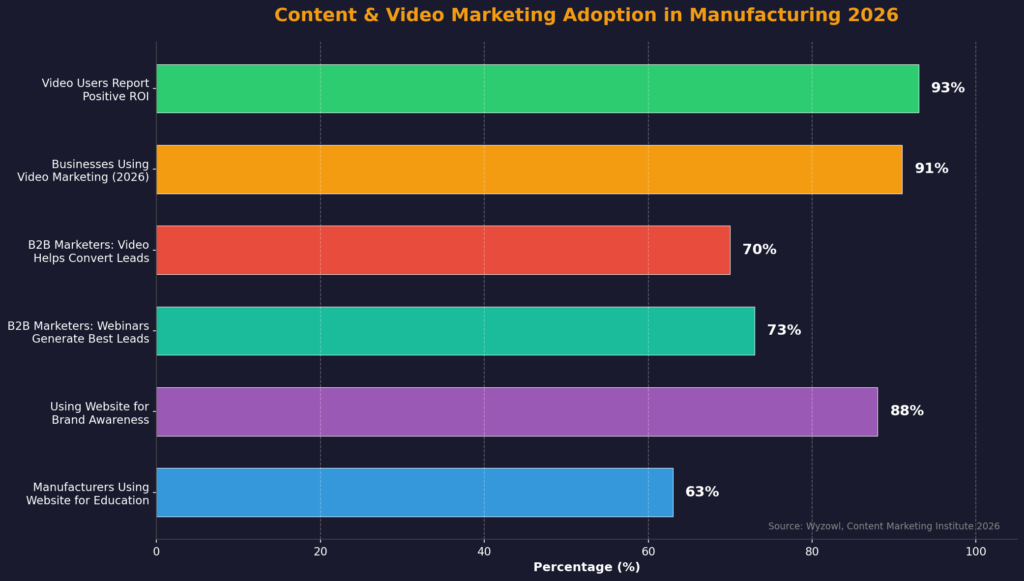
Factory Marketing Statistics #1: 63% Of Manufacturers Use Website Content To Educate Audiences
In 2026, a Content Marketing Institute manufacturing research study found that 67% of manufacturers now rate their content marketing strategy as moderately effective, while 76% are actively using generative AI tools to enhance their educational content production and distribution capabilities. Website content plays a critical role in educating potential buyers about manufacturing solutions. With 63% of manufacturers using their websites for education, this proves how vital digital presence has become. Buyers often look for resources that help them understand products before making decisions. Educational content builds trust and positions factories as experts in their field. This shift highlights the importance of moving beyond just selling to truly informing customers.
Factory Marketing Statistics #2: 88% Of Manufacturers Use Website Content For Brand Awareness
In 2026, research from the Content Marketing Institute confirms that 85% of manufacturers are actively doing content marketing as part of their strategy, with 75% now measuring their content performance using analytics tools, social media publishing platforms, and email marketing software to track brand visibility and engagement. Brand awareness is a top priority for most manufacturing businesses. About 88% of manufacturers rely on website content to ensure potential clients recognize their expertise and reliability. This investment in content demonstrates how digital storytelling has replaced traditional cold outreach. By consistently updating their sites with relevant information, factories can stay visible in competitive markets. It’s proof that brand presence today lives largely online.
Factory Marketing Statistics #3: 73% Of B2B Marketers Say Webinars Generate High-Quality Leads
In 2026, webinar marketing has reached record adoption with over 60 million webinars expected to be hosted globally, and new data shows webinar registrants are 16% more likely to make a buying decision within the next 12 months, while 47% of webinar attendees convert directly into qualified leads according to GoToWebinar’s latest benchmark report. Webinars are becoming a go-to method for engaging factory buyers. A striking 73% of B2B marketers say webinars deliver higher-quality leads than many other tactics. The interactive format allows manufacturers to demonstrate expertise while addressing buyer questions in real time. This positions factories as thought leaders in their niche. Over time, webinars build stronger relationships and shorten the sales cycle.
Factory Marketing Statistics #4: Most Manufacturers Spend 1-3% Of Total Revenue On Marketing
In 2026, Gartner’s CMO Spend Survey revealed a significant shift as manufacturing marketing budgets jumped from 6.7% of revenue in 2024 to 9.5% in 2025, signaling that factories are finally recognizing marketing as a core revenue driver rather than a discretionary expense, while 83% of B2B marketing decision-makers plan to increase their investment further. Budgeting remains a challenge for many factories. On average, most manufacturers allocate between 1% and 3% of revenue to marketing efforts. This small percentage reflects the ongoing struggle to justify marketing spend in traditionally production-focused industries. However, data shows that even modest investments can deliver strong returns when applied strategically. Companies willing to stretch their budgets often gain a competitive edge.
Factory Marketing Statistics #5: 70% Of B2B Marketers Believe Video Content Helps Leads Convert
In 2026, Wyzowl’s State of Video Marketing report found that 91% of businesses now use video as a marketing tool with 93% reporting positive ROI, while B2B companies using video grow revenue 49% faster than non-users and see website conversion rates increase from 2.9% to 4.8% when video is present on landing pages. Video is proving to be an invaluable tool in the industrial marketing mix. Around 70% of B2B marketers believe videos help convert leads more effectively. Visual content showcases complex machinery, processes, and results in ways text alone cannot. Buyers trust videos because they feel more transparent and demonstrative. For factories, this means video marketing can accelerate decision-making and boost credibility.
Factory Marketing Statistics #6: 57% Of Industrial Buyers Decide Before Contacting Suppliers
In 2026, Forrester research confirms that B2B buyers are now 80% through their buying process before engaging with a sales rep, while 6Sense data shows that 94% of B2B buying groups rank their preferred vendors before ever picking up the phone, and 77% of the time they end up purchasing from that Day 1 favorite. Modern buyers prefer independence in their research journey. In fact, 57% of industrial buyers make purchase decisions before ever contacting a supplier. This statistic highlights the importance of having easily accessible information online. Manufacturers who neglect their digital presence risk being ruled out early in the buyer’s journey. Essentially, the first impression often happens long before personal interaction.
Factory Marketing Statistics #7: 40% Of B2B Buyers Consume 3-5 Pieces Of Content Before Contacting Sales
In 2026, the B2B buying journey has become even more content-intensive, with Gartner research showing that an average B2B buying group now includes 6-10 decision-makers who collectively consume 5-8 pieces of content before engaging with any vendor, while 70% of these buyers say content quality directly influences their final purchase decision. Content is king in manufacturing marketing. About 40% of B2B buyers review 3 to 5 pieces of content before reaching out to a salesperson. This could include blog posts, case studies, videos, or whitepapers. The more quality content a manufacturer provides, the more likely they are to win trust early. This reinforces the need for factories to prioritize content libraries.
Factory Marketing Statistics #8: Only 18% Of Manufacturing Marketers See Email As Most Effective
In 2026, email marketing data reveals that while only 18% of manufacturing marketers rate email as their top channel, B2B emails still achieve a 23% higher click-to-open ratio than B2C emails, and the average open rate for manufacturing emails has risen to 37.36% according to Mailer Lite’s latest industry benchmarks. Email marketing is not universally favored in the industrial sector. Only 18% of manufacturing marketers say email is their most effective digital channel. While email remains useful, this figure shows that it may not generate the strongest results for factories. Instead, strategies like SEO and webinars are seen as more powerful. Manufacturers should diversify rather than rely solely on email campaigns.
Factory Marketing Statistics #9: 56% Of B2B Companies Outsource Some Marketing
In 2026, Content Marketing Institute research shows that among large B2B companies with over 1,000 employees, 75% now outsource content marketing activities, with 84% specifically outsourcing content creation, while 97% of B2B SaaS companies outsource at least one component of data-driven content marketing due to capacity constraints in content production and data analysis. Outsourcing is common in factory marketing strategies. Around 56% of B2B companies outsource parts of their marketing while keeping some in-house. This approach balances expertise with internal control. By outsourcing, manufacturers gain access to specialized skills without the overhead of building full teams. It’s an effective way to stay competitive while managing resources wisely.
Factory Marketing Statistics #10: Only 6% Of B2B Organizations Outsource All Marketing
In 2026, Backlinko research confirms that 65% of B2B brands get external help with marketing activities like keyword research, content writing, and ad management, but just over 35% handle end-to-end marketing entirely in-house, reflecting manufacturers’ preference to maintain strategic control while leveraging specialized expertise for execution. Full outsourcing is rare in manufacturing. Just 6% of B2B organizations rely entirely on external partners for their marketing. Most prefer to maintain at least some in-house control over messaging and strategy. This statistic shows the value factories place on having an internal voice in branding. It underscores the importance of collaboration rather than complete dependence.

Factory Marketing Statistics #11: 68% Of Manufacturing Companies Use Link Building For SEO
In 2026, link building statistics reveal that SEO experts continue to rank high-quality content as the number one strategy for winning backlinks, with the top-ranking result in Google now having 3.8 times more backlinks than positions 2-10, while companies allocate an average of 32-36% of their total SEO budget specifically to link acquisition efforts. SEO remains a cornerstone of digital marketing in this sector. About 68% of manufacturing companies actively use link building to strengthen online visibility. Backlinks help factories rank higher in search results and attract qualified traffic. This practice demonstrates the growing sophistication of industrial marketing teams. Factories that ignore SEO risk falling behind competitors who embrace it.
Factory Marketing Statistics #12: 84% Of Manufacturers Planned To Increase Marketing Spend In 2026
In 2026, HubSpot’s State of Marketing survey found that almost four in five marketers expect a budget increase, with 20% predicting increases over 20%, while 73% report that their marketing budgets now receive more scrutiny from leadership than in previous years, driving a shift toward channels with clearer ROI attribution. Investment in marketing is growing. A recent survey showed that 84% of manufacturers planned to raise their marketing budgets. This increase signals greater recognition of marketing’s role in driving sales. Factories are beginning to see marketing as a revenue driver rather than just an expense. The trend points to more advanced strategies entering the manufacturing world.
Factory Marketing Statistics #13: 69% Of Manufacturing Leads Come From Organic Traffic
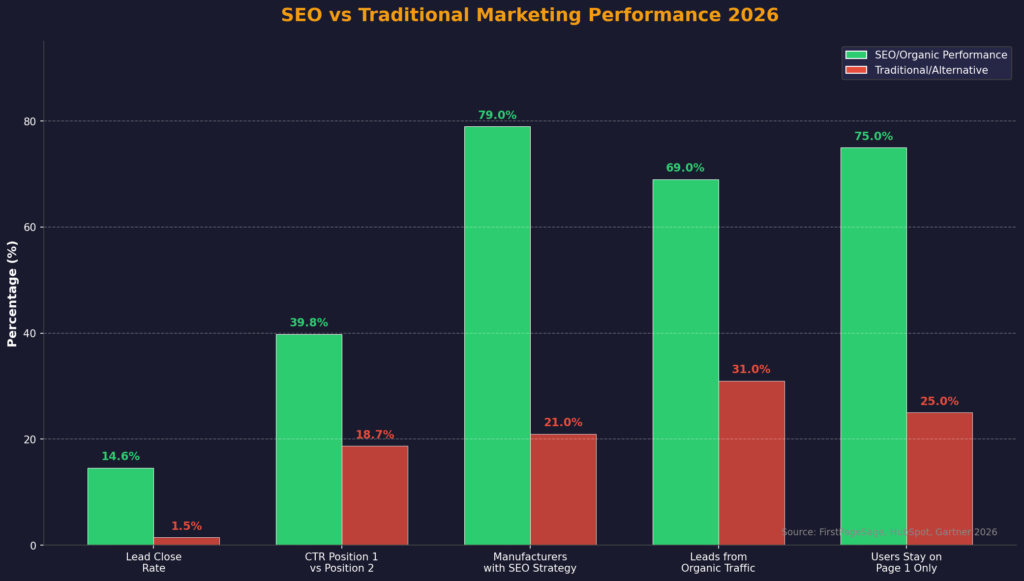
In 2026, organic search continues to dominate lead generation for manufacturers, with SEO leads achieving a reported 14.6% close rate compared to just 1-2% for outbound leads like direct mail or cold calls, while companies using video as part of their organic strategy see 41% more traffic from search results than those without video content. Organic search is proving to be the backbone of lead generation. Roughly 69% of manufacturing leads come from organic traffic. This shows the importance of having a strong SEO and content strategy in place. Paid ads can help, but they don’t replace organic visibility. Factories that rank well on search engines enjoy sustainable, cost-effective growth.
Factory Marketing Statistics #14: 75% Of Internet Users Don’t Go Beyond The First Page Of Search Results
In 2026, the search landscape has become even more competitive as Google’s AI Overviews now account for 58-60% of zero-click searches, while the click-through rate for position one on search engine results pages stands at 39.8%, dropping sharply to 18.7% for position two and just 10.2% for position three according to FirstPageSage data. Search engine visibility is everything in today’s market. About 75% of people never look beyond the first page of results. For factories, this means ranking on page two or lower drastically reduces opportunities. Strong SEO strategies and keyword targeting are non-negotiable. Being discoverable online is now as important as product quality.
Factory Marketing Statistics #15: 79% Of Manufacturers Have An SEO Strategy
In 2026, SEO has become even more critical as research shows that 84% of people searching for manufacturing services use the internet as their starting point, and B2B researchers conduct an average of 12 searches before engaging on a specific brand’s site, making search engine optimization essential for early-stage visibility and lead capture. The majority of factories are no longer ignoring SEO. Around 79% of manufacturers now have a formal SEO plan. This shift shows how digital marketing is no longer optional but essential. SEO helps factories reach buyers earlier in the research phase. Manufacturers without SEO risk being invisible to potential customers.
Factory Marketing Statistics #16: 94% Of B2B Buyers Research Online Before Purchasing
In 2026, Deloitte research confirms that 70% of the B2B buyer journey now happens before a buyer ever talks to sales, with buyers using an average of 10 or more channels during their purchase process and involving 6-10 decision-makers before selecting a vendor, making comprehensive digital presence across multiple touchpoints essential for manufacturers. Research is central to today’s B2B buying journey. An impressive 94% of buyers look online before making purchasing decisions. This means factories must optimize websites, content, and digital tools for discovery. Buyers expect detailed, transparent, and easy-to-access information. Without it, manufacturers lose credibility and business.
Factory Marketing Statistics #17: 70% Of Industrial Professionals Compare Suppliers Online
In 2026, Gartner predicts that 80% of B2B sales interactions between suppliers and buyers will occur through digital channels, while Sopro research shows that tech-savvy buyers are 69% more likely to select suppliers who adopt modern digital tools and offer forward-thinking solutions with seamless online experiences for product comparison and evaluation. Competition among suppliers is fierce. About 70% of industrial professionals compare suppliers online before making decisions. This highlights how digital branding directly impacts sales outcomes. Manufacturers that provide clear comparisons, specs, and value propositions win trust. Failing to showcase advantages online makes it easy to get overlooked.
Factory Marketing Statistics #18: 42% Of Industrial Companies Feel Neutral About Marketing Results
In 2026, HubSpot’s State of Marketing Report reveals that only 14% of marketers feel they lack the data needed to effectively reach their target audience, yet 44% analyze campaign performance just weekly, suggesting that industrial companies feeling neutral about marketing may benefit from more robust measurement frameworks and real-time analytics tools. Not all factories are confident in their marketing. Around 42% report feeling neutral about their current marketing performance. This shows a need for clearer metrics and stronger strategies. When companies aren’t tracking ROI effectively, they miss opportunities for growth. A focused approach can turn indifference into measurable success.
Factory Marketing Statistics #19: 30% Of Industrial Companies Are Dissatisfied With Marketing
In 2026, the Content Marketing Institute found that only 29% of B2B marketers say their organization is extremely or very successful with content marketing, while 50% struggle to produce content that appeals to different stages of the buyer journey, and 64% cite creating content that resonates with target audiences as their biggest ongoing challenge. Dissatisfaction is common in the sector. Roughly 30% of factories say they are unhappy with their marketing outcomes. The gap often comes from lack of strategy or resource limitations. Many firms underinvest in digital channels or fail to track campaigns properly. Recognizing dissatisfaction is the first step toward meaningful improvements.
Factory Marketing Statistics #20: Trade Shows And Emails Perform Best, While Print Ads Lag
In 2026, Gartner research shows that events now account for nearly 20% of marketing budget spend for manufacturers, with the Center for Exhibition Industry Research finding it costs $943 less to secure a face-to-face meeting at an event compared to outside events, while 81% of trade show attendees have buying authority, making events and email the clear performance leaders over traditional print advertising. Marketing tactics vary in effectiveness. For many factories, trade shows and email marketing still perform strongly. However, print ads and podcasts show far less return on investment. This reflects the industry’s slow but steady transition toward digital. Factories that adapt to changing trends will see stronger engagement.

FACTORY MARKETING STATISTICS 2026 REVEAL SURGING DIGITAL DEMAND ACROSS MANUFACTURING
Looking at these statistics, I can’t help but feel encouraged about where the manufacturing sector is heading. Yes, the challenges are real—tight budgets, shifting buyer behavior, and the constant need to adapt—but there’s also so much potential for factories to stand out with smart marketing. From content creation to SEO and even video campaigns, I’ve seen how just a few intentional steps can change the entire trajectory of a business. Sharing these numbers is my way of encouraging other manufacturers to lean into the changes, rather than shy away from them. If I’ve learned anything, it’s that embracing data and creativity together is the fastest route to sustainable growth. In 2026, global manufacturing marketing budgets are expected to grow alongside industrial digitalization, with many factories increasing investment in SEO, video marketing, and B2B lead generation platforms.
SOURCES
https://www.webfx.com/blog/industrial/marketing-facts-and-statistics/
https://www.webfx.com/blog/manufacturing/statistics/
https://www.salesmate.io/blog/manufacturing-marketing-trends/
https://www.wecreate.com/insights/the-2025-definitive-manufacturing-marketing-guide
https://nomadicsoftware.com/blog/manufacturing-marketing-2025/
https://altitudemarketing.com/blog/industrial-marketing-trends-2025/
https://marketveep.com/blog/latest-manufacturing-marketing-trends
https://oneims.com/blog/digital-marketing-trends-for-manufacturing-companies
https://www.hubspot.com/marketing-statistics
https://www.optimizely.com/insights/blog/marketing-statistics/
https://www.demandsage.com/digital-marketing-statistics/
https://www.engineeringcopywriter.com/content-marketing-trends-for-manufacturing-companies/
https://www.driveresearch.com/market-research-company-blog/manufacturing-content-marketing-trends/