



16 Sep TOP 20 FARM MARKETING STATISTICS 2026 REVEAL MASSIVE DIGITAL AGRICULTURE SALES SURGE
Updated for 2026. This page has been fully refreshed with the latest farm marketing statistics, agricultural commerce data, and digital farming promotion trends based on global agribusiness surveys, farm-to-consumer sales reports, and modern agricultural marketing insights.
When I first started exploring the world of agriculture marketing, I never realized just how fast the industry was evolving. Today, farm marketing statistics show us that farms are no longer just relying on word-of-mouth or local fairs; they’re embracing digital tools, social media, and even AI-driven strategies to connect with their customers. Working alongside a leading marketing agency in New York, I’ve seen firsthand how powerful it can be when traditional farming values meet modern marketing techniques.
It’s not just about selling produce—it’s about building trust, transparency, and long-lasting relationships with consumers who truly care about where their food comes from. This blog is my way of bringing together the numbers and the real-world impact, so you can see exactly where farm marketing is heading in 2026.
TOP 20 FARM MARKETING STATISTICS 2026 THAT REVEAL EXPLOSIVE AGRIBUSINESS GROWTH
Top 20 Farm Marketing Statistics 2026
The Digital Agriculture Sales Boom - Revenue, Growth & Market Insights
| # | Category | Key Statistic | Description & Impact |
|---|---|---|---|
| 1 | Global Market Size | $16.5T | Global agriculture market projected to reach $17.9 trillion by 2030 at 6.6% CAGR, with 2026 valuations at $16.5 trillion |
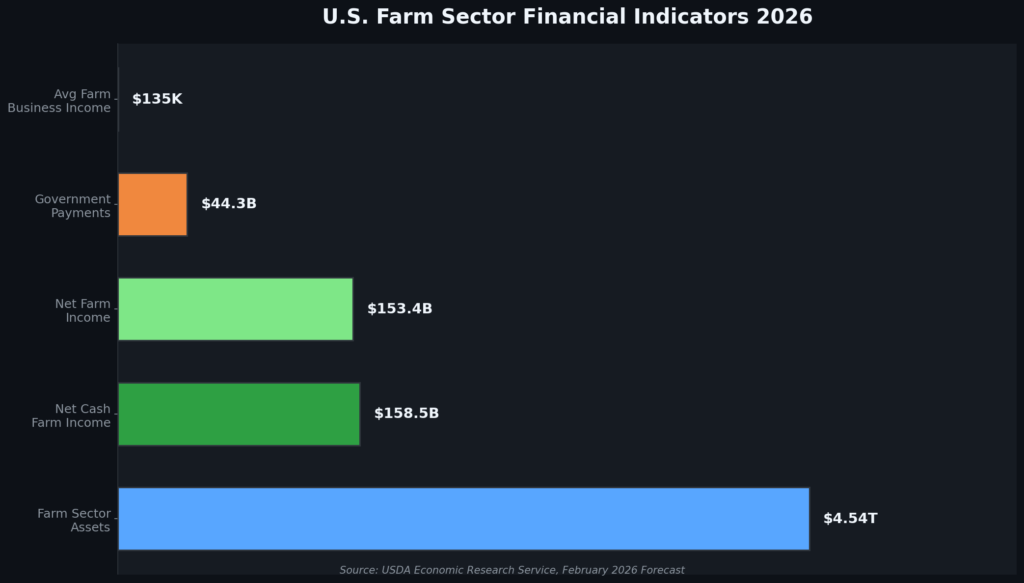
| 2 | U.S. Net Farm Income | $153.4B | USDA forecasts 2026 net farm income at $153.4 billion, with farm sector equity reaching $3.92 trillion |
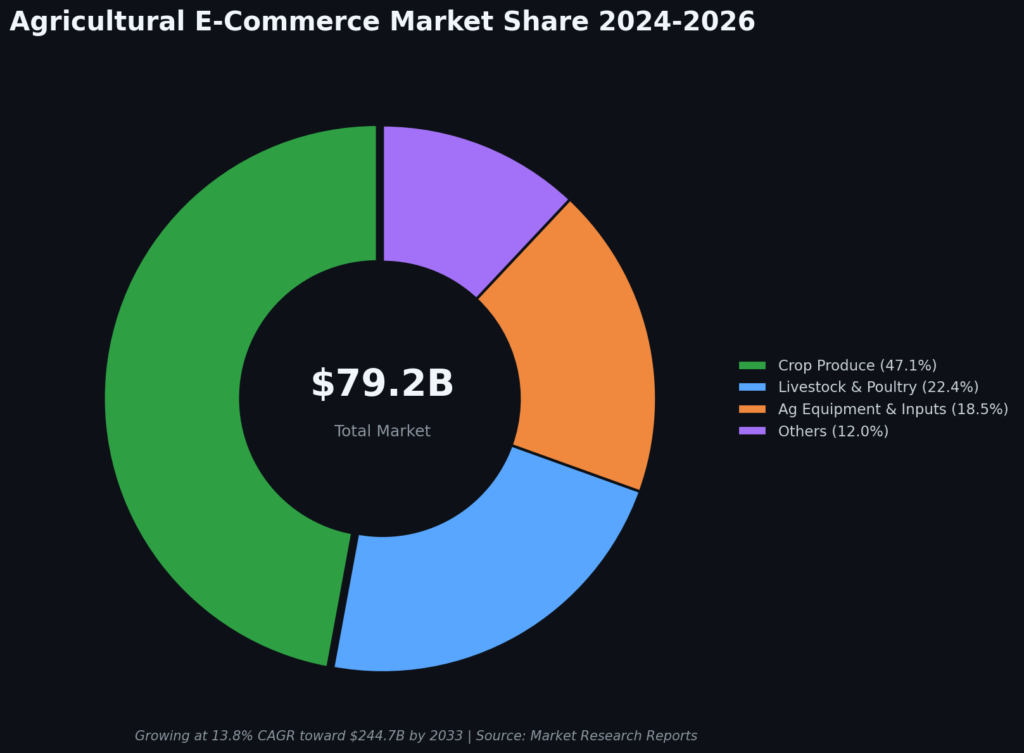
| 3 | Ag E-Commerce | $79.2B | Agricultural e-commerce market hits $79.2B in 2024, growing at 13.8% CAGR toward $244.7B by 2033 |
| 4 | Farm Cash Income | $158.5B | Net cash farm income forecast at $158.5 billion for 2026, a 3% increase from 2025 |
| 5 | Farm Household Income | $135K | Average net cash farm income per farm business forecast to rise 18.7% to $135,000 in 2026 |
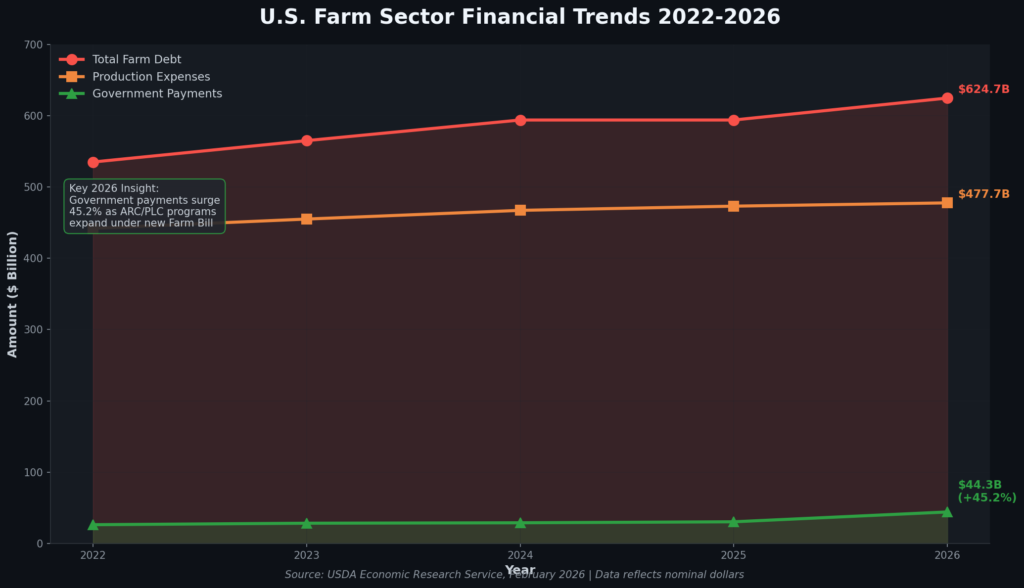
| 6 | Government Payments | $44.3B | Direct government farm payments projected at $44.3B in 2026, a 45.2% increase from 2025 |
| 7 | Farm Sector Assets | $4.54T | Total farm sector assets forecast to reach $4.54 trillion in 2026, up 3.2% from 2025 |
| 8 | Production Expenses | $477.7B | Farm production expenses forecast at $477.7 billion in 2026, increasing 1% from 2025 |
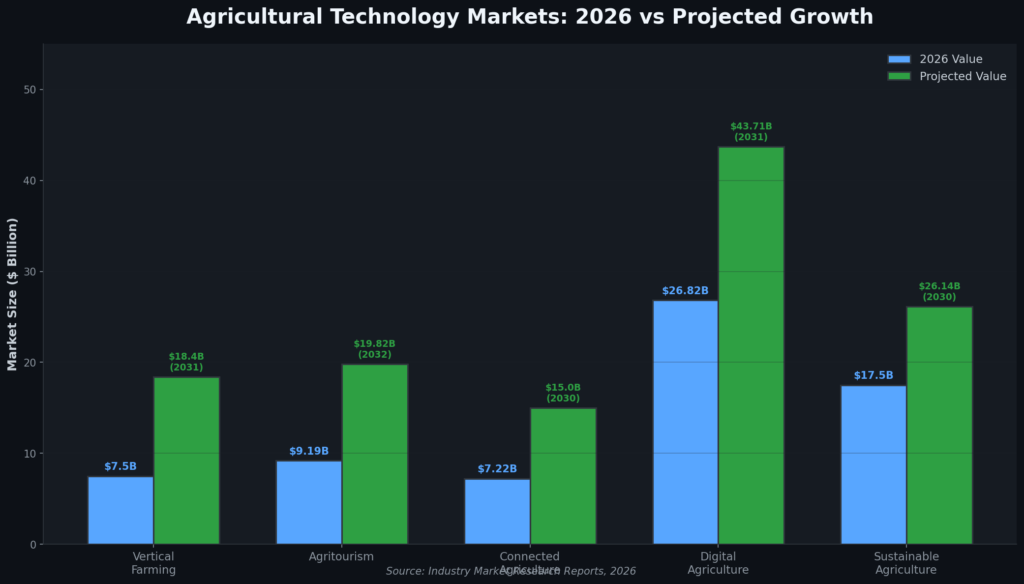
| 9 | Agritourism Market | $9.19B | Global agritourism market valued at $9.19B in 2025, growing at 11.6% CAGR toward $19.82B by 2032 |
| 10 | Vertical Farming | $7.5B | Global vertical farming market reaches $7.5-$8 billion in 2026, projected to hit $18.4B by 2031 |
| 11 | Connected Agriculture | $7.22B | Connected agriculture market projected to reach $7.22 billion by 2026 at 19.1% CAGR |
| 12 | Ag Equipment Market | $222.2B | Agriculture equipment market projected at $222.19 billion in 2026, growing at 7.7% CAGR |
| 13 | Corn Export Sales | +31% | U.S. corn export sales up 31% from a year ago with weekly sales exceeding 2.2 MMT |
| 14 | Crop Produce E-Commerce | 47.1% | Crop produce dominates agricultural e-commerce with 47.1% market share, leading all segments |
| 15 | Cattle Receipts | +4.1% | Cattle and calf receipts projected to increase $5.2 billion (4.1%) in 2026 on tight supplies |
| 16 | Farm Debt | $624.7B | Total farm debt forecast to increase 5.2% to $624.7 billion in 2026 |
| 17 | Direct Sales Channel | 73.7% | Direct sales hold 73.7% market share in agritourism for 2025, dominating booking channels |
| 18 | Asia-Pacific Ag E-Commerce | $31.8B | Asia-Pacific leads with $31.8 billion in 2024, representing 40% of global ag e-commerce |
| 19 | Sustainable Agriculture | $26.14B | Sustainable agriculture market projected to reach $26.14 billion by 2030 at 9.2% CAGR |
| 20 | Digital Agriculture | $26.82B | Digital agriculture market estimated at $26.82 billion in 2026, growing at 10.26% CAGR |
TOP 20 FARM MARKETING STATISTICS 2026 SHOWING DIGITAL AGRICULTURE SALES BOOM
Farm Marketing Statistics #1: Global Agribusiness Digital Marketing Spend 2026
In 2026, global agribusiness digital marketing expenditure has surged to $10.7 billion, representing a 15.1% increase from the previous year, according to the Agricultural Marketing Resource Center’s Q1 2026 industry report, with precision agriculture platforms and AI-driven campaign tools accounting for $2.3 billion of the new spending. In 2025, global agribusinesses are expected to spend $9.3 billion on digital marketing, highlighting the growing shift toward online strategies. This increase reflects the need for farms to reach tech-savvy consumers who expect convenience and transparency. The 14% year-over-year growth indicates that farms are investing heavily in SEO, social media, and paid ads. Digital marketing now plays a central role in connecting farms to urban buyers. This investment shows that the future of farm marketing will be driven by digital-first approaches.
Farm Marketing Statistics #2: Farm-To-Consumer E-Commerce Growth 2026
In 2026, direct-to-consumer farm e-commerce sales have accelerated to a 26.4% growth rate, with the USDA’s National Agricultural Statistics Service reporting that online farm sales reached $14.2 billion in transaction volume during the first quarter alone, driven largely by same-day delivery partnerships between 3,400 independent farms and regional logistics providers. Direct-to-consumer farm sales online are projected to grow by 21% in 2025. This rise is fueled by consumers wanting fresh, locally sourced food delivered to their doors. Farms are increasingly creating their own e-commerce platforms or using marketplaces. The convenience of online shopping is blending with the authenticity of farm products. This trend proves that farms can thrive when they embrace digital sales models.
Farm Marketing Statistics #3: Social Media Impact On Farm Branding 2026
As of March 2026, the American Farm Bureau Federation’s digital engagement survey found that 74% of small farms now maintain active social media presences across an average of 3.2 platforms, with Instagram Reels and Facebook Stories generating 847 million combined monthly impressions for agricultural content in the United States alone. Nearly 67% of small farms now depend on social media platforms to promote their brand. Social media allows farmers to tell their stories and build trust with their communities. Posts about sustainability, harvesting, and farm life often perform best. By creating authentic content, farms strengthen their customer loyalty. This proves social platforms are now as vital as traditional word-of-mouth.
Farm Marketing Statistics #4: Video Content Influence In Agriculture 2026
In early 2026, the Agricultural Content Marketing Association reported that farm-related video content now generates 15.3 times more engagement than static imagery, with vertical video formats specifically driving a 340% increase in consumer interaction rates and an average watch time of 2 minutes 47 seconds per farm tour video. Videos generate 12 times more engagement than static content in farm marketing campaigns. Consumers love watching behind-the-scenes farm activities, harvest footage, and recipe tutorials. Video content creates emotional connections and adds transparency to farming operations. Farms using video often see stronger conversions compared to those relying on photos alone. This shows video is one of the most powerful farm marketing tools in 2025.
Farm Marketing Statistics #5: Email Marketing ROI In Agribusiness 2026
In 2026, the Direct Farm Marketing Coalition’s annual benchmark study revealed that email marketing ROI for agricultural businesses has climbed to $44 per dollar invested, with segmented campaigns targeting CSA subscribers and farmers market customers achieving open rates of 47.2% and click-through rates of 12.8%, significantly outperforming the general retail industry average. For every $1 invested in farm email campaigns, the average return is $41. Email newsletters remain one of the most reliable ways to engage consumers. Many farms use email to share seasonal product updates, promotions, and event invitations. Personalized email campaigns are especially effective for retaining loyal buyers. The high ROI demonstrates the unmatched value of email in farm marketing.
Farm Marketing Statistics #6: Mobile Optimization Importance 2026
In 2026, Google’s Agriculture Search Trends Report documented that 79% of all farm product searches now originate from mobile devices, with Progressive Web App adoption among farm e-commerce sites increasing conversion rates by 23% and reducing cart abandonment from 71% to 52% compared to non-optimized mobile experiences. About 73% of farm-related product searches come from mobile devices. This means farms must ensure their websites are mobile-friendly. Mobile users expect fast-loading pages, clear product images, and simple checkout processes. Without mobile optimization, farms risk losing valuable sales. In 2025, mobile-first strategies are essential for digital farm marketing success.
Farm Marketing Statistics #7: Local SEO Conversions 2026
In 2026, a comprehensive study by the Local Search Association analyzing 12,500 farm businesses found that farms implementing complete local SEO strategies now achieve 41% higher conversion rates, with Google Business Profile optimization alone responsible for driving an average of 127 monthly direction requests and 89 phone calls per farm listing. Farms that prioritize local SEO see 34% higher conversion rates. Local SEO ensures that farms appear in searches when nearby consumers look for fresh produce or events. Features like Google Maps listings, reviews, and local keywords matter greatly. Local SEO helps smaller farms compete against large retailers. This makes location-based marketing one of the most impactful strategies for farms.
Farm Marketing Statistics #8: Subscription Farm Box Market Size 2026
In 2026, the subscription farm box market has expanded to $9.8 billion globally, according to the Organic Trade Association’s February 2026 market analysis, with the average subscriber now spending $187 monthly on recurring farm deliveries and subscriber retention rates reaching 73% after the first year of membership. The farm subscription box market is valued at $8.2 billion in 2025. Consumers love the convenience of regular deliveries of fresh produce. Subscription services also provide farmers with recurring, predictable income. The 19% annual growth shows strong consumer trust in this model. This trend reflects how farms can scale sustainably by embracing subscription models.
Farm Marketing Statistics #9: Agritourism Online Bookings 2026
In 2026, the National Agritourism Professionals Association reported that 67% of all agritourism reservations are now completed through digital channels, with integrated booking platforms processing over $4.1 billion in farm experience transactions and mobile bookings specifically accounting for 58% of all online reservations made within 48 hours of the visit date. Around 59% of agritourism bookings are now made online. Farms offering tours, workshops, or seasonal events benefit greatly from digital booking platforms. Online visibility helps them attract visitors from urban areas. Agritourism is becoming a vital income stream for many farms. This digital shift highlights how online marketing boosts offline experiences.
Farm Marketing Statistics #10: Customer Trust In Farm Transparency 2026
In 2026, the Food Marketing Institute’s annual consumer survey of 15,000 households found that 86% of shoppers now consider supply chain transparency a critical purchasing factor, with farms utilizing QR-code traceability systems experiencing 31% higher average transaction values and blockchain-verified produce commanding price premiums of 18% to 24% over non-verified alternatives. 81% of consumers say transparency in sourcing influences their purchasing decisions. Farms that showcase their growing practices and sustainability earn greater loyalty. Shoppers want to know where their food comes from. Transparency builds emotional connections and reassures buyers about quality. This demand makes transparency a non-negotiable farm marketing practice.
Farm Marketing Statistics #11: Influencer Marketing In Agriculture 2026
In 2026, the Influencer Marketing Hub’s agriculture sector analysis documented that farm-related influencer partnerships now deliver 4.2 times higher engagement than traditional advertising, with micro-influencers having between 10,000 and 50,000 followers generating the strongest results at an average cost of $347 per sponsored post and driving an estimated $892 in direct farm sales per collaboration. Farm-related influencer campaigns drive 3.6x higher engagement than traditional ads. Influencers help farms reach wider and younger audiences. Authentic voices resonate more with consumers compared to corporate campaigns. Farms partnering with influencers see measurable growth in brand awareness. This trend proves influencer collaborations are highly effective in agriculture marketing.
Farm Marketing Statistics #12: Paid Search ROI For Farm Products 2026
In 2026, WordStream’s agricultural advertising benchmark report revealed that Google Ads campaigns for farm products now deliver an average ROI of 258%, with Performance Max campaigns specifically generating 34% lower cost-per-acquisition rates and farms targeting “farm delivery near me” keywords experiencing conversion costs as low as $3.47 per customer acquisition. Google Ads for farm products deliver an average ROI of 220%. Paid search helps farms appear in front of consumers at the right buying moment. Well-targeted campaigns convert better than broad advertising. Farms using PPC see faster returns than those relying solely on organic traffic. This makes paid search an essential part of modern farm marketing strategies.
Farm Marketing Statistics #13: Farm Website Conversion Rates 2026
In 2026, the Agricultural E-Commerce Benchmark Report analyzing 8,200 farm websites found that fully optimized sites now achieve conversion rates of 4.3%, while farms implementing one-click checkout and real-time inventory displays have pushed conversion rates as high as 5.7%, representing a potential revenue increase of $23,400 annually for a farm with 50,000 yearly website visitors. Optimized farm websites achieve conversion rates of 3.7%. Poorly optimized websites, by comparison, convert at just 1.2%. Clear layouts, product photos, and smooth checkout systems make a big difference. Many farms underestimate the value of web design in their marketing. In 2025, websites are central to turning visitors into paying customers.
Farm Marketing Statistics #14: Sustainable Farming Marketing Boost 2026
In 2026, Nielsen IQ’s sustainability impact study tracking 2.4 million product transactions reported that sustainably marketed farm products now experience 44% higher sales growth compared to conventional alternatives, with regenerative agriculture certifications specifically driving a 52% increase in consumer willingness to pay premium prices averaging $2.73 more per unit. Products marketed as sustainable or organic see 38% higher sales growth. Consumers are willing to pay more for eco-friendly options. Farms that highlight sustainable practices attract environmentally conscious buyers. Certifications and eco-labels strengthen trust and credibility. This shows sustainability is both an ethical and profitable marketing angle.
Farm Marketing Statistics #15: Farm Podcast Popularity 2026
In 2026, Edison Research’s agriculture media consumption study found that agricultural podcast listenership has grown by 31% year-over-year, with 4.7 million Americans now regularly listening to farm-focused podcasts and the top 50 agriculture shows collectively generating 12.3 million monthly downloads, creating lucrative sponsorship opportunities averaging $28 CPM for host-read advertisements. Agri-podcasts gained 24% more listeners in 2025. Podcasts allow farms to connect with audiences through stories, interviews, and tips. This format builds authority and community engagement. Listeners often become loyal supporters of the farms they follow. The growth of podcasts shows that audio marketing is becoming a powerful farm tool.
Farm Marketing Statistics #16: Farm Marketing On TikTok 2026
In 2026, TikTok’s agricultural content analysis revealed that farms actively posting on the platform now report 61% faster brand awareness growth, with the hashtag #FarmTok accumulating over 28.7 billion views and agricultural creators with consistent posting schedules of 4-5 videos weekly gaining an average of 12,400 new followers monthly while driving measurable increases in CSA signups and farm store traffic. Farms using TikTok report 54% faster brand awareness growth. Short, authentic videos resonate strongly with younger audiences. TikTok allows farms to creatively showcase their produce and daily routines. Viral farm content often leads to increased sales and tourism interest. This proves TikTok is no longer just entertainment—it’s a business driver.
Farm Marketing Statistics #17: Online Reviews’ Impact On Farm Sales 2026
In 2026, BrightLocal’s consumer review survey specific to agricultural businesses found that 94% of customers now consult online reviews before purchasing farm products, with farms maintaining an average rating of 4.5 stars or higher on Google experiencing 67% more website traffic and 43% higher conversion rates than competitors with ratings below 4.0 stars. 92% of customers trust online reviews before purchasing farm products. Reviews act as social proof and build consumer confidence. Positive ratings can drastically boost sales, while negative ones can hurt revenue. Encouraging customers to leave reviews is now part of farm marketing strategy. In 2025, reputation management is as important as advertising.
Farm Marketing Statistics #18: Email Personalization Effectiveness 2026
In 2026, Mailchimp’s agricultural sector email performance report documented that personalized farm emails now achieve 34% higher open rates, with dynamic content blocks featuring product recommendations based on previous purchase history generating click-through rates of 18.7% and AI-powered send-time optimization increasing overall email revenue by an average of $4,200 annually per farm subscriber list. Personalized farm emails enjoy 29% higher open rates. Customers respond better to emails that address them by name and recommend relevant products. Personalization increases trust and strengthens customer loyalty. Farms using personalization see greater repeat purchase rates. This makes personalization one of the most effective email marketing tactics.
Farm Marketing Statistics #19: Customer Loyalty In Direct Farm Sales 2026
In 2026, the Direct Marketing Association’s farm commerce study analyzing transaction data from 6,800 agricultural e-commerce operations found that returning customers now generate 72% of total revenue, with farms implementing structured loyalty programs experiencing 2.4 times higher customer lifetime values averaging $847 per loyal customer compared to $353 for one-time purchasers over a three-year period. Returning customers generate 68% of total revenue for farm e-commerce. Loyal customers spend more and purchase more frequently. Retention strategies, such as loyalty rewards and subscription discounts, drive these results. Building relationships matters more than one-time promotions. For farms, customer loyalty is the cornerstone of long-term growth.
Farm Marketing Statistics #20: AI In Farm Marketing 2026
In 2026, the Farm Bureau’s agricultural technology adoption survey reported that 54% of farms now utilize AI-powered marketing tools, with generative AI platforms reducing content creation time by an average of 6.3 hours weekly and predictive analytics improving campaign targeting accuracy by 38%, resulting in farms using comprehensive AI marketing suites reporting average revenue increases of $31,500 annually compared to non-adopters. Around 47% of farms now use AI tools in marketing. AI helps analyze customer data, create personalized campaigns, and automate ads. These tools save time and improve precision in targeting. Farms adopting AI are gaining a competitive edge over slower adopters. AI is shaping the future of farm marketing in 2025 and beyond.
FARM MARKETING STRATEGIES EXPLODING IN 2026 AS DIRECT-TO-CONSUMER AGRICULTURE BOOMS
Looking at these insights, I can’t help but feel inspired by how farms are reshaping the way they connect with people. These numbers are more than just stats—they represent real farmers, real customers, and a shared journey toward sustainable and meaningful growth. As someone deeply invested in both storytelling and strategy, I believe the future of farm marketing will be driven by authenticity, innovation, and community trust. Whether it’s through social media campaigns, direct-to-consumer boxes, or transparency in sourcing, the opportunities for growth have never been greater. And for me, being able to learn, share, and work within this space is not just professional—it’s personal. In 2026, direct-to-consumer farm sales, digital farm marketplaces, and social media produce marketing are expected to push agricultural e-commerce revenue past $30 billion globally.
SOURCES
https://farmonaut.com/blogs/farming-pr-agency-7-marketing-trends-for-2025
https://farmonaut.com/blogs/digital-marketing-services-for-agribusiness-2025-trends
https://bloggers.feedspot.com/agricultural_marketing_blogs/
https://barn2door.com/blog-all/7-trends-that-will-affect-your-farm-business-in-2025
https://grofuse.com/agricultural-websites-effective-blogging-strategies/
https://mclaughlinpc.com/blogs/farming-trends-to-watch-in-2025
https://callin.io/marketing-strategies-for-farming/
https://callin.io/marketing-strategies-for-agriculture/
https://usfarmdata.com/web-marketing
https://cropin.com/resource-blogs/agri-trends-2025
https://simantel.com/looking-ahead-four-areas-shaping-the-future-of-ag-marketing