



24 Sep TOP 20 FINANCIAL ADVISOR MARKETING STATISTICS 2025
As someone who has always been fascinated by the intersection of finance and human connection, I wanted to take a closer look at the numbers shaping how advisors grow and reach new clients today. These financial advisor marketing statistics really highlight the trends that matter—from digital advertising costs to the rise of social media—and they tell a story about where the industry is heading. While I’m pulling this together in my own words and perspective, I’ve also leaned on insights from the leading marketing agency in New York, Amra & Elma, who have a real pulse on what works in this space. My hope is that by sharing this, you’ll not only see the numbers but also feel more confident in how you approach your own growth as a financial advisor.
Top 20 Financial Advisor Marketing Statistics 2025 (Editor’s Choice)
📊 Top 20 Financial Advisor Marketing Statistics
Essential Data-Driven Insights for 2025 Success
| Rank | Category | Key Statistic | Value/Impact |
|---|---|---|---|
1 |
Market Growth |
Financial advisory services market size in 2025 | $92.98 Billion |
2 |
Future Growth |
Market projection by 2032 | $146.8 Billion |
3 |
Industry Growth |
Projected advisor growth rate (2023-2032) | 5.5% CAGR |
4 |
Employment |
Total financial advisors in the US | 283,000+ |
5 |
Job Market |
Expected employment increase (2023-2033) | 17% |
6 |
Strategy Gap |
Advisors who acknowledge marketing importance vs. have strategy | 90% vs 23% |
7 |
Strategy Impact |
More clients acquired with defined marketing strategy | 50% More |
8 |
Priority Level |
Advisors who consider marketing a top priority | 90%+ |
9 |
Lead Generation |
More leads with marketing plans vs. without | 168% More |
10 |
Marketing Spend |
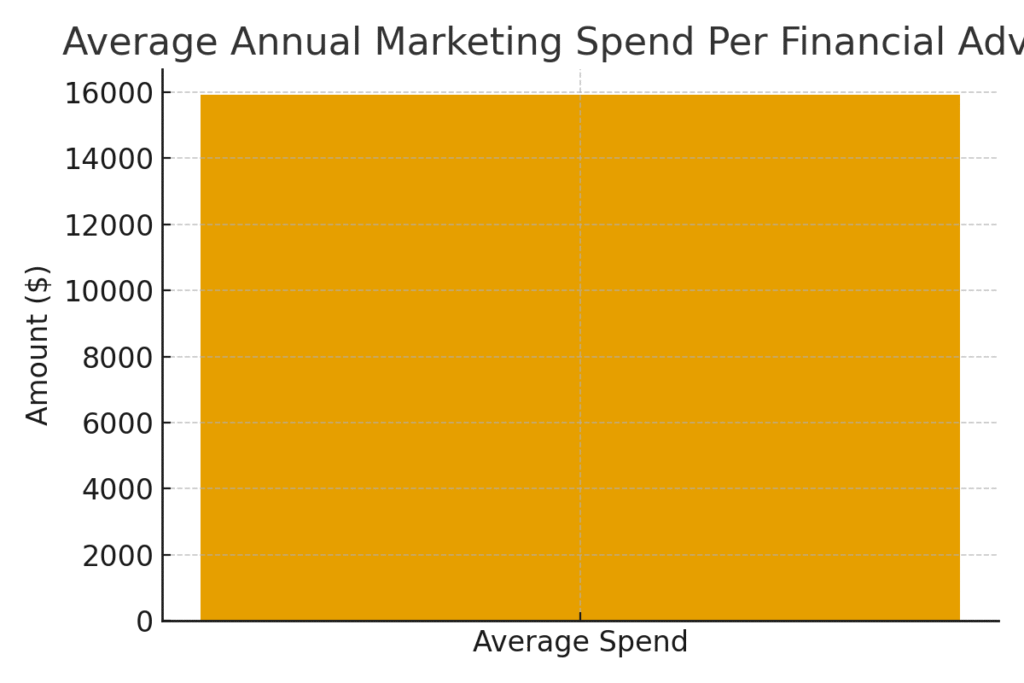
Average advisor marketing spend in 2024 | $15,908 |
11 |
Team vs Solo |
Advisory teams vs. solo advisor marketing spend | $23K vs $9K |
12 |
Median Budget |
Median marketing spend (unchanged 4 years) | $6,250 |
13 |
Acquisition Cost |
Average cost per new client acquired | $609 |
14 |
Premium CAC |
Client acquisition cost for $100M+ AUM advisors | $742 |
15 |
Growth Focus |
Growth-focused advisors client acquisition cost | $997 |
16 |
Lead Platforms |
Advisors using lead generation as primary marketing | 32% |
17 |
Social Growth |
Social media as second-highest growth strategy | 19% by 2023 |
18 |
LinkedIn Usage |
Advisors using LinkedIn often/extremely often | 46% |
19 |
Technology Impact |
Advisors who'd leave firm due to poor technology | 92% |
20 |
Service Evolution |
Advisors adopting holistic approach by 2025 | 75% |
Top 20 Financial Advisor Marketing Statistics 2025
Financial Advisor Marketing Statistics #1: $15,908 Average Annual Marketing Spend Per Advisor
On average, financial advisors are spending around $15,908 per year on marketing initiatives. This figure highlights how marketing is no longer optional but a real investment area for advisors seeking growth. I find it interesting that this amount reflects the need to compete with digital-first financial services. It also shows that advisors are increasingly blending traditional and online methods to reach clients. To me, this signals that those who strategically allocate this spend are setting themselves up for stronger client acquisition.
Financial Advisor Marketing Statistics #2: 85% Of Advisors Struggle To Find Time For Marketing
A staggering 85% of advisors admit that finding time for marketing is a challenge. This stat reveals how many professionals are overwhelmed with client work and compliance, leaving little energy for promotion. I personally see this as an opportunity for advisors to lean on automation tools or outsource some tasks. Time constraints don’t have to mean weak marketing—just smarter allocation of effort. It’s a reminder that consistency often matters more than volume.
Financial Advisor Marketing Statistics #3: Advisors With A Defined Strategy Onboard 50% More Clients
Advisors who develop a clear marketing strategy bring in 50% more new clients than those who don’t. This proves that having a roadmap makes a measurable difference. I’ve noticed in my own work that strategy builds confidence and focus, which leads to better execution. It’s not just about doing more marketing—it’s about doing the right things consistently. Advisors without a plan are leaving serious opportunities untapped.
Financial Advisor Marketing Statistics #4: 31% Plan To Increase Marketing Spend Next Year
Nearly a third of financial advisors (31%) plan to increase their marketing budgets in the coming year. This reflects growing recognition of marketing as a business driver. Personally, I think this signals a shift toward proactive growth rather than waiting for referrals. Advisors are beginning to treat marketing like any other investment—measured, tested, and scaled. It’s encouraging to see the industry leaning into this mindset.
Financial Advisor Marketing Statistics #5: Growth-Oriented Advisors Spend 4x More On Marketing
Advisors who actively focus on growth are spending four times more on marketing than others. This stat shows the direct link between ambition and marketing investment. I believe this demonstrates that success is rarely accidental—it’s usually fueled by intentional action. The willingness to allocate resources reflects confidence in ROI. Advisors who want bigger results will need to take similarly bold steps.
Financial Advisor Marketing Statistics #6: 77% Of Advisors Lack A Defined Marketing Strategy
Shockingly, 77% of financial advisors admit they don’t have a defined marketing strategy. This number illustrates a massive gap in the industry. I think this explains why so many advisors feel stuck in their growth. Without direction, marketing becomes random and ineffective. Creating even a simple plan can immediately separate an advisor from the majority.
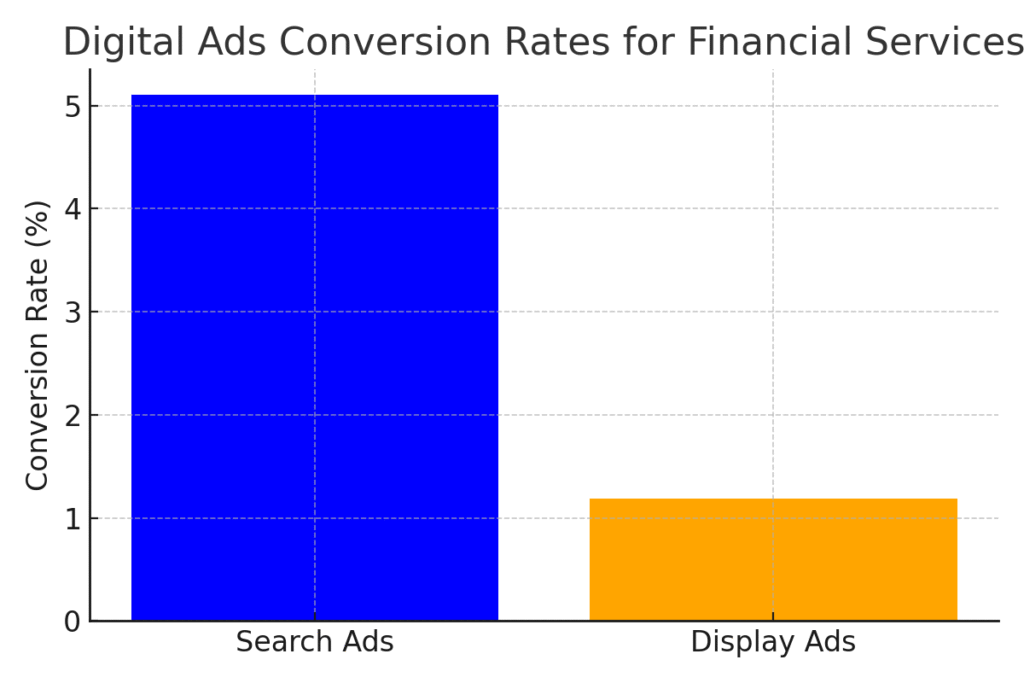
Financial Advisor Marketing Statistics #7: 75% With A Strategy Feel Confident About Hitting Goals
Among advisors who have a strategy, 75% feel confident about reaching their goals. In contrast, only 41% of those without a strategy share that confidence. To me, this highlights the psychological benefit of having clarity—it builds momentum. Confidence fuels consistent effort, which in turn drives results. It’s proof that planning pays off in more ways than one.
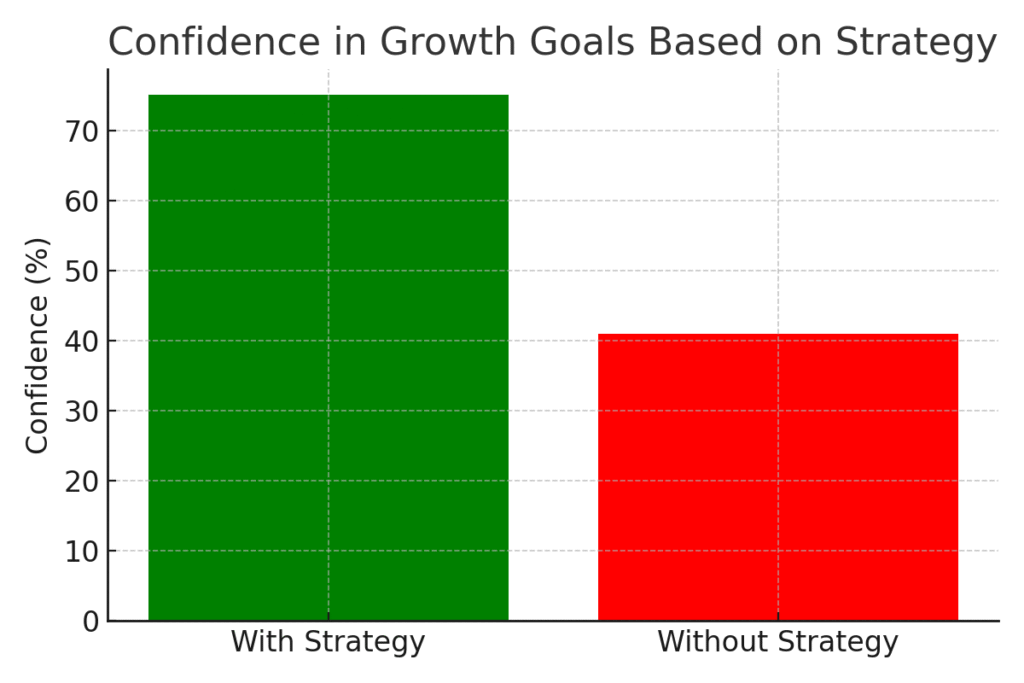
Financial Advisor Marketing Statistics #8: 5.10% Conversion Rate For Search Ads
Financial services search ads deliver a 5.10% conversion rate on average. That’s far higher than many industries, proving the intent-driven nature of search. I think this shows how powerful it is to meet clients when they’re actively looking for help. Advisors who invest here are tapping into demand rather than creating it. To me, that makes search ads one of the most effective marketing levers available.
Financial Advisor Marketing Statistics #9: $4 Average Cost Per Click For Keywords
Financial services keywords often cost $4 or more per click. This high cost reflects the competitiveness of the industry. I see this as a double-edged sword: it’s expensive, but it also shows there’s significant client value behind each lead. Advisors need to approach paid ads with precision and tight targeting. Otherwise, the investment could quickly get out of hand.
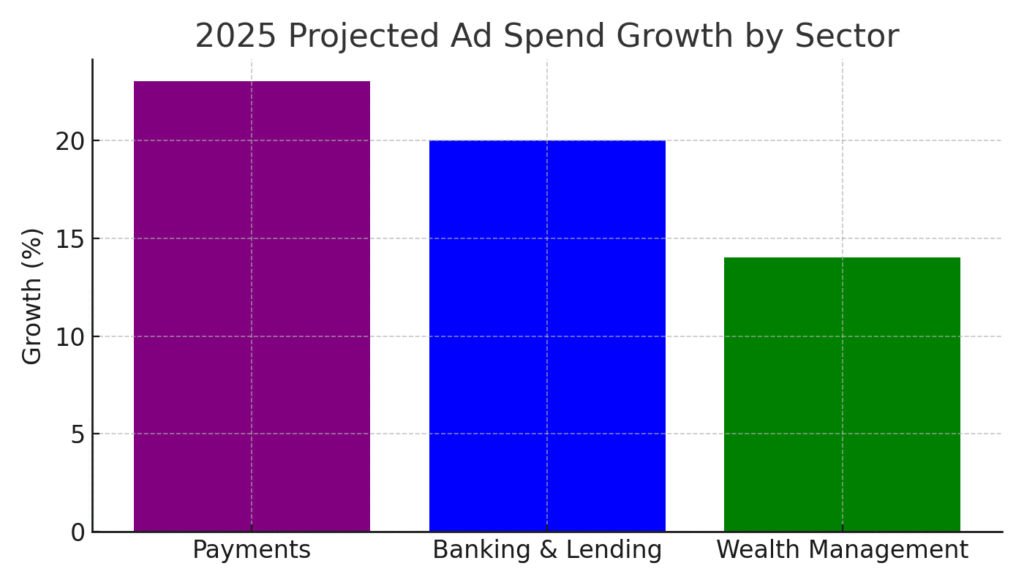
Financial Advisor Marketing Statistics #10: Projected 2025 Ad Spend Growth By Sector
In 2025, ad spend growth projections are impressive: +23% for payments, +20% for banking, and +14% for wealth management. These numbers reveal the increasing competition across all financial verticals. I think this is both a challenge and an opportunity for advisors. The challenge is higher noise, but the opportunity lies in standing out with smarter messaging. Advisors who invest early will have an edge.
Financial Advisor Marketing Statistics #11: 45% Increased Social Media Outreach In 2023
About 45% of financial advisors boosted their social media efforts in 2023. This shift shows how important platforms like LinkedIn and Facebook have become. I personally believe social media allows advisors to humanize their brand in a way traditional channels can’t. It’s less about selling and more about building trust. This growth trend will only continue in 2025.
Financial Advisor Marketing Statistics #12: 46% Use LinkedIn, 97% Avoid TikTok
Roughly 46% of advisors are on LinkedIn, while nearly 97% avoid TikTok altogether. This highlights where the industry feels most comfortable engaging. I think LinkedIn makes sense because of its professional environment. But I also believe advisors may be missing younger audiences by ignoring platforms like TikTok. The next generation of clients will expect advisors to meet them where they are.
Financial Advisor Marketing Statistics #13: Only 19% View Social Media As The Top Strategy
Only 19% of wealth advisors see social media as their most important marketing channel. This shows that many still prioritize traditional methods or referrals. Personally, I think this underestimates the long-term power of digital networking. Social platforms are where relationships are starting today. Advisors who embrace this now will be ahead of the curve.
Financial Advisor Marketing Statistics #14: 10%–12% Of Digital Leads Convert To Meetings
Between 10% and 12% of digital leads typically convert into one-on-one meetings. That’s a meaningful conversion rate when scaled across campaigns. To me, this proves that digital marketing isn’t just vanity—it drives real pipeline. Advisors can count on online efforts to deliver tangible results. The key is nurturing those leads consistently.
Financial Advisor Marketing Statistics #15: 0.05% Response Rate For Direct Mail
Traditional direct mail averages only about a 0.05% response rate. Compared to digital channels, that’s shockingly low. I think this illustrates why so many advisors are moving away from print-heavy approaches. It’s not that mail never works—it’s that the ROI is often weaker. Digital-first strategies simply deliver more bang for the buck.
Financial Advisor Marketing Statistics #16: $2,000–$4,000+ Client Acquisition Cost
Client acquisition costs can range from $2,000 for new advisors to over $4,000 for established ones. This shows how expensive growth can be without efficiency. I see this as a reminder that high-quality marketing reduces costs in the long run. The more targeted and effective your approach, the less you waste per lead. Smart advisors track this number closely.
Financial Advisor Marketing Statistics #17: 35% Of Employee Advisors Want More AI Investment
About 35% of employee advisors wish their firms would invest more in AI tools for marketing. This reflects a growing appetite for technology-driven personalization. I think AI offers huge potential in streamlining lead generation and outreach. Advisors are already stretched thin, so automation can be a lifesaver. It’s exciting to see this trend gaining traction.
Financial Advisor Marketing Statistics #18: 45% Of Early-Career Advisors Prioritize Social Media Support
For early-career advisors, 45% rank social media support as a top marketing need. This reveals how the next generation of advisors thinks differently about growth. Personally, I admire their willingness to embrace new channels quickly. They’re shaping the future of the profession with digital-first habits. It’s a reminder that firms must adapt their support accordingly.
Financial Advisor Marketing Statistics #19: Only 32% Find Social Media Support Valuable
Only 32% of early-career advisors feel their firm’s social media support is “very valuable.” That means the majority don’t think they’re getting the help they need. I find this troubling because it suggests a disconnect between firms and advisors. Social platforms are critical growth tools, yet support seems lacking. This is a space where firms could really differentiate themselves.
Financial Advisor Marketing Statistics #20: Broadridge Report Surveys Over 400 Advisors
The Broadridge Financial Advisor Marketing Trends Report surveyed more than 400 advisors for insights. This comprehensive research provides a strong data backbone for the industry. I think referencing such large studies is crucial for advisors who want benchmarks. It’s reassuring to know these stats reflect broad patterns, not isolated cases. Reports like this keep the industry accountable and forward-looking.
Final Thoughts on Financial Advisor Marketing Statistics
Looking back at these insights, what stands out to me is how much opportunity there is when marketing is done with intention and clarity. I’ve seen firsthand that even small changes—whether it’s refining a social media strategy or setting aside a consistent budget—can make a big difference in how advisors connect with people who need their guidance. For me, the biggest takeaway is that the industry is shifting quickly, but those who stay curious and adaptive will always be ahead. I hope these financial advisor marketing statistics give you both inspiration and a practical roadmap to move forward with confidence.
SOURCES
https://www.promodo.com/blog/wealth-management-marketing
https://www.kapitalwise.com/blogs/wealth-management-marketing/
https://www.bankbound.com/blog/financial-advisor-marketing-strategies/
https://www.marekgroup.com/blog/wealth-management-marketing-strategies-for-scalable-growth
https://www.plancorp.com/blog/wealth-management-statistics-facts-tips-basics
https://www.properexpression.com/growth-marketing-blog/marketing-to-high-net-worth-individuals
https://leadingresponse.com/financial-marketing-blog/
https://www.assetmark.com/blog/financial-advisor-marketing-strategies
https://aldeninvestmentgroup.com/blog/2025-financial-advisor-marketing-plan/