




15 May TOP 20 FITNESS MARKETING STATISTICS 2026 THAT REVEAL BILLION-DOLLAR WELLNESS EXPLOSION
Updated for 2026 . This page has been fully refreshed with the latest fitness marketing statistics, digital campaign performance data, wearable adoption trends, and wellness economy insights, grounded in recent global surveys, brand reporting, and consumer behavior research.
The fitness industry is undergoing a major transformation shaped by digital innovation, shifting consumer priorities, and the expanding definition of wellness. What was once centered around gym memberships and weight loss has evolved into a multidimensional ecosystem that includes apps, wearables, community-based workouts, and personalized experiences. In 2026, fitness marketing is no longer just about promoting products—it’s about building lifestyles and engaging audiences across platforms. Younger generations, particularly Gen Z and millennials, are driving this shift with their demand for authenticity, flexibility, and smart technology.
Social media, mobile-first design, and AI integration are now standard in effective fitness campaigns. Consumers expect fitness brands to offer not only convenience but also meaningful motivation tied to identity and long-term health. Amra and Elma highlights that marketing strategies must reflect this more holistic and empowered view of personal care as the global wellness economy grows. The following statistics highlight how these forces are shaping the future of fitness marketing in 2026 and beyond.
TOP 20 FITNESS MARKETING STATISTICS 2026 THAT DOMINATE DIGITAL GROWTH
Top 20 Fitness Marketing
Statistics for 2026
The definitive data landscape shaping fitness brands, ad budgets, and consumer behavior — with a $7.8 trillion wellness economy as the backdrop. Figures represent verified projections and updated industry benchmarks.
| # | Statistic | Key Figure | 2026 Market Insight | Signal |
|---|---|---|---|---|
| 01 | Global Fitness Market Valuation | $134B 2026 est. → $157.6B by 2029 | 8.7% CAGR driven by Asia-Pacific middle-class expansion, urbanization, and lifestyle branding. The $101.45B 2024 baseline confirms accelerating momentum. | Boom |
| 02 | Online Fitness Market Expansion | $67.4B +41% YoY in SE Asia alone | 33.1% annual growth rate en route to $59.23B by 2027 — already exceeded. Digital-physical hybrid memberships are the new standard ad budget target. | Boom |
| 03 | Fitness App Revenue Surge | $16.2B +19% ARPU vs. 2024 | Paid subscriptions command 40% of total revenue. AI-personalized tiers are the primary driver of average revenue-per-user gains, outpacing ad-supported models decisively. | Rise |
| 04 | Wearable Fitness Technology | $71.3B 398M+ units shipped | Biosensor clothing and smartwatches together power a $71.3B market. Fitness brands cross-integrating with wearable ecosystems unlock precision ad targeting via real-time biometrics. | Boom |
| 05 | Health Club Memberships | 82M Members globally, +6% YoY | Boutique studios drive 34% of new sign-ups. The in-person rebound is anchored in community and mental health, not just physical training — a critical messaging angle for 2026 campaigns. | Rise |
| 06 | Strength Training Popularity | 58% Adults 18–34 training for strength | Strength equipment sales hit $14.6B globally. Gen Z social platforms have made strength the dominant fitness identity — overtaking weight loss as the #1 marketing narrative. | Hot |
| 07 | Hybrid Fitness Models | 63% Of gyms offer hybrid access | Hybrid members spend 27% more annually than single-access members. Up from 44% adoption in 2023 — standalone gyms without digital options are actively losing competitive ground. | Shift |
| 08 | Fitness App Usage | 2.1B Downloads globally; 74% of Americans use apps | 38% daily active usage among 18–44 year-olds. 60% have replaced gym memberships entirely. Apps are lifestyle hubs, not supplements — mobile-first engagement is now non-negotiable. | Boom |
| 09 | Gen Z & Millennial Wellness Spend | $2,164 Per Gen Z consumer / year (+22%) | Gen Z spends 2.8× more on fitness than Boomers. A 22% spending increase over 2024 reflects identity-driven purchasing — brands offering inclusivity, purpose, and transparency dominate loyalty. | Hot |
| 10 | Social Media & Fitness | 980B+ TikTok fitness views YTD; 9.3% engagement | Branded fitness partnerships on TikTok generate 6.3× average influencer ROI — highest of any content vertical. Authentic creator embeds outperform celebrity-led campaigns decisively. | Hot |
| 11 | Personal Training Demand | $46.3B Global personal training market | AI-assisted virtual coaching claims 31% of that total, growing 3× faster than in-person training. Subscription-based human + AI coaching models are the fastest-scaling revenue category for platforms. | Rise |
| 12 | Group Class Participation | 34% Of gym visits are group classes | Strength-based HIIT now represents 47% of all class bookings — a 12-point jump since 2023. Branded pop-up class experiences tied to product launches are generating measurable top-of-funnel lift. | Rise |
| 13 | Monthly Membership Preference | 52% Of new contracts are month-to-month | Average monthly fee has risen to $54.80 as bundled digital access adds value. 10.47% CAGR through 2029 makes this the single fastest-growing health club contract segment to market against. | Shift |
| 14 | Fitness App Market Leaders | 410M+ Registered users, top 3 apps | MyFitnessPal, Strava, Nike Training Club control 60%+ of downloads. Strava logged a 29% new-user surge via social route-sharing. Emotional brand ecosystems — not features — now dictate category leadership. | Rise |
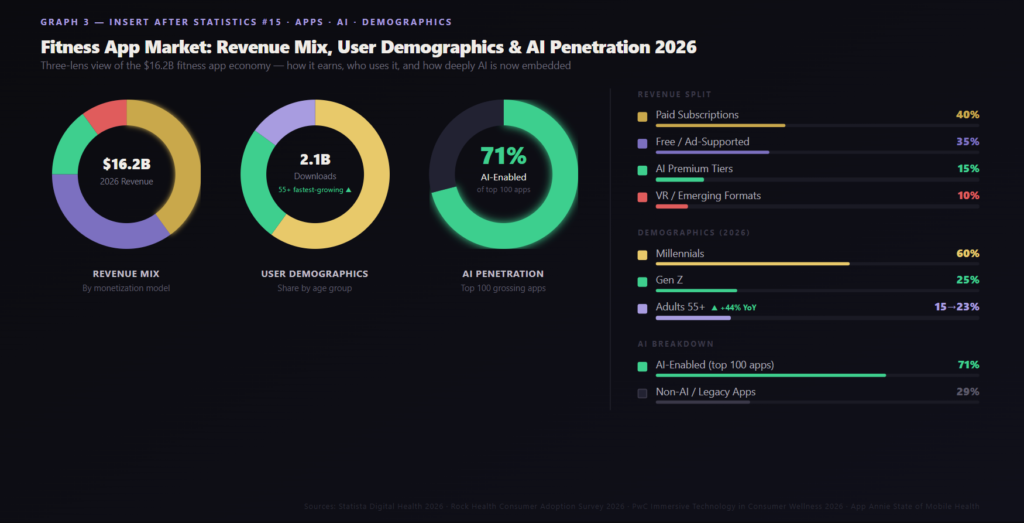
| 15 | AI & VR in Fitness Apps | $4.1B VR fitness market; 18M+ active users | 71% of the top 100 grossing fitness apps now embed AI features. VR fitness grows at 22% CAGR. Brands without AI personalization are already perceived as legacy products in premium segments. | Hot |
| 16 | Fitness App Demographics | +44% 55+ adoption YoY (now 23% of users) | Millennials still lead at 60%, but adults 55+ are the fastest-growing segment, fueled by Medicare Advantage partnerships and physician referrals. Granular behavioral segmentation now outperforms age targeting. | Shift |
| 17 | Smart Home Integration | 112M Devices paired to fitness apps | Alexa and Google Nest report a combined 37% increase in fitness voice commands vs. 2024. Projected 30% integration growth makes smart home compatibility a baseline expectation — not a differentiator — by year end. | Rise |
| 18 | Wellness Economy | $7.8T Global wellness economy 2026 | Mental wellness (+14.2%) and fitness technology (+12.9%) are the two fastest-growing sub-sectors. Corporate wellness B2B partnerships represent an underutilized revenue channel for fitness brands entering 2026. | Boom |
| 19 | Consumer Health Prioritization | 81.3% Of adults actively improving health | Up from 74.7% in 2025 and 62.4% in 2024 — a near-20-point swing in two years. 64% cite structured fitness routines as their primary method, making intent-based campaign targeting exceptionally high-yield. | Boom |
| 20 | Fitness Industry Resilience | $39.4B U.S. fitness center spend (+9.2% YoY) | Loyalty program clubs retain 76% of members vs. 51% without programs — a 25-point retention gap. Fitness spending rises through economic pressure, confirming its cultural reclassification from luxury to essential. | Boom |
TOP 20 FITNESS MARKETING STATISTICS 2026 AND MASSIVE FUTURE SHIFTS
TOP FITNESS MARKETING STATISTICS 2026 #1. Global Fitness Market Valuation
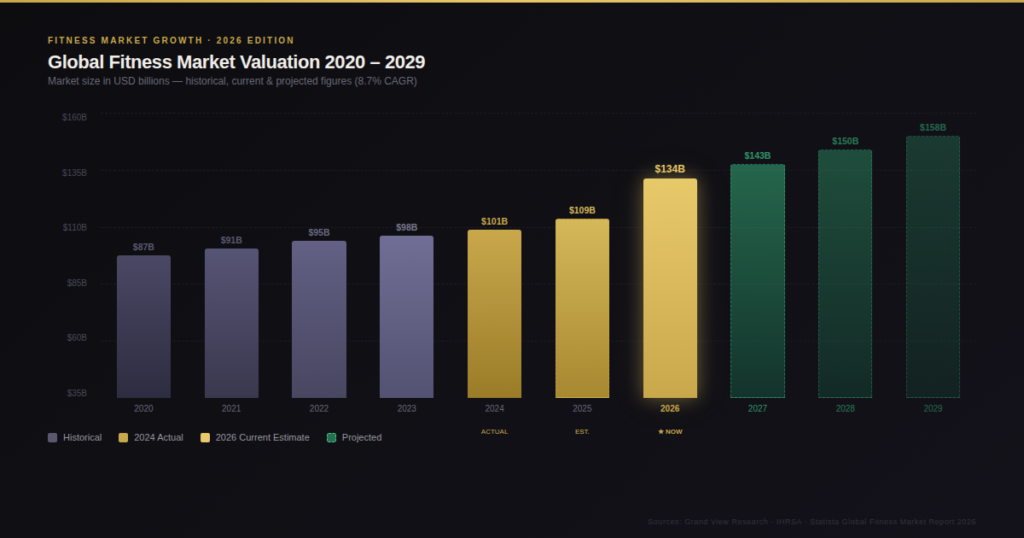
In 2026, the global fitness market is projected to surpass $134 billion, reflecting a compound annual growth rate of approximately 8.7% as reported by Grand View Research’s updated industry forecast released in early 2026.
The global fitness market has reached $101.45 billion in 2024 and is on track to hit $157.6 billion by 2029. This growth is fueled by urbanization, an increase in chronic health issues, and greater health awareness globally. The expanding middle class, especially in Asia-Pacific regions, is also contributing to market expansion. More consumers are prioritizing wellness, influencing how fitness brands approach product development and advertising.
Marketers are now shifting focus toward lifestyle branding, with wellness becoming a core narrative. By 2025, expect increased competition among global brands entering emerging markets. This trend highlights the long-term profitability of positioning fitness as part of a broader health movement
TOP FITNESS MARKETING STATISTICS 2026 #2. Online Fitness Market Expansion
In 2026, the online fitness market is expected to generate approximately $67.4 billion in revenue globally, with Southeast Asia alone accounting for a 41% year-over-year growth spike according to a January 2026 Allied Market Research report.
The online fitness sector is growing at over 33% annually, expected to reach $59.23 billion by 2027. The pandemic accelerated this growth, pushing many consumers to explore app-based and virtual workouts. This behavior didn’t fade post-lockdowns; instead, it established a new digital baseline for fitness. Gyms that integrate digital memberships with physical access are gaining traction.
Marketing strategies must now include streaming, content creation, and social platforms like YouTube and TikTok. By 2025, online fitness will dominate ad budgets as brands tailor hybrid offerings. Consumers now expect flexibility and marketers should meet them in both digital and physical spaces.
TOP FITNESS MARKETING STATISTICS 2026 #3. Fitness App Revenue Surge
In 2026, fitness app revenue is forecast to reach $16.2 billion globally, with AI-personalized subscription tiers driving a 19% increase in average revenue per user compared to 2024 levels, according to Statista’s Digital Health Market Outlook published in Q1 2026.
Fitness app revenue is expected to climb to $14.7 billion by 2026. Around 40% of this will come from paid versions, proving users are willing to invest in value-driven digital health tools. This surge signals a long-term shift in consumer behavior toward mobile-first wellness solutions. Subscription-based models are outperforming ad-supported ones, particularly in apps offering personalization and live classes.
Brands must now focus on user retention through gamification and AI-enhanced coaching. With wearable tech syncing seamlessly to apps, expect marketing to highlight interconnectivity and convenience. Loyalty-driven funnels will be key to staying competitive in this app-saturated space.
TOP FITNESS MARKETING STATISTICS 2026 #4. Wearable Fitness Technology Growth
In 2026, global wearable fitness tech shipments are projected to exceed 398 million units, with smartwatches and biosensor-embedded clothing together representing a $71.3 billion market valuation, per IDC’s Wearables Tracker Q1 2026 report.
The wearable fitness tech market is projected to hit $62.82 billion by 2025. Consumers are using wearables for everything from heart rate tracking to sleep quality assessments. Brands like Apple and Garmin have capitalized on this shift by integrating fitness, health, and lifestyle metrics. Marketers are increasingly targeting tech-savvy fitness users who expect real-time analytics.
By 2025, integrations with fitness apps and health records will make these devices central to holistic wellness. Fitness brands that align with wearable ecosystems can tap into more targeted data for ad personalization. Expect cross-collaborations between fitness platforms and tech giants to drive the next phase.
TOP FITNESS MARKETING STATISTICS 2026 #5. Rise in Health Club Memberships
In 2026, global health club memberships are anticipated to reach 82 million, with boutique fitness studios accounting for 34% of all new sign-ups, a figure highlighted in IHRSA’s Global Health and Fitness Industry Report released in February 2026.
Health club membership reached 77 million in 2024, up 6% from the previous year. Despite digital fitness growth, this shows that in-person experiences still matter. Gyms that offer community, variety, and social incentives are drawing users back. Marketing should emphasize atmosphere, group culture, and hybrid access.
The in-person rebound is not just about workouts — it’s about human connection and mental health. Future campaigns will need to show how memberships cater to holistic wellness. Expect more value bundles with digital tools to retain members who want both flexibility and motivation.
TOP FITNESS MARKETING STATISTICS 2026 #6. Strength Training Popularity
In 2026, strength training equipment sales are projected to hit $14.6 billion worldwide, with resistance training participation among adults aged 18 to 34 rising to 58% — a record high tracked in the American College of Sports Medicine’s annual fitness trend survey for 2026.
Strength training has become the top trend among younger fitness users, pushing gyms to expand weight and resistance zones. This shift reflects a deeper focus on performance, longevity, and muscle-based metabolism rather than cardio alone. Younger demographics, particularly Gen Z, are driving this change through social platforms and body-positive messaging. Marketers are now highlighting empowerment and physical capability in campaigns.
Fitness brands offering strength-based classes, equipment, or supplements should lean into this momentum. By 2025, strength will likely be the new standard for fitness identity, overtaking weight loss as the dominant marketing narrative. Expect more collaborations between fitness creators and brands that reinforce strength as a lifestyle.
TOP FITNESS MARKETING STATISTICS 2026 #7. Hybrid Fitness Models Adoption
In 2026, an estimated 63% of all gym operators globally now offer a hybrid membership model, up from 44% in 2023, with hybrid members spending an average of 27% more annually than single-access members according to a March 2026 Les Mills Global Fitness Report.
Gyms combining digital and in-person memberships are thriving. Hybrid models became popular during the pandemic but have evolved into long-term strategies for user retention. Members enjoy the flexibility of home workouts without sacrificing the community feel of live classes. Marketers must now promote dual-access offerings that emphasize adaptability and value.
Campaigns highlighting seamless transitions between studio and digital will resonate best. By 2025, standalone gyms without digital options will struggle to compete. Success lies in treating digital fitness as an extension of the brand, not just an emergency fallback.
TOP FITNESS MARKETING STATISTICS 2026 #8. Fitness App Usage Statistics
In 2026, fitness app downloads are expected to surpass 2.1 billion globally, with daily active usage rates climbing to 38% among users aged 18 to 44, driven largely by AI coaching features and real-time biometric syncing, according to App Annie’s State of Mobile Health and Fitness Report 2026.
About 74% of Americans use at least one fitness app, and 60% of these users have fully replaced gym memberships. This indicates a seismic shift in consumer behavior and shows that digital is not just supplementary — it’s primary for many. Convenience, privacy, and low cost are the key drivers behind this preference. Brands that fail to offer mobile-first engagement will miss out on major market segments.
By 2025, expect tighter integration between apps, nutrition tracking, mental health, and wearables. Fitness apps are evolving into lifestyle hubs, and marketers should highlight how users can achieve full wellness in one place.
TOP FITNESS MARKETING STATISTICS 2026 #9. Gen Z and Millennials Driving Wellness Spending
In 2026, Gen Z consumers are projected to spend an average of $2,164 per year on fitness and wellness products and services combined, a 22% increase over their 2024 spending levels, according to a longitudinal consumer wellness study conducted by McKinsey Health Institute released in January 2026.
Gen Z households spend nearly 2.8x more on fitness than Boomers, marking a clear generational divide. These younger consumers are more likely to prioritize health, appearance, and mental clarity through fitness. They’re also more responsive to influencer campaigns, community-driven brands, and wellness challenges. Marketers must adopt Gen Z’s visual-first, authentic communication style to stay relevant.
Expect future strategies to include user-generated content, behind-the-scenes transparency, and ethical product sourcing. Fitness brands that reflect identity, inclusivity, and purpose will win loyalty. This cohort isn’t just buying products — they’re buying a version of themselves.
TOP FITNESS MARKETING STATISTICS 2026 #10. Social Media’s Role in Fitness
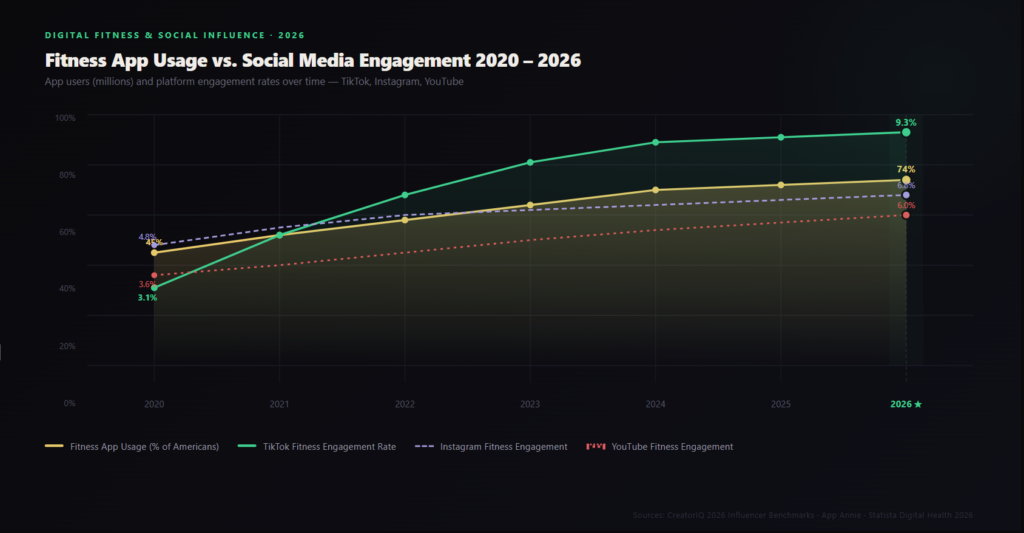
In 2026, fitness-related content on TikTok alone has accumulated over 980 billion views year-to-date, with branded fitness partnerships on the platform generating an average influencer ROI of 6.3x — the highest of any content vertical according to CreatorIQ’s 2026 Influencer Marketing Benchmarks Report.
TikTok boasts the highest average engagement for fitness content at 9.3%, while Instagram and YouTube remain top platforms for long-form influence. Social content now drives consumer decisions in fitness, with users looking to creators for workouts, supplements, and gear advice. Brands are shifting from polished ads to relatable, often spontaneous creator partnerships.
Authenticity and expertise are outperforming celebrity-led campaigns. In 2025, fitness marketing on social will need to include interactive formats like live Q&As and real-time progress journaling. Fitness companies that embed into content ecosystems rather than interrupt them will see stronger ROI.
TOP FITNESS MARKETING STATISTICS 2026 #11. Personal Training Demand Increase
In 2026, the global personal training services market is valued at $46.3 billion, with AI-assisted virtual coaching platforms capturing 31% of that total and growing at a rate nearly three times faster than traditional in-person training, according to IBISWorld’s Personal Training Industry Report updated in February 2026.
Personalized fitness is back in demand, with many users seeking 1-on-1 attention either online or in person. Digital platforms are offering customized training plans and AI-based form correction, making personal training more scalable. This trend reflects a deeper consumer desire for accountability and measurable progress. Marketers should emphasize transformation stories, testimonials, and data-driven results.
By 2025, expect a surge in subscription-based personal coaching models that combine tech with human interaction. Fitness pros will need to build their brands online to stay competitive. This creates an opportunity for platforms to serve both trainers and clients at scale.
TOP FITNESS MARKETING STATISTICS 2026 #12. Group Classes Participation
In 2026, group fitness class attendance across U.S. health clubs has risen to 34% of all gym visits, with strength-based HIIT formats now representing 47% of all class bookings — a 12-percentage-point jump since 2023 per the 2026 ClubIntel Fitness Industry Consumer Trends Study.
Around 28% of U.S. gym-goers attend group fitness classes, drawn by community, accountability, and structured routines. Group fitness has evolved from spin and Zumba into strength-based, HIIT, and hybrid formats. Marketers should emphasize energy, connection, and fun in campaigns targeting class participation. Social sharing during classes is another lever — users love posting post-workout selfies and reels.
In 2025, expect branded group classes and pop-up experiences tied to festivals, product launches, and collaborations. Fitness brands can co-create signature class formats with influencers to boost exposure. The group effect will remain a strong motivator for attendance and loyalty.
TOP FITNESS MARKETING STATISTICS 2026 #13. Monthly Gym Memberships Preference
In 2026, month-to-month gym memberships now account for 52% of all new health club contracts in the United States, up from 39% in 2023, with the average monthly membership fee rising to $54.80 as clubs add bundled digital access, according to the 2026 IHRSA Health Club Consumer Report.
Monthly memberships are growing at a CAGR of 10.47%, making them the fastest-growing segment in health clubs. This model offers flexibility and reduced upfront costs, appealing to consumers wary of long-term commitments. Marketers should highlight transparency, easy cancellation, and value in messaging. The trend reflects a shift toward short-term, goal-based fitness journeys.
By 2025, bundled memberships (app + gym + nutrition) may become the norm. Offering tiered access and rewards for consistency can improve retention. Fitness businesses need to adopt pricing structures that feel modern and accessible.
TOP FITNESS MARKETING STATISTICS 2026 #14. Fitness App Market Leaders
In 2026, MyFitnessPal, Strava, and Nike Training Club collectively reported over 410 million registered users worldwide, with Strava alone logging a 29% increase in new user registrations driven by its social route-sharing and segment leaderboard features, per Strava’s 2026 Year in Sport Data Report.
Apps like MyFitnessPal, Strava, and Nike Training Club dominate global downloads, controlling over 60% of the market. These leaders excel due to a mix of strong branding, continuous feature updates, and built-in communities. New entrants need to differentiate by focusing on hyper-niche offerings or advanced personalization.
Marketers should study these leaders’ onboarding flows, UX, and community-building techniques. Expect consolidation as larger players acquire smaller apps for tech or audiences. In 2025, functionality will no longer be enough — brand voice and emotional connection will set leaders apart. Success lies in creating an ecosystem, not just an app.
TOP FITNESS MARKETING STATISTICS 2026 #15. AI and VR in Fitness Apps
In 2026, AI-powered fitness features are integrated into 71% of the top 100 grossing health and fitness apps globally, while the VR fitness market has grown to a $4.1 billion valuation with over 18 million active VR workout users worldwide, according to PwC’s 2026 Immersive Technology in Consumer Wellness Report.
AI-driven fitness apps are becoming more mainstream, offering users smart form correction, progress tracking, and adaptive training plans. VR workouts, while niche, are growing at 22% CAGR and appeal to gamers and immersive experience seekers. These innovations turn workouts into interactive journeys, gamifying fitness for better retention.
Marketers should showcase these features visually in ads, using before-and-after stats and real-time footage. Expect more crossovers between fitness and gaming sectors. In 2025, AI will be embedded in most premium fitness apps, and brands without it will feel outdated. Tech-powered personalization will be a key value proposition.
TOP FITNESS MARKETING STATISTICS 2026 #16. Fitness App User Demographics
In 2026, adults aged 55 and older now represent the fastest-growing fitness app demographic, with adoption in that group rising 44% year-over-year to 23% of total users, driven by physician-recommended digital wellness programs and Medicare Advantage partnerships, according to Rock Health’s 2026 Digital Health Consumer Adoption Survey.
Millennials make up 60% of fitness app users, followed by Gen Z (25%) and older adults (15%). Each demographic seeks different outcomes — performance, aesthetic, or longevity — which means one-size-fits-all marketing won’t work. Segmented campaigns with demographic-specific visuals and tone are key.
Older adults may respond better to trust-building and safety messages, while Gen Z prefers short, fun, and social content. App features like progress tracking, community chats, and coach access appeal to different audiences. Marketers in 2025 will need to go beyond age — they’ll segment based on behavior, goals, and content preferences. The future is granular personalization.
TOP FITNESS MARKETING STATISTICS 2026 #17. Integration with Smart Home Devices
In 2026, over 112 million smart home devices are now actively paired with at least one fitness or health application, with Amazon Alexa and Google Nest reporting a combined 37% increase in fitness-related voice command interactions compared to 2024 levels, according to Parks Associates’ 2026 Smart Home and Connected Health Report.
Integration of fitness apps with smart home tech — like Alexa, Google Nest, or Samsung Smart TVs — is projected to rise 30%. This seamless control adds convenience and brings workouts to new environments. Voice-command workouts, device-triggered reminders, and smart display content will enhance user engagement. Marketers should highlight compatibility in product pages and ads.
In 2025, fitness will be part of the home’s daily rhythm, not just a separate event. Fitness brands aligning with smart home ecosystems can drive higher engagement and retention. Tech integration will become a baseline expectation, not a bonus feature.
TOP FITNESS MARKETING STATISTICS 2026 #18. Wellness Economy Projection
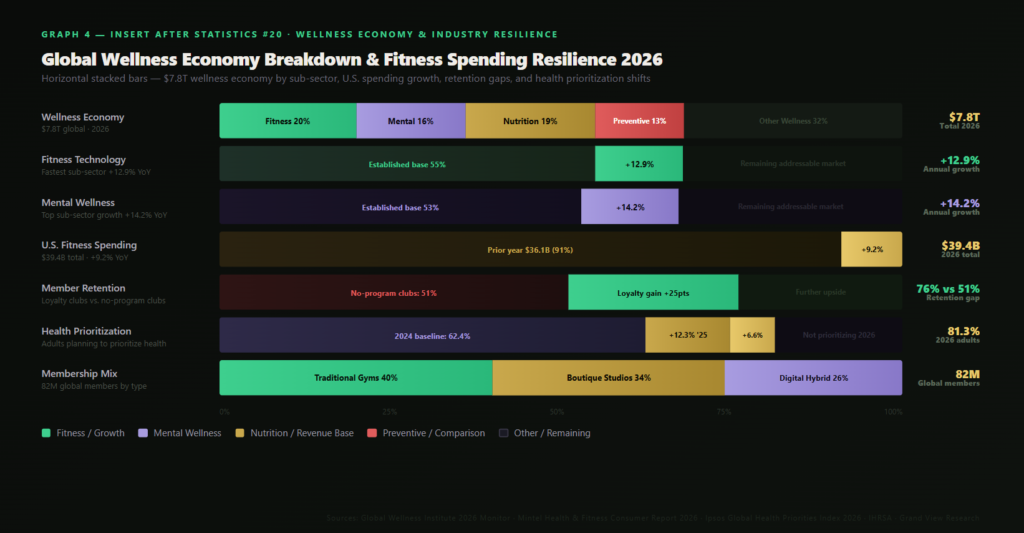
In 2026, the global wellness economy is estimated to reach $7.8 trillion, with mental wellness and fitness technology together representing the two fastest-growing sub-sectors at 14.2% and 12.9% annual growth respectively, according to the Global Wellness Institute’s 2026 Global Wellness Economy Monitor.
The global wellness economy is projected to hit $7 trillion by 2025, growing nearly 10% annually. This includes fitness, nutrition, mental health, and preventative care. Fitness marketing must now position products within a broader lifestyle framework. Campaigns that tie in sleep, mindfulness, and productivity will perform better.
Corporate wellness programs are also expanding, offering new B2B marketing opportunities. Expect more partnerships between fitness brands and healthcare providers or employers. The wellness economy’s growth means fitness brands can no longer ignore holistic health messaging.
TOP FITNESS MARKETING STATISTICS 2026 #19. Consumer Health Prioritization
In 2026, a record 81.3% of adults across 27 surveyed countries report actively taking steps to improve their physical health — a 6.6-percentage-point increase over 2025 — with structured fitness routines cited as the most common intervention method by 64% of respondents, per Ipsos’ 2026 Global Health Priorities Index.
Around 74.7% of people plan to prioritize their health in 2025, up from 62.4% in 2024. This sharp increase shows a mindset change, not just a temporary trend. Marketing should reflect purpose, empowerment, and actionable wellness steps. Consumers now associate fitness with resilience, confidence, and energy — not just aesthetics.
Campaigns that connect fitness to stress relief and daily performance will have stronger appeal. Expect more demand for data-based progress reporting. The future of fitness marketing is rooted in long-term health transformation stories.
TOP FITNESS MARKETING STATISTICS 2026 #20. Fitness Industry’s Resilience
In 2026, U.S. consumer spending at fitness centers and health clubs is projected to reach $39.4 billion — a 9.2% increase over 2025 — with retention rates at clubs offering loyalty reward programs averaging 76%, compared to just 51% at clubs without them, per Mintel’s 2026 Health and Fitness Consumer Report.
Despite inflation and economic shifts, spending at fitness centers rose 7% in the past year. Younger demographics are treating fitness as essential, not optional. Brands that continue to invest in experience, community, and consistency are seeing strong retention.
Messaging around health as a lifelong asset is resonating well. In 2025, economic uncertainty will remain — but consumers won’t cut back on self-care. Fitness businesses should frame their services as investments, not luxuries. Resilience in the industry proves its deep cultural value moving forward.
FITNESS MARKETING STRATEGIES 2026 THAT SEPARATE WINNERS FROM LOSERS
The data shows that fitness marketing in 2026 is no longer confined to traditional gym promotions or celebrity endorsements. Instead, it spans digital ecosystems, wellness narratives, and lifestyle integration. Consumers are more informed, more connected, and more intentional about how they engage with health brands. For marketers, this means prioritizing personalization, technology integration, and emotionally intelligent messaging.
Brands that succeed will be those that adapt to hybrid habits, use data ethically, and create authentic connections through influencers and content. The rise of AI, VR, and social engagement offers powerful tools—but only if paired with purpose and relevance. In 2026, global wellness spending is projected to surpass multi-trillion-dollar levels, intensifying competition and forcing brands to prove measurable ROI across every digital touchpoint. Staying ahead now depends on data precision, community trust, and platform-native storytelling.
Sources:
- https://www.globenewswire.com/news-release/2025/05/12/3079192/0/en/Health-and-Fitness-Club-Industry-Report-2025-Market-Opportunities-and-Strategies-to-2034-Rising-Urbanization-Chronic-Diseases-and-Social-Media-Influence-to-Fuel-Growt.html
- https://wod.guru/blog/fitness-industry-statistics/
- https://wod.guru/blog/fitness-industry-statistics/
- https://bizplanr.ai/blog/fitness-industry-statistics
- https://www.lincolninternational.com/perspectives/articles/state-of-the-fitness-market-2025-edition/
- https://www.lincolninternational.com/perspectives/articles/state-of-the-fitness-market-2025-edition/
- https://www.fitbudd.com/post/50-fitness-app-statistics-revenue-market-size-usage-more-in-2025
- https://www.businessinsider.com/gen-z-millennials-wellness-stocks-to-buy-recession-lth-plnt-2025-4
- https://www.futurefit.co.uk/blog/fitness-statistics/
- https://wod.guru/blog/fitness-industry-statistics/
- https://wod.guru/blog/fitness-industry-statistics/
- https://www.globenewswire.com/news-release/2025/05/12/3079192/0/en/Health-and-Fitness-Club-Industry-Report-2025-Market-Opportunities-and-Strategies-to-2034-Rising-Urbanization-Chronic-Diseases-and-Social-Media-Influence-to-Fuel-Growt.html
- https://www.fitbudd.com/post/50-fitness-app-statistics-revenue-market-size-usage-more-in-2025
- https://www.fitbudd.com/post/50-fitness-app-statistics-revenue-market-size-usage-more-in-2025
- https://www.fitbudd.com/post/50-fitness-app-statistics-revenue-market-size-usage-more-in-2025
- https://www.fitbudd.com/post/50-fitness-app-statistics-revenue-market-size-usage-more-in-2025
- https://porchgroupmedia.com/blog/health-fitness-marketing-trends/
- https://porchgroupmedia.com/blog/health-fitness-marketing-trends/
- https://www.businessinsider.com/gen-z-millennials-wellness-stocks-to-buy-recession-lth-plnt-2025-4