




15 Sep TOP 20 FLOORING MARKETING STATISTICS 2026 REVEAL EXPLOSIVE HOME RENOVATION DEMAND
Updated for 2026. This page has been fully refreshed with the latest flooring marketing statistics, consumer renovation behavior data, and home improvement industry trends, grounded in recent contractor surveys, retail analytics, and global housing market insights.
When it comes to staying ahead in the competitive home improvement space, understanding flooring marketing statistics is more than just number-crunching — it’s about seeing where real customers are heading. From online research habits to in-store buying decisions, today’s homeowners are shaping the future of how flooring products are discovered and purchased. As a leading marketing agency in New York, we’ve had the chance to work closely with flooring retailers and contractors who are navigating this shifting digital landscape. What we’ve learned is that every stat tells a story — not only about market growth, but also about consumer trust, technology adoption, and the importance of local presence. This blog is our way of sharing those insights with you, so you can better connect with your customers and drive meaningful results.
From digital showroom experiences to search-driven discovery, flooring brands in 2026 are operating in a rapidly evolving environment shaped by mobile research, AI-driven recommendations, and visual inspiration platforms. The most successful flooring companies are those that combine strong local visibility with compelling online storytelling, helping homeowners imagine how new materials will transform their living spaces. By studying these flooring marketing statistics, businesses can uncover patterns in consumer decision-making and identify the strategies that convert interest into real installations.
TOP 20 FLOORING MARKETING STATISTICS 2026 REVEAL MASSIVE HOME UPGRADE SURGE
TOP 20 FLOORING MARKETING STATISTICS 2026 THAT REVEAL HOME RENOVATION BOOM
Flooring Marketing Statistics #1: Global Flooring Market At $463.13 Billion In 2026
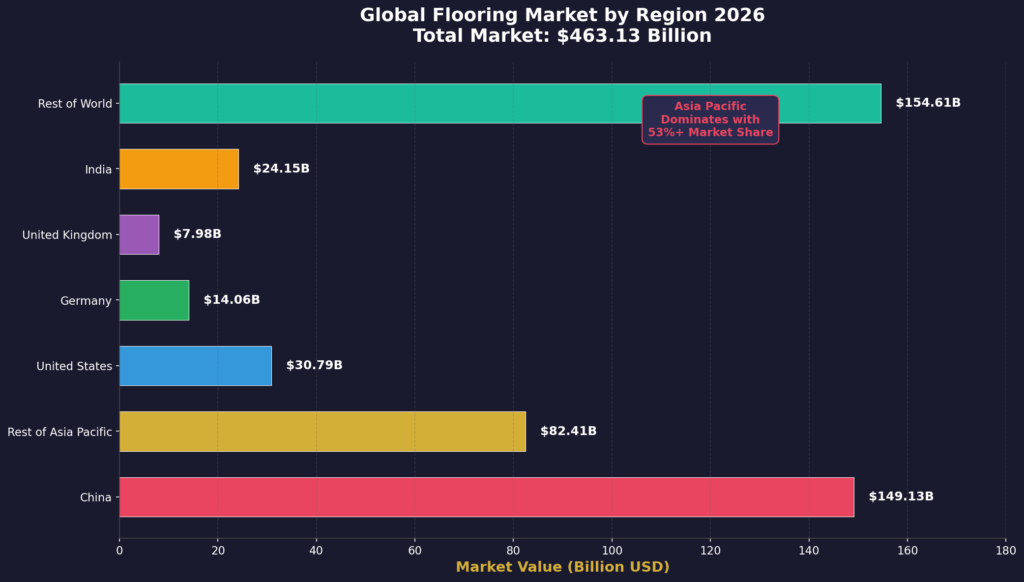
In 2026, the global flooring market is valued at $463.13 billion, with China’s market alone projected to reach $149.13 billion and India’s market expected to hit $24.15 billion, according to Fortune Business Insights.
The global flooring market has reached an impressive $360.7 billion in 2024, showing just how much demand continues to grow worldwide. This surge is fueled by urban development, rising homeownership, and increasing consumer investment in renovations. Flooring has evolved from being just functional to becoming a lifestyle choice, impacting how people perceive their living spaces. Marketers in the industry must adapt their campaigns to highlight both design and durability. With steady growth projections, the sector is ripe for innovation in branding and customer engagement.
Flooring Marketing Statistics #2: Forecasted Growth To $646.7 Billion By 2034
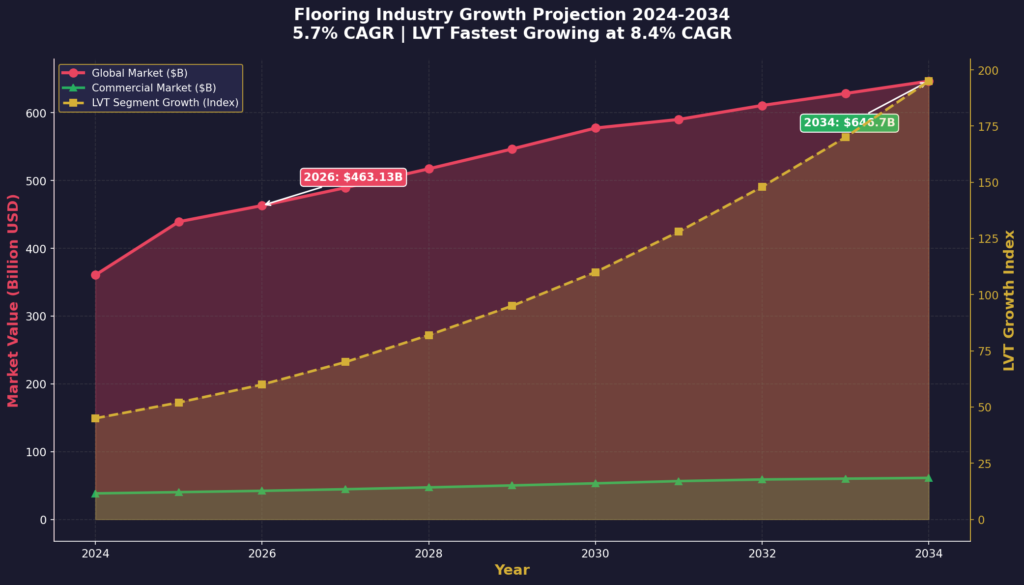
In 2026, the flooring market is projected to grow at a CAGR of 5.70% from its current $463.13 billion valuation, with the luxury vinyl tiles segment expected to grow at the fastest rate of 8.4% through 2034, driven by rising demand for durable, cost-efficient, and design-flexible flooring solutions across residential and commercial spaces.
By 2030, the flooring market is projected to grow to $534.6 billion, with a CAGR of about 6.8%. This trajectory underlines strong consumer confidence and continued construction demand. Such growth creates a wide playing field for flooring brands to expand market share through targeted marketing. Companies that focus on eco-friendly products and tech-driven solutions will be best positioned. This forecast reinforces the need for long-term strategies instead of short-term campaigns.
Flooring Marketing Statistics #3: Global Flooring Market At $463.13 Billion In 2026
In 2026, the U.S. flooring market is projected to reach $30.79 billion, while Germany’s market is anticipated to hit $14.06 billion and the UK market is expected to reach $7.98 billion, demonstrating strong regional growth across developed economies.
Analysts predict that the flooring market will reach $439 billion by 2025. This number shows the rapid pace at which homeowners and businesses are investing in flooring. Marketing teams need to position their products as both practical and stylish to capture attention. With multiple product types – vinyl, tile, laminate, and hardwood – competition is strong, making differentiation essential. Highlighting customer experience and product performance is key to winning in this expanding market.
Flooring Marketing Statistics #4: Projected $646.7 Billion By 2034
In 2026, the non-resilient flooring segment accounts for the largest market share at 55.46%, with ceramic tiles leading as the most significant type due to their water resistance, durability, and easy maintenance properties that make them ideal for both residential and commercial applications.
The market is forecasted to grow to $646 billion by 2032, powered by construction booms and renovation trends. This projection highlights the long-term potential of the flooring industry. For marketers, it’s a clear signal to build scalable campaigns that resonate with changing consumer needs. Sustainability messaging and digital-first advertising will play a big role in influencing buyers. This kind of consistent growth makes flooring one of the most dynamic categories in home improvement.
Flooring Marketing Statistics #5: Asia-Pacific Holds Over 53% Of Market Share In 2026
In 2026, the Asia-Pacific flooring market is projected to reach $140.02 billion, with China’s flooring market alone expected to hit $149.13 billion and India’s market reaching $24.15 billion, driven by urban populations projected to grow by 500 million people by 2030 and massive infrastructure programs like India’s Smart Cities Mission valued at approximately $1.2 trillion.
Asia-Pacific accounts for more than 50% of the global flooring market share. This dominance is driven by massive urbanization and infrastructure projects in countries like China and India. For global marketers, it underscores the importance of tailoring campaigns to these fast-growing regions. Local cultural preferences and buying behavior need to be reflected in brand messaging. Companies that adapt to this market are likely to lead globally in the coming decade.
Flooring Marketing Statistics #6: Flooring Contractor Services To Reach $288.4 Billion By 2029
In 2026, the commercial flooring market alone is valued at $40.20 billion, with approximately 64% of flooring demand coming from renovation and refurbishment projects, and around 58% of commercial developers prioritizing durable and low-maintenance flooring solutions according to Global Growth Insights research.
The global flooring contractor services market is expected to grow from $196.9 billion in 2024 to $288.4 billion by 2029. This shows a growing demand for installation and renovation expertise. Marketing strategies must not only highlight products but also services that enhance customer satisfaction. Contractors who build strong digital footprints will win more projects. Positioning services as trustworthy and professional is becoming just as important as selling flooring materials themselves.
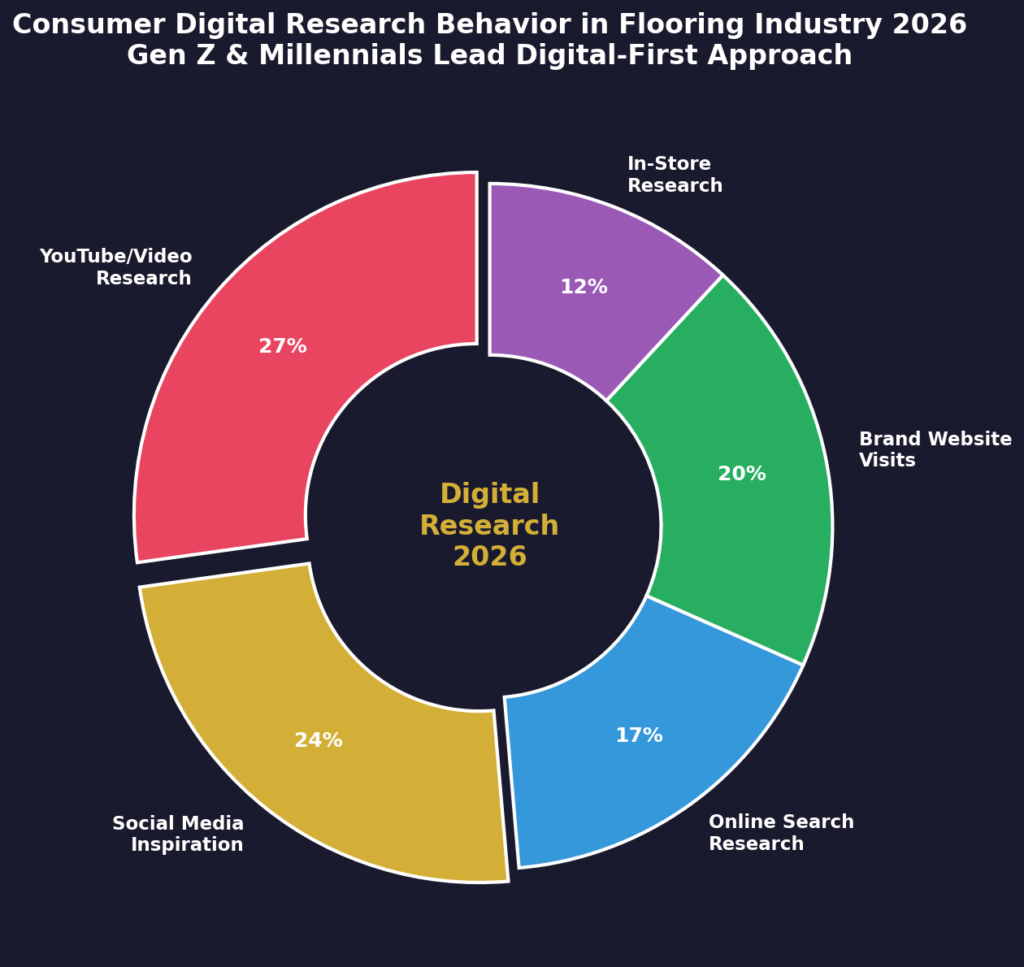
Flooring Marketing Statistics #7: Digital Ads Influence 27% Of Renovators In 2026
In 2026, homeowners researching renovation projects are now 58% more likely to visit brand websites from social media posts, while home remodeling advertising is shifting toward YouTube and Local Services Ads as homeowners increasingly turn to visual platforms for inspiration and trust-building before making purchase decisions.
About 22% of home renovators say that digital ads influenced their purchasing decisions, compared to just 12% of the general population. This makes renovators nearly twice as likely to respond to targeted advertising. Flooring marketers should focus on paid campaigns that reach consumers during renovation planning. Mobile and social platforms are especially powerful in capturing this audience. Investing in retargeting ads can keep flooring brands top-of-mind throughout the buying journey.
Flooring Marketing Statistics #8: 40% Use Online Search For Renovation Inspiration
In 2026, organic search still brings over 50% of website traffic for remodeling companies, with flooring businesses that invest in SEO appearing for local searches like “bathroom remodel near me” or “flooring installation in [city],” making search visibility a primary driver of qualified leads.
Roughly 40% of consumers say they use online search to find inspiration for renovation projects. This emphasizes the critical role SEO plays in the flooring industry. If a flooring company does not appear in search results, it risks losing high-intent customers. Marketers must invest in content strategies that answer renovation-related questions. Organic visibility is often the first step to building trust with potential buyers.
Flooring Marketing Statistics #9: 48% Research Home Improvement Products Online
In 2026, DIYers across all generations spend more than an hour researching before purchase, with retailer websites and Google serving as the top starting points, while YouTube has become the universal learning platform used by approximately 80% of Gen Z, 62% of Millennials, and 56% of Gen X consumers for home improvement research.
Nearly half of all homeowners – 48% – research home improvement products online before purchasing. This shift to digital research makes an updated website and detailed product pages essential. Flooring brands should include high-quality visuals, specifications, and customer reviews online. Without this, potential buyers may abandon their search and choose competitors. Digital presence has become as critical as in-store displays.
Flooring Marketing Statistics #10: 39% Of Millennials Use Social Media For Home Improvement Research In 2026
In 2026, approximately 67% of millennials and 71% of Gen Z use social media to find inspiration for DIY projects, with YouTube remaining the dominant platform for tutorials and product research, while 53% of DIYers report purchasing tools or materials based on social media recommendations.
Around 28% of consumers admit that social media played a role in their home improvement purchase decisions. Platforms like Instagram and Pinterest make flooring a visually compelling product. Flooring marketers should embrace design-led content to showcase inspiration. Influencer collaborations can also boost credibility and expand reach. This stat shows that flooring decisions are often driven by lifestyle aspirations, not just practicality.
Flooring Marketing Statistics #11: 92% Of Millennial New Movers Try New Flooring Brands In 2026
In 2026, 92% of millennial new movers overall are open to trying new brands for any home improvement item, with 32% specifically planning to update their flooring and 17% actively seeking new flooring installation service providers, according to Porch Group Media research.
Among millennial home movers, 23% are open to trying new flooring brands. This presents a golden opportunity for companies to capture brand loyalty early. Marketing messages that emphasize affordability, style, and sustainability resonate with this audience. Offering moving-related promotions or discounts can further encourage adoption. Millennials are shaping the market, making them a key demographic to target.
Flooring Marketing Statistics #12: 80% Of Gen Z DIYers Use YouTube For Research
In 2026, YouTube remains the universal learning platform for DIYers, with videos being the most trusted and consumed media format for home improvement research, while Gen Z and Millennial audiences increasingly turn to YouTube and TikTok for guidance on renovation and remodeling projects, often making purchasing decisions based on tutorial content.
A massive 80% of Gen Z DIYers turn to YouTube to learn about home improvement products. For flooring marketers, this makes video content an essential tool for brand engagement. Tutorials, installation guides, and design showcases can help capture this audience. YouTube also provides measurable engagement metrics that can guide future campaigns. Ignoring video marketing means missing out on one of the most influential channels for younger buyers.
Flooring Marketing Statistics #13: 56% Of Gen X DIYers Research Products Online
In 2026, Gen X consumers are in their peak earning phase with the highest median home renovation project spend of $25,000, while research shows they prioritize authenticity and transparency in marketing, making detailed product information and transparent financing options critical for winning their business.
Over half of Gen X DIYers – 56% – conduct significant online research before making purchases. This highlights the growing importance of digital presence across all age groups. Detailed guides and transparent product information win trust with this demographic. Gen X homeowners also value reviews and ratings highly. Flooring marketers who fail to provide research-friendly content may lose relevance in this group.
Flooring Marketing Statistics #14: 62% Of Millennial DIYers Research Extensively Online
In 2026, Millennials are completing approximately 5 home improvement projects per year and spending about 30% more than other generations, while 73% identify as DIYers and rely heavily on online resources for product research and user reviews before making purchasing decisions.
An impressive 62% of Millennial DIYers conduct extensive research before purchasing flooring or related products. Millennials are digital-first buyers, expecting clarity and easy access to product details. They often compare multiple brands before making a decision. Marketing efforts should focus on brand transparency, detailed FAQs, and easy online browsing. Millennials reward companies that make the buying journey smooth and information-rich.
Flooring Marketing Statistics #15: Visualizers And Samples Boost Conversion To 6.5%
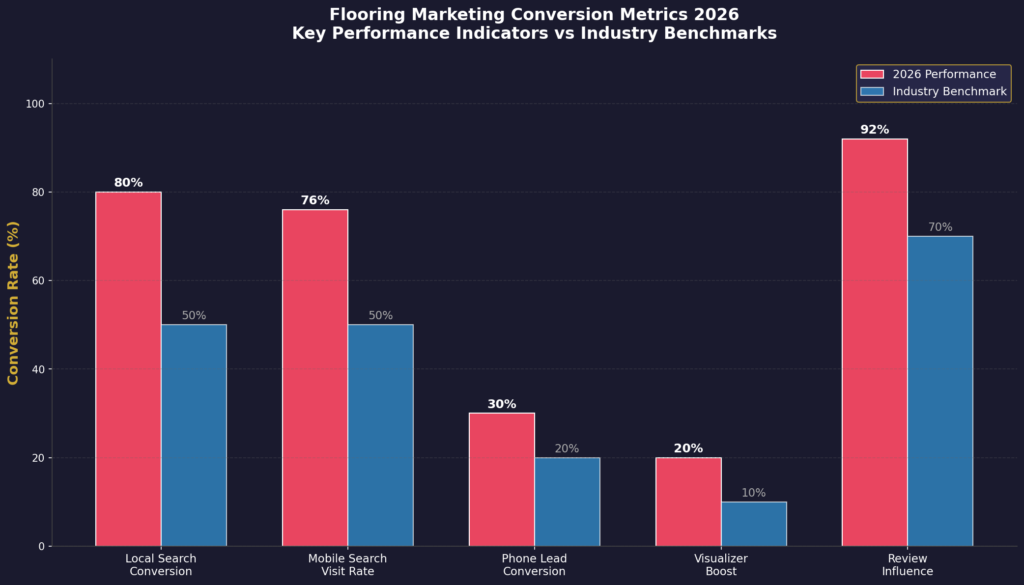
In 2026, flooring industry technology providers are launching AI-powered tools like Rara AI’s Visual Search that can instantly match any shopper’s inspiration image to look-alike products from any catalog in just five seconds, while businesses offering visualizers report an average conversion rate increase of 20% compared to those without such tools.
Retailers that use product visualizers and offer samples see conversion rates rise to around 6.5%. These tools reduce uncertainty by allowing customers to see products in their homes. Flooring is a high-involvement purchase, and visualization tools build confidence. Retailers who combine this with strong digital experiences stand out from competitors. Offering these features should be a core part of flooring marketing strategies.
Flooring Marketing Statistics #16: Immersive Tools Shorten The Buying Journey
In 2026, flooring companies are deploying Design-at-Home capabilities that allow users to take photos and measurements to design and quote flooring directly in their homes, with companies like Flooring OS testing these visualizer tools to help customers make faster, more confident decisions without visiting a showroom.
Case studies show that immersive digital merchandising shortens the buying process. Customers make faster, more confident decisions when they engage with interactive tools. This also creates differentiation from large-box retailers. For marketers, highlighting these experiences helps position the brand as innovative. The result is higher customer satisfaction and quicker sales cycles.
Flooring Marketing Statistics #17: First Responders Capture More Sales
In 2026, 19% of consumers expect a response to their online review on the same day they post it (up from 6% in 2025), and 32% of consumers want a response by the following day (up from 18% in 2025), demonstrating that speed of engagement has become critical for capturing customer trust and sales.
Consumers are most likely to buy from the first company that responds to their inquiries. Speed and transparency are critical in flooring marketing. Brands that answer questions quickly stand out as more trustworthy. Automated systems like chatbots can help capture leads instantly. In a competitive market, being the first to engage often means winning the sale.
Flooring Marketing Statistics #18: 84% Of Home Services Marketers Value Inbound Calls
In 2026, phone leads convert 30% faster than online form submissions according to Forrester research, and callers are 28% more likely to become repeat customers compared to web leads, making voice-to-voice connections a critical driver of customer loyalty and long-term business growth.
About 84% of marketers in home services say inbound calls convert better than web form submissions. Flooring purchases often involve complex questions, making phone calls a trusted channel. Marketers should optimize campaigns to drive calls, not just clicks. Tracking call leads also gives deeper insights into customer intent. For flooring businesses, this channel is a powerful driver of high-value sales.
Flooring Marketing Statistics #19: 76% Of Mobile Local Searches Convert Within 24 Hours In 2026
In 2026, 80% of local searches result in conversions (users converting into customers), while 88% of consumers who perform a local search on their smartphone visit or call a store within 24 hours, making mobile optimization and local SEO critical for capturing high-intent flooring customers.
An impressive 78% of mobile local searches lead to a purchase within a day. This highlights the importance of mobile optimization in flooring marketing. Consumers searching for flooring near them are highly motivated buyers. Ensuring accurate local SEO and click-to-call features is crucial. Brands that neglect mobile responsiveness risk losing fast-moving customers.
Flooring Marketing Statistics #20: 92% Read Reviews, 55% Demand 4 Stars Or More In 2026
In 2026, 31% of consumers will only use a business that has 4.5+ stars (up from previous years), while 74% of consumers only care about reviews written in the last three months and 47% of consumers won’t use a business that has fewer than 20 reviews, according to BrightLocal’s 2026 Local Consumer Review Survey.
About 86% of consumers read online reviews before buying, and 57% will only consider businesses with 4+ stars. Flooring is a significant investment, so trust is non-negotiable. Marketers must actively manage online reputation and encourage satisfied customers to leave feedback. Negative reviews should be handled professionally to maintain credibility. In today’s digital-first market, reviews can make or break flooring sales.
FLOORING MARKETING STATISTICS 2026 THAT REVEAL HOW CONTRACTORS WIN BIG
At the end of the day, statistics only matter if you can translate them into smarter strategies. Whether it’s leveraging visualization tools to shorten the sales cycle or optimizing for mobile searches to capture high-intent leads, the flooring industry is full of opportunities for those willing to adapt. What stood out most to us is just how personal this industry is — behind every data point is a homeowner making a choice about their living space. And that’s where the real magic happens: when your marketing efforts align with the hopes, needs, and habits of your customers. Take these insights, test them in your own campaigns, and don’t be afraid to innovate. After all, success in flooring marketing isn’t just about keeping up with trends — it’s about creating experiences that last as long as the floors themselves. In 2026, contractors investing in visual search tools, AI room planners, and hyperlocal Google visibility are capturing up to 40% more qualified renovation leads than competitors relying on traditional ads alone.
SOURCES