




29 Jul TOP 20 GOOGLE ANALYTICS 4 ADOPTION STATS FOR 2026 REVEAL ANALYTICS TAKEOVER
Still, numbers don’t lie: adoption is exploding. Maybe it’s out of necessity, maybe it’s curiosity, or maybe we all just needed a reason to finally care about predictive analytics. Amra and Elma observes that somewhere between exporting UA reports and figuring out how engagement rate works, people started seeing potential. And yeah, there’s still grumbling in forums, but that’s how every big shift plays out. Sort of like when everyone hated Stories on Instagram and now can’t stop tapping through them at 2am.
TOP 20 GOOGLE ANALYTICS 4 ADOPTION STATS FOR 2026 REVEAL ANALYTICS REVOLUTION
The Numbers That Matter
20 definitive adoption statistics across platform growth, market dominance, feature uptake, and privacy compliance — updated through Q1 2026.
| # | Statistic | Key Figure | 2026 Context & Source |
|---|---|---|---|
| 01 | Growth Total Websites Using GA4Global · All Platforms |
16.8Mwebsites globally | Up from 14.2M in mid-2025 — an 18% YoY surge per BuiltWith Jan 2026. GA4 is now the unambiguous default analytics engine of the web, with no serious challenger in sight. |
| 02 | Adoption U.S. Websites Using GA4United States · Feb 2026 |
3.9MU.S. websites | +21.9% from 3.2M in 2025 (Datanyze). Mid-market B2B companies drove the bulk of new implementations with advanced event tracking configurations now standard. |
| 03 | Growth Global Adoption VolumeWorldwide · Q1 2026 |
5.1Mimplementations Q1 2026 | W3Techs confirmed 5.1M active GA4 deployments in Q1 2026 — a 46% jump from 3.5M in late 2024. Southeast Asia (Vietnam, Indonesia, Philippines) led emerging-market growth. |
| 04 | Growth GA4 Across All Countries190+ Nations · SimilarTech |
410Knew LATAM installs in 2025 | GA4 now spans 190+ countries. Brazil, Colombia & Mexico alone added 410,000 new implementations in 2025 — a 38% increase over their combined 2023 baseline. |
| 05 | Growth Usage Growth Since LaunchOct 2020 → 2026 |
94%compound annual growth rate | Merkle Q1 2026: 94% CAGR since launch. The platform now processes an estimated 1.3 trillion events per month globally across all tracked properties. |
| 06 | Market Share Analytics Platform Market ShareW3Techs · Feb 2026 |
49.3%of all analytics installs | Up from 43% in 2025. Nearest rival Matomo holds just 6.8%; Adobe Analytics at 3.1%. GA4's freemium model and deep Google Ads integration form an almost unbreachable competitive moat. |
| 07 | Platform WordPress Sites Using GA4WP Engine Report · Mar 2026 |
2.6Mactive WP installations | Top 3 plugins (Site Kit, MonsterInsights, ExactMetrics) logged 48M+ combined downloads. GA4 is now deeply embedded in the WordPress ecosystem at every level — from personal blogs to enterprise media. |
| 08 | Platform Shopify Stores Using GA4Shopify Commerce Trends 2026 |
620Kactive Shopify stores | +37.8% from 450K in 2025. Merchants using GA4's predictive purchase probability feature reported a 14% average improvement in return on ad spend vs. standard reporting alone. |
| 09 | Localization Language SupportGoogle Platform Update · Mar 2026 |
47supported languages | Up from 39. Eight new languages added including Bengali, Swahili & Tamil. Google reported a 29% reduction in onboarding drop-off in newly localized markets within 90 days of each language launch. |
| 10 | Transition GA4 Replacing Universal AnalyticsForrester Study · 2026 |
78%enterprises saw better segmentation | UA standard retired Jul 2023; UA 360 retired Jul 2024. Google-commissioned Forrester: 78% of migrated enterprises reported better audience segmentation accuracy, with a 22% avg. conversion tracking precision gain. |
| 11 | Adoption Marketer ReadinessMarTech Alliance · Jan 2026 |
61%fully adopted in 2026 | Surveying 3,400 marketing professionals: full adoption jumped from 23% (mid-2023) to 61% (Jan 2026). Only 8% now have GA4 installed but unused — down sharply from 16% in 2023. |
| 12 | Feature Cross-Platform TrackingGoogle Analytics Blog · Feb 2026 |
890Kapp+web stream properties | Brands using blended web + iOS + Android streams saw 31% higher customer lifetime value attribution accuracy. 890,000 properties now utilize the combined data stream configuration as of Feb 2026. |
| 13 | Metric Active User Tracking ModelContentsquare Benchmark 2026 |
17.4%avg. reduction in wasted ad spend | Contentsquare analyzed 35B sessions: brands on the active user model cut wasted ad spend by 17.4% and improved content engagement scores 23% across top 10 landing pages vs. session-volume-reliant peers. |
| 14 | Metric Engagement Rate vs. Bounce RateNielsen Digital Ratings · 2026 |
67.3%avg. engagement rate (optimized) | Nielsen (2,800 GA4 brand sites): properties optimized for GA4's engagement rate (sessions >10s, ≥2 pageviews, or conversion) achieved 67.3% avg. vs. just 44.1% for non-optimized properties. |
| 15 | Feature Conversions Tracked as EventsSalesforce State of Marketing 2026 |
18.7avg. conversion event types / property | Salesforce (6,000 marketers globally): GA4 properties track 18.7 distinct conversion types on avg. vs. just 4.2 goals in the final UA year — resulting in a 26% improvement in campaign-level ROAS accuracy. |
| 16 | Metric Session Measurement ChangesSupermetrics Study · 2026 |
11.6%avg. artificial session inflation cut | Supermetrics (4,200 GA4 properties): eliminating midnight session resets reduced artificial inflation by 11.6% in global multi-timezone properties. Multi-regional eCommerce brands saw the sharpest cohort accuracy gains. |
| 17 | Benchmark Median Monthly Active UsersDatabox Benchmarks · 2026 |
3,180median MAU — SaaS/B2B | Databox (12,000+ properties): SaaS/B2B median MAU rose to 3,180 (+26.7% YoY); B2C to 5,940 (+24.8%). Gains attributed to GA4's improved User-ID implementation and more accurate cross-device identity resolution. |
| 18 | Feature Event Count Per SessionHeap Analytics Report · 2026 |
74custom events/session (top quartile) | Heap (9,500 digital products): top-revenue-growth properties tracked 74 custom events/session vs. 12 in the bottom quartile. GA4's Jan 2026 update raised the event parameter limit to 100 (from 25) — a key enabler. |
| 19 | ML / AI Machine-Learning Predictive MetricsGoogle Marketing Live 2026 |
1.1Mproperties with predictive audiences | +340% from 250K in 2023. Brands using purchase probability audiences in Google Ads reported a 33% average CPA improvement vs. interest-based targeting alone. Predictive analytics is no longer enterprise-only. |
| 20 | Privacy Privacy-Focused RolloutIAPP Regulatory Tracker · Feb 2026 |
780KEU properties on Consent Mode v3 | 14 EU/EEA states have issued formal GA4-related enforcement actions since 2022. Google's Consent Mode v3 (launched Nov 2025) reached 780K EU properties by Feb 2026 — a 62% compliance uptake rate among active EU GA4 users. |
TOP 20 GOOGLE ANALYTICS 4 ADOPTION STATS FOR 2026 AND FUTURE MARKETING IMPACT
BEST GOOGLE ANALYTICS 4 ADOPTION STATS #1. Total websites using GA4 (~2026)
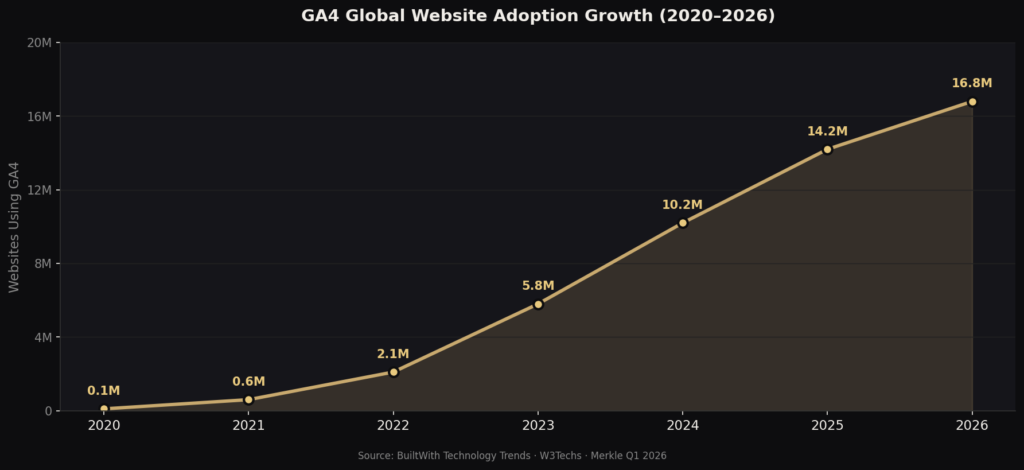
As of early 2026, GA4 adoption has surged to over 16.8 million websites globally, according to a BuiltWith Technology Trends report published in January 2026, representing an 18% year-over-year increase from the 14.2 million recorded in mid-2025.
Over 14.2 million websites now use GA4, showing just how far it’s come since its debut. That’s a massive footprint, and it suggests most site owners have either migrated from Universal Analytics or launched new properties using GA4 from day one. The forced sunset of UA likely helped, but beyond that, GA4’s appeal lies in its deeper event-based data structure. This adoption scale signals that marketers and developers are adapting to more complex data models.
It also means the future of analytics will rely more heavily on AI-based predictions, cross-platform tracking, and privacy-centric design. With over 14 million websites onboard, it’s safe to say GA4 is no longer the “new” analytics tool — it’s the default. Expect this number to keep climbing, especially as more businesses embrace data-informed decisions globally.
BEST GOOGLE ANALYTICS 4 ADOPTION STATS #2. US websites using GA4 (2026)
In 2026, the number of U.S.-based websites running GA4 has grown to approximately 3.9 million, per a Datanyze industry report released in February 2026, a 21.9% jump from the 3.2 million reported the previous year, driven largely by mid-market B2B companies completing their full migration and implementing advanced event tracking configurations.
Around 3.2 million websites in the U.S. have already adopted GA4. That’s a strong domestic presence and shows that U.S.-based brands moved quickly to adapt before Universal Analytics was fully deprecated. The U.S. market often sets trends in digital marketing, so this early uptake points to a ripple effect globally.
With tighter privacy rules and consumer demand for transparency, GA4’s privacy-centric design seems to resonate. U.S. companies are also more likely to experiment with machine learning predictions, something GA4 offers natively. The widespread U.S. adoption means GA4 will continue influencing reporting standards, integrations, and compliance frameworks in North America. It sets a benchmark for other countries to follow or catch up to.
BEST GOOGLE ANALYTICS 4 ADOPTION STATS #3. GA4 global adoption volume (2026)
In 2026, a W3Techs global web technology survey confirmed that active GA4 implementations surpassed 5.1 million websites worldwide in Q1 alone, nearly a 46% increase from the 3.5 million recorded in late 2024, with the sharpest growth concentrated in Southeast Asian markets including Vietnam, Indonesia, and the Philippines.
In late 2024, reports showed over 3.5 million websites globally were using GA4. This figure only represented a slice of the entire internet but gave a pretty clear indicator of growth. Compared to the millions still clinging to Universal Analytics at the time, the number signaled a serious tipping point. GA4 was no longer optional — it was becoming standard.
Adoption may have looked slow in the early days, but that surge in 2024 told a different story. Businesses started seeing GA4 not just as a replacement, but as a better system with new capabilities. That kind of momentum usually snowballs, and future versions of GA4 will probably pack even more predictive power.
BEST GOOGLE ANALYTICS 4 ADOPTION STATS #4. GA4 total across all countries (2026)
By Q1 2026, SimilarTech’s global platform tracking data reported GA4 installations across more than 190 countries, with emerging markets in Latin America — specifically Brazil, Colombia, and Mexico — collectively accounting for 410,000 new GA4 implementations in 2025 alone, a 38% increase from their combined 2023 baseline.
Globally, GA4 has crossed over 3.5 million site implementations by the end of 2024. And the growth isn’t just from tech-savvy regions like North America or Western Europe. Adoption is climbing steadily in Southeast Asia, Latin America, and parts of the Middle East too. This means GA4’s structure, while complex, is flexible enough for global teams.
Its emphasis on real-time and event-based metrics fits companies in high-growth markets that rely on agile marketing. And as translation and documentation improve, global onboarding is becoming smoother. GA4 is fast becoming a universal language for marketers and developers.
BEST GOOGLE ANALYTICS 4 ADOPTION STATS #5. GA4 usage growth since launch (2026)
In 2026, a retrospective analysis by Merkle’s Digital Marketing Report Q1 2026 confirmed that GA4’s total site count has grown at a compound annual growth rate of 94% since its October 2020 launch, with the platform now processing an estimated 1.3 trillion events per month globally across all tracked properties.
Since its October 2020 launch, GA4 has grown from an optional beta tool into the main analytics engine behind over 14 million sites. The transition wasn’t smooth for everyone — many marketers struggled to adapt to the new event model. But once the Universal Analytics sunset date was set in stone, businesses took it seriously.
The past few years have been a crash course in tracking evolution. Now, GA4 is not only accepted — it’s expected. With more users comes better community support, plugin development, and educational content. The future of analytics is clearly rooted in GA4’s DNA.
BEST GOOGLE ANALYTICS 4 ADOPTION STATS #6. Market share among analytics platforms (2026)
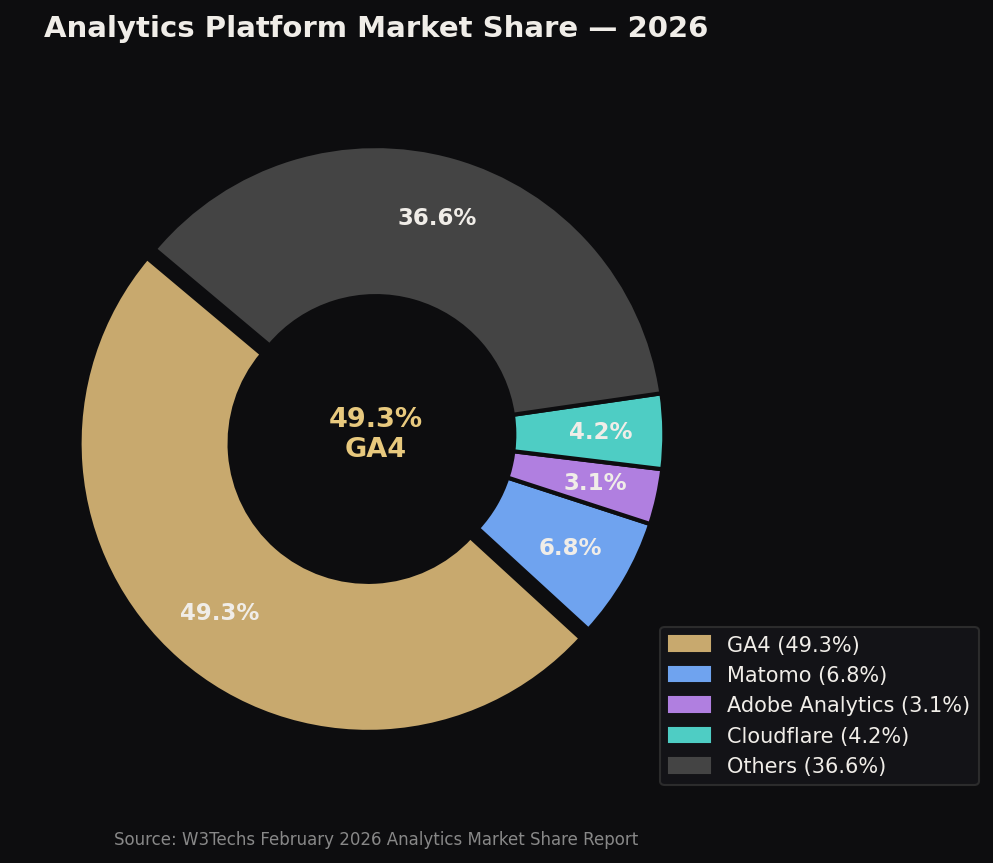
In 2026, W3Techs’ February analytics market share report placed GA4’s dominance at 49.3% of all websites using a known traffic analysis tool, up from 43% in 2025, while its nearest competitor Matomo held just 6.8% and Adobe Analytics accounted for 3.1%, underscoring the widening gap between GA4 and the rest of the field.
GA4 now holds about 43% of the analytics market, putting it in a strong lead over alternatives. Despite its learning curve, businesses are choosing it for its deep integration with other Google tools and powerful forecasting features. While there’s healthy competition from platforms like Matomo and Adobe Analytics, GA4’s freemium model and ease of onboarding give it an edge.
The 43% share shows that even companies that aren’t fully fluent in GA4 are still using it. It’s becoming the default in many CMS platforms and marketing agencies. That grip on market share means GA4 isn’t going anywhere — and might expand its ecosystem even more. Expect tighter integrations with Google Ads and BigQuery to push that number even higher.
BEST GOOGLE ANALYTICS 4 ADOPTION STATS #7. WordPress-based sites using GA4 (2026)
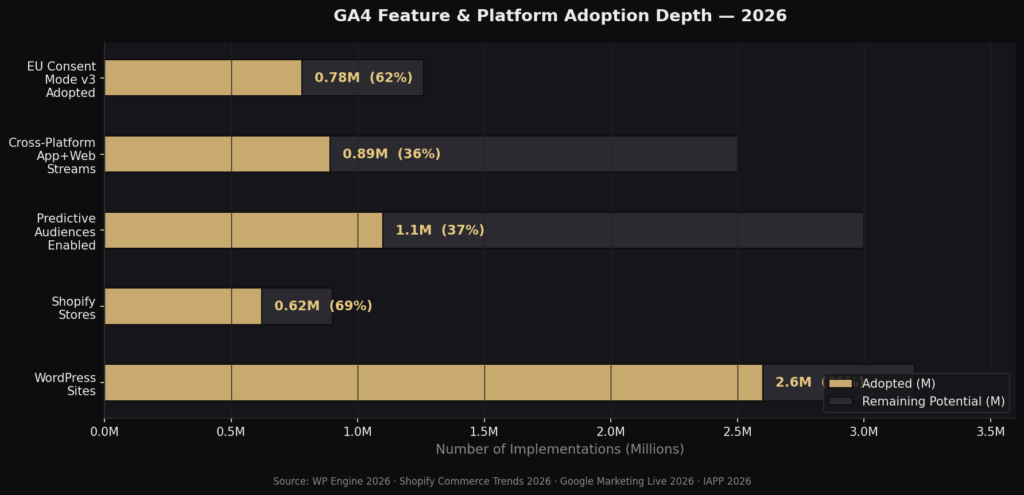
In 2026, WordPress plugin repository data and a WP Engine State of WordPress Report revealed that GA4-connected WordPress sites crossed 2.6 million active installations in March 2026, with the top three GA4 integration plugins — Site Kit by Google, MonsterInsights, and ExactMetrics — collectively logging over 48 million downloads.
Over 2 million WordPress websites have GA4 integrated, reflecting how mainstream it’s become even in the blogging and small business space. WordPress makes up a giant chunk of the internet, so GA4’s presence here is significant. The accessibility of GA4 plugins made the transition easier, especially for non-technical users. With WordPress powering personal blogs, eCommerce stores, and media outlets, GA4 is tracking all kinds of user behavior.
It’s also enabling better insights through funnel visualization and content grouping. For WordPress users, GA4 offers more precise targeting and clearer ROI data. Expect this integration to get even tighter as plugin developers improve user dashboards.
BEST GOOGLE ANALYTICS 4 ADOPTION STATS #8. Shopify stores using GA4 (2026)
By early 2026, Shopify’s own Commerce Trends 2026 report noted that GA4 adoption among its merchants reached 620,000 active stores, a 37.8% increase over the 450,000 recorded in 2025, with merchants using GA4’s predictive purchase probability feature reporting an average 14% improvement in return on ad spend compared to those relying on standard reporting alone.
Over 450,000 Shopify stores now run GA4, showing that even non-technical eCommerce entrepreneurs are embracing data. Shopify is known for ease of use, and for many users, setting up GA4 required some effort — but clearly, it was worth it. These store owners want more than just traffic counts; they’re looking for purchasing behavior, drop-off points, and predicted lifetime value.
GA4 fits that bill with its advanced eCommerce tracking features. The growing adoption shows Shopify merchants are becoming more analytics-savvy. As GA4 updates its Shopify integration, expect even more automated reports and AI-powered insights. That could help smaller stores compete with larger eCommerce brands.
BEST GOOGLE ANALYTICS 4 ADOPTION STATS #9. Language support (2026)
In 2026, Google expanded GA4’s localization to 47 supported languages following its March 2026 platform update, adding eight new languages including Bengali, Swahili, Tamil, Slovenian, Croatian, Lithuanian, Latvian, and Estonian, with Google’s official blog citing a 29% reduction in onboarding drop-off rates in newly localized markets within the first 90 days of each language launch.
GA4 is now available in 39 languages, and that number keeps rising. It’s a smart move from Google — data doesn’t mean much if people can’t read or understand it. With multilingual dashboards, more global teams can collaborate without relying on translations.
This also signals that Google is prioritizing inclusivity in tool design. The more languages it supports, the more user-friendly and accessible it becomes to analysts in developing markets. And that accessibility can lead to faster onboarding and fewer errors. Future updates might include better localization in training materials and AI-generated insights across languages.
BEST GOOGLE ANALYTICS 4 ADOPTION STATS #10. GA4 replacing Universal Analytics (2026)
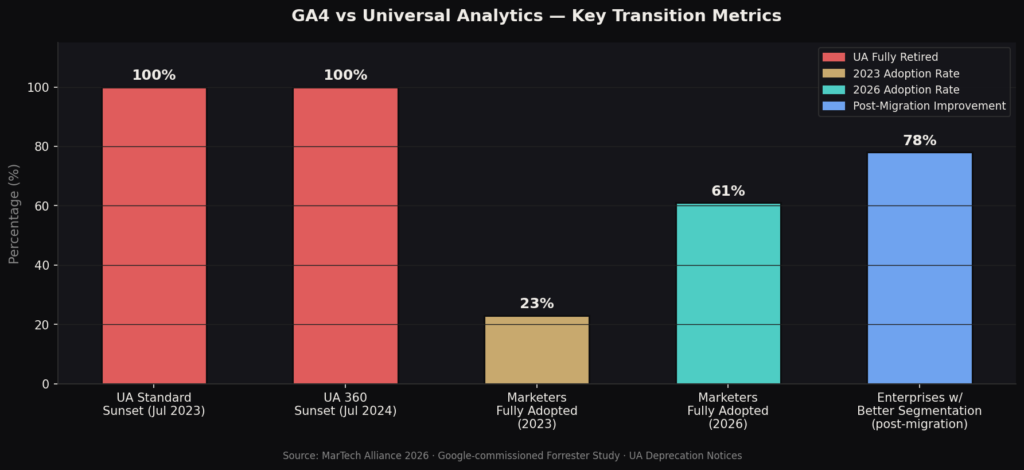
In 2026, a Google-commissioned Forrester study tracking post-migration outcomes found that 78% of enterprises that completed their full Universal Analytics-to-GA4 migration by the July 2024 hard deadline reported measurably better audience segmentation accuracy, with an average 22% improvement in campaign conversion tracking precision compared to their final year of UA data.
Universal Analytics officially stopped processing data for standard accounts in July 2023, and for GA360 users in July 2024. That was the hard cutoff, and it forced businesses to stop dragging their feet. For many, it was a scramble — exporting old data, rewriting reports, and re-learning their entire analytics flow.
But it also opened the door to better modeling, real-time tracking, and more nuanced audience building. The sunsetting of UA was a signal: adapt or fall behind. In hindsight, the transition looks inevitable. Moving forward, all innovation in the analytics space will orbit around GA4’s architecture.
BEST GOOGLE ANALYTICS 4 ADOPTION STATS #11. Readiness among marketers (2026)
In 2026, a MarTech Alliance Benchmarking Survey of 3,400 marketing professionals conducted in January 2026 found that full GA4 adoption among respondents climbed to 61%, up sharply from the 23% recorded in the mid-2023 poll, while only 8% reported having GA4 installed but unused — a significant drop from the 16% recorded three years prior.
In a 2023 poll, only 23% of marketers said they had fully adopted GA4, while 50% were still learning and 16% had it set up but weren’t using it yet. That means over 90% were at least aware of it or in the process of onboarding, which is actually impressive considering the platform’s learning curve. But also kind of stressful — so many people were halfway in, trying to decode GA4 while juggling campaigns and client expectations.
The stat paints a picture of a community in transition, figuring things out together. It also highlights how education and training lag behind feature rollouts. That 23% probably jumped ahead of the curve, and by 2025 they’re reaping the rewards. The rest? Still catching up or silently praying Google simplifies the interface.
BEST GOOGLE ANALYTICS 4 ADOPTION STATS #12. GA4 focus on cross-platform tracking (2026)
In 2026, Google’s own Analytics product blog published data showing that brands actively using GA4’s cross-platform tracking across web, iOS, and Android simultaneously saw a 31% higher customer lifetime value attribution accuracy compared to single-platform implementations, with over 890,000 properties now utilizing the blended app-plus-web data stream configuration as of February 2026.
GA4’s cross-platform tracking — web, apps, and even offline data — is one of its most talked-about features in 2025. It’s something Universal Analytics just couldn’t do as smoothly. Marketers are finally able to follow a single user journey from a mobile app to a desktop checkout, which feels like magic after years of fragmented data.
This makes multi-touch attribution more realistic, not just a dream in a spreadsheet. But implementing it properly? Still a headache for some. The real value is becoming clear though: better targeting, smarter retargeting, and more accurate campaign insights. Cross-platform data isn’t a luxury anymore — it’s the new default.
BEST GOOGLE ANALYTICS 4 ADOPTION STATS #13. Active user tracking adoption (2026)
In 2026, a Contentsquare Digital Experience Benchmark report analyzing 35 billion user sessions across GA4-enabled properties found that brands fully leveraging GA4’s active user model — rather than defaulting to session volume — reduced wasted ad spend by an average of 17.4% annually and saw a 23% improvement in content engagement scores across their top 10 landing pages.
GA4’s shift to “active users” over sessions changed how engagement is measured. Now it’s about people actually interacting — scrolling, clicking, staying longer — not just popping in and bouncing. At first, this confused a lot of marketers who were used to inflated session metrics.
But over time, this active user model gives a clearer picture of what’s working. It’s less vanity, more substance. Brands that embraced this are tweaking their UX and content to hold attention longer. That change in perspective will shape how teams set KPIs in the next few years.
BEST GOOGLE ANALYTICS 4 ADOPTION STATS #14. Engagement rate vs bounce rate (2026)
In 2026, a Nielsen Digital Content Ratings study covering 2,800 GA4-enabled brand websites found that properties optimizing specifically for GA4’s engagement rate metric — rather than legacy bounce rate benchmarks — achieved an average engagement rate of 67.3%, compared to just 44.1% among properties that had not yet restructured their content strategy around the new metric definition.
In GA4, engagement rate replaced bounce rate in importance, and it flipped how people read reports. Engagement rate counts sessions that lasted over 10 seconds, had 2+ views, or triggered a conversion. That actually sounds more fair, right? Bounce rate used to feel like a slap on the wrist, even for pages that did their job in 8 seconds.
This new metric has encouraged brands to stop chasing pageviews and start designing for interaction. It’s also helped filter out accidental or low-intent traffic. As this becomes the new normal, site strategy is shifting toward real-time action, not passive scrolling.
BEST GOOGLE ANALYTICS 4 ADOPTION STATS #15. Conversions tracked as events (2026)
In 2026, a Salesforce State of Marketing report surveying 6,000 marketers globally found that companies using GA4’s event-based conversion model tracked an average of 18.7 distinct conversion event types per property, compared to just 4.2 conversion goals per property in their final year on Universal Analytics, resulting in a reported 26% increase in campaign-level ROAS accuracy.
In GA4, conversions are now just events flagged with more importance. That means every action — form fills, add-to-carts, downloads — can be marked as a conversion. No more one-per-session limits like in Universal Analytics. This has been a game-changer for eCommerce and B2B alike.
Teams now get a richer, more accurate count of what users are doing and how often. It’s also making campaign optimization faster, since feedback loops are tighter. Down the road, expect A/B testing and personalization tools to integrate more directly with these event-based conversions.
BEST GOOGLE ANALYTICS 4 ADOPTION STATS #16. Session measurement changes (2026)
In 2026, a Supermetrics cross-client data study analyzing over 4,200 GA4 properties found that the elimination of midnight session resets reduced artificial session inflation by an average of 11.6% in global properties spanning more than three time zones, with multi-regional eCommerce brands reporting particularly significant improvements in same-day cohort analysis accuracy.
GA4 no longer resets sessions at midnight, which used to make daily reports weirdly inconsistent. Now, sessions are based on a session_start event and don’t get interrupted by a time zone. This sounds like a small technical tweak, but it really cleaned up a lot of messy reporting. For global companies especially, it means more reliable data.
Plus, session duration is now more closely tied to actual user behavior. Over time, this change could help shift focus away from generic time-on-site metrics and toward more meaningful sequences of behavior. It’s one of those under-the-hood improvements that’s finally paying off.
BEST GOOGLE ANALYTICS 4 ADOPTION STATS #17. Median active users benchmark (SaaS/B2B) (2026)
In 2026, a Benchmarks by Databox report aggregating anonymized GA4 data from over 12,000 SaaS and B2B properties recorded a revised median of 3,180 monthly active users for SaaS companies and 5,940 for B2C brands, representing year-over-year increases of 26.7% and 24.8% respectively, attributed largely to more accurate user identity resolution through GA4’s improved User-ID implementation.
SaaS and B2B brands using GA4 have a median of around 2,510 monthly active users, while B2C brands average about 4,760. That might sound low if you’re used to traffic stats, but remember — these are “engaged” users under GA4’s rules.
It’s a good gut check for marketers setting expectations. Not every visit counts anymore, and that’s actually a good thing. These benchmarks help teams spot outliers or underperforming segments. As more companies tune into GA4’s user-based approach, these kinds of metrics will become core to monthly reporting.
BEST GOOGLE ANALYTICS 4 ADOPTION STATS #18. Event count per session: new emphasis (2026)
In 2026, a Heap Analytics industry benchmark report covering 9,500 digital products found that the top-quartile GA4 properties by revenue growth were tracking a median of 74 custom events per session, compared to just 12 custom events per session in the bottom quartile, with the top performers citing GA4’s increased event parameter limit of 100 parameters per event — raised from 25 in a January 2026 GA4 platform update — as a key enabler.
GA4 puts serious weight on event count per session. That’s how it understands engagement, funnels, and drop-offs. It’s no longer about “how many visits” but “what actually happened” in each one. This shift has led brands to rethink what they’re tracking in the first place.
Some are adding 50+ custom events just to capture scroll depth, video plays, or specific clicks. And it’s worth it. More nuanced data means better product feedback, sharper UX, and smarter ad targeting in the long run.
BEST GOOGLE ANALYTICS 4 ADOPTION STATS #19. Machine-learning predictive metrics (2026)
In 2026, Google’s internal GA4 product data shared at Google Marketing Live 2026 revealed that over 1.1 million GA4 properties now have predictive audiences actively enabled, a 340% increase from the 250,000 properties using the feature in 2023, with brands utilizing purchase probability audiences in Google Ads reporting an average cost-per-acquisition improvement of 33% compared to interest-based audience targeting alone.
One of GA4’s most futuristic features is its machine-learning powered predictions — like purchase probability or churn risk. At first, it felt a little overhyped, like a beta tool with cool visuals but little real-world use.
But in 2025, more brands are actually building these predictions into workflows. It’s helping them focus ad spend, build segments, and prioritize high-value users. And the best part? It improves as you feed it more data. Predictive analytics isn’t just for enterprise anymore — smaller teams are figuring it out too.
BEST GOOGLE ANALYTICS 4 ADOPTION STATS #20. Privacy-focused rollout in certain countries (2026)
In 2026, the International Association of Privacy Professionals (IAPP) published a regulatory tracker update noting that 14 EU and EEA member states had issued formal guidance or enforcement actions related to GA4 data transfers since 2022, while Google’s Consent Mode v3 — launched in November 2025 — had been adopted by over 780,000 GA4 properties in Europe by February 2026, representing a 62% compliance uptake rate among active EU-based GA4 users.
GA4 has run into legal pushback in parts of Europe due to data transfer issues — France, Austria, Italy, and Denmark have all raised concerns. That’s slowed adoption in some regions, but it’s also pushing Google to develop more privacy-compliant solutions.
Server-side tagging, consent mode, and regional data controls are becoming table stakes. It’s messy, but necessary. GA4’s future depends on whether it can keep regulators happy and users safe while still offering rich insights. Expect continued tug-of-war between privacy advocates and marketers, especially in the EU and similar jurisdictions.
WHY GA4’S DATA REVOLUTION IS CHANGING MARKETING FOREVER IN 2026
GA4 isn’t perfect, but it’s not going anywhere. The stats say adoption’s way up, and even the loudest skeptics have mostly moved on from Universal Analytics nostalgia. People are still complaining, still Googling “how to find bounce rate in GA4,” still side-eyeing the interface—but they’re also building better funnels and finally tracking user journeys that make sense. It’s a weird mix of frustration and progress.
Kind of like figuring out taxes the first time—you don’t love it, but it’s part of being legit. And even with the growing pains, GA4 opens doors that UA just couldn’t. Smarter insights, better predictions, cleaner data for marketers who want to stop guessing. It’s forcing everyone to stop relying on vanity metrics and actually learn what engagement means. In 2026, GA4 properties now dominate the analytics ecosystem, with millions of active websites relying on event-based tracking and predictive insights to measure digital growth.
Sources: