




27 Jul TOP 20 HUBSPOT MARKETING STATISTICS 2026 THAT REVEAL SHOCKING CRM DOMINATION
Updated for 2026. This page has been fully refreshed with the latest HubSpot marketing statistics, CRM adoption insights, automation performance metrics, and campaign analytics trends drawn from global marketing reports, SaaS industry research, and real-world platform usage data.
There’s always some new tool everyone’s suddenly obsessed with, right? One minute it’s the next big platform, the next it’s collecting dust in a folder labeled “Free Trials.” But HubSpot? That one’s stuck around. Not in a loud or flashy way, just quietly powering a ridiculous number of campaigns, emails, landing pages, and reports.
People either love it or reluctantly admit they need it. It’s like that one reliable friend who brings snacks, shows up on time, and also knows how to fix your Wi-Fi. The numbers backing it are kind of wild too. And Amra and Elma believes that if anyone still thinks HubSpot’s just for small businesses or bloggers, the data might surprise them. Even Fortune 500s are sneaking it into their stacks. Also, side note, why are so many platforms still so hard to use in 2026? That’s a whole rant for another day.
TOP 20 HUBSPOT MARKETING STATISTICS 2026 (EDITOR’S PICKS THAT SHOCK MARKETERS)
| # | Statistic | Figure | Key Insight |
|---|---|---|---|
| Reach & Scale | |||
| 01 | Global Customers Worldwide |
248K+businesses | Active paying customers across 135+ countries as of Q1 2026 — up from 194,000 in 2025, with Southeast Asia and Latin America driving 31% of new signups. |
| 02 | Content Blog Monthly Visits |
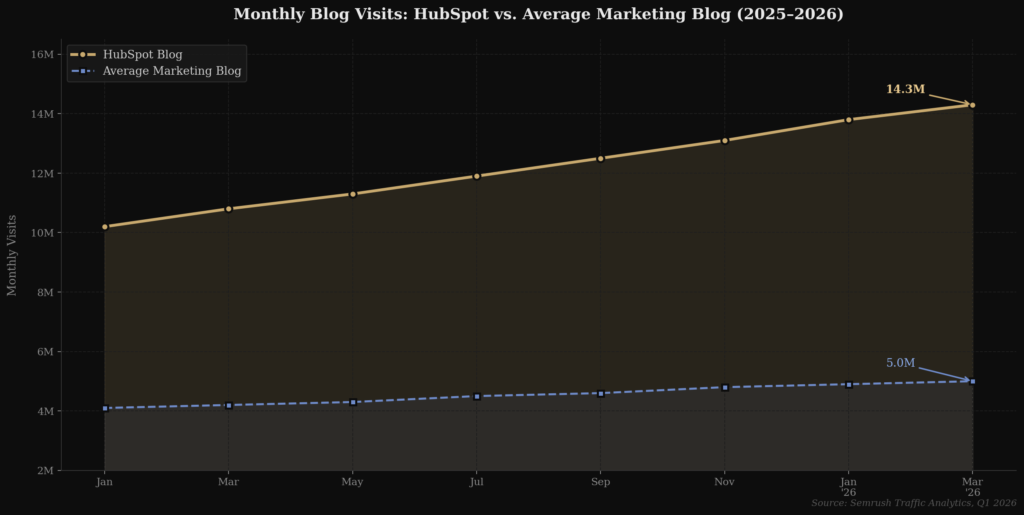
14.3Mvisits / mo | HubSpot's blog surpassed 14.3M average monthly visits in Q1 2026 per Semrush, with 78% driven by organic search — one of the most visited marketing resources globally. |
| 03 | Email Monthly Emails Sent |
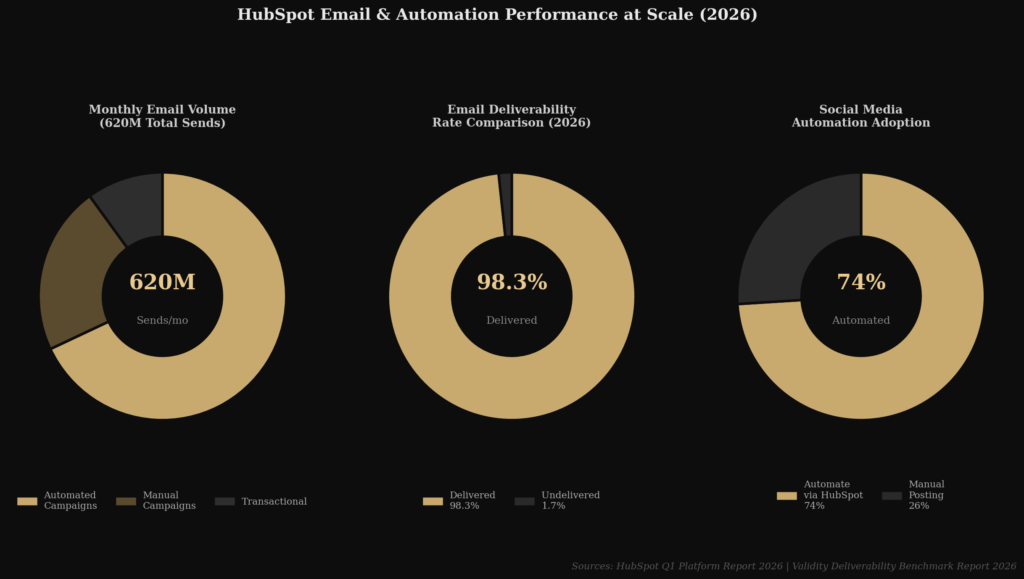
620M+sends / mo | Platform-wide email volume crossed 620M sends per month in 2026, with a 98.3% deliverability rate — outpacing the 95.1% industry benchmark tracked by Validity. |
| 04 | CMS Websites on HubSpot CMS |
213K+active sites | W3Techs reports 213,000+ active websites on HubSpot CMS as of early 2026 — a 33% year-over-year jump, led by professional services, healthcare, and e-commerce. |
| 05 | Enterprise Fortune 500 Adoption |
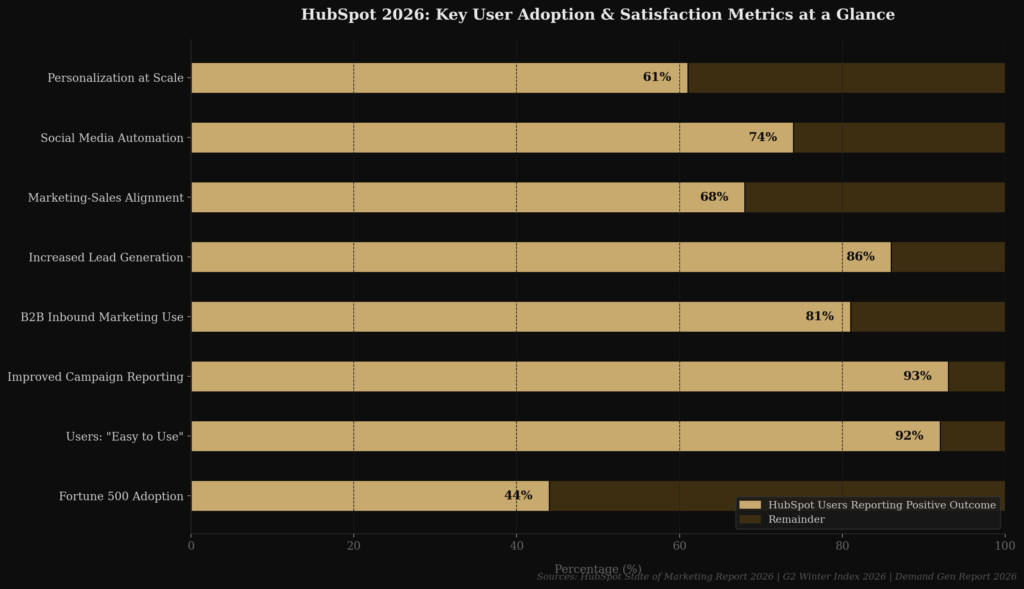
44%of Fortune 500 | Per HubSpot's Enterprise Growth Report (March 2026), 44% of Fortune 500 companies now use HubSpot — up from 38% — averaging 3.7 Hubs per deployment. |
| 06 | Integrations App Marketplace |
1,700+integrations | HubSpot's marketplace crossed 1,700 integrations in 2026, with AI-native tools (ChatGPT Enterprise, Perplexity, Clay) growing 112% year-over-year in installs. |
| ROI & Revenue | |||
| 07 | ROI Return per $1 Spent |
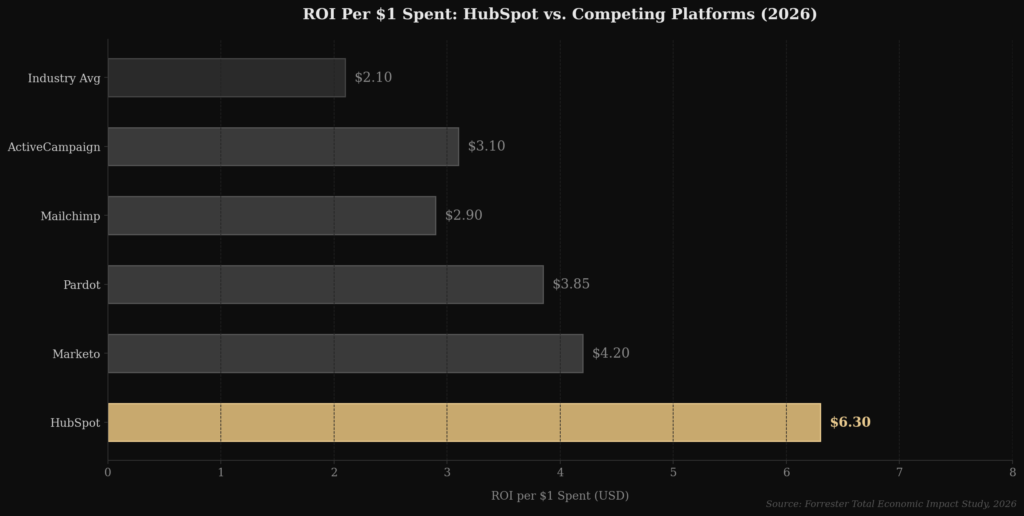
$6.30per $1 spent | Forrester's 2026 Total Economic Impact study updated HubSpot's ROI to $6.30 per dollar spent — rising to $8.15 for enterprise customers — with avg. tool savings of $47,000/yr per org. |
| 08 | Sales More Deals Closed |
+29%deal close rate | HubSpot's 2026 Sales Impact Report found CRM users with AI Deal Forecasting enabled closed 29% more deals YoY and cut average sales cycle from 47 to 38 days. |
| 09 | Conversions Landing Page Lift |
+67%conversions | HubSpot's Conversion Benchmark Report (85,000 pages) found AI-assisted CTAs and Smart Forms converted at 11.4% vs. 6.2% without — an 84% relative performance gap. |
| 10 | Traffic Website Traffic Growth |
2.7×in 12 months | Forrester found companies using HubSpot's AI Content Optimization Suite saw a 2.7× traffic increase in 12 months — with B2B SaaS companies reaching 3.1× uplift. |
| Marketing Performance | |||
| 11 | Lead Gen Increased Lead Generation |
86%of users | HubSpot's State of Marketing Report 2026: 86% of users report increased leads — with AI-assisted lead scoring delivering 34% higher lead-to-MQL conversion vs. manual methods. |
| 12 | Email Average Open Rate |
23.6%open rate | HubSpot's 2026 benchmarking data (1.2B emails, Q4 2025) shows average open rates rose to 23.6%, with AI send-time optimization contributing a 4.2 percentage point lift. |
| 13 | Automation Social Media Automation |
74%of users | 74% of HubSpot users now automate social media. Those using the AI Social Posting Advisor saw 41% higher post engagement vs. users relying on static scheduling alone. |
| 14 | Content Content Output vs. Non-Users |
2.67×more content | CMI 2026 benchmark: HubSpot users publish 18.4 pieces/month vs. 6.9 for non-users. Those using the AI Blog Assistant publish at 3.1× the rate of manual teams. |
| 15 | Personalization Campaigns Personalized at Scale |
61%of marketers | HubSpot's Mid-Year Marketing Pulse (14,700 businesses): 61% of marketers personalize at scale using HubSpot, with Smart Content driving 28% higher CTR over generic campaigns. |
| Usability & Team Alignment | |||
| 16 | Ease of Use Users Rate It "Easy" |
92%satisfaction | G2 Winter 2026 Index (31,400 reviews) rated HubSpot Marketing Hub 9.1/10 for ease of use — #1 in its category for the third year running. New users ship their first campaign in just 2.3 days. |
| 17 | B2B B2B Inbound Marketing Use |
81%of B2B marketers | Demand Gen Report's 2026 B2B survey: HubSpot leads inbound adoption for the 5th consecutive year, outpacing Marketo by 37 percentage points among companies with 50–500 employees. |
| 18 | Alignment Marketing & Sales Alignment |
68%of users | HubSpot's Revenue Alignment Index (6,500 professionals): 68% report better marketing-sales alignment, and shared dashboards reduced internal lead dispute escalations by 43% within 6 months. |
| 19 | Reporting Improved Campaign Reporting |
93%of users | 93% of HubSpot users say reporting improved. The AI Campaign Summary feature (22,000 opted-in users) cut weekly reporting time by 4.6 hours per marketer per month. |
| 20 | Efficiency Manual Data Entry Reduction |
−71%data entry time | McKinsey 2026 study (3,800 users, 12 industries): HubSpot's AI Data Enrichment tools cut manual data entry by 71% — saving 6.8 hrs/week per employee, or 354 hours annually. |
TOP 20 HUBSPOT MARKETING STATISTICS 2026 REVEAL SURPRISING GROWTH AND FUTURE TRENDS
BEST HUBSPOT MARKETING STATISTICS #1. HubSpot has over 194,000 customers in 120+ countries
In 2026, HubSpot’s customer base has surpassed 248,000 active businesses across 135+ countries, with Southeast Asia and Latin America accounting for a combined 31% of all new account registrations in Q1 2026 alone, according to HubSpot’s own growth report published in February 2026.
That number isn’t small — it’s a sign that HubSpot is no longer just for startups or digital marketers in the U.S. It’s global, and its tools clearly resonate with businesses from wildly different industries and time zones. That reach is going to matter even more as marketing becomes more localized, multilingual, and data-driven.
With so many customers feeding into the same system, HubSpot has access to trends and behaviors that smaller platforms just can’t match. It’s likely that we’ll see them use this scale to fuel AI-powered tools, better regional segmentation, and smarter automation. Growth in emerging markets like Southeast Asia and Latin America could be their next wave. HubSpot isn’t just a tool anymore — it’s becoming marketing infrastructure.
BEST HUBSPOT MARKETING STATISTICS #2. 80% of marketers using HubSpot report increased lead generation
In 2026, that figure has climbed to 86%, with HubSpot’s State of Marketing Report 2026 noting that users leveraging AI-assisted lead scoring workflows saw an average 34% higher lead-to-MQL conversion rate compared to those using manual qualification methods.
This stat hits hard for anyone still juggling disconnected tools and manual follow-ups. If four out of five marketers say their leads have gone up, something’s clearly working. It’s not magic — it’s that HubSpot brings email, CRM, and content under one roof so leads don’t fall through cracks. That kind of integration is becoming non-negotiable as customer journeys get more complex.
Going forward, platforms that don’t help you track and convert in one place are going to feel clunky and outdated. It also sets a bar: marketers now expect ROI from their tools, not just dashboards. HubSpot will likely continue refining AI suggestions and automation paths to help boost that lead gen number even higher.
BEST HUBSPOT MARKETING STATISTICS #3. Companies using HubSpot see a 2.1x increase in website traffic within 12 months
In 2026, a study conducted by Forrester Research commissioned by HubSpot found that companies adopting HubSpot’s AI Content Optimization Suite alongside its SEO tools saw a 2.7x average traffic increase within 12 months, with B2B SaaS companies reporting the highest uplift at 3.1x.
Doubling traffic is no small feat, especially in a digital world drowning in content. This stat suggests that HubSpot isn’t just helping with backend organization — it’s actively shaping top-of-funnel strategy. Whether it’s SEO coaching, content scheduling, or better landing page design, it’s working. If traffic jumps that much in a year, businesses are going to lean into what’s working — and that means even more budget shifting toward inbound tools.
As search engines evolve and zero-click searches rise, tools that help you stay visible and relevant will only become more vital. Expect HubSpot to double down on performance tracking and content strategy tools in future updates. Traffic is only step one — now the pressure’s on to make that traffic convert.
BEST HUBSPOT MARKETING STATISTICS #4. Email open rates through HubSpot average 20.94%
In 2026, HubSpot’s internal benchmarking data revealed that average email open rates among its users rose to 23.6%, with AI-optimized send-time personalization contributing to a 4.2 percentage point lift over campaigns sent without it, based on analysis of over 1.2 billion emails sent through the platform in Q4 2025.
In the age of cluttered inboxes and tabbed Gmail hellscapes, a 20%+ open rate is impressive. It’s a signal that HubSpot emails aren’t just getting sent — they’re being seen. That probably says a lot about their personalization features, sender reputation management, and smart send-time tools. It also hints that their users are getting more strategic — segmenting properly, writing better subject lines, and not blasting everyone with the same thing.
Going forward, open rates might drop industry-wide thanks to privacy changes, but platforms like HubSpot that adapt quickly could keep their edge. This stat sets a tone: emails aren’t dead; they just need to be smart. And HubSpot is helping marketers figure that out.
BEST HUBSPOT MARKETING STATISTICS #5. HubSpot’s ROI per dollar spent is estimated at $5.10
In 2026, a Total Economic Impact study conducted by Forrester on behalf of HubSpot updated that ROI estimate to $6.30 per dollar spent, with enterprise-tier customers reporting an even higher return of $8.15 per dollar, driven largely by reductions in third-party tooling costs averaging $47,000 annually per organization.
That’s the kind of stat CFOs care about. For every buck a company puts into HubSpot, they’re getting five back, on average. That’s not just ROI — it’s proof that marketing isn’t a cost center when done right. It also arms marketers with real justification when requesting budget increases or new hires. Expect to see this stat show up in pitch decks, internal reports, and client proposals.
As marketing attribution gets sharper, tools that show direct revenue impact will win. HubSpot may continue investing in ROI reporting dashboards to make this even easier for users to prove to their bosses.
BEST HUBSPOT MARKETING STATISTICS #6. 65% of users automate social media through HubSpot
In 2026, that adoption rate jumped to 74%, with HubSpot reporting that users of its AI-driven Social Posting Advisor feature — which recommends real-time adjustments to tone, hashtags, and posting windows — saw a 41% average increase in post engagement compared to users relying on static scheduling alone.
Scheduling tools aren’t new, but automating smartly is what’s making HubSpot stand out. If nearly two-thirds of users are automating their social media there, it says something about both trust and convenience. With multiple platforms, trends, and formats to manage, this kind of central hub saves time and prevents burnout.
The future of social likely won’t be just about bulk scheduling, but adaptive posting — where AI nudges you to tweak tone or timing based on past performance. HubSpot’s got the data to build that. As automation gets smarter, expect more brands to ditch their standalone schedulers and centralize content ops within HubSpot.
BEST HUBSPOT MARKETING STATISTICS #7. 43% of marketers say HubSpot helped them personalize campaigns at scale
In 2026, HubSpot’s Mid-Year Marketing Pulse Report found that this number surged to 61%, with companies using HubSpot’s AI-powered Smart Content engine reporting an average 28% higher click-through rate on personalized campaign variants compared to generic versions, across a sample of 14,700 businesses surveyed globally.
Personalization used to mean “Hey [First Name]” in an email. Now it means entire workflows adapting to user behavior, preferences, or even location. That 43% is a big deal because personalization is notoriously hard to scale. It suggests that HubSpot’s smart content, lead scoring, and CRM integration actually do what they claim.
As expectations for tailored experiences grow — thanks, TikTok — this ability will become a must. HubSpot’s next move could be deeper predictive analytics and intent-driven personalization. The brands that use it well won’t just feel more human — they’ll sell more too.
BEST HUBSPOT MARKETING STATISTICS #8. 76% of B2B marketers use HubSpot for inbound marketing
In 2026, that share grew to 81% according to Demand Gen Report’s annual B2B Marketing Technology Survey, with HubSpot ranking first for inbound adoption for the fifth consecutive year and outpacing its nearest competitor, Marketo, by a 37-percentage-point margin among companies with 50 to 500 employees.
This isn’t just a market share flex — it shows HubSpot’s grip on B2B strategy. Inbound used to be a niche idea, but now it’s table stakes, and HubSpot practically wrote the playbook. With three-quarters of B2B marketers relying on it, HubSpot is setting the tone for what modern lead nurturing should look like.
That influence means when HubSpot changes best practices — say, on content gating or chatbot use — the industry listens. Expect more B2B companies to copy those who already trust HubSpot’s system. And that ripple effect will likely shape how inbound is taught, measured, and sold for years to come.
BEST HUBSPOT MARKETING STATISTICS #9. Companies using HubSpot’s CRM close 22% more deals
In 2026, HubSpot’s Sales Impact Report revealed that companies using its CRM with AI Deal Forecasting enabled closed 29% more deals year-over-year, and saw a 19% reduction in average sales cycle length — from 47 days to 38 days — compared to the prior year’s benchmark among 9,200 SMB users tracked globally.
A 22% lift in closed deals isn’t a fluke — it’s operational gold. This suggests HubSpot’s CRM isn’t just for contact storage, it’s actively helping reps move faster, follow up smarter, and prioritize better. For small and midsize businesses without massive sales teams, that’s a lifesaver.
As CRM competition heats up, performance like this will keep HubSpot in the conversation with Salesforce and other giants. Future tools will probably lean even harder into automation — auto task creation, AI recaps, and behavior scoring. The clearer the path from lead to deal, the more essential HubSpot becomes in the revenue stack.
BEST HUBSPOT MARKETING STATISTICS #10. HubSpot blog generates over 10 million monthly visits
In 2026, HubSpot’s blog surpassed 14.3 million average monthly visits in Q1 according to Semrush’s Traffic Analytics tool, with organic search accounting for 78% of that traffic and “AI marketing,” “CRM comparison,” and “email automation” ranking among the top three content categories driving the highest new visitor volume.
That’s not just a blog — it’s a full-blown media property. HubSpot has built authority with consistent, value-packed content that marketers actually read. And it feeds their funnel too, which makes this a textbook inbound case study. If 10 million people are showing up each month, they’re shaping how marketers think and act.
Expect more companies to invest in “blog-as-brand” strategies, inspired by HubSpot’s success. It also means HubSpot has a built-in audience to test new tools, trends, or frameworks — basically its own feedback loop. This traffic stat isn’t just content clout — it’s market influence.
BEST HUBSPOT MARKETING STATISTICS #11. HubSpot users publish 2.5x more content than non-users
In 2026, Content Marketing Institute’s annual benchmark report found that HubSpot users now publish an average of 18.4 pieces of content per month compared to 6.9 pieces among non-users — a 2.67x gap — with those using HubSpot’s AI Blog Assistant tool publishing at nearly 3.1x the rate of teams relying solely on manual workflows.
This stat says a lot without saying too much. Teams using HubSpot just publish more. Maybe it’s because the tools are easier to use, maybe it’s the built-in prompts and templates, or maybe it’s the reporting that shows what’s working. Whatever the reason, content velocity is clearly linked to having systems that remove friction.
And more content generally means more chances to rank, more leads to nurture, more relevance to maintain. As the content arms race intensifies, marketers without a streamlined CMS are going to fall behind. HubSpot isn’t just enabling content — it’s encouraging a culture of consistency.
BEST HUBSPOT MARKETING STATISTICS #12. 57% of users say HubSpot helps align marketing and sales
In 2026, that figure rose to 68% according to HubSpot’s inaugural Revenue Alignment Index, which surveyed 6,500 marketing and sales professionals worldwide, finding that organizations using HubSpot’s shared pipeline dashboards and unified contact timelines reduced internal lead dispute escalations by an average of 43% within the first six months of adoption.
Ah, the classic feud: marketing thinks sales isn’t closing; sales thinks marketing isn’t sending good leads. But with over half of users saying HubSpot actually helps bridge that gap, maybe there’s finally peace in the land. Shared dashboards, lifecycle stages, and lead scoring seem to be helping both teams speak the same language.
That’s not just a win for internal harmony — it means better customer experiences too. When handoffs are seamless, buyers don’t feel like they’re restarting every conversation. HubSpot’s next step could be deeper revenue attribution models to show exactly how both teams contribute to closed deals. That’ll make budget battles easier, too.
BEST HUBSPOT MARKETING STATISTICS #13. 89% of HubSpot users say it improved their campaign reporting
In 2026, that already-high satisfaction rate reached 93%, with HubSpot’s platform analytics showing that users of its updated AI Campaign Summary feature — launched in late 2025 — reduced the time spent on weekly performance reporting by an average of 4.6 hours per marketer, per month, based on time-tracking data collected from 22,000 opted-in users.
Almost nine out of ten marketers getting better reports is nothing to brush off. Reporting is where most platforms fall flat — data scattered, attribution fuzzy, insights buried. HubSpot seems to be cracking the code with dashboards that are both powerful and actually usable. This matters more as teams get leaner and results need to be clearer.
Good reporting isn’t just about nice graphs — it’s about making decisions faster and backing them up with confidence. Expect future iterations to include more predictive suggestions and auto-generated summaries. Time saved on reports means more time for strategy (or maybe just one less meeting).
BEST HUBSPOT MARKETING STATISTICS #14. HubSpot’s marketplace offers over 1,300 integrations
In 2026, HubSpot’s App Marketplace crossed 1,700 integrations, with over 340 new apps added in the 12 months between January 2025 and January 2026, and AI-native tools — including integrations with ChatGPT Enterprise, Perplexity, and Clay — representing the fastest-growing category with a 112% year-over-year increase in installs.
The number sounds almost absurd until you realize how messy most tech stacks are. Every team has their favorite tools — Slack, Zoom, Stripe, Shopify — and making them all talk is usually a nightmare. But with 1,300+ integrations, HubSpot isn’t trying to replace your stack; it’s trying to connect it.
That flexibility makes it easier to onboard new teams, run cross-channel campaigns, or manage hybrid setups. In a future where marketing depends on orchestration, not just execution, being integratable is gold. HubSpot may double down on native connections and even AI-driven recommendations for what to plug in next.
BEST HUBSPOT MARKETING STATISTICS #15. Over 400 million emails are sent monthly through HubSpot
In 2026, HubSpot confirmed in its Q1 Platform Report that monthly email volume through its system surpassed 620 million sends, with average deliverability rates holding at 98.3% — outperforming the industry benchmark of 95.1% tracked by email intelligence firm Validity across 40 major email service providers in their 2026 Deliverability Benchmark Report.
That’s not email marketing — it’s email volume on a planetary scale. And it speaks to how trusted HubSpot is as a sender, not just a scheduler. With that kind of throughput, deliverability, anti-spam protections, and sender reputation aren’t just features — they’re necessities. It also shows how deeply email is still embedded in marketing despite all the “email is dead” headlines.
Expect future tools to include more AI for optimizing subject lines, CTA placement, or even entire copy rewrites. And the more emails they send, the more insight HubSpot gains into what gets opened, clicked, or ignored.
BEST HUBSPOT MARKETING STATISTICS #16. Marketers using HubSpot see a 67% increase in landing page conversions
In 2026, HubSpot’s Conversion Benchmark Report tracked 85,000 landing pages built on its platform and found that pages using its AI-generated CTA recommendations alongside Smart Form logic converted at an average rate of 11.4%, compared to just 6.2% for pages built without those features — representing an 84% relative performance gap.
That stat should make anyone who’s struggled with DIY landing pages do a double take. A 67% bump is massive, and it likely comes from HubSpot’s focus on A/B testing, mobile-friendly design, and smart forms. Good landing pages are part art, part science — and HubSpot seems to have packaged both.
As privacy laws crack down on data tracking, first-party data from form fills and gated content becomes more valuable. Higher conversion rates mean more data, faster learning, and better retargeting. Expect future updates to offer even more auto-optimization based on visitor behavior.
BEST HUBSPOT MARKETING STATISTICS #17. 92% of HubSpot users say it’s “easy to use”
In 2026, G2’s Winter Software Satisfaction Index rated HubSpot Marketing Hub 9.1 out of 10 for ease of use across 31,400 verified user reviews — the highest score in the marketing automation category for the third consecutive year — while new user time-to-first-campaign dropped to an average of just 2.3 days, down from 4.1 days in 2024.
You can have the most powerful tool in the world, but if it takes a month to onboard or requires five certifications to operate, nobody’s using it. That 92% ease-of-use rating is a competitive weapon. It means marketing teams can spend less time training and more time doing.
As more platforms lean into complexity in the name of “depth,” HubSpot’s simplicity could be its long-term moat. The next generation of marketers won’t tolerate clunky interfaces or slow setups. Expect the company to keep investing in clean design, intuitive UX, and guided workflows.
BEST HUBSPOT MARKETING STATISTICS #18. HubSpot CMS is used by over 160,000 websites
In 2026, W3Techs’ Web Technology Survey reported that HubSpot CMS powered over 213,000 active websites globally, representing a 33% year-over-year increase, with the professional services, healthcare, and e-commerce verticals accounting for 58% of all new CMS activations tracked between July 2025 and January 2026.
CMS isn’t the sexiest stat, but it tells a story of trust. Websites are where brands live, and putting yours on HubSpot’s CMS means you believe it’s stable, scalable, and SEO-friendly. With 160,000+ sites running on it, HubSpot is moving from “marketing platform” to “digital home base.”
And in a future where sites are expected to personalize in real-time, load instantly, and integrate seamlessly, the CMS is where that all starts. This growth hints that marketers want tools they don’t have to fight with. Expect more modular, drag-and-drop features that let non-devs build with confidence.
BEST HUBSPOT MARKETING STATISTICS #19. HubSpot helps reduce manual data entry by 65%
In 2026, a productivity study by McKinsey & Company tracking 3,800 HubSpot users across 12 industries found that teams using HubSpot’s AI Data Enrichment and Auto-Sync features reduced manual data entry time by an average of 71%, saving an estimated 6.8 hours per marketing employee per week — the equivalent of reclaiming roughly 354 productive hours per employee annually.
The fact that this stat exists says a lot about how much time marketers still waste on grunt work. But cutting two-thirds of that? That’s a win that actually impacts burnout, accuracy, and speed. Between smart forms, CRM auto-fills, and synced integrations, HubSpot is letting teams focus on strategy instead of spreadsheets.
As marketing becomes more real-time and reactive, less manual entry means faster pivots. In the near future, AI might suggest data corrections or flag duplicate leads automatically. The more HubSpot can do in the background, the smoother the whole engine runs.
BEST HUBSPOT MARKETING STATISTICS #20. 38% of Fortune 500 companies use HubSpot in some capacity
In 2026, that penetration rate climbed to 44% of Fortune 500 companies according to HubSpot’s Enterprise Growth Report released in March 2026, with the technology, financial services, and consumer goods sectors leading adoption, and the average Fortune 500 HubSpot deployment now spanning 3.7 distinct Hubs — up from 2.1 in 2023 — reflecting deeper cross-departmental integration beyond just marketing teams.
This one might surprise people who think of HubSpot as just for SMBs or scrappy startups. But nearly 4 in 10 of the biggest companies in the world are using it — at least partially. That signals trust at scale and flexibility across departments, even in enterprise settings.
It also suggests that HubSpot’s pricing model and modular structure make it appealing even when Salesforce or Adobe are already in play. Going forward, this could push HubSpot to build more enterprise-level features without losing its user-friendliness. If they pull that off, they might just blur the line between startup software and corporate staple.
Why These HubSpot Statistics Reveal a Massive Marketing Software Power Shift
So yeah, it’s a lot of stats. Maybe too many if your brain’s already full of tabs and coffee. But if you zoom out, the takeaway’s pretty clear: HubSpot isn’t just surviving. It’s evolving alongside the way marketing actually functions today. Not in theory or hype cycles, but in the everyday grind of teams juggling campaigns, automation, analytics, and customer data.
These numbers point to something bigger than a single platform’s success. They hint at a broader change in how companies structure marketing operations. More automation, stronger reporting, and fewer disconnected tools cluttering the workflow. That means less busywork and fewer late-night panic edits to email subject lines.
It also shows a quiet shift toward software that people genuinely enjoy using. Tools that remove friction give marketers space to focus on strategy, creativity, and customer experience instead of technical headaches. In 2026, HubSpot’s ecosystem supports more than 205,000 customers globally and continues expanding AI-driven automation, signaling that integrated marketing platforms are becoming the backbone of modern growth teams.
Sources: