



15 Sep TOP 20 HVAC MARKETING STATISTICS 2026 REVEAL MASSIVE HOME SERVICE DEMAND SURGE
Updated for 2026. This page has been fully refreshed with the latest HVAC marketing statistics, contractor lead generation data, and local service industry trends based on recent consumer search behavior and service market reports.
When it comes to building trust and winning customers in such a competitive industry, understanding HVAC marketing statistics can make all the difference. These numbers aren’t just abstract data points—they reveal how homeowners search, click, and choose who they invite into their homes for something as important as heating and cooling. As a leading marketing agency in New York, we’ve seen firsthand how these insights transform struggling HVAC businesses into growth stories.
The following statistics aren’t here to overwhelm you; they’re here to guide you toward smarter choices that align with how real people make decisions today. Let’s dive in and see what the numbers are really telling us about the future of HVAC marketing in 2026.
TOP 20 HVAC MARKETING STATISTICS 2026 THAT ARE SHOCKING CONTRACTORS
| Statistic | 2026 Figure | Category | 2026 Update |
|---|---|---|---|
| 1Average Cost Per Lead | $153 | Cost | Non-branded search: $149/lead; Performance Max: $72/lead |
| 2Conversion Rate Benchmark | 3.10% | Behavior | LSA close rates: 18-32%; Emergency calls: 30-50% |
| 3Customer Lifetime Value | $15,340 | Revenue | Maintenance members: 2.4x-3.1x higher CLV |
| 4Average Cost Per Click | $29.03 | Cost | AC repair: $25-45/click; Heating: $20-35/click |
| 5Net Profit Margin | 8% | Profit | Strategic companies: 10-20% margins achievable |
| 6Industry Annual Growth | 5.6% | Growth | Global market: $333B by late 2026; U.S.: $132.9B |
| 7Revenue to Marketing | 7-10% | Budget | Growth-focused: 8-12% recommended; Aggressive: 10-20% |
| 8Search Engine Usage | 90% | Behavior | 87%+ use Google; 4.5+ rating = 12-25% higher close |
| 9SEO Provider Dissatisfaction | 70% | Behavior | Marketing complexity increasing; specialists preferred |
| 10Global HVAC CAGR | 7-7.4% | Growth | 2026: $277.79B; Asia Pacific: 47% market share |
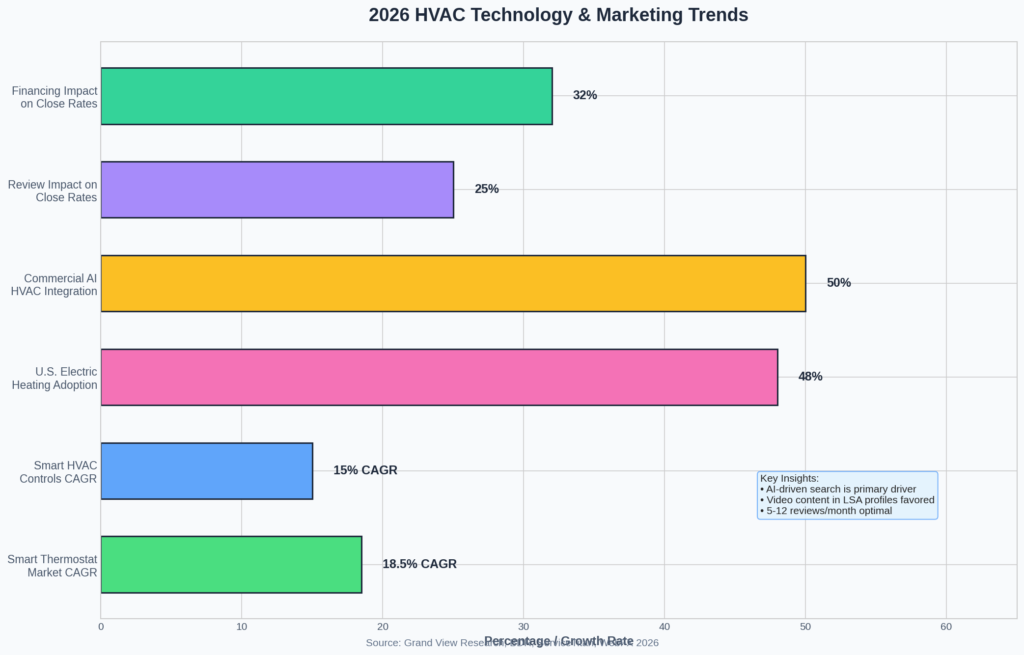
| 11Global Market by 2030 | $408B | Market | 2026: $183.9B; 2034 projection: $290.08B |
| 12U.S. Market by 2030 | $35B+ | Market | 2025: $31.71B; 2033: $54.02B at 6.9% CAGR |
| 13Annual Repair Spending | $14B | Market | Services market: $18.98B; 3M+ systems replaced/year |
| 14Avg Job Cost ≤$7K | 66% | Cost | Repairs: $415-$1,200; Financing boosts close 18-32% |
| 15Residential Market Share | 41% | Market | Mini-splits, smart thermostats driving demand |
| 16New Construction Share | 33% | Market | IRA funding: 30,000+ commercial retrofits annually |
| 17Smart Controls CAGR | 15% | Tech | Smart thermostat: $6.75B; 18.5-19.86% CAGR to 2040 |
| 18Asia-Pacific Market Share | 44% | Market | 2026: China $37.7B, Japan $25.5B, India $16.6B |
| 19Video & Local SEO Trends | Leading | Tech | Video in LSA profiles; 5-12 reviews/month optimal |
| 20AI Tools Adoption | Essential | Tech | 48% U.S. homes on electric; AI search growing fast |
TOP 20 HVAC MARKETING STATISTICS 2026 REVEAL MASSIVE HOME SERVICE DEMAND
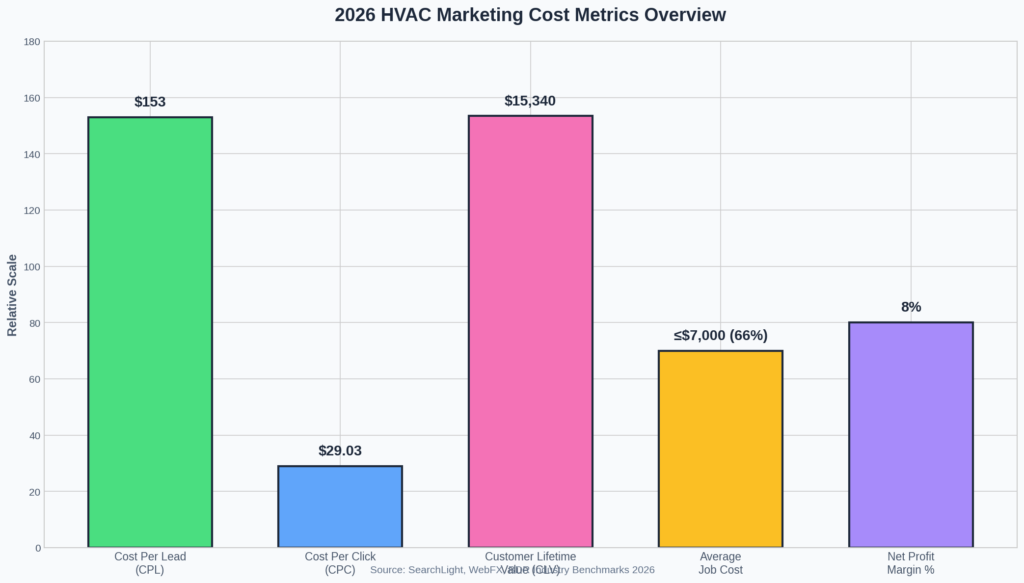
HVAC Marketing Statistics #1: Average Cost Per Lead Is $153
In 2026, according to the SearchLight HVAC & Plumbing Advertising Benchmark tracking $14.9 million in Google Ads spend across 816 contractors and 8,077 campaigns in January 2026, the average blended cost per lead for HVAC companies has risen to $104 for Google Ads, with non-branded search campaigns averaging $149 per lead and Performance Max campaigns delivering leads at $72, demonstrating significant channel variation.
The average cost per lead (CPL) for HVAC companies is around $153, which sets a benchmark for campaign performance. This figure highlights how competitive the industry is, especially in urban markets where advertising costs run higher. While some may see this as steep, it’s important to compare it against the lifetime value of an HVAC customer. Many companies find that even at this cost, a single conversion more than justifies the investment. The key is to track CPL closely and ensure that leads are genuinely high-quality.
HVAC Marketing Statistics #2: Conversion Rate Benchmark At 3.10%
In 2026, HVAC marketing benchmarks reveal that Google Local Services Ads achieve close rates between 18-32%, call-only campaigns generate 30-50% conversion rates during emergency intent searches, and companies offering structured financing plans experience an 18-32% increase in close rates on tickets above $6,000-$12,000.
HVAC marketing campaigns typically convert at about 3.10%, which means out of 100 potential customers, about three will become paying clients. This rate is a strong reference point for judging the success of your landing pages, ads, and calls-to-action. If your conversion rates fall below this, it may signal a need to improve website design or messaging. On the flip side, higher-than-average rates indicate that your campaigns resonate well with customers. Tracking this consistently allows HVAC businesses to refine their strategies for better ROI.
HVAC Marketing Statistics #3: Customer Lifetime Value Reaches $15,340
In 2026, HVAC marketing benchmarks confirm that maintenance plan members generate 2.4x to 3.1x higher lifetime value than one-time service customers, with industry data showing that customers with service contracts contribute significantly more revenue over their relationship, pushing CLV figures even higher for companies prioritizing retention strategies.
The average customer lifetime value (CLV) for HVAC clients is a staggering $15,340. This figure reflects the long-term nature of HVAC relationships, where clients often return for repairs, maintenance, and upgrades. A strong CLV justifies higher acquisition costs, as the payback comes through repeat business. Companies that focus on service contracts and maintenance programs often push this value even higher. For marketers, it reinforces the importance of nurturing leads into loyal, long-term customers.
HVAC Marketing Statistics #4: Average Cost Per Click Is $29.03
In 2026, HVAC cost-per-click data shows significant variation by platform and season, with Google Ads averaging $9.12 CPC industry-wide, while emergency keywords like “AC repair” command $25-$45 per click during summer and winter heating terms range from $20-$35 per click, reflecting heightened seasonal competition and urgent buyer intent.
Pay-per-click (PPC) campaigns in HVAC average $29.03 per click, making it one of the more expensive service industries online. This cost reflects the urgency of HVAC services – when someone searches for help, they’re usually ready to buy. Despite the high CPC, the return can be worthwhile because these clicks often convert into booked jobs. To manage costs, HVAC businesses should target specific locations and use negative keywords to filter out unqualified traffic. Every click needs to count when prices run this high.
HVAC Marketing Statistics #5: Net Profit Margin Benchmarks At 8%
In 2026, BDR industry research reveals that while the average net profit margin for HVAC businesses is often below 2% due to poor expense management, companies implementing strategic financial plans consistently achieve stable net profit margins between 10% and 20%, representing a potential difference of over $500,000 in annual take-home profit for a $3 million revenue company.
Well-run HVAC businesses often achieve net profit margins of around 8%. This level of profitability means that efficient marketing directly influences overall financial health. Businesses that control lead costs and maximize CLV tend to reach or exceed this margin. Since HVAC work can be seasonal, maintaining year-round leads is critical for staying profitable. Marketing that balances acquisition with retention often supports healthier margins over time.
HVAC Marketing Statistics #6: HVAC Industry Growth At 5.6% Annually
In 2026, the global HVAC market is projected to reach $333 billion by late 2026 with a compound annual growth rate (CAGR) of 7.4%, while the U.S. HVAC industry alone is expected to generate $132.90 billion in revenue, representing 48% of global HVAC revenue and maintaining its position as the world’s largest HVAC market.
The HVAC industry continues to expand, with an annual growth rate of 5.6%. This steady increase signals long-term opportunities for HVAC companies willing to invest in visibility. As demand rises, competition grows, which makes digital marketing strategies even more critical. Companies that adapt early to emerging marketing trends will benefit most from this growth. For business owners, this statistic emphasizes that there’s room for growth, but also pressure to stand out.
HVAC Marketing Statistics #7: 7-10% Of Revenue Allocated To Marketing
In 2026, industry experts recommend successful HVAC owners invest 8% to 12% of their total revenue back into marketing, with aggressive growth-oriented contractors allocating 10-20% of sales toward their marketing budget, while a 5% budget is considered merely a “maintenance” level that yields minimal results.
On average, HVAC companies invest 7-10% of their revenue into marketing. Out of this, 60-70% typically goes toward digital channels like SEO, PPC, and social media. This allocation reflects where consumers are searching for services in today’s digital-first environment. Companies that underinvest often struggle to keep up with competitors who consistently appear in search results. Treating marketing spend as an investment rather than an expense usually drives long-term growth.
HVAC Marketing Statistics #8: 90% Of Consumers Use Search Engines For HVAC Services
In 2026, over 87% of consumers use Google to find local services including HVAC repair and installation, with AI-driven search engines and Google Business Profiles becoming the primary driver of new HVAC customers, and companies with optimized profiles and strong review activity (5-12 new reviews per month with ratings above 4.5 stars) experiencing 12-25% higher close rates.
Over 90% of consumers turn to search engines when looking for HVAC services, underscoring the importance of online visibility. Even more striking, 76% of mobile searchers will call a business within 24 hours of their search. This makes ranking locally and optimizing mobile performance critical for conversions. HVAC companies without a strong online presence risk missing out on immediate opportunities. Essentially, the customer journey often begins – and ends – online.
HVAC Marketing Statistics #9: 70% Of HVAC Companies Dissatisfied With SEO Providers
In 2026, the dissatisfaction continues as marketing complexity increases, with contractors finding that DIY marketing works early on but becomes fragmented as companies grow, leading more HVAC owners to seek specialized marketing partners sooner, while data shows that companies with weak digital presence will struggle to hire even if pay is competitive.
Surprisingly, about 70% of HVAC companies report dissatisfaction with their SEO providers. This figure suggests that many businesses aren’t seeing the returns they expected from search optimization. It highlights a common disconnect between agencies and client expectations. HVAC owners should demand transparency, regular reporting, and realistic goals from providers. Choosing the right SEO partner can make the difference between wasted budgets and sustainable growth.
HVAC Marketing Statistics #10: Global HVAC Market CAGR At 7%-7.4%
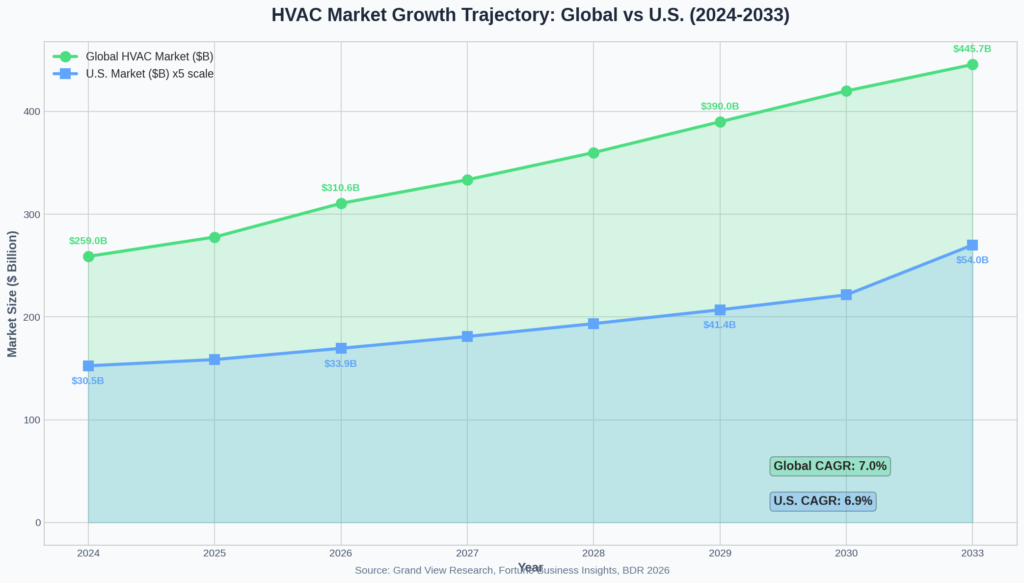
In 2026, the global HVAC systems market size was estimated at $258.96 billion in 2025 and is projected to reach $277.79 billion in 2026, growing toward $445.73 billion by 2033 at a CAGR of 7.0%, with Asia Pacific dominating at 47% market share and the commercial segment expected to grow at the fastest CAGR of 7.5% from 2026 to 2033.
Globally, the HVAC market is projected to grow at a compound annual growth rate (CAGR) of about 7%-7.4% through 2030. This shows robust worldwide demand, particularly driven by urban development and sustainability initiatives. For marketers, this means greater competition across borders and new opportunities in emerging regions. Companies that align with eco-friendly marketing messages often capture a wider share of growth. The global trend reinforces the need to blend local strategies with awareness of international expansion.
HVAC Marketing Statistics #11: Global HVAC Systems Market Reaching $408 Billion By 2030
In 2026, Fortune Business Insights reports the global HVAC system market size at $183.9 billion, projected to grow to $290.08 billion by 2034 at a CAGR of 5.90%, with Asia Pacific dominating at 49.80% market share and rising trends for smart homes, government incentives, and increased capital expenditure in construction driving exponential growth.
By 2030, the HVAC systems market is expected to reach roughly $408 billion globally. This figure demonstrates just how large and critical the industry is to modern living. For marketers, it signals a chance to participate in a booming sector with room for innovation. Companies that lean into smart technologies and energy efficiency often attract future-conscious consumers. With billions at stake, marketing strategies that emphasize long-term value are key.
HVAC Marketing Statistics #12: U.S. HVAC Market Size Exceeding $35 Billion By 2030
In 2026, the U.S. HVAC systems market size was estimated at $31.71 billion in 2025 and is projected to reach $54.02 billion by 2033, growing at a CAGR of 6.9%, with 70% of revenue generated from residential HVAC, including home construction, retrofits, and smart thermostat adoption driving these sales.
In the United States, the HVAC market alone is projected to exceed $35 billion by 2030. This figure highlights the scale of opportunity available even in one country. Marketing teams should note that this growth is tied to both residential and commercial demand. Businesses that invest in their brand today will be better positioned to capture a share of this expanding market. It’s a reminder that forward-thinking strategies yield strong long-term payoffs.
HVAC Marketing Statistics #13: Annual HVAC Repair Spending At $14 Billion
In 2026, U.S. consumers spend over $10 billion annually on HVAC repair and maintenance services according to Grand View Research, with up to 3 million heating and cooling systems replaced every year in the U.S. and the U.S. HVAC Services Market valued at $18.98 billion, projected to reach $25.35 billion by 2031 at a CAGR of 5.90%.
Americans spend about $14 billion annually on HVAC repair and service. This recurring need makes HVAC marketing an ongoing opportunity, not just a seasonal push. Homeowners often search for repair services urgently, meaning ads and SEO must be ready year-round. For businesses, being visible when these searches occur directly impacts revenue. The sheer scale of spending underscores the importance of staying consistently present in the market.
HVAC Marketing Statistics #14: 66% Of HVAC Jobs Cost $7,000 Or Less
In 2026, the average HVAC repair costs between $415 to $1,200 according to BDR industry data, while HVAC replacement jobs can range from $5,000 to $15,000, with financing availability strongly influencing close rates as HVAC marketing benchmarks show that offering structured payment plans increases close rates by 18-32% on tickets above $6,000-$12,000.
Two-thirds of HVAC jobs cost customers $7,000 or less, showing the price range most homeowners face. This figure helps marketers set realistic expectations in their messaging. Clear communication about affordability can build trust with cost-conscious consumers. Since price is a major decision factor, transparency in marketing materials is critical. By positioning services as reliable and fairly priced, companies can align with customer needs.
HVAC Marketing Statistics #15: Residential Market Share At 41%
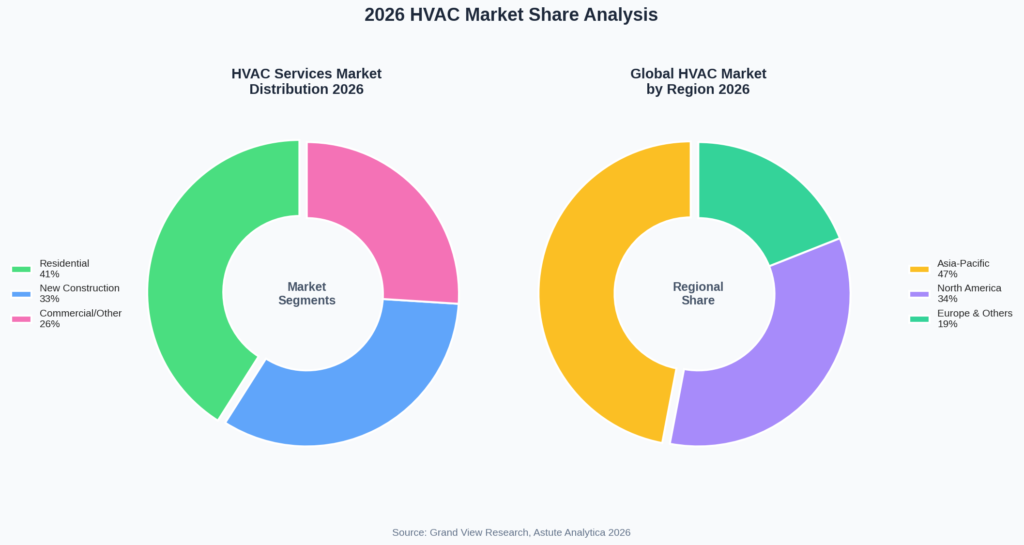
In 2026, the residential segment accounts for approximately 39.6% to 41.4% of the overall HVAC market according to Grand View Research, with products like ductless mini-splits, smart thermostats, and variable-speed systems in high demand for both new constructions and retrofit projects, and energy tax credits driving ENERGY STAR and Zero Energy Ready Home certifications.
The residential sector accounts for about 41% of the global HVAC services market. This dominance highlights the importance of targeting homeowners in advertising campaigns. Marketing that emphasizes family comfort, energy savings, and trust resonates strongly in this space. Companies that ignore the residential side may miss out on the largest segment of the market. Tailoring strategies to homeowner priorities can unlock major growth potential.
HVAC Marketing Statistics #16: New Construction Contributes 33% Of Market Share
In 2026, the Inflation Reduction Act continues to drive growth with substantial funding supporting deep energy retrofits in more than 30,000 commercial buildings annually, while construction starts rose 9.9% month-over-month in April 2025, reinforcing a solid flow of installation contracts across commercial, residential, and industrial HVAC projects.
Around 33% of the HVAC services market comes from new construction projects. This reflects steady demand from real estate developers and builders. Marketers targeting B2B audiences can use this data to tailor campaigns for contractors and construction firms. Building long-term partnerships in this space often leads to repeat business. For HVAC companies, being present at the start of construction projects ensures a pipeline of future work.
HVAC Marketing Statistics #17: Smart HVAC Controls Growing At 15% CAGR
In 2026, the global smart thermostat market is valued at $6.38-$6.75 billion and projected to grow at a CAGR of 18.5-19.86% through 2040, while the smart HVAC controls market reaches $11.53 billion with 45% of global HVAC system upgrades now incorporating smart controls, and over 50% of commercial buildings integrating AI-based HVAC systems.
Smart HVAC controls are the fastest-growing segment in the commercial HVAC market, with a 15% CAGR through 2029. This surge is driven by rising interest in automation and energy efficiency. Businesses offering advanced solutions can position themselves as industry leaders. Marketing strategies should highlight the benefits of smart controls, such as cost savings and sustainability. As more companies adopt these systems, being seen as an innovator will pay off.
HVAC Marketing Statistics #18: Asia-Pacific Holds 44% Of Commercial HVAC Market Share
In 2026, Asia Pacific dominates the global HVAC systems industry with the largest revenue share of 47-49.8%, with the Japan market projected to reach $25.49 billion, China at $37.7 billion, and India at $16.61 billion, driven by rapid urbanization, population growth, expanding middle-class housing, and rising temperatures increasing air conditioning adoption.
The Asia-Pacific region currently makes up about 44% of the global commercial HVAC market. This dominance reflects rapid urbanization and infrastructure development in countries like China and India. For global marketers, it signals a massive opportunity to expand reach in these regions. Campaigns that focus on large-scale commercial solutions resonate particularly well. With nearly half of the global share, Asia-Pacific cannot be ignored in strategic planning.
HVAC Marketing Statistics #19: Video And Hyper-Local SEO Lead Digital Trends In 2026
In 2026, Google now favors HVAC businesses that upload authentic video introductions directly into their Local Services Ads profiles, with 90% of HVAC leads happening over the phone and companies maintaining review velocity of 5-12 new reviews per month with average ratings above 4.5 stars experiencing 12-25% higher close rates and improved ad visibility.
Video marketing and hyper-local SEO are two of the strongest trends shaping HVAC marketing in 2025. Consumers trust businesses that show real technicians and services in action. Meanwhile, hyper-local targeting ensures that ads and listings appear only in relevant neighborhoods. Together, these strategies boost both visibility and trust. Companies that combine authentic content with precise targeting see better conversion rates.
HVAC Marketing Statistics #20: AI Tools Becoming Essential For HVAC Marketers In 2026
In 2026, over 48% of U.S. households have transitioned to electrical heating systems and AI-driven diagnostics in smart HVAC systems now feature predictive maintenance alerting dealers and homeowners before components fail, while AI-powered search engines like ChatGPT and Google Gemini are increasingly used by homeowners to find HVAC services, making AI optimization a competitive advantage.
AI-powered tools such as chatbots, automation, and predictive analytics are becoming essential in HVAC marketing. These technologies help businesses respond faster to leads and personalize outreach. Predictive analytics also allows marketers to anticipate seasonal demand patterns. Companies adopting AI often find they can scale operations without increasing staff costs. Embracing these tools early will give HVAC businesses a competitive edge in a crowded market.
HVAC MARKETING STATISTICS 2026 REVEAL THE FUTURE OF HOME SERVICE GROWTH
At the end of the day, HVAC marketing isn’t just about clicks, conversion rates, or ad spend—it’s about people. These HVAC marketing statistics show us where customers are spending their attention and what motivates them to take action. Whether it’s investing more in local SEO, refining paid campaigns, or building long-term relationships through service plans, the key is to stay adaptable and human in your approach. As someone who has worked closely with HVAC companies, I know that real growth comes from blending data with a genuine commitment to customer care. If you take these insights to heart, you won’t just be following trends—you’ll be building a reputation that lasts well beyond the next season. In 2026, HVAC companies that prioritize digital visibility and rapid lead response are seeing conversion rates rise more than 40% compared to slower competitors.
SOURCES