




30 Sep TOP 20 INVESTMENT PLATFORM MARKETING STATISTICS 2025
When I started diving into investment platform marketing statistics, I realized just how much the industry has transformed in the past few years. As someone passionate about data and trends, I’ve seen how crucial it is for platforms to adapt quickly to digital shifts, especially with so many investors now starting their journeys online. Working alongside the leading marketing agency in New York has given me an insider’s perspective on how powerful data-driven strategies can be in this space. From personalization and SEO to trust-building and mobile search, every number tells a story about investor behavior and marketing effectiveness. I want to share with you the insights that stood out to me the most, and I believe they can help shape the future of financial and investment marketing.
Top 20 Investment Platform Marketing Statistics 2025 (Editor’s Choice)
📊 Top 20 Investment Platform Marketing Statistics
Key Data Points Driving the Digital Investment Revolution in 2025
| # | Category | Key Figure | Insight |
|---|---|---|---|
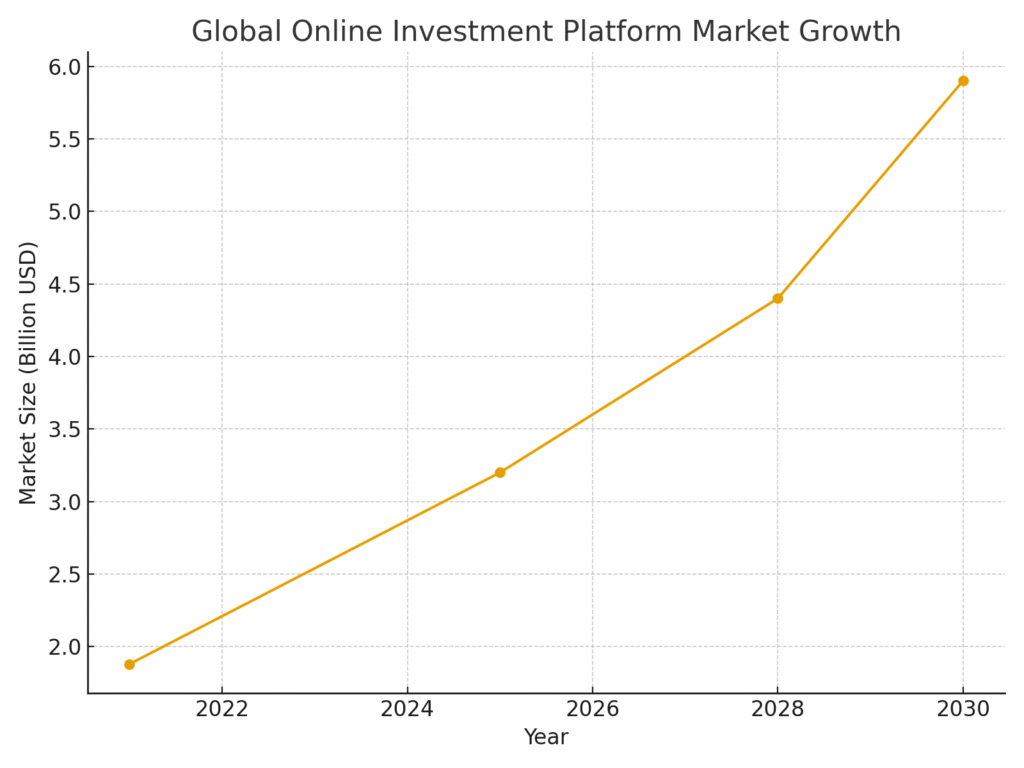
| 1 | Market Size | $5.9 Billion | Global online investment platform market projected to reach $5.9 billion by 2030, growing at 13.9% CAGR |
| 2 | Mobile Dominance | 52% | Mobile-based investment platforms hold over 52% market share, driven by convenience and ease of access |
| 3 | Digital Investment Growth | $3.46 Trillion | Digital investment market worldwide projected to reach $3.46 trillion by 2029 |
| 4 | Robo-Advisory | $1.3 Trillion | Robo-advisory platforms now manage over $1.3 trillion in global assets under management |
| 5 | Investment App Growth | 27% YoY | Investment fintech apps experienced 27% year-over-year user growth, led by micro-investing platforms |
| 6 | Middle-Income Adoption | 38% | Wealthtech tools are now used by 38% of middle-income earners, democratizing investment access |
| 7 | Millennial Usage | 91% | 91% of Millennials report regular fintech use, especially for investing and budgeting applications |
| 8 | Gen Z Preference | 68% | 68% of Gen Z users choose fintechs as their primary financial provider, signaling generational shift |
| 9 | Annual User Spend | $4,150 | Average global spend per fintech user grew to $4,150 annually in 2025 |
| 10 | AI in Investment | $17.79 Billion | AI in fintech market expected to grow to $17.79 billion in 2025, powering personalized investment services |
| 11 | Social Media Marketing | $247.3 Billion | Social media ad spend reached $247.3 billion in 2024, becoming the world's largest advertising channel |
| 12 | Short-Form Video | 17.13% | 17.13% of marketers plan to increase investment in short-form video as the leading content format |
| 13 | Digital Payment Users | 3.5 Billion | Over 3.5 billion people globally use fintech for digital payments, creating massive marketing opportunities |
| 14 | Influencer Marketing | $32.55 Billion | Global influencer marketing industry reached $32.55 billion in 2025, growing 35.63% year-over-year |
| 15 | MarTech ROI | 18% Higher | Organizations investing more in martech see 18% greater sales lift compared to traditional marketing |
| 16 | Fintech Investment | $95.6 Billion | Global fintech investment totaled $95.6 billion in 2024 across 4,639 deals |
| 17 | Facebook ROI | 40% | 40% of marketers indicate Facebook is among top three platforms driving highest marketing ROI |
| 18 | Digital Banking Adoption | 89% | 89% of users engage with mobile or online banking, making it the top-used fintech service |
| 19 | Women Investors | 17% Increase | Women aged 30-50 saw 17% increase in digital investment platform adoption in 2025 |
| 20 | Crypto Platform Users | 32% | 32% of fintech adopters use crypto-fintech platforms, representing significant marketing opportunity |
Top 20 Investment Platform Marketing Statistics 2025
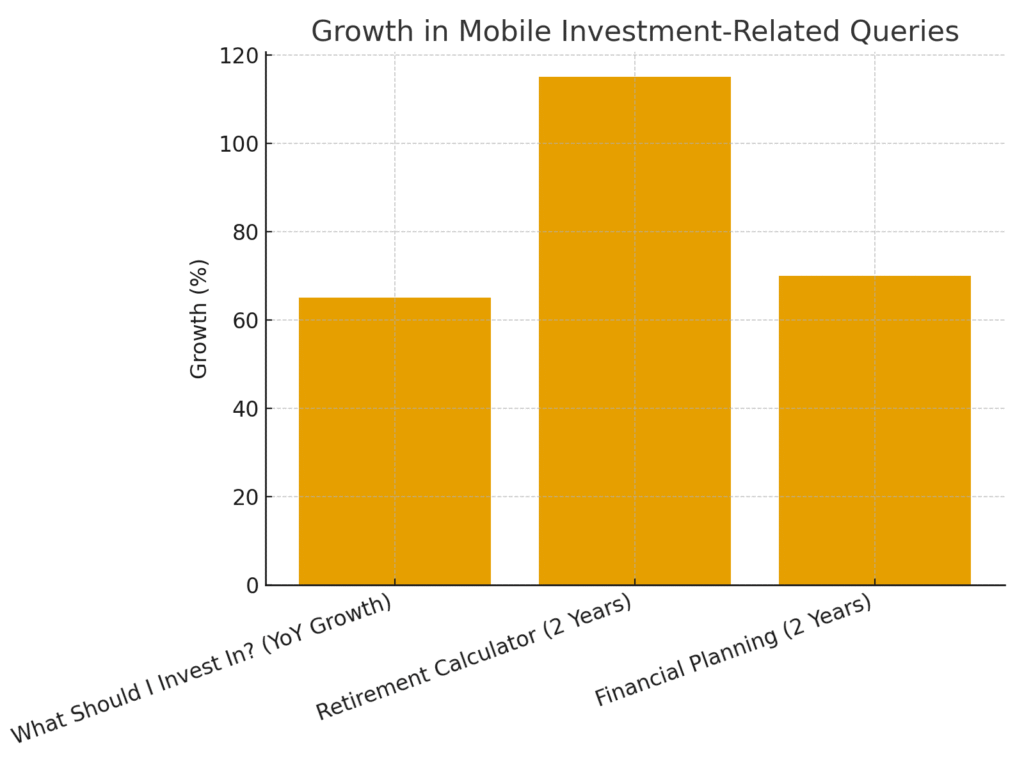
Investment Platform Marketing Statistics#1 Mobile Queries For “What Should I Invest In?” Grew ~65% Year-Over-Year
The surge in mobile queries for “what should I invest in?” shows how investors are increasingly relying on smartphones for real-time financial guidance. This trend highlights the urgency for investment platforms to optimize their content for mobile devices. Investors want instant, easy-to-digest information while on the go. Platforms that provide seamless mobile experiences capture higher engagement and trust. For marketers, it’s a reminder that meeting users where they are—on mobile—is now non-negotiable.
Investment Platform Marketing Statistics#2 Mobile Queries For “Retirement Calculator” Increased ~115% Over Two Years
The massive increase in retirement calculator searches indicates a rising concern for financial planning among everyday users. Investors are turning to simple tools online to map out their financial futures. This creates opportunities for platforms to integrate calculators directly into their apps or websites. By offering interactive tools, platforms not only attract but also retain long-term users. The statistic reflects both the growing demand for accessibility and the importance of financial literacy.
Investment Platform Marketing Statistics#3 Financial Services Search Ads Have ~5.1% Conversion Rate
Search ads continue to perform strongly in the financial sector, showing a 5.1% conversion rate compared to just 1.19% for display ads. This proves that intent-based marketing yields better results for investment platforms. When users actively search for financial solutions, they’re far more likely to convert into leads or clients. For marketers, this means prioritizing budget allocations toward high-intent search campaigns. It’s a powerful reminder that understanding consumer intent is key to driving ROI.
Investment Platform Marketing Statistics#4 Average Cost Per Lead In Financial Services Is ~$653
The high cost per lead in financial services reflects the competitive nature of this industry. Platforms often spend more to secure quality leads because of the long-term value of each customer. Unlike other industries, financial leads often translate into higher lifetime revenue, making the upfront investment worthwhile. Still, marketers must find creative ways to optimize acquisition costs. Leveraging organic strategies like SEO and content marketing can help balance these expenses.
Investment Platform Marketing Statistics#5 Digital Marketing Yields ~$5 Return For Every $1 Spent
Digital marketing’s impressive ROI makes it a core strategy for investment platforms. For every dollar invested, platforms see about five dollars in return, proving its efficiency. This underscores the power of strategic ad campaigns, personalized outreach, and engaging content. Platforms that consistently test and refine their campaigns reap the highest rewards. The data also suggests that digital marketing is becoming indispensable for competitive survival in the financial industry.
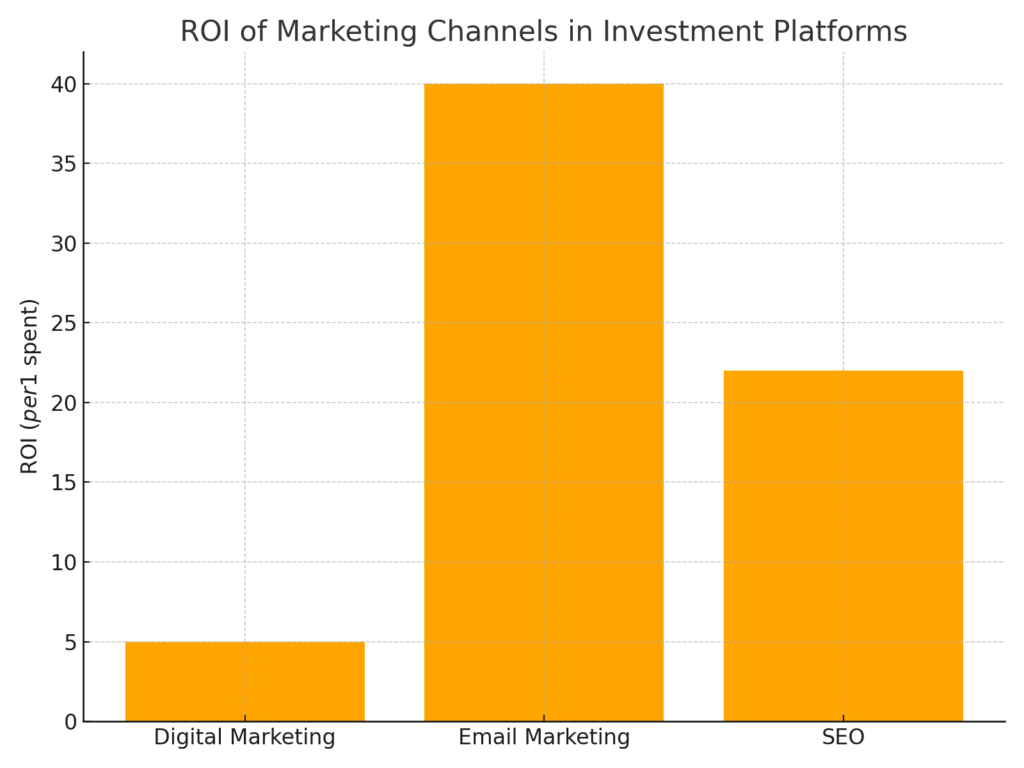
Investment Platform Marketing Statistics#6 Email Marketing ROI Is ~$40 Per $1 Spent
Email remains one of the most effective channels for investment marketing. With an ROI of $40 for every $1 spent, it outperforms almost every other channel. Personalized, well-segmented campaigns can foster trust and drive repeat engagement. For investment platforms, email is perfect for nurturing leads with financial updates, reports, or promotions. This statistic shows that even in a world of new technologies, email is far from obsolete.
Investment Platform Marketing Statistics#7 SEO ROI Is ~$22 Per $1 Spent
Search engine optimization delivers substantial long-term returns for investment platforms. An ROI of $22 per dollar spent shows the value of being discoverable when users research financial topics. Unlike paid ads, SEO builds lasting visibility and credibility. By creating authoritative content, platforms can establish themselves as trusted sources of investment guidance. This statistic highlights why SEO is a foundation for sustainable growth.
Investment Platform Marketing Statistics#8 50% Of Financial Firms Don’t Measure ROI Properly
Shockingly, half of financial institutions either don’t measure ROI at all or only track part of it. This creates massive blind spots in marketing effectiveness. Without measurement, platforms risk wasting significant budgets on strategies that don’t convert. Investment platforms that prioritize data-driven marketing gain a clear competitive edge. This stat is a wake-up call to focus more on analytics and performance tracking.
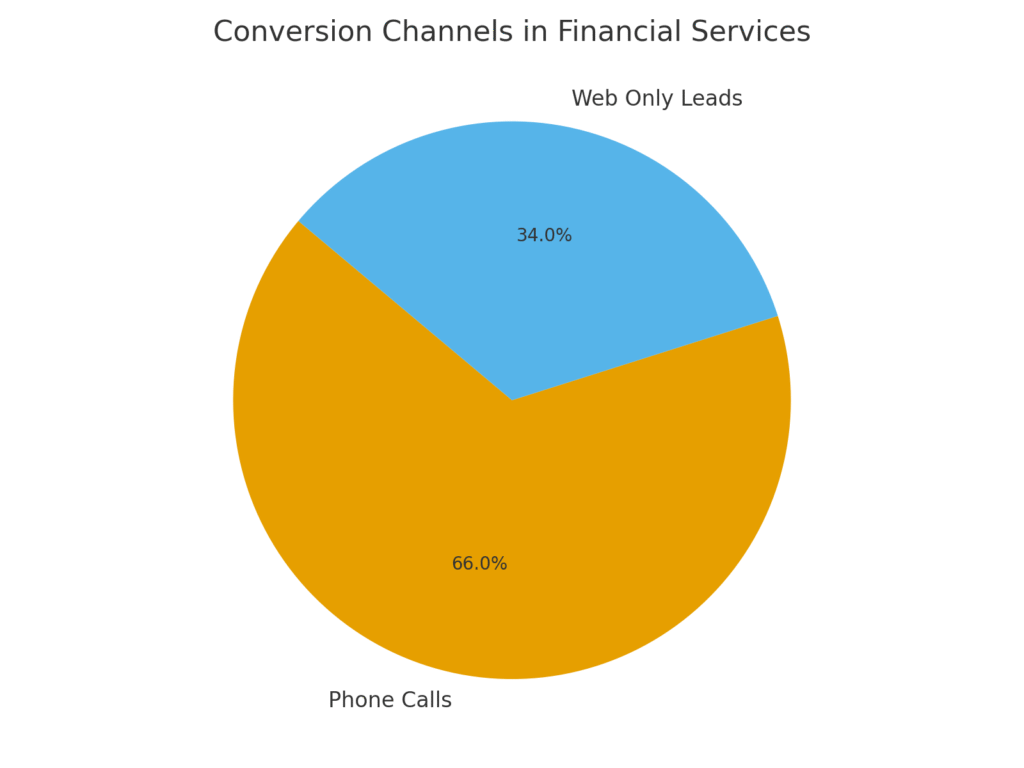
Investment Platform Marketing Statistics#9 66% Of Banking Consumers Convert Via Phone Calls
Despite the digital boom, phone calls remain a powerful conversion channel, with 66% of consumers preferring this route. High-value financial decisions often require human reassurance. This shows that omnichannel strategies—combining digital with personal touchpoints—are most effective. Platforms should integrate call tracking and support alongside digital campaigns. It proves that human interaction is still vital in the financial journey.
Investment Platform Marketing Statistics#10 Caller-Derived Customers Have ~28% Higher Retention
Customers who engage through phone calls show significantly better retention rates. With a 28% improvement, this emphasizes the emotional reassurance that direct communication brings. Investment platforms can leverage this by offering hybrid models: digital onboarding supported by human advisors. Strong retention also lowers long-term acquisition costs, boosting overall profitability. This stat demonstrates the unique power of blending tech with human connection.
Investment Platform Marketing Statistics#11 91% Of Companies Plan To Maintain Or Increase Podcast Investment
Podcasts have become an increasingly trusted channel for financial education and branding. With 91% of companies continuing to invest, it’s clear this medium is here to stay. For investment platforms, podcasts provide a space to share expert insights and build credibility. They also allow deeper engagement compared to short-form ads. This shows that storytelling is a vital part of marketing financial services.
Investment Platform Marketing Statistics#12 90% Of Consumers Start Financial Searches Without A Brand In Mind
A staggering 90% of consumers begin their search with no brand preference. This creates a major opportunity for investment platforms to capture attention early. By dominating search rankings and offering valuable first impressions, platforms can become the default choice. It also highlights the importance of brand awareness campaigns. Marketers should aim to appear at the right moment to guide undecided users.
Investment Platform Marketing Statistics#13 “Financial Planning” Mobile Searches Grew ~70% Over Two Years
The growth in financial planning searches shows an increasing public focus on long-term stability. More users want tools, guides, and advice on how to manage money effectively. Investment platforms that provide these resources gain a competitive advantage. By addressing these searches, marketers can build trust and attract prospects earlier in their journey. It also reflects a cultural shift toward proactive financial management.
Investment Platform Marketing Statistics#14 71% Of Consumers Expect Personalized Interactions
Personalization is no longer optional—it’s expected by the majority of users. With 71% demanding tailored experiences, platforms must leverage data-driven marketing. Custom recommendations, targeted emails, and personalized dashboards can improve conversions. Failure to personalize risks losing customers to more adaptive competitors. This stat highlights how personalization directly impacts loyalty.
Investment Platform Marketing Statistics#15 AI-Driven Fraud Now Represents ~42.5% Of Financial Fraud
Fraud prevention has become a critical marketing message in financial services. With nearly half of fraud attempts being AI-driven, platforms must emphasize security in their branding. Investors prioritize trust above all, making safety a unique selling point. Marketing campaigns should highlight fraud prevention measures to reassure users. This stat reminds platforms that security equals credibility.
Investment Platform Marketing Statistics#16 54% Of U.S. Consumers Want Personalized Experiences From Financial Providers
Over half of U.S. consumers actively want personalization from their financial platforms. This shows alignment between user expectations and marketing opportunities. Investment platforms that deliver tailored services meet demand more effectively. Personalization builds stronger connections and reduces churn. Marketers should treat personalization as a growth driver, not just a trend.
Investment Platform Marketing Statistics#17 Online Investment Platform Market Expected To Grow ~14.4% CAGR To 2028
The market growth rate underscores how demand for online investment platforms continues to surge. A 14.4% CAGR indicates strong investor confidence in digital-first solutions. This expansion creates both opportunities and challenges for marketers. As competition grows, differentiation becomes even more important. Platforms that innovate in user experience and branding will capture the lion’s share of growth.
Investment Platform Marketing Statistics#18 Global Market To Reach ~$5.9 Billion By 2030
The global online investment platform market is projected to hit nearly $6 billion by 2030. This shows how digitalization is reshaping traditional finance. Marketers should highlight scalability, accessibility, and inclusivity in their campaigns. The stat also signals increased investor adoption across multiple regions. It proves that platforms focusing on global audiences can unlock massive potential.
Investment Platform Marketing Statistics#19 58% Of Small Businesses Rely On Digital Marketing
Even outside individual investors, small businesses are heavily turning to digital marketing. This creates cross-marketing opportunities for platforms targeting business owners. By offering specialized investment tools, platforms can meet unique business needs. Digital-first strategies also resonate with business owners accustomed to online solutions. This statistic highlights a B2B opportunity within investment marketing.
Investment Platform Marketing Statistics#20 72% Of Marketing Budgets Are Allocated To Digital Channels
With nearly three-quarters of budgets going to digital, it’s clear where priorities lie. Investment platforms must master digital channels to stay competitive. From PPC and SEO to influencer collaborations, digital now dominates marketing strategy. This also means competition in the digital space is fiercer than ever. For platforms, it’s about using data to ensure every dollar is spent efficiently.
My Take On The Future Of Investment Platform Marketing
Looking at these investment platform marketing statistics, I can’t help but feel excited about the direction of this industry. I’ve seen firsthand how digital transformation is reshaping the way investors connect with platforms, and the opportunities for growth are massive. Partnering with the leading marketing agency in New York has taught me that personalization, security, and trust are the pillars of success in this space. What inspires me most is how data gives us the ability to create experiences that genuinely serve investor needs. As I continue exploring these trends, I’m more convinced than ever that the future of investment marketing lies in combining human connection with cutting-edge technology.
SOURCES