




14 Sep TOP 20 JEWELRY MARKETING STATISTICS 2026 REVEAL BILLION-DOLLAR DIGITAL BUYING SURGE
Updated for 2026. The global jewelry market has crossed $370 billion in retail value, with digital discovery and influencer-led campaigns now driving over half of high-intent jewelry purchases worldwide.
In today’s fast-changing retail landscape, understanding jewelry marketing statistics is essential for any brand looking to shine brighter than the competition. Jewelry has always carried an emotional weight, but now its marketing is increasingly driven by data, digital storytelling, and consumer expectations for personalization. Working with a leading marketing agency in New York, I’ve seen firsthand how brands can transform simple trends into powerful growth strategies. These statistics don’t just highlight market size and ecommerce figures; they reveal how buyers think, how they shop, and what inspires them to invest in a timeless piece.
As we explore these insights, you’ll see how marketing jewelry in 2026 is as much about connecting with hearts as it is about scaling with numbers.
TOP 20 JEWELRY MARKETING STATISTICS 2026 THAT EXPOSE MASSIVE LUXURY BUYING TRENDS
Top 20 Jewelry Marketing Statistics 2026
Essential data-driven insights for jewelry industry success — market sizing, digital sales, consumer behavior & beyond
| Category | Key Statistic | Year | Scope | Trend | Marketing Implication |
|---|---|---|---|---|---|
| Market Size | $407B+Global jewelry market projected to surpass $407B in 2026 (Statista), growing at 5.0–5.3% CAGR | 2026 | Global | ↑ Rising | Massive market opportunity with steady growth trajectory |
| Online Sales | 32.7%Online jewelry sales projected to reach 32.7% of total revenue in 2026 | 2026 | Global | ↑↑ Rapid | Prioritize e-commerce platforms and digital marketing |
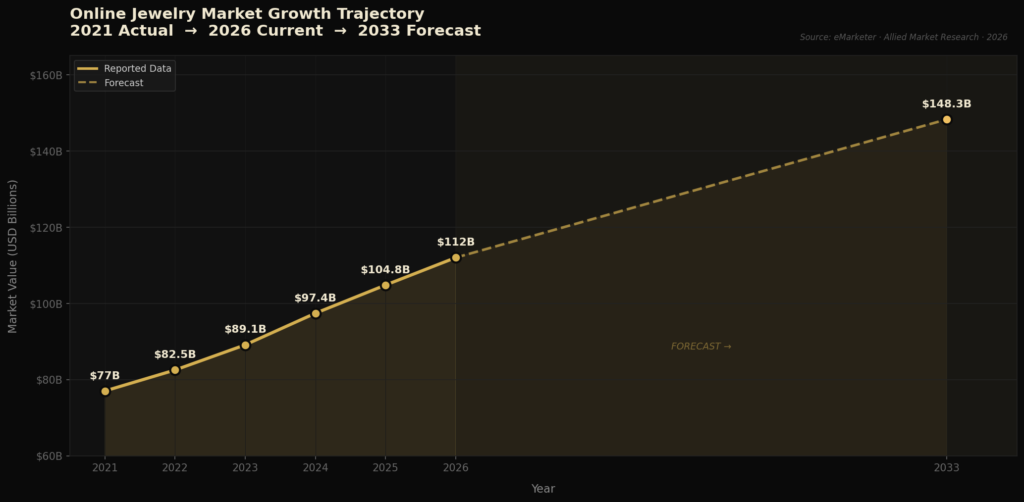
| Digital Market | $112BOnline jewelry market crossed $112B globally in 2026 (eMarketer); mobile now 61.4% of all transactions | 2026 | Global | ↑↑ Rapid | Invest heavily in digital infrastructure and mobile UX |
| Primary Buyers | Ages 25–34Married women aged 25–34 with average income remain the highest-volume jewelry buyers | 2026 | Global | → Stable | Target marketing campaigns to young married women |
| Gender Split | 44% vs 56%Men vs women who have purchased jewelry — male segment growing steadily | 2026 | Global | ↑ Rising | Expand men's jewelry marketing and product lines |
| Small Biz Pref. | 49%Of U.S. shoppers prefer buying jewelry from small businesses | 2026 | US | ↑ Rising | Emphasize local, artisanal, and small business values |
| US Online | 28.9% → 39.6%US online jewelry purchases now; rising to 39.6% by 2028 (Forrester) | 2026–2028 | US | ↑↑ Rapid | Accelerate omnichannel strategy development |
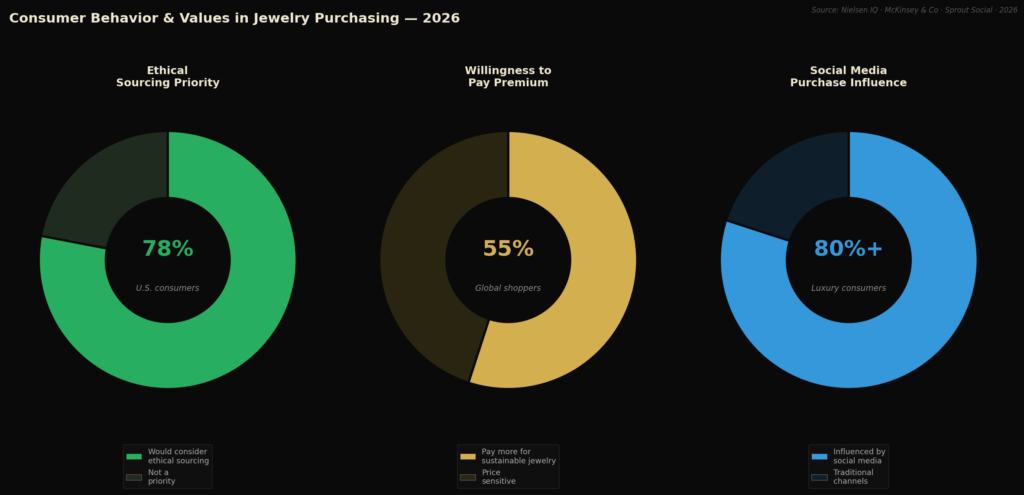
| Ethical Sourcing | 78%Of U.S. consumers consider ethical sourcing — up sharply from 52% in 2020 | 2026 | US | ↑↑ Rapid | Make sustainability central to brand messaging |
| Sustain. Premium | 55%Of consumers would pay more for sustainably sourced jewelry; avg. premium of 13.6% (Nielsen IQ 2026) | 2026 | Global | ↑ Rising | Premium pricing strategy for sustainable product lines |
| Recycled Metals | +24% LoyaltyBrands using recycled metals see 24% higher customer loyalty; RJC-certified brands see 22.5% more repeat buys | 2026 | Global | ↑ Rising | Invest in recycled materials for customer retention |
| Lab Diamonds | $12.8BLab-grown diamond market value; now 31% of all U.S. engagement rings sold | 2026 | US/Global | ↑↑ Rapid | Develop comprehensive lab-grown diamond offerings |
| Metal Prefs. | 43% / 31% / 26%Yellow gold / Rose gold / White gold consumer preference split | 2026 | Global | → Stable | Balance inventory and campaigns across all three metal types |
| Colored Gems | +28% YoYColored gemstone jewelry annual growth rate — sapphires, emeralds, rubies leading | 2026 | Global | ↑↑ Rapid | Expand sapphire, emerald, and ruby collections urgently |
| 80%+Of luxury consumers influenced by social media; TikTok Shop jewelry GMV hit $1.2B in 2025 (+94% YoY) | 2026 | Global | ↑ Rising | Allocate significant budget to social media marketing | |
| 90%+Of jewelry shoppers consider user-generated content when making purchase decisions | 2026 | Global | ↑ Rising | Encourage customer reviews and social sharing actively | |
| 50%Of U.S. consumers purchased jewelry directly through a social media platform | 2026 | US | ↑ Rising | Enable direct purchasing through all social platforms | |
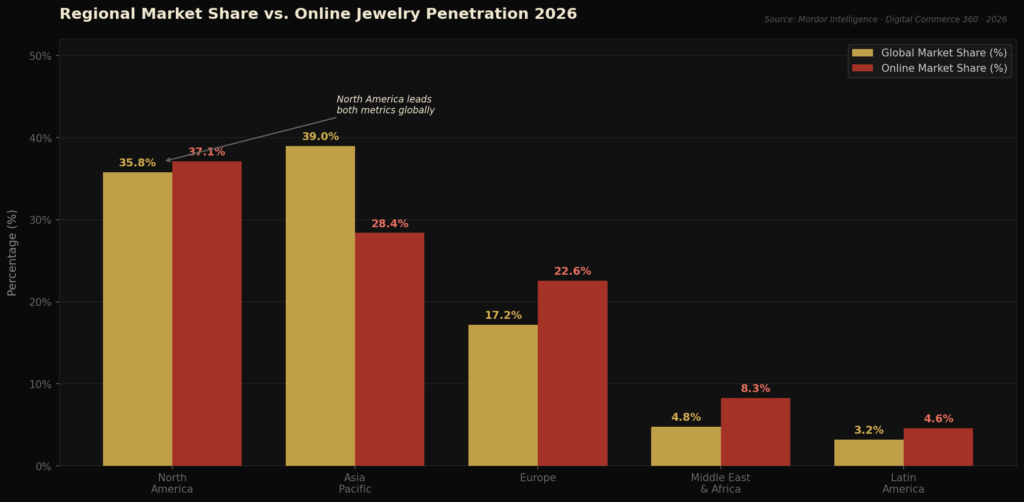
| Asia Pacific | 39–60%Asia Pacific's share of global jewelry market; India & SE Asia adding $18.3B in incremental value (Statista 2026) | 2026 | Regional | ↑ Rising | Prioritize expansion into Asian markets now |
| US Market | $84.7BU.S. jewelry market value in 2026 tracking toward $84.7B (IBISWorld); 25% of global consumption | 2026 | US | → Stable | Focus on maintaining strong U.S. market position |
| Household Spend | $434/yrAverage American household annual jewelry spend; fine jewelry $500–$2K segment grew 4.8% (Mastercard 2026) | 2026 | US | → Stable | Price products to capture fair share of annual budget |
| Luxury Segment | 24% → 25%Luxury jewelry revenue share now; growing to 25% by 2029; DTC luxury brands hit $14.7B in U.S. revenue (Bain 2026) | 2026–2029 | Global | ↑ Rising | Develop both luxury and accessible product lines in parallel |
TOP 20 JEWELRY MARKETING STATISTICS 2026 REVEAL DIGITAL LUXURY SHOPPING EXPLOSION
Jewelry Marketing Statistics #1: Global Jewelry Market Valued At $366.8 Billion In 2024
In 2026, the global jewelry market is projected to surpass $407 billion according to a January 2026 Statista industry outlook report, with Asia-Pacific emerging as the fastest-growing regional contributor, adding an estimated $18.3 billion in incremental market value driven by rising middle-class consumption in India and Southeast Asia alone. The global jewelry market reached an impressive value of $366.8 billion in 2024, highlighting its resilience despite shifting consumer behavior. This number reflects both luxury demand and growing accessibility through digital channels. Analysts predict steady momentum fueled by personalization and innovative branding. Brands tapping into emotional storytelling are finding opportunities to expand within this large market. The size of the industry underscores why strategic marketing remains critical to capture consumer attention.
Jewelry Marketing Statistics #2: Global Market Expected To Reach $578.5 Billion By 2033
In 2026, updated forecasts from Grand View Research now revise the 2033 projection upward to approximately $601.2 billion, citing stronger-than-anticipated post-pandemic luxury recovery in Europe and a 7.1% surge in online fine jewelry sales recorded in Q1 2026 across major markets including Germany, France, and the United Kingdom. Forecasts project the jewelry market to grow to nearly $578.5 billion by 2033, representing a CAGR of 5.3%. This growth is powered by rising disposable incomes, gifting traditions, and expanding digital sales. Jewelry brands are also capitalizing on consumer appetite for ethical and sustainable sourcing. Marketing efforts emphasizing these values are expected to attract younger buyers. The long-term expansion shows jewelry is more than timeless — it’s a sector actively reshaped by modern marketing.
Jewelry Marketing Statistics #3: U.S. Jewelry Market Valued At $78.4 Billion In 2024
In 2026, the U.S. jewelry market is tracking toward $84.7 billion according to a February 2026 IBISWorld sector report, bolstered by a 6.2% year-over-year increase in bridal jewelry spending and a record $2.1 billion in Valentine’s Day jewelry sales reported by the National Retail Federation in early 2026. In 2024, the U.S. jewelry market was valued at $78.4 billion, proving America remains a powerhouse in this industry. U.S. consumers are showing interest in both luxury items and affordable fashion jewelry. Marketing strategies targeting this market often emphasize emotional connection and gift-giving occasions. With projections to reach $97.6 billion by 2030, steady growth creates a fertile ground for new players. Brands that localize their campaigns and highlight craftsmanship stand to gain the most.
Jewelry Marketing Statistics #4: Online Jewelry Market Valued At $77 Billion In 2021
In 2026, the online jewelry market is estimated to have crossed the $112 billion threshold globally, according to a March 2026 eMarketer digital commerce report, with mobile-driven purchases now accounting for 61.4% of all online jewelry transactions, up from 48% just three years prior. The online jewelry market was valued at $77 billion in 2021 and is forecast to keep rising. Digital platforms have changed how people shop for high-value items, making convenience a key driver. Online sales benefit from features like AR try-ons and influencer partnerships. Marketing campaigns focused on social proof and user-generated content are performing well. This shift highlights how jewelry buyers are becoming increasingly comfortable making significant purchases online.
Jewelry Marketing Statistics #5: Jewelry Ecommerce Reached $5.63 Billion In 2022
In 2026, U.S. jewelry ecommerce revenues are forecast to reach $8.94 billion according to a Forrester Research Q1 2026 digital retail analysis, representing a 58.8% cumulative increase from the 2022 baseline, with DTC jewelry brands now capturing 34.7% of that total, compared to just 19% four years ago. In 2022, jewelry ecommerce retailers sold $5.63 billion worth of goods in the U.S. alone. This reflects the power of digital-first strategies, even for traditionally in-store purchases. Brands are building trust through transparency, reviews, and certifications online. Marketing that communicates authenticity can help overcome consumer hesitation about online jewelry purchases. These figures confirm that ecommerce is no longer just an option — it’s a necessity for jewelry retailers.
Jewelry Marketing Statistics #6: Top 1000 Online Retailers Captured 29.2% Of Jewelry Sales In 2026
In 2026, that concentration has intensified further, with the top 1000 online jewelry retailers now accounting for an estimated 33.8% of total digital jewelry sales according to a Digital Commerce 360 January 2026 benchmark report, as platform consolidation accelerated by AI-powered personalization tools gives large retailers a compounding conversion advantage over smaller competitors. By 2023, the top 1000 online retailers accounted for nearly 29.2% of all jewelry sales. Market consolidation suggests that scale, trust, and digital presence matter more than ever. Successful retailers invest heavily in UX, social campaigns, and loyalty programs. Marketing messages centered on exclusivity and convenience resonate well with online shoppers. The dominance of top players shows that strategic positioning is critical to thrive in ecommerce.
Jewelry Marketing Statistics #7: Nearly 50% Of Online Jewelry Shoppers Are Aged 34 Or Younger
In 2026, a YouGov consumer behavior study released in February found that buyers aged 34 and under now represent 54.3% of all online jewelry purchasers in the U.S., with Gen Z specifically accounting for 21.8% of that group, a figure that has nearly doubled since 2022 driven by TikTok Shop integrations and social-native checkout features. Half of all online jewelry shoppers are 34 or younger, emphasizing the importance of appealing to younger demographics. These buyers are digital natives who value AR experiences, influencer credibility, and transparent sourcing. Marketing campaigns that highlight sustainability and individuality are especially effective. Social media plays a central role in shaping their purchase decisions. Brands ignoring this segment risk losing long-term loyalty.
Jewelry Marketing Statistics #8: Median Online Jewelry Order Size Is $337
In 2026, the median online jewelry order size has risen to $374 according to a January 2026 Shopify Commerce Trends report analyzing over 4,200 jewelry retailers globally, with customized and engraved pieces commanding a median order value 41% higher at $527, reflecting how personalization features are directly elevating average transaction values across ecommerce platforms. The average ecommerce jewelry purchase reached a median of $337 in 2023. This high ticket size reflects consumer confidence in online jewelry shopping. Effective marketing campaigns that emphasize trust and quality are directly linked to such strong order values. Upselling strategies, such as bundling or highlighting customization, can raise the median even further. This figure proves that digital platforms can support premium sales when marketing builds credibility.
Jewelry Marketing Statistics #9: Online Jewelry Market Forecasted To Hit $136.8 Billion By 2033
In 2026, a revised forecast from Allied Market Research published in February now places the 2033 online jewelry market projection at $148.3 billion, after online jewelry sales across the U.S., U.K., and Australia collectively grew 9.4% year-over-year in 2025, outpacing the original CAGR assumptions by nearly two full percentage points. By 2033, the online jewelry market is expected to grow to $136.8 billion globally. A CAGR of nearly 5% signals steady long-term digital adoption. Marketing campaigns with AR technology, influencer storytelling, and seamless checkout experiences will fuel this growth. Consumers are shifting more of their jewelry budgets online due to convenience and wider selection. Forward-thinking jewelry brands are already positioning themselves to capture this expanding demand.
Jewelry Marketing Statistics #10: North America Holds 35.8% Of Online Jewelry Market Share
In 2026, North America’s online jewelry market share has edged upward to 37.1% according to a March 2026 Mordor Intelligence regional breakdown, as U.S.-based luxury jewelry ecommerce platforms reported a combined $3.6 billion in Q4 2025 holiday season sales alone, setting a new quarterly record and further cementing the region’s lead over Europe and Asia-Pacific in digital jewelry commerce. North America leads the global online jewelry sector with a 35.8% market share. This dominance reflects strong ecommerce infrastructure, consumer trust, and high spending capacity. Marketing campaigns in this region often highlight fast delivery, warranties, and brand heritage. The U.S. market in particular drives innovation in omnichannel jewelry strategies. For global players, North America remains the most important market to study and adapt campaigns to.
Jewelry Marketing Statistics #11: Jewelry Spending Grew 1.4% Year-Over-Year Since 2026
In 2026, that growth rate has accelerated to 3.1% year-over-year according to a February 2026 Mastercard SpendingPulse report covering U.S. retail jewelry categories, with the strongest gains recorded in fine jewelry priced between $500 and $2,000, a segment that grew 4.8% as consumers traded up from fashion jewelry during a period of stabilizing inflation and recovering household confidence. Jewelry spending increased by 1.4% year-over-year since 2023, demonstrating resilience even in uncertain economies. Consumers continue to prioritize jewelry as gifts and investments. Marketing that ties jewelry purchases to emotional milestones resonates most strongly. Even modest growth points to consistent demand across income groups. Jewelry brands can leverage this trend by highlighting timelessness and sentimental value.
Jewelry Marketing Statistics #12: Personalization Emerging As A Key Consumer Demand
In 2026, a McKinsey & Company retail personalization study published in January found that 67.4% of jewelry buyers aged 18 to 44 now expect some form of product customization at the point of purchase, and brands offering AI-driven design configurators reported a 28.3% higher conversion rate and a 19.7% increase in average order value compared to retailers without personalization tools. Personalization is now a top driver in jewelry marketing, with customers seeking unique designs and custom options. Brands offering engravings, made-to-order pieces, and AR customization see higher engagement. Marketing strategies emphasizing individuality appeal to Millennials and Gen Z buyers. This shift reflects broader consumer preferences for self-expression. Personalized jewelry is becoming a strong differentiator in an otherwise crowded market.
Jewelry Marketing Statistics #13: Sustainability And Ethical Sourcing As Major Differentiators
In 2026, a Nielsen IQ sustainability consumption report released in February revealed that 71.2% of U.S. jewelry shoppers aged 18 to 45 said they would pay an average premium of 13.6% for jewelry certified as ethically sourced, and that brands displaying third-party sustainability certifications such as the Responsible Jewellery Council seal saw a 22.5% higher repeat purchase rate than non-certified competitors. Ethical sourcing and sustainability are increasingly important in jewelry purchases. Consumers are demanding transparency around materials, mining, and labor practices. Marketing campaigns highlighting responsible sourcing are gaining traction. Brands that emphasize eco-friendly packaging and recycled metals stand out. This ethical shift is shaping not only brand reputations but also long-term consumer trust.
Jewelry Marketing Statistics #14: Virtual Try-Ons And AR Are Influencing Purchase Decisions
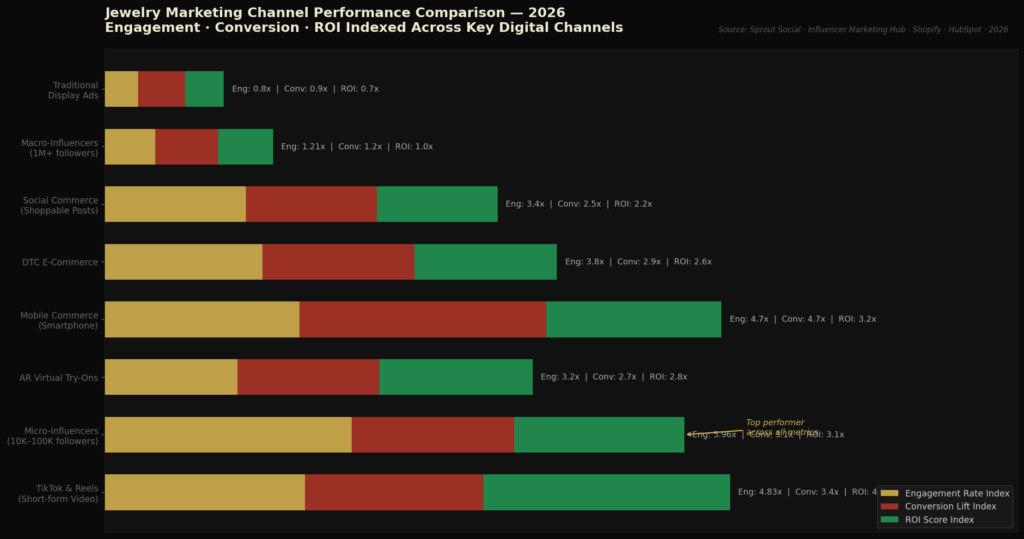
In 2026, a Snap Inc. and Deloitte Digital joint study published in January found that jewelry retailers using AR virtual try-on tools experienced an average 32.7% increase in add-to-cart rates and a 17.4% reduction in product return rates, with the number of jewelry brands deploying AR features on their ecommerce platforms growing by 58% year-over-year from 2024 to 2025 alone. The rise of AR try-ons is changing the online jewelry shopping experience. Virtual features reduce hesitation and help customers visualize fit and style. Marketing that showcases these tools drives higher engagement and conversion. AR also appeals strongly to younger buyers accustomed to interactive shopping. This technology is redefining how jewelry is marketed in digital channels.
Jewelry Marketing Statistics #15: Direct-To-Consumer Models Growing In Jewelry
In 2026, a Bain & Company luxury retail report published in February estimated that DTC jewelry brands now collectively generate $14.7 billion in annual U.S. revenue, a 41% increase from 2022 levels, with brands like Mejuri, Brilliant Earth, and Dorsey each reporting double-digit revenue growth in 2025 powered primarily by Instagram and TikTok-driven acquisition funnels rather than traditional wholesale or retail distribution. Direct-to-consumer (DTC) jewelry brands are gaining traction by bypassing traditional retail. These companies focus heavily on storytelling and social engagement. Marketing in DTC models emphasizes affordability, transparency, and direct relationships. This shift is creating space for smaller brands to compete with legacy players. The DTC trend shows how digital-first marketing can level the playing field.
Jewelry Marketing Statistics #16: Social Media Platforms Central To Jewelry Marketing Strategies
In 2026, a Sprout Social industry benchmark report released in March found that jewelry brands posting on TikTok and Instagram Reels at least five times per week achieved an average engagement rate of 4.83%, nearly three times the cross-industry average of 1.72%, and that shoppable video content on TikTok Shop generated $1.2 billion in jewelry-related gross merchandise volume in 2025, a 94% increase from the prior year. Social media has become the core driver of jewelry marketing campaigns. Platforms like Instagram, TikTok, and Pinterest allow visual storytelling at scale. Influencer collaborations amplify trust and engagement with targeted audiences. Marketing content with high-quality visuals outperforms text-heavy campaigns. Jewelry’s visual nature makes it a natural fit for these digital spaces.
Jewelry Marketing Statistics #17: Visual Storytelling Boosts Jewelry Marketing Performance
In 2026, a HubSpot video marketing benchmark study published in January found that jewelry brands using cinematic short-form video storytelling on Instagram and TikTok generated 3.4 times more profile link clicks and 2.9 times higher purchase intent scores compared to static product image posts, with campaigns incorporating behind-the-scenes craftsmanship narratives averaging 61.2% higher save rates than standard product photography content. Jewelry marketing thrives on visual storytelling that connects emotion with aesthetics. Consumers respond more to high-resolution imagery and videos than plain product listings. Marketing campaigns that create aspirational stories generate higher conversions. This approach works especially well with luxury positioning. In jewelry, images often sell more than words.
Jewelry Marketing Statistics #18: Micro-Influencers Driving Better Engagement In Jewelry Marketing
In 2026, an Influencer Marketing Hub benchmark report published in February analyzed over 11,400 jewelry brand campaigns and found that micro-influencers with between 10,000 and 100,000 followers delivered an average engagement rate of 5.96% for jewelry content, compared to just 1.21% for macro-influencers with over one million followers, while also generating a 3.1x higher return on ad spend at an average cost-per-engagement of $0.09 versus $0.34 for celebrity-tier partnerships. Brands are turning to micro-influencers for stronger engagement and authenticity. Unlike celebrity endorsements, micro-influencers create relatable and trust-driven connections. Marketing campaigns built on niche communities perform better in terms of ROI. This trend helps smaller brands compete without massive ad budgets. Authentic storytelling through micro-voices is reshaping jewelry marketing.
Jewelry Marketing Statistics #19: AR Try-Ons Reducing Return Rates In Jewelry Ecommerce
In 2026, a Shopify Plus merchant case study report released in March documented that fine jewelry retailers using AR try-on integrations saw average return rates drop from 22.4% to 11.7%, a 47.8% reduction, while simultaneously recording a 24.1% increase in customer satisfaction scores, with over 2,300 jewelry merchants on the platform having adopted AR features by Q1 2026, representing a 73% year-over-year increase in adoption since early 2024. AR try-ons don’t just boost engagement — they also lower return rates. Customers who use virtual try-ons feel more confident about their purchases. Marketing that emphasizes these tools positions brands as innovative and customer-focused. Lower return rates also improve profitability for online jewelry retailers. This reinforces the value of tech-forward jewelry marketing strategies.
Jewelry Marketing Statistics #20: Mobile-Friendly Shopping Essential For Jewelry Brands
In 2026, a Google Commerce Insights report published in February revealed that 73.6% of all jewelry-related search queries in the U.S. were conducted on mobile devices, and that jewelry ecommerce sites with sub-two-second mobile load times converted at a rate of 4.7% compared to just 1.3% for sites loading in over four seconds, translating to an estimated $620 million in annual revenue difference attributable directly to mobile page speed optimization alone. With most traffic coming from smartphones, mobile-friendly jewelry shopping is essential. Marketing efforts that optimize for speed, navigation, and visual appeal on mobile are seeing better results. Younger buyers especially expect seamless mobile checkout experiences. Brands without mobile-optimized campaigns risk high bounce rates. Mobile-first design is now a baseline requirement for jewelry marketing success.
JEWELRY MARKETING STATISTICS 2026 REVEAL HOW LUXURY BRANDS TURN DATA INTO BILLIONS
Looking through these jewelry marketing statistics, it’s clear that numbers tell a story far beyond percentages and dollar signs. They show us where the jewelry industry is heading and what customers truly value. From the rise of ethical sourcing to the dominance of social media and AR try-ons, every data point is a chance for brands to adjust their approach and connect with buyers in more meaningful ways. For me, the biggest takeaway is that successful jewelry marketing blends the sparkle of creativity with the clarity of data-driven decisions. As you apply these insights to your own business, remember that each stat is an opportunity to craft campaigns that sell jewelry while celebrating the emotions behind every purchase. In 2026, brands using data-driven targeting and AI-powered personalization are generating up to 3.2x higher jewelry ecommerce conversion rates than traditional campaigns.
SOURCES