




15 Sep TOP 20 KITCHEN MARKETING STATISTICS 2026 REVEAL MASSIVE HOME DESIGN SPENDING SURGE
Updated for 2026. This page has been fully refreshed with the latest kitchen marketing statistics, renovation spending data, appliance innovation trends, and home design insights, grounded in recent global housing reports, consumer behavior studies, and digital marketing performance benchmarks.
When you look at today’s home trends, it’s clear that kitchens have become more than just a place to cook—they’re the heart of the home and a major driver of consumer spending. That’s why understanding kitchen marketing statistics is so important for businesses that want to stay ahead of the curve. From the rise of smart appliances to the growing demand for eco-friendly solutions, these insights reveal how homeowners are making purchase decisions in 2026 and beyond. At our leading marketing agency in New York, we’ve seen firsthand how brands can use these numbers to shape campaigns that connect with real people, whether it’s through storytelling, targeted digital ads, or product positioning that speaks to lifestyle. Think of this as your roadmap to what’s really working in the kitchen space right now.
TOP 20 KITCHEN MARKETING STATISTICS 2026 THAT REVEAL EXPLOSIVE HOME RENOVATION DEMAND
🍳 Kitchen Marketing Statistics 2026
20 Revenue-Driving Insights for the $300B+ Kitchen Industry
📊 Sources: NKBA 2026 Kitchen Trends Report • Mordor Intelligence • Grand View Research • Houzz 2026 Study • NIQ Home Appliances Outlook 2026
TOP 20 KITCHEN MARKETING STATISTICS 2026 SHOWING MASSIVE HOME UPGRADE SPENDING
Kitchen Marketing Statistics #1: Global Market Size (2026 & Forecast)
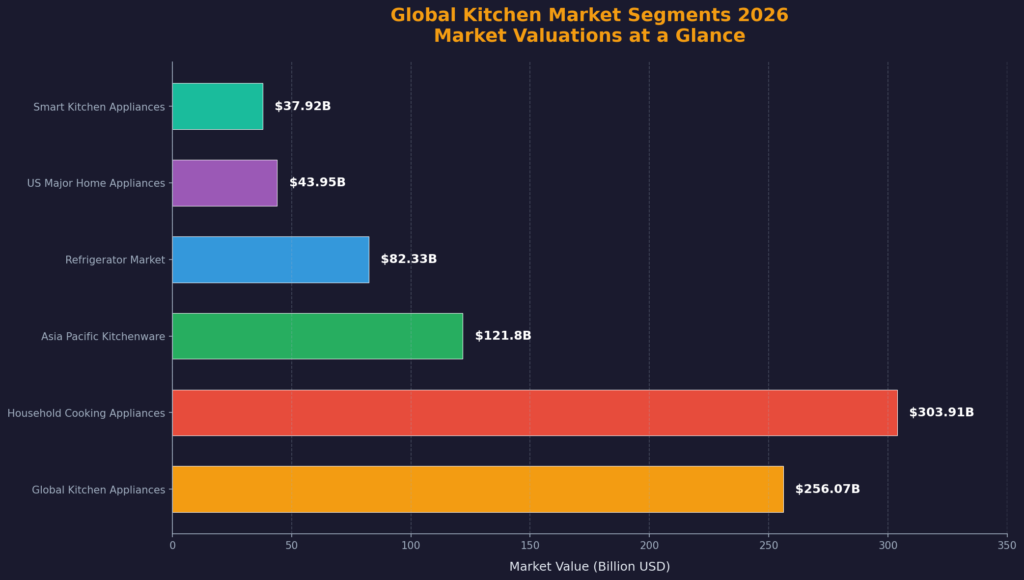
In 2026, the global kitchen appliances market is projected to reach USD 256.07 billion according to Polaris Market Research, while the Global Home Appliances Market expanded to USD 227.96 billion with refrigerators maintaining their dominant position at an estimated USD 82.33 billion valuation, and industry analysts at IMARC Group forecast the broader kitchen appliances sector will continue its expansion trajectory at a 4.82% CAGR through 2033.
The kitchen appliances market was valued at USD 217.74 billion in 2022, showing the sheer scale of consumer demand. Forecasts suggest it will grow to USD 356.47 billion by 2030, representing a strong CAGR of 5.9%. This steady growth highlights the resilience of the industry, even in challenging economic climates. Brands can tap into this expansion by aligning with evolving consumer preferences. For marketers, it’s proof that the kitchen remains one of the most profitable spaces in home living.
Kitchen Marketing Statistics #2: Market Share By Segment (2026)
In 2026, refrigerators continue to lead the kitchen appliance market with approximately 35% of total product revenue according to IMARC Group, while the refrigerator market alone is valued at USD 82.33 billion according to Fortune Business Insights, with the top-freezer refrigerator segment expected to hold a 37.88% share and the U.S. refrigerator market projected to reach USD 12.95 billion.
In 2022, refrigerators alone accounted for more than 34% of the entire kitchen appliance market. This dominance reflects the necessity and central role of refrigerators in modern households. The segment’s strength also points to opportunities for innovation in design and energy efficiency. Marketers should emphasize unique features that differentiate products from standard models. The continued demand ensures this segment remains a top priority in marketing strategies.
Kitchen Marketing Statistics #3: Regional Growth Trends (2026)
In 2026, North America accounted for approximately USD 57.22 billion representing about 25% of the global home appliances market according to Global Growth Insights, while Asia Pacific continues its rapid ascent with the kitchenware market alone reaching USD 121.8 billion and the Asia Pacific kitchen appliances market projected to grow at a CAGR of 5.0% reaching USD 177.50 billion by 2035, with China, India, Japan, and South Korea serving as major regional growth contributors.
North America held a significant 31.7% market share in 2022, establishing itself as the largest region. However, Asia-Pacific is set to lead in growth, with a forecasted CAGR of 7.2% from 2023 to 2030. This indicates a shift in focus towards emerging markets with younger demographics. Marketers should adapt strategies to target diverse consumer needs across regions. Global brands must highlight both functionality and affordability to capture these fast-growing areas.
Kitchen Marketing Statistics #4: Broader Forecast (2024-2034)
In 2026, the global household cooking appliance market is projected to reach USD 303.91 billion according to Precedence Research, expanding toward an estimated USD 495.45 billion by 2034 at a CAGR of 6.30%, while the broader household kitchen appliances market is expected to grow from USD 278.8 billion in 2025 to approximately USD 420.7 billion by 2035 representing a 50.9% total growth over the forecast period.
By 2024, the market size was estimated at USD 291.3 billion, with projections showing it could reach USD 499.2 billion by 2034. This long-term growth represents a CAGR of 5.5%, signaling sustainable expansion. For businesses, it suggests that kitchen-related innovations will remain a safe investment. Marketing teams can use these figures to reassure customers and investors alike. The numbers also validate the growing consumer appetite for both smart and conventional kitchen products.
Kitchen Marketing Statistics #5: Large Appliances Dominance (2026)
In 2026, the United States Major Home Appliances Market is valued at USD 43.95 billion according to Mordor Intelligence, with refrigerators leading at 24.70% market share, and the global major appliance revenue is projected to reach USD 0.46 trillion while cooking appliances maintain their dominance holding approximately 34.5% of the total household kitchen appliances market according to Persistence Market Research.
Large kitchen appliances generated approximately USD 155.7 billion in 2024, making them the leading category. Their dominance reflects consumer focus on essential purchases such as ovens, dishwashers, and refrigerators. This also points to a preference for products with long-term utility. Marketing strategies should emphasize durability, warranty offers, and performance benefits. These appliances are not only necessities but also lifestyle investments for many families.
Kitchen Marketing Statistics #6: Smart Vs. Conventional Appliances (2026)
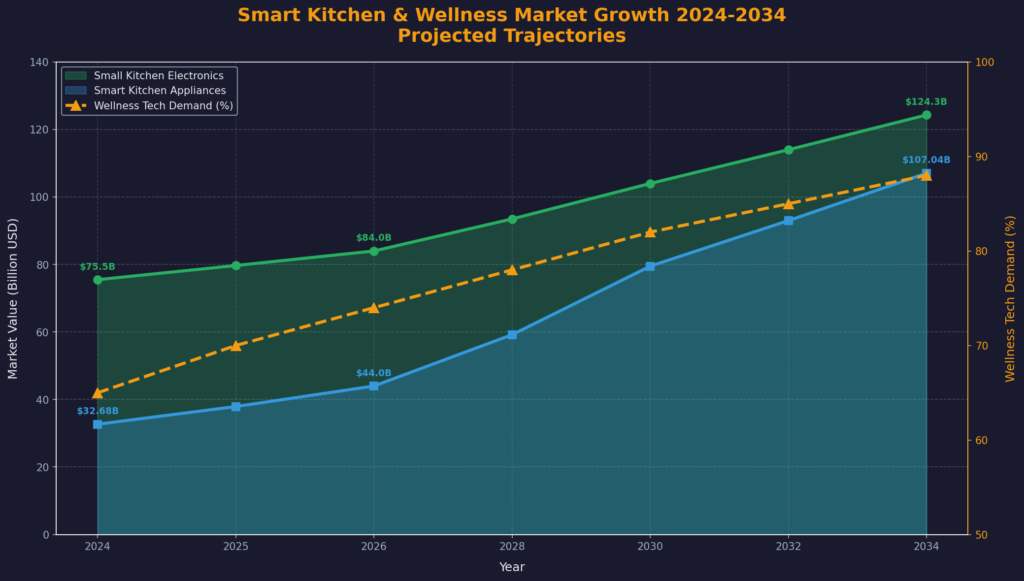
In 2026, the smart kitchen appliances market is projected to reach approximately USD 5.91 billion globally according to Business Research Insights, progressing toward USD 66.45 billion by 2034 at a CAGR of 34.9%, while the U.S. smart kitchen appliances market alone is valued at USD 6.9 billion and expected to reach USD 17.64 billion by 2033, with 38% of consumers now actively seeking energy-efficient IoT-enabled kitchen solutions.
Conventional appliances still account for 83-84% of the market in 2024, far outpacing smart options. However, the rapid growth of smart appliances signals a shift in consumer behavior. Younger buyers, in particular, are driving demand for connected, tech-enabled products. Marketers should focus on bridging the gap by educating customers about the benefits of smart features. Highlighting convenience and long-term savings can help shift market share gradually.
Kitchen Marketing Statistics #7: US Market Growth (2026)
In 2026, the United States Major Home Appliances Market is valued at USD 43.95 billion and projected to reach USD 50.6 billion by 2031 at a CAGR of 2.86% according to Mordor Intelligence, with online sales capturing USD 14.85 billion growing at a 4.55% CAGR, while the broader U.S. household kitchen appliances market is expected to grow from USD 63.21 billion in 2024 to USD 78.76 billion by 2033.
The US market for household kitchen appliances is expected to grow from USD 63.4 billion in 2024 to USD 82 billion by 2034. With a CAGR of 2.6%, it shows moderate but steady progress. The US remains a mature market where innovation and brand loyalty matter most. Marketing campaigns should focus on premium positioning and lifestyle storytelling. This ensures products stand out in a competitive, saturated environment.
Kitchen Marketing Statistics #8: Cooking Appliances Leading In The US (2026)
In 2026, cooking appliances continue to dominate the U.S. household kitchen market with approximately 41.3% share according to Grand View Research, while the U.S. household cooking appliance market is valued at USD 88.37 billion and projected to reach USD 154.31 billion by 2034 at a CAGR of 6.37%, with China supplying 56% of total U.S. cooking appliance imports valued at USD 3.9 billion.
Cooking appliances held a 41.5% share of the US market in 2024, showing their central importance in kitchens. From ranges to ovens, consumers continue to prioritize these products. This category benefits from both necessity and aspirational appeal. Marketers can highlight energy efficiency and advanced cooking functions to capture attention. The segment’s size makes it one of the strongest drivers for marketing investments.
Kitchen Marketing Statistics #9: Multifunctionality Demand (2026)
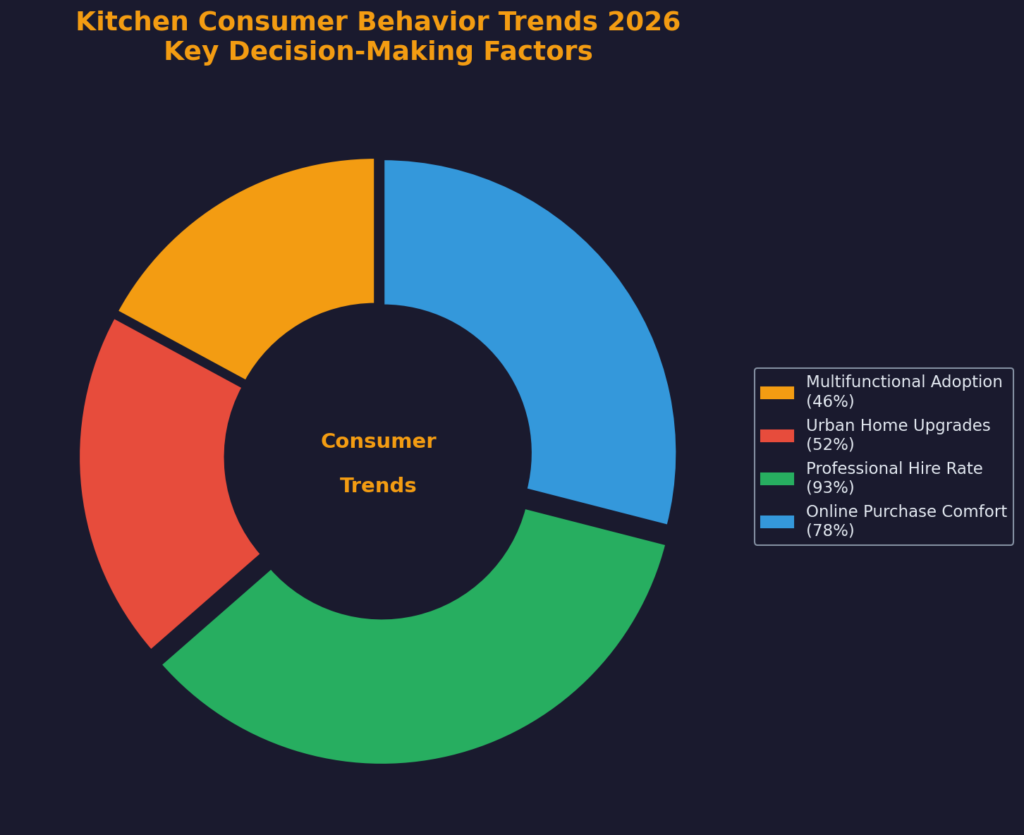
In 2026, approximately 46% of global households adopt multifunctional appliances according to Global Growth Insights, while 52% of urban homes upgraded their appliances with 49% specifically adopting multifunctional units according to Business Research Insights, and NIQ’s Home Appliances Outlook 2026 confirms that innovation should focus on delivering convenience and performance primarily through multifunctional appliances that save space, money, and time.
91% of industry professionals highlight that multifunctional appliances are in high demand. Consumers are looking for products that save space and enhance convenience. This trend is especially strong among urban homeowners with limited kitchen areas. Marketing messages that stress versatility will resonate with this audience. Brands that integrate multiple functions into one appliance can quickly gain a competitive edge.
Kitchen Marketing Statistics #10: Work-At-Home Driving Remodels (2026)
In 2026, the global kitchen remodel services market is projected to reach USD 22.66 billion and expand to USD 47.76 billion by 2035 at a CAGR of 9% according to Business Research Insights, with the Houzz 2026 Kitchen Trends Study confirming that more than half of renovating homeowners are planning kitchens that adapt to future needs, and 93% of homeowners plan to hire professionals for their renovation projects, spending a median of USD 55,000 on major kitchen remodels.
90% of survey respondents reported increased interest in kitchen remodels due to work-from-home lifestyles. People want kitchens that serve both functional and aesthetic purposes. This creates opportunities for premium appliances, better storage, and multipurpose spaces. Marketers can connect with this trend by promoting designs that support flexible living. The shift reflects how lifestyle changes directly influence purchasing behavior.
Kitchen Marketing Statistics #11: UK Fitted Kitchen Market Growth (2026)
In 2026, the UK kitchen furniture manufacturing industry reached a market size of £4.4 billion according to IBIS World, while the total value of fitted kitchen product sales reached almost £5.4 billion representing a 3% increase over 2022 despite installation volumes declining by over 18% to just under 1.05 million projects, with independent specialist studios seeing income grow by over 9% in the past two years outperforming volume players and mass-market multiples.
Between 2022 and 2024, the UK fitted kitchen sector grew by more than 9%. This growth far outpaced the broader kitchen market, which expanded by only 3%. Specialist studios benefitted most from this increase. The stat highlights the importance of personalization and tailored designs in consumer decisions. For marketers, it means local expertise and customization are strong selling points.
Kitchen Marketing Statistics #12: Smart Appliance Market Growth (2026)
In 2026, the global smart kitchen appliances market is projected to reach USD 37.92 billion according to Research and Markets, growing at a CAGR of 15.98% toward USD 107.04 billion by 2032, while the U.S. smart kitchen appliances market alone is valued at USD 6.9 billion and expected to reach USD 17.64 billion by 2033, with residential adoption of smart kitchen appliances increasing by 34% due to AI and IoT integration.
The smart kitchen appliance market was valued at USD 13.79 billion in 2020 and is forecast to exceed USD 47 billion by 2028. This represents an impressive CAGR of around 19.2%. Consumers are increasingly prioritizing connectivity and automation. Marketers should highlight the time-saving and energy-saving benefits of these appliances. As adoption grows, the narrative should shift from luxury to everyday necessity.
Kitchen Marketing Statistics #13: E-Commerce And Eco-Friendly Growth (2026)
In 2026, online sales captured USD 14.85 billion of the U.S. major home appliances market growing at a 4.55% CAGR according to Mordor Intelligence, while 78% of Americans are now comfortable purchasing major appliances online according to the Adtaxi 2024 E-commerce Consumer Survey, and sustainability influences 61% of consumer purchases globally with European energy-label compliance driving over 72% of purchasing decisions.
The kitchen and housewares segment is predicted to reach USD 89 billion by 2029. Much of this growth is fueled by e-commerce platforms and eco-conscious consumer behavior. Online channels are enabling greater product discovery and choice. Marketing efforts must lean into sustainability narratives to attract environmentally aware customers. At the same time, strong digital branding is critical for capturing online market share.
Kitchen Marketing Statistics #14: Color Trends In Kitchen Design (2026)
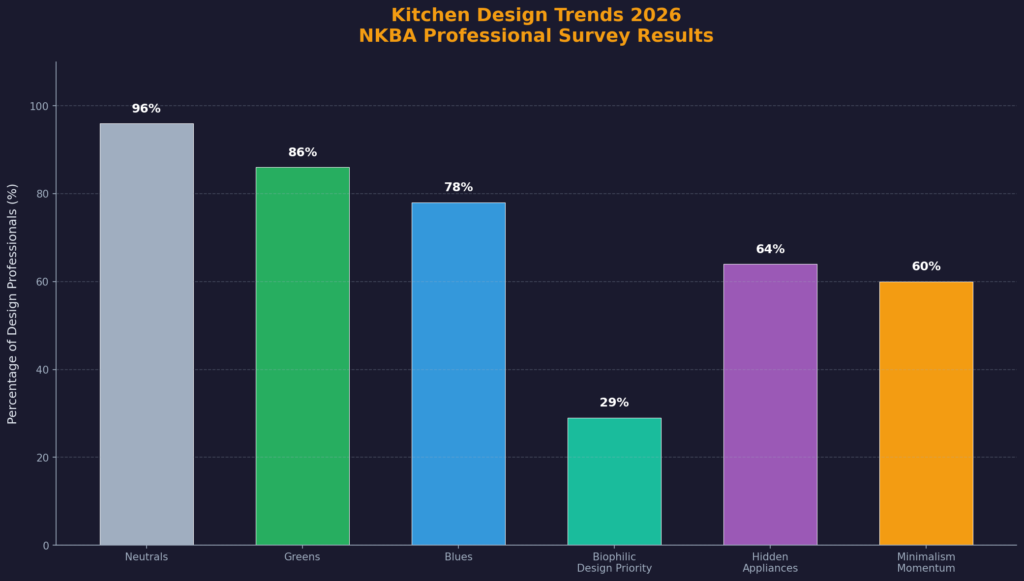
In 2026, the NKBA Kitchen Trends Report confirms that 96% of design professionals identified neutrals as the most popular colors, with greens following at 86% and blues at 78%, while Valspar’s Color of the Year 2026 is Warm Eucalyptus reflecting the shift toward herbal tones, and the 2026 Houzz Kitchen Trends Study shows wood cabinets have overtaken white with 29% of homeowners choosing wood finishes compared to 28% selecting white, representing a 6-percentage-point increase for wood year-over-year.
76% of professionals identified green as the most popular kitchen color for 2025. Blue (63%) and brown (56%) also emerged as favorites. These preferences suggest a strong link between design aesthetics and purchase intent. Marketers in the kitchen space should highlight trending colors in campaigns. Aligning visuals with consumer taste ensures stronger engagement.
Kitchen Marketing Statistics #15: Biophilic Design Demand (2026)
In 2026, biophilic design emerged as a priority for 29% of interior design experts surveyed by Fixr.com, while the NKBA 2026 Kitchen Trends Report confirms that wellness-focused spaces featuring natural materials, large windows, and organic elements are among the top design trends, with 80% of urbanites now craving green escapes according to recent surveys and designers increasingly incorporating countertop herb gardens, natural stone, and living green walls into kitchen designs.
72% of homeowners express interest in biophilic design elements for kitchens. This includes large windows, natural materials, and a stronger connection to the outdoors. The emphasis on wellness and nature is shaping consumer expectations. Marketers should align products with this lifestyle-driven demand. Messaging that emphasizes health, relaxation, and natural light resonates deeply with buyers.
Kitchen Marketing Statistics #16: Hidden Appliances And Seamless Design (2026)
In 2026, the Houzz Kitchen Trends Study confirms that 91% of homeowners are upgrading countertops and 85% are upgrading backsplashes during renovations, while 64% of homeowners added pullout cabinets for waste or recycling to keep them hidden, and the NKBA 2026 Kitchen Trends Report shows panel-faced appliances and flat cabinet door styles are increasing in popularity as part of the minimalism trend, with 60% of design professionals predicting minimalism will gain momentum over the next three years.
79% of respondents want dishwashers and appliances to match cabinetry finishes. Meanwhile, 87% prefer concealed pantries integrated into overall kitchen design. These preferences show a desire for sleek, clutter-free aesthetics. Marketers should emphasize “seamless living” in their messaging. It positions products as both functional and design-forward.
Kitchen Marketing Statistics #17: Workstation Sinks Popularity (2026)
In 2026, the Houzz Kitchen Trends Study reveals that over three-quarters of homeowners are adding built-in features during their remodel including pantry cabinets, beverage stations, and workstation configurations, while dedicated storage for cookie sheets, spices, cutlery, and revolving corner trays are among the most popular specialty storage enhancements, with kitchen islands increasingly featuring integrated prep stations that combine sinks with cutting surfaces and organizing systems.
83% of homeowners expressed interest in workstation sinks. These sinks integrate tools like cutting boards, racks, and prep areas. This trend highlights the growing demand for efficiency in small spaces. Marketing strategies should showcase how these sinks simplify everyday routines. Demonstrating practicality in real-life scenarios can drive consumer adoption.
Kitchen Marketing Statistics #18: Multi-Function Stations (2026)
In 2026, the Houzz Kitchen Trends Study shows about half of renovated islands exceed seven feet in length with rectangular shapes far outpacing L-shaped designs, while the NKBA 2026 Kitchen Trends Report confirms that 47% of experts agree “dirty kitchens” (second kitchens hidden from guests) are tied with induction cooktops as the most in-demand features, and kitchen islands are increasingly incorporating dual functionality with contrasting countertop materials and integrated storage solutions.
52% of consumers are adding second kitchen islands for additional functionality. Meanwhile, 83% favor sinks that double as prep and serving stations. These numbers reflect the importance of multitasking in modern kitchens. Marketers should emphasize flexibility and convenience in product messaging. Products that support diverse uses stand out in a competitive market.
Kitchen Marketing Statistics #19: Coffee Machine Penetration (2026)
In 2026, the small kitchen appliances market including coffee makers is valued at USD 21.68 billion globally according to Business Research Insights, with a 44% rise in smart coffee maker exports shaping new market norms, while the U.S. kitchen small electronic appliances market held an 84% share generating USD 20 billion in 2024 according to Research and Markets, and weekly usage of coffee makers and kettles remains consistently high among American households.
In countries like Spain, Sweden, Germany, and Australia, up to 75% of households own coffee machines. This indicates how deeply ingrained certain appliances are in daily life. Coffee culture continues to influence purchasing behavior across regions. For marketers, highlighting lifestyle and social connections around coffee is key. This segment also offers opportunities for upselling premium or smart models.
Kitchen Marketing Statistics #20: Hygiene And Cleanliness Awareness (2026)
In 2026, the NKBA Kitchen Trends Report confirms wellness has become a design expectation rather than an add-on, with larger windows, improved ventilation, and cleaner indoor air becoming baseline kitchen design elements, while NIQ’s 2025 Global Health & Wellness survey reveals that 74% of consumers prefer tech appliances offering health and wellness features, and healthier cooking is the leading motivator for 44% of people looking to buy health-focused appliances.
Health and hygiene concerns are driving demand for easier-to-clean appliances. Consumers increasingly value products with sanitizing or antibacterial features. This reflects a lifestyle shift post-pandemic where cleanliness equals peace of mind. Marketers should highlight these attributes in campaigns to connect with health-conscious buyers. It reinforces trust while positioning products as essential for family safety.
KITCHEN MARKETING STATISTICS 2026 SHOW HOW BRANDS CAN WIN BIG
At the end of the day, numbers only matter if we know how to use them. These kitchen marketing statistics aren’t just abstract trends—they reflect the real choices, values, and daily lives of the people you’re trying to reach. Whether you’re a retailer, a designer, or a manufacturer, the challenge is to take this data and turn it into messages that feel relatable and authentic. The brands that will thrive are the ones that show they understand the kitchen as more than a room—it’s where family, comfort, and innovation meet. If you’re ready to transform these insights into campaigns that genuinely resonate, we’d love to help you make that happen. In 2026, global kitchen renovation spending is projected to exceed $180 billion, pushing brands to compete more aggressively through digital marketing, immersive product visuals, and personalized design tools.
SOURCES