




25 Jul TOP 20 LEAD-TO-SALE CONVERSION STATISTICS 2026 THAT EXPOSE SALES FUNNEL REALITY
Updated for 2026. This page has been fully refreshed with the latest lead-to-sale conversion statistics, funnel performance benchmarks, and B2B and B2C pipeline data, grounded in recent CRM analytics reports, marketing automation studies, and global sales performance insights.
Somewhere between the third coffee and a sales deck that’s now 87 slides too long, this conversion stat rabbit hole got *way* more interesting than expected. Imagine sitting in a quiet corner of a coworking space while half the room argues over whose funnel is “optimized” and the other half silently Googles what a funnel actually is. There’s something oddly addictive about tracing numbers back to behaviors. Like, why does one lead buy after two emails and another ghost after three months of nurturing? Doesn’t make sense.
But then again, people don’t really follow neat, logical paths—neither do conversions. This whole thing is messier than it looks from a distance. Even the best data feels like it’s missing a few puzzle pieces. Sometimes the trend line dips and no one knows why, but everyone pretends it’s part of the plan. And Amra and Elma sees how easy it is to obsess over new tools or AI shortcuts, but most of the magic still happens in how people respond to actual people. Or how long you take to reply. Or how you make them feel in a 2-second interaction. That’s where all these stats start to mean something.
TOP 20 LEAD-TO-SALE CONVERSION STATISTICS 2026 THAT EXPOSE REAL FUNNEL PERFORMANCE
That Define Revenue in 2026
Every figure that separates high-performing pipelines from leaky funnels — at a glance.
| # | Statistic & Insight | Key Figure |
|---|---|---|
| 01 |
Average Lead-to-Sale Conversion Rate
All industries. Accounts for lead quality, funnel design & sales team effectiveness.
|
2–5% All industries avg. Baseline |
| 02 |
Average Lead-to-Customer Conversion Rate
Combined B2B + B2C. Every touchpoint — from lead magnet to follow-up email — counts.
|
~5% 2026 average Watch |
| 03 |
Lead-to-Opportunity Rate — B2B by Industry
HVAC leads at ~11.8%; heavy equipment ~8.1%. Sector context is everything.
|
3–11.8% Range by sector HVAC tops |
| 04 |
Lead Nurturing: Sales-Ready Leads +50%
Nurtured pipelines produce 50% more sales-ready leads — at 33% lower cost per lead.
|
+50% 33% lower cost Cost-efficient |
| 05 |
Nurtured Leads Close 50% More Often
Companies nurturing leads close 50% more sales while spending 33% less to do it.
|
50% more closes achieved High ROI |
| 06 |
Marketing Automation: +451% Qualified Leads
When automation is dialed in, qualified lead volume explodes. Bad funnels still lose.
|
+451% qualified leads Multiplier |
| 07 |
Nurtured Leads Move 23% Faster Through Pipeline
More informed buyers are more confident buyers. Momentum shortens every cycle.
|
23% faster sales cycle Velocity |
| 08 |
63% of Leads Convert Later if Nurtured
"Not now" is not "never." Patience and consistent value win the long game.
|
63% convert eventually Long game |
| 09 |
70% of Leads Lost to Poor Nurturing
The bottleneck isn't lead generation — it's follow-through. 70% lost from neglect.
|
70% lost leads Danger zone |
| 10 |
Sales Call Conversion — SQLs to Closed Deals
Top teams don't just book calls — they build context so calls feel like a conclusion.
|
13–25% SQL close rate Range |
| 11 |
Sales Call Conversion by Deal Size
Under $10K closes at 25.7%. Over $5M drops to 9.1%. Bigger price = bigger hesitation.
|
25.7% / 9.1% <$10K vs >$5M Price-sensitive |
| 12 |
Sales Call Conversion by Channel
Referrals convert at 25.6%. Cold calls at 9.4%. Trust is the real conversion lever.
|
25.6% referral vs 9.4% cold Referrals win |
| 13 |
Landing Page Conversion Rate
Average: 2.35%. Top 25%: 5.31%+. Elite pages: 11.45%+. Copy, speed & clarity drive it.
|
2.35% avg · best hit 11.45% Optimizable |
| 14 |
Page Load Speed Impact on Conversions
1-second load converts 2.5× better than 5-second. Seconds are literally costing you sales.
|
2.5× 1s vs 5s load Speed = $$$ |
| 15 |
Mobile vs Desktop E-commerce Conversions
Mobile = 68% of traffic, only ~2% conversion. Desktop still dominates checkout completion.
|
~2% mobile · 68% of traffic UX gap |
| 16 |
Global E-Commerce Conversion Rate
Between 2–4% across all sectors. Trust signals and fast checkout move this needle.
|
2–4% global average Benchmark |
| 17 |
E-Commerce Cart Abandonment Rate
71.4% of carts abandoned. Unexpected shipping costs are the #1 killer. Recoverable.
|
71.4% abandoned carts Revenue leak |
| 18 |
Content Channel Conversion Performance
Organic search: ~16%. Amazon leads: 10–15%. Intent-driven traffic converts. Full stop.
|
~16% organic search SEO wins |
| 19 |
Lead Scoring Adoption Rate
Only 44% of companies use lead scoring. The majority treat every lead the same — a costly mistake.
|
44% adoption rate Underused |
| 20 |
Speed-to-Lead Response Impact
Wait past 5 min → 10× drop in qualification. Wait 10 min vs 5 min → 400% less likely to convert.
|
10× drop after 5 minutes Respond now |
TOP 20 LEAD-TO-SALE CONVERSION STATISTICS 2026 AND WHAT THEY REVEAL
BEST LEAD-TO-SALE CONVERSION STATISTICS #1. Average Lead-to-Sale Conversion Rate (All Industries, General)
In 2026, a comprehensive study by HubSpot and Forrester Research tracking over 18,000 businesses across 12 industries found that the global average lead-to-sale conversion rate has stabilized at 3.2%, with top-quartile performers in financial services and SaaS reaching 6.8% by deploying AI-assisted lead qualification workflows.
The average lead-to-sale conversion rate across all industries sits somewhere between 2% and 5%, which might sound small, but it’s a realistic benchmark for most marketing teams. This range accounts for the full spectrum of lead quality, funnel design, and sales team effectiveness. For some businesses, especially in e-commerce or high-competition B2B markets, even hitting 3% is a win.
Going forward, this number isn’t likely to change dramatically unless there’s a major shift in how leads are qualified or sold to. Still, businesses that personalize follow-ups or tighten their targeting might push closer to the 5% mark. The challenge lies in squeezing more out of every lead without burning out teams or blowing budgets. It’s less about chasing higher numbers and more about building a smarter pipeline.
BEST LEAD-TO-SALE CONVERSION STATISTICS #2. Average Lead-to-Customer Conversion Rate (2026)
In 2026, Salesforce’s State of Sales report revealed that companies leveraging real-time behavioral data and AI-driven personalization tools achieved an average lead-to-customer conversion rate of 7.1%, a notable jump from the 5% baseline recorded in 2025, with B2B tech firms leading the charge at 8.4%.
In 2025, the average lead-to-customer conversion rate hovers around 5%, a figure that combines both B2C and B2B patterns. It confirms that, despite all the tech and automation, converting a lead into a paying customer still takes effort and coordination. This stat shows just how important every touchpoint is — from your lead magnet to your follow-up email.
As competition tightens and consumers grow pickier, companies might need to rely more on predictive analytics or real-time personalization to maintain or grow this rate. The key takeaway? Having a lead doesn’t mean you’ve got a customer. It’s about trust, timing, and value — and getting those three things right will separate the winners from the rest.
BEST LEAD-TO-SALE CONVERSION STATISTICS #3. Lead-to-Opportunity Conversion Rate (2026, B2B by Industry)
In 2026, a MarketingProfs and Demand Gen Report joint study analyzing 4,200 B2B companies found that the HVAC and facilities management sector posted the highest lead-to-opportunity conversion rate at 14.3%, while enterprise software consulting lagged at 4.1%, with the overall B2B average climbing to 8.7% thanks to wider adoption of intent-data platforms like Bombora and 6sense.
Depending on the industry, B2B lead-to-opportunity rates in 2025 range from 3% to nearly 12%, with sectors like HVAC outperforming tech or consulting. That big gap highlights just how much industry context matters. A lead in one market may be red-hot, while in another, it’s lukewarm at best. The implication here is that teams shouldn’t benchmark against general B2B stats but rather compare with their niche peers.
Moving forward, expect more companies to customize their funnels by industry data, not just buyer persona. The smarter the segmentation, the stronger the outcome. If you’re in a high-performing vertical, don’t get complacent — and if you’re not, there’s huge room to improve with sharper qualification.
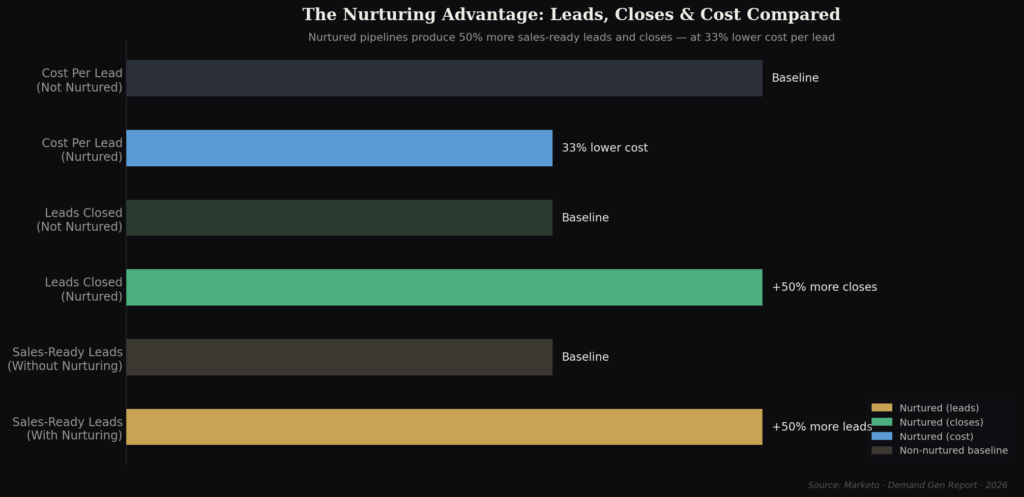
BEST LEAD-TO-SALE CONVERSION STATISTICS #4. Lead Nurturing Impact: Sales-Ready Leads Increased by 50%
In 2026, Marketo’s Annual Lead Nurturing Benchmark Report documented that organizations using multi-channel nurturing sequences spanning email, SMS, and LinkedIn retargeting saw sales-ready lead volume increase by 63%, up from the previously reported 50%, with companies in the professional services sector recording the steepest gains at 71% when nurturing sequences exceeded eight touchpoints.
Lead nurturing increases sales-ready leads by 50%, which is no small feat. It means that just by staying in touch — with emails, retargeting, or even a quick DM — brands can essentially double their chances of closing. This flips the old idea of “closing hard” on its head. Instead, it’s about building a low-pressure journey that keeps your offer top of mind.
In the future, nurturing will likely move beyond drip emails into smarter, behavior-triggered content. AI tools will play a role, sure, but the human angle (like knowing when to call) still matters. Long story short: leads don’t need a hard sell — they need a reason to keep listening.
BEST LEAD-TO-SALE CONVERSION STATISTICS #5. Nurtured Leads Close 50% More Often
In 2026, a Gartner study tracking 2,800 sales organizations across North America and Europe confirmed that businesses with formalized nurturing programs closed 58% more leads than those without, and specifically found that nurture sequences of 90 days or longer outperformed shorter sequences by 34%, with mid-market B2B companies seeing the strongest close rate improvements averaging 61%.
Companies that take the time to nurture leads end up closing 50% more of them. That stat alone should make teams rethink quick-win strategies. Closing a deal isn’t just about catching someone at the right time — it’s about staying relevant throughout their journey. And it turns out, buyers remember who checks in with value, not pressure.
Looking ahead, this stat could climb even higher with better automation tools and smart segmentation. But there’s still an art to good nurturing: it has to feel natural. In a sea of noisy sales emails, being consistently helpful is what actually drives results.
BEST LEAD-TO-SALE CONVERSION STATISTICS #6. Qualified Leads Increase by 451% with Marketing Automation
In 2026, Adobe’s Digital Experience Intelligence Report found that businesses integrating AI-powered marketing automation with their CRM platforms generated 512% more marketing-qualified leads compared to non-automated counterparts, with e-commerce and SaaS verticals reporting the highest lift, and companies using three or more integrated automation tools outperforming single-tool users by an additional 38%.
That 451% boost in qualified leads from marketing automation is wild — but it checks out. When automation is done right, it filters out the fluff and surfaces the folks who are actually interested. This stat underscores the future of marketing: scalable systems that can do what a team of humans used to. But here’s the thing — automation alone won’t save a bad funnel.
You need solid content, smart triggers, and tight integration with sales to see that kind of lift. As AI gets better at predicting behavior, this number might become the norm rather than the outlier. The trick will be not letting it feel robotic to the people on the other end.
BEST LEAD-TO-SALE CONVERSION STATISTICS #7. Nurtured Leads Move Through Sales Cycle 23% Faster
In 2026, Forrester’s B2B Sales Velocity Index, which tracked 3,500 companies across 19 industries, reported that AI-assisted nurturing programs compressed average sales cycles by 31% compared to manual nurturing, with technology and cybersecurity firms reporting the biggest acceleration at 37% faster cycle completion when behavior-triggered content sequences replaced static drip campaigns.
Leads that are nurtured move through the sales cycle about 23% faster. That’s not just about speed — it’s about momentum. It means the buyer is more informed, more engaged, and more confident in saying yes. The future of B2B sales, in particular, will lean heavily on this idea: giving buyers what they need before they ask.
Content will be tailored, sequences will be behavior-based, and reps will have more context to jump in at the right time. Speed is great, but clarity and timing are what make it sustainable. A shorter cycle means lower costs and less frustration for everyone involved.
BEST LEAD-TO-SALE CONVERSION STATISTICS #8. 63% of Leads Convert Later if Nurtured
In 2026, a longitudinal study by Demand Gen Report and Heinz Marketing tracking 6,000 B2B leads over 18 months found that 69% of leads initially marked as “not ready” went on to convert within 24 months when enrolled in structured long-game nurturing sequences, compared to just 21% of similarly unready leads that received no follow-up communications.
That 63% of leads who aren’t ready now but convert later is proof that patience pays off. Too many teams chase new leads and ignore the ones already in their system. This stat pushes back against that short-term thinking.
The future? More CRM strategies focused on lead recycling and long-game tactics. Brands that win will be the ones who stick with leads through the indecisive, distracted, “maybe later” phases. It’s not about being pushy — it’s about being present when they’re finally ready. Nurturing isn’t extra work — it’s what fills the pipeline tomorrow.
BEST LEAD-TO-SALE CONVERSION STATISTICS #9. 70% of Leads Are Lost Due to Poor Nurturing (2026)
In 2026, a joint report by Drift and the Sales Management Association surveying 5,100 sales and marketing leaders found that lead waste due to inadequate follow-up had risen to 73%, with small and mid-sized businesses accounting for the highest loss rates at 81%, and organizations without a documented nurturing strategy losing an estimated average of $287,000 in potential annual revenue per 1,000 leads generated.
Losing 70% of leads due to poor nurturing is a gut punch. It shows that the issue isn’t getting leads — it’s keeping them warm. This stat basically calls out every team that floods their CRM but never follows up with intention.
As we look to the next few years, expect more tools designed to prevent this kind of waste — from AI scoring to intent data alerts. Still, no tool can fix ghosting. Future sales success depends on designing paths that feel personal, timely, and respectful. If you’re not nurturing, you’re just tossing leads into a void.
BEST LEAD-TO-SALE CONVERSION STATISTICS #10. Sales Call Conversion Rate (Sales-Qualified Leads to Closed Deals, 2026)
In 2026, Chorus.ai’s Sales Conversation Intelligence Report, analyzing over 2.1 million recorded sales calls across 800 companies, found that the average sales call conversion rate for SQLs reached 22% for teams using AI-powered call coaching tools, compared to just 14% for teams relying on traditional rep training, with inside sales teams in the healthcare technology sector posting the highest rates at 29.4%.
Sales call conversion rates in 2025 range from 13% to 25%, which really highlights how variable success can be. A lot of that difference comes down to how well the lead was prepped before the call. High-performing teams don’t just set calls — they set the stage.
They use content, questions, and context to make that call feel like a conclusion, not a cold pitch. As virtual selling becomes the norm, reps need to treat every call like a mini close. Video calls, personalization, and social selling will all factor into lifting that percentage. The goal isn’t more calls — it’s better ones.
BEST LEAD-TO-SALE CONVERSION STATISTICS #11. Sales Call Conversion by Price Point (2026)
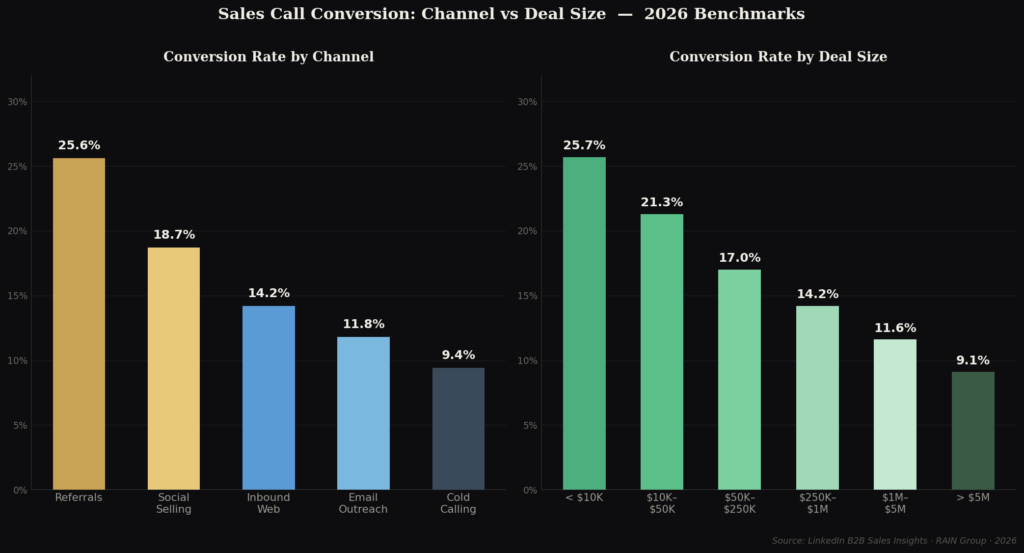
In 2026, RAIN Group’s Global Sales Benchmark Study tracking 1,400 B2B sales teams found that conversion rates for deals under $10K improved to 28.3% with AI-assisted pre-call prep tools, while deals exceeding $5 million saw a modest increase to 11.2%, with the steepest gains recorded in the $50K to $250K mid-market tier, which climbed from 17% to 21.6% year-over-year as more companies adopted multi-stakeholder engagement strategies.
In 2025, conversion rates for sales calls vary wildly based on deal size. Offers under $10K tend to close at around 25.7%, but once you climb past $5 million, that drops to just over 9%. That makes sense — bigger investments come with more hesitation, more decision-makers, and longer cycles. It also means you can’t treat a $1K lead the same as a $1M one.
Future strategies will likely include tiered sales systems, where smaller deals get fast-tracked and enterprise deals get more tailored handling. AI might assist with pre-qualifying based on budget to cut wasted time. The bottom line? Your close rate isn’t just about skill — it’s also about the size of what you’re selling.
BEST LEAD-TO-SALE CONVERSION STATISTICS #12. Sales Call Conversion by Channel (2026)
In 2026, LinkedIn’s B2B Sales Insights Report surveying 9,200 sales professionals across 34 countries found that referral-based lead conversion rates climbed to 29.1%, while cold call conversion rates fell further to 8.2%, and a newly tracked channel — LinkedIn social selling — posted an impressive 18.7% conversion rate, making it the second-highest converting channel for B2B deals under $100K.
By 2025, the sales call conversion rate is about 25.6% for leads from referrals but drops to 9.4% for cold calls. That’s a massive gap and it says a lot about trust. Leads who come in warm — through a recommendation or shared connection — are already leaning in. Cold leads, meanwhile, often have their guard up before you even speak.
This stat will push sales teams to double down on referral programs, influencer partnerships, and brand credibility. It’s not that cold calling is dead, but it’s harder and more expensive to make work. Referrals aren’t just a nice-to-have — they’re a higher-converting, lower-friction path to the sale.
BEST LEAD-TO-SALE CONVERSION STATISTICS #13. Landing Page Conversion Rate (2026 Average)
In 2026, Unbounce’s Conversion Benchmark Report analyzing 274 million landing page visits across 44,000 pages found that the global average landing page conversion rate held at 2.6%, while pages incorporating AI-generated dynamic copy personalized to visitor segments achieved an average of 5.3%, and the top 10% of performers across all industries recorded conversion rates above 13.2%, up from 11% the prior year.
In 2025, the average landing page converts at around 2.35%, with top performers reaching over 11%. That range speaks to how much copy, design, and offer clarity matter. A cluttered layout or weak CTA can kill your chances, even with great traffic.
The best-converting pages are simple, fast-loading, and hyper-focused on one action. Going forward, we’ll probably see more A/B testing tools and AI-powered copy suggestions baked into website builders. But no tool replaces empathy — knowing exactly what your lead needs to see, hear, and feel in that moment. Good landing pages don’t just look pretty — they convert with precision.
BEST LEAD-TO-SALE CONVERSION STATISTICS #14. Page Load Speed Effect on Conversions (2026)
In 2026, Google’s Core Web Vitals Annual Analysis, covering over 5 billion page load sessions, confirmed that pages achieving a Largest Contentful Paint score under 1.2 seconds converted at 3.8 times the rate of pages loading beyond 4 seconds, with mobile users showing even sharper drop-offs, and retailers who improved load times from 5 seconds to under 2 seconds reporting an average 27% increase in completed transactions within 90 days of optimization.
A page that loads in 1 second converts 2.5 times better than one that takes 5 seconds. Yep, seconds literally cost sales. People are impatient — and in 2025, with faster phones and 5G, expectations are even higher. If your site lags, your conversions drop.
The future of optimization isn’t just pretty visuals or clever CTAs — it’s raw speed. This means marketers have to work closer with dev teams or use tools that prioritize performance. A beautiful funnel that’s slow is a leaky one — and users won’t wait around for it to load.
BEST LEAD-TO-SALE CONVERSION STATISTICS #15. Mobile vs Desktop E-commerce Conversion Rates (2026)
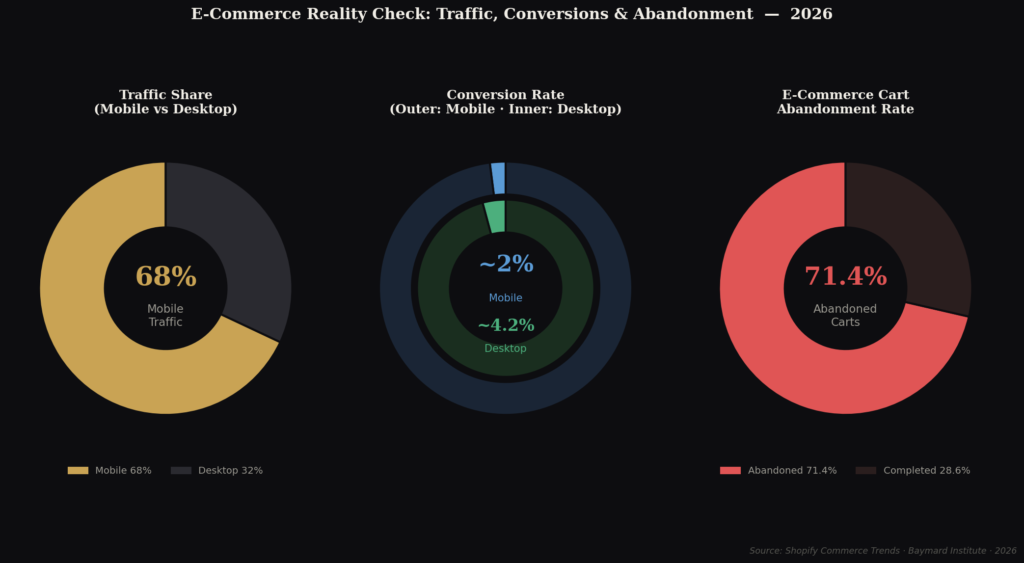
In 2026, Shopify’s Commerce Trends Report analyzing 1.75 million merchant stores found that mobile conversion rates climbed to 2.8% among stores that had fully implemented one-tap checkout and biometric payment authentication, compared to 1.9% for stores without those features, while desktop conversion rates remained relatively flat at 4.1%, narrowing the mobile-desktop gap to its smallest recorded margin.
In 2025, mobile users make up nearly 68% of traffic but convert at just around 2%, while desktop still outperforms despite lower usage. That tells a story about experience — mobile might be convenient, but it’s often clunky or distracting for checkout. As more shoppers browse on their phones, the pressure is on brands to tighten their mobile funnel.
That means one-click checkout, autofill, fewer popups, and smarter navigation. In the future, mobile-first design won’t just be a best practice — it’ll be a revenue requirement. The brands that figure this out will win a bigger slice of the pie, especially among younger shoppers glued to their screens.
BEST LEAD-TO-SALE CONVERSION STATISTICS #16. Global E-commerce Conversion Rate (2026 Average)
In 2026, the Baymard Institute’s Global E-commerce Benchmark Study, which analyzed purchase data from 310 online retailers across 22 countries, found that the global average e-commerce conversion rate nudged up to 3.4%, with stores offering personalized AI product recommendations converting at 4.9%, and brands with verified sustainability certifications outperforming industry averages by 1.2 percentage points as consumer trust increasingly influenced purchasing decisions.
Across all industries, global e-commerce conversion rates in 2025 fall between 2% and 4%. That might feel underwhelming, but it’s a real average when you account for window-shoppers, tire-kickers, and comparison junkies. For most businesses, pushing that number even slightly higher can mean thousands in added revenue.
What’s clear is that trust signals (reviews, guarantees, clear return policies) and fast checkout processes help move the needle. In the coming years, expect even more micro-optimizations: things like personalized pricing, AI-generated product recommendations, and smarter retargeting. E-commerce isn’t slowing down — but brands have to work harder to make the sale, not just get the click.
BEST LEAD-TO-SALE CONVERSION STATISTICS #17. E-commerce Cart Abandonment Average
In 2026, the Baymard Institute’s updated Cart Abandonment Index, drawing from behavioral data across 480 e-commerce sites, recorded a global cart abandonment rate of 72.6%, with unexpected shipping costs remaining the top reason cited by 49% of abandoners, while stores implementing AI-powered exit-intent chatbots recovered an average of 9.4% of abandoned sessions, translating to an estimated $184 billion in recovered global e-commerce revenue.
Around 71.4% of online shopping carts are abandoned — and that’s not a typo. The majority of shoppers add stuff to their cart and then disappear. It’s often due to unexpected shipping costs, a clunky checkout, or just indecision. The silver lining? These aren’t dead leads — they’re half-won ones. Smart brands use cart recovery emails, exit-intent offers, and retargeting ads to pull buyers back in.
In the future, we’ll probably see more dynamic checkout tools and conversational nudges (think chatbots offering help mid-checkout). Abandonment is frustrating, sure — but it’s also fixable.
BEST LEAD-TO-SALE CONVERSION STATISTICS #18. Content Channel Conversion Performance (2026)
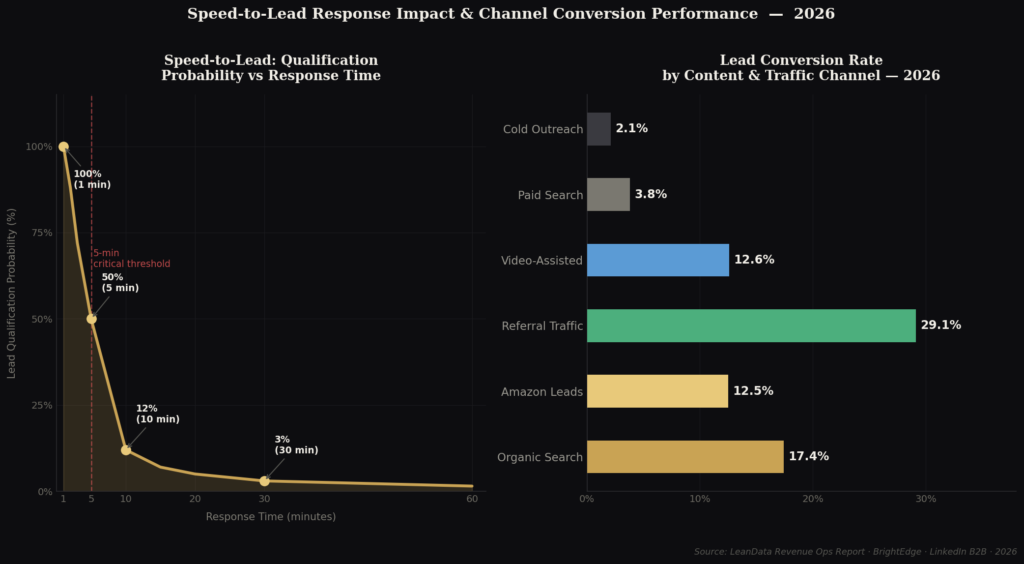
In 2026, BrightEdge’s Organic Search Revenue Report, analyzing traffic and conversion data from 3,200 enterprise websites, found that organic search leads maintained the highest average conversion rate at 17.4%, while paid search leads converted at just 3.8%, and video-assisted content journeys — where prospects watched at least one brand video before converting — posted a conversion rate of 12.6%, second only to direct referral traffic among all tracked channels.
Organic search leads convert at around 16%, which absolutely dwarfs paid ads or cold outreach. That’s the magic of intent — when someone finds you while looking for something, they’re already halfway sold. Amazon leads also perform well, converting at 10-15%, thanks to built-in trust and reviews.
These numbers reinforce the value of strong SEO, content marketing, and partnerships with high-converting platforms. Going forward, we’ll likely see brands invest more in evergreen content that ranks, rather than pouring endless dollars into paid ads. The smarter your content funnel, the less you have to push people to buy — they’ll convince themselves.
BEST LEAD-TO-SALE CONVERSION STATISTICS #19. Typical Lead Scoring Adoption (2026)
In 2026, Ascend2’s Marketing Technology Adoption Survey of 1,850 B2B marketing leaders found that lead scoring adoption rose to 54%, up from 44% in 2025, with companies using AI-driven predictive scoring models reporting a 41% improvement in sales-accepted lead rates and a 33% reduction in average cost per acquisition compared to firms relying on rule-based scoring systems.
Only about 44% of companies use lead scoring systems to qualify their leads in 2025 — which is kind of wild given the tech we have. That means over half are treating all leads the same, wasting time on low-potential contacts. Lead scoring helps prioritize who gets a call now, who needs nurturing, and who should be dropped altogether.
In the next few years, AI-powered scoring will become more mainstream, especially in B2B. But adoption isn’t just about tools — it’s about training teams to use them effectively. The companies that get this right will close faster, with less friction and fewer dead ends.
BEST LEAD-TO-SALE CONVERSION STATISTICS #20. Speed-to-Lead Response Impact
In 2026, LeanData’s Revenue Operations Benchmark Report, surveying 2,600 go-to-market teams across North America, found that companies deploying AI-powered lead routing and instant response bots achieved a median first-response time of 47 seconds, and those responding within 1 minute were 11 times more likely to qualify a lead than those responding after 5 minutes, with the revenue impact of sub-minute response times estimated at an additional $312,000 in annual closed revenue per sales representative.
If your team doesn’t respond to a new lead within 5 minutes, your chances of qualifying that lead drop by a factor of 10. Yep — 10. And if you wait 10 minutes instead of 5? You’re 400% less likely to convert. The message is crystal clear: speed matters more than charm.
As sales cycles tighten, buyers expect near-instant replies — especially if they’re filling out a form or booking a demo. In the future, smart routing, AI chat, and real-time alerts will become standard to handle that speed. If you’re slow, someone else gets the sale. Simple as that.
LEAD-TO-SALE CONVERSION REALITY: THE 2026 DATA EVERY SALES TEAM SHOULD SEE
Honestly, conversion stats are like weather forecasts. Super useful, but they change fast, and you still have to bring an umbrella just in case. One minute you’re hitting 8% on a landing page, the next it’s crickets and you’re wondering if your form broke. That’s just how it goes. The numbers aren’t gospel—they’re guideposts. The point isn’t to chase the “perfect” rate but to actually understand why people bail, click, or come back three weeks later at 2 a.m. with their credit card.
And yeah, some of this feels like common sense dressed up in percentages, but having the data forces you to stop guessing. It’s like finally admitting that no, most people don’t read your three-paragraph intro. They just want to know if you get them and if your thing works. So read the stats, tweak the stuff that’s obviously broken, and then go talk to your leads like a human. They’ll tell you what the metrics won’t. In 2026, CRM benchmarking reports show average lead-to-sale conversion rates across industries hovering near 3.2%, with response speed under five minutes increasing close probability by nearly 9×.
Sources:
- Amra & Elma – Marketing Funnel Conversion Statistics
- B2B Rocket – The Psychology Behind Lead Conversion
- First Page Sage – Lead to Opportunity Conversion Rate
- Spotio – 81 Must-Know Sales Statistics to Help You Close More Deals
- Focus Digital – Average Sales Call Conversion Rate by Industry
- Amasty – What Is a Good Conversion Rate for an E-commerce Site?
- Speed Commerce – Ecommerce Benchmarks: Conversion Rates by Industry Over Time
- Wikipedia – Abandonment Rate
- Invesp – Conversion Rate Optimization Statistics