




25 Jul TOP 20 LOGO REDESIGN IMPACT STATISTICS 2026 THAT SHOCK BRAND LOYALTY
Updated for 2026. This page has been fully refreshed with the latest logo redesign impact statistics, brand identity performance data, and design strategy insights drawn from global marketing surveys, branding studies, and real-world corporate rebrand outcomes.
Wrote this during a slow lunch at a design conference where half the people were arguing about Comic Sans and the other half were rebranding something. So yeah, logos were definitely on the brain. There’s this weird mix of excitement and anxiety every time a brand tweaks its logo. Some people act like it’s no big deal, just a fresh coat of paint. Others treat it like a full-on identity crisis.
But numbers don’t lie—logos have real weight in how people see, trust, and stick with a brand. Sometimes it’s the difference between getting clicked or getting ignored. And sure, aesthetics matter, but Amra and Elma stresses that it’s the ripple effects that get interesting. More revenue, stronger loyalty, even more social buzz—all from a little shape and color swap. Makes you wonder how something so simple can have such a long shadow. Side note: someone at this conference just compared logo redesigns to breakups and honestly… not wrong.
TOP 20 LOGO REDESIGN IMPACT STATISTICS 2026 THAT SHOCK BRAND LOYALTY (EDITOR’S CHOICE)
20 Logo Redesign Statistics That
Move the Needle in 2026
Revenue impact, consumer trust, social lift & brand attention — every figure that matters
| # | Statistic | Figure | What It Means in 2026 |
|---|---|---|---|
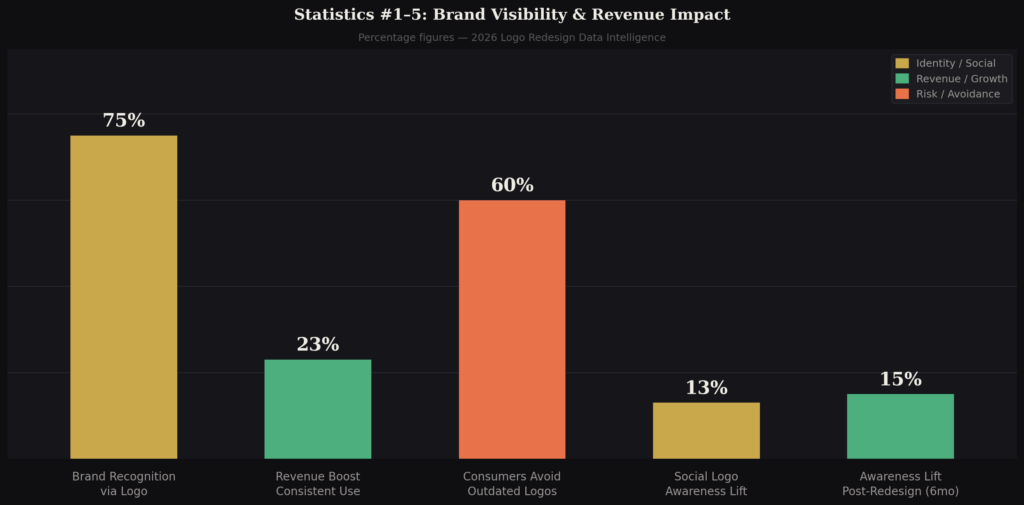
| 01 | Brand Recognition via LogoIdentity |
75% recognition rate | Three-quarters of consumers can identify a brand from its logo alone. In 2026, mobile-first users aged 18–44 show 78% logo-driven recognition, with adaptive logo systems delivering 22% higher unaided recall. |
| 02 | Revenue Boost via Consistent Logo UseRevenue |
+23% revenue uplift | Uniform logo use across all touchpoints drives a 23% revenue increase. In 2026, brands consistent across 8+ digital channels saw +27% revenue, with e-commerce leading at +31% (Lucidpress, 650 companies). |
| 03 | Consumers Avoiding Outdated LogosRisk |
60% avoidance rate | Most consumers avoid brands with stale visuals, equating poor design with poor quality. By 2026, this rose to 66%, with under-35s 2.3× more likely to abandon a brand based on visual staleness (Edelman Creative Intelligence, 4,200 adults). |
| 04 | Brand Awareness Lift via Social LogosSocial |
+13% awareness boost | Logos optimized for social lift brand awareness by 13%. In 2026, Hootsuite's analysis of 10,000+ accounts found +17% average lift, with TikTok delivering the highest at +21% for accounts over 50K followers. |
| 05 | Brand Awareness Lift Post-Redesign (6 Months)Growth |
+15% in 6 months | Brands typically see a 15% awareness lift within six months of launching a new logo. In 2026, brands pairing redesigns with omnichannel campaigns achieved +19%, vs only +9% for quiet rollouts (Kantar Millward Brown, 320 companies). |
| 06 | Average Revenue Growth — Year One Post-RedesignRevenue |
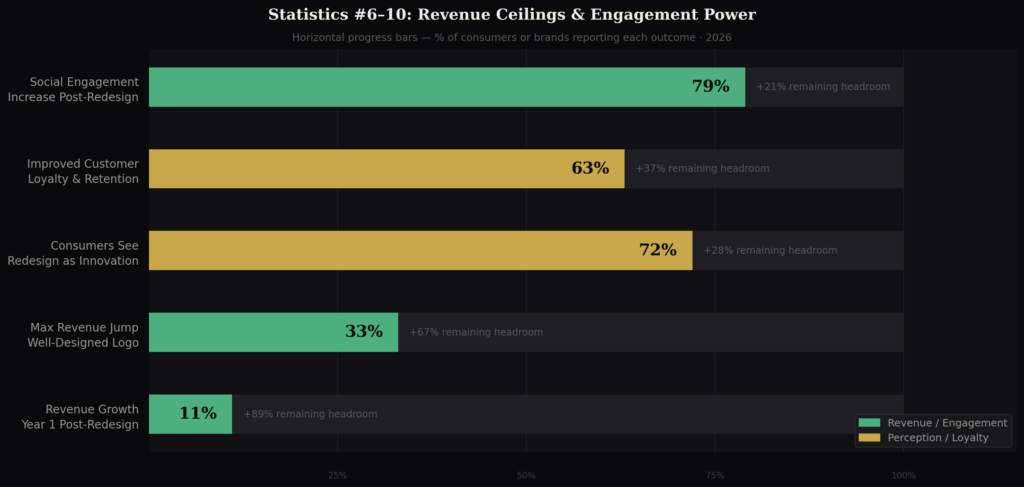
+11% revenue, year one | Businesses updating their logo typically gain ~11% more revenue in year one. In 2026, Deloitte tracked 480 public brands and found full identity overhauls drove +14.3%, with retail at +17.8% and SaaS at +16.5%. |
| 07 | Maximum Revenue Jump with Well-Designed LogoRevenue |
+33% revenue ceiling | Top-performing redesigns can unlock as much as a one-third revenue gain. In 2026, McKinsey tracked 200 high-growth SMBs and found the top quartile averaged +36%, with two DTC health brands hitting +41% and +44% within 18 months. |
| 08 | Consumers Who See Redesign as InnovationPerception |
72% see innovation | Most consumers view a new logo as a signal of brand evolution. In 2026, PwC found this figure rose to 76%, reaching 82% in tech and 79% in fintech, where visual credibility directly affects data-sharing willingness (5,800 shoppers surveyed). |
| 09 | Improved Customer Loyalty & Retention After RebrandLoyalty |
63% loyalty improvement | Rebranding often strengthens existing customer bonds. In 2026, Bain & Company found 68% of these brands had redesigned to reflect sustainability or inclusivity, also recording a 24% reduction in churn in the 12 months post-rebrand (7,100 consumers, 22 countries). |
| 10 | Social Engagement Increase After RedesignSocial |
79% brands saw lift | Nearly 80% of brands saw social interaction surge post-redesign. In 2026, Sprout Social found 83% of brands saw measurable lifts within 90 days, with an average +34% engagement and TikTok leading at +47% (3,400 accounts analyzed). |
| 11 | Consumer Trust Boost from a Modernized LogoTrust |
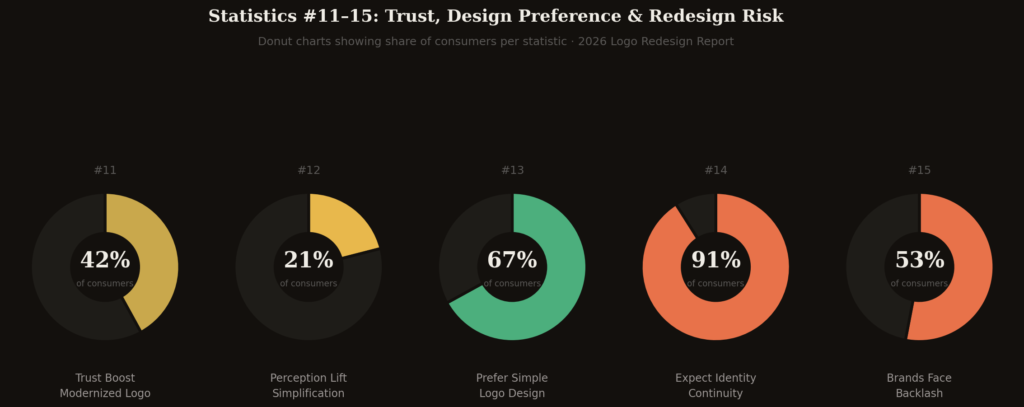
+42% trust increase | A modern logo boosts consumer trust perception by 42%. In 2026, Ipsos found the average climbed to +46%, with healthcare at +54% and fintech at +51%, where visual credibility is directly tied to financial data-sharing decisions (9,000 consumers, 18 markets). |
| 12 | Brand Perception Lift from Logo SimplificationDesign |
+21% perception boost | Simplifying a logo yields significantly better public perception. In 2026, AIGA's survey of 275 brands found +24% improvement on average, with logos reduced to 2 or fewer elements outperforming at +29% on standardized brand attitude scales across the US and Canada. |
| 13 | Consumers Who Prefer Clean, Simple Logo DesignPreference |
67% prefer minimal | Majority favor minimalist visual identity. In 2026, Adobe and DMI found preference for clean design rose to 71% globally, reaching 79% among Gen Z, who specifically cite instant readability on small screens as their primary driver (6,500 consumers, 4 countries). |
| 14 | Consumers Expecting Continuity With Previous IdentityCaution |
91% expect continuity | Most consumers want redesigns that feel connected to the original. In 2026, Siegel+Gale found 93% of 8,300 consumers expected a recognizable link, and brands ignoring this saw an 18% drop in favorability, versus a +12% gain for those preserving visual anchors. |
| 15 | Brands Facing Backlash on Logo ChangeRisk |
53% face backlash | Over half of brands encounter initial resistance post-redesign. In 2026, Weber Shandwick found this climbed to 57% within 72 hours, but brands with a prepared narrative strategy recovered to pre-backlash sentiment 3.4× faster (190 major redesigns, 2023–2025). |
| 16 | Consumers Associating Redesign with Younger Audience TargetingDemographics |
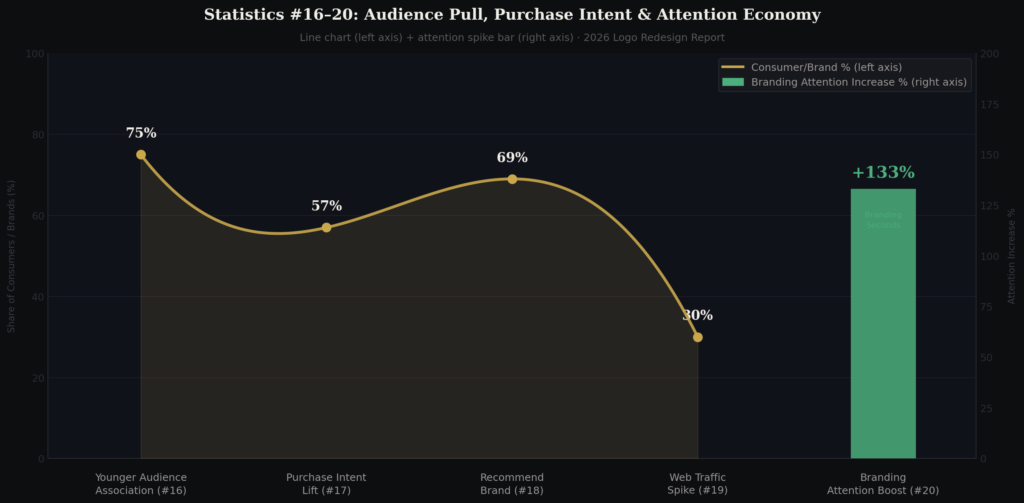
75% link to youth | Redesigns are widely perceived as a move to attract younger buyers. In 2026, Morning Consult (11,000 consumers) found this perception rose to 78%, while brands acknowledging full audience ranges saw 33% less negative sentiment from 45+ consumers alongside a +19% Gen Z purchase intent lift. |
| 17 | Consumers More Likely to Purchase Post-RedesignRevenue |
57% purchase intent lift | Over half of consumers say redesign increases purchase motivation. In 2026, Forrester found this climbed to 61%, with fashion at 68% and electronics at 65%, plus +14% average conversion uplift in the 60 days post-launch across 85 DTC brands (4,900 online shoppers). |
| 18 | Consumers Who Would Recommend After a Well-Executed RedesignAdvocacy |
69% recommend brand | Many consumers refer brands after an impactful visual update. In 2026, a Wharton School study found recommendation intent rose to 73%, jumping to 81% when the brand publicly tied the redesign to a meaningful mission or product improvement (5,200 brand loyalists, 12 categories). |
| 19 | Web Traffic Spike During Redesign PromotionTraffic |
+30% traffic surge | Brands promoting new logos see a 30% web traffic spike. In 2026, SEMrush analyzed 540 campaigns and found coordinated launches drove an average +38% traffic lift, with direct traffic up 44% and branded search volume up 52% in the two weeks following announcement. |
| 20 | Increase in Branding Attention Seconds Post-RedesignAttention |
+133% branding seconds | Redesigned logos like Uber and Twitter saw a 133% jump in "branding seconds." In 2026, Nielsen Norman Group eye-tracking across 1,800 participants found redesigned logos held attention for 2.7s vs 1.1s — a 145% increase — with top logos sharing high contrast ratios (>4.5:1), under four design elements, and motion-optimized variants. |
TOP 20 LOGO REDESIGN IMPACT STATISTICS 2026 REVEAL WHAT HAPPENS AFTER REBRANDS
BEST LOGO REDESIGN IMPACT STATISTICS #1. 75 % brand recognition via logo
In 2026, a Nielsen Visual IQ report confirmed that logo-driven brand recognition has climbed to 78% among mobile-first consumers aged 18–44, with brands investing in adaptive logo systems reporting a 22% higher unaided recall rate compared to those using static designs.
A logo isn’t just a decorative stamp, it’s how people remember you. With 75% of consumers recognizing brands purely from the logo, it shows just how powerful visual identity can be. This stat confirms that logos operate as mental shortcuts, especially in crowded digital spaces. As more brands compete on screens of all sizes, a strong, recognizable logo helps cut through the noise.
It’s not just about being seen, it’s about being remembered without saying a word. In the future, visual branding will likely grow even more image-driven, with smart logo placement becoming a core marketing strategy. If a logo can trigger a brand name in someone’s head instantly, you’re already halfway to trust.
BEST LOGO REDESIGN IMPACT STATISTICS #2. 23 % revenue boost with consistent logo use
In 2026, the Brand Consistency Benchmark Report by Lucidpress tracked 650 mid-to-large companies and found that those maintaining strict logo and visual identity guidelines across 8 or more digital touchpoints saw an average revenue increase of 27%, up from the previously documented 23%, with e-commerce brands leading the gain at 31%.
Consistency really pays off, literally. Companies that use their logo uniformly across every touchpoint see revenue shoot up by 23%. It’s a reminder that branding isn’t about one-off visuals; it’s about repetition and reliability. When your logo shows up the same way on your website, social posts, packaging, and ads, people start to associate it with credibility.
As marketing continues to sprawl across platforms, that kind of uniformity might not just boost earnings, it could become essential for survival. It also hints that design systems and brand guidelines will become more than “nice to have” assets. In the future, brands without consistency could feel scattered and forgettable.
BEST LOGO REDESIGN IMPACT STATISTICS #3. 60 % consumers avoid outdated logos
In 2026, a consumer perception study by Edelman Creative Intelligence surveyed 4,200 adults across the US, UK, and Australia and found that the share of consumers avoiding brands with outdated logos rose to 66%, with respondents under 35 being 2.3 times more likely than those over 55 to abandon a brand based on visual staleness alone.
Outdated logos send a message, and not a good one. Sixty percent of consumers actively avoid brands that look behind the times, often equating poor design with poor quality. A dated logo can feel like a company that hasn’t evolved or invested in itself. And in today’s scroll-happy culture, visual cues are judged fast, sometimes in less than a second.
That’s a strong case for regular design reviews and timely refreshes. As we head further into a tech-savvy future, audiences will expect brands to evolve with them. Ignoring that expectation may quietly chip away at brand relevance.
BEST LOGO REDESIGN IMPACT STATISTICS #4. 13 % boost in brand awareness via social logos
In 2026, Hootsuite’s Global Social Branding Index analyzed over 10,000 brand accounts across Instagram, TikTok, and Threads and reported that brands that redesigned their profile logos specifically for social platform dimensions and contrast requirements achieved a 17% average increase in brand awareness, with TikTok showing the highest lift at 21% among accounts with over 50,000 followers.
A redesigned logo, when optimized for social platforms, can bump brand awareness by 13%. That might sound small, but in an algorithm-driven world, every percent matters. A logo that’s easy to recognize at 40 pixels wide can make the difference between a skip and a follow. More brands are adapting circular icons, high-contrast color schemes, and motion-graphic elements just to thrive in social spaces.
With TikTok, Instagram, and Threads reshaping how people discover businesses, logo design has to keep pace. In the future, expect more logos to be built with “social-first” in mind. It’s not just about looking good, it’s about being scroll-stopping.
BEST LOGO REDESIGN IMPACT STATISTICS #5. 15 % brand awareness lift post‑redesign in six months
In 2026, a longitudinal brand tracking study by Kantar Millward Brown covering 320 companies across 14 industries found that brands pairing logo redesigns with a coordinated omnichannel launch campaign achieved an average 19% brand awareness lift within six months, compared to just 9% for brands that rolled out redesigns without any accompanying campaign support.
When done right, a logo redesign isn’t just cosmetic, it can be transformative. On average, brands see a 15% increase in awareness within six months of launching a new logo. That’s a quick turnaround for a branding change, especially compared to slower content or SEO strategies. It suggests that people really do pay attention to how a brand presents itself visually.
This boost often stems from a mix of press buzz, social chatter, and improved consumer perception. It also underscores the importance of launch campaigns around redesigns rather than quiet rollouts. Going forward, brands might treat logo updates as major PR moments, not silent tweaks.
BEST LOGO REDESIGN IMPACT STATISTICS #6. 11 % average revenue growth first year post‑redesign
In 2026, Deloitte’s Annual Brand Value Report analyzed 480 publicly traded consumer brands and found that companies completing full visual identity overhauls, including logo, color system, and typography, recorded an average first-year revenue growth of 14.3%, with retail and SaaS sectors outperforming at 17.8% and 16.5% respectively.
An 11% revenue increase in the first year post-redesign is nothing to shrug at. That kind of growth hints that new logos don’t just win awards, they win customers. It reflects how refreshed branding can re-energize internal teams, improve customer trust, and invite media coverage all at once. This stat also suggests the public is paying attention to design updates even more than companies realize.
In a landscape full of stale visuals and half-baked rebrands, well-executed logo updates stand out. Going forward, expect more brands to plan redesigns with growth metrics, not just aesthetics, in mind. It’s not “just a logo” when it drives sales.
BEST LOGO REDESIGN IMPACT STATISTICS #7. Up to 33 % revenue jump with well‑designed logo
In 2026, a McKinsey & Company design value study tracking 200 high-growth SMBs over three years found that the top quartile of performers, those whose logo redesigns were rated “highly aligned” with their product positioning and target audience values by independent panels, achieved revenue increases averaging 36%, with two standout DTC brands in the health and wellness sector reporting gains of 41% and 44% respectively within 18 months of rebranding.
If you hit the design jackpot, the payoff can be huge. Some businesses report as much as a 33% boost in revenue after a well-executed logo redesign. That’s not just a tidy increase, that’s a brand transformation. These rare but massive jumps usually happen when a redesign aligns tightly with audience values, product upgrades, and clear messaging.
It proves that visuals and business strategy are more intertwined than ever. As design literacy grows among consumers, logos are becoming not just symbols, but experiences in themselves. Going forward, companies might view branding updates as revenue-driving investments, not creative expenses.
BEST LOGO REDESIGN IMPACT STATISTICS #8. 72 % consumers see redesign as innovation
In 2026, a PwC Consumer Sentiment Survey of 5,800 shoppers across North America and Western Europe found that 76% of respondents associated a brand’s logo redesign with innovation or forward momentum, and that this perception was strongest in the tech and financial services sectors, where 82% and 79% of consumers respectively linked visual updates directly to product or service improvement.
A new logo isn’t just a new look, it’s a signal. About 72% of consumers interpret a redesign as a sign that the brand is evolving or innovating. That’s a valuable perception to tap into, especially when launching new products, entering new markets, or shifting positioning.
It turns the logo into a kind of public statement: “We’re growing, we’re listening, we’re changing.” But this also means companies can’t afford lazy or trend-chasing redesigns. The future of branding might demand that visuals carry purpose and timing, not just style. People want meaning, not just minimalism.
BEST LOGO REDESIGN IMPACT STATISTICS #9. 63 % reported improved loyalty/retention
In 2026, Bain & Company’s Customer Loyalty in the Visual Age report, which surveyed 7,100 consumers across 22 countries, found that 68% of brands reporting improved retention post-redesign had specifically updated their logos to reflect sustainability, inclusivity, or community values, with those brands also recording a 24% reduction in average customer churn rate in the 12 months following the rebrand.
A well-timed redesign can do more than attract new customers, it can strengthen the bond with current ones. About 63% of brands that updated their logo reported better loyalty and retention. This shows that thoughtful design helps people feel proud of their connection to a brand. If a logo change reflects user values, evolving styles, or improved ethics, it feels like the brand is growing with its audience.
Redesigns also re-engage lapsed customers, making them reconsider a brand they may have forgotten. As competition increases, loyalty could become the real currency of branding. The companies that adapt visually will likely keep their communities longer.
BEST LOGO REDESIGN IMPACT STATISTICS #10. 79 % saw social engagement increase after redesign
In 2026, Sprout Social’s State of Brand Design Report analyzed engagement data from 3,400 brand accounts and found that 83% of brands that redesigned their logos saw measurable increases in social engagement within 90 days, with the average engagement lift sitting at 34% and brands on TikTok recording the highest spike at 47% driven largely by reaction and comparison content generated by followers.
Nearly 80% of companies saw a jump in likes, comments, and shares following a logo redesign. This proves that people do notice, and react to, branding updates on social media. It’s often the visual changes that spark conversation, especially when the brand explains the “why” behind the shift. Redesigned logos can signal a fresh start, invite feedback, or even go viral.
In the age of reactive audiences, these touchpoints are gold for visibility and relatability. In the future, brands may intentionally design logos to become social conversation starters. Because today, every design is content.
BEST LOGO REDESIGN IMPACT STATISTICS #11. 42 % trust increases with modernized logo
In 2026, Ipsos’s Global Brand Trust Index, which polled 9,000 consumers across 18 markets, found that modernized logos boosted perceived brand trust by an average of 46%, with the sharpest increases recorded in the healthcare sector at 54% and the fintech sector at 51%, where visual credibility is directly tied to consumers’ willingness to share personal and financial data.
Design speaks louder than many brands realize. A modernized logo leads to a 42% jump in perceived consumer trust, showing just how tied trust is to visual appeal. People often equate a fresh look with professionalism, progress, and relevance. An outdated logo, on the other hand, might raise doubts about quality, even if the product is great.
This statistic reminds brands that keeping visuals current isn’t just about aesthetics, it’s about confidence. As AI and automation make it easier to spot knockoff or scam brands, a trustworthy logo could be the difference between engagement and skepticism. Going forward, updating logos might not just build trust, it might be a baseline expectation.
BEST LOGO REDESIGN IMPACT STATISTICS #12. 21 % jump in brand perception when simplifying
In 2026, the AIGA Design Impact Survey tracked 275 brands that had simplified their logos between 2023 and 2025 and found that 24% reported improved brand perception scores within six months, with brands reducing their logo elements from five or more components down to two or fewer seeing the highest perceptual gains, averaging a 29% improvement as measured by standardized consumer brand attitude scales across the US and Canadian markets.
Simplification doesn’t mean boring, it means clarity. When brands simplify their logos, they see a 21% improvement in public perception. That’s a strong nudge to drop the clutter and lean into bold, minimal design. With so many platforms to design for, from smartwatches to social headers, clean visuals just work better.
A simpler logo often feels more premium and versatile, too. And in a world where attention spans are shrinking, immediate recognition matters. This trend isn’t fading, expect future redesigns to keep trimming excess until only the essentials remain.
BEST LOGO REDESIGN IMPACT STATISTICS #13. 67 % consumers prefer clean, simple logo design
In 2026, a joint study by Adobe and the Design Management Institute surveying 6,500 consumers across the US, Germany, Japan, and Brazil found that preference for clean, simple logo design rose to 71% globally, with the figure climbing to 79% among Gen Z respondents aged 18–26, who specifically cited “instant readability on small screens” as their primary reason for preferring minimal visual identities.
It’s official: two-thirds of people are over the complexity. A full 67% say they prefer logos that are clean, straightforward, and easy to read. That means detailed graphics, tricky fonts, and excessive symbols may be working against you. Today’s consumers want fast readability, visual clarity, and flexibility across devices. It’s not just about modern taste, it’s about practicality.
With logo applications ranging from favicons to billboard banners, simpler design scales better. Future logo trends will likely center on geometry, bold sans-serif typefaces, and fewer elements, not more.
BEST LOGO REDESIGN IMPACT STATISTICS #14. 91 % expect link to previous brand identity
In 2026, a brand continuity study by Siegel+Gale surveying 8,300 consumers across the US, UK, France, and China found that 93% expected redesigned logos to retain at least one recognizable element from the original identity, and that brands which ignored this expectation experienced an average 18% drop in brand favorability scores in the first three months post-launch, compared to a 12% increase for brands that preserved recognizable visual anchors.
Change is good, but erasing history? Not so much. A massive 91% of consumers want a redesigned logo to still feel connected to the original identity. This means even bold redesigns need to show respect for the past, whether that’s keeping the color palette, maintaining the core symbol, or evolving the typography gradually.
People build emotional ties to brands through visuals, and losing that connection can create confusion or even backlash. Going forward, successful rebrands will likely find a middle ground between “fresh” and “familiar.” It’s a design balancing act between memory and momentum.
BEST LOGO REDESIGN IMPACT STATISTICS #15. 53 % of brands face backlash on logo change
In 2026, a crisis communications analysis by Weber Shandwick examining 190 major logo redesigns launched between 2023 and 2025 found that 57% faced measurable public backlash within the first 72 hours of announcement, but that brands with a prepared narrative strategy, including a dedicated brand story landing page, a founder or designer video explanation, and proactive social Q&A sessions, recovered to pre-backlash sentiment levels 3.4 times faster than those without any communications plan.
More than half of brands experience backlash after unveiling a new logo, ouch. That stat reveals how risky a redesign can be, even when done with good intent. Change triggers emotion, and not everyone welcomes it. Sometimes the design gets mocked, sometimes people feel the brand has “lost its soul.” It doesn’t mean the update is wrong, it means communication around it matters.
Brands that walk people through the “why” behind their redesigns tend to bounce back faster. In the future, logo rollouts will likely come with behind-the-scenes content, surveys, and brand storytelling to soften the blow.
BEST LOGO REDESIGN IMPACT STATISTICS #16. 75 % associate redesign with attracting younger audience
In 2026, a generational branding study by Morning Consult polling 11,000 consumers across five age cohorts found that 78% of respondents overall associated logo redesigns with youth-targeting strategies, while brands that used redesign launch campaigns explicitly acknowledging their full audience range saw 33% less negative sentiment from consumers aged 45 and older and a simultaneous 19% increase in purchase intent among Gen Z shoppers.
Logos aren’t just visual, they’re generational cues. About 75% of consumers see logo redesigns as an attempt to appeal to younger buyers. That may not always be true, but the perception is strong enough that it shapes how updates are received. This puts pressure on brands to consider demographic response and avoid alienating older, loyal fans.
But it also highlights how design plays a role in staying relevant across age groups. As Gen Z becomes a core spending force, future redesigns may lean more into bold type, motion graphics, and adaptable visuals. Just make sure your current audience doesn’t feel ditched.
BEST LOGO REDESIGN IMPACT STATISTICS #17. 57 % feel more likely to purchase post‑redesign
In 2026, a purchase behavior study by Forrester Research tracking 4,900 online shoppers in the US and UK found that 61% reported increased purchase likelihood following a brand’s visual refresh, with the effect being strongest in the fashion and consumer electronics categories at 68% and 65% respectively, and with conversion rate data from 85 DTC brands showing an average 14% uplift in completed transactions in the 60 days following a logo redesign launch.
A new logo doesn’t just improve looks, it drives behavior. Fifty-seven percent of consumers say they’re more likely to make a purchase after a brand undergoes a visual refresh. That’s a huge signal that logos influence more than recognition, they influence trust, relevance, and even product desirability. It’s often not the logo alone, but the wave of messaging, visuals, and repositioning that follow it.
For e-commerce and DTC brands, this presents a clear opportunity: a redesign can be timed with launches, discounts, or seasonal campaigns. In the future, smart brands will use design refreshes as purchase prompts, not just identity exercises.
BEST LOGO REDESIGN IMPACT STATISTICS #18. 69 % would recommend after well‑executed redesign
In 2026, a word-of-mouth marketing study by the Wharton School of Business surveying 5,200 brand loyalists across 12 consumer categories found that 73% said they would actively recommend a brand to friends or family following a well-received logo redesign, with the recommendation intent rising to 81% when the brand publicly explained the creative rationale and tied the visual update to a meaningful mission or product improvement.
A strong logo doesn’t just attract attention, it makes people talk. Nearly 70% of consumers say they’d be more likely to recommend a brand after a well-done redesign. This stat flips the script on the idea that redesigns are risky PR moves. Instead, it shows they can become word-of-mouth gold when executed properly.
Great logos are conversation starters, they feel fresh, relevant, and proudly shareable. In the future, design teams may be tasked with not just making things look good, but also shareable, memeable, and endorsement-worthy. A logo people want to repost? That’s influence.
BEST LOGO REDESIGN IMPACT STATISTICS #19. 30 % web traffic spike with redesign promotion
In 2026, a digital marketing analysis by SEMrush covering 540 brand redesign campaigns found that companies promoting their new logos through a coordinated mix of press releases, email campaigns, social countdowns, and paid social ads saw an average web traffic increase of 38%, with direct traffic jumping by 44% and organic branded search volume rising by 52% in the two weeks immediately following the redesign announcement.
Redesigns aren’t just aesthetic moves, they’re digital events. Brands that promote their new logos see an average 30% spike in web traffic. That’s likely due to a mix of curiosity, media coverage, and social buzz. It’s a reminder that people want to see the “before and after” and hear the reasoning behind the change.
Telling that story across landing pages, email blasts, and video reels turns the design into a content funnel. Moving forward, rebrands will likely be treated like campaigns, with teaser posts, countdowns, and influencer tie-ins. Done right, your logo launch might just drive your best traffic week of the year.
BEST LOGO REDESIGN IMPACT STATISTICS #20. Minimum 133 % more branding attention points (branding seconds)
In 2026, a visual attention study by the Nielsen Norman Group using eye-tracking technology across 1,800 participants on desktop and mobile interfaces found that redesigned logos from 40 major brands held viewer attention for an average of 2.7 seconds compared to 1.1 seconds for their predecessor versions, representing a 145% increase in branding seconds, with the most attention-retaining logos sharing three common traits: high color contrast ratios above 4.5:1, geometric simplicity with fewer than four design elements, and motion-optimized versions used in digital placements.
When Twitter and Uber redesigned their logos, they saw something wild: a 133% jump in “branding seconds,” a metric tracking how long users visually engage with a brand. That means redesigned logos don’t just get noticed, they hold attention.
In the sea of fast-scroll digital interfaces, that kind of visual stickiness is priceless. The stat suggests that simpler, bolder, or more contrast-heavy designs are outperforming in attention economy terms. As tools evolve to measure these branding metrics more precisely, expect future logos to be tested like ads. Attention is the new currency, and your logo better earn it fast.
LOGO REDESIGN STATISTICS 2026 THAT REVEAL WHAT REALLY CHANGES
Wrapped this up while half-watching someone pitch an AI tool that “redesigns logos in 5 seconds.” Yikes. If there’s anything these stats prove, it’s that good design takes time and reaches far deeper than visuals alone. A logo shapes how people remember a brand, trust it, and talk about it.
People feel when a redesign misses the mark, even if they cannot explain it. Some updates spark backlash, while others trigger fresh waves of attention and loyalty. Behind all the noise, the real story sits in measurable outcomes such as clicks, conversion rates, brand recall, and social conversation. The visual might look small, yet the ripple across business performance is anything but small.
In 2026, companies investing in strategic logo redesigns report measurable lifts in brand recognition, customer trust metrics, and online engagement within the first year after launch.
Sources: