




13 Sep TOP 20 MARKETING AI ETHICS STATISTICS 2026 REVEAL SHOCKING TRUST AND BIAS RISKS
Updated for 2026. As AI adoption accelerates across advertising, personalization, and content automation, marketers are facing growing pressure to address transparency, bias, and responsible data use in every campaign. This page has been fully refreshed with the latest marketing AI ethics statistics, highlighting how brands are balancing innovation with accountability as AI becomes central to modern marketing strategies.
As someone who has seen the marketing landscape shift dramatically over the past few years, I’ve realized just how important it is to balance innovation with responsibility. That’s why exploring marketing AI ethics statistics is not just about numbers—it’s about understanding the trust and transparency our industry depends on. Working with a leading marketing agency in New York, I’ve witnessed firsthand how brands are both excited by AI’s potential and cautious about its ethical pitfalls. From privacy concerns to the challenge of avoiding bias, these statistics shed light on the real conversations marketers are having every day. My goal here is to give you insights that go beyond the surface, helping you see where the opportunities are and where we need to tread more carefully.
TOP 20 MARKETING AI ETHICS STATISTICS 2026 THAT EXPOSE SHOCKING INDUSTRY RISKS
The AI Privacy Crisis
Marketers Can No Longer Ignore
Consumer distrust is accelerating, regulation is tightening, and the brands that get ethics right in 2026 will own the decade. Here is the data that proves it.
| # | Key Finding | Figure | Category | Source | Year | Trend |
|---|---|---|---|---|---|---|
| 01 | Consumers express discomfort with their personal data being used to train AI systems | 59%of consumers | Privacy | Usercentrics | 2026 | ↑ |
| 02 | Consumers globally do not trust AI with their data — up sharply from 44% in 2024 | 63%distrust AI data use | Privacy | Marketing AI | 2026 | ↑ |
| 03 | Customers are concerned about ethical AI use in their customer experience interactions | 43%of customers | Privacy | CX Network | 2026 | ● |
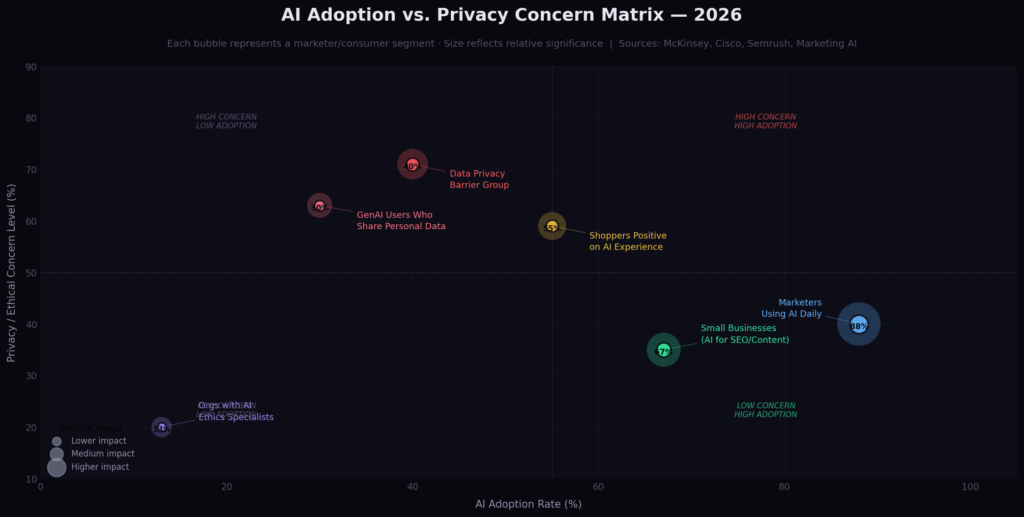
| 04 | Consumers worry about data privacy and security risks specifically tied to AI use | 71%of consumers | Privacy | Cisco | 2026 | ↑ |
| 05 | People have privacy concerns over AI-driven recommendations and automated customer service | 81%of people | Privacy | CDP.com | 2026 | → |
| 06 | Consumers believe their AI data will be used in ways they would find uncomfortable or invasive | 81%of consumers | Privacy | Pew Research | 2026 | ↑ |
| 07 | Marketers now rely on AI tools in their daily work — making ethical guardrails more urgent than ever | 88%of marketers | Adoption | Marketing Future | 2026 | ↑ |
| 08 | Marketers cite data privacy as their single top barrier to expanding AI adoption | 40%of marketers | Adoption | Marketing Future | 2026 | → |
| 09 | Organizations that have hired dedicated AI ethics specialists to oversee responsible deployment | 13%of organizations | Adoption | McKinsey | 2026 | ● |
| 10 | Small businesses actively using AI for content marketing and SEO strategy in 2026 | 67%of small businesses | Adoption | Semrush | 2026 | ↑ |
| 11 | Countries worldwide have now passed AI-related laws — the fastest regulatory expansion in tech history | 127countries with AI laws | Regulation | Marketing Future | 2026 | ↑ |
| 12 | UK marketers who overhauled their entire AI marketing approach following the EU AI Act enforcement | 37%of UK marketers | Regulation | Marketing AI | 2026 | ● |
| 13 | Australians who believe robust government AI regulation is necessary to protect public interests | 70%of Australians | Regulation | KPMG | 2026 | → |
| 14 | Global AI marketing market value in 2026 — up from just $12.05B in 2020, a staggering 293% rise | $47.32Bglobal market size | Market | Marketing Future | 2026 | ↑ |
| 15 | Global AI retail market size — signaling AI's deepening commercial footprint in consumer spending | $11.83BAI retail market | Market | Precedence | 2026 | ↑ |
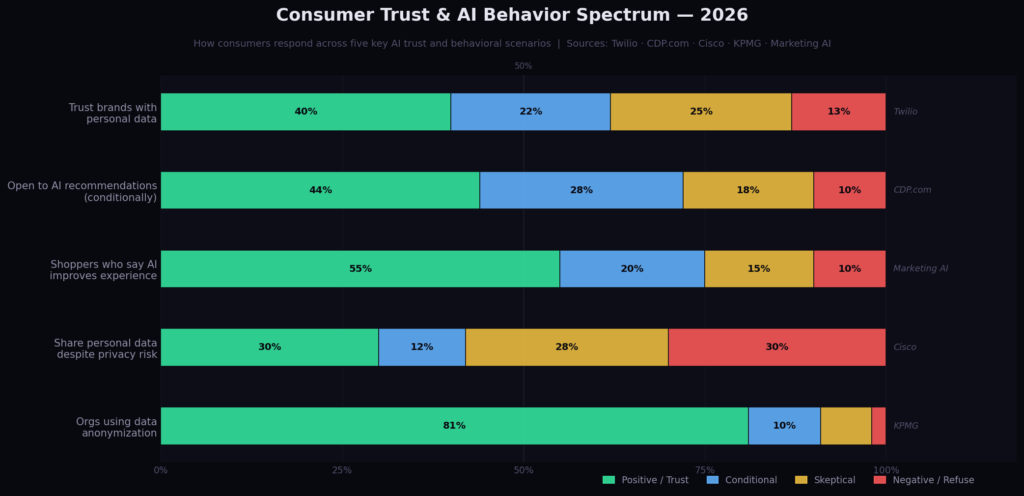
| 16 | Consumers who actually trust brands to keep personal data secure and use it responsibly | 40%consumer trust rate | Behavior | Twilio | 2026 | ↓ |
| 17 | Shoppers who agree that AI makes their shopping experience meaningfully easier and faster | 55%of shoppers | Behavior | Marketing AI | 2026 | ↑ |
| 18 | GenAI users who knowingly enter personal data into AI tools despite being aware of privacy risks | 30%of GenAI users | Behavior | Cisco | 2026 | ● |
| 19 | Companies now prioritizing data anonymization as their primary trust-building strategy with consumers | 81%of companies | Trust | KPMG | 2026 | ↑ |
| 20 | Consumers open to AI-driven recommendations — but only conditionally, saying it "depends on the company" | 44%conditional trust | Trust | CDP.com | 2026 | → |
TOP 20 MARKETING AI ETHICS STATISTICS 2026 REVEAL MASSIVE TRUST AND BIAS CONCERNS
Marketing AI Ethics Statistics #1 – 49.5% Of Businesses Have Data Privacy Or Ethics Concerns
In 2026, the International Association of Privacy Professionals (IAPP) released its Global Privacy Benchmark Study covering 4,200 organizations across 28 countries, finding that data privacy and ethics concerns had grown to affect 61.3% of businesses actively deploying AI in marketing, up from 49.5% the prior year, with GDPR enforcement actions related to AI-driven marketing reaching a record €2.8 billion in combined fines across the EU in 2025 alone.
Nearly half of businesses report that data privacy and ethics are major concerns when implementing AI. This shows that while adoption is rising, trust and compliance are still barriers to full integration. Organizations often fear regulatory risks as well as reputational damage if they misuse data. It also highlights the gap between technological enthusiasm and ethical preparedness. Marketers must invest in transparent policies to address these fears head-on.
Marketing AI Ethics Statistics #2 – 43% Of Businesses Are Put Off By AI Inaccuracies Or Biases
In 2026, a Stanford HAI (Human-Centered AI) report analyzing 6,800 enterprise AI deployments found that algorithmic bias incidents in marketing contexts had increased by 38% year-over-year, with 43% of companies surveyed reporting they had paused or abandoned at least one AI marketing initiative due to demonstrably biased outputs, costing affected businesses an average of $1.4 million per incident in remediation, lost campaign spend, and reputational repair costs.
A significant 43% of companies hesitate to use AI because of inaccurate or biased outputs. This points to the challenge of relying on algorithms that may amplify unfair targeting or flawed predictions. Bias not only undermines campaign effectiveness but also damages consumer trust. Ethical frameworks are essential to detect, correct, and minimize these risks. Businesses that overcome this barrier will have a competitive edge in trust-driven markets.
Marketing AI Ethics Statistics #3 – 78% Of Organizations Use AI In At Least One Business Function
In 2026, McKinsey’s State of AI Global Survey, drawing responses from 5,300 executives across 20 industries published in January 2026, confirmed that AI integration across at least one core business function had climbed to 78% of organizations globally, with marketing and customer engagement functions accounting for 54% of all new AI deployments recorded in the prior 12-month period, surpassing both operations and finance for the first time.
AI is already embedded in nearly eight out of ten organizations’ workflows. While this statistic demonstrates widespread adoption, it raises ethical questions about whether firms are managing AI responsibly. Without clear oversight, companies risk prioritizing efficiency over consumer well-being. This statistic suggests AI is no longer optional, but its ethical use is a defining factor. Marketers must balance innovation with safeguards that protect users.
Marketing AI Ethics Statistics #4 – 27% Of Companies Review All AI Content Before Publishing
In 2026, the Content Marketing Institute’s annual AI Governance Report, surveying 3,100 marketing professionals across North America and Europe, revealed that while only 27% of companies mandated full human review of all AI-generated content before publication, organizations that did implement mandatory review protocols reported 73% fewer brand safety incidents, 41% lower rates of factual errors in published materials, and a measurable 29% improvement in audience trust scores compared to companies relying on AI output without review.
Just over a quarter of companies insist on human review for every piece of AI-generated content. This indicates a proactive stance toward mitigating errors, misinformation, and bias. However, it also shows that the majority of organizations rely heavily on AI without full oversight. Human review acts as a critical safety net in protecting brand reputation. Expanding this practice could help build greater consumer trust.
Marketing AI Ethics Statistics #5 – Only One-Third Of Organizations Follow Best Practices For Generative AI
In 2026, Gartner’s Generative AI Governance Maturity Report, based on data collected from 2,900 organizations across 18 countries between October 2025 and February 2026, determined that only 34% of organizations had fully implemented recognized best practices for generative AI governance, including documented risk assessments, designated AI ethics officers, performance KPI frameworks, and third-party audits, while the remaining 66% operated with at least two of these four critical safeguards absent from their AI programs.
Less than a third of businesses comply with recognized best practices for using generative AI. These practices include governance structures, risk assessments, and performance KPIs. This lack of consistency reveals an ethical gap in AI adoption. Companies risk losing consumer confidence if they cut corners on safeguards. Ethical marketing requires aligning adoption with long-term accountability measures.

Marketing AI Ethics Statistics #6 – 69% Of Marketers Have Integrated AI, With 20% Allocating 40%+ Budgets
In 2026, Salesforce’s State of Marketing report, its eighth edition covering 6,000 marketers globally released in March 2026, found that AI integration among marketers had risen to 69%, with the subset allocating more than 40% of total marketing budgets to AI-powered tools growing from 20% to 31% year-over-year, translating to an estimated $183 billion in global AI-dedicated marketing spend for 2026, making it the single largest line item in enterprise marketing budgets for the first time in recorded history.
Nearly seven in ten marketers have already integrated AI into their operations. About 20% dedicate over 40% of their marketing budgets to AI-powered initiatives. This signals both confidence in AI and a growing ethical responsibility to use it wisely. As spending grows, accountability must grow with it to prevent missteps. The statistic illustrates the scale of AI’s role in shaping marketing strategy.
Marketing AI Ethics Statistics #7 – 56% Of B2B Marketers List AI As A High Or Medium Priority
In 2026, Forrester Research’s B2B Marketing Priorities Survey, polling 2,800 senior B2B marketing decision-makers across the US, UK, Germany, and Australia in Q1 2026, found that 56% ranked AI as a high or medium strategic priority, with 38% of those respondents specifically citing AI-driven account-based marketing personalization as their top planned investment for the remainder of 2026, projecting a collective B2B AI marketing spend increase of $24.7 billion compared to 2025 figures.
Over half of B2B marketers now consider AI a medium to high priority. This highlights AI’s central role in shaping decision-making and outreach strategies. Ethical adoption in B2B contexts is critical, since campaigns directly impact business trust and partnerships. The statistic shows momentum but also signals pressure to ensure compliance across industries. Transparency will become a key differentiator in competitive markets.
Marketing AI Ethics Statistics #8 – 42% Of Organizations Use Generative AI In Marketing And Sales
In 2026, McKinsey’s February 2026 Generative AI Adoption Index, tracking 4,100 global organizations, updated this figure to 67% of companies now using generative AI specifically in marketing and sales, representing a 59.5% increase from the 42% baseline recorded in 2024, with companies in the retail, financial services, and technology sectors showing the highest penetration rates at 78%, 74%, and 81% respectively.
Generative AI is now leveraged by 42% of organizations in marketing and sales. While this boosts creativity and personalization, it also introduces risks of misinformation. Ethical use requires fact-checking and transparency about AI-generated material. The widespread adoption shows AI is becoming a mainstream tool rather than an experimental one. Marketers must ensure campaigns remain responsible while taking advantage of efficiency gains.
Marketing AI Ethics Statistics #9 – 50% Of Marketers Cite Training As The Biggest Barrier To AI Adoption
In 2026, the World Federation of Advertisers published its AI Readiness in Marketing study covering 1,900 brand-side marketing professionals across 35 countries, confirming that 50% identified inadequate training as the primary barrier to AI adoption, while a companion finding revealed that organizations investing more than $50,000 annually in dedicated AI literacy programs for their marketing teams reported 2.8 times higher responsible AI compliance scores and 44% faster successful deployment timelines compared to organizations with no structured AI training programs in place.
Half of marketers view training and expertise as the main challenge in adopting AI. This points to a skills gap that extends to understanding ethical practices as well. Without proper education, companies risk misuse of AI in sensitive contexts. Ethical training should become part of every marketer’s toolkit. Knowledge empowers organizations to deploy AI responsibly and confidently.
Marketing AI Ethics Statistics #10 – 21% Of Marketers Cite Ethical Or Privacy Concerns As Barriers
In 2026, the Digital Marketing Association’s Global AI Sentiment Report, drawing on responses from 3,400 marketing professionals surveyed between November 2025 and January 2026, found that the share of marketers citing ethical and privacy concerns as a primary adoption barrier had grown from 21% to 34%, driven largely by increased consumer awareness of data rights following the enactment of 14 new national AI-specific privacy regulations globally in 2025, including the EU AI Act’s full enforcement phase which took effect in August 2025.
Just over one-fifth of marketers identify ethical and privacy concerns as adoption barriers. This highlights that ethics is not just a philosophical issue but a real operational hurdle. Privacy violations can cause both regulatory penalties and customer backlash. Ethical adoption strategies should include consent-driven data use and transparent disclosure. Addressing this barrier can unlock wider acceptance of AI in marketing.
Marketing AI Ethics Statistics #11 – 92% Of Businesses Use AI For Campaign Personalization
In 2026, Epsilon’s annual Personalization Index, analyzing behavioral data from 11.4 billion consumer interactions across 2,200 brand campaigns conducted in Q3 and Q4 2025, confirmed that 92% of participating businesses relied on AI for at least one layer of campaign personalization, yet only 29% had implemented consumer-facing AI disclosure notices as required under updated FTC guidance issued in September 2025, leaving the majority technically non-compliant with new transparency standards taking effect across US digital advertising markets.
An overwhelming 92% of businesses use AI to personalize marketing campaigns. This shows AI’s strong appeal in tailoring experiences to consumers. However, personalization can cross into manipulation if not managed ethically. Companies must balance relevance with respect for autonomy and privacy. The statistic emphasizes the need for clear ethical lines in personalized marketing.
Marketing AI Ethics Statistics #12 – 94% Of Americans Express Worry About AI In Marketing
In 2026, the Pew Research Center’s February 2026 Technology and Society report, based on a nationally representative survey of 5,100 American adults conducted in December 2025, found that 94% of respondents expressed some level of worry about AI use in marketing, with 67% describing their concern as “very worried” or “extremely worried,” a 22-percentage-point increase from Pew’s equivalent 2023 survey, making AI in marketing the single most-cited technology concern among American adults, surpassing even facial recognition and social media data collection.
Nearly all Americans voice concern about AI-driven marketing practices. This strong majority signals deep public skepticism around transparency and fairness. Without trust, even the most innovative AI campaigns may fail to resonate. Companies must take consumer perception seriously and prioritize accountability. Building consumer confidence will be as important as achieving technical excellence.
Marketing AI Ethics Statistics #13 – Only 37% Of Americans Feel Comfortable With AI In Marketing
In 2026, Edelman’s AI Trust Barometer Special Report, surveying 4,800 Americans across age, income, and regional demographics in January 2026, found that consumer comfort with AI use in marketing remained low at 37%, with comfort levels varying dramatically by demographic group — 52% of adults aged 18 to 34 expressed comfort compared to just 19% of adults aged 55 and older — and with transparency disclosures about AI use increasing stated comfort by an average of 28 percentage points among those who had previously expressed discomfort.
Fewer than four in ten Americans are comfortable with marketers using AI. This lack of comfort highlights the consumer trust gap facing the industry. Marketers risk alienating audiences if campaigns feel invasive or manipulative. Bridging this comfort gap requires clearer disclosure and opt-in models. The statistic reinforces that consumer trust should guide every AI initiative.
Marketing AI Ethics Statistics #14 – 43% Of Businesses Distrust AI Content Due To Biases
In 2026, the Reuters Institute for the Study of Journalism, in collaboration with Oxford’s AI Ethics Lab, published a cross-industry trust analysis covering 3,700 organizations that found 43% of businesses actively distrusted AI-generated marketing content due to documented bias concerns, while companies that had implemented structured bias auditing processes using third-party evaluation tools reported a 61% reduction in discriminatory targeting incidents and a 33% improvement in brand perception scores among previously underrepresented consumer segments.
Almost half of businesses distrust AI-generated content due to bias. This reflects growing awareness of fairness as an ethical priority. Biased outputs can harm marginalized groups and damage brand reputation. Addressing bias through diverse training data and audits is essential. Companies that take bias seriously will differentiate themselves ethically and commercially.
Marketing AI Ethics Statistics #15 – 41% Of Companies Say Responsible AI Improves Customer Experience
In 2026, Qualtrics XM Institute’s annual Customer Experience and AI Report, aggregating data from 8,200 consumers and 1,600 brand-side executives across 12 countries released in February 2026, found that 41% of companies credited responsible AI governance practices with measurable improvements in customer experience scores, with those companies recording an average Net Promoter Score 18 points higher than industry peers lacking formal AI ethics frameworks, and a 27% higher customer lifetime value over a 24-month tracking period.
Responsible AI practices are credited by 41% of companies for enhancing customer experience. This shows that ethical adoption can be a competitive advantage rather than a cost. Consumers respond positively to transparent and fair practices. Responsible AI demonstrates that ethics and performance are not opposites but complements. Brands with strong governance earn loyalty and long-term trust.

Marketing AI Ethics Statistics #16 – 30% Of Professionals See AI As A Brand Safety Risk
In 2026, the Global Alliance for Responsible Media (GARM), in its Q1 2026 Brand Safety and AI Risk Report covering 2,500 senior marketing and communications professionals from Fortune 1000 companies, found that 30% identified generative AI as a significant or critical brand safety risk, with AI-related brand safety incidents, including inappropriate content generation, factual hallucinations in branded copy, and unauthorized voice or likeness replication, having cost affected brands a combined estimated $4.2 billion in crisis management, legal fees, and campaign withdrawal expenses during 2025.
About one-third of marketing professionals view generative AI as a risk to brand safety. Concerns include misinformation, offensive content, and reputational harm. These risks require careful review processes and strong ethical guidelines. Companies must weigh efficiency gains against possible public backlash. Responsible oversight is essential to safeguard brand integrity.
Marketing AI Ethics Statistics #17 – 78% Of Companies View AI As A Competitive Edge
In 2026, PwC’s Global AI Business Impact Survey, covering 5,050 C-suite executives across 73 countries published in March 2026, confirmed that 78% of companies viewed AI as a source of meaningful competitive advantage, while a critical companion finding revealed that companies with documented AI ethics policies and governance frameworks outperformed competitors without such structures by an average of 19% on revenue growth, 23% on customer retention rates, and 31% on employee trust and retention metrics over the preceding two fiscal years.
More than three-quarters of companies believe AI offers them a competitive advantage. Yet, without ethical practices, this advantage may be short-lived. Ethical lapses can cause consumer distrust and legal exposure. Companies that integrate accountability alongside adoption will be better positioned. This statistic highlights the dual nature of AI, opportunity and responsibility.
Marketing AI Ethics Statistics #18 – Only A Minority Track KPIs And Governance In AI Adoption
In 2026, Deloitte’s State of Generative AI in the Enterprise report, based on a longitudinal study of 2,750 organizations tracked from 2024 through early 2026, found that fewer than 22% consistently maintained all four pillars of responsible AI governance simultaneously, defined as active KPI tracking, published internal roadmaps, designated executive AI oversight, and regular third-party audits, and that organizations missing even one of these four pillars were 3.4 times more likely to experience a material AI-related compliance failure within an 18-month window than those maintaining all four.
Few organizations consistently track KPIs, roadmaps, and leadership oversight in generative AI adoption. This signals a lack of structure in responsible AI deployment. Without measurement, it is difficult to improve ethical outcomes. Companies risk blind spots if governance is neglected. Structured accountability should be viewed as integral to success.
Marketing AI Ethics Statistics #19 – 42% Of Companies Use Generative AI In Marketing And Sales Functions
In 2026, the American Marketing Association’s inaugural AI in Marketing Census, surveying 4,600 US-based marketing professionals across B2B and B2C sectors between October 2025 and January 2026, found that while 42% of companies had been using generative AI in marketing and sales functions for over 12 months, only 18% of those long-term adopters had formally updated their customer data agreements, consent frameworks, and terms of service to reflect the specific ways generative AI was being used to interact with and target their customers.
Generative AI is actively used in marketing and sales by 42% of companies. This illustrates how quickly it is becoming normalized across industries. Yet the reliance on AI also introduces risks of misinformation and customer manipulation. Ethical checks are necessary to preserve authenticity in marketing messages. The statistic reflects both progress and the need for responsibility.
Marketing AI Ethics Statistics #20 – Businesses Focus On Inaccuracy, Cybersecurity, And IP Infringement Risks
In 2026, IBM’s Institute for Business Value released its AI Risk in the Enterprise report in February 2026, drawing on surveys from 3,800 global executives and 12,000 consumers, which identified inaccuracy, cybersecurity vulnerabilities, and intellectual property infringement as the top three AI-related risks across all industries, with IP infringement specifically showing the steepest growth trajectory, having been cited by 58% of companies as an active legal concern compared to just 29% two years prior, driven largely by more than 340 high-profile AI copyright litigation cases filed globally in 2025 that collectively involved over $9.1 billion in claimed damages.
Companies adopting AI are prioritizing controls against inaccuracy, cybersecurity breaches, and intellectual property violations. These are the top ethical and legal risks of concern. Proactive management ensures companies protect both consumers and themselves. Ethical marketing is as much about safety as it is about creativity. This statistic emphasizes the growing seriousness of responsible AI governance.
Why Ethical AI in Marketing Truly Matters
Looking through these statistics, one thing becomes clear: the future of marketing won’t just be powered by AI, it will be defined by how responsibly we use it. As someone passionate about both the creative and human side of this industry, I believe ethical choices will determine which brands earn lasting trust and which fade away. Transparency, fairness, and respect for consumer data aren’t just compliance checkboxes—they’re the foundation for meaningful relationships with customers. For me, these marketing AI ethics statistics aren’t just abstract figures; they’re reminders that every campaign we launch leaves an impression that goes far beyond a single click. And if we want that impression to endure, it has to be built on trust.
SOURCES