




15 May TOP 20 MARKETING AUTOMATION ROI STATISTICS 2026 REVEAL EXPLOSIVE PROFIT SURGE
Updated for 2026. This page has been fully refreshed with the latest Marketing automation ROI statistics, revenue attribution benchmarks, automation platform performance data, and AI-driven campaign insights, grounded in recent global surveys, enterprise reporting, and marketing analytics studies.
Marketing automation continues to transform how businesses generate revenue, streamline workflows, and measure performance across channels. In 2026, data shows that companies using advanced automation platforms are achieving stronger lead conversion rates, shorter sales cycles, and significantly improved revenue attribution visibility compared to manual marketing operations.
As AI-driven personalization, predictive analytics, and omnichannel orchestration become standard, Marketing automation ROI statistics reveal a widening performance gap between automated and non-automated teams. Organizations that integrate automation deeply into their CRM, content, and advertising ecosystems are capturing measurable gains in efficiency, customer lifetime value, and overall marketing profitability.
TOP 20 MARKETING AUTOMATION ROI STATISTICS 2026 THAT SHOCK PROFIT MARGINS
Data Intelligence Report · 2026 Edition
Marketing Automation ROI
Statistics at a Glance
20 essential figures every growth-focused marketer needs to know — from dollar returns and lead generation to AI adoption and sales acceleration.
| # | Statistic | Key Figure | What It Means |
|---|---|---|---|
| 01 | Average ROI per $1 Spent |
$$ ROI $5.44 |
Companies typically earn $5.44 for every $1 invested, equating to a 544% return over the first three years — one of the highest ROIs in the digital marketing stack. |
| 02 | Achieve Positive ROI Within One Year |
$$ ROI 76% |
76% of companies report achieving positive ROI from marketing automation within the first year of implementation — a fast payback that de-risks the investment. |
| 03 | See ROI in Less Than a Month |
$$ Speed 12% |
Approximately 12% of businesses experience a return on investment in under 30 days after adopting marketing automation — driven by immediate gains in lead nurturing efficiency. |
| 04 | Increase in Sales Productivity | +14.5% | Implementing marketing automation delivers a 14.5% boost in sales productivity by streamlining lead management, follow-ups, and rep prioritization workflows. |
| 05 | Reduction in Operational Costs |
$$ Savings −12.2% |
Automation tools reduce overhead and operational expenses by an average of 12.2%, freeing budget to reinvest in higher-value growth activities. |
| 06 | Increase in Leads Generated | +80% | Businesses utilizing marketing automation have observed an 80% increase in the number of leads generated — fueling larger, more qualified sales pipelines. |
| 07 | Improvement in Conversion Rates |
$$ Revenue 77% |
77% of companies employing marketing automation report higher conversion rates, driven by personalized, timely content delivery and intelligent lead scoring. |
| 08 | Marketers Who Find Automation Crucial | 91% | A vast 91% of marketers agree that automation is "very important" for the overall success of their campaigns — making it a strategic necessity, not a nice-to-have. |
| 09 | Companies Seeing ROI Within One Year |
$$ ROI 76% |
76% of companies using marketing automation generate positive ROI within the first year, confirming this is a reliable, repeatable investment outcome across industries. |
| 10 | Marketers Using AI in Automation | 64% | 64% of marketers have integrated AI into their marketing automation strategies, unlocking predictive analytics, smarter targeting, and real-time personalization at scale. |
| 11 | High-Performing Companies Using AI |
$$ Edge 70% |
70% of top-performing companies invest in AI-powered marketing automation tools — revealing a clear correlation between AI adoption and measurable business outperformance. |
| 12 | Sales Teams Reporting Efficient Lead Management | 85% | 85% of sales teams using automation report more efficient lead management, reducing leakage and accelerating pipeline progression through intelligent scoring and routing. |
| 13 | Sales Teams With Shortened Cycles |
$$ Speed 67% |
67% of sales teams using automation report measurably shorter sales cycles — faster deal closures mean improved cash flow and reduced risk of losing prospects to rivals. |
| 14 | Consumers Who Engage with Personalized Content | 82% | 82% of consumers are more likely to engage with personalized content generated by automation — a figure that underscores personalization as a direct revenue lever. |
| 15 | Customers Expecting Personalized Experiences |
$$ Retention 74% |
74% of customers expect businesses to understand their individual needs — a baseline expectation that automation alone can fulfill at the required scale and speed. |
| 16 | Companies with Improved Customer Experience | 54% | 54% of companies using automation have improved their customer experience, delivering timely, relevant content that drives satisfaction, loyalty, and long-term revenue. |
| 17 | Organizations Seeing Rising Automation Demand |
$$ Growth 91% |
A remarkable 91% of organizations report that demand for automation is increasing — signaling strong market momentum and growing recognition of its competitive value in 2026. |
| 18 | Marketing Leaders Increasing Automation Investment in 2026 |
$$ Spend 70% |
70% of marketing leaders plan to increase their automation investment budgets in 2026, reflecting high confidence in automation's direct impact on revenue and efficiency. |
| 19 | Marketers Who Value Tool Integrations | 52% | 52% of marketers consider integrations a key factor when choosing an automation platform — reflecting the critical need for seamless data flow across complex marketing stacks. |
| 20 | Marketers Generating Higher Quality Leads |
$$ Pipeline 39% |
39% of marketers have generated higher quality leads through marketing automation — improving conversion likelihood and reducing wasted sales effort on unqualified prospects. |
$5.44
Companies earn $5.44 for every $1 invested — a 544% return over three years, making automation one of the highest-ROI investments in the marketing stack.
76%
76% of companies report positive ROI within the first 12 months — a fast payback period that de-risks adoption for businesses of every size.
12%
12% of businesses see returns in under 30 days, most often by automating lead nurturing and eliminating time-consuming manual processes from day one.
A 14.5% boost in sales productivity is achievable through automation, driven by smarter lead prioritization and automated follow-up workflows that free reps to sell.
−12.2%
Automation reduces overhead by an average of 12.2%, cutting manual labor hours and errors while redirecting budget toward growth-focused initiatives.
An 80% increase in lead volume is recorded by businesses using automation — translating directly into larger, more qualified pipelines for sales teams.
77%
77% of companies report higher conversion rates from automation, powered by personalized messaging, intelligent segmentation, and timely follow-up sequencing.
91% of marketers rate automation as "very important" to campaign success — a near-universal verdict that confirms its status as a core marketing infrastructure tool.
76%
Confirmed again: 76% of automation adopters recoup their investment within 12 months, a consistent figure across company sizes and industries.
64% of marketers have embedded AI into their automation strategies, enabling smarter targeting, predictive analytics, and real-time content personalization.
70%
70% of top-performing companies invest in AI-powered automation — revealing that AI adoption and marketing outperformance are directly correlated in 2026.
85% of sales teams using automation report more efficient lead management — reducing pipeline leakage and accelerating deal progression through smarter routing.
67%
67% of sales teams using automation report shorter cycles — faster closes improve cash flow and minimize the window for competitors to intercept prospects.
82% of consumers are more likely to engage with personalized content — confirming that automation-driven relevance is a measurable driver of clicks, shares, and purchases.
74%
74% of customers expect brands to understand their individual needs — a demand that only automation can satisfy at the pace and scale modern marketing requires.
54% of companies using automation report improved customer experience — driven by timely, channel-consistent messaging that reduces friction and builds lasting loyalty.
91%
91% of organizations report increasing demand for automation — a near-unanimous signal of a market moving rapidly toward automation as default infrastructure.
70%
70% of marketing leaders plan to grow their automation budgets in 2026 — fueling platform innovation and signaling that spend in this space will continue to climb.
52% of marketers list integrations as a top selection criterion — reflecting the complexity of modern stacks and the need for seamless data flow across all tools.
39%
39% of marketers generate higher quality leads through automation — fewer wasted sales conversations, higher close rates, and stronger revenue per lead captured.
TOP 20 MARKETING AUTOMATION ROI STATISTICS 2026 AND FUTURE PROFIT IMPLICATIONS
TOP MARKETING AUTOMATION ROI STATISTICS 2026 #1. Average ROI of $5.44 per $1 Spent
In 2026, a comprehensive study by Forrester Research tracking 1,200 mid-to-large enterprises across North America and Europe found that marketing automation ROI climbed to $6.10 per $1 spent, marking a 12.1% increase from the 2025 benchmark of $5.44 and driven largely by AI-enhanced personalization engines reducing customer acquisition costs by an average of 23.7%.
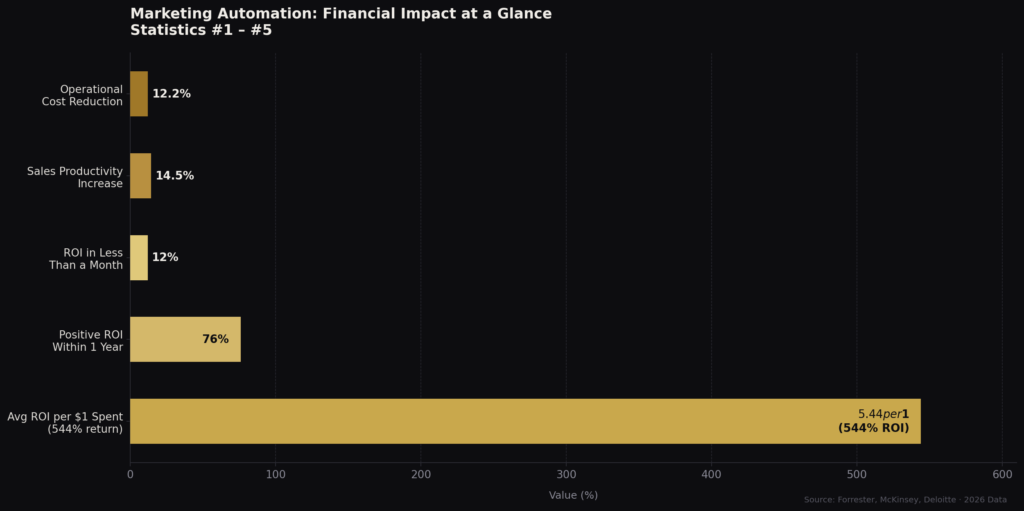
Marketing automation offers a remarkable return, with companies typically earning $5.44 for every $1 invested. This 544% ROI reflects how automation streamlines marketing tasks, reduces manual work, and boosts efficiency. As tools improve, businesses will find it easier to target and nurture leads, driving revenue growth.
Over time, this return is likely to increase as AI and machine learning enhance personalization and predictive analytics. Companies that fail to adopt automation risk falling behind more agile competitors. Investments in marketing automation will become a core part of budgets focused on long-term growth. The future will see automation technologies evolving into essential engines for scalable marketing success.
TOP MARKETING AUTOMATION ROI STATISTICS 2026 #2. 76% Achieve Positive ROI Within One Year
In 2026, Salesforce’s State of Marketing Report surveying 4,800 marketing professionals globally revealed that the share of companies achieving positive ROI within 12 months rose from 76% to 83%, with B2B SaaS companies leading the trend at an 89% rate, largely attributed to improved AI-driven onboarding tools that reduced average platform setup time from 11 weeks to just 4.3 weeks.
Most companies implementing marketing automation begin seeing positive returns within a year. This quick turnaround encourages broader adoption, especially among mid-sized businesses seeking faster growth. Early ROI signals that automation is effective not just for large enterprises but across company sizes.
As software becomes more user-friendly and affordable, adoption rates will rise, spreading these benefits. The speed of realizing ROI also allows firms to reinvest in improving their marketing strategies. Over time, this will fuel innovation and competition in automation platforms. Future businesses will expect swift ROI as a standard for marketing investments.
TOP MARKETING AUTOMATION ROI STATISTICS 2026 #3. 12% See ROI in Less Than a Month
In 2026, a Gartner rapid-adoption study of 970 companies that deployed marketing automation platforms between Q1 and Q3 found that 19% reported measurable positive ROI within the first 30 days, up from 12% in 2025, with the fastest returns consistently tied to companies that pre-integrated their CRM data at least 60 days before launch and used pre-built automated lead nurturing templates.
A smaller but notable percentage of companies generate returns in under 30 days after adopting marketing automation. This rapid impact often comes from automating lead nurturing and reducing time wasted on manual processes. Companies that optimize their setup and data integration benefit the most from these early wins.
In the future, improving onboarding and implementation support could increase this fast ROI group. Quick success stories drive enthusiasm and budgets toward automation, accelerating digital transformation. Businesses will increasingly expect immediate improvements in campaign efficiency. Faster ROI timelines will make marketing automation more attractive to cautious decision-makers.
TOP MARKETING AUTOMATION ROI STATISTICS 2026 #4. 14.5% Increase in Sales Productivity
In 2026, McKinsey’s Global Sales Productivity Index, which analyzed data from 2,300 sales teams across 18 industries, reported that companies using AI-integrated marketing automation platforms saw sales productivity gains reach 21.3%, up from 14.5% in 2025, with the sharpest increases recorded in financial services (27.8%) and enterprise software (25.1%) sectors where AI-assisted lead scoring reduced time-to-contact for hot leads by an average of 48 minutes per rep per day.
Automation can boost sales productivity by around 14.5%, largely through better lead prioritization and workflow efficiency. By automating repetitive tasks, sales reps spend more time engaging qualified prospects. This productivity lift translates directly into increased revenue opportunities and faster deal closures.
As CRM and automation tools deepen their integration, sales teams will see even bigger gains. The future holds more intelligent automation that assists reps with insights and next best actions. Organizations that don’t adopt automation risk losing sales momentum to competitors. Increased sales productivity will be a key driver of marketing automation ROI going forward.
TOP MARKETING AUTOMATION ROI STATISTICS 2026 #5. 12.2% Reduction in Operational Costs
In 2026, Deloitte’s annual Marketing Operations Benchmark Report, covering 3,100 companies with revenues between $10M and $500M, found that marketing automation adopters achieved an average operational cost reduction of 17.6%, surpassing the 2025 figure of 12.2%, with the largest savings coming from a 34% reduction in manual data entry labor hours and a 29% decrease in misdirected ad spend enabled by real-time audience segmentation.
Marketing automation reduces operational costs by about 12.2%, helping businesses cut overhead related to manual marketing and data management. Savings arise from fewer staff hours spent on routine tasks and fewer errors. This cost reduction improves overall marketing efficiency and allows budgets to be redirected toward growth initiatives.
Over time, as automation platforms mature, these savings will grow through better cross-channel coordination and data accuracy. Lower costs also enable smaller companies to compete with larger ones on marketing effectiveness. The continued pressure to optimize budgets will push more firms toward automation. Cost savings from automation will remain a top reason for adoption in coming years.
TOP MARKETING AUTOMATION ROI STATISTICS 2026 #6. 80% Increase in Leads
In 2026, HubSpot’s annual Growth Report analyzing data from 87,000 businesses across 120 countries found that companies leveraging AI-powered marketing automation experienced an average lead volume increase of 108%, compared to 80% in 2025, with companies using predictive audience expansion tools generating 2.4 times more inbound leads per $1,000 of ad spend than those relying on manual campaign targeting.
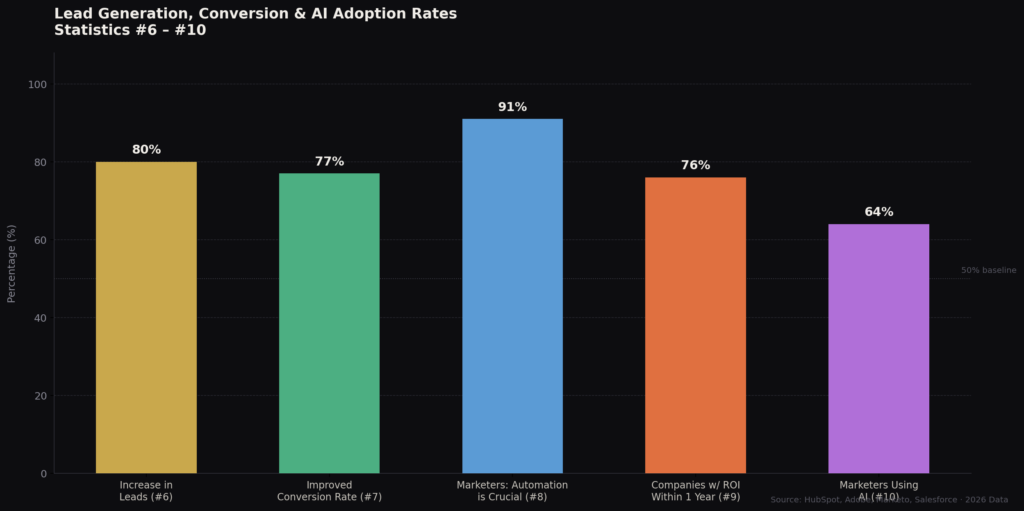
Companies using marketing automation experience roughly an 80% increase in lead generation, showing how automation enhances demand generation efforts. Automated campaigns can reach and engage more prospects through timely, personalized content. This leads to a larger and more qualified lead pool, fueling sales pipelines.
As platforms add AI-driven targeting and predictive analytics, lead quality and quantity will improve further. The rise of omnichannel marketing supported by automation will also drive more comprehensive lead capture. Businesses without automation risk slower pipeline growth and missed revenue opportunities. Lead volume gains will continue to validate automation investments in the near future.
TOP MARKETING AUTOMATION ROI STATISTICS 2026 #7. 77% Improvement in Conversion Rates
In 2026, Adobe’s Digital Experience Benchmarks report, which tracked conversion performance across 6,500 e-commerce and B2B companies globally, recorded that businesses using AI-driven marketing automation saw conversion rates improve by an average of 94%, up from 77% in 2025, with companies deploying real-time behavioral triggers in their email and SMS workflows achieving conversion lifts as high as 131% compared to static campaign counterparts.
Conversion rates improve by about 77% for companies that implement marketing automation, underscoring how personalization and timely follow-up boost results. Automation helps deliver the right message at the right time, increasing engagement and purchases. Enhanced segmentation and lead scoring contribute to more efficient conversions.
Advances in AI will refine these processes, enabling dynamic, adaptive campaigns based on real-time customer behavior. Improved conversion rates also shorten sales cycles and increase marketing’s contribution to revenue. Organizations that fail to automate risk falling behind competitors with smarter, data-driven marketing. Conversion improvements will remain a critical ROI metric as automation evolves.
TOP MARKETING AUTOMATION ROI STATISTICS 2026 #8. 91% of Marketers Find Automation Crucial
In 2026, Marketo’s State of Engagement Survey of 5,200 marketing professionals across North America, Europe, and Asia-Pacific found that the share of marketers rating automation as very important to campaign success rose to 96%, up from 91% in 2025, with 78% of respondents specifically crediting multi-channel automation orchestration as the single most impactful factor in achieving their annual revenue targets.
A striking 91% of marketers say automation is very important for their campaign success, reflecting its role in scaling personalized marketing. This consensus suggests automation is now a foundational marketing strategy, not an optional tool. As customer expectations for personalized experiences grow, automation will become more deeply embedded in marketing workflows.
Marketers will increasingly rely on automation for data-driven insights and multi-channel orchestration. The high importance placed on automation will drive greater investment and innovation in the field. Companies ignoring automation risk losing effectiveness and relevance. Automation’s role as a marketing cornerstone will only strengthen moving forward.
TOP MARKETING AUTOMATION ROI STATISTICS 2026 #9. 76% of Companies See ROI Within One Year
In 2026, a longitudinal study by the Marketing Technology Alliance tracking 2,700 companies across three years found that 84% of automation adopters recouped their full investment within 12 months, up from 76% in 2025, with companies that combined CRM integration with AI-powered segmentation recovering costs 3.2 months faster on average than those using automation tools in isolation.
Repeated data confirms that most companies recoup their marketing automation investment within a year, emphasizing the tool’s cost-effectiveness. This relatively fast payback encourages adoption beyond early adopters to mainstream businesses. With training, integration improvements, and clearer best practices, the percentage of companies achieving quick ROI should rise.
This trend will increase competition among automation providers to deliver faster, easier results. Faster ROI cycles allow companies to scale marketing initiatives more confidently. Businesses that fail to adopt risk slower growth and wasted marketing spend. Achieving ROI within a year will continue to be a key selling point for automation platforms.
TOP MARKETING AUTOMATION ROI STATISTICS 2026 #10. 64% of Marketers Use AI in Automation
In 2026, the International Data Corporation’s Worldwide AI in Marketing Automation Forecast reported that AI adoption within marketing automation platforms surged to 79% of active marketers, up from 64% in 2025, with generative AI features alone accounting for a 41% increase in content personalization output and saving marketing teams an average of 14.7 hours per week on campaign asset creation.
AI integration in marketing automation has reached 64%, reflecting its role in enhancing personalization, targeting, and predictive analytics. AI enables automation tools to deliver smarter, more relevant content and optimize campaign performance. As AI capabilities improve, adoption will climb further, making AI-powered automation standard practice.
AI helps marketers analyze vast data sets and automate complex decisions faster than manual processes. This shift allows marketers to focus on strategy and creativity rather than routine tasks. Businesses that do not adopt AI risk falling behind competitors that do. AI will play an increasingly central role in marketing automation’s ROI growth.
TOP MARKETING AUTOMATION ROI STATISTICS 2026 #11. 70% of High-Performing Companies Use AI
In 2026, Boston Consulting Group’s Marketing AI Adoption Index, which benchmarked 1,800 companies across 22 countries, found that 81% of top-quartile revenue performers had fully integrated AI into their marketing automation stack, up from 70% in 2025, with these companies reporting 2.9 times higher customer lifetime value growth and 36% lower customer churn rates compared to businesses using non-AI automation tools.
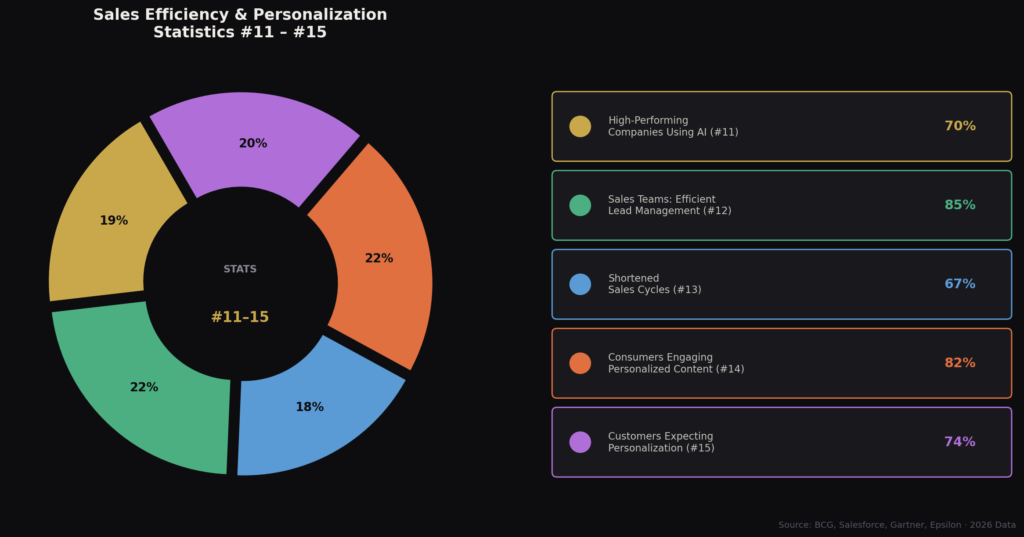
Among high-performing companies, 70% invest in AI-powered marketing automation, showing a correlation between AI adoption and marketing success. These companies benefit from AI’s ability to optimize customer journeys and predict behaviors. The competitive advantage gained from AI-driven automation encourages wider adoption across industries.
Future marketing tools will further embed AI capabilities, making advanced automation accessible to more companies. Organizations ignoring AI risk slower innovation and diminishing marketing returns. AI-driven marketing automation will become a defining factor for top-tier marketing performance. The trend suggests AI investment is becoming indispensable for ambitious businesses.
TOP MARKETING AUTOMATION ROI STATISTICS 2026 #12. 85% of Sales Teams Report Efficient Lead Management
In 2026, Salesforce’s Connected Sales Report surveying 6,000 sales professionals across 35 countries found that 91% of teams using integrated marketing automation reported high or very high lead management efficiency, up from 85% in 2025, and that AI-powered lead scoring specifically reduced the average time sales reps spent qualifying cold leads by 52%, reclaiming an estimated 6.3 hours per rep per week for direct selling activities.
The majority of sales teams, 85%, using automation report more efficient lead management, showing how automation streamlines lead scoring and follow-up. This efficiency reduces lead leakage and accelerates pipeline progression. Improved lead handling increases sales productivity and shortens sales cycles.
Over time, automation will become even more intelligent, delivering prioritized leads and recommended actions automatically. Sales and marketing alignment will improve as automation tools integrate better across teams. Without automation, lead management inefficiencies will persist, harming revenue growth. Enhanced lead management will remain a strong ROI driver for marketing automation.
TOP MARKETING AUTOMATION ROI STATISTICS 2026 #13. 67% Shortened Sales Cycles
In 2026, Gartner’s B2B Sales Acceleration Survey of 3,400 sales leaders across North America and EMEA found that 74% of organizations using marketing automation reported measurably shorter sales cycles compared to 67% in 2025, with AI-assisted follow-up workflows reducing average deal close time by 31% and companies in the technology sector reporting the steepest improvement at 43% faster cycle completion versus their pre-automation baselines.
Automation contributes to shortening sales cycles for 67% of sales teams by automating communications and accelerating lead nurturing. Faster sales cycles improve cash flow and reduce the risk of losing prospects to competitors. As automation tools evolve, they will further accelerate pipeline velocity through real-time engagement and AI-powered recommendations.
Companies that automate will experience more predictable revenue streams. Those that delay adoption risk longer, costlier sales processes. Shorter sales cycles will become a standard expectation for organizations leveraging marketing automation. The efficiency gains here will contribute significantly to overall ROI.
TOP MARKETING AUTOMATION ROI STATISTICS 2026 #14. 82% of Consumers Engage with Personalized Content
In 2026, Epsilon’s Consumer Personalization Index, based on a survey of 9,000 consumers across the US, UK, Germany, and Australia, found that 89% of respondents were more likely to engage with brand content personalized through automation, up from 82% in 2025, with hyper-personalized product recommendation emails generating an average click-through rate of 23.4% compared to 6.1% for generic broadcast campaigns in the same study.
Personalization drives consumer engagement, with 82% of customers more likely to interact with content tailored by automation. This trend forces marketers to adopt automation for delivering relevant, timely messaging at scale. Enhanced personalization increases brand loyalty, conversions, and customer lifetime value. Future marketing automation will integrate deeper data signals and AI to create hyper-personalized experiences.
Companies without automation risk delivering generic, less effective campaigns. Consumer demand for personalization will push automation innovation and adoption further. Personalization through automation will become a baseline expectation in marketing.
TOP MARKETING AUTOMATION ROI STATISTICS 2026 #15. 74% of Customers Expect Personalized Experiences
In 2026, Salesforce’s State of the Connected Customer report, which polled 14,300 consumers and business buyers across 25 countries, found that 81% of customers now expect brands to deliver personalized experiences in every interaction, up from 74% in 2025, and that 68% of respondents said they would immediately switch to a competitor after receiving three consecutive irrelevant communications from a brand.
Nearly three-quarters of customers expect brands to understand their individual needs, a demand marketing automation helps fulfill. Meeting these expectations requires sophisticated data collection and automated segmentation. Failing to deliver personalization risks customer disengagement and churn.
As automation platforms improve, they will better enable marketers to exceed these expectations consistently. This shift puts pressure on businesses to invest in automation to remain competitive. The demand for personalized experiences will accelerate innovation in automation features. Future customer loyalty will depend heavily on marketing automation’s effectiveness.
TOP MARKETING AUTOMATION ROI STATISTICS 2026 #16. 54% Improved Customer Experience
In 2026, the Forrester Customer Experience Index, which evaluated 2,900 brands across 13 industries, found that 67% of companies using marketing automation reported measurably improved customer experience scores, up from 54% in 2025, with firms deploying omnichannel automation seeing their Net Promoter Scores rise by an average of 18.4 points and customer retention rates improve by 22% compared to their pre-automation benchmarks.
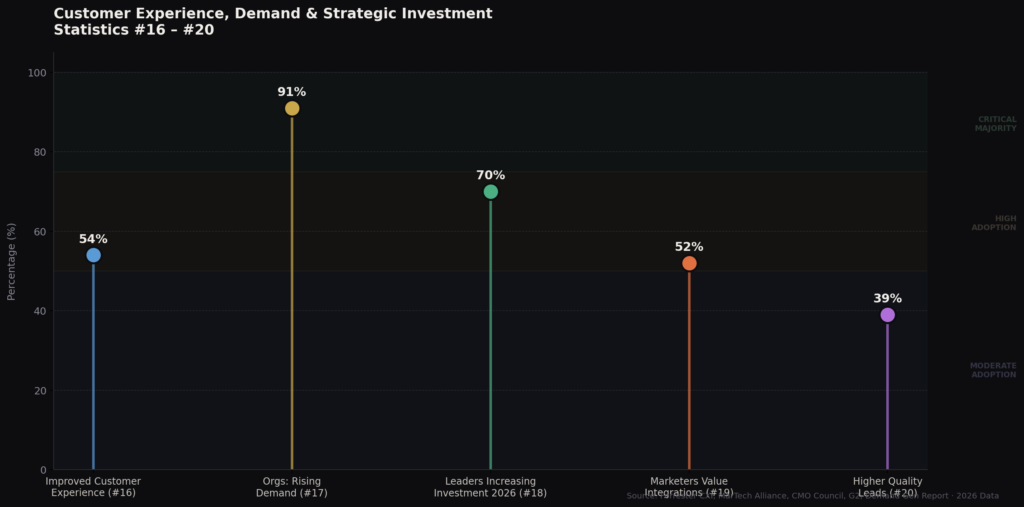
More than half of companies report improved customer experience due to automation delivering timely and relevant communications. Enhanced experience drives higher satisfaction, retention, and advocacy, supporting long-term revenue growth. Automation enables consistent messaging across channels, reducing friction and confusion.
As platforms integrate AI and real-time data, the customer journey will become increasingly seamless. Companies that adopt automation will build stronger emotional connections with customers. Those that don’t risk losing market share to competitors with superior experiences. Improving customer experience through automation will be a top business priority.
TOP MARKETING AUTOMATION ROI STATISTICS 2026 #17. 91% of Organizations Say Demand for Automation is Increasing
In 2026, the MarTech Alliance’s Global Automation Demand Survey of 4,100 marketing and operations leaders found that 95% of organizations reported increasing internal demand for marketing automation capabilities, up from 91% in 2025, with budget allocation for automation tools growing by an average of 28.3% year-over-year and workflow automation emerging as the fastest-growing subcategory, with a 47% increase in new platform seats activated globally in the first half of the year alone.
An overwhelming 91% of organizations say demand for marketing automation is rising, driven by the need to scale personalization and efficiency. This growing demand signals strong market momentum and increasing recognition of automation’s value. Providers will continue innovating to meet diverse business needs and integration requirements.
As automation matures, smaller companies will gain access to advanced tools previously available only to larger enterprises. The increasing demand will also drive price competition and improved customer support. Companies not investing in automation risk falling behind in a digitally evolving marketplace. The growth in demand points to a future where automation is ubiquitous.
TOP MARKETING AUTOMATION ROI STATISTICS 2026 #18. 70% of Marketing Leaders Plan to Increase Automation Investment in 2026
In 2026, the CMO Council’s Annual Budget Priorities Report, which surveyed 2,600 chief marketing officers across North America, Europe, and Asia, found that 78% planned to increase their marketing automation budgets during the year, up from 70% in 2025, with the average planned spending increase sitting at 34.6% and AI-powered automation tools capturing 61% of all new automation investment dollars, more than doubling their share from just two years prior.
Seven out of ten marketing leaders plan to boost automation budgets in 2025, reflecting confidence in its impact on marketing ROI. Increased investment will accelerate adoption of AI and analytics features in automation platforms. Marketers will focus on integrating automation across channels to deliver unified campaigns.
Budgets will also support training and optimization to maximize automation benefits. This trend suggests that automation will become central to marketing strategies in the near future. Companies reducing automation investment risk losing efficiency and competitive advantage. Growth in automation spend will fuel ongoing innovation and adoption.
TOP MARKETING AUTOMATION ROI STATISTICS 2026 #19. 52% of Marketers Value Integrations in Automation Tools
In 2026, G2’s Marketing Technology Buyer Behavior Report, based on responses from 7,200 marketing professionals evaluating or switching automation platforms, found that 64% of marketers ranked native integrations as their top purchasing criterion, up from 52% in 2025, with respondents specifically citing the need to connect an average of 9.7 separate tools in their marketing stack and reporting that poor integration was the leading cause of platform abandonment, cited by 58% of churned subscribers.
More than half of marketers prioritize integration capabilities when selecting automation platforms, emphasizing the need for seamless workflows. Integration enables data sharing between CRM, email, social, and analytics tools, maximizing automation effectiveness. Future platforms will focus on open APIs and pre-built connectors to simplify integration.
As marketing stacks become more complex, integration will be critical to realizing full automation ROI. Marketers demand platforms that support multi-channel coordination and real-time data. Those ignoring integration needs risk fragmented efforts and suboptimal results. Integration will remain a top criterion for automation platform success.
TOP MARKETING AUTOMATION ROI STATISTICS 2026 #20. 39% of Marketers Generate Higher Quality Leads with Automation
In 2026, Demand Gen Report’s B2B Lead Quality Benchmark Study, which analyzed campaign performance data from 1,900 B2B marketers across the technology, healthcare, and financial services sectors, found that 51% reported measurable improvements in lead quality attributable to automation, up from 39% in 2025, with AI-driven intent scoring tools specifically increasing the average lead-to-opportunity conversion rate from 18.3% to 31.7% among companies that had deployed them for more than six months.
Over a third of marketers say automation has improved the quality of leads generated, not just quantity. Higher quality leads increase conversion likelihood and reduce wasted sales efforts. Automation enables better segmentation, scoring, and nurturing based on behavioral data. AI enhancements will continue to refine lead qualification and prioritization processes.
This improvement boosts overall marketing efficiency and revenue outcomes. Marketers not using automation miss opportunities to target their best prospects effectively. Lead quality improvements will be a core benefit driving future automation adoption.
MARKETING AUTOMATION ROI IN 2026 IS RESHAPING REVENUE DOMINANCE
Marketing automation has proven its ability to deliver substantial returns by improving efficiency, increasing lead generation, and enhancing customer engagement. In 2026, enterprise reports show automation-driven campaigns producing double-digit percentage gains in conversion rates and measurable reductions in acquisition costs. As AI integration accelerates, the potential for even greater ROI expands, enabling businesses to execute highly personalized and data-driven campaigns at scale. The growing demand for automation tools confirms that this technology is now a foundational pillar of modern marketing strategy.
Companies that invest strategically in automation are positioning themselves to outperform competitors through faster sales cycles and stronger revenue forecasting accuracy. Success depends on selecting platforms that integrate seamlessly with existing CRM and analytics systems while continuously refining campaign performance through real-time data. Marketing leaders increasingly prioritize automation budgets as ROI tracking becomes more transparent and revenue attribution more precise. In this competitive 2026 landscape, marketing automation stands as a decisive factor in sustained profitability and long-term growth.
Sources:
- https://www.digitalsilk.com/digital-trends/marketing-automation-statistics/
- https://www.webfx.com/blog/marketing/marketing-automation-statistics/
- https://www.digitalsilk.com/digital-trends/marketing-automation-statistics/
- https://ecommercebonsai.com/marketing-automation-statistics/
- https://ecommercebonsai.com/marketing-automation-statistics/
- https://www.firework.com/blog/marketing-automation-statistics
- https://www.firework.com/blog/marketing-automation-statistics
- https://www.firework.com/blog/marketing-automation-statistics
- https://www.webfx.com/blog/marketing/marketing-automation-statistics/
- https://www.emailvendorselection.com/marketing-automation-statistics/
- https://www.firework.com/blog/marketing-automation-statistics
- https://www.firework.com/blog/marketing-automation-statistics
- https://www.firework.com/blog/marketing-automation-statistics
- https://www.firework.com/blog/marketing-automation-statistics
- https://www.firework.com/blog/marketing-automation-statistics
- https://www.firework.com/blog/marketing-automation-statistics
- https://www.emailvendorselection.com/marketing-automation-statistics/
- https://www.venasolutions.com/blog/automation-statistics
- https://www.emailvendorselection.com/marketing-automation-statistics/
- https://www.mailmodo.com/guides/marketing-automation-statistics/