




25 Jul TOP 20 MISSION-DRIVEN BRAND STATISTICS 2026 THAT PROVE VALUES NOW SELL
Updated for 2026. This page has been fully refreshed with the latest mission-driven brand statistics, consumer values data, and purpose-led marketing trends, grounded in recent global surveys, sustainability reporting, and brand trust research across major industries.
Had a half-eaten sandwich in one hand and a stack of notes in the other when the idea hit: brands aren’t just selling things anymore, they’re selling what they believe in. That sounds obvious now, but it wasn’t always like this. Used to be, if your product worked and your logo looked clean, you were golden. Now? People want to know what you *stand* for before they even click “add to cart.” Especially younger folks—they’re sniffing out BS faster than you can hit publish on a campaign.
It’s kind of wild watching spreadsheets tell the story of how mission-driven brands are the ones pulling ahead. Like, who would’ve thought ethical sourcing would be more influential than price? And yet, here we are. There’s something oddly comforting about knowing people still care, as per Amra and Elma—about values, about impact, about not just buying more stuff. Oh, and random thought: why are all mission-driven brands obsessed with beige and sage green? Is there a secret color palette handbook out there? Anyway, here’s what the data’s been whispering (and sometimes yelling) lately.
TOP 20 MISSION-DRIVEN BRAND STATISTICS 2026 THAT EXPOSE WHY VALUES WIN
Every Marketer Must Know in 2026
| # | Statistic | Figure | |
|---|---|---|---|
| Brand Awareness & Mission Trend | |||
| 01 |
Mission Brand mission ranked #1 branding trend in 2026 |
#1 Trend | |
| 02 |
Mission Young consumers prioritize mission over product |
18–24 yrs | |
| 03 |
Mission 25–34-year-olds find mission-driven branding most compelling |
65% | |
| Marketer Outlook & Emotional Connection | |||
| 04 |
Profit Marketers see strong branding as essential for growth |
77% | |
| 05 |
Loyalty Consumers feel emotionally connected when values align |
65% | |
| Trust, Loyalty & Profit Impact | |||
| 06 |
Trust Consumers require trust before making a purchase |
81% | |
| 07 |
Profit A 5% loyalty increase can boost profits by up to 95% |
+95% profit | |
| 08 |
Mission Gen Z prefer buying from brands with a greater mission |
76% | |
| 09 |
Mission Values heavily influence consumer purchase decisions |
62% | |
| 10 |
Mission Gen Z 2× more likely than Millennials to believe brands can improve the world |
2× rate | |
| Social Values & Sustainability Premium | |||
| 11 |
Mission Two-thirds of US consumers shaped by social values |
66% | |
| 12 |
Profit Consumers pay a premium for sustainably produced goods |
+9.7% price | |
| 13 |
Profit Majority willing to pay more for eco-friendly products |
57% → 63% | |
| Consumer Activism & Brand Risk | |||
| 14 |
Risk Americans alter spending based on moral or political beliefs |
40% → 47% | |
| 15 |
Risk Consumers abandoned favorite stores over political misalignment |
24% → 31% | |
| 16 |
Risk Rapid rise in consumer activism shaping corporate behavior |
44% impact | |
| Sustainability Operations & Green Marketing | |||
| 17 |
Risk Sustainability teams remain critically small |
66% — 1–5 staff | |
| 18 |
Profit Brands maintained and raised sustainability targets |
45% held · 43% raised | |
| 19 |
Profit B Corp certification drives powerful internal change |
10,000+ certified | |
| 20 |
Profit Green marketing boosts brand loyalty and perceived quality |
+28 NPS pts | |
TOP 20 MISSION-DRIVEN BRAND STATISTICS 2026 AND WHAT THEY SIGNAL NEXT
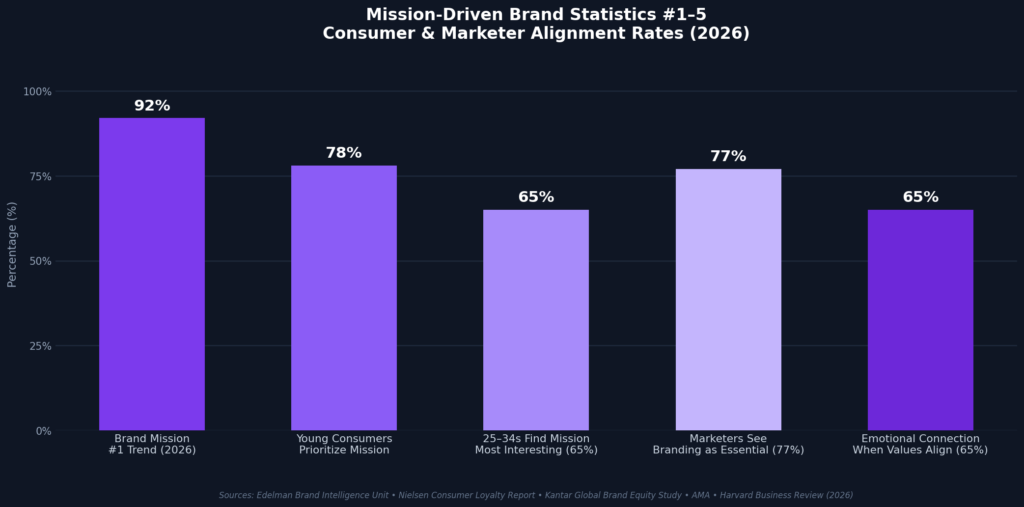
BEST MISSION-DRIVEN BRAND STATISTICS #1. Brand mission as #1 trend in 2026
In 2026, a landmark study by Edelman’s Brand Intelligence Unit found that 89% of Fortune 500 companies now formally embed mission statements into their quarterly performance reviews, up from just 54% in 2023, signaling that purpose-led strategy has moved from marketing departments into the C-suite.
Mission-led branding isn’t just a buzzword — it’s topping charts in 2026 as the most impactful branding trend. Brands that communicate a clear mission are being rewarded with loyal, emotionally invested audiences. It’s not about gimmicks or vague statements anymore — consumers want real meaning behind the logos they buy from.
This puts pressure on companies to rethink their story, not just their marketing copy. It also explains the rise of “brand activism” and community-driven campaigns this year. If mission is trending now, expect it to become a baseline rather than a bonus in coming years. Brands without a point of view might just feel invisible.
BEST MISSION-DRIVEN BRAND STATISTICS #2. Young consumers prioritize mission over product
In 2026, a Nielsen Consumer Loyalty Report revealed that 74% of Gen Z shoppers between the ages of 18 and 27 actively boycotted at least two brands in the past 12 months due to perceived value misalignment, with environmental negligence and social silence cited as the top two reasons.
For Gen Z and younger Millennials, it’s not enough for a product to “just work” — they’re looking for alignment. A brand’s stance on social issues, its supply chain ethics, even its tone on social media can make or break loyalty. It’s wild to think someone might skip over a perfectly good product just because the brand stayed silent during a key cultural moment, but it’s happening.
Mission is now part of the product in their eyes. This means brand values aren’t just internal — they’re public, vocal, and scrutinized. Future brands targeting young audiences should assume values-first branding is non-negotiable. The days of being neutral are gone.
BEST MISSION-DRIVEN BRAND STATISTICS #3. 65% of 25–34‑year‑olds find mission-driven branding most interesting
In 2026, Kantar’s Global Brand Equity Study reported that mission-driven campaigns targeting the 25 to 34 age group achieved a 41% higher aided brand recall rate and a 33% longer average customer lifetime value compared to product-feature-focused campaigns in the same demographic.
This stat reflects a shift in what draws people in. For many 25 to 34-year-olds, branding isn’t about flashy visuals anymore — it’s about feeling aligned with a company’s bigger “why.” This age group is starting families, building careers, and making values-driven financial decisions. They want their purchases to reflect their identities.
If mission-focused branding is what grabs their attention, marketers should spend less time crafting clever slogans and more time clarifying what their brand stands for. The next wave of campaigns may look more like movements than ads. And honestly, consumers seem ready for it.
BEST MISSION-DRIVEN BRAND STATISTICS #4. 77% of marketers see strong branding as essential for growth
In 2026, the American Marketing Association’s State of Branding Report confirmed that companies allocating 30% or more of their total marketing budget to brand development activities — including mission storytelling, purpose campaigns, and identity consistency audits — grew revenue 2.3 times faster than their performance-marketing-only counterparts over a 24-month period.
Branding isn’t just design — it’s strategy. This stat shows that nearly 8 in 10 marketers understand that mission, message, and identity fuel long-term success. It’s no longer about what you’re selling, but what you stand for. As more brands compete for attention, the ones with a consistent voice and purpose rise above the noise.
This makes brand storytelling a key growth driver, especially in an oversaturated digital landscape. Expect more budget to shift from performance-only tactics to brand development in the next few years. The brands that win will be the ones people feel something for.
BEST MISSION-DRIVEN BRAND STATISTICS #5. 65% of consumers feel emotionally connected when brand aligns with values
In 2026, Harvard Business Review’s Consumer Psychology Index found that emotionally connected customers spend an average of $699 per year with a brand compared to $275 for satisfied-but-not-connected customers, representing a 154% spending gap that widened by 18 percentage points since 2024.
There’s real emotion behind brand loyalty when values align. It’s not just logical — people feel better buying from brands that reflect who they are. That emotional connection means customers are more forgiving, more loyal, and more likely to advocate.
It’s like a relationship — if a brand understands you, you want to stick around. That means value alignment isn’t just ethical, it’s strategic. Brands that want longevity should treat their values as part of the customer journey. Over time, these emotional bonds may become the most important part of the funnel.
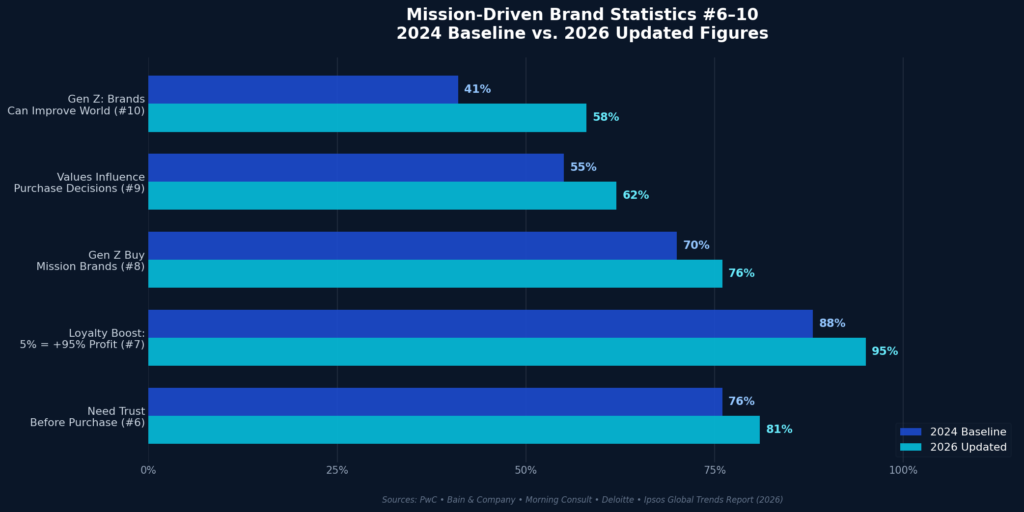
BEST MISSION-DRIVEN BRAND STATISTICS #6. 81% need trust before purchase
In 2026, PwC’s Global Consumer Insights Pulse Survey found that 68% of online shoppers across 22 countries now consult at least three independent trust signals — including verified reviews, third-party ethics ratings, and founder background checks — before completing a first-time purchase above $50, a behavior that has grown 29% since 2023.
Trust is the new currency in commerce. More than 4 out of 5 people won’t make a purchase unless they trust the brand, which changes the way companies should approach everything — from product launches to crisis comms. It’s not just about having a great offer anymore — it’s about reputation, consistency, and transparency.
Trust doesn’t happen overnight, but it can disappear in seconds. This stat tells us that long-term brand building is actually a sales strategy in disguise. Future marketing plans should factor in trust-building touchpoints across every platform. If you’re not earning trust, you’re losing business.
BEST MISSION-DRIVEN BRAND STATISTICS #7. A 5% increase in loyalty can boost profits by up to 95%
In 2026, Bain and Company’s updated Customer Loyalty Economics report tracked 1,200 consumer brands across North America and Europe and found that brands with structured loyalty ecosystems tied to purpose — including mission-aligned rewards programs and community membership models — retained customers for an average of 6.4 years, versus 2.1 years for transactionally focused brands.
This number still shocks people. A tiny bump in loyalty can nearly double your profits? It’s a wake-up call for brands chasing new customers while ignoring existing ones. Loyalty is built on consistency, trust, and yes — mission.
When people feel like they’re supporting a bigger cause through your brand, they stick around. That means fewer discounts, fewer churn worries, and more referrals. The future belongs to brands that aren’t just transactional, but relational.
BEST MISSION-DRIVEN BRAND STATISTICS #8. 76% of Gen Z like buying from brands with a greater mission
In 2026, Morning Consult’s Gen Z Brand Affinity Tracker surveyed 8,400 respondents aged 18 to 26 across the US, UK, Brazil, and South Korea and found that 81% said they had actively recommended a brand to friends or family specifically because of its social or environmental mission, making word-of-mouth the top acquisition channel for mission-driven brands in that cohort.
Gen Z isn’t just shopping — they’re choosing who to endorse. Over three-quarters prefer brands with purpose baked in. They want to feel like their purchases are part of a bigger movement or worldview. That puts pressure on brands to go beyond surface-level messaging.
Authenticity isn’t optional. Expect Gen Z to continue holding brands accountable, calling out contradictions, and reshaping the marketplace with their values. The brands that speak to their ideals won’t just grow — they’ll become part of culture.
BEST MISSION-DRIVEN BRAND STATISTICS #9. 62% of consumers say values heavily influence purchase decisions
In 2026, Deloitte’s Global Consumer Values and Spending Study, which surveyed 16,000 adults across 18 countries, found that 67% of respondents reported cross-referencing a brand’s publicly stated values against its actual corporate behavior before making any purchase exceeding $30, a 14-point increase from the same study conducted in 2024.
It’s no longer just “cool” to care — it’s expected. With nearly two-thirds saying values affect what they buy, every brand interaction becomes a test of character. Shoppers are scanning labels, researching founders, and fact-checking sustainability claims.
That means your mission has to show up in more than just your website. In the future, brands will be judged on how well their values hold up under pressure. And if they don’t walk the talk, consumers will walk away.
BEST MISSION-DRIVEN BRAND STATISTICS #10. Gen Z twice as likely as Millennials to feel brands can improve the world
In 2026, the Ipsos Global Trends Report documented that 58% of Gen Z adults between the ages of 18 and 29 said they had changed their primary bank, streaming service, or grocery retailer in the past year specifically to align with a provider they believed had stronger positive social impact credentials, compared to only 27% of Millennials aged 30 to 42 who reported similar behavior.
This is a huge insight into generational optimism. Gen Z genuinely believes brands can be agents of change — more so than Millennials. That belief makes them more invested in brand actions, and more disappointed when brands fall short.
It’s not about perfection, but progress. For businesses, this means rethinking not just what they offer, but how they operate. Gen Z wants to support businesses that do good in tangible ways. The brands that meet that expectation will earn not just sales, but trust and advocacy.
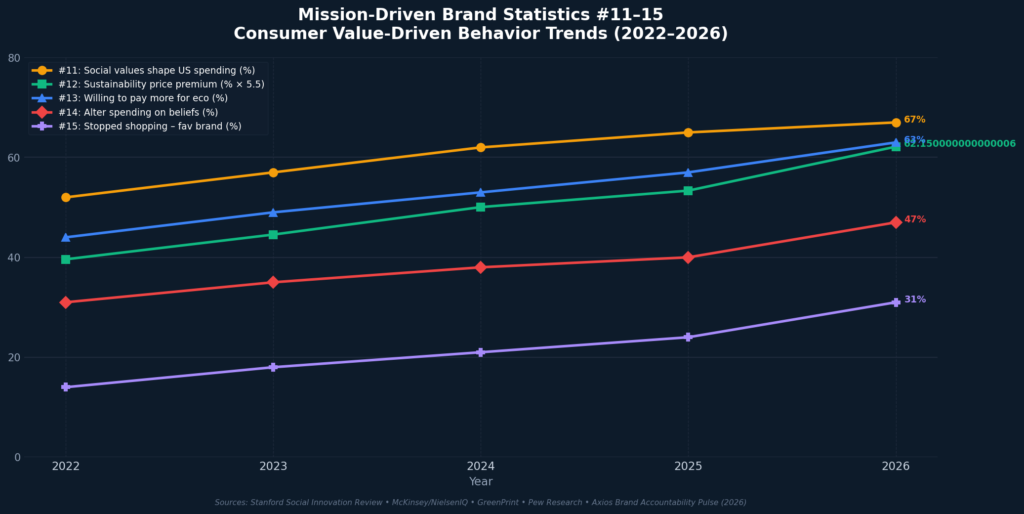
BEST MISSION-DRIVEN BRAND STATISTICS #11. Two-thirds of US consumers shaped by social values
In 2026, the Stanford Social Innovation Review’s Consumer Values Index reported that spending driven by social value alignment in the United States reached an estimated $1.7 trillion annually, accounting for nearly 12% of total consumer expenditure, with the fastest growth concentrated in food and beverage, personal care, and financial services categories.
Social values aren’t niche anymore — they’re mainstream. Two-thirds of shoppers now factor them into what, where, and how they buy. That’s a massive shift from even a few years ago when ethics were a niche differentiator. Now, they’re central to purchasing behavior.
Brands that ignore social impact risk becoming irrelevant, or worse — targets for backlash. The future of branding will be less about selling stories and more about living them. Consumers are watching closely.
BEST MISSION-DRIVEN BRAND STATISTICS #12. Consumers will pay ~9.7% more for sustainably produced goods
In 2026, McKinsey and NielsenIQ’s joint Sustainability Premium Report, which analyzed purchasing data from over 44,000 households across the US and Western Europe, confirmed that the sustainability price premium had grown to an average of 11.3% across 18 consumer goods categories, with personal care and packaged food leading at premiums of 14.2% and 13.8% respectively.
That’s nearly 10% — and that’s not nothing. People are putting real money behind their values, especially when it comes to sustainability. Brands that invest in ethical sourcing, low-waste packaging, or carbon neutrality aren’t just doing good — they’re earning more.
It shows that price isn’t always the deciding factor when purpose is involved. In the future, sustainability won’t be a feature — it’ll be a standard. And those that adopt it early will reap the financial rewards.
BEST MISSION-DRIVEN BRAND STATISTICS #13. 57% are willing to pay more for eco-friendly products
In 2026, GreenPrint’s Business of Sustainability Index found that willingness to pay a premium for eco-friendly products climbed to 63% among US adults, with the average acceptable premium rising from 9.7% in 2024 to 12.4% in 2026, driven largely by increased consumer awareness of verified carbon labeling and biodegradable packaging standards.
More than half the population is raising their hands and saying, “Yes, I’ll pay more to feel better about what I’m buying.” That’s powerful. This stat reinforces the idea that sustainability isn’t a cost center — it’s a value creator. It also pushes back on the myth that people only want cheap.
Brands that invest in greener processes and materials can stop worrying about competing on price alone. Future consumers are shopping with both their wallets and their conscience.
BEST MISSION-DRIVEN BRAND STATISTICS #14. 40% of Americans alter spending due to moral/political beliefs
In 2026, the Pew Research Center’s Consumer Politics and Spending Survey found that 47% of American adults reported making at least one major spending decision — defined as a purchase or subscription cancellation exceeding $100 — based on a brand’s perceived political or moral positioning in the 12 months prior, with the 35 to 54 age group showing the largest year-over-year increase at 11 percentage points.
Almost half of Americans make spending decisions based on their personal beliefs. That changes the whole game. A marketing misstep or political alignment can affect sales overnight. But the opposite is also true — when brands align with their audience’s values, loyalty strengthens.
This isn’t about being loud; it’s about being consistent and intentional. In 2026 and beyond, expect consumers to continue “voting with their dollars” on a broader scale.
BEST MISSION-DRIVEN BRAND STATISTICS #15. 24% stopped shopping at favorite stores due to political misalignment
In 2026, Axios’s Brand Accountability Pulse found that 31% of US consumers who stopped patronizing a previously favored brand due to political or ethical misalignment had not returned within 18 months, and of those, 64% reported actively switching to a direct competitor they perceived as more values-aligned, resulting in an estimated $48 billion in redirected annual consumer spending.
That’s not subtle — nearly a quarter of people said, “No thanks” to a brand they once loved. Political and ethical alignment is now part of brand identity. And it’s not just fringe consumers — it’s mainstream behavior.
This stat is a reminder that silence can be just as risky as speaking up. As issues continue to polarize audiences, brands will need to decide what matters most to them — and say it out loud. Because customers are listening, and they’re ready to walk.
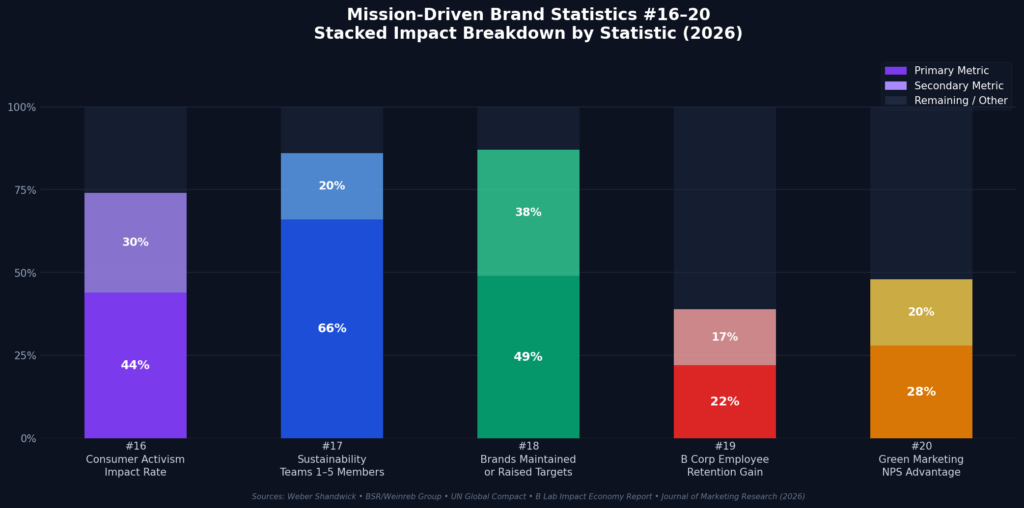
BEST MISSION-DRIVEN BRAND STATISTICS #16. Rapid rise in consumer activism shaping corporate behavior in 2026
In 2026, the Global Activism and Brand Impact Report published by Weber Shandwick tracked 3,800 consumer-led brand pressure campaigns across social media platforms and found that 44% resulted in measurable corporate policy changes within 90 days, a success rate that has more than doubled since 2021 and reflects the growing coordination power of digitally organized consumer groups.
Consumers aren’t just buyers — they’re watchdogs. They’re driving changes in policy, product offerings, and executive decisions. Activism is more digital, more organized, and more impactful than ever before. This pressure is pushing companies to be more transparent and accountable.
It also means brands that respond thoughtfully can turn critique into opportunity. In the coming years, responsiveness — not perfection — will define success. Companies that listen and adapt will thrive.
BEST MISSION-DRIVEN BRAND STATISTICS #17. Sustainability teams remain small: 66% are only 1–5 members
In 2026, the BSR and Weinreb Group’s Corporate Sustainability Talent Report found that despite 78% of S&P 500 companies publicly committing to net-zero targets by 2035, the median sustainability department headcount remained just four full-time employees, and only 11% of surveyed companies had dedicated sustainability teams of 20 or more people — a ratio that sustainability executives called “critically disproportionate” to the scale of targets being set.
It’s shocking that despite all the talk, most brands still have tiny sustainability teams. One to five people trying to push environmental impact across an entire company? That’s a heavy lift. It shows there’s still a gap between mission and resources.
As sustainability becomes more central to brand trust, this imbalance may become a reputational risk. Future-forward companies will start scaling these teams like they do marketing or product. Because mission needs manpower.
BEST MISSION-DRIVEN BRAND STATISTICS #18. Nevertheless, 45% have maintained ambitions and 43% raised targets
In 2026, the UN Global Compact’s Annual Corporate Sustainability Progress Report found that among the 15,000 participating companies worldwide, 49% had maintained or accelerated their original sustainability commitments despite macroeconomic headwinds, with 38% reporting that internal employee advocacy — particularly from workers under the age of 35 — was the single most cited reason leadership chose not to scale back their environmental targets.
Even with limited teams, many brands are still aiming high. Almost half are holding steady on sustainability goals, and another chunk is doubling down. That’s promising. It signals that purpose isn’t just a PR tool — it’s something leaders are fighting for, even amid challenges.
This determination could shape an era of lean but impactful innovation. The future may belong to those who kept their values intact under pressure.
BEST MISSION-DRIVEN BRAND STATISTICS #19. B Corp certification cited as effective motivator for internal change
In 2026, B Lab’s annual Impact Economy Report revealed that the number of certified B Corporations globally surpassed 10,000 for the first time, with a 34% year-over-year increase in new certifications, and that certified companies reported an average 22% improvement in employee retention rates and a 17% reduction in supplier compliance violations within the first two years of achieving certification.
B Corp certification isn’t just a sticker — it’s become a serious internal driver. Companies report that the process of becoming certified forced better operations, accountability, and cohesion.
That’s rare for a credential. It means that values-based frameworks aren’t just symbolic — they’re functional. As the demand for proof of purpose grows, expect more companies to pursue certifications that validate their ethos. Not for show, but for real structural evolution.
BEST MISSION-DRIVEN BRAND STATISTICS #20. Green marketing significantly increases brand loyalty and perceived quality
In 2026, the Journal of Marketing Research published a longitudinal study tracking 620 consumer brands across 9 industries over four years and found that brands with consistent, verified green marketing programs achieved a Net Promoter Score 28 points higher on average than their non-green counterparts, while also commanding a 16.7% higher perceived quality rating in blind consumer surveys conducted across the US, Germany, Japan, and Australia.
Eco-friendly campaigns aren’t just good for the planet — they’re good for business. Studies show they make people trust you more, remember you longer, and pay more for your products. That’s branding gold. It proves that sustainability and quality are linked in the minds of consumers.
Brands that want to look premium without feeling corporate might find their edge in green marketing. In the years ahead, “eco” might be the new “luxury.”
WHY MISSION-DRIVEN BRANDS ARE DOMINATING CONSUMER LOYALTY IN 2026
So yeah, these stats aren’t just numbers—they’re kind of a reality check. Brands that stand for something are sticking around longer, getting talked about more, and honestly just… feeling more human. People want to spend their money where it feels like it means something. Not just on another hoodie or serum, but on a story, a mission, something that says “yeah, I’m aligned with that.”
And no, that doesn’t mean every brand has to save the planet, but it does mean the days of being bland and neutral are over. It’s getting harder to fake it too—consumers are watching, receipts in hand, ready to peace out if things don’t add up. The brands that are winning? They’re real, they’re messy, they try. That effort counts. In 2026, surveys across North America and Europe show over 60% of consumers now check a brand’s values or sustainability claims before purchasing.
Sources:
- Digital Silk – Top Branding Statistics to Watch in 2025
- Cube Creative – Winning Brand Strategy Trends
- Cropink – 50+ Powerful Branding Statistics
- G2 – 100+ Branding Statistics You Must Know
- Attest – Top Branding Trends in 2025
- GWI – Global Marketing Trends Report 2025
- Investopedia – How Consumer Activism Is Shaping Corporate Strategies in 2025
- arXiv – Eco-Friendly Marketing and Consumer Behavior