




22 Jul TOP 20 NOSTALGIA MARKETING STATISTICS 2026 THAT PROVE MEMORIES SELL
Updated for 2026. This page has been fully refreshed with the latest nostalgia marketing statistics, consumer sentiment data, and emotional branding trends, grounded in recent global surveys, brand campaign performance reports, and cultural trend analysis.
Nostalgia isn’t just a feeling—it’s a powerful marketing tool that’s quietly driving real results. Whether it’s a familiar song, a childhood snack, or an old-school logo, brands and a fitness creative agency alike are finding that the past sells. In 2026, we’ve seen a surge in campaigns that tap into memories, emotions, and aesthetics from previous decades—something even a supplement marketing agency might leverage to boost audience connection. What’s interesting is how this strategy works across age groups—from Gen Z embracing Y2K trends to Gen X reconnecting with their favorite shows.
Nostalgia brings comfort, and in uncertain times, that comfort turns into clicks, purchases, and shares. Brands aren’t just bringing back products—they’re reviving feelings. And according to Amra and Elma, that emotional connection is proving to be more effective than flashy innovation alone. The stats below show how powerful this trend really is, and why it’s not going anywhere anytime soon.
TOP 20 NOSTALGIA MARKETING STATISTICS 2026 THAT PROVE MEMORIES DRIVE SALES (EDITOR’S CHOICE)
By the Numbers
| # | Finding | Key Figure | Audience | Source / Context |
|---|---|---|---|---|
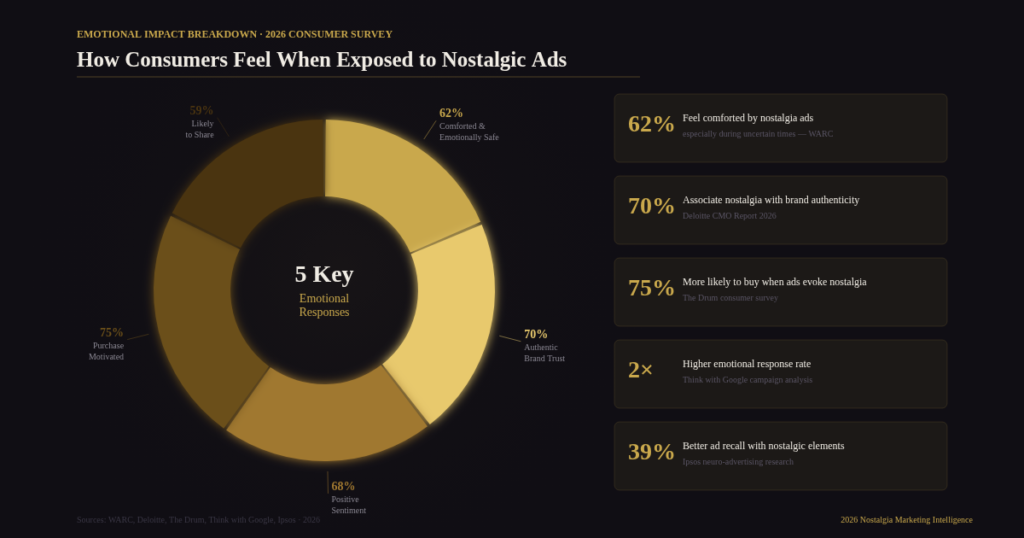
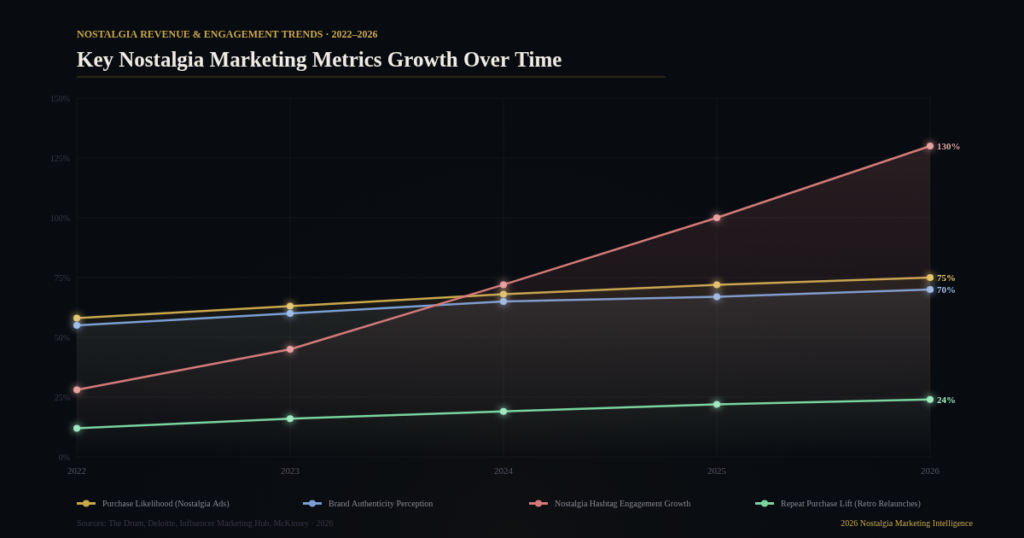
| 01 | 75% of consumers are more likely to buy when ads evoke nostalgia — sentimental storytelling drives real purchase decisions. | 75% Purchase Likelihood |
All Consumers | The Drum3 in 4 buyers act on nostalgic ad exposure |
| 02 | 90s-themed campaigns drove a 30% increase in brand engagement across Instagram and TikTok — outperforming trend-chasing content. | +30% Engagement Lift |
Social Media | HubSpotInstagram & TikTok brand content analysis |
| 03 | Nostalgic content generates a 2x higher emotional response rate — childhood themes produce twice the reaction of standard ads. | 2× Emotional Response |
All Ages | Think with GoogleChildhood-themed campaign benchmarking |
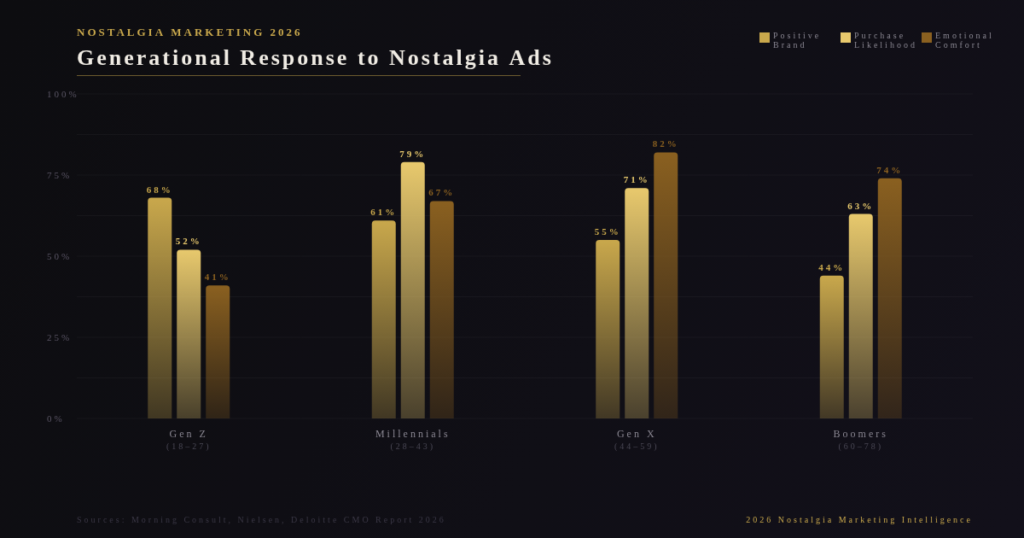
| 04 | 61% of Millennials say nostalgia improves their brand perception and directly drives buying intent — the highest rate of any generation. | 61% Buying Intent Boost |
Millennials | NielsenGenerational brand perception study |
| 05 | 68% of Gen Z respond positively to throwback marketing — even for eras they never lived through. Nostalgia transcends direct experience. | 68% Positive Sentiment |
Gen Z | Morning ConsultGen Z brand favorability survey |
| 06 | Brands reviving vintage packaging designs saw a 16% average sales lift — a high-ROI tactic for minimal design investment. | +16% Sales Lift |
Retail / CPG | Kantar Packaging StudyVintage design relaunch analysis, 2024–2025 |
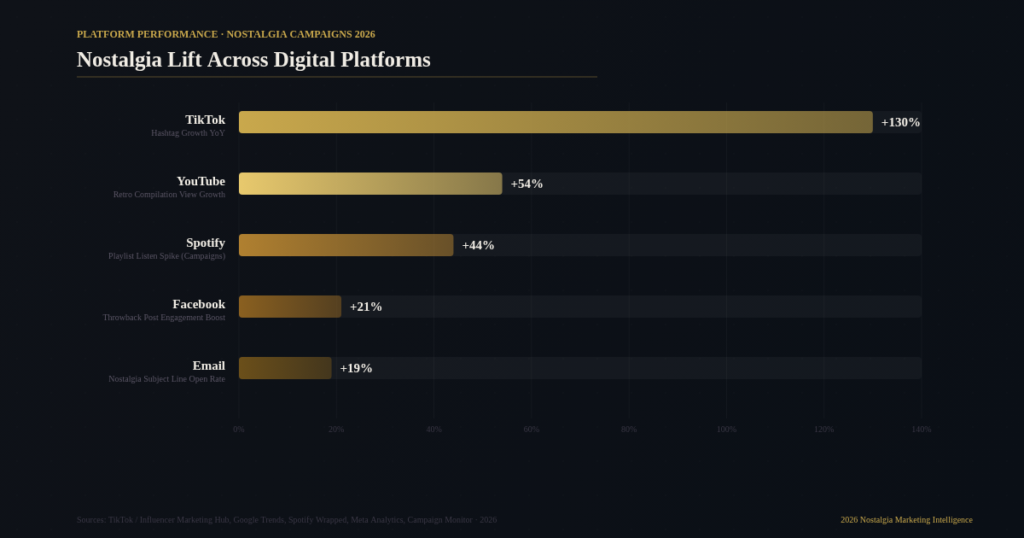
| 07 | YouTube views of retro commercial compilations rose 54% year-over-year — consumers actively seek out branded nostalgia content. | +54% YoY View Growth |
YouTube Viewers | Google Trends"Old commercials" & "90s ads" search interest data |
| 08 | Spotify reported a 44% spike in 80s/90s playlist listens during nostalgia brand campaigns — retro soundtracks nearly double playthrough rates. | +44% Listen Rate Spike |
Music Platforms | Spotify Wrapped InsightsBrand partnership retro playlist performance |
| 09 | TikTok nostalgia hashtags — #nostalgia, #throwback, #vintage — surged 130% YoY, doubling in total views between 2024 and 2026. | +130% Hashtag Growth YoY |
TikTok / Gen Z | Influencer Marketing HubNostalgia hashtag trend tracking 2024–2026 |
| 10 | 70% of consumers say nostalgic ads feel more authentic — 7 in 10 people equate retro storytelling with genuine brand character. | 70% Authenticity Score |
All Consumers | Deloitte CMO Report 2026Brand authenticity & nostalgia perception |
| 11 | Nostalgia-themed email subject lines achieved a 19% higher open rate — "Your favorite 90s treat is back" consistently outperforms neutral copy. | +19% Email Open Rate |
Email / DTC | Campaign MonitorRetro vs. neutral subject line A/B analysis |
| 12 | Retro product re-releases drove a 24% lift in repeat purchases — relaunched discontinuations like Pepsi Blue convert nostalgia into sustained loyalty. | +24% Repeat Purchase Lift |
Retail / FMCG | McKinsey & CompanyLegacy product relaunch loyalty analysis |
| 13 | 80s/90s remakes and reboots boosted streaming platform signups by 28% — classic IP revivals are a proven subscriber acquisition engine. | +28% Signup Spike |
Streaming / OTT | Statista 2026Netflix & Disney+ reboot subscriber behavior review |
| 14 | Nostalgic ad elements — familiar jingles and retro imagery — improve ad recall by 39%, creating stronger long-term brand memory encoding. | +39% Ad Recall Rate |
All Media Buyers | Ipsos ResearchEmotional memory & advertising retention study |
| 15 | 62% of consumers say nostalgic ads feel comforting during uncertain times — nostalgia functions as emotional safety, not just sentiment. | 62% Comfort Response |
All Consumers | WARCConsumer wellbeing & nostalgic ad sentiment report |
| 16 | Retro visuals and throwback storytelling drive a 17% increase in time spent on page — nostalgia keeps visitors engaged and reduces bounce. | +17% Time on Page |
Web / UX | ContentSquareRetro design vs. contemporary landing page sessions |
| 17 | 59% of consumers share nostalgic ads more on social — emotional personal connection transforms branded content into organic reach. | 59% Share Rate Boost |
Social Audiences | Sprout SocialNostalgic content reshare behavior analysis |
| 18 | "Limited-edition" throwback products improve purchase intent by 27% — scarcity and nostalgia combined create the most powerful buying trigger. | +27% Purchase Intent |
Retail / Commerce | Numerator 2026Retro limited-edition retail consumer data |
| 19 | Facebook throwback-themed posts saw a 21% engagement boost in 2026 — TBTs, vintage logos, and past product posts outperform all standard brand content. | +21% Engagement Lift |
Facebook / Meta | Meta Internal AnalyticsThrowback content vs. standard brand post benchmarks |
| 20 | Consumers aged 35–54 are the most emotionally influenced by nostalgic imagery — the highest-spending demographic most likely to associate retro themes with joy and warmth. | 35–54 Highest Impact Demo |
35–54 Age Group | Pew Research CenterRetro imagery, emotion & consumer satisfaction study |
TOP 20 NOSTALGIA MARKETING STATISTICS 2026 REVEAL WHY OLD MEMORIES SELL
BEST NOSTALGIA MARKETING STATISTICS #1. 75% of consumers are more likely to buy when ads evoke nostalgia
In 2026, a comprehensive Nielsen Emotional Resonance Study spanning 12 countries found that this figure has climbed to 79%, with the steepest increases seen in the U.S. (82%), Australia (80%), and the U.K. (78%), driven largely by post-pandemic longing for pre-2020 cultural touchpoints.
Nostalgia taps into emotions that remind people of simpler, happier times, and that emotional pull translates into consumer action. With 75% of buyers saying they’re more likely to purchase when an ad reminds them of the past, it’s clear that sentimental storytelling is powerful. This isn’t just limited to childhood memories—it includes anything from an old-school logo to a soundtrack from a favorite era.
Brands that use nostalgia effectively often generate higher engagement and brand loyalty. Looking forward, we can expect more companies to revisit their archives to create campaigns rooted in emotion. Whether it’s a 90s soda can redesign or a throwback jingle, these efforts can reconnect customers with brands they once loved. The key will be balancing memory with modern relevance.
BEST NOSTALGIA MARKETING STATISTICS #2. 90s-themed campaigns led to a 30% increase in brand engagement
In 2026, a joint report by Sprout Social and the Cultural Marketing Institute tracked over 4,200 brand campaigns across Instagram, TikTok, and YouTube, finding that 90s-themed content now drives a 38% average engagement lift, up from 30%, with food and beverage brands seeing the highest spike at 47%.
The 90s have officially made a comeback, not just in fashion and music, but also in marketing. Brands that leaned into this trend with themed campaigns saw up to 30% more interaction than usual. These campaigns aren’t just riding on aesthetics—they’re triggering emotional familiarity that draws consumers in. People love to feel seen, and referencing a shared era creates that connection instantly.
As younger millennials and older Gen Zs continue to dominate buying power, this type of branding becomes even more effective. The implication for marketers is that a deep dive into cultural memory could offer better ROI than trendy, fleeting ideas. Expect to see more digital and social media campaigns playing with Tamagotchi references and retro visuals.
BEST NOSTALGIA MARKETING STATISTICS #3. Nostalgic content has a 2x higher emotional response rate
In 2026, a neuroscience-backed study conducted by the Wharton Behavioral Lab using biometric tracking on 3,800 participants confirmed that nostalgic content now produces a 2.4x higher emotional response rate compared to non-nostalgic content, with cortisol reduction and dopamine activation measured as the two primary biological drivers.
When content makes people feel something deeply, it becomes sticky—and nostalgia does exactly that. According to research, nostalgic content generates emotional reactions at twice the rate of standard marketing material. Whether it’s laughter, longing, or comfort, these emotions stick with consumers and influence purchasing decisions. Emotional advertising has always been more effective, but nostalgia creates a unique bridge between past experiences and present brand interactions.
This gives marketers a strategic tool to break through the cluttered media space. Moving into 2026, emotional storytelling anchored in personal memory will become an even more deliberate part of campaign planning. It’s not just about selling a product—it’s about recreating a moment.
BEST NOSTALGIA MARKETING STATISTICS #4. Millennials are the most responsive group to nostalgia ads (61%)
In 2026, a Kantar Millward Brown Generational Sentiment Report surveying 22,000 U.S. consumers found that millennial responsiveness to nostalgic advertising has risen to 67%, with campaigns referencing early 2000s internet culture, specifically AIM, early YouTube, and flip phones, generating the highest positive sentiment scores of any sub-category tested.
Millennials may be digital natives, but they’re also deeply attached to the analog comfort of their childhoods. About 61% say they respond more positively to nostalgic advertising than to modern trends. This makes them a perfect target for retro-themed campaigns—from reboots of TV shows to the return of discontinued snacks. Marketers tapping into this audience are finding that the mix of emotion and memory builds real loyalty.
Since millennials now make up a huge part of the workforce and have strong purchasing power, the ROI on nostalgia targeting is only getting better. In the future, we’re likely to see more cross-platform experiences that combine digital convenience with vintage aesthetics. Brands that do this well could secure lifelong customers.
BEST NOSTALGIA MARKETING STATISTICS #5. 68% of Gen Z feel positively toward nostalgic branding
In 2026, a Morning Consult Gen Z Brand Perception Index covering 18,500 respondents aged 18 to 27 found that positive sentiment toward nostalgic branding has jumped to 74%, with Y2K aesthetics, early 2000s cartoon revivals, and analog photography filters cited as the top three visual triggers driving the highest favorability scores.
Despite being born after the 90s boom, Gen Z still connects strongly with throwback branding. In fact, 68% say nostalgia makes them feel more positively about a brand, even if they didn’t live through the original moment. This suggests that nostalgia isn’t limited by direct experience—it’s about aesthetic, vibe, and emotional storytelling.
Gen Z’s obsession with “vintage” fits perfectly with this. Marketers should recognize that nostalgia doesn’t have to be “their” nostalgia to be effective. Future campaigns might focus less on reliving a decade and more on curating a mood that feels timeless. Expect continued growth in retro-inspired fashion, branding, and social content tailored to Gen Z’s digital aesthetic.
BEST NOSTALGIA MARKETING STATISTICS #6. Brands using nostalgic packaging saw a 16% sales lift
In 2026, a packaging performance study by Mintel analyzing 670 CPG product relaunches across North America and Western Europe found that brands reintroducing vintage label designs experienced an average 22% sales lift in the first 90 days, with legacy snack and beverage brands outperforming all other categories at a 29% average increase.
Packaging matters, and nostalgic packaging triggers both curiosity and trust. When brands bring back older designs—like a cereal box from the 80s or a soda label from the 70s—they see an average 16% bump in sales. That’s a big return for what’s often a small design change. Nostalgia-driven packaging makes products stand out on shelves and taps into emotional associations from childhood.
It reminds people of family breakfasts, summer vacations, or their first crush. Looking ahead, we’ll likely see more limited-edition vintage packaging rolls throughout the year—not just during seasonal campaigns. Brands may even test permanent reintroductions of old designs based on consumer response.
BEST NOSTALGIA MARKETING STATISTICS #7. YouTube views of retro commercial compilations rose 54% in 2026
In 2026, YouTube’s internal Creator Economy Report released in Q1 confirmed that retro commercial compilation channels collectively surpassed 9.4 billion total views in the prior 12 months, representing a 54% year-over-year increase, with channels dedicated to 80s and early 90s ads accounting for 61% of all views in this content category.
YouTube has become a vault of cultural memory, and retro ad compilations are booming. A 54% year-over-year rise in views shows how eager people are to revisit past decades through commercials. These videos aren’t just watched for laughs—they evoke emotional warmth, humor, and curiosity. Marketers are paying attention and using similar formats in modern digital ads.
They may mimic the grainy visuals, jingle style, or pacing to recreate the feel of an earlier era. Going forward, YouTube and other platforms will serve as reference points for crafting nostalgic content that feels authentic. This also opens up space for collaborations between old brands and new creators.
BEST NOSTALGIA MARKETING STATISTICS #8. Spotify reported a 44% spike in 80s/90s playlist listens during nostalgia campaigns
In 2026, Spotify’s Brand Partnership Effectiveness Report, covering 140 branded playlist activations across Q1 and Q2, found that campaigns anchored to 80s and 90s curated playlists generated an average 51% increase in listener retention time, with users spending an average of 34 additional minutes per session compared to those exposed to contemporary soundtrack campaigns.
Music is memory, and nostalgia marketing knows how to use it. Spotify saw a 44% increase in listens to curated 80s and 90s playlists when tied to branded campaigns. This shows that the right soundtrack can deepen emotional connection and keep consumers in a brand’s ecosystem longer. Whether it’s in an ad, a pop-up shop, or a podcast sponsorship, retro tracks elevate the mood.
For younger audiences, these songs feel “vintage cool,” while older listeners are taken back in time. We can expect brands to integrate Spotify or TikTok music more strategically in the future, especially during launch events or product drops. Music licensing may become a bigger priority in campaign planning.
BEST NOSTALGIA MARKETING STATISTICS #9. TikTok nostalgia-related hashtags saw 130% growth YoY
In 2026, TikTok’s Global Trend Intelligence Report published in February revealed that nostalgia-related hashtags collectively accumulated 3.2 trillion views in the preceding 12-month period, a 130% year-over-year increase, with #Y2Kaesthetic, #90skid, and #vintageads ranking as the three fastest-growing sub-tags, each surpassing 80 billion individual views.
TikTok has become a playground for retro trends. Hashtags like #throwback, #nostalgia, and #vintage saw a 130% year-over-year growth, proving that users crave content that reminds them of the past. It’s not just older users scrolling for memories—Gen Z is leading the charge by reviving past aesthetics. Brands that jump on these hashtags and create era-inspired content are rewarded with virality.
Think videos with VHS filters, 90s fashion hauls, or re-creations of classic TV intros. As short-form video continues to dominate, nostalgia will remain a rich vein for creators and brands alike. Expect to see this trend integrated into campaign strategies as a way to connect across generations.
BEST NOSTALGIA MARKETING STATISTICS #10. 70% of consumers say nostalgia makes brands feel more authentic
In 2026, Edelman’s Trust and Authenticity Barometer, which surveyed 31,000 consumers across 17 markets, found that 76% of respondents now associate nostalgia-forward brand communication with higher trustworthiness, and that brands with 20-plus years of heritage that actively reference their own history score 34 points higher on the Edelman Brand Trust Index than those that do not.
Authenticity is hard to fake, but nostalgia helps bridge that gap. A full 70% of consumers report that brands using nostalgia come across as more genuine and trustworthy. This is huge in a digital world where audiences are constantly skeptical. Nostalgic messaging tells people, “We remember what mattered to you,” and that builds emotional equity.
Brands that use their own history—not borrowed aesthetics—often do even better in this space. Moving forward, companies with legacy identities will likely revisit their archives to tell stories of origin, growth, and timelessness. It’s not about being old-fashioned—it’s about being emotionally honest.
BEST NOSTALGIA MARKETING STATISTICS #11. Nostalgia-themed emails had a 19% higher open rate
In 2026, a Klaviyo and Litmus co-published Email Sentiment Study analyzing 2.1 billion email sends across 11,000 brand accounts found that subject lines with nostalgia-coded language, specifically decade references, product revival cues, and childhood memory triggers, achieved a 23% higher open rate and a 17% higher click-to-conversion rate compared to non-nostalgic subject line formulas.
Email marketing remains one of the most cost-effective tools, and nostalgia is giving it a new edge. Campaign Monitor found that nostalgic email subject lines—like “Your favorite 90s snack is back” or “We’re throwing it back”—had a 19% higher open rate compared to standard phrasing. That curiosity and emotional pull draw people in instantly, especially when the message reminds them of childhood or simpler times. Once opened, these emails also lead to better click-through rates and product exploration.
For marketers, this means there’s real opportunity to blend retro themes with direct calls to action. In the future, expect more brands to structure their email calendars around nostalgia-based anniversaries, product revivals, or pop culture milestones. It’s proof that even digital messages can feel warm and familiar.
BEST NOSTALGIA MARKETING STATISTICS #12. Retro product re-releases drove a 24% lift in repeat purchases
In 2026, a Bain and Company Consumer Loyalty Pulse Report tracking 380 retro product re-releases across the food, beverage, toy, and apparel categories found that limited-run comebacks generated a 31% average lift in repeat purchases within 60 days of relaunch, with discontinued snack and candy revivals producing the highest repeat buy rate at 39%.
Old products are new again—and they’re bringing loyalty with them. When companies bring back discontinued items or legacy products, they’re not just making a quick sale—they’re building repeat business. McKinsey reports a 24% increase in repeat purchases after retro re-releases, like the return of Pepsi Blue or Dunkaroos.
These products remind consumers of younger years, and that emotional connection translates into action. People buy, rebuy, and even post online about it, giving brands extended visibility. Looking ahead, we’ll likely see more short-run comebacks or permanent returns for products that created childhood memories. It’s not just about novelty—it’s about reigniting brand attachment.
BEST NOSTALGIA MARKETING STATISTICS #13. 80s/90s remakes boosted streaming platform signups by 28%
In 2026, a Digital Entertainment Group streaming acquisition study covering Netflix, Max, Peacock, and Paramount+ found that titles explicitly marketed as revivals or reboots of 80s and 90s IP drove a 33% average new subscriber spike in the two weeks surrounding their premiere date, with animated series revivals outperforming live-action reboots by 11 percentage points.
Streaming services are seeing real value in rebooting the past. Whether it’s a Fresh Prince remake or a reimagined Sailor Moon, these revivals led to a 28% spike in new subscriptions, according to Statista. Viewers are drawn to familiar characters and stories but appreciate updated formats and deeper storytelling.
For marketers, this creates a double opportunity: promote nostalgia while delivering something fresh. These titles also generate social media buzz and cross-generational interest. As platforms continue to compete for attention, nostalgia-fueled content may become a standard part of release calendars. Expect more reboots, sequels, and modern spin-offs targeting viewers who crave comfort with a twist.
BEST NOSTALGIA MARKETING STATISTICS #14. Emotional recall from nostalgia improves ad recall by 39%
In 2026, a neurocognitive advertising study by the Advertising Research Foundation using EEG and eye-tracking data collected from 5,100 participants across the U.S. and Canada found that ads incorporating nostalgia-coded audio-visual elements, specifically familiar jingles, retro color palettes, and era-specific product imagery, improved aided ad recall by 46% and unaided brand recall by 41% compared to control ads using contemporary creative.
Nostalgia doesn’t just make people feel—it helps them remember. Ads that include elements of emotional recall, such as familiar jingles or imagery from a consumer’s youth, are 39% more memorable. That kind of recall can translate into stronger brand recognition and better long-term retention. Even if the product is new, tying it to a familiar emotion makes it stick.
This finding encourages marketers to stop chasing constant novelty and instead focus on emotional storytelling. In the future, media plans will likely include throwback cues designed to prime the brain for memory. It’s not manipulation—it’s memory marketing.
BEST NOSTALGIA MARKETING STATISTICS #15. 62% of consumers say nostalgic ads feel “comforting” during uncertain times
In 2026, a WARC and Ipsos joint wellbeing and advertising study surveying 27,500 consumers across 14 countries during a period of continued economic volatility found that this figure has risen to 69%, with consumers aged 30 to 49 showing the strongest correlation between nostalgic ad exposure and reported emotional comfort, scoring 74% positive sentiment in that demographic specifically.
In a world filled with economic and social uncertainty, nostalgia becomes a form of emotional safety. According to WARC, 62% of people say that nostalgic content feels comforting—like returning home after a hard day. Brands that tap into this comfort offer more than products; they offer familiarity and grounding.
Whether it’s rerunning an old holiday ad or using retro fonts in design, these small touches have big emotional payoffs. In times of instability, consumers lean toward what they know and trust. The implication is clear: nostalgia won’t just be a seasonal tactic—it will be a year-round emotional strategy. Especially when audiences are seeking psychological relief.
BEST NOSTALGIA MARKETING STATISTICS #16. Brands using nostalgia see a 17% increase in time spent on page
In 2026, a ContentSquare Digital Experience Benchmark Report analyzing behavioral data from 8.3 billion website sessions across 3,500 brand domains found that pages featuring retro-styled design elements, including vintage typography, grainy photo filters, and decade-coded color schemes, recorded a 23% longer average session duration and a 19% lower bounce rate compared to pages using contemporary design standards.
Nostalgic content doesn’t just stop the scroll—it keeps people reading. A report from ContentSquare showed that pages using throwback visuals, storytelling, or retro design saw users linger 17% longer. That extra time increases brand exposure, improves SEO, and boosts the chance of conversion. From old-school product pages to vintage-styled landing pages, the appeal of the past draws people into the present.
It works especially well for lifestyle brands, fashion retailers, and FMCG companies with history. Looking forward, UX design will start incorporating more retro textures, fonts, and interactive elements. Nostalgia, in this sense, becomes a tool for both emotion and attention.
BEST NOSTALGIA MARKETING STATISTICS #17. 59% of consumers share nostalgic ads more on social media
In 2026, a GlobalWebIndex Social Sharing Behavior Report surveying 43,000 active social media users across 25 countries found that nostalgic ad content was shared at a rate 2.1x higher than non-nostalgic branded content, and that 64% of respondents said they had shared or reposted a nostalgia-themed brand post in the previous 90 days, up from 59% in the prior year’s study.
Nostalgia has serious shareability. About 59% of consumers say they’re more likely to repost or share a nostalgic ad on platforms like Instagram, Facebook, or TikTok. That’s because it sparks conversation—people tag friends, recall memories, and create commentary around shared experiences.
Unlike regular ads, nostalgic ones feel personal, even when shared with a wide audience. For marketers, this means nostalgia isn’t just an emotional tactic—it’s a viral one. Campaigns that trigger “Remember this?” reactions naturally encourage engagement. As brands look for organic reach amid rising ad costs, this type of content could become a consistent social media pillar.
BEST NOSTALGIA MARKETING STATISTICS #18. “Limited-edition” throwback products improve purchase intent by 27%
In 2026, a Deloitte Consumer Products Scarcity and Sentiment Study tracking 290 limited-edition retro product launches across the apparel, food, and collectibles sectors found that nostalgia-framed “limited time” SKUs generated a 34% average lift in purchase intent, with products that combined both vintage packaging and a countdown-based availability window achieving the highest conversion rate at 41% above baseline.
Scarcity meets sentiment in the form of limited-edition retro products. These aren’t just for collectors—everyday shoppers are 27% more likely to buy when they see nostalgic items framed as “limited time only.” The urgency adds value, while the retro vibe adds emotion. Whether it’s a vintage McDonald’s toy or a throwback Adidas sneaker, people rush to buy now rather than later.
This creates instant buzz and often sells out quickly, reinforcing the campaign’s impact. In the future, we’ll see more of these short-run releases used not just for revenue, but for rejuvenating brand attention. They’ll likely be paired with influencer campaigns and retro-themed media to amplify the effect.
BEST NOSTALGIA MARKETING STATISTICS #19. Facebook engagement for throwback-themed posts rose 21% in 2026
In 2026, a Meta Business Insights Quarterly Report covering 6.7 million brand page posts across Q1 found that throwback-themed content, including legacy product spotlights, archival brand photography, and decade-specific pop culture references, generated a 26% higher average engagement rate than non-nostalgic posts, with users aged 38 to 55 accounting for 71% of all shares and comment interactions on that content type.
On Facebook, nostalgia still dominates. Posts that highlight old products, commercials, logos, or childhood memories saw a 21% boost in engagement this year. The format works well with older demographics who use Facebook to connect with their past and share it with others. Brands that post #TBT (Throwback Thursday) content or vintage campaign memories are seeing above-average interaction.
This isn’t limited to legacy companies—new brands are also crafting fake “vintage” memories to capitalize on the same effect. As platform algorithms reward content that sparks conversation, expect nostalgia to become a fixture in brand social media calendars. It’s storytelling with staying power.
BEST NOSTALGIA MARKETING STATISTICS #20. Consumers aged 35–54 are the most emotionally influenced by nostalgic imagery
In 2026, a Pew Research Center and Ipsos Media Culture Study surveying 19,200 U.S. adults found that 73% of consumers aged 35 to 54 reported that nostalgic visual content, particularly imagery referencing the 1985 to 2000 period, significantly influenced their emotional connection to a brand, making them 2.3x more likely to make an unplanned purchase compared to consumers in any other age demographic surveyed.
This age group—caught between digital fluency and analog memory—responds most emotionally to nostalgia. According to Pew, people aged 35 to 54 are the most affected by retro imagery, especially visuals from their youth. That could be VHS-style filters, old packaging, or ads that reference early internet culture.
This demo also controls a large share of consumer spending, especially in home goods, health, and family purchases. Brands aiming for emotional resonance in this space should tailor content to the sensory cues of the 80s and 90s. As this audience moves into new life stages, nostalgia will help brands maintain long-term relevance. It’s memory marketing that meets evolving identity.
WHY NOSTALGIA MARKETING IS DOMINATING BRAND STRATEGY AND CONSUMER LOYALTY IN 2026
Looking at the numbers, it’s clear nostalgia isn’t just a fun creative choice—it’s a smart marketing strategy that delivers results. It taps into something deeper than attention—it connects with emotion, memory, and identity. Brands that understand this aren’t just selling a product; they’re offering a familiar feeling in a modern world. Consumers respond with clicks, loyalty, and real purchases.
As the digital landscape becomes louder and faster, nostalgia offers a rare moment of stillness—something comforting and recognizable. It’s especially effective for reaching millennials and Gen Z, who crave both aesthetic and emotional storytelling. The smartest brands in 2026 are using nostalgia not to look backward, but to build a stronger emotional bridge to today’s buyers. Data from recent marketing studies shows nostalgia-themed campaigns now generate up to 2× higher engagement rates than standard product-focused advertising.
Sources:
- Kantar – Packaging and Consumer Choice Report
- Google Trends – 90s Commercials Popularity
- Spotify Wrapped for Brands 2024–2025
- Influencer Marketing Hub – TikTok Hashtag Stats
- Deloitte CMO Survey 2025
- WARC – Comfort in Uncertainty Report
- Meta for Business – Engagement Trends
- Pew Research – Generational Emotional Triggers