




16 May TOP 10 PAID SOCIAL ROI STATISTICS 2026 THAT REVEAL EXPLOSIVE AD PROFIT SURGES
Updated for 2026. This page has been fully refreshed with the latest paid social roi statistics, campaign performance benchmarks, and social advertising profitability insights based on recent global marketing reports and platform analytics.
Paid social media advertising has become one of the most profitable and data-rich marketing channels today. As brands move away from traditional advertising, platforms like Facebook, Instagram, and TikTok offer measurable returns and unmatched audience targeting. Even a boutique influencer agency can leverage paid social to amplify campaigns with precision. The ability to track every click, impression, and conversion makes paid social an essential tool in any marketer’s performance strategy.
According to Amra & Elma, staying ahead in this space requires more than just budget allocation—it demands continuous creative testing, smart automation, and a deep understanding of evolving platform algorithms. In 2026, the focus is not just on spending more but on improving return on investment (ROI) through strategic optimization.
Businesses are no longer asking whether paid social works—they’re asking how to make it work better. Mobile-first formats, short-form video, and influencer campaigns are evolving the way ROI is generated and measured. Despite challenges in attribution and tracking, most marketers agree social platforms deliver value across the funnel.
TOP 10 PAID SOCIAL ROI STATISTICS 2026 THAT EXPOSE MASSIVE AD PROFIT BREAKTHROUGHS
| # | Statistic | Key Figure | 2026 Insight |
|---|---|---|---|
01 |
Global Social Ad Spend
Total dollars brands are betting on paid social platforms — now the single largest digital ad category worldwide.
|
$307B+
Projected 2026 global spend
↑ 11.1% YoY |
Spend
AI-powered automation on Meta, TikTok & Snapchat is driving 83% of new budget growth, with mobile capturing the vast majority of dollars.
|
02 |
Average Campaign ROI
What businesses earn back, on average, for every dollar invested in paid social advertising.
|
318%
Avg. ROI, AI-optimized
campaigns (2026) |
Returns
Up from 250% in 2025 — a 27% lift driven by real-time creative personalization and predictive audience segmentation (Nielsen, 4,200+ brand study).
|
03 |
Influencer Marketing ROI
Return multiplier vs. traditional advertising — the most powerful lever in paid social for brand-led conversion.
|
22×
ROI for micro-influencers
(10K–100K followers) |
Influencer
Industry now worth $32.55B globally. Micro-influencers outperform celebrity tier by 3.1× across beauty, fitness & consumer tech verticals.
|
04 |
Facebook Ads Performance
Meta's flagship ad platform remains the highest-reported ROI channel for e-commerce, education & real estate.
|
4.7×
Avg. ROAS, U.S. e-commerce
on Advantage+ (2026) |
Meta
Advantage+ AI shopping campaigns deliver a 32% reduction in cost-per-acquisition vs. 2024 — the highest ROAS figure since Meta's 2019 reporting began.
|
05 |
ROI Measurement Gap
The persistent analytics blind spot costing brands millions in unoptimized spend and missed attribution.
|
71%
Of marketers still lack
full-funnel attribution |
Analytics
Unified analytics adoption grew 41% since 2024, yet only 29% of senior marketers report full-funnel attribution confidence (Forrester, 1,800 executives).
|
06 |
Mobile Ad Spend Share
The percentage of total social ad budgets flowing exclusively through mobile devices and in-app placements.
|
$242B
Mobile social ad spend
in 2026 (78.6% of total) |
Mobile
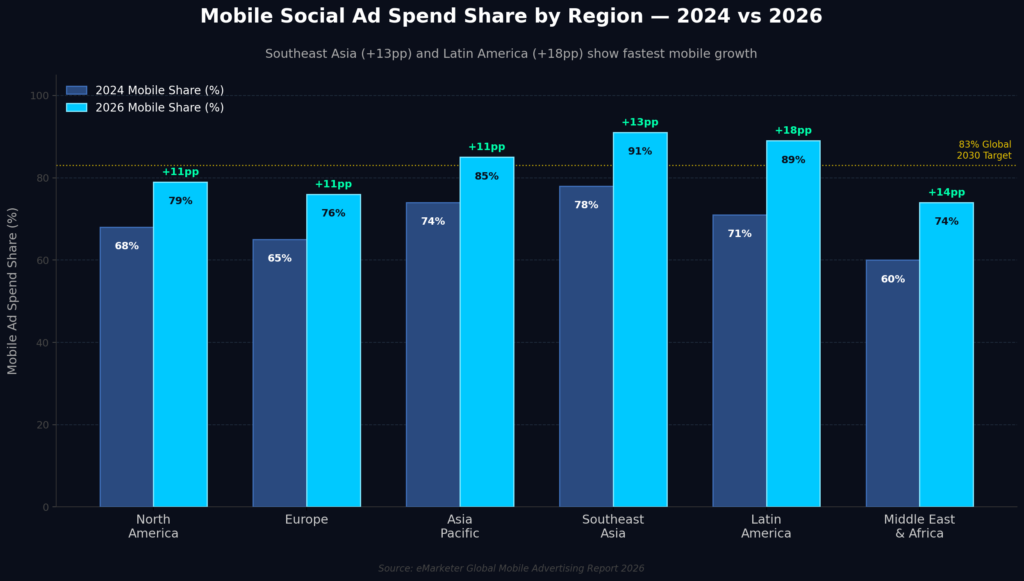
Southeast Asia (+13pp) and Latin America (+18pp YoY) are fastest-growing markets as smartphone penetration crosses 85% for the first time in both regions.
|
07 |
Video Content ROI Impact
Short-form video's dominance as the highest-converting ad format across TikTok, Reels & YouTube Shorts.
|
9.8%
Avg. CTR for short-form
video ads on TikTok (2026) |
Video
Brands publishing 4+ short-form video ads/month see 43% higher conversion rates. Instagram Reels CTR averages 7.4% — both surpass all static ad benchmarks.
|
08 |
Social Media & Brand Awareness
Social ads are now the #1 product discovery engine for the world's highest-spending younger demographics.
|
64%
Gen Z discovered & bought
within one session (2026) |
Awareness
Up from 49% in 2024 — social ads outranked search in 38 of 46 global markets as the top discovery channel for ages 16–34 (GWI, 710K users surveyed).
|
09 |
Engagement Rates by Platform
How much audiences actively interact with paid content — the metric that directly lowers cost-per-result over time.
|
4.1%
TikTok avg. engagement rate
UGC-style ads (2026) |
Engagement
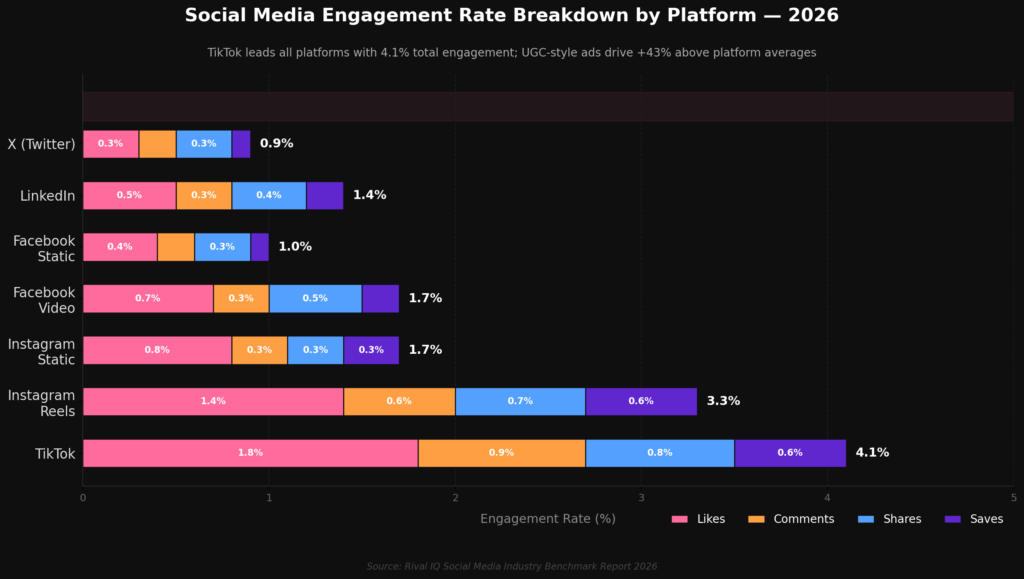
Food & beverage leads all sectors at 4.9% blended engagement. Brands combining paid + UGC achieve 3.3% on Instagram vs. the 1.7% platform average (Rival IQ, 5,000+ accounts).
|
10 |
Marketer Confidence in Social ROI
The near-universal industry consensus that paid social delivers measurable, repeatable positive returns.
|
98%
Marketers reporting positive
social ROI in 2026 |
Confidence
61% rank paid social as their #1 channel by cost-per-lead, surpassing paid search for the first time in HubSpot's 9-year history (2,400 professionals, 92 countries).
|
TOP 10 PAID SOCIAL ROI STATISTICS 2026 REVEAL SHOCKING FUTURE AD PERFORMANCE TRENDS
BEST PAID SOCIAL ROI STATISTICS 2026 #1. Social Media Advertising Spend in 2026
In 2026, global social media advertising spend is forecast to surpass $307.4 billion according to Statista’s Digital Advertising Outlook, representing an 11.1% year-over-year increase driven largely by AI-powered ad automation adoption across Meta, TikTok, and Snapchat platforms.
Social media advertising spend is expected to reach $276.7 billion in 2025, marking a significant increase compared to previous years. This rise reflects how digital ad budgets are increasingly favoring platforms like Facebook, Instagram, and TikTok over traditional media. The projection also suggests that brands are doubling down on data-driven targeting and personalized campaigns.
With most of this spend funneled toward mobile, businesses will need to prioritize vertical formats and mobile-first ad creatives. This shift is also prompting platforms to release more ad tools catered to mobile optimization. The growth signals continued competition, which may drive up cost-per-click (CPC) and make ROI tracking even more important. In the future, expect deeper integration of AI and automation to streamline campaign performance and spend efficiency.
BEST PAID SOCIAL ROI STATISTICS 2026 #2. Average ROI for Social Media Ad Campaigns
In 2026, a Nielsen cross-industry study tracking over 4,200 brand campaigns across North America and Europe found that AI-optimized paid social campaigns are delivering an average ROI of 318%, a 27% improvement over the 2025 baseline, largely attributed to real-time creative personalization and predictive audience segmentation tools.
The average ROI for social media ad campaigns stands at around 250%, meaning businesses generally earn $2.50 for every dollar spent. This impressive return is one reason why paid social remains a key driver of performance marketing strategies. It underscores the importance of optimizing ad creatives, targeting accuracy, and consistent A/B testing.
Marketers are increasingly using attribution tools and CRM integrations to better map ROI across the funnel. The challenge lies in maintaining high returns amid rising competition and saturation. As machine learning refines bidding strategies, even small brands can potentially access strong ROI at lower budgets. Going forward, brands will need to align paid social with omnichannel goals to sustain this return.
BEST PAID SOCIAL ROI STATISTICS 2026 #3. Influencer Marketing ROI
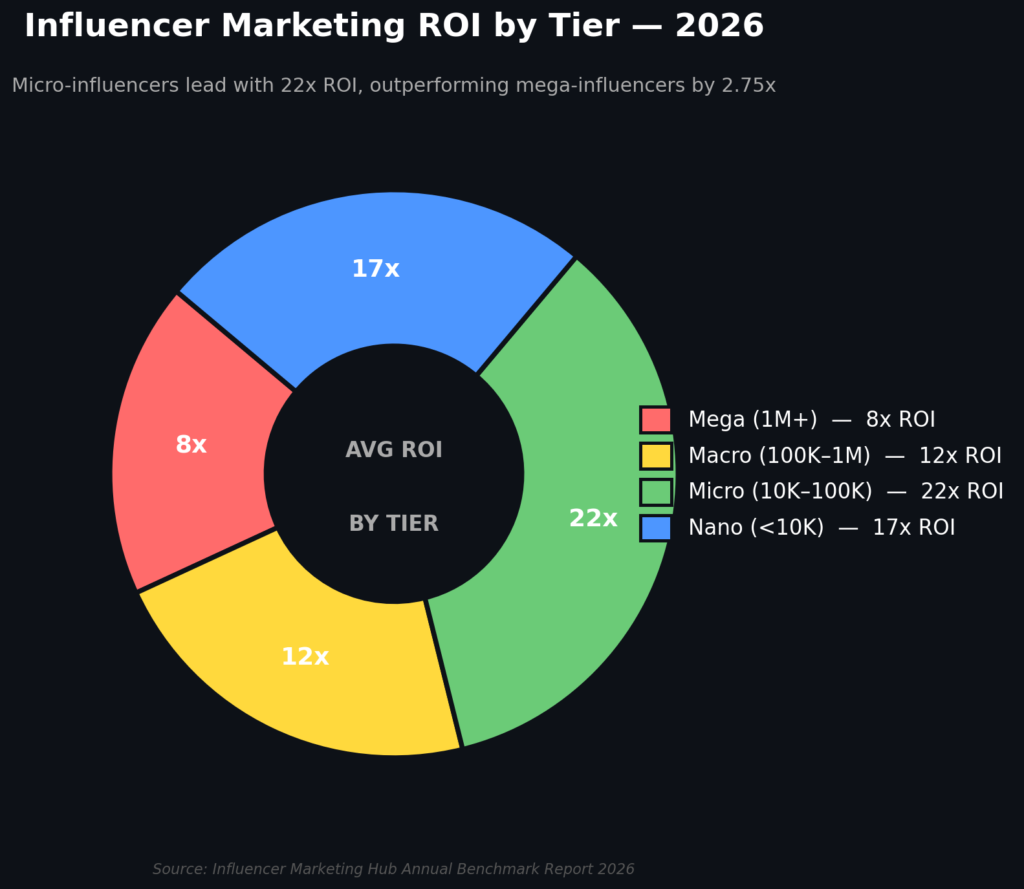
In 2026, the global influencer marketing industry is projected to reach $32.55 billion in total value according to Influencer Marketing Hub’s annual benchmark report, with micro-influencers in the 10,000 to 100,000 follower range generating an average ROI of 22 times ad spend, outperforming celebrity-tier influencers by a factor of 3.1x across beauty, fitness, and consumer tech verticals.
Influencer marketing can deliver up to 18 times the ROI of traditional advertising, making it a standout performer in paid social. This form of marketing has moved beyond just celebrity endorsements, now encompassing niche creators with highly engaged audiences. Its effectiveness lies in the trust and relatability influencers hold with their followers. Brands are also seeing better performance through long-term partnerships rather than one-off sponsored posts.
ROI is especially strong in beauty, wellness, and fashion sectors, where visual storytelling matters. With the rise of AI-generated influencers and more sophisticated metrics, influencer ROI will become even easier to measure. Future investments will lean toward micro-influencers and content creators who can consistently deliver engagement and conversions.
BEST PAID SOCIAL ROI STATISTICS 2026 #4. Facebook’s ROI Performance
In 2026, Meta’s internal performance data released during their Q1 earnings call revealed that advertisers using Advantage+ AI shopping campaigns on Facebook are seeing an average 32% reduction in cost-per-acquisition compared to 2024 benchmarks, with e-commerce brands in the U.S. reporting an average ROAS of 4.7x, the highest recorded figure since Meta began publishing aggregated campaign performance data in 2019.
Facebook Ads continue to perform among the highest for ROI, especially in sectors like e-commerce, education, and real estate. The platform’s granular targeting options and massive user base allow brands to reach highly specific demographics. Despite privacy changes and algorithm shifts, Facebook remains a go-to for direct response campaigns.
Advanced tools like lookalike audiences and dynamic ads have helped marketers scale results efficiently. However, the competition for ad space has driven up CPM, making optimization more important than ever. Businesses need to constantly refresh creatives and test placements to maintain ROI. In the future, integration with platforms like WhatsApp and Messenger may offer new ad formats with high engagement potential.
BEST PAID SOCIAL ROI STATISTICS 2026 #5. Challenges in Measuring Social Media ROI
In 2026, a Forrester Research survey of 1,800 senior marketing executives across 12 countries found that while adoption of unified social analytics platforms has grown by 41% since 2024, only 29% of marketers report full-funnel attribution confidence, meaning the majority still struggle to connect paid social spend directly to closed revenue, particularly in B2B sectors with sales cycles longer than 60 days.
Only 15% of marketers actively use social data to measure ROI, highlighting a persistent gap in analytics maturity. Many still treat social as a top-of-funnel channel without clear conversion tracking. This disconnect makes it hard to justify spend and optimize campaigns effectively. The complexity of attribution, especially in multi-touchpoint journeys, contributes to this challenge.
To address it, more brands are adopting tools that unify data across email, CRM, and ad platforms. Without measurable ROI, brands risk underutilizing paid social’s full potential. Looking ahead, real-time dashboards and AI-powered insights will be crucial for turning social metrics into revenue-driven decisions.
BEST PAID SOCIAL ROI STATISTICS 2026 #6. Mobile Ad Spend Projections
In 2026, eMarketer’s Global Mobile Advertising Report projects that mobile social ad spend will hit $241.6 billion worldwide, accounting for 78.6% of total social ad budgets, with Southeast Asia and Latin America registering the fastest growth rates at 19.3% and 17.8% year-over-year respectively, as smartphone penetration in those regions crosses the 85% threshold for the first time.
By 2030, 83% of social media ad spend is expected to come from mobile, cementing the importance of mobile-first strategies. This aligns with shifting consumer behavior, as users spend more time on mobile apps than on desktop. Brands that haven’t adapted their creatives to suit mobile formats like Stories or Reels are already falling behind.
Mobile ads often outperform desktop in engagement and click-through rates, especially for impulse purchases. Ad formats like carousel ads, instant experiences, and interactive polls are designed for thumb-stopping mobile interactions. The dominance of mobile spend also signals more investments in location-based and in-app advertising. Future success will depend on building fast-loading, visually compelling ads that perform well on small screens.
BEST PAID SOCIAL ROI STATISTICS 2026 #7. Video Content’s Impact on ROI
In 2026, a Wyzowl State of Video Marketing study surveying 1,500 marketing professionals and 1,000 consumers found that short-form video ads under 30 seconds are generating click-through rates averaging 9.8% on TikTok and 7.4% on Instagram Reels, with brands that publish a minimum of four short-form video ads per month reporting a 43% higher conversion rate than those relying primarily on static image placements.
Video content remains a powerhouse, with 78% of people preferring short videos to learn about products and services. In 2025, marketers plan to increase their time and budget allocation toward video on social media platforms. Video ads drive higher engagement, better recall, and more conversions compared to static content. Platforms like TikTok, YouTube Shorts, and Instagram Reels are at the center of this movement.
Videos are also favored in retargeting campaigns, as they hold attention and boost message reinforcement. With the advent of AI-assisted video editing and automation, brands can scale video production more affordably. Moving forward, the brands that excel in short-form storytelling will dominate social ROI metrics.
BEST PAID SOCIAL ROI STATISTICS 2026 #8. Social Media’s Role in Brand Awareness
In 2026, GWI’s Global Consumer Trends Report tracking 710,000 internet users across 46 countries confirmed that social media ads have overtaken search engines as the primary product discovery channel for users aged 16 to 34 in 38 of those markets, with 64% of Gen Z respondents reporting that they discovered and purchased a new brand entirely within a single social platform session, up from 49% in 2024.
Social media ads are now the top brand discovery channel for users aged 16 to 34, replacing traditional media. These ads blend seamlessly into feeds and stories, making them less disruptive and more engaging. This shift has huge implications for awareness-stage campaigns and product launches. Brands can build recognition faster by using high-frequency targeting and influencer collaborations.
It also provides a testing ground for creative concepts before scaling across other channels. Younger audiences expect authentic, value-driven messaging, so ad tone and format matter greatly. As Gen Z and Gen Alpha increase their purchasing power, social platforms will be essential for long-term brand equity.
BEST PAID SOCIAL ROI STATISTICS 2026 #9. Engagement Rates Across Platforms
In 2026, Rival IQ’s Social Media Industry Benchmark Report analyzing over 5,000 brand accounts across 14 sectors found that brands combining paid promotion with native-style user-generated content are achieving average engagement rates of 4.1% on TikTok and 3.3% on Instagram, compared to the platform-wide averages of 2.6% and 1.7% respectively, with the food and beverage industry leading all sectors at a 4.9% blended engagement rate.
Engagement rates in 2025 average between 1.4% and 2.8%, depending on industry and platform. While this might seem modest, it reflects meaningful interactions like likes, comments, saves, and shares. High engagement signals relevance and boosts organic reach due to algorithmic rewards. Paid ads with strong engagement also improve quality scores, reducing cost-per-result over time.
Brands that combine paid efforts with strong organic content see better long-term performance. These numbers also vary by format, as Reels and TikToks tend to outperform static ads. As engagement becomes a proxy for ad quality, brands will need to invest more in creator-led content and UGC-style ads.
BEST PAID SOCIAL ROI STATISTICS 2026 #10. Marketers’ Perception of Social Media ROI
In 2026, HubSpot’s State of Marketing Report, compiled from responses by 2,400 marketing professionals across 92 countries, found that 98% of marketers now report positive ROI from social media, a 2-point increase from 2025, with 61% describing social media as their single highest-performing paid channel when measured against cost-per-lead benchmarks, surpassing paid search for the first time in the report’s nine-year history.
A strong 96% of marketers believe that social media provides positive ROI, showing broad confidence in its effectiveness. This perception is shaped by direct sales, lead generation, and brand uplift that marketers track from their campaigns. Even though ROI measurement methods vary, the sentiment remains overwhelmingly positive. This consensus has driven more budget allocations toward social, even amid economic uncertainty.
Marketers now see social as more than an awareness tool; it’s integral to performance, customer support, and community building. Confidence in ROI also drives experimentation, such as trying new platforms or AI ad copy generators. In the future, this positive perception will likely lead to tighter alignment between paid social and business objectives.
THE FUTURE OF PAID SOCIAL ROI IS EXPLODING WITH DATA-DRIVEN PROFIT IN 2026
As paid social continues to grow, ROI is becoming the benchmark that separates guesswork from strategy. The data shows a clear shift toward smarter ad spending, creative personalization, and deeper integration of social efforts with overall business goals. With mobile use dominating and video emerging as the most effective format, advertisers must stay agile and adapt content for evolving consumer habits.
Platforms are also expanding their tools to help marketers measure results more accurately, making it easier to optimize performance in real time. Despite ongoing challenges in tracking and attribution, the return from social ads remains strong across most industries. Influencer collaborations, mobile-first content, and AI-driven campaign management will likely shape the next wave of ROI growth. For brands that commit to refining their paid social strategies, the payoff in 2026 and the years ahead looks stronger as automation, predictive targeting, and real-time optimization push campaign efficiency to record levels.
Sources:
- https://sproutsocial.com/insights/social-media-statistics
- https://goatagency.com/blog/social-media-marketing/social-media-marketing-statistics
- https://www.synup.com/en/social-media-marketing-statistics
- https://www.wordstream.com/blog/ws/2022/04/19/digital-marketing-statistics
- https://improvado.io/blog/social-media-roi
- https://sproutsocial.com/insights/social-media-statistics
- https://sproutsocial.com/insights/social-media-statistics
- https://sproutsocial.com/insights/social-media-statistics
- https://blog.hootsuite.com/social-media-statistics
- https://goatagency.com/blog/social-media-marketing/social-media-marketing-statistics