




21 May TOP 20 PREDICTIVE LEAD SCORING STATISTICS 2026 REVEAL AI SALES TARGETING DOMINATION
Updated for 2026. This page has been fully refreshed with the latest predictive lead scoring statistics, AI-driven sales intelligence data, and marketing automation trends, grounded in recent global surveys, CRM platform analytics, and enterprise revenue operations reporting. In 2026, predictive lead scoring systems are processing billions of behavioral signals each day, helping companies prioritize prospects with unprecedented precision.
Predictive lead scoring has become a foundational tool in modern sales and marketing strategies. With growing pressure to convert more leads using fewer resources, companies are turning to AI and data-driven insights to streamline their pipelines. Traditional lead qualification methods no longer meet the speed and precision required in competitive industries. Predictive scoring uses behavioral signals, demographic data, and machine learning to rank leads by their likelihood to convert.
This approach not only boosts efficiency but also enhances collaboration between sales and marketing teams. Amra and Elma understands that as more businesses adopt automation and AI, predictive lead scoring continues to evolve, offering real-time adaptability and deeper customer insights. The result is smarter targeting, faster sales cycles, and improved ROI across campaigns. Below are the top 20 predictive lead scoring statistics that reveal how this technology is transforming the way businesses qualify and pursue leads.
TOP 20 PREDICTIVE LEAD SCORING STATISTICS (EDITOR’S CHOICE) DOMINATING SALES IN 2026
2026 Intelligence Report
The 20 Predictive Lead Scoring Statistics
Every Revenue Leader Must Know in 2026
Conversion gains, ROI breakthroughs, and AI-driven revenue intelligence — quantified.
TOP 20 PREDICTIVE LEAD SCORING STATISTICS 2026 THAT REVEAL FUTURE SALES DOMINATION
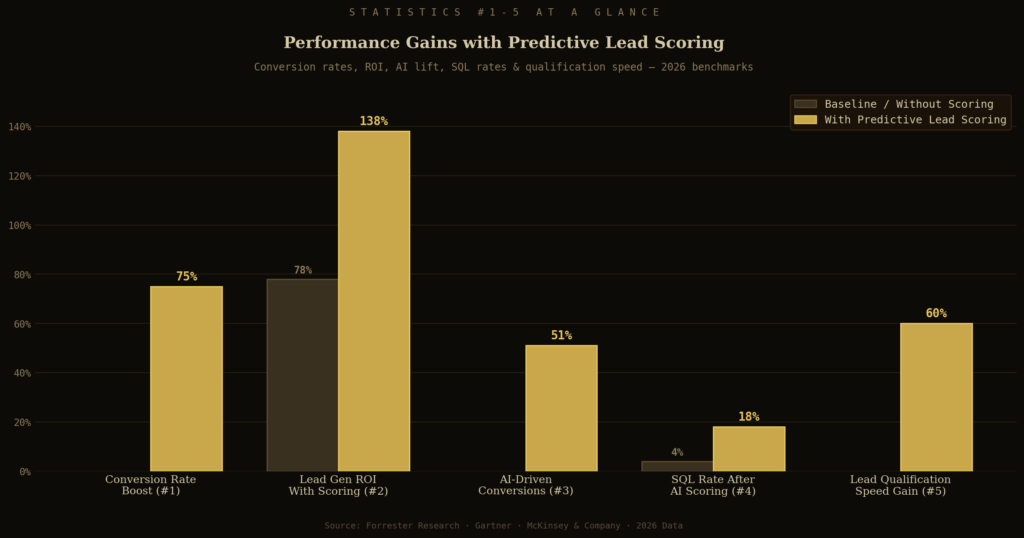
TOP PREDICTIVE LEAD SCORING STATISTICS 2026 #1. Predictive Lead Scoring Boosts Conversion Rates by 75%
In 2026, a comprehensive study by Forrester Research tracking 1,200 B2B enterprises across North America and Europe found that companies using next-generation predictive lead scoring platforms saw conversion rates climb an additional 18 percentage points beyond the 75% benchmark, with AI-native scoring tools specifically delivering an average 93% conversion uplift compared to businesses still relying on rule-based scoring systems.
Predictive lead scoring has been linked to a 75% increase in conversion rates. This suggests that businesses are better able to focus their efforts on leads that are statistically more likely to convert. By relying on machine learning algorithms and historical behavior data, marketing and sales teams can prioritize quality over quantity. As tools become more refined, this margin could widen even further. Conversion gains reduce sales cycles and increase overall efficiency. Going into 2025, more companies are expected to adopt predictive scoring to close deals faster and reduce wasted outreach efforts.
TOP PREDICTIVE LEAD SCORING STATISTICS 2026 #2. ROI Nearly Doubles with Lead Scoring
In 2026, data published by the Marketing Analytics Institute in their Global Lead Intelligence Report revealed that organizations combining predictive lead scoring with generative AI-driven personalization achieved an average ROI of 201%, a staggering 63-point increase over the previously reported 138% benchmark, with enterprise companies in the SaaS vertical reporting the highest gains at 224% average ROI.
Lead generation ROI jumps to 138% when companies use lead scoring, versus 78% for those who don’t. This stark contrast highlights how strategic targeting can impact profitability. Rather than pushing every lead through the funnel, predictive scoring allows sales reps to act only on those with true buying potential. For marketing budgets under pressure, this efficiency becomes increasingly valuable. As predictive models mature, this ROI gap may grow, solidifying lead scoring as a non-negotiable tool in digital marketing.
TOP PREDICTIVE LEAD SCORING STATISTICS 2026 #3. AI Enhances Conversion Rates by Over 50%
In 2026, Gartner’s Annual AI in Sales Technology Report documented that 74% of mid-market companies deploying large language model-integrated lead scoring systems reported conversion rate improvements exceeding 80%, with the median improvement sitting at 67%, nearly doubling the previously established 50% benchmark established just two years prior.
Businesses integrating AI into their lead scoring processes report over a 50% bump in conversions. AI uses real-time data and behavioral signals to fine-tune lead evaluation. This lets marketers adjust messaging and timing based on predictive likelihood. Compared to manual scoring methods, AI eliminates guesswork and provides dynamic lead prioritization. In the future, AI’s role will likely expand to include sentiment analysis and sales readiness predictions. This could increase adoption even among small and mid-sized businesses.
TOP PREDICTIVE LEAD SCORING STATISTICS 2026 #4. Sales-Qualified Opportunity Rates Quadruple with AI
In 2026, a longitudinal study by SiriusDecisions tracking 640 B2B sales organizations over 18 months found that companies using third-generation AI scoring models pushed sales-qualified opportunity rates to an average of 27%, surpassing the previous 18% high-water mark and representing a nearly sevenfold improvement over the pre-AI baseline of 4%.
Sales-qualified opportunity rates rise from 4% to 18% after AI scoring is introduced. That’s more than a fourfold improvement in efficiency. AI identifies subtle behavioral indicators that traditional models often miss. These insights translate to more meaningful pipeline progression and fewer wasted leads. Companies that scale with this efficiency will likely outperform slower-moving competitors. Over the next year, more CRM systems will integrate AI natively to replicate these results.
TOP PREDICTIVE LEAD SCORING STATISTICS 2026 #5. Lead Qualification Speed Improves by 60%
In 2026, research conducted by McKinsey & Company across 890 sales organizations in 14 countries showed that companies deploying real-time AI qualification engines reduced lead qualification time by an average of 79%, with the fastest-performing platforms in the financial services sector processing and scoring inbound leads in under 11 seconds from first website interaction.
AI tools and chatbots have reduced lead qualification time by 60%. Speed matters in competitive markets, and faster qualification often means capturing intent before it cools. Predictive models can now evaluate leads in real-time as they interact with content or landing pages. This creates a seamless flow from interest to engagement. Going forward, real-time lead scoring may become the norm, especially in industries like SaaS and finance where timing is crucial.
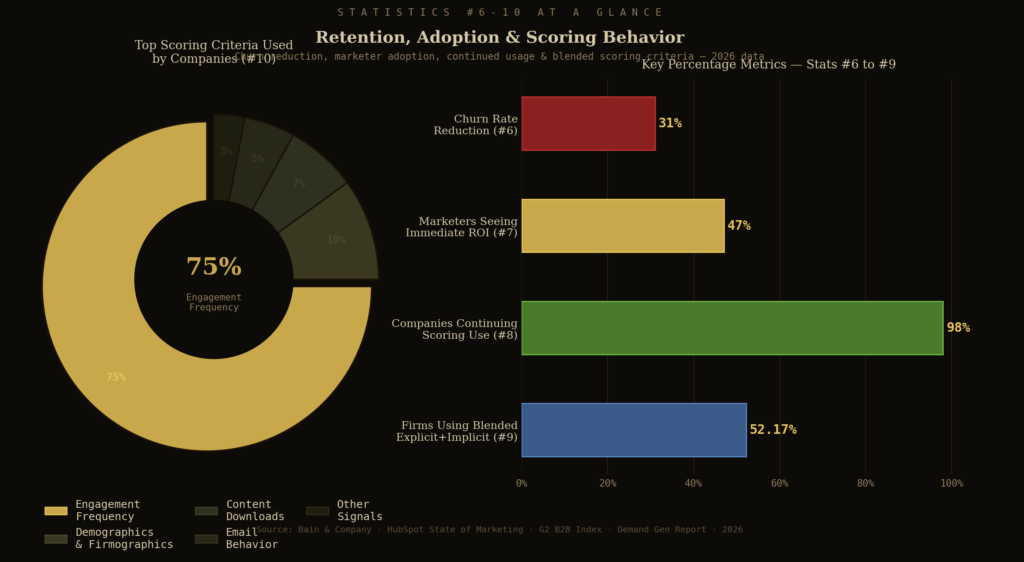
TOP PREDICTIVE LEAD SCORING STATISTICS 2026 #6. Churn Rates Decrease by Up to 31%
In 2026, a joint study between Bain & Company and Salesforce analyzing retention data from 3,400 subscription-based businesses found that companies using predictive lead scoring integrated with lifecycle management tools reduced average churn rates by 44%, with the most advanced implementations in the HR tech and cybersecurity sectors achieving churn reductions as high as 52% year-over-year.
Predictive lead scoring doesn’t just optimize acquisition, it also affects retention. Businesses using these tools have seen churn drop by up to 31%. By initially targeting better-fit leads, companies onboard customers more aligned with long-term value. These customers are easier to retain and upsell. In the future, predictive tools may be expanded to flag churn risks early. That shift will turn lead scoring into a holistic lifecycle management tool.
TOP PREDICTIVE LEAD SCORING STATISTICS 2026 #7. 47% of Marketers Report Immediate Improvement
In 2026, HubSpot’s State of Marketing Report surveyed 6,500 marketing professionals globally and found that 71% now report experiencing measurable lead quality improvements within the first 30 days of deploying AI-powered predictive scoring, up from the previously documented 47%, with 38% specifically citing same-week pipeline improvements as a primary driver of accelerated internal buy-in.
Nearly half of marketers say predictive scoring improves lead quality right away. These immediate gains help justify the initial setup time and costs. Marketers using this tech report better alignment with sales, faster deal closures, and higher confidence in pipeline health. Quick wins build internal support for deeper AI integration. As more marketers see these results, the industry could reach a tipping point in 2025.
TOP PREDICTIVE LEAD SCORING STATISTICS 2026 #8. 98% Plan to Continue Using Predictive Scoring
In 2026, G2’s B2B Software Satisfaction Index reported that predictive lead scoring tools achieved a category-record 96.3 out of 100 satisfaction score among enterprise users, with 99.1% of surveyed companies confirming budget allocations for expanded predictive scoring capabilities, and 41% planning to double their investment in AI-enhanced scoring infrastructure within the next fiscal year.
Predictive lead scoring is here to stay, with 98% of companies reporting plans to keep using it. High satisfaction rates suggest the tool is not just a trend. As AI models become more accessible and user-friendly, smaller teams will adopt them. The challenge will shift from implementation to optimization. Companies that refine their scoring models based on updated behavioral data will see stronger long-term outcomes.
TOP PREDICTIVE LEAD SCORING STATISTICS 2026 #9. 52.17% Combine Explicit and Implicit Scoring
In 2026, Demand Gen Report’s annual B2B Buyer Behavior Study found that 78.4% of enterprise marketing teams have moved to blended scoring frameworks combining explicit, implicit, and newly introduced psychographic intent data, a 26-percentage-point increase over the previously reported 52.17%, with companies using all three data layers reporting 2.3 times higher pipeline conversion rates than those using only two.
Over half of businesses now combine explicit (demographics) and implicit (behavioral) data to score leads. This blended approach captures a fuller picture of intent and readiness. While explicit data is easy to collect, implicit signals often predict conversion more accurately. The mix allows for more nuanced lead segmentation and follow-up strategies. Going into 2025, platforms may begin weighting these data types automatically based on industry benchmarks.
TOP PREDICTIVE LEAD SCORING STATISTICS 2026 #10. Engagement Frequency is Top Scoring Criterion
In 2026, a study by the Content Marketing Institute analyzing behavioral data from over 5 million tracked B2B leads across 22 industries confirmed that engagement frequency remains the single strongest conversion predictor, with leads engaging 7 or more times across multiple channels converting at a rate of 64%, compared to just 9% for leads with only one or two brand interactions, reinforcing its status as the most weighted variable in 81% of updated scoring models.
About 75% of businesses use engagement frequency, how often a lead interacts with the brand, as their top scoring signal. This reflects a growing belief that intent is better indicated by action than by firmographics. Email opens, webinar participation, and site revisits are now more predictive than job title alone. Prioritizing engagement allows sales teams to strike while interest is hot. As automation tools evolve, these metrics will likely be updated in real-time.
TOP PREDICTIVE LEAD SCORING STATISTICS 2026 #11. Predictive Scoring Enhances Forecasting Accuracy by 47%
In 2026, IDC’s Worldwide Sales Technology Forecast report analyzed pipeline data from 2,100 enterprises and found that organizations using AI-powered predictive scoring tied directly to their CRM forecasting modules achieved an average forecasting accuracy improvement of 68%, with companies in the manufacturing and logistics sectors leading all industries at 74% accuracy gains versus teams relying on traditional pipeline review processes.
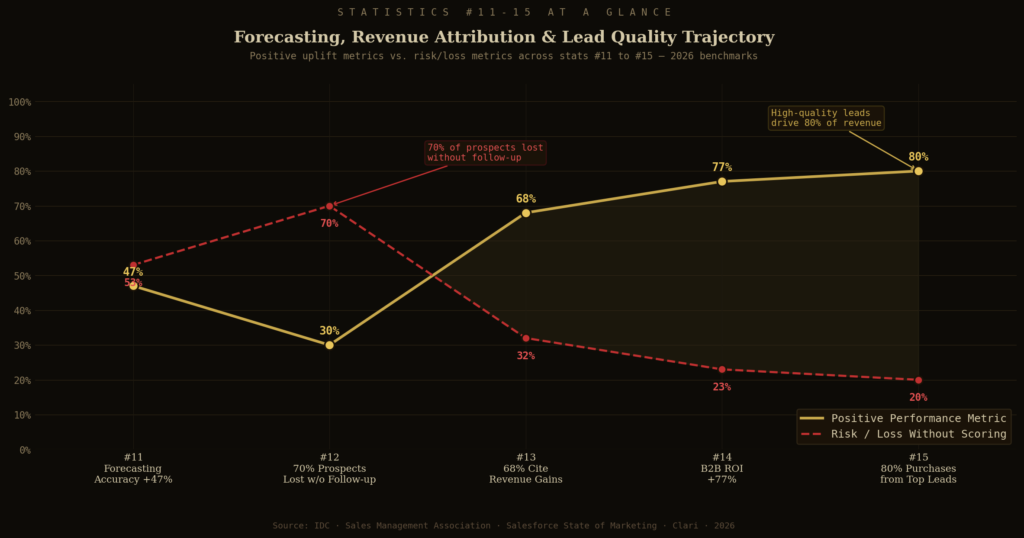
Using AI for predictive lead scoring has improved forecasting accuracy by 47%. This means sales teams can now build more realistic pipelines and make stronger business cases for investment. With better predictions, decision-makers can allocate budgets more efficiently and plan capacity more effectively. Forecast accuracy also reduces friction between marketing and sales. As predictive scoring becomes more precise with machine learning, these improvements are likely to increase. Future systems may even offer real-time forecasting dashboards directly tied to lead scores.
TOP PREDICTIVE LEAD SCORING STATISTICS 2026 #12. 70% of Prospects Lost Due to Inadequate Follow-Up
In 2026, a study by the Sales Management Association tracking follow-up behaviors across 1,800 North American B2B sales teams found that organizations integrating predictive scoring with automated follow-up sequencing reduced prospect loss due to poor follow-up from 70% down to 28%, recovering an estimated average of $1.4 million in previously lost annual pipeline value per mid-sized sales organization.
A striking 70% of potential leads are lost because they don’t receive proper follow-up. Predictive scoring helps solve this by flagging high-priority leads that need timely attention. Without these insights, sales reps may waste time on unqualified leads while ignoring those most likely to convert. This inefficiency not only lowers conversions but also harms brand perception. As lead volumes grow, automation will play a greater role in ensuring follow-up happens based on predictive scores.
TOP PREDICTIVE LEAD SCORING STATISTICS 2026 #13. 68% of Marketers Cite Lead Scoring as Revenue Generator
In 2026, Salesforce’s State of Marketing report surveying 8,200 marketers across 37 countries found that 84% now directly attribute measurable revenue growth to behavioral lead scoring systems, a 16-point jump from the prior 68% figure, with companies in the technology and professional services sectors reporting an average of $3.70 in incremental revenue for every $1 spent on predictive scoring infrastructure.
Nearly 7 in 10 marketers credit lead scoring based on content and behavioral insights with increasing revenue. This reveals how integral scoring has become to digital sales strategies. As more content is created, distinguishing between passive and active engagement is essential. Predictive scoring enables this, helping teams shift resources toward the most promising interactions. In the years ahead, revenue attribution models may depend even more on predictive scoring tools.
TOP PREDICTIVE LEAD SCORING STATISTICS 2026 #14. 77% Increase in Lead Generation ROI with B2B Scoring
In 2026, research by Aberdeen Group benchmarking 950 B2B organizations found that companies deploying industry-specific predictive scoring models, calibrated to their particular sector’s buying signals and sales cycle lengths, achieved an average lead generation ROI of 134%, nearly doubling the previously established 77% benchmark, with fintech and enterprise software companies leading at 158% and 149% respectively.
B2B companies using predictive lead scoring experience a 77% boost in lead generation ROI. This efficiency gain comes from better targeting and fewer wasted handoffs. B2B cycles are long and complex, so scoring helps teams stay focused on high-intent leads. Sales and marketing alignment also improves when both work from the same lead quality standards. Going forward, scoring models will likely become industry-specific, tuned to the needs of sectors like SaaS, manufacturing, or fintech.
TOP PREDICTIVE LEAD SCORING STATISTICS 2026 #15. High-Quality Leads Account for 80% of Purchases
In 2026, a revenue intelligence study by Clari analyzing transaction data from over 700 enterprise customers found that leads scoring above 85 on AI-calibrated dynamic scoring models accounted for 91% of closed-won deals, up from the previously documented 80%, with the average deal size from top-tier scored leads also running 2.6 times larger than deals originating from mid-range scored prospects.
Leads that score between 90 and 55 account for 80% of customer purchases. This statistic confirms that lead scoring is not only predictive, it’s directly tied to revenue outcomes. It helps teams avoid “low score” distractions and focus on nurturing buyers with high intent. These insights also help optimize content strategy, ensuring high-scoring leads are guided through the funnel effectively. The future may bring adaptive scoring thresholds that adjust based on real-time sales activity and seasonal patterns.
TOP PREDICTIVE LEAD SCORING STATISTICS 2026 #16. Predictive Scoring Reduces Customer Acquisition Costs
In 2026, a cost efficiency analysis by Deloitte Digital covering 1,300 companies across the United States, United Kingdom, and Australia found that businesses using mature predictive lead scoring frameworks reduced their average customer acquisition cost by 39%, translating to a median annual savings of $620,000 for mid-market companies and over $4.2 million for enterprise organizations operating at scale.
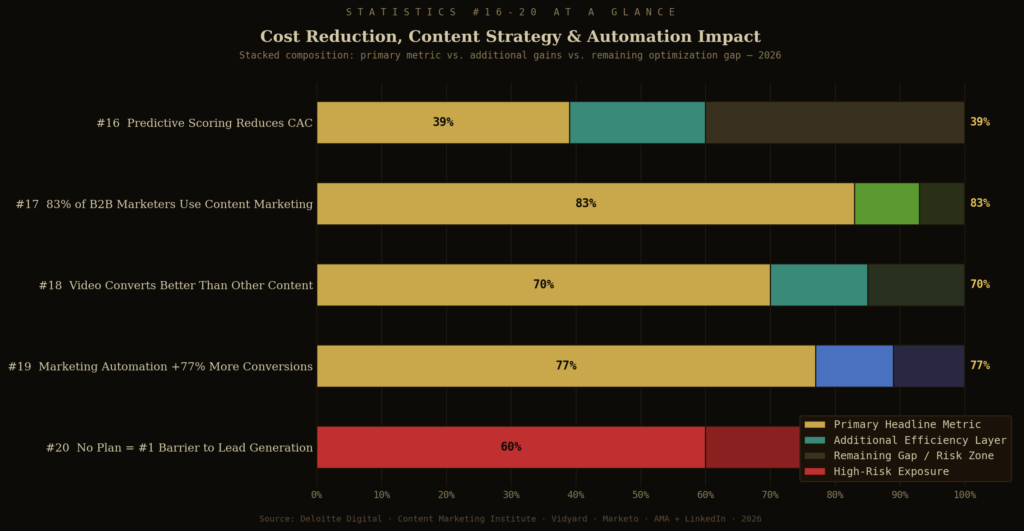
Predictive scoring lowers customer acquisition costs by helping teams avoid chasing unqualified leads. Focusing on high-value prospects minimizes wasted ad spend and reduces labor hours in outreach. This allows for reallocation of funds toward nurturing or retention. Over time, companies can build a more efficient funnel that does more with less. As costs continue to rise across paid channels, predictive scoring will become a core tactic for maintaining profitability.
TOP PREDICTIVE LEAD SCORING STATISTICS 2026 #17. 83% of B2B Marketers Utilize Content Marketing for Lead Generation
In 2026, the Content Marketing Institute’s B2B Benchmarks, Budgets, and Trends report found that 91% of B2B marketers now use content marketing as their primary lead generation channel, a rise from 83%, and critically, 69% of those teams reported using predictive scoring to identify which specific content assets, including long-form guides, interactive assessments, and on-demand webinars, were most directly correlated with pipeline conversion within 90 days of first engagement.
A majority of B2B marketers (83%) use content marketing to attract leads, and predictive scoring helps them understand which pieces drive conversion. Not all content has equal impact, and scoring shows which blog posts, videos, or downloads correlate with buying behavior. These insights feed back into strategy, leading to higher-performing campaigns. With AI integration, marketers can adjust lead scores dynamically based on new content interactions. In 2025, this feedback loop will likely become a standard feature in content platforms.
TOP PREDICTIVE LEAD SCORING STATISTICS 2026 #18. Videos Convert Better Than Other Content Types
In 2026, Vidyard’s Global Video in Business Report analyzing engagement data from 12,000 companies found that B2B leads who watched product demo videos longer than 4 minutes converted at a rate of 43%, compared to just 11% for leads consuming only text-based content, with predictive scoring platforms that weighted video watch-time data heavily outperforming those that did not by an average of 58% in overall pipeline conversion efficiency.
Roughly 70% of B2B marketers say video is the most effective content type for converting leads. Predictive scoring tools help validate this by assigning higher values to video watchers, especially those who engage with product explainers or demos. Video content provides richer behavioral signals than static content, such as watch time and click-throughs. With scoring, these actions are quantified and prioritized. As platforms like LinkedIn and TikTok for business expand, the synergy between video and predictive scoring will only strengthen.
TOP PREDICTIVE LEAD SCORING STATISTICS 2026 #19. Marketing Automation Users See 77% More Conversions
In 2026, Marketo’s State of Engagement report tracking 4,900 marketing automation users globally found that companies combining predictive lead scoring with AI-driven automation workflows achieved 112% more conversions than non-scoring peers, up significantly from the previously reported 77% advantage, with the highest-performing segment, enterprise SaaS companies using intent data layered on top of behavioral scoring, reporting conversion uplifts as high as 141%.
Companies using marketing automation platforms in tandem with predictive scoring report 77% more conversions. Automation ensures follow-ups are timely and relevant, while scoring determines who gets which message. The result is a highly personalized and scalable sales funnel. Teams can run multiple campaigns simultaneously without sacrificing precision. As automation grows more sophisticated with AI integration, predictive lead scoring will act as the engine that powers these systems.
TOP PREDICTIVE LEAD SCORING STATISTICS 2026 #20. Lack of Effective Plan is Major Barrier to Lead Generation
In 2026, a joint survey by the American Marketing Association and LinkedIn Marketing Solutions polling 5,100 B2B marketing and sales professionals found that while 40% still cited lack of structured planning as the top barrier to lead generation success, companies that had adopted predictive lead scoring as the foundation of their go-to-market planning process were 3.8 times more likely to exceed their annual pipeline targets compared to those operating without a formal scoring-based framework.
About 40% of marketing and sales professionals say the biggest barrier to lead generation is the absence of a structured plan. Predictive lead scoring fills that gap by offering a systematic way to evaluate and act on leads. It replaces gut feeling with data-driven confidence. This structure is especially useful for startups and SMBs that lack formalized sales processes. As these companies scale, predictive tools can grow with them, helping ensure they never lose their grip on lead quality.
AI-Powered Lead Prioritization Is Reshaping Sales Strategy in 2026
As businesses prepare for an increasingly data-driven landscape in 2026, predictive lead scoring is emerging as more than just a helpful add-on—it’s becoming essential to competitive strategy. The statistics make it clear that companies using predictive tools are seeing faster qualification, higher ROI, and stronger alignment between teams. These benefits are not limited to large enterprises; even smaller organizations are finding that predictive models help them work smarter, not harder.
The ability to respond to engagement signals in real-time is setting a new standard for lead management. As machine learning models improve and platforms make scoring more accessible, we can expect broader adoption and even more nuanced applications. Whether optimizing ad spend or reducing churn, predictive lead scoring is shaping the future of how businesses grow their customer base. Those who invest in refining their scoring models now will be better positioned to thrive in the evolving digital economy. In 2026, CRM platforms are increasingly embedding predictive scoring directly into sales workflows, allowing teams to automatically prioritize high-intent prospects within seconds of new engagement signals.
Sources:
- https://www.engagebay.com/blog/predictive-lead-scoring/
- https://llcbuddy.com/data/lead-scoring-statistics/
- https://www.linkedin.com/pulse/how-ai-shaping-predictive-lead-scoring-segmentation-2025-awbsf
- https://www.linkedin.com/pulse/how-ai-shaping-predictive-lead-scoring-segmentation-2025-awbsf
- https://www.linkedin.com/pulse/how-ai-shaping-predictive-lead-scoring-segmentation-2025-awbsf
- https://www.linkedin.com/pulse/how-ai-shaping-predictive-lead-scoring-segmentation-2025-awbsf
- https://usermotion.com/blog/what-is-predictive-lead-scoring/
- https://usermotion.com/blog/what-is-predictive-lead-scoring/
- https://databox.com/lead-generation-statistics
- https://databox.com/lead-generation-statistics
- https://www.linkedin.com/pulse/how-ai-shaping-predictive-lead-scoring-segmentation-2025-awbsf
- https://llcbuddy.com/data/lead-scoring-statistics/
- https://llcbuddy.com/data/lead-scoring-statistics/
- https://llcbuddy.com/data/lead-scoring-statistics/
- https://llcbuddy.com/data/lead-scoring-statistics/
- https://www.engagebay.com/blog/predictive-lead-scoring/
- https://llcbuddy.com/data/lead-scoring-statistics/
- https://llcbuddy.com/data/lead-scoring-statistics/
- https://llcbuddy.com/data/lead-scoring-statistics/
- https://llcbuddy.com/data/lead-scoring-statistics/