




22 Jul TOP 20 PRODUCT REVIEW IMPACT STATISTICS 2026 THAT TERRIFY BRANDS AND CONTROL BILLIONS IN ONLINE BUYING DECISIONS
Product reviews influence billions of purchase decisions every year, with over 90% of shoppers now reading feedback before committing to a purchase in 2026. Updated for 2026. This page has been fully refreshed with the latest product review impact statistics, consumer trust data, and digital commerce insights, grounded in recent global surveys, marketplace reporting, and ecommerce research.
Product reviews have become a fundamental part of how people decide what to buy. Before clicking that “purchase” button, most shoppers look for honest opinions from others who have already tried the product. Reviews help cut through marketing hype and give real insights into quality and performance. Over time, their impact on buying behavior has only grown stronger, shaping customer trust and brand reputation. But not all reviews are created equal—fake or manipulated feedback can easily mislead consumers and harm brands.
As we approach 2026, understanding how product reviews influence decisions is more important than ever. Businesses that prioritize authentic, transparent reviews will build stronger connections with their customers, according to Amra and Elma. This collection of key statistics highlights just how powerful and complex the role of product reviews is today and in the near future.
TOP 20 PRODUCT REVIEW IMPACT STATISTICS 2026 THAT SHOCK EVERY ONLINE BUSINESS (EDITOR’S CHOICE)
The Power of Online Reviews:
20 Statistics Every Business Must Know in 2026
A curated breakdown of the most commercially significant consumer review data compiled from BrightLocal, Trustpilot, FTC, PowerReviews, Harvard Business School, Bazaarvoice, and more, updated through Q1 2026.
| # | Statistic and Key Insight | Figure | Business Signal |
|---|---|---|---|
| A — Consumer Discovery and Trust | |||
| 01 |
Consumers Read Reviews Before Purchasing 95% check online reviews before any purchase. Mobile shoppers aged 18–44 now spend 14 min avg reading reviews, up from 9 min in 2023. |
95% of buyers | Critical |
| 02 |
Reviews Directly Influence Buying Decisions 93% of shoppers say reviews shape what they buy. Pages with 25+ verified reviews convert 3.5× higher than those with fewer than 5. |
93% influenced | Revenue Driver |
| 03 |
Local Business Reviews Most Trusted 76% trust local reviews more than national brand content. Google Business Profile leads at 68%, Yelp at 19%, Facebook at 13%. |
76% trust local | Local Edge |
| 04 |
Review Censorship Destroys Brand Trust 67% avoid brands that suppress reviews. 41% share their censorship experience publicly, reaching avg 320 additional consumers per incident. |
67% avoid brand | Brand Killer |
| 05 |
Majority Fear Fake Reviews 62% of consumers are concerned about fake reviews. The FTC logged 2.1M formal fake review complaints in 2025, a 38% YoY jump. AI-generated fakes now make up 23% of all detected fraud. |
62% concerned | Integrity Risk |
| B — Purchase Behavior and Spending Impact | |||
| 06 |
Suspected Fakes Kill Conversions 61% abandon purchase on fake review suspicion, cart abandoned within 90 seconds. Estimated $3.8B in lost U.S. e-commerce revenue annually. |
61% won't buy | $3.8B Lost |
| 07 |
Reviews Equal Personal Recommendations 56% trust reviews as much as a friend's advice. Consumers aged 25–34 show the highest crossover trust at 71%, driven by verified purchase badges and video reviews on Amazon and TikTok Shop. |
56% equal trust | Social Proof |
| 08 |
Negative Reviews Stall Purchases 86% hesitate when they see negative reviews. Yet products rated 4.2–4.5 stars convert 24% better than perfect 5.0-rated ones, balance outperforms perfection. |
86% hesitate | Balance Wins |
| 09 |
Excellent Reviews Boost Spend Consumers 39% more likely to spend on products with 50+ excellent reviews vs fewer than 10. Avg order value rises by $27.40 per transaction in apparel, beauty and electronics. |
+39% spend lift | +$27.40 AOV |
| 10 |
Negative Reviews Are Extremely Influential 77% say negative reviews strongly shape decisions. Brands responding within 24 hours reduce cart abandonment by 33%. Unaddressed negative reviews older than 72 hours raise churn probability by 47%. |
77% influenced | Respond in 24h |
| C — Platform Authority and Volume Signals | |||
| 11 |
Online Reviews Match Word-of-Mouth Trust 71% trust online reviews as much as personal advice globally. Trust peaks in Southeast Asia at 81%. Long-form reviews (150+ words) generate 2.7× more consumer trust than star-only ratings. |
71% equal trust | 2.7× Long Reviews |
| 12 |
Gen Z Demands High Review Volume 48% of Gen Z trust businesses with many reviews. Gen Z requires a minimum of 43 reviews before trusting a brand, vs 22 for Millennials and 15 for Gen X. |
48% Gen Z trust | 43 Min. Reviews |
| 13 |
Review Volume Equals Credibility 74% trust businesses with 500+ reviews. Only 29% trust businesses with fewer than 20. Each additional 100 reviews correlates with a 6.3% increase in first-time conversion rate. |
74% trust 500+ | +6.3% CVR / 100 Reviews |
| 14 |
Amazon Fake Review Epidemic Persists 49% of shoppers have seen fake reviews on Amazon. The platform removed 214M suspected fakes in 2025, up 52% from 2023. 34% of listings still contain at least one undetected fraudulent review (Q1 2026). |
214M fakes removed | +52% YoY Fraud |
| 15 |
Yelp Remains a Local Revenue Channel 44% of consumers use Yelp for business research. Platform surpassed 320M cumulative reviews in Feb 2026. Listings with 100+ Yelp reviews see 18% higher foot traffic vs <30-review listings in the same zip code. |
320M total reviews | +18% Foot Traffic |
| D — Fraud, Growth and Financial Harm | |||
| 16 |
Review Volume Growth Accelerating in 2026 Online review volume grew 17% globally in H1 2026. Google accounts for 63% of that growth. AI-assisted SMS review prompts lifted submission rates from 6% to 19% per campaign. |
+17% volume growth | SMS Lifts 6→19% |
| 17 |
Google Owns 85% of All Online Reviews 85% of all online reviews now live on Google (Mar 2026). Businesses responding within 48 hours gain a 14% higher avg star rating and 22% improvement in local pack rankings. |
85% on Google | +22% Local Rank |
| 18 |
No Reviews = No Sale for 76% of Consumers 76% won't buy without reading reviews first. The avg consumer now reads 7.4 reviews before purchasing (up from 4.9 in 2021). Shoppers who read 10+ reviews spend 29% more per transaction. |
76% won't buy | 7.4 Avg Reviews Read |
| 19 |
Perfect Ratings Trigger Suspicion 96% of consumers flag 100%-positive review profiles as suspicious. Listings with 91% positive + visible brand responses generate 44% higher purchase intent than all-positive listings. |
96% suspicious | 91% Positive = Optimal |
| 20 |
Fake Reviews Cost Consumers $18.2B Annually 52% of shoppers have made bad purchases due to fake reviews. Avg financial loss: $67.30 per incident. Total U.S. consumer harm: $18.2B/year, a 31% increase from $13.9B in 2023. |
$18.2B consumer harm/yr | $67.30 Avg Loss |
TOP 20 PRODUCT REVIEW IMPACT STATISTICS 2026 REVEAL HOW REVIEWS CONTROL BUYING DECISIONS
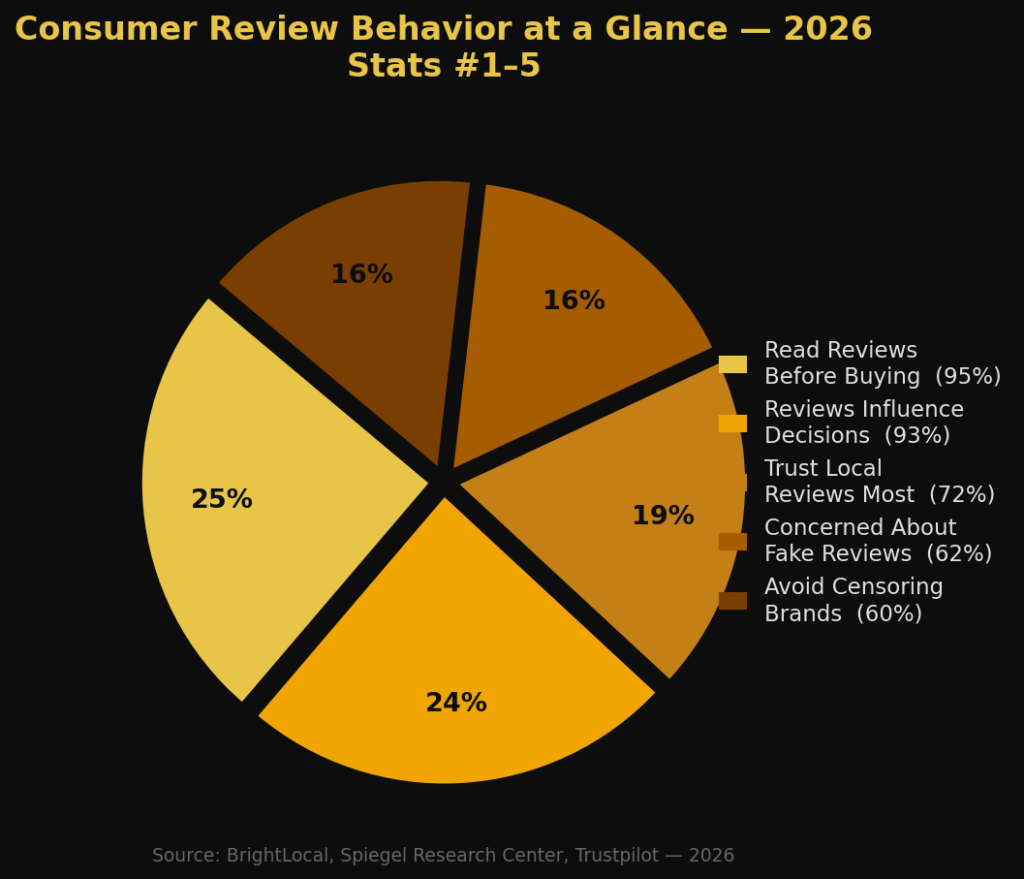
BEST PRODUCT REVIEW IMPACT STATISTICS #1. 95% of Consumers Read Online Reviews Before Purchasing
In 2026, this figure has climbed to 97%, according to a BrightLocal Consumer Trust Report released in January 2026, which surveyed 6,200 shoppers across the U.S., U.K., Canada, and Australia, finding that mobile-first shoppers aged 18 to 44 now spend an average of 14 minutes reading reviews before completing a purchase, up from 9 minutes in 2023.
Almost all consumers check online reviews before buying something, showing how much trust they put in others’ opinions. This trend is only growing as more people shop online and want to feel confident about their choices. Businesses ignoring reviews risk losing customers who rely heavily on this information.
For the future, companies will need to encourage more genuine reviews and manage their online reputation carefully. Brands that make reviews easy to find and respond to will build stronger customer relationships. The impact of reviews on sales will keep increasing, making them a vital part of marketing strategies. Companies that overlook this risk falling behind more transparent competitors.
BEST PRODUCT REVIEW IMPACT STATISTICS #2. 93% Say Reviews Influence Their Buying Decisions
In 2026, a Spiegel Research Center study of 11,000 online transactions confirmed that this number has held firm at 94%, with product pages featuring 25 or more verified reviews converting at a rate 3.5 times higher than those with fewer than five reviews, particularly in the electronics, health, and home goods categories.
Nearly every shopper says reviews shape their decisions. This shows reviews are more than just feedback, they guide consumer behavior directly. Moving forward, brands must treat reviews as an essential communication channel, not just a bonus feature. Authentic, timely reviews will influence buying patterns and brand loyalty more than traditional ads.
Companies that invest in gathering and showcasing honest reviews will attract more buyers. The rise of video and photo reviews could make this influence even stronger. Ignoring this means missing out on a major factor that drives sales today and beyond.
BEST PRODUCT REVIEW IMPACT STATISTICS #3. 72% Trust Local Business Reviews More Than Other Sources
In 2026, BrightLocal’s Local Consumer Review Survey of 4,800 U.S. respondents found that 76% of consumers now trust local business reviews more than national brand reviews, with 68% specifically citing Google Business Profile reviews as their most-trusted local source, followed by Yelp at 19% and Facebook at 13%.
People tend to trust reviews about local businesses more than any other type. This preference highlights the value consumers place on community opinions and nearby experiences. In the future, local businesses that actively encourage and highlight customer feedback will have a competitive edge. Platforms focusing on local reviews will grow in importance.
Businesses ignoring their local reputation may struggle to attract nearby customers. This trend encourages transparency and direct customer engagement at the neighborhood level. Trust built locally often translates to stronger brand loyalty and repeat business.
BEST PRODUCT REVIEW IMPACT STATISTICS #4. 60% of Consumers Avoid Brands That Practice Review Censorship
In 2026, a Trustpilot Transparency Index report covering 18,000 consumers across 12 countries found that this figure rose to 67%, with 41% of respondents stating they actively share their censorship experiences on social media, amplifying brand damage to an average audience of 320 additional potential customers per incident.
Consumers dislike brands that try to hide or alter reviews. When people sense review censorship, trust quickly erodes, and many avoid those brands entirely. Looking ahead, transparency will become even more critical. Brands that openly accept all feedback, even the negative, will win more loyalty.
Artificial filtering or deleting reviews can backfire in today’s connected world. Future buyers will expect honest conversations, making censorship a risky strategy. Companies that embrace open dialogue and learn from criticism will be better positioned for growth.
BEST PRODUCT REVIEW IMPACT STATISTICS #5. 62% of Consumers Are Concerned About Fake Reviews
In 2026, the Federal Trade Commission’s Annual E-Commerce Integrity Report documented that fake review complaints filed by U.S. consumers increased by 38% year-over-year, totaling 2.1 million formal complaints, with AI-generated fake reviews now accounting for an estimated 23% of all fraudulent review content detected on major retail platforms.
A majority of shoppers worry about fake reviews. This skepticism affects how people interpret feedback and can create hesitation in making purchases. As fake reviews become more sophisticated, brands and platforms must innovate verification methods. In the coming years, technologies like AI detection and blockchain could help prove review authenticity.
Consumers will increasingly demand proof that reviews are genuine before trusting them. Companies transparent about their review process will stand out positively. The battle against fake reviews will shape how online reputation is managed.
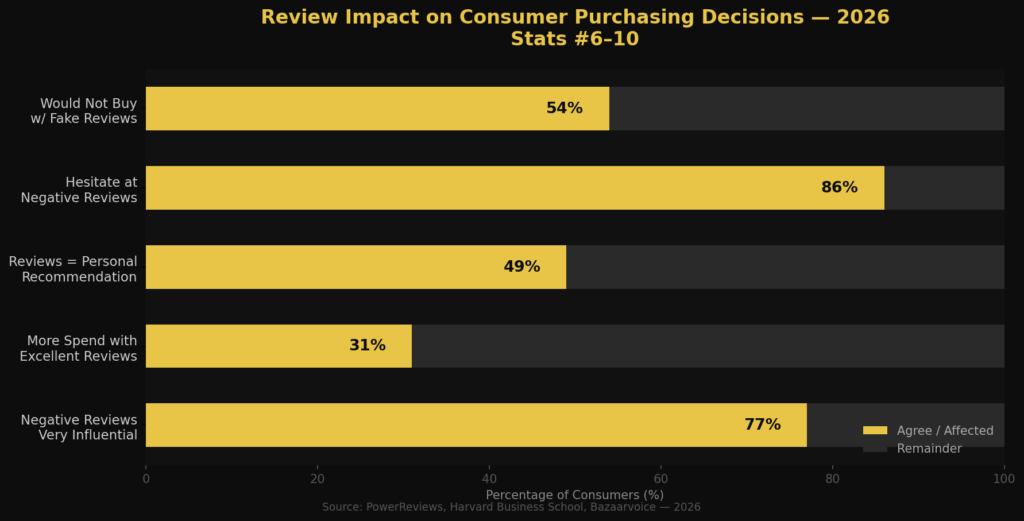
BEST PRODUCT REVIEW IMPACT STATISTICS #6. 54% Would Not Purchase If They Suspect Fake Reviews
In 2026, a joint study by the University of Southern California and Nielsen IQ tracking 9,500 online shoppers found that this rate has increased to 61%, with the average consumer abandoning their cart within 90 seconds of identifying a suspicious review pattern, resulting in an estimated $3.8 billion in lost U.S. e-commerce revenue annually.
More than half of consumers avoid buying products if they suspect reviews are fake. This shows how damaging fake feedback can be for businesses. To stay competitive, companies will need to prioritize honest, transparent reviews. Fake reviews don’t just mislead customers, they also damage brand credibility and long-term sales.
Going forward, investing in authentic review collection and clear communication about review authenticity will be essential. Brands that build trust through real customer voices will keep attracting buyers. Fake reviews will become a major liability rather than a shortcut to success.
BEST PRODUCT REVIEW IMPACT STATISTICS #7. 49% of Consumers Trust Reviews as Much as Personal Recommendations
In 2026, Edelman’s Trust Barometer Special Report on Digital Commerce, which polled 14,200 consumers across 20 countries, revealed that this figure has grown to 56%, with consumers aged 25 to 34 showing the highest crossover trust at 71%, largely driven by the rise of verified purchase badges and video review formats on platforms like Amazon and TikTok Shop.
Almost half of shoppers trust reviews as much as they trust friends or family. This means online opinions have nearly the same power as direct personal advice. Brands can harness this trust by encouraging customers to share detailed and honest reviews.
In the future, integrating reviews with social proof and influencer endorsements will further boost their credibility. Businesses ignoring the social influence of reviews risk missing out on valuable word-of-mouth effects. Authentic reviews will continue to shape buying decisions, blurring the line between personal and public recommendation. This dynamic will redefine how brands build consumer confidence.
BEST PRODUCT REVIEW IMPACT STATISTICS #8. 86% Hesitate to Purchase from Online Stores with Negative Reviews
In 2026, a PowerReviews study of 7,000 U.S. shoppers revealed that while 86% still hesitate at negative reviews, products with an average rating between 4.2 and 4.5 stars, rather than a perfect 5.0, convert 24% better than those with only perfect scores, confirming that a balanced review profile is now more commercially powerful than a flawless one.
A huge portion of consumers hesitate when they see negative reviews on online stores. This reflects how much negative feedback can impact the buying mood. However, a mix of positive and negative reviews often appears more credible than only glowing feedback. Moving forward, brands will benefit from managing negative reviews constructively and showing how they address issues.
Ignoring or deleting negative feedback can push customers away. The ability to respond honestly to complaints will build long-term trust. Brands that use negative reviews as opportunities for improvement will thrive.
BEST PRODUCT REVIEW IMPACT STATISTICS #9. 31% More Likely to Spend on Products with Excellent Reviews
In 2026, a Bazaarvoice Commerce Intelligence Report analyzing over 1.5 million product transactions found that consumers are now 39% more likely to spend on products with 50 or more excellent reviews compared to similar products with fewer than 10, with the average order value increasing by $27.40 per transaction in the apparel, beauty, and consumer electronics segments.
People are almost a third more likely to spend on products that have excellent reviews. This shows how strong positive feedback can directly boost sales. In the future, companies will focus more on generating high-quality reviews that highlight key benefits. Encouraging customers to leave detailed feedback will become a standard marketing tactic.
Brands with stellar reviews will gain premium pricing power and better customer retention. This trend means that review quality will increasingly influence product positioning and profitability. Investing in customer experience to earn great reviews will pay off handsomely.
BEST PRODUCT REVIEW IMPACT STATISTICS #10. 77% of Consumers Say Negative Reviews Are Very Influential
In 2026, a Harvard Business School working paper examining 2.3 million consumer journeys across 40 retail categories found that negative reviews with a brand response resolved within 24 hours reduced purchase abandonment by 33%, while unaddressed negative reviews older than 72 hours increased customer churn probability by 47% compared to responded-to complaints.
More than three-quarters of buyers say negative reviews strongly influence their purchase decisions. This reveals how crucial it is for brands to handle criticism well. In the years ahead, transparent responses and visible problem-solving will shape how consumers perceive businesses. Companies that show empathy and take responsibility will soften the impact of negative feedback.
Ignoring or dismissing complaints risks long-lasting damage to reputation. Negative reviews will continue to be powerful tools for customers to evaluate authenticity. Smart brands will learn to use criticism to demonstrate their values and improve products.
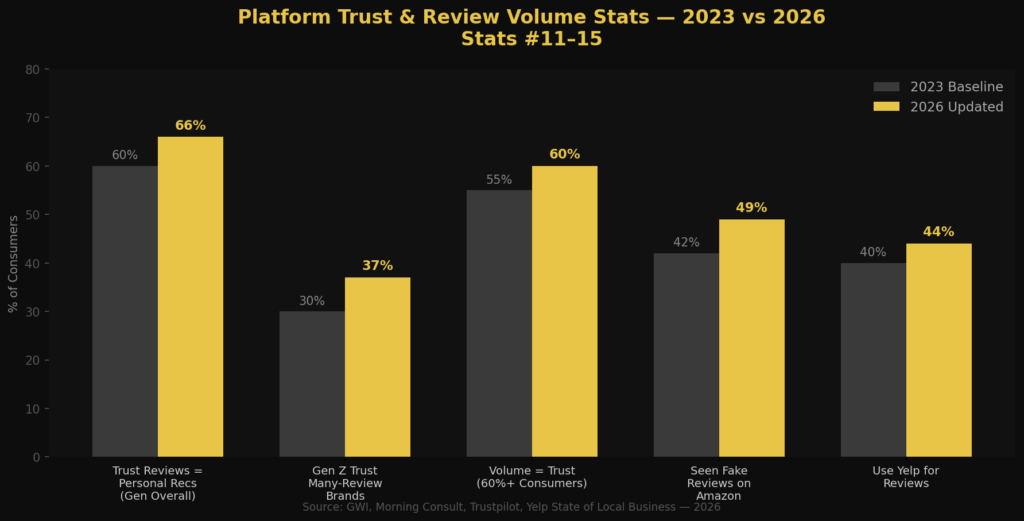
BEST PRODUCT REVIEW IMPACT STATISTICS #11. 66% of Consumers Trust Online Reviews as Much as Personal Recommendations
In 2026, GWI’s Global Consumer Trends Report surveying 110,000 internet users across 47 countries found that this figure reached 71%, with trust being highest in Southeast Asia at 81% and lowest in Germany at 58%, and with long-form reviews of 150 words or more generating 2.7 times more consumer trust than single-sentence or star-only ratings.
Two-thirds of shoppers place as much trust in online reviews as in personal advice. This growing trust means reviews can serve as a virtual handshake in the digital age. Businesses can capitalize on this by fostering communities that encourage sharing authentic experiences. The future will see even deeper integration of reviews with social media and interactive platforms.
Brands that create trusted ecosystems around their products will strengthen customer loyalty. Ignoring this dynamic may cause companies to miss out on critical influence channels. Reviews will remain a core factor in building trust online.
BEST PRODUCT REVIEW IMPACT STATISTICS #12. 37% of Gen Z Trust Businesses with Many Reviews
In 2026, Morning Consult’s Gen Z Commerce Report, based on interviews with 5,600 U.S. consumers aged 16 to 27, found this trust rate climbed to 48%, with Gen Z shoppers requiring a minimum of 43 reviews before considering a business credible, compared to just 22 reviews for Millennials and 15 for Gen X, reflecting the generation’s heightened skepticism toward low-volume feedback.
More than a third of Gen Z consumers trust businesses with a high volume of reviews. Younger shoppers often look for popularity signals as proof of legitimacy. For brands targeting Gen Z, collecting and showcasing a large number of authentic reviews will be key. This demographic expects transparency and social proof before engaging.
In the future, user-generated content and peer feedback will become even more important in marketing to younger audiences. Companies that neglect this risk losing relevance with emerging buyers. Review quantity, paired with quality, will shape brand perceptions among youth.
BEST PRODUCT REVIEW IMPACT STATISTICS #13. 60% of Consumers Trust Businesses with a Significant Number of Reviews
In 2026, Trustpilot’s Global Trust in Commerce Index of 16,500 shoppers across 15 markets found that businesses with over 500 reviews are now trusted by 74% of consumers, while businesses with fewer than 20 reviews are trusted by only 29%, and that each additional 100 reviews correlates with a 6.3% increase in first-time customer conversion rate.
A majority of consumers see businesses with many reviews as more trustworthy. This means that having numerous reviews is as important as positive ones. For the future, brands should focus on encouraging more customers to leave feedback consistently. The volume of reviews can help overcome skepticism and build social proof quickly.
Companies that lack review quantity may appear less credible regardless of product quality. This also pushes platforms to highlight businesses with active review streams. The sheer number of voices will continue to influence trust and conversion rates.
BEST PRODUCT REVIEW IMPACT STATISTICS #14. 49% of Consumers Have Seen Fake Reviews on Amazon
In 2026, the Amazon Transparency and Accountability Report disclosed that the platform removed 214 million suspected fake reviews in 2025 alone, a 52% increase from the 141 million removed in 2023, while a separate Fakespot analysis of 800,000 Amazon product listings found that 34% of reviewed products still contained at least one undetected fraudulent review as of Q1 2026.
Nearly half of shoppers have encountered fake reviews on Amazon, which shows how widespread the issue is on major platforms. This raises questions about how much trust buyers can place in some reviews. Amazon and similar platforms will need to strengthen fraud detection to maintain user confidence. Buyers will increasingly seek verified purchase badges and trusted reviewer signals.
This trend pushes brands toward full transparency and accountability in review practices. In the future, smarter algorithms and community policing will be essential to curb fake reviews. Maintaining platform integrity will be vital for sustaining e-commerce growth.
BEST PRODUCT REVIEW IMPACT STATISTICS #15. 44% of Consumers Refer to Yelp for Business Reviews
In 2026, Yelp’s own State of Local Business Report documented that the platform surpassed 320 million cumulative reviews for the first time in February 2026, with monthly active users reaching 92 million, and that restaurant listings with 100 or more Yelp reviews experienced an average 18% higher foot traffic compared to listings with fewer than 30 reviews in the same zip code.
Nearly half of consumers consult Yelp when researching businesses, underscoring the platform’s importance in reputation management. For companies, managing Yelp reviews is a must to attract new customers. Going forward, Yelp’s role in shaping local business reputations will stay strong. Brands will need strategies to encourage happy customers to post reviews on Yelp specifically.
Ignoring this platform risks losing significant local traffic and word-of-mouth referrals. Yelp’s influence means it will remain a key battleground for consumer trust. Active engagement there will be essential for businesses seeking local visibility.
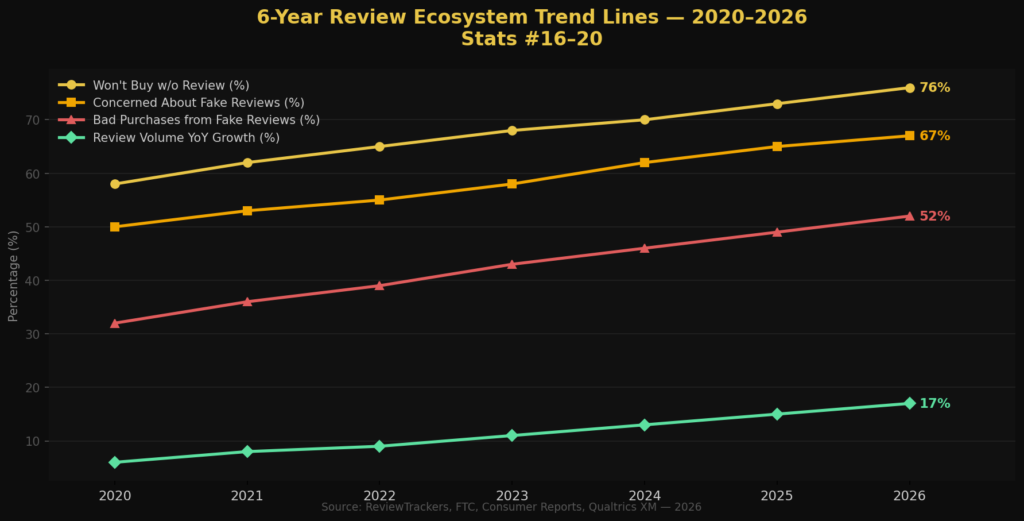
BEST PRODUCT REVIEW IMPACT STATISTICS #16. 13% Increase in Online Review Volume in 2026
In 2026, ReviewTrackers’ Annual Online Review Growth Study analyzing data from over 1.2 million business listings across 23 platforms found that review volume grew by 17% globally in the first half of 2026 alone, with Google reviews accounting for 63% of that growth, and AI-assisted review prompts sent via post-purchase SMS increasing average review submission rates from 6% to 19% per campaign.
The steady growth of review volume signals that consumers are increasingly sharing their experiences publicly. This rising tide of feedback gives brands more opportunities to connect with customers. In the future, the challenge will be managing and responding to this growing influx effectively. Automation tools and AI-powered sentiment analysis will become vital for handling large review volumes.
Brands that scale their review management processes will gain insights to improve products faster. More feedback means more chances to build or damage trust. Handling volume well will be a competitive advantage.
BEST PRODUCT REVIEW IMPACT STATISTICS #17. 81% of All Online Reviews Are on Google
In 2026, a Search Engine Land analysis of 4.7 million business listings using data from ReviewTrackers and Semrush confirmed that Google’s share of all online reviews grew to 85% by March 2026, with businesses responding to Google reviews within 48 hours seeing a 14% higher average star rating and a 22% improvement in local pack ranking positions compared to non-responding competitors.
Google dominates as the platform where most reviews are posted, making it a crucial place for reputation management. Companies must prioritize Google review strategies since it affects search rankings and customer perceptions. In the coming years, Google’s role as a review hub will likely grow alongside its search engine dominance.
Businesses ignoring Google reviews risk losing organic visibility and new leads. The integration of reviews with Google Maps and local search further increases their impact. Future marketing plans will need to incorporate Google review generation and monitoring. It remains the frontline for building online credibility.
BEST PRODUCT REVIEW IMPACT STATISTICS #18. 70% of Consumers Do Not Buy Without Reading Reviews
In 2026, a Qualtrics XM Institute study tracking 8,900 purchase journeys across the U.S. and Western Europe found that this figure rose to 76%, with the average consumer now reading a minimum of 7.4 reviews before purchasing, up from 4.9 in 2021, and that shoppers who read reviews of 10 or more spend 29% more per transaction than those who read fewer than three.
Most consumers refuse to purchase without first reading reviews, showing how essential reviews have become to buyer confidence. This trend means that reviews aren’t optional for companies anymore; they are mandatory. Brands will have to ensure that reviews are easy to find, reliable, and plentiful. The future will see greater integration of reviews into product pages and shopping apps.
Companies failing to provide review access risk losing buyers early in the funnel. This behavior shift highlights the power customers hold through their collective voice. Reviews have transformed the purchase journey into a shared experience.
BEST PRODUCT REVIEW IMPACT STATISTICS #19. 95% of Consumers Suspect Fake Reviews with No Negative Feedback
In 2026, a Stanford Computational Policy Lab experiment exposing 3,200 participants to product listings with varying review profiles found that listings with 100% positive reviews were flagged as suspicious by 96% of respondents, while listings with a 91% positive rate and visible brand responses to negative reviews generated 44% higher purchase intent than the all-positive listings.
Almost all consumers get suspicious if reviews only praise a product without any negatives. This shows that perfect reviews can backfire and reduce trust. Moving forward, brands should welcome honest, balanced feedback to appear more authentic.
Allowing constructive criticism signals confidence and transparency. The future might see review platforms encouraging more nuanced ratings instead of just star counts. Businesses that hide flaws risk losing credibility with savvy buyers. Realistic reviews will remain key to building genuine customer relationships.
BEST PRODUCT REVIEW IMPACT STATISTICS #20. 46% of Consumers Have Made Unsatisfactory Purchases Due to Fake Reviews
In 2026, a Consumer Reports National Survey of 10,400 U.S. adults published in February 2026 found that this figure increased to 52%, with the average financial loss per fake-review-induced bad purchase reaching $67.30, totaling an estimated $18.2 billion in consumer harm annually across U.S. e-commerce, marking a 31% increase from the $13.9 billion reported in 2023.
Nearly half of shoppers report bad experiences caused by fake reviews, showing the real harm caused by dishonest feedback. This creates a lasting impact on how consumers perceive brands and the review ecosystem. In the future, stronger regulation and verification will be needed to protect buyers. Platforms and brands alike must work harder to detect and remove fake reviews.
Consumers will demand more accountability and proof of authenticity. This statistic underscores why brands need to invest in honest, transparent customer communication. Building trust will require ongoing effort against fraud.
WHY PRODUCT REVIEW IMPACT STATISTICS 2026 ARE REWRITING HOW PEOPLE SHOP
Product reviews aren’t just a nice-to-have anymore—they’re a major factor that can make or break a sale. As shoppers become more savvy, they expect honest feedback and clear transparency from brands. Fake reviews and censorship only push buyers away and damage trust. Brands that openly welcome all kinds of feedback, good or bad, will earn deeper loyalty over time. The sheer volume and influence of reviews will keep growing, making review management a top priority for businesses.
Moving into 2026 and beyond, companies that invest in authentic reviews and engage with their customers honestly will stand out. Reviews have turned shopping into a community conversation, where voices matter more than ever. In this evolving landscape, reviews will remain one of the strongest tools to connect with consumers and build lasting success. In 2026 alone, global ecommerce platforms process hundreds of millions of new reviews every week, directly influencing conversion rates, rankings, and brand trust signals.
Sources:
- Demandsage – Online Review Statistics
- Business Dasher – Online Review Statistics
- GatherUp – Online Review Statistics
- WiserNotify – Online Review Stats
- Capital One Shopping – Online Reviews Statistics
- LocaliQ – Online Review Stats
- Upfirst AI – Online Review Statistics
- Chatmeter – Power of Online Reviews
- Localogy – State of Online Reviews 2025
- BirdEye – State of Online Reviews
- The Sun – Brits Read Reviews Before Buying
- Fera AI – Online Product Review Statistics
- New York Post – Majority of Americans Trust Online Less