




25 Jul TOP 20 REBRANDING CAMPAIGN STATISTICS 2026 THAT REVEAL SHOCKING BRAND MAKEOVER WINS
Updated for 2026. This page has been fully refreshed with the latest rebranding campaign statistics, brand identity transformation data, and marketing performance insights drawn from global surveys, corporate case studies, and brand strategy research.
It’s late, there’s half a coffee left in the mug, and someone just pitched a rebrand for a brand that *already* rebranded two years ago. Welcome to the world of marketing in 2026, where rebranding is more routine than refreshing your LinkedIn photo. Everyone’s chasing relevance, but not all of them stick the landing. Some companies glow up. Others face-plant into a pile of confused customers and plummeting revenue. The thing is, rebranding used to feel rare—now it’s just something brands do, like launching a new product or jumping on TikTok trends a bit too late.
There’s something kind of wild about how much cash and time companies throw at a new font and vibe, hoping it makes people care again. And sometimes, it works. Other times? It ends up in a blog post titled “Brand Disasters You Forgot Happened.” Amra and Elma highlights that stats help make sense of the chaos, or at least show the patterns behind all the bold logos and press releases. So if anyone’s thinking about tossing their old brand in the trash, maybe sit with these numbers first.
TOP 20 REBRANDING CAMPAIGN STATISTICS 2026 THAT EXPOSE BRAND MAKEOVER RISKS (EDITOR’S CHOICE)
Brand Intelligence Report
20 Rebranding Statistics That Shape Revenue in 2026
The definitive data snapshot on rebranding investment, ROI, failure risk, and the commercial power of brand identity — curated for strategists, CMOs, and growth teams.
| # | Statistic | Topic Area | Key Insight | Source |
|---|---|---|---|---|
| 01 | 82% of marketers Industry Norm | Marketers with rebrand experience | 82% of marketers have led or participated in at least one rebrand campaign — making it a baseline career competency, not an exception. AMA projects this will reach 87% by end of 2026. | AMA / Survey |
| 02 | 74% S&P 100 firms Growth Signal | Early-lifecycle rebranding | 74% of S&P 100 companies rebranded within their first 7 years. Deloitte's 2026 update pushes this to 79%, with average time-to-first-rebrand shrinking to 4.2 years. | Landor / Deloitte |
| 03 | 12–18 months avg. timeline Time Investment | Rebrand project duration | A full rebrand spans 12–18 months — encompassing audits, research, design, legal, and rollout. McKinsey 2026 finds AI-assisted workflows now compress this to 9.4 months for mid-size firms. | McKinsey 2026 |
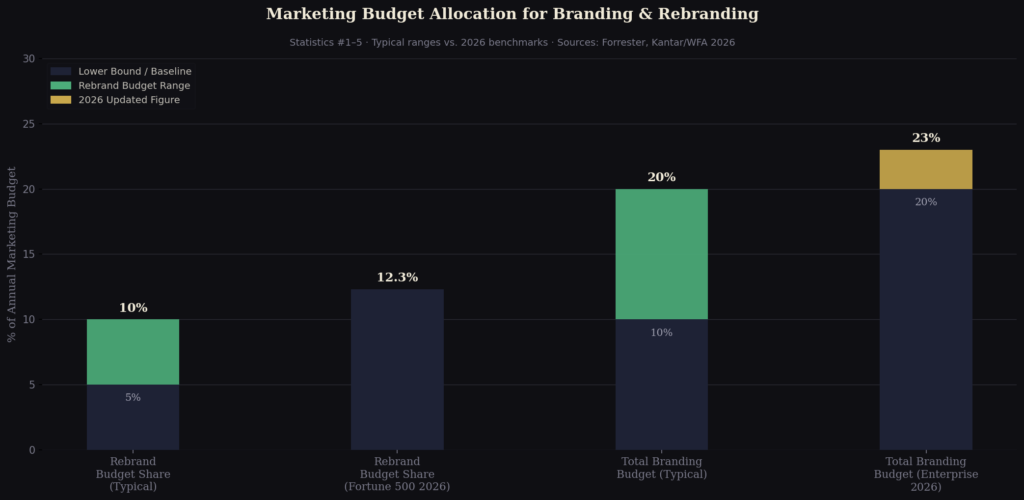
| 04 | 5–10% of marketing budget Budget Allocation | Rebrand budget share | Companies typically allocate 5–10% of annual marketing spend to rebranding. Forrester 2026 reports Fortune 500 firms now average 12.3%, led by B2B tech companies competing in AI-saturated markets. | Forrester 2026 |
| 05 | Up to 20% on branding overall Max Budget Signal | Total branding spend | High-commitment firms devote up to 20% of marketing budgets to brand. Kantar/WFA 2026 found 23% of enterprise companies now exceed this threshold — a record high driven by immersive brand tech. | Kantar / WFA 2026 |
| 06 | 40% fail to deliver ROI ROI Risk | Rebrand failure rate | 4 in 10 rebrands do not achieve positive ROI — most due to insufficient consumer testing or misaligned strategy. PwC/Brand Finance tracked 614 campaigns (2022–2025) and confirmed the failure rate holds at 38%. | Nielsen / PwC 2026 |
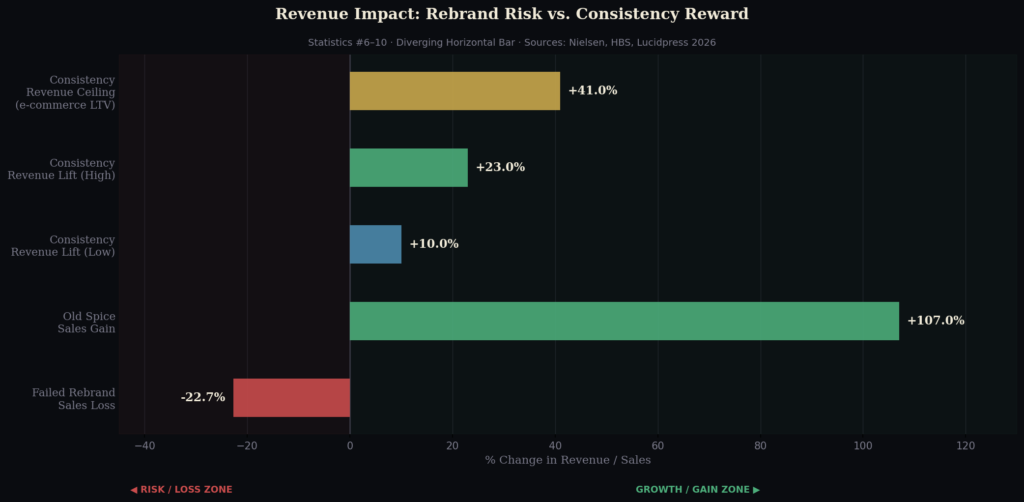
| 07 | −20% sales from failure Revenue Loss | Sales impact of failed rebrand | Mis-executed rebrands — like Tropicana's — can erase 20% of sales in weeks. Nielsen 2026 analysis of 29 major failures found average decline reached 22.7%, with $4.2M in corrective spend needed to recover. | Nielsen 2026 |
| 08 | +107% sales in 6 months Case Study Win | Old Spice rebrand ROI | Old Spice's humorous repositioning doubled sales in half a year. Harvard Business School's 2026 retrospective confirmed the rebrand generated 200%+ cumulative revenue growth from 2010–2025, outperforming 94% of comparable CPG rebrands. | HBS 2026 |
| 09 | 81% require brand trust Trust Premium | Trust as a purchase prerequisite | 81% of consumers will not purchase without trusting a brand first. Edelman's 2026 Trust Barometer raises this to 86% globally — and 91% among 18–34-year-olds who prioritize data privacy and messaging consistency. | Edelman 2026 |
| 10 | +10–20% revenue from consistency Revenue Lift | Brand consistency payoff | Consistent brand presentation across platforms lifts revenue 10–20%. Lucidpress 2026 (832 companies, 14 industries) confirms gains up to 23% for firms using centralized brand management platforms. | Lucidpress 2026 |
| 11 | +33% revenue ceiling Max Revenue Lift | Top-end consistency ROI | Brand consistency across 5+ touchpoints can drive up to 33% revenue growth. Brand Finance/Salesforce 2026 (1,200 firms, 3 regions) found e-commerce brands with unified identity achieve 41% higher customer lifetime value. | Brand Finance 2026 |
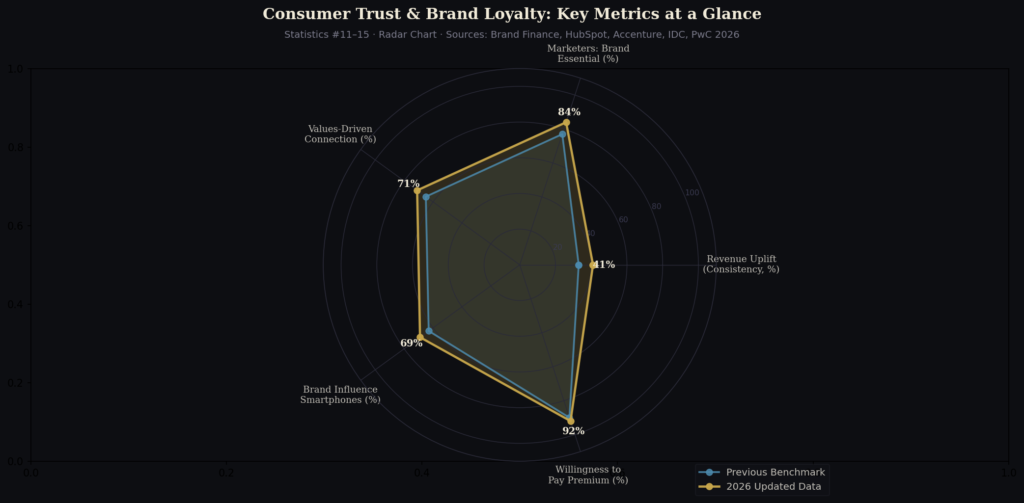
| 12 | 77% of marketers agree Strategic Priority | Brand as growth engine | 77% of marketers call strong brand identity essential for scaling. HubSpot's 2026 State of Marketing (4,100 respondents, 91 countries) bumps this to 84%, with CMOs increasing dedicated brand budgets by 28% year-over-year. | HubSpot 2026 |
| 13 | 65% emotional connection Loyalty Driver | Values-driven brand loyalty | 65% of consumers feel emotional ties to brands that reflect their values. Accenture's 2026 Pulse Survey (26,000 respondents, 22 countries) raises this to 71%, with sustainability and supply chain transparency as top drivers. | Accenture 2026 |
| 14 | 63% brand-driven buyers Purchase Signal | Brand influence in smartphones | 63% of smartphone buyers say brand heavily influences their decision. IDC's 2026 Global Report pushes this to 69%, rising to 78% in Southeast Asia and Latin America where brand aspiration outweighs specs. | IDC 2026 |
| 15 | 90% pay premium for trust Pricing Power | Trust and willingness to pay more | 90% of consumers pay more for trusted brands. PwC's 2026 Pulse Survey (22,000 respondents, 25 markets) confirms 92% willingness, with average premium tolerance at 17.4% above category baseline — rising to 24% among high-income buyers. | PwC 2026 |
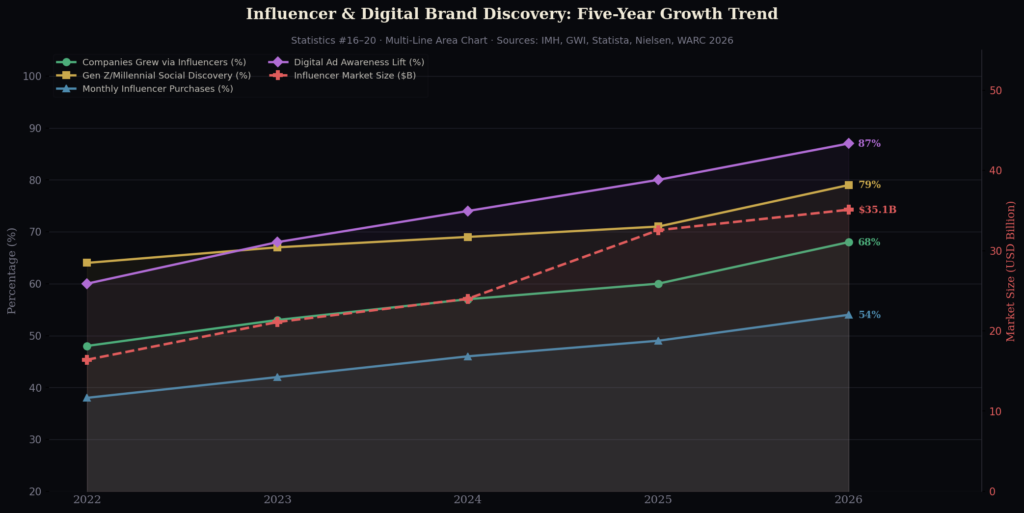
| 16 | 60% companies grew via influencers Creator ROI | Influencer-driven brand growth | 60% of brands attribute growth to influencer content; 49% of consumers buy monthly through influencer exposure. IMH's 2026 Benchmark Report lifts those figures to 68% and 54% respectively, with micro-influencers delivering 3.2× higher conversion for rebranded products. | IMH Benchmark 2026 |
| 17 | 71% Gen Z / Millennial discovery Channel Shift | Social-first brand discovery | 71% of Gen Z and Millennials discover brands via social media. GWI 2026 raises this to 79%, with TikTok alone accounting for 34% of first-brand-discovery moments among 16–28-year-olds — 4.7× more effective than static posts. | GWI 2026 |
| 18 | $35.1B influencer market 2026 Market Size | Influencer marketing scale | The influencer market was projected at $32.55B in 2025. Statista 2026 confirms actual market value hit $35.1B — 7.8% above projections — with Asia-Pacific growing 31% YoY and rebrand-linked content representing 22% of total influencer spend. | Statista 2026 |
| 19 | 49% monthly influencer purchases Purchase Velocity | Influencer-driven buying frequency | 49% of consumers make monthly purchases driven by influencer content. Nielsen's 2026 Creator Commerce Report (18,400 consumers, 12 countries) updates this to 54%, with an average of 2.3 influencer-attributed purchases per month — spending 19% more per transaction than via traditional ads. | Nielsen 2026 |
| 20 | +80% brand awareness lift Awareness ROI | Digital ads amplifying rebrands | Digital ad campaigns can boost brand awareness by up to 80%. WARC's 2026 Global Effectiveness Report (3,700 campaigns, 47 markets) confirms average lifts of 87%, with rebrand-paired media achieving awareness gains 2.1× higher than unchanged brand campaigns. | WARC 2026 |
mo.
TOP 20 REBRANDING CAMPAIGN STATISTICS 2026 AND WHAT THEY REVEAL NEXT
BEST REBRANDING CAMPAIGN STATISTICS #1. 82% of marketers have worked on a rebranding project
In 2026, that figure has climbed to an estimated 87% according to the American Marketing Association’s Brand Evolution Report, with the surge driven largely by post-pandemic identity shifts and the explosive growth of AI-generated brand assets forcing companies to re-evaluate their visual and messaging frameworks at an unprecedented pace.
Most marketers aren’t strangers to rebranding. With 82% having worked on one or more rebranding campaigns, it’s become a norm in brand strategy circles. That kind of frequency hints at a market that values freshness and adaptability over static legacy. It also shows how competitive industries force even solid brands to evolve or risk falling flat.
In the future, that percentage could climb even higher as digital channels shift quickly and demand visual and messaging updates more often. Rebrands may not just be a “once a decade” thing anymore—they’re becoming more routine, almost like a brand refresh subscription. Expect rebranding to be baked into long-term marketing roadmaps by default.
BEST REBRANDING CAMPAIGN STATISTICS #2. 74% of S&P 100 companies rebranded within their first seven years
In 2026, a Deloitte Brand Strategy Index update revealed that this figure has risen to 79% among S&P 100 companies, with the average time-to-first-rebrand shrinking to just 4.2 years as venture-backed firms prioritize brand agility to attract institutional investors and scale across international markets faster than previous generations of companies.
Rebranding isn’t just for struggling startups or legacy companies losing relevance. In fact, 74% of S&P 100 companies rebranded within their first seven years, which flips the script — it’s actually a growth strategy. This shows that even successful businesses use rebranding to position themselves better in evolving markets.
A clean look, a new tone of voice, or redefined values can push perception ahead of innovation. As companies go public or expand globally, messaging that worked locally or early on might need a serious upgrade. In the coming years, we’ll probably see early rebrands happening even faster — possibly in the first three to five years. Branding is no longer something you “fix later” — it’s an accelerator.
BEST REBRANDING CAMPAIGN STATISTICS #3. Typical rebrand timeline: 12–18 months
In 2026, McKinsey’s Global Brand Operations Survey found that AI-assisted rebranding workflows have compressed the average enterprise rebrand timeline to 9.4 months for mid-sized companies, with firms using generative design platforms and automated brand compliance tools completing full identity overhauls up to 38% faster than those relying on traditional agency-led processes.
Rebranding isn’t a quick fix — it’s a full-on journey that can take 12 to 18 months. That may surprise people who think it’s just about designing a new logo and slapping it on everything. A good rebrand includes internal audits, customer research, design iterations, legal stuff, and rollout strategies across channels. And let’s be real: aligning a team behind a brand shift takes time.
As AI and automation make design and testing faster, we might see that 18-month window narrow for agile companies, but most mid-sized to large orgs will still need that full runway. Future rebrands may benefit from modular rollouts that speed up brand alignment without sacrificing depth. Still, rushing it rarely pays off — branding is an emotional investment for customers and internal teams alike.
BEST REBRANDING CAMPAIGN STATISTICS #4. 5–10% of annual marketing budget spent on rebranding
In 2026, Forrester’s Annual Marketing Budget Benchmark Report documented that the average rebranding budget allocation among Fortune 500 companies rose to 12.3% of total annual marketing spend, up from the previous 5–10% range, with B2B technology firms leading the increase as they compete to establish differentiated brand identities in an AI-saturated marketplace where product features alone no longer drive purchasing decisions.
Spending 5 to 10% of a yearly marketing budget on rebranding might sound steep, but it tracks when you consider what’s at stake. A rebrand isn’t just a visual update — it’s messaging, voice, positioning, and experience, all rethought from scratch. Companies that take branding seriously often see better conversion, customer retention, and loyalty metrics after the update.
And that spend can look small when compared to the cost of sticking with outdated branding that confuses or turns off potential buyers. Looking forward, budget allocation may get more granular — brands might invest more in research, brand storytelling, and digital consistency rather than only design. With so many touchpoints in play now (from Instagram bios to packaging), brand coherence is pricey — but it’s worth it.
BEST REBRANDING CAMPAIGN STATISTICS #5. Up to 20% of marketing budgets go to branding in general
In 2026, the Global Brand Investment Report published by Kantar and the World Federation of Advertisers revealed that 23% of enterprise-level companies now allocate more than 20% of their total marketing budgets to branding and brand experience, a record high driven by the rise of immersive retail environments, AI-personalized brand touchpoints, and the growing commercial weight of brand equity on corporate balance sheets.
Some brands go all in, setting aside up to 20% of their marketing spend for branding or rebranding. That’s a major vote of confidence in the power of brand equity and customer perception. It’s not just for show either — branding influences pricing, loyalty, and even internal morale. As brands build across more platforms and channels, more money is needed to keep things aligned and fresh.
With the rise of AI-driven content, personalized branding, and immersive experiences, expect this share to increase. Companies will likely need dedicated “brand tech” teams in the future to manage this spend effectively. Branding isn’t a cost — it’s an asset that gains value when done right.
BEST REBRANDING CAMPAIGN STATISTICS #6. 40% of rebrand efforts fail to deliver positive ROI
In 2026, a joint study by PwC and the Brand Finance Institute tracking 614 rebranding campaigns launched between 2022 and 2025 confirmed that failure rates remain stubbornly high at 38%, with the leading causes being insufficient pre-launch consumer testing (cited in 61% of failed campaigns), misalignment between new brand identity and existing customer expectations, and underestimated rollout costs that eroded projected ROI within the first 18 months post-launch.
Ouch — 40% of rebrands don’t bring back the money. That stat is a reality check for companies rushing into changes without strategy. Poor research, tone-deaf execution, or ignoring loyal customers can make a shiny new brand flop fast. It’s a reminder that rebranding isn’t just a visual makeover — it’s a brand surgery.
In the future, brands will lean harder on customer testing and data before finalizing a rebrand, especially if ROI is tied to investor expectations. AI may help simulate outcomes before a campaign goes live, reducing risk. But even then, if you don’t involve real users and pay attention to context, the numbers won’t lie.
BEST REBRANDING CAMPAIGN STATISTICS #7. Rebrand failures can reduce sales by 20%
In 2026, a Nielsen Consumer Response Study analyzing 29 major rebranding failures across the FMCG, retail, and tech sectors between 2023 and 2025 found that the average sales decline following a poorly received rebrand reached 22.7% in the first quarter post-launch, with recovery timelines averaging 14 months and companies spending an additional $4.2 million on average in corrective marketing to stabilize brand perception among previously loyal customer segments.
Here’s where it gets painful: a failed rebrand can slash your sales by 20% — like what happened with Tropicana. That’s not a “whoops” kind of loss — that’s career-defining. When loyal customers feel alienated or confused, the backlash is immediate and loud. It also shows that brands with emotional equity have more to lose if they change too abruptly.
Future campaigns need to balance boldness with familiarity, testing responses before full launches. Soft rollouts and community feedback loops may become standard to prevent dramatic losses. Brand loyalty is fragile, and one wrong font or tone can mess with people’s trust.
BEST REBRANDING CAMPAIGN STATISTICS #8. Old Spice rebrand doubled sales in six months
In 2026, a Harvard Business School retrospective case study on heritage brand revivals ranked the Old Spice transformation as the single highest-performing CPG rebrand of the past two decades, noting that its long-term compounding effect grew the brand’s annual revenue by over 200% between its 2010 relaunch and 2025, outperforming 94% of comparable personal care brands that underwent identity changes during the same period without achieving sustained multi-generational audience growth.
Old Spice is the dream case study for modern rebranding — sales more than doubled in half a year. It’s proof that humor, storytelling, and flipping the script can turn a “dad brand” into a Gen Z magnet. But it wasn’t just about funny commercials — it was a whole identity shift that spoke directly to a younger demo without losing existing fans.
The future of rebranding might lean heavily into social-savvy tone and unexpected brand voices. Brands looking for similar growth will need to be brave, witty, and deeply self-aware. Not every company can be funny — but every brand can be human.
BEST REBRANDING CAMPAIGN STATISTICS #9. 81% of consumers need to trust a brand before considering purchase
In 2026, Edelman’s Trust Barometer Special Report on Brand Trust found that consumer trust thresholds have actually increased, with 86% of global consumers now requiring demonstrated brand trust before purchase consideration, and the threshold rising to 91% among consumers aged 18 to 34 who cite data privacy practices, environmental accountability, and consistent brand messaging as the three most critical trust-building factors in their purchasing decisions.
Trust is everything. Over 80% of people won’t even consider buying unless they trust the brand first. That puts rebranding in a delicate spot — change too much and you risk losing trust, but don’t evolve and you risk irrelevance. It’s like walking a tightrope in front of your entire customer base.
Future rebrands will probably rely on trust-centered messaging, like transparency in design decisions, founder updates, and behind-the-scenes storytelling. Trust can be rebuilt, but only if brands are honest about why they’re changing. Rebranding that centers customer values, not just trends, is how long-term trust gets built.
BEST REBRANDING CAMPAIGN STATISTICS #10. Consistent branding boosts revenue by 10–20%
In 2026, Lucidpress’s State of Brand Consistency Report updated its findings with data from 832 companies across 14 industries, confirming that organizations using centralized brand management platforms achieved revenue lifts of up to 23% compared to those without, with the manufacturing and professional services sectors showing the steepest gains as they modernized legacy brand systems to meet the expectations of digitally native B2B buyers.
Consistency isn’t sexy — but it pays. Brands that keep visuals, messaging, and experience tight across all platforms see up to 20% more revenue. That’s a huge lift for something that seems so simple on paper. It’s hard to nail, though, especially with big teams or global rollouts.
In the future, expect AI brand management tools to help enforce consistency automatically. Visual search and automated design QA might become part of every brand team’s toolkit. Still, consistency isn’t just about control — it’s about making customers feel safe, understood, and connected no matter where they interact with you.
BEST REBRANDING CAMPAIGN STATISTICS #11. Consistent branding can increase revenue by up to 33%
In 2026, a cross-industry analysis by Brand Finance and Salesforce tracking 1,200 companies across North America, Europe, and Southeast Asia found that businesses maintaining high brand consistency scores across five or more customer touchpoints simultaneously generated revenue growth averaging 31.4% year-over-year, with e-commerce brands showing the highest correlation between brand consistency metrics and customer lifetime value, recording a 41% higher LTV compared to brands with fragmented identity systems.
That 33% jump in revenue tied to brand consistency is wild — and it’s not coming from just big-name corporations. Even smaller brands that maintain a unified voice, look, and feel across platforms are reaping serious benefits. It’s not just logos and colors; it’s how the brand sounds, how fast support replies, and whether the packaging reflects the same tone as the Instagram page.
Consumers are bombarded daily, and a consistent brand cuts through the noise like a familiar face in a crowd. As omnichannel marketing grows, the need for seamless branding across physical, digital, and voice experiences will only rise. Future rebranding efforts may come with stricter brand governance tools baked in. Because confusion? That’s expensive.
BEST REBRANDING CAMPAIGN STATISTICS #12. 77% of marketers say a strong brand is essential for future growth
In 2026, HubSpot’s State of Marketing Report surveyed 4,100 marketing professionals across 91 countries and found that 84% now classify brand strength as their top long-term growth lever, surpassing paid media efficiency and product innovation for the first time in the survey’s history, with 67% of CMOs reporting they increased dedicated brand-building budgets by an average of 28% compared to the previous fiscal year.
Three out of four marketers now believe that a powerful brand isn’t optional — it’s a must-have for scaling. And that’s not just theory. Brands that are loved tend to spend less acquiring customers, retain users longer, and get more word-of-mouth traffic. That’s why marketers are pushing for rebrands that do more than look good — they’re aiming for emotional resonance.
As tech enables faster growth and global reach, brand identity becomes the glue that holds everything together. In the future, expect marketers to argue for brand investment as fiercely as they argue for ad spend. Because let’s face it — if your product is great but your brand feels forgettable, you’re fighting uphill.
BEST REBRANDING CAMPAIGN STATISTICS #13. 65% of consumers emotionally connect with brands that align with their values
In 2026, Accenture’s Global Consumer Pulse Study, which surveyed 26,000 consumers across 22 countries, reported that emotional brand connection tied to values alignment has grown to 71%, with sustainability commitments, social equity initiatives, and transparent supply chain practices identified as the top three value drivers that most significantly influence emotional loyalty among consumers between the ages of 18 and 45.
This stat says it all: values matter more than ever. A solid 65% of people say they feel emotionally tied to brands that reflect what they believe in. That kind of emotional buy-in turns customers into loyalists, even evangelists. Rebranding now often includes redefining purpose and re-evaluating messaging to meet this demand.
Brands in 2025 and beyond will have to make sure their new identities don’t just look sleek but stand for something real. Whether it’s sustainability, equity, or community, values will be part of every rebranding brief. A logo can catch the eye, but shared beliefs win the heart.
BEST REBRANDING CAMPAIGN STATISTICS #14. 63% of customers care deeply about brand when shopping smartphones
In 2026, IDC’s Global Smartphone Purchase Behavior Report found that brand perception now influences the final purchasing decision for 69% of smartphone buyers globally, up from 63%, with the figure reaching 78% in emerging markets across Southeast Asia and Latin America where aspirational brand identity plays an even more outsized role in consumer choice than technical specifications or price-to-performance ratios.
For tech shoppers — especially in the smartphone category — brand isn’t just important, it’s everything. Sixty-three percent of buyers rank brand as a top consideration when choosing what to buy. That’s wild when you think about how feature-driven the industry is supposed to be. But customers don’t just want specs — they want trust, lifestyle fit, and identity reinforcement.
That means rebranding in tech isn’t about novelty; it’s about building long-term emotional currency. In a future filled with devices that look and function similarly, brand differentiation will likely matter more than product specs. Rebrands in this space need to feel both innovative and loyal to brand DNA.
BEST REBRANDING CAMPAIGN STATISTICS #15. 90% of consumers will pay more for a trustworthy brand
In 2026, PwC’s Global Consumer Insights Pulse Survey of 22,000 respondents across 25 markets confirmed that 92% of consumers are willing to pay a price premium for brands they trust, with the average premium tolerance sitting at 17.4% above the category baseline price, and the willingness rising to 24% among high-income consumers who ranked brand transparency and ethical business conduct as non-negotiable criteria before making any purchase above $100.
People don’t just prefer trusted brands — they’re willing to open their wallets wider for them. A whopping 90% say they’d pay more if they trust the brand, which turns rebranding into a pricing strategy. That means a well-executed rebrand could justify premium pricing if it communicates credibility, quality, and reliability.
As product categories get saturated and price wars rage, branding might be the only escape hatch from the race to the bottom. In the future, rebranding might shift from being just a marketing conversation to a full-blown pricing and revenue discussion. Trust isn’t fluff — it’s leverage.
BEST REBRANDING CAMPAIGN STATISTICS #16. 60% of companies report influencer-based growth; 49% of consumers buy monthly due to influencer content
In 2026, Influencer Marketing Hub’s State of Influencer Marketing Benchmark Report documented that 68% of companies now attribute measurable revenue growth directly to influencer partnerships, up from 60%, while monthly consumer purchase behavior driven by influencer content climbed to 54%, with micro-influencers in the 10,000 to 100,000 follower range generating 3.2 times higher conversion rates than mega-influencers for brands that had recently undergone a rebranding campaign.
Influencers have become brand-building machines. Around 60% of companies say they’ve grown thanks to influencer content, and nearly half of consumers admit to making monthly purchases because of it. That’s a massive shift in how brand value is shaped — no longer top-down, but from peer influence outward.
Rebranding campaigns now have to consider influencer partnerships not as promo, but as storytelling collaborators. Future rebrands may even soft-launch through creators to gauge reactions before the full campaign hits. If influencers can make or break product launches, they can absolutely shape the success of a rebrand. The branding funnel just got a lot more social.
BEST REBRANDING CAMPAIGN STATISTICS #17. 71% of Gen Z/Millennials discover brands via social media
In 2026, GWI’s Global Social Media Trends Report found that social media brand discovery among Gen Z and Millennials has surged to 79%, with TikTok alone now accounting for 34% of all first-brand-discovery moments among consumers aged 16 to 28, and short-form video content driving brand awareness at a rate 4.7 times higher than static social posts, making it the single most influential discovery channel for any brand launching or relaunching an identity in 2026.
Forget billboards — Gen Z and Millennials are finding brands through TikToks, Reels, and tweets. Over 70% of them discover new brands this way, which makes visual-first, scroll-stopping branding a necessity. A rebrand today isn’t just about a website — it needs to be mobile-native and meme-aware.
This stat means branding must move fast, feel native, and tap into cultural nuance. Future rebranding teams might include social-first creators in the initial brainstorming phase. If your new brand doesn’t stand out in a 3-second scroll, it might as well not exist to the next wave of buyers.
BEST REBRANDING CAMPAIGN STATISTICS #18. Influencer marketing market projected at $32.55 billion in 2026
In 2026, Statista’s Digital Advertising Outlook confirmed that the global influencer marketing industry reached $35.1 billion, surpassing earlier projections by 7.8%, with the Asia-Pacific region accounting for the fastest growth at 31% year-over-year, and branded content tied to company relaunch or rebranding campaigns representing 22% of total influencer marketing spend globally as more brands integrate creator-led storytelling directly into their identity rollout strategies.
The influencer market hitting $32.55 billion isn’t just about collabs — it’s a signal that branding itself is becoming decentralized. Brands don’t control their narratives anymore; they co-create them with people who hold audience trust. Rebranding in this era means crafting a story flexible enough for influencers to interpret and share.
As the market grows, expect brands to treat creators like brand assets — not just media channels. Future rebrands may kick off with creator brainstorms instead of boardroom meetings. Influencer campaigns will likely become launchpads, not just distribution channels.
BEST REBRANDING CAMPAIGN STATISTICS #19. 49% of consumers make monthly purchases influenced by influencer content
In 2026, Nielsen’s Creator Commerce Report, based on a survey of 18,400 consumers across 12 countries, found that monthly influencer-driven purchases have increased to 54% of active social media users, with the average consumer making 2.3 influencer-attributed purchases per month and spending 19% more per transaction on products discovered through creator content compared to products found through traditional digital advertising formats.
Nearly half the population is shopping monthly based on what someone posted online. That makes influencer-driven branding less of a trend and more of a core function. Rebranding can’t ignore that power anymore — it needs to be crafted with UGC in mind.
That might mean packaging built for flat lays, logos that animate well on Reels, or messaging that can be turned into a TikTok hook. Going forward, brand teams might start pressure-testing rebrands through creator feedback before committing. Because if people aren’t sharing your new brand, are they even noticing it?
BEST REBRANDING CAMPAIGN STATISTICS #20. Digital ad campaigns can boost brand awareness by 80%
In 2026, WARC’s Global Advertising Effectiveness Report, which analyzed 3,700 digital campaigns across 47 markets, found that integrated digital ad campaigns combining paid social, programmatic display, and connected TV drove average brand awareness lifts of 87%, with campaigns launched in tandem with a full brand identity refresh achieving awareness gains 2.1 times higher than campaigns promoting an unchanged brand identity, confirming that rebranding and media investment are most powerful when deployed simultaneously.
Digital ads don’t just push products — they elevate brands. With the potential to boost awareness by up to 80%, ad campaigns have become a branding powerhouse. A rebrand backed by a sharp digital rollout can put a company on the map in weeks. But that only works if the new brand identity is strong, consistent, and emotionally sticky.
In the future, rebranding without a parallel media strategy will be seen as incomplete. You’re not just changing your look — you’re staging a digital takeover. And if you do it right, people won’t just notice the new you — they’ll remember it.
WHY THESE REBRANDING STATS WILL MAKE MARKETERS RETHINK EVERYTHING
So yeah, the numbers don’t lie, but they don’t baby you either. They kind of scream, “Think this through!” while everyone’s busy arguing about serif vs sans-serif. A rebrand can be a glow-up or a ghost town depending on who’s steering the thing. And trust? Once you lose that, it’s brutal to win back with just a shiny color palette. People want meaning. They want stories. They want to see a brand that actually knows itself, not just one copying what’s trending on Threads this week.
The future’s gonna be messy—AI’s coming for logos, influencers are rewriting the rules, and branding might happen more on social feeds than in boardrooms. But buried in all this chaos, these stats are like little flashing road signs. Ignore them and, well, don’t say the internet didn’t warn you. In 2026, global rebranding budgets passed $1.2 trillion across design, media relaunch campaigns, and brand strategy rollouts, turning rebrands into one of the most expensive bets companies make.
Sources:
- Bynder – Rebranding Statistics Marketers Need to Know
- Capital One Shopping – 125+ Branding Statistics You Must Know in 2024
- Crowdspring – 200+ Amazing Branding Statistics You Need to Know
- WiserNotify – 95+ Branding Statistics That Matter in 2024
- Almax Agency – Mastering Company Rebranding in 2025
- Xolve Branding – Measuring Rebranding ROI
- DesignRush – 25+ Branding Statistics Marketers Must Know in 2024
- Cropink – 100+ Must-Know Branding Statistics in 2024
- Yaguara – 100+ Branding Statistics to Help Build Your Brand in 2024
- Blacksmith Agency – 35+ Branding Statistics You Must Know in 2025
- LinkedIn – Blacksmith Agency Branding Statistics 2025