




15 May TOP 20 SAAS CUSTOMER ACQUISITION STATISTICS 2026 THAT EXPOSE SKYROCKETING CAC AND BILLION-DOLLAR GROWTH SHIFTS
Updated for 2026. This page has been fully refreshed with the latest SaaS customer acquisition statistics, conversion benchmarks, CAC trends, and revenue growth data, grounded in recent global surveys, venture capital reports, and SaaS ecosystem insights. In 2026, acquisition costs, AI-driven targeting, and usage-based pricing models are redefining how SaaS companies compete for every customer.
Customer acquisition has become one of the most competitive and costly areas in the SaaS industry. As more companies enter the space, standing out requires more than just a good product—it demands a data-driven, adaptive marketing and sales strategy. Trends like AI automation, freemium models, and usage-based pricing are reshaping how SaaS companies attract and convert users. Partnering with a marketing agency NYC can also help SaaS brands refine their positioning, optimize ad spend, and scale customer acquisition more effectively. At the same time, rising customer expectations and longer sales cycles are pushing businesses to rethink how they deliver value early in the journey.
Understanding the full scope of acquisition metrics—from CAC to churn—is essential for building a sustainable growth model.
In 2026, it’s not enough to just acquire customers, says Amra and Elma; retaining them and expanding their lifetime value is just as vital. The global SaaS market continues to grow rapidly, but so do the costs and complexities associated with customer acquisition. These 20 statistics paint a clear picture of where SaaS growth is heading and what companies must do to keep pace.
TOP 20 SAAS CUSTOMER ACQUISITION STATISTICS 2026 THAT REVEAL EXPLOSIVE CAC SPIKES (EDITOR’S CHOICE)
SaaS Customer Acquisition
by the Numbers
20 essential statistics shaping the SaaS growth economy — benchmarks, costs, and conversion metrics that matter.
| # | Metric | Key Figure | Category | Context / Signal |
|---|---|---|---|---|
| 01 | Global SaaS Market Size Projected 2026 valuation with accelerating growth runway through 2029 | $375.57B 2026 projection · 19.38% CAGR to 2029 | Market Size | Market to hit $793B by 2029. Fortune Business Insights pegs 2026 at $375.57B, up from $315.68B in 2025. |
| 02 | Average Customer Acquisition Cost Blended industry CAC across all segments | $702 Industry average CAC | CAC | Enterprise SaaS CAC averages $1,200; SMB CAC sits at $98 median. Wide variance by segment and channel. |
| 03 | CAC Payback Period Benchmarks Time to recoup acquisition cost by company size | 9–24 mo Range across company sizes | CAC | <20 employees: 9–12 mo · 20–100: 12–14 mo · Midmarket: 14–18 mo · Enterprise (>1,000): 18–24 months |
| 04 | LTV : CAC Ratio Standard The golden ratio separating healthy from struggling SaaS | 3 : 1 Healthy benchmark | Efficiency | A 3:1 ratio means every dollar spent on acquisition returns three in lifetime value. Below 3:1 signals unsustainable burn. |
| 05 | CAC Surge Over 8 Years Long-term cost inflation of customer acquisition | +222% CAC increase over 8 years | CAC | CAC payback periods have also stretched by 150%. Acquiring customers in 2026 costs more than triple what it did a decade ago. |
| 06 | Average B2B SaaS Sales Cycle From first touch to closed deal | 134 days ≈ 4.4 months · Up from 107 days (2022) | Sales | Average B2B buyer journey now takes 211 days and requires 76 touches before purchase, per 2026 benchmarks. |
| 07 | AI Impact on CAC Reduction Cost savings unlocked by AI-powered acquisition strategies | –50% CAC reduction in top industries | AI | AI-native SaaS companies also achieve 3–5× faster customer acquisition than traditional SaaS competitors. |
| 08 | Top Customer Acquisition Channels Most-used channels for pipeline generation | 89% · 81% · 72% Website · Email · Social | Channels | Inbound leads carry a 47% lower CAC than outbound. SEO alone delivers a 702% ROI vs. paid acquisition. |
| 09 | Usage-Based Pricing Adoption SaaS companies shifting to consumption billing | 56% of SaaS companies · Rising to 70% by 2027 | Pricing | Gartner forecasts 70% of leading SaaS vendors will offer consumption-based pricing by 2027. A 1% price optimization lifts profit by 11.1%. |
| 10 | Free Trial Conversion: No Credit Card Frictionless trials vs. credit-card-gated trials | 2× More paying customers · No card required | Conversion | Removing the credit card gate doubles paying conversions from free trials. Freemium CAC averages $141 vs. $205 for paid acquisition models. |
| 11 | Sales Contact During Free Trials Lift in conversion when reps engage active trial users | +70% Higher conversion likelihood | Conversion | Active trial users contacted by a sales rep are 70% more likely to convert. SaaS demo conversion rates run 15–20%. |
| 12 | Average Annual Churn Rate Percentage of customers lost per year | 5–7% Annual · B2B median: 3.5–5% | Retention | 30% of customers cancel within the first 3 months. Enterprise churn is just 1–2% monthly. Onboarding investment reduces churn by 50%. |
| 13 | SaaS Companies Meeting Rule of 40 Growth rate + profit margin ≥ 40% | 11% of SaaS companies · As of 2024 | Performance | Only 1 in 9 SaaS companies clears the Rule of 40 threshold. Top quartile public SaaS still delivered ~6% YoY gains in 2025. |
| 14 | Median Growth Rate · Public SaaS Revenue growth benchmark for listed SaaS firms | 30% Median · Down from 35% in 2023 | Growth | Private equity-backed private SaaS companies post 30% growth; bootstrapped firms average 25%. AI-powered SaaS grows at 35–45%. |
| 15 | North America SaaS Market Share Regional dominance in global SaaS revenue | $229.5B Projected 2026 · 62% global share | Market Size | U.S. alone expected to generate $141–192B in 2026. Asia-Pacific posts the fastest regional CAGR globally. |
| 16 | SaaS Spending Per Employee Annual per-seat software investment in U.S. organizations | $8,700 Per employee · U.S. avg · Up from $7,900 (2023) | Spending | Companies allocate an average of 50% of revenue to sales and marketing — rising to 75% in the first 3 years of operations. |
| 17 | SaaS Apps Used Per Organization Average application stack size amid consolidation trend | 291 apps Avg enterprise 2026 · Down from 371 (2023) | Adoption | Large orgs (+10K employees) average 473 apps. 60%+ of apps remain unsanctioned — ChatGPT is now the #1 unsanctioned IT application. |
| 18 | Waste from Unused SaaS Licenses License utilization rate and annual financial waste | $21M Wasted annually · 51% of licenses unused | Spending | 51% of SaaS licenses go unused in 2026 — the highest rate ever recorded. Organizations are actively consolidating stacks to recover ROI. |
| 19 | AI-as-a-Service (AIaaS) Growth The fastest-expanding SaaS sub-segment | 37.1% CAGR To $5.6B by 2030 · AI SaaS: $770B by 2031 | AI | AI SaaS features command 28–42% price premiums. 80%+ of companies will deploy AI-enabled apps by end of 2026. |
| 20 | SaaS Companies Offering Freemium Freemium as a top-of-funnel acquisition lever | 48% of SaaS companies offer freemium tiers | Conversion | Content marketing drives a 400% increase in lead generation for SaaS. 57% of companies prioritize content; 98% maintain active blogs. |
TOP 20 SAAS CUSTOMER ACQUISITION STATISTICS 2026 AND FUTURE PROFIT IMPLICATIONS
TOP SaaS CUSTOMER ACQUISITION STATISTICS 2026 #1. Global SaaS Market Size in 2026
In 2026, the global SaaS market is projected to reach $375.57 billion according to Fortune Business Insights, with the broader market forecast to hit $793.10 billion by 2029 at a 19.38% CAGR — and AI-powered SaaS alone is expected to account for a $770.32 billion segment by 2031 growing at a 40.2% CAGR.
The SaaS market is projected to reach $390.50 billion in 2025, growing at nearly 20% annually. This reflects growing enterprise dependence on subscription-based software to streamline workflows and scale faster. SaaS tools are no longer exclusive to tech companies—retail, healthcare, and education are aggressively adopting cloud platforms.
This growth is accelerating due to remote work demands, data integration needs, and increased SaaS investment in AI and machine learning. Emerging markets in Southeast Asia and Latin America are also contributing to this expansion. Future competition will likely intensify, meaning customer acquisition will require sharper positioning and more tailored user experiences.
TOP SaaS CUSTOMER ACQUISITION STATISTICS 2026 #2. Average Customer Acquisition Cost (CAC) for SaaS
In 2026, the CAC landscape has widened dramatically — enterprise SaaS CAC now averages $1,200 per customer while SMB-focused SaaS sits at a $98 median, and the median SaaS company now spends $2.00 to acquire every $1.00 of new annual recurring revenue, a 14% increase from 2023, with fourth-quartile companies spending as much as $2.82 per dollar of ARR according to industry benchmarks published in early 2026.
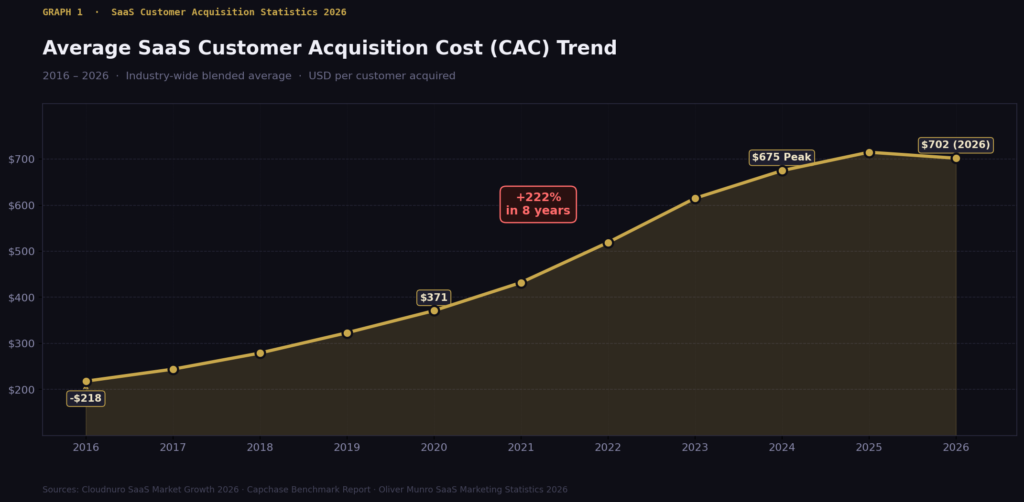
The average CAC in SaaS is now $702, a significant amount considering the need for profitability in recurring revenue models. This figure highlights how much companies must spend in marketing and sales to gain a single paying customer. As customer expectations rise, the cost to attract attention and convert leads increases.
Startups may face challenges here, particularly if they don’t have precise targeting or optimized funnels. Lowering CAC will increasingly depend on automation, inbound content strategies, and referral systems. Future winners will be the companies who master cost efficiency without sacrificing personalization.
TOP SaaS CUSTOMER ACQUISITION STATISTICS 2026 #3. CAC Payback Period Benchmarks
In 2026, CAC payback periods have stretched by an estimated 150% over the past several years according to the Cloudnuro SaaS Market Size and Growth Trends 2026 report, with the average B2B customer journey now taking 211 days and requiring 76 distinct touches before a purchase decision is made — meaning companies targeting enterprise clients must now plan for payback windows that can extend beyond two full fiscal years.
Payback periods vary widely: from 9–12 months for small businesses to 18–24 months for enterprise clients. This time frame represents how long it takes to recover the cost of acquiring a new customer. A longer payback period means higher financial risk, especially in volatile markets.
SaaS companies targeting larger clients may need robust capital buffers to sustain operations before seeing returns. Optimizing onboarding and upsell strategies will be key to accelerating time-to-value. Companies that can compress the payback window without reducing customer quality will thrive in an increasingly saturated market.
TOP SaaS CUSTOMER ACQUISITION STATISTICS 2026 #4. LTV:CAC Ratio Standards
In 2026, top-performing SaaS companies are pushing well beyond the 3:1 standard — leaders are achieving net revenue retention rates of 110% or higher, with private SaaS firms above $20 million ARR posting a median net revenue retention of 104%, and expansion ARR now representing 40% of total new revenue across high-performing SaaS businesses according to 2026 industry benchmarks.
The standard benchmark for LTV:CAC ratio is 3:1 — meaning the lifetime value of a customer should be three times what it cost to acquire them. If this ratio drops below 1:1, companies are essentially losing money on each user. SaaS businesses must balance acquisition with long-term retention and upselling.
Enhancing LTV through better customer success, recurring value, and feature expansion is more efficient than constantly acquiring new users. As subscription fatigue rises, maintaining a strong ratio becomes harder without product differentiation. Moving forward, pricing strategies and engagement models will play a larger role in protecting margins.
TOP SaaS CUSTOMER ACQUISITION STATISTICS 2026 #5. Increase in CAC Over Time
In 2026, the compounding pressure on acquisition budgets is clearer than ever — CAC has surged 180% specifically over the most recent multi-year period tracked by the Cloudnuro 2026 SaaS Growth Report, while the proliferation of more than 15,000 SaaS vendors globally has compressed average contract values by 8% on an inflation-adjusted basis between 2020 and 2024, making it simultaneously more expensive to acquire customers and harder to charge them more.
CAC has surged 222% over the past eight years, reflecting market saturation and rising ad costs. Traditional paid channels like Google and Meta are no longer as efficient as they once were. Customers are bombarded with choices, making it harder to stand out without deep pockets or innovative campaigns.
This also reflects the increasing sophistication of buyers, who demand more education and trust before committing. In the future, SaaS companies may need to build communities, create brand ambassadors, and offer more value upfront. Those who diversify acquisition beyond ads will likely reduce their dependency on rising CAC trends.
TOP SaaS CUSTOMER ACQUISITION STATISTICS 2026 #6. Average B2B SaaS Sales Cycle Length
In 2026, the sales cycle burden has compounded further — the average B2B customer journey now demands 76 touchpoints across 211 days before conversion according to a 2026 SaaS marketing benchmarks report by Oliver Munro, while Gartner projects that by 2027, generative AI will reduce the risk of noncompliance in software and cloud contracts by 30%, which could meaningfully streamline procurement and approval processes that currently drag enterprise cycles past the 134-day average.
The current B2B SaaS sales cycle averages 134 days — up from 107 just a year earlier. This trend suggests increased buyer caution, complex stakeholder involvement, and longer decision-making. It also implies higher CAC since sales teams spend more time per lead.
To mitigate this, SaaS vendors must invest in automated demos, proof-of-value tools, and clearer ROI messaging. Companies with data-backed case studies and fast onboarding will move deals faster. In the future, those who reduce friction in buyer journeys will shorten cycles and gain competitive advantage.
TOP SaaS CUSTOMER ACQUISITION STATISTICS 2026 #7. Effectiveness of AI in Reducing CAC
In 2026, AI-native SaaS companies have demonstrated a staggering structural advantage — they achieve 3 to 5 times faster customer acquisition than traditional SaaS companies according to the Cloudnuro 2026 SaaS Market Size and Growth Trends report, and AI-powered features now command price premiums of 28 to 42% over non-AI equivalents, with generative AI capabilities embedded in platforms creating upsell opportunities estimated to be worth $40 to $80 billion in incremental annual revenue by 2027.
AI has helped some SaaS companies reduce CAC by up to 50%. Predictive lead scoring, intelligent automation, and chat-based nurturing have streamlined acquisition. Instead of mass outreach, AI tools now enable hyper-personalized campaigns with higher conversion rates.
This not only saves budget but also accelerates the funnel. As AI models get better, smaller teams will compete effectively against larger competitors. Companies that fully embrace AI-driven customer insights will build more efficient acquisition engines over the next few years.
TOP SaaS CUSTOMER ACQUISITION STATISTICS 2026 #8. Preferred Channels for Customer Acquisition
In 2026, organic search and content marketing have emerged as the highest-ROI acquisition channel in SaaS — delivering a documented 702% return on investment with dramatically lower CAC compared to paid acquisition, while account-based marketing (ABM) reduces CAC by 33%, retargeting ads improve CAC ROI by 200%, and webinar-sourced leads convert at 20 to 40%, all according to 2026 SaaS marketing benchmark data compiled from leading industry reports.
Websites (89%), email (81%), and social media (72%) are the most used acquisition channels in SaaS. This reveals a reliance on owned and earned media rather than purely paid ads. Email, despite being traditional, remains one of the most profitable due to its low cost and high ROI.
Social platforms help generate brand awareness but may not always convert directly. SaaS marketers should focus on optimizing the customer journey across multiple channels to reduce friction. Future acquisition strategies will prioritize cross-channel orchestration and better attribution models.
TOP SaaS CUSTOMER ACQUISITION STATISTICS 2026 #9. Usage-Based Pricing Adoption
In 2026, consumption-based billing has crossed a critical threshold — Gartner now forecasts that by 2027, 70% of leading SaaS vendors will offer consumption-based pricing for at least part of their product portfolio, while vertical SaaS, the fastest-growing segment, is expanding at 24% year-over-year versus only 16% for horizontal SaaS, and a 1% improvement in price optimization has been shown to produce an 11.1% increase in profit according to 2026 SaaS pricing studies.
More than 56% of SaaS companies have adopted usage-based pricing, appealing to both startups and enterprises. This model aligns cost with value received, making adoption easier for hesitant buyers. It also encourages customer retention, as users pay based on their actual use rather than being locked into fixed tiers.
While harder to forecast revenue, usage-based pricing often increases LTV in the long term. In 2025 and beyond, flexible billing will become a competitive differentiator, especially in product-led growth models. Companies that balance simplicity with scalability in pricing will capture more market share.
TOP SaaS CUSTOMER ACQUISITION STATISTICS 2026 #10. Impact of Free Trials on Conversion
In 2026, the economics of freemium acquisition have become more precise — freemium CAC averages just $141 compared to $205 for paid acquisition models, and SaaS companies offering no-credit-card trials still see 2× the conversion volume, while 48% of SaaS companies now offer freemium tiers as a primary top-of-funnel strategy and content marketing — a key freemium amplifier — drives a documented 400% increase in lead generation according to 2026 SaaS marketing data.
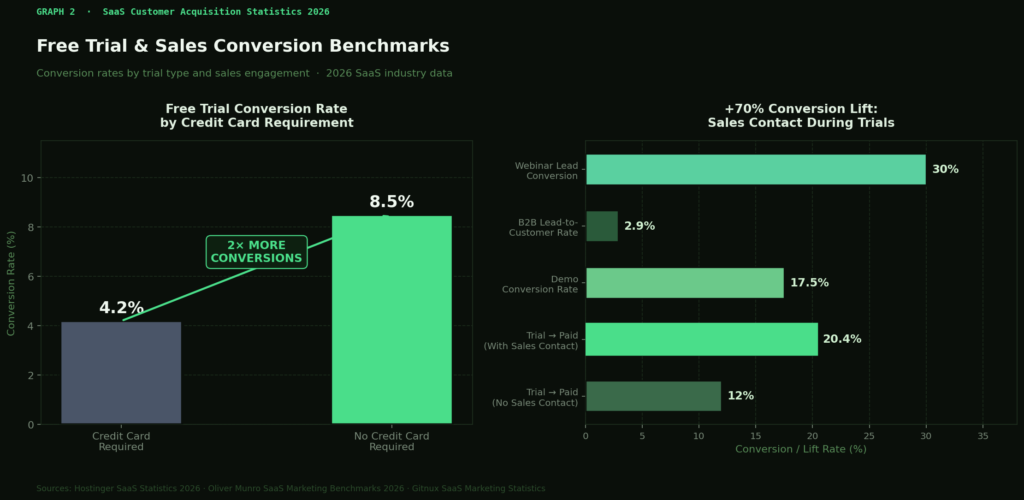
SaaS companies offering no-credit-card trials see twice the conversion rate compared to those requiring payment details. This reduces friction and increases initial trust. More users are willing to explore a product when there’s no financial barrier.
While it may attract non-serious users, the overall volume of qualified leads tends to rise. To convert trial users effectively, onboarding must deliver quick value and highlight long-term benefits. In the future, companies may further personalize trial experiences using behavioral data to nudge users toward conversion.
TOP SaaS CUSTOMER ACQUISITION STATISTICS 2026 #11. Importance of Sales Contact During Trials
In 2026, the hybrid sales motion has become a quantified growth lever — SaaS demo conversion rates now run between 15 and 20%, while lead-to-customer conversion for B2B SaaS sits at 2.9% overall, meaning the 70% conversion lift from direct sales contact during trials represents a critical multiplier that can move the needle significantly when applied to even a modest trial pipeline of several thousand users.
Trial users contacted by sales reps are 70% more likely to convert, showing the power of human connection in B2B environments. While self-serve is convenient, strategic outreach can significantly impact buying decisions. Reps can answer questions, show relevant use cases, and build trust.
This hybrid model — self-service combined with guided sales — offers a balanced approach. It’s especially effective in mid-tier SaaS products, where pricing justifies human touch. Future SaaS growth will depend on aligning sales efforts with real-time user behavior during trials.
TOP SaaS CUSTOMER ACQUISITION STATISTICS 2026 #12. Average Annual Churn Rate
In 2026, churn benchmarks have become more segmented and actionable — enterprise SaaS churn sits at just 1 to 2% monthly while self-serve SaaS churn runs 8 to 10% monthly, and a new Zylo 2026 SaaS Management Index report reveals that 30% of customers cancel their subscriptions within the first three months, making early-stage onboarding investment — which has been shown to reduce churn by up to 50% — one of the highest-ROI interventions available to SaaS companies today.
SaaS churn rates average between 5–7% annually, representing customers who cancel their subscriptions. This metric is critical, as high churn offsets growth from new acquisitions. Reducing churn requires consistent customer engagement, proactive support, and ongoing product value.
Companies that invest in customer success see stronger LTV and less pressure to continuously acquire. With more competition entering the space, retaining users will be just as important as winning them. Companies that ignore churn risk eroding profitability over time.
TOP SaaS CUSTOMER ACQUISITION STATISTICS 2026 #13. SaaS Companies Meeting the Rule of 40
In 2026, the performance gap between Rule of 40 achievers and the rest of the market has widened considerably — the SEG 2026 Annual SaaS Report confirms that while the broader public SaaS index declined, the top quartile of companies delivered approximately 6% year-over-year gains driven by companies tied to mission-critical workflows, data infrastructure, and AI enablement, and private equity buyers were involved in nearly 58% of all SaaS M&A transactions in 2025, one of the most sponsor-heavy years on record, signaling that Rule of 40 performance is increasingly a prerequisite for favorable deal terms.
Only 11% of SaaS firms currently meet the Rule of 40 (growth rate + profit margin ≥ 40%), revealing how few companies are balancing scale with efficiency. Many are still prioritizing growth at the expense of profitability. Investors and acquirers increasingly look for firms that manage both.
As funding becomes more selective, meeting this rule could impact valuations and M&A interest. SaaS leaders will need to improve operational discipline while still capturing market share. This shift will change how companies approach customer acquisition budgets.
TOP SaaS CUSTOMER ACQUISITION STATISTICS 2026 #14. Median Growth Rate for Public SaaS Companies
In 2026, growth stratification within the public SaaS market has intensified — AI-powered SaaS companies are expanding at 35 to 45% while the broader public SaaS median holds at 30%, and the SEG 2026 Annual SaaS Report notes that AI-referenced M&A targets accounted for approximately 72% of all SaaS transactions in 2025, up from a fraction of that just two years prior, reflecting how dramatically AI positioning now influences both growth trajectories and exit multiples.
Public SaaS companies had a median growth rate of 30% in 2024, slightly down from the year before. This decline suggests maturation in the market and more realistic forecasts. Growth is now coming from efficiency, expansion into verticals, and internationalization rather than just aggressive acquisition.
Companies need to prove sustainable growth — not just fast growth — to remain competitive. Future success will likely hinge on niche targeting and customer lifetime expansion. Growth alone won’t be enough without margin and retention improvements.
TOP SaaS CUSTOMER ACQUISITION STATISTICS 2026 #15. SaaS Market Share by Region
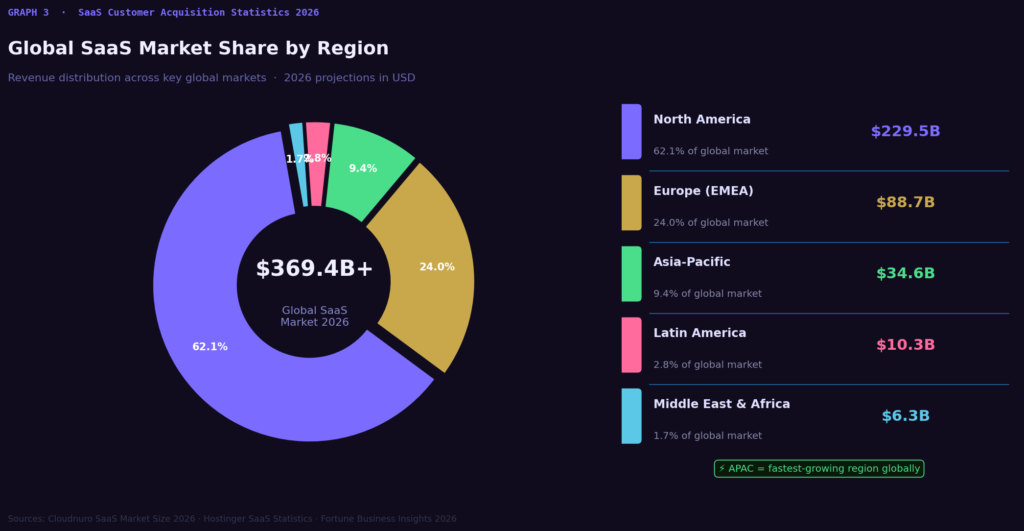
In 2026, North America’s projected SaaS revenue ranges between $211.7 billion and $229.5 billion depending on the source, with the U.S. alone expected to generate between $141 billion and $192.8 billion — while Asia-Pacific now posts the fastest regional CAGR globally, India’s SaaS industry is on track to reach $50 billion by 2030, and Europe’s SaaS market is expected to bring in $95.02 billion in 2025 revenue with Germany, France, and the UK leading at $14.81B, $13.19B, and $12.93B respectively according to 2026 regional SaaS market projections.
North America accounted for 48% of the SaaS market in 2023, with strong demand from the U.S. and Canada. However, this dominance is slowly giving way to regions like APAC and South America. Globalization means SaaS brands must now consider multi-language support, region-specific compliance, and localized pricing.
Customer acquisition in international markets often requires different strategies and channel partners. Companies that tailor campaigns for regional audiences will grow faster outside their home base. The next phase of expansion will require deeper understanding of cross-cultural buying behavior.
TOP SaaS CUSTOMER ACQUISITION STATISTICS 2026 #16. SaaS Spending per Employee
In 2026, per-employee SaaS spending continues to climb — U.S. organizations spent $8,700 per employee on SaaS tools in 2024 and that figure is trending upward, while globally the average SaaS spend per employee is anticipated to reach $108.70 in 2025 per Statista projections, and SaaS companies themselves allocate an average of 50% of total revenue to sales and marketing — a figure that spikes to 75% of total revenue during the first three years of operations according to 2026 industry data.
U.S. organizations spent an average of $8,700 per employee on SaaS tools in 2024. This figure underscores how integral software has become in daily operations. It also reflects how fragmented software stacks can become when not properly managed. High per-employee spend can strain budgets if license utilization isn’t tracked.
In the future, SaaS optimization platforms will help businesses cut waste and improve usage. Finance and IT teams will need to collaborate to ensure every dollar spent supports productivity.
TOP SaaS CUSTOMER ACQUISITION STATISTICS 2026 #17. SaaS Application Usage in Organizations
In 2026, the application stack has rebounded and grown more complex than ever — the average enterprise now manages 291 SaaS applications according to Zylo’s 2026 SaaS Management Index, up from 254 in 2023, with large organizations of 10,000 or more employees averaging 473 applications, and shadow IT adding an estimated 30 to 40% more on top of officially managed software — with ChatGPT now ranking as the single most-used unsanctioned IT application across enterprises globally.
In 2024, companies used an average of 220 SaaS apps, down from 371 in 2023. This sharp decline shows a trend toward consolidation and cost control. Too many tools create redundancy, integration issues, and user fatigue.
Streamlining the tech stack not only reduces costs but also improves data flow and user adoption. Future acquisition strategies must account for existing tool saturation among target customers. SaaS companies offering integrations or all-in-one platforms will have an edge.
TOP SaaS CUSTOMER ACQUISITION STATISTICS 2026 #18. Waste Due to Unused SaaS Licenses
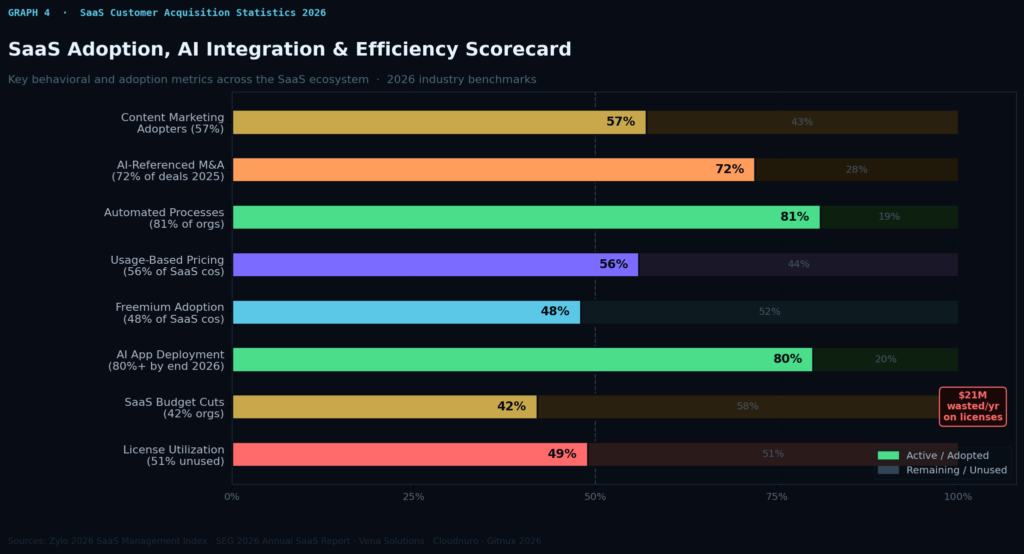
In 2026, SaaS license waste has hit a record high — 51% of enterprise SaaS licenses now go unused according to Zylo’s 2026 SaaS Management Index, surpassing the previously reported 47% figure and representing the highest unused license rate ever recorded, while 42% of organizations have actively cut SaaS budgets due to economic uncertainty, pushing procurement teams to demand usage dashboards, automatic downgrades, and demonstrable ROI before renewing contracts.
Only 47% of SaaS licenses are actively used, leading to $21 million in annual waste for large enterprises. This reveals a misalignment between purchasing and actual usage. Poor onboarding, redundant features, or lack of user training often contribute to underutilization.
To combat this, vendors may introduce usage monitoring dashboards and automatic downgrades. Clients are becoming more selective, demanding accountability and visible ROI. SaaS providers must now think beyond acquisition and focus on sustained product adoption.
TOP SaaS CUSTOMER ACQUISITION STATISTICS 2026 #19. Growth of AI-as-a-Service (AIaaS) Market
In 2026, the AI-native SaaS category has become the market’s primary growth engine — the global AI Created SaaS market is estimated to reach $770.32 billion by 2031 at a 40.2% CAGR, more than 80% of companies are expected to have deployed AI-enabled apps in their IT environments by the end of 2026 (up from just 5% in 2023), and AI-referenced targets accounted for approximately 72% of all SaaS M&A transactions completed in 2025 according to the SEG 2026 Annual SaaS Report, reflecting how completely AI has embedded itself across the acquisition, retention, and valuation landscape.
The AIaaS market is projected to grow at a CAGR of 37.1%, reaching $5.6 billion by 2030. This boom is driven by demand for scalable, cloud-based AI tools that don’t require in-house expertise. AIaaS solutions are helping startups and enterprises alike automate operations, personalize user experiences, and extract insights.
Customer acquisition in this space will require strong trust signals due to concerns around data and ethics. As more companies adopt AI, standing out will require transparent outcomes and responsible deployment. Expect rising competition and more emphasis on partnerships with cloud providers.
TOP SaaS CUSTOMER ACQUISITION STATISTICS 2026 #20. SaaS Companies Offering Freemium Models
In 2026, freemium has matured into a data-driven science — 57% of SaaS companies now prioritize content marketing as their primary freemium amplifier with an extraordinary 98% maintaining active blogs, content marketing drives a 400% increase in lead generation, buyers now spend 27% of their total purchase research time evaluating SaaS products before ever speaking to a rep, and MQL-to-SQL conversion rates in SaaS run at 13% — all according to 2026 SaaS marketing benchmark reports — meaning the freemium funnel’s performance increasingly depends on the quality of educational content surrounding it.
Around 48% of SaaS companies now offer freemium models to attract users. This tactic provides immediate value and allows users to experience the product risk-free. It’s a strong tool for user acquisition, especially in crowded markets.
However, the freemium model requires a clear upgrade path and compelling features behind the paywall. If done poorly, it can lead to high support costs with low revenue conversion. In the future, successful freemium strategies will depend on behavioral analytics and feature gating based on user needs.
SAAS GROWTH IN 2026: THE EFFICIENCY ERA THAT WILL CRUSH OR SCALE YOU
The SaaS industry is entering a phase where growth requires sharper efficiency, not just volume. Customer acquisition costs are rising, sales cycles are lengthening, and buyers are more discerning than ever. At the same time, tools like AI, usage-based pricing, and behavioral personalization are unlocking new paths to scale smarter.
The statistics above show that while the market opportunity is massive, success hinges on how well companies balance cost, speed, and long-term value. Freemium models, stronger onboarding, and optimized retention will separate top performers from the rest. In this environment, growth is no longer just a marketing goal—it’s a cross-functional responsibility. Companies that treat acquisition as part of a broader lifecycle strategy will be best positioned to thrive in 2026 and beyond, especially as CAC volatility and AI-driven competition intensify across global SaaS markets.
Sources:
- https://cropink.com/saas-statistics
- https://churnfree.com/blog/average-customer-acquisition-cost-saas
- https://clickstrike.com/blog/saas-cac
- https://clickstrike.com/blog/saas-cac
- https://inbeat.agency/blog/customer-acquisition-statistics
- https://www.madx.digital/learn/saas-stats
- https://inbeat.agency/blog/customer-acquisition-statistics
- https://inbeat.agency/blog/customer-acquisition-statistics
- https://www.saasacademy.com/blog/saas-statistics
- https://www.invespcro.com/blog/saas-customer-acquisition
- https://www.invespcro.com/blog/saas-customer-acquisition
- https://www.venasolutions.com/blog/saas-statistics
- https://www.cloudzero.com/blog/saas-statistics
- https://www.venasolutions.com/blog/saas-statistics
- https://www.venasolutions.com/blog/saas-statistics
- https://www.venasolutions.com/blog/saas-statistics
- https://www.saasacademy.com/blog/saas-statistics