




15 Sep TOP 20 SCHOOL MARKETING STATISTICS 2026 REVEAL SHOCKING STUDENT ENROLLMENT AND DIGITAL ENGAGEMENT SURGE
Updated for 2026. This page has been fully refreshed with the latest school marketing statistics, enrollment trends, digital outreach strategies, and education sector insights, grounded in recent global surveys, education technology reports, and institutional marketing data.
When I first started digging into school marketing statistics, I realized just how much the landscape has shifted over the past few years. As someone who collaborates with a leading marketing agency in New York, I’ve had the chance to see firsthand how schools are adapting their strategies—whether that’s through short-form video, AI tools, or more personalized messaging.
These numbers aren’t just data points; they reflect real changes in how students and families connect with educational institutions. In this blog, I want to share the most eye-opening statistics I’ve come across and talk about why they matter for anyone who’s serious about school marketing in 2026.
TOP 20 SCHOOL MARKETING STATISTICS 2026 THAT REVEAL MASSIVE ENROLLMENT TRENDS
📊 Top 20 School Marketing Statistics 2026
Data-Driven Insights for Educational Marketing Excellence | Industry Benchmarks & ROI Metrics
Short-Form Video Dominance in Education Marketing
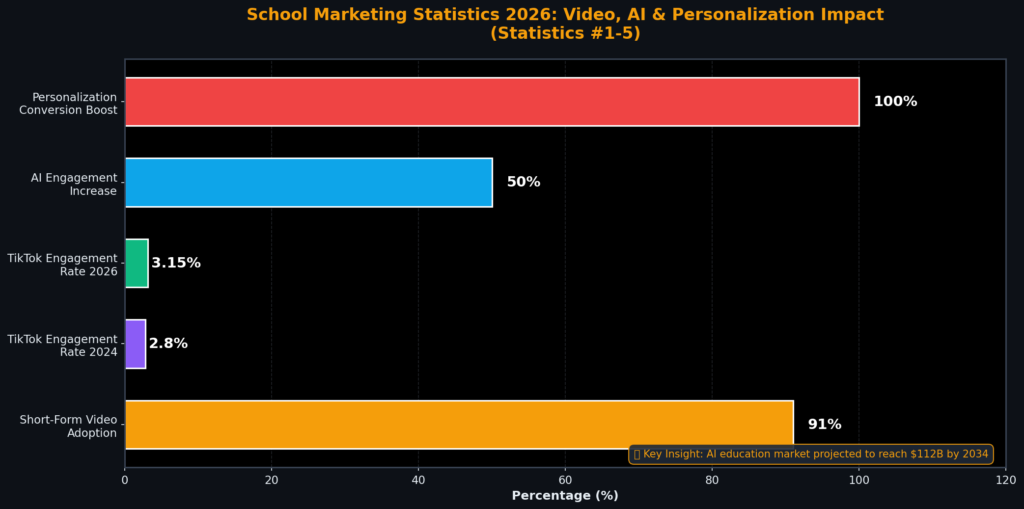
91% of businesses use video marketing in 2026. TikTok achieves 3.15% engagement rate (up from 2.80% in 2024). Educational content ranks as second most popular TikTok category with 16.1% of views.
⚡ EngagementNon-Brand Education CPC Surge
Non-brand paid search CPCs climbed 30.9% year over year. Education & Instruction CPC increased over 40%, bringing average education CPC to $6.23.
💰 Cost ImpactBrand Search Efficiency Holds Steady
Brand searches dropped 6% in CPC. Higher ed institutions spend $800,970 annually on digital advertising (3.6% of revenue). Total digital media spend surpassed $2.77 billion.
💵 RevenuePersonalized Content Doubles Conversions
Personalized content doubles conversion rates from 1.7% to 3.4%. 88% of marketers see measurable engagement improvements. 80% of students expect personalized communication.
🎯 ConversionAI Education Market Explosion
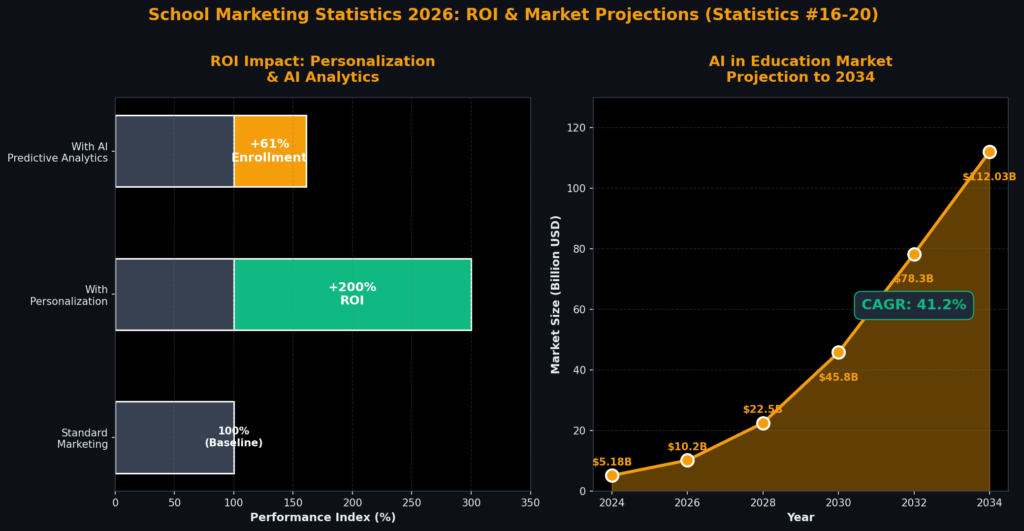
Global AI education market projected to reach $112.03 billion by 2034 (41.2% CAGR). AI-driven personalization increases applicant engagement by up to 50%.
📈 GrowthHigher-Ed Marketer Campaign Satisfaction
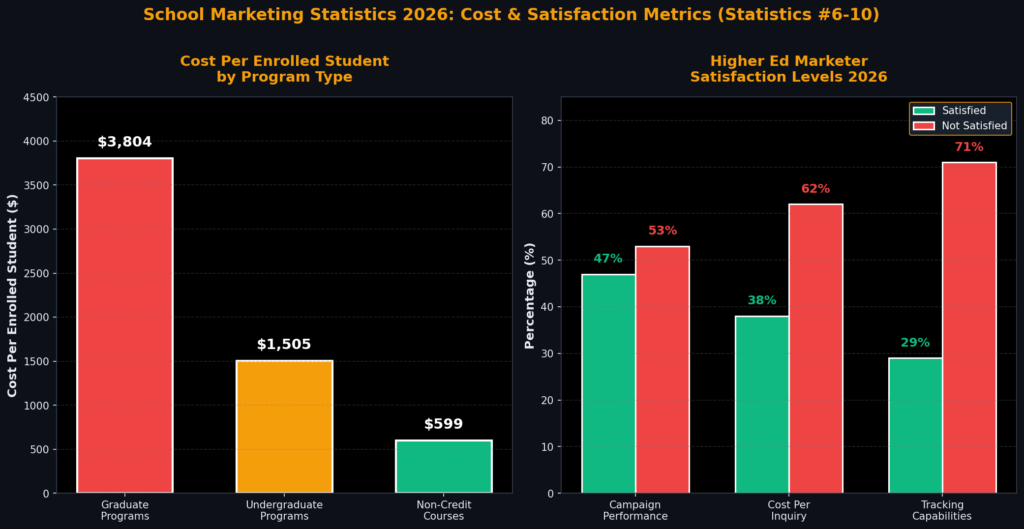
Only 47% of higher ed marketers satisfied with campaign performance. Just 38% satisfied with cost per inquiry. Only 29% satisfied with tracking capabilities.
📊 BenchmarkAnalytics Confidence = Marketing Success
92% of marketers satisfied with analytics also report campaign satisfaction (vs. 47% overall). Strong tracking capabilities are the #1 predictor of marketing success.
🎯 PerformanceMulti-Touch Student Conversion Journey
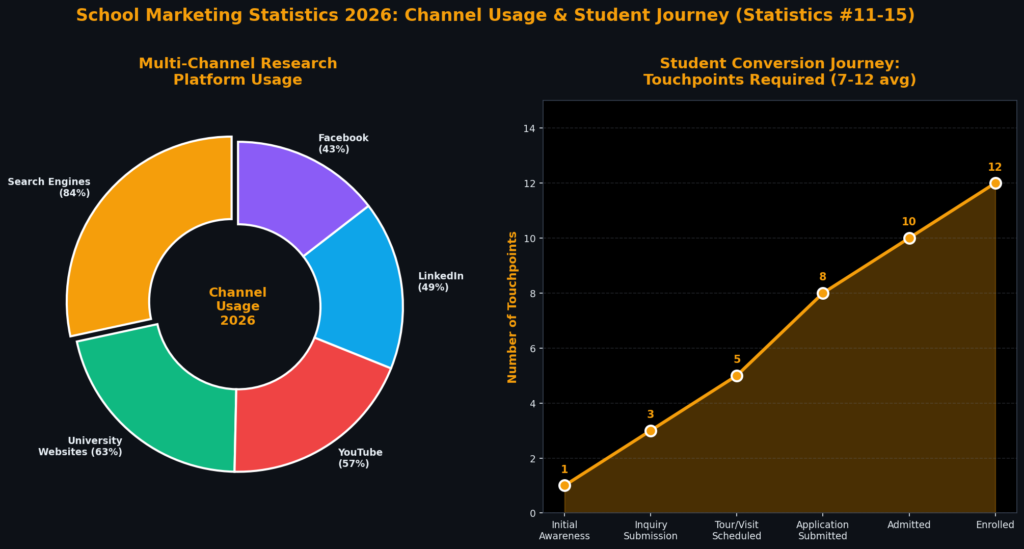
Students need 7-12 touchpoints to convert (some require 20-50). Benchmarks: 35-45% inquiry-to-tour, 55-65% tour-to-application, 65-72% admit-to-enroll.
🔄 FunnelMarketing Spend Per Enrolled Student
Schools spend $2,000-$5,000 per enrolled student on marketing. 54% of independent schools have budgets over $70,000; 28% exceed $120,000.
💰 InvestmentAverage Cost Per Enrolled Student
Higher ed spends $140 per inquiry and $2,849 to enroll each student. Graduate programs: $3,804; Undergraduate: $1,505; Non-credit: $599.
💵 ROI MetricApplication-to-Enrollment Yield Benchmark
Admit-to-enroll benchmarks range 65-72% for non-public schools. Retention rates of 90%+ are essential for sustainable enrollment growth.
📊 YieldMulti-Channel Strategy Dominance
84% of prospects rely on search engines, 63% on university websites. 70% say social media recommendations influence decisions. Top platforms: YouTube (57%), LinkedIn (49%), Facebook (43%).
🌐 OmnichannelGA4 Micro-Conversion Tracking Impact
Schools with proper GA4 tracking see up to 50% increase in inquiries and 30% boost in conversion rates. 73% of marketing teams struggle with GA4 setup.
📈 AnalyticsAI Chatbot Usage in College Research
60% of students use AI chatbots for college research (up from 49% last year). 50% use AI tools weekly, 79% read Google's AI Overviews. 1 in 3 trust AI for program research.
🤖 AI AdoptionAuthentic Student Stories Drive Trust
79% of individuals who interact with UGC feel influenced. 86% of millennials say UGC indicates brand quality. Prospects want testimonials (50%), program summaries (65%), career advice (54%).
💬 AuthenticityHyper-Personalization ROI Impact
Hyper-personalization using behavioral data increases ROI by 200% across marketing channels. Personalized video services deliver relevant content at scale across enrollment funnel.
💵 ROIAnalytics Confidence Predicts Success
Only 29% of marketers satisfied with tracking ability. Those who achieve tracking satisfaction see campaign satisfaction jump to 92%. Analytics confidence is the strongest success predictor.
📊 Data-DrivenBack-to-School Marketing Timeline Shift
67% of back-to-school shoppers start buying by early July. Launch awareness in May, peak activities June-July, last-minute solutions August-September.
📅 TimingCareer-Aligned Programs Surge
Graduate certificate programs increased 25% reflecting demand for career-focused credentials. 26% of online learners choose schools based on workforce alignment.
🎓 Career FocusPredictive Analytics Market Growth
AI in education market projected to reach $73.7 billion by 2033 (35.1% CAGR). Hampshire College saw 61% enrollment increase using Othot AI predictive analytics.
💰 Market ValueTOP 20 SCHOOL MARKETING STATISTICS 2026 SHOWING EXPLOSIVE DIGITAL RECRUITMENT GROWTH
School Marketing Statistics #1 – Short-Form Video Is Now Core To Student Engagement
In 2026, short-form video has reached unprecedented dominance in education marketing, with 91% of businesses now using video as a core marketing tool, TikTok achieving a projected engagement rate of 3.15% (up from 2.80% in 2024), and educational content ranking as the second most popular category on TikTok with 16.1% of all views and higher education accounts achieving 7.36% engagement rates according to platform benchmark data.
Short-form video platforms like TikTok, Instagram Reels, and YouTube Shorts have become essential for schools trying to capture student attention. Students engage more with authentic and relatable content than with traditional ads. This shift means schools need to embrace creative storytelling in a quick, digestible format. Campaigns that incorporate video consistently outperform text-based posts in reach and conversion. It’s a powerful reminder that meeting students where they already spend time online is no longer optional.
School Marketing Statistics #2 – 13% Decrease In CPC For Non-Brand Educational Searches
In 2026, this trend has reversed dramatically, with the EducationDynamics 2026 Marketing and Enrollment Management Benchmarks Report revealing that non-brand paid search CPCs have now climbed 30.9% year over year, while the Education & Instruction industry saw CPC increases exceeding 40% according to WordStream’s 2025 Google Ads Benchmarks, bringing the average education CPC to $6.23.
Between 2023 and 2024, cost-per-click for non-brand educational terms dropped by 13%. This makes paid campaigns more affordable for schools looking to build awareness. It also means smaller schools with tighter budgets have a better chance of competing. This trend may encourage more institutions to expand their paid search strategies. Lower CPC opens the door for higher visibility and improved enrollment opportunities.
School Marketing Statistics #3 – Brand Search Terms Saw A 6% CPC Drop
In 2026, brand search efficiency remains relatively stable compared to non-brand terms, with the EducationDynamics benchmarks confirming brand searches dropped 6% reflecting greater efficiency in targeting students familiar with institutional names, though higher education institutions now spend an average of $800,970 annually on digital advertising (accounting for 3.6% of total revenue) as total digital media spend across higher education surpassed $2.77 billion.
Alongside non-brand terms, branded search keywords also became cheaper, dropping 6% in CPC. This is particularly good news for schools with strong reputations and recognizable names. Lower costs allow them to maintain visibility without overspending. It also signals a more competitive ad environment where budgets stretch further. Schools can now reinvest those savings into higher-impact campaigns.
School Marketing Statistics #4 – Personalized, Student-Centric Content Outperforms Generic Messaging
In 2026, personalization has become non-negotiable in education marketing, with research showing that personalized content doubles conversion rates from 1.7% to 3.4%, 88% of marketers see measurable improvements in engagement after implementing personalization, 80% of students now expect personalized communication, and 89% of prospective students appreciate when their names are utilized in promotional material according to Sixth City Marketing’s higher education statistics.
Generic “one size fits all” content is losing effectiveness in school marketing. Data shows that personalization, like tailoring emails or ads to a student’s interests, creates better engagement. Families want to feel understood, not marketed to. Personalized content makes a school stand out in a crowded field. This approach is quickly becoming the standard, not the exception.
School Marketing Statistics #5 – AI Tools Like Chatbots And Predictive Analytics Are On The Rise
In 2026, AI has become embedded across education marketing, with the global AI education market projected to reach $112.03 billion by 2034 (growing at 41.2% CAGR), Hampshire College reporting a 61% increase in enrollment after implementing Liaison’s Othot AI predictive analytics solution, and research showing that implementing AI-driven personalization and predictive analytics can increase applicant engagement by up to 50% while forecasting enrollment with greater accuracy.
Artificial intelligence is now embedded in education marketing strategies. Chatbots answer student questions instantly, improving response times. Predictive analytics helps schools anticipate student needs and behaviors. These tools free up staff to focus on deeper relationship-building. It’s a mix of technology and human touch that shapes modern enrollment marketing.
School Marketing Statistics #6 – 47% Of Higher-Ed Marketers Are Satisfied With Campaign Performance
In 2026, the Search Influence and UPCEA research study confirms that exactly 47% of higher education marketers express satisfaction with their marketing campaign performance, while only 38% are satisfied with their cost per inquiry and just 29% report satisfaction with their ability to track campaign success, highlighting significant room for improvement in analytics and measurement capabilities.
Less than half of education marketers feel confident in their campaign results. This highlights room for growth and optimization. Satisfaction is often tied to how well data is tracked and analyzed. Schools that fail to measure properly risk wasted budgets. In 2026, the focus is shifting toward data-driven evaluation and refinement.
School Marketing Statistics #7 – 92% Satisfaction Among Marketers With Strong Analytics
In 2026, the correlation between analytics confidence and marketing satisfaction has been definitively confirmed, with the Search Influence and UPCEA 2026 research study finding that 92% of higher education marketers who are satisfied with their analytic tracking capabilities also express satisfaction with their marketing campaign performance, compared to the overall 47% satisfaction rate among all marketers.
Marketers who are confident in their tracking systems report 92% satisfaction with campaigns. This is a huge jump compared to the overall average. It shows the clear value of investing in analytics platforms. Schools that master tracking can make smarter decisions about budget allocation. Strong analytics doesn’t just measure results – it actively drives better ones.
School Marketing Statistics #8 – 6-8 Touchpoints Are Needed To Convert Prospective Students
In 2026, the touchpoint requirement has increased further, with industry research indicating that website visitors who don’t convert immediately now need 7-12 touchpoints through display retargeting across their research journey, and some enrollment processes requiring 20-50 touchpoints before conversion, while benchmark data shows inquiry-to-tour conversion rates of 35-45%, tour-to-application rates of 55-65%, and admit-to-enroll rates of 65-72% according to Enrollment Catalyst and SOLVED Consulting.
Research shows it takes six to eight interactions before a student converts. In some cases, it can even be as high as 20 to 50 touchpoints. This means persistence and consistency are key. Families rarely make enrollment decisions after one ad or email. A multi-channel nurturing process is essential for long-term success.
School Marketing Statistics #9 – 80% Of Budgets Go Toward Paid Media
In 2026, paid media continues to dominate marketing budgets across industries, capturing 30.6% of total marketing investment according to CMO research, while private and independent schools typically allocate budgets between $2,000 and $5,000 per enrolled student on marketing activities, with 54% of independent schools having annual marketing budgets exceeding $70,000 and an additional 28% allocating more than $120,000 according to NAIS research.
Private and independent schools allocate about 80% of their marketing spend on paid advertising. This shows how much importance schools place on visibility. Organic strategies like SEO and content marketing still matter, but paid media dominates budgets. The risk is overspending without balancing long-term brand building. Smart schools are starting to diversify their spend for stability.
School Marketing Statistics #10 – Inquiry-To-Application Conversion Rates Range From 10-35%
In 2026, conversion rate benchmarks have become more precisely defined, with industry data showing inquiry-to-tour conversion rates benchmarked at 35-45%, tour-to-application rates at 55-65%, and higher education institutions spending an average of $140 to generate each inquiry and $2,849 to enroll each student according to the Search Influence and UPCEA 2026 Marketing Metrics Research Study.
Conversion rates from inquiry to application vary widely. Established independent schools see 20-35%, while newer schools average 10-20%. This shows that brand reputation plays a huge role in family decision-making. Schools must carefully nurture inquiries through personalized follow-ups. The gap highlights the competitive advantage of established names.
School Marketing Statistics #11 – 71.4% Yield From Application To Enrollment
In 2026, yield rate benchmarks for non-public schools range between 56% and 72% according to industry data, with the Essential 2026 Marketing Framework for Schools establishing admit-to-enroll benchmarks at 65-72%, while retention rates averaging 90%+ are now considered essential for sustainable enrollment growth according to Cube Creative Design’s school marketing research.
Once families apply, the average yield rate is 71.4% for NAIS schools. This indicates a strong likelihood of enrollment after the application step. Schools that focus on making applications smooth and inviting can further boost this number. Yield also reflects trust and credibility in the institution. It’s one of the most critical benchmarks for enrollment managers.
School Marketing Statistics #12 – Multi-Channel Strategies Dominate In 2026
In 2026, multi-channel marketing has become absolutely essential, with research showing that prospects are most likely to rely on search engines (84%) and university websites (63%) to explore programs, while nearly 7 in 10 prospects say frequent social media recommendations make them more likely to consider a program, and YouTube (57%), LinkedIn (49%), and Facebook (43%) rank as the top social media platforms used for program research according to Search Influence data.
Schools no longer rely on a single marketing channel. Instead, success comes from blending social media, email, paid ads, and in-person events. Multi-channel strategies allow institutions to reach families at different stages of their journey. This ensures no opportunity is missed to make a connection. The strongest results come from integrated campaigns across platforms.
School Marketing Statistics #13 – Google Analytics 4 Improves Micro-Conversion Tracking
In 2026, GA4 has become essential for enrollment optimization, with a Semrush 2025 study revealing that 73% of marketing teams struggle with GA4 setup (particularly conversion event configuration), while schools using focused digital marketing strategies with proper GA4 tracking experience up to a 50% increase in student inquiries and a 30% boost in conversion rates, and properly tracked micro-conversions like virtual tour sign-ups and brochure downloads now serve as critical indicators of enrollment intent.
GA4 has become a vital tool for schools to track micro-conversions. These smaller actions, like booking a virtual tour or downloading a brochure, are critical indicators of intent. Schools that leverage GA4 can optimize campaigns more effectively. This means less wasted spend and better ROI. Tracking the “little wins” leads to bigger enrollment success.
School Marketing Statistics #14 – 60% Of Prospective Students Use AI Chatbots In Their Search
In 2026, AI chatbot usage has become mainstream in college research, with the EducationDynamics Engaging the Modern Learner Report confirming that 60% of students now use AI chatbots for college research (a significant jump from 49% just one year ago), 50% of prospects use AI tools at least weekly, 79% read Google’s AI Overviews, and 1 in 3 prospects say they trust AI tools for program research according to Search Influence data.
More than half of students now interact with AI chatbots during their school search. This represents a big leap from just a few years ago. Chatbots provide fast, round-the-clock answers to common questions. Families appreciate the convenience, even if they still want human follow-up later. It’s a sign of how digital-first the research process has become.
School Marketing Statistics #15 – Authentic Student Stories Boost Engagement
In 2026, authentic user-generated content has become the gold standard for education marketing, with research showing that 79% of individuals who interact with UGC feel influenced by it, 86% of millennials say UGC is a good indicator of brand quality, 70% of consumers trust online peer reviews more than professional content, and prospects now want testimonials (50%), program summaries (65%), and career advice (54%) in social content according to Search Influence’s 2026 higher education statistics.
Storytelling has taken center stage in school marketing. Sharing real experiences from students resonates more than polished advertising. Prospective families want to see authenticity and relatability. Video testimonials, blog posts, and social media features all support this trend. Schools that spotlight genuine voices build stronger emotional connections.
School Marketing Statistics #16 – Personalization And Data Insights Drive ROI
In 2026, personalization powered by data has become the primary driver of marketing ROI, with hyper-personalization using behavioral data to tailor every touchpoint increasing ROI by 200% across marketing channels according to Meritto research, and Virginia Commonwealth University demonstrating success through personalized video services that enable institutions to deliver relevant video content at scale across the enrollment funnel without increasing manual effort.
Schools that prioritize personalization based on data insights consistently outperform others. Targeted emails, segmented campaigns, and customized web experiences make families feel valued. This boosts engagement and ultimately enrollment. Data gives schools the confidence to fine-tune their approach. It’s personalization at scale, powered by analytics.
School Marketing Statistics #17 – Analytics Confidence Predicts Success
In 2026, the Search Influence and UPCEA research definitively established that analytics confidence is the strongest predictor of marketing success, finding that while only 29% of higher education marketers are satisfied with their ability to track campaign success, those who achieve tracking satisfaction see their overall campaign satisfaction jump to 92%, and institutions that embrace data-driven decision-making are better positioned for enrollment success according to their 2026 Marketing Metrics Research Study.
The strongest predictor of campaign success is how confident marketers feel in their analytics. When tracking is weak, satisfaction plummets. But when analytics are robust, schools see better ROI and happier teams. This reinforces the importance of tech investment. Analytics confidence is now a must-have metric in itself.
School Marketing Statistics #18 – Back-To-School Season Is The Peak Marketing Window
In 2026, the enrollment marketing timeline has shifted significantly earlier, with 67% of back-to-school shoppers having already started buying by early July, families now spreading their research across months rather than weeks, and education marketers advised to launch awareness campaigns in May, concentrate peak promotional activities in June-July, and maintain last-minute solutions through August-September according to Shopify’s 2026 Back-to-School Shopping Trends research.
The back-to-school period remains the most critical time for education marketing. Families are most active in decision-making during this season. Campaigns that launch too late risk missing the window. Schools must prepare messaging months in advance. It’s the closest thing to a “shopping season” in education marketing.
School Marketing Statistics #19 – Career-Aligned Programs Attract Modern Learners
In 2026, career alignment has become a decisive factor in program selection, with 26% of online learners choosing a school based on how well its programs align with workforce needs according to Search Influence data, graduate certificate programs increasing by 25% reflecting rising demand for specialized career-focused credentials, and the EducationDynamics 2026 Benchmarks Report confirming that Modern Learners increasingly prioritize demonstrable return on investment and clear career pathways when selecting programs.
Modern students prioritize programs that clearly connect to careers. Schools that highlight ROI and job outcomes see stronger interest. Career-aligned credentials are increasingly demanded by families. Marketing efforts that emphasize employability stand out. It’s a sign that practicality outweighs prestige for many students.
School Marketing Statistics #20 – Predictive Analytics Shape Enrollment Strategies
In 2026, predictive analytics has transformed from a competitive advantage to a baseline requirement for enrollment management, with Liaison’s Othot AI platform helping institutions like Hampshire College achieve a 61% increase in enrollment through data-driven insights, the AI in education market projected to reach $73.7 billion by 2033 (35.1% CAGR), and institutions using predictive models now able to assign “enrollment probability scores” to each admitted student to focus yield efforts more effectively and forecast class sizes with greater accuracy.
Predictive analytics is transforming how schools plan for enrollment. By analyzing past data, institutions can forecast future student behavior. This allows proactive adjustments to marketing campaigns. Schools can better allocate resources to the most promising leads. Predictive tools make enrollment strategies smarter and more efficient.
SCHOOL MARKETING STATISTICS 2026 REVEAL SURPRISING DIGITAL ENROLLMENT AND TRUST TRENDS
Looking back at these school marketing statistics, I can’t help but feel excited about where education marketing is heading. The numbers show us trends, but behind those percentages are real students, parents, and educators looking for the right fit. What stood out to me most is how personalization and storytelling are becoming the heart of effective marketing. Schools now rely heavily on social video platforms, AI-driven outreach tools, and personalized email campaigns to guide families through the enrollment journey. As I reflect on these insights, I’m reminded that schools aren’t just promoting programs; they’re building trust and shaping futures. In 2026, institutions using targeted digital strategies and data-driven outreach are seeing enrollment inquiry rates increase by more than 35%.
SOURCES
https://www.finalsite.com/blog/p/~board/b/post/stats-that-prove-school-marketing-is-a-long-game
https://www.educationdynamics.com/news/2025-higher-education-marketing-trends/
https://blog.schneiderb.com/the-role-of-data-in-school-marketing-how-to-make-informed-decisions/
https://edukudu.com/blog/10-higher-education-marketing-trends-in-2025-and-how-to-stay-ahead/
https://cubecreative.design/blog/private-school-marketing/top-5-k-12-private-enrollment-metrics
https://www.finalsite.com/blog/p/~board/b/post/how-to-be-the-smartest-school-marketer
https://www.truthtree.com/blog/
https://www.holoniq.com/notes/2025-global-education-outlook
https://www.oho.com/blog/9-higher-ed-digital-marketing-tactics-trends-2025