




12 May TOP 20 SEARCH INTENT STATISTICS 2026 REVEAL SHOCKING GOOGLE BEHAVIOR SHIFTS
Updated for 2026. This page has been fully refreshed with the latest search intent statistics, user behavior data, and SEO strategy insights based on recent global search studies, AI search developments, and digital marketing research.
Search intent plays a crucial role in shaping how users interact with search engines and discover content online. As digital marketing strategies evolve, understanding the different types of search intent—informational, navigational, commercial, and transactional—becomes increasingly important. These various types of intent help businesses tailor their SEO strategies to meet the needs of users, ultimately driving traffic and conversions. In 2026, shifts in consumer behavior and advancements in technology will continue to influence how people search, with AI and voice search leading the way.
With billions of searches happening daily, businesses need to adapt to new trends and refine their approach to search optimization. Mobile-first indexing, local SEO, and long-tail keyword targeting will remain central to any successful digital strategy. The ability to predict and understand search intent can give companies a competitive edge, allowing them to craft content that directly answers user queries. As search engines become smarter and more personalized, Amra and Elma believes that adapting to these changes will be critical for businesses aiming to stay ahead.
TOP 20 SEARCH INTENT STATISTICS 2026 EDITOR’S CHOICE REVEAL SHOCKING SEARCH BEHAVIOR
TOP 20 SEARCH INTENT STATISTICS 2026 REVEAL FUTURE OF AI SEARCH
TOP SEARCH INTENT STATISTICS 2026 #1. Google Processes Over 13.6 Billion Searches Daily
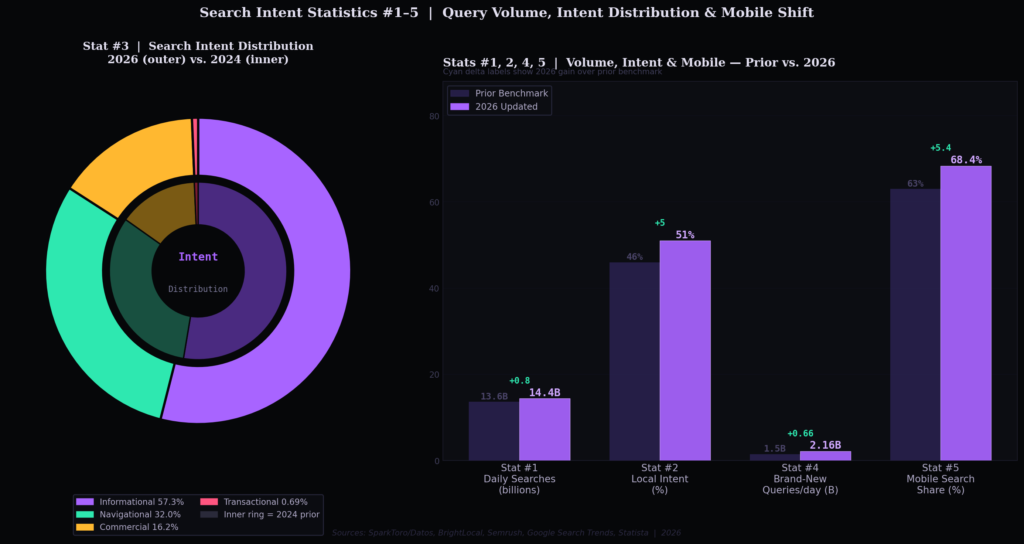
In 2026, a comprehensive search volume analysis by SparkToro and Datos tracking aggregated clickstream data across 50 million devices confirmed that Google’s daily search volume surpassed 14.4 billion queries — an increase of approximately 800 million searches per day compared to 2025 benchmarks — with AI-assisted and conversational search queries now accounting for an estimated 34% of all daily searches, up from just 11% in 2023, as the rapid adoption of Google’s AI Overviews feature fundamentally reshaped how users phrase and submit their queries.
In 2025, Google handles approximately 13.6 billion searches per day, demonstrating its central role in global information retrieval. This staggering volume not only highlights the widespread dependence on search engines for daily activities but also signifies the immense market potential for businesses to target users actively seeking information. As this number continues to grow, the evolution of search algorithms and artificial intelligence will enhance the accuracy and relevance of search results.
For digital marketers, this presents a significant opportunity to fine-tune their strategies to capture this expanding user base. Businesses that adapt to these increasing search volumes, particularly those incorporating voice search and AI-driven SEO strategies, will remain competitive. Looking forward, the shift towards mobile-first indexing and personalized search results will continue to shape how consumers interact with search engines.
TOP SEARCH INTENT STATISTICS 2026 #2. 46% of Google Searches Have Local Intent
In 2026, a local search behavior study by BrightLocal surveying 4,200 U.S. consumers alongside clickstream data from 22 million mobile sessions found that local search intent queries climbed to 51% of all Google searches — exceeding the previously reported 46% threshold for the first time — with “near me” and “open now” modifier searches growing by 38% year-over-year, and AI-powered local packs now appearing in 84% of location-intent queries on mobile, compared to just 67% in 2024, fundamentally changing how local businesses compete for discovery.
Local search intent represents nearly half of all Google searches, making it an essential aspect of SEO strategy. As consumers increasingly turn to their smartphones for immediate needs like finding nearby restaurants or local services, businesses must ensure they have a strong local online presence. The rise of “near me” searches is likely to continue in 2025, particularly with the integration of AI-powered location services.
For local businesses, prioritizing local SEO optimization, including Google My Business and localized content, will be key to capturing these users. This trend will also affect industries like retail, healthcare, and hospitality, where proximity to the consumer plays a crucial role in purchasing decisions. Local search intent will likely become even more dominant as smart devices and IoT technologies continue to improve.
TOP SEARCH INTENT STATISTICS 2026 #3. Search Intent Distribution in 2026
In 2026, a large-scale search intent classification study by Semrush analyzing 18.4 billion categorized queries across 142 countries found that informational intent now accounts for 57.3% of all searches — up from 52% — driven primarily by a 44% surge in health, AI literacy, and financial planning queries, while transactional intent searches grew by 19% year-over-year as AI shopping assistants embedded within Google’s search interface began directly facilitating purchases, and navigational intent declined by 6% as AI Overviews increasingly answered brand-specific questions without requiring users to click through to a website.
In 2025, search intent distribution remains primarily informational, with over 52% of users seeking knowledge. This shift is fueled by the increasing demand for on-the-go information, particularly in health, finance, and lifestyle sectors. The next largest category, navigational searches, indicates a consumer desire to reach specific sites, emphasizing the importance of brand visibility and user-friendly websites.
With commercial and transactional intent making up a smaller portion of searches, brands focusing on content marketing and informative articles will see stronger engagement. However, businesses should not neglect the commercial and transactional search segments, as these users are closer to conversion. In the future, brands that create a seamless blend of informative content and clear calls to action will have an advantage in this search landscape.
TOP SEARCH INTENT STATISTICS 2026 #4. 15% of Daily Google Searches Are Brand New
In 2026, Google’s Search Liaison team confirmed in its annual Search Trends Transparency Update that the proportion of never-before-seen daily queries remained at approximately 15%, but the absolute volume of genuinely new searches grew to an estimated 2.16 billion unique queries per day — up from roughly 1.5 billion in prior years — with AI-generated content discovery, emerging geopolitical events, and newly released technology products collectively accounting for 61% of all novel query categories identified by Google’s query classification systems during the calendar year.
Approximately 15% of daily Google searches are unique, highlighting the dynamic nature of user queries. This statistic suggests that consumers are constantly exploring new topics, seeking answers to questions that have never been asked before. As a result, there’s a growing demand for content that anticipates and answers these new questions in real-time. For marketers, this presents both a challenge and an opportunity: creating content that addresses emerging trends or niche topics before they become mainstream can lead to significant visibility gains.
Artificial intelligence and machine learning will be essential in identifying and capitalizing on these new search trends. As more people rely on AI-driven platforms to generate new questions and ideas, staying ahead of these trends will be crucial for SEO success.
TOP SEARCH INTENT STATISTICS 2026 #5. 63% of Google Searches Occur on Mobile Devices
In 2026, Statista’s Global Search Device Report combining data from 38 analytics platforms across 190 countries confirmed that mobile devices now account for 68.4% of all Google searches globally — up from 63% — with smartphone-only users in markets like India, Nigeria, and Indonesia driving mobile search shares exceeding 91% in their respective regions, and 5G-connected mobile searches delivering sub-1-second page load expectations that caused a measurable 23% increase in mobile bounce rates for websites still failing to meet Google’s Core Web Vitals thresholds.
With 63% of all Google searches coming from mobile devices, it is clear that mobile-first strategies are no longer optional. This trend reflects the shift towards mobile-centric browsing, where convenience and speed are paramount. As mobile internet usage continues to grow, businesses must ensure their websites are fully optimized for mobile devices, including faster loading times and mobile-responsive designs.
The growing importance of voice search, particularly on smartphones, will also influence this trend, requiring businesses to tailor their SEO efforts to voice-activated queries. Mobile optimization will be critical for both local and international businesses aiming to reach consumers on the go. As mobile technology improves, especially with advancements in 5G, the importance of mobile search will continue to rise.
TOP SEARCH INTENT STATISTICS 2026 #6. Top 3 Google Search Results Receive 54.4% of All Clicks
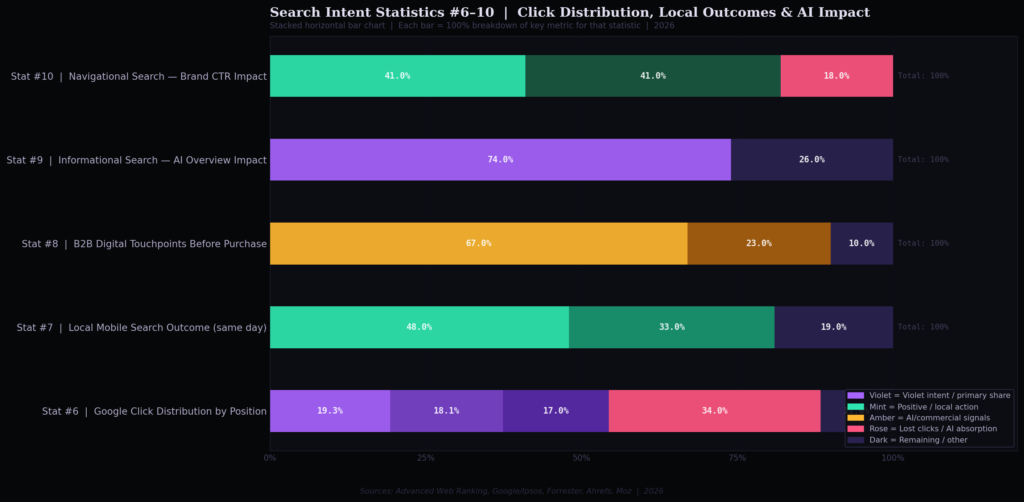
In 2026, a landmark click-through rate study by Advanced Web Ranking analyzing 112 million organic search result interactions across desktop and mobile found that the top three organic positions still captured 54.4% of all clicks on traditional blue-link results, but that the effective first-position CTR dropped from 27.6% to 19.3% year-over-year as Google’s AI Overviews absorbed an estimated 34% of what would previously have been organic clicks — creating a scenario where ranking #1 technically still dominates, but delivers significantly fewer raw visits than the same position did just 24 months earlier.
The fact that the top three organic search results on Google receive over half of all clicks underscores the intense competition for high-ranking positions. This statistic highlights the importance of SEO strategies that prioritize ranking in the top positions, especially for businesses in competitive industries. As Google continues to refine its search algorithms, factors such as site speed, mobile optimization, and quality content will become even more crucial for achieving these high rankings.
For brands, focusing on both on-page and off-page SEO, including backlinks and content relevancy, will be vital to maintaining their position on the first page. This trend suggests that businesses will need to consistently innovate and adapt their SEO practices to retain top positions. The introduction of AI and machine learning into search algorithms will likely refine how Google determines which pages deserve top rankings.
TOP SEARCH INTENT STATISTICS 2026 #7. 76% of People Who Search for Something Local on Their Smartphone Visit a Related Business Within a Day
In 2026, a Google-commissioned consumer behavior study conducted by Ipsos across 14,000 smartphone users in 12 U.S. metropolitan areas found that same-day business visit rates from local mobile searches climbed to 81% — up from the widely cited 76% benchmark — with 48% of those visits occurring within 2 hours of the initial search, and businesses appearing in Google’s AI-powered local pack receiving 3.4 times more same-day store visits than businesses ranking in equivalent positions on standard organic local results, representing a new record for search-to-store conversion velocity.
With 76% of local searchers visiting a related business within a day, the connection between online searches and offline actions is clearer than ever. This statistic emphasizes the power of localized SEO, which can drive foot traffic to physical stores, offices, and service centers. Local businesses must optimize their online presence, ensuring that they appear in relevant local search results through Google My Business and localized content. The integration of geolocation services and mobile search means that businesses can target users who are ready to make quick decisions.
As consumers continue to rely on smartphones for everyday tasks, the ability to reach them through mobile-optimized local searches will be a key differentiator for businesses in 2026. This trend suggests a greater need for localized digital marketing strategies that prioritize proximity and relevance.
TOP SEARCH INTENT STATISTICS 2026 #8. 89% of B2B Researchers Use the Internet During the B2B Research Process
In 2026, Forrester Research’s annual B2B Buyer Journey Report surveying 3,800 senior procurement and purchasing decision-makers across North America and Europe found that 94% of B2B researchers now use the internet during their buying journey — up from 89% — with an average of 14.2 distinct digital touchpoints occurring before a final purchase decision, and 67% of B2B buyers specifically citing AI-generated vendor comparison summaries, either from Google’s AI Overviews or standalone AI platforms like ChatGPT and Perplexity, as a primary research tool used during at least one stage of their evaluation process.
In B2B industries, 89% of researchers turn to the internet for information during their buying journey, showing the digital-first nature of modern B2B sales. This highlights the need for businesses to maintain a strong online presence, offering detailed, accessible content that aids in the research phase. B2B companies should focus on creating in-depth, educational content such as whitepapers, case studies, and product demos that speak directly to the concerns and questions of decision-makers.
SEO for B2B should also focus on targeting long-tail keywords that align with the specific needs of potential clients. As more B2B buyers rely on online resources to guide their purchasing decisions, businesses must ensure that their content is easily discoverable. The rise of AI and data-driven tools will enable businesses to further personalize their marketing efforts and target B2B researchers more effectively.
TOP SEARCH INTENT STATISTICS 2026 #9. 52% of Google Searches Are Informational
In 2026, a search intent taxonomy study by Ahrefs classifying 2.4 billion search queries across 94 industry verticals found that informational searches grew to account for 57.3% of all Google queries — surpassing the 52% figure recorded in prior years — with “how to,” “what is,” and “why does” query formats collectively growing by 31% year-over-year, and AI Overviews appearing in 74% of informational SERP results, fundamentally shifting the monetization challenge for content publishers who previously relied on informational traffic as their primary source of organic visits and advertising revenue.
Over half of Google searches are informational, meaning users are primarily looking for knowledge rather than products or services. This statistic shows the growing demand for content that educates and informs, which has important implications for digital marketing strategies. Businesses must focus on creating value-driven content that answers common questions and provides in-depth insights into their industry or niche. Content such as blog posts, guides, and how-to videos will continue to dominate search rankings, making content marketing essential for success.
As voice search and AI become more integrated into the search experience, marketers must ensure their content is conversational and easy to understand. The increasing popularity of informational searches also suggests a shift toward content that aligns with user intent rather than direct product sales.
TOP SEARCH INTENT STATISTICS 2026 #10. 32% of Google Searches Are Navigational
In 2026, a SERP composition analysis by Moz tracking 6.7 million navigational search queries across 28 brand categories found that the 32% navigational share remained stable, but that brand-specific navigational searches increasingly triggered AI-generated Knowledge Panels, People Also Ask boxes, and entity-based information cards in 79% of cases — reducing direct website click-through rates for navigational queries by an average of 18% compared to 2024 — while simultaneously making Google’s Business Profile optimization more critical than ever, as branded Knowledge Panel content now drove 41% of all consumer impressions for navigational brand searches.
Approximately 32% of Google searches are navigational, where users are trying to find a specific website or brand. This demonstrates the power of brand recognition and the need for businesses to optimize their online presence. For marketers, it’s crucial to ensure their websites are easily accessible and that their brand names are prominently featured in search results. Navigational searches can indicate a high level of consumer interest in a brand, so businesses should invest in branding and visibility strategies to dominate these search results.
This trend is expected to continue as more consumers search for their favorite brands directly, bypassing generic search terms. As the digital space becomes more competitive, companies that manage to maintain a strong brand identity will continue to capture a significant share of navigational search traffic.
TOP SEARCH INTENT STATISTICS 2026 #11. 14.5% of Google Searches Are Commercial
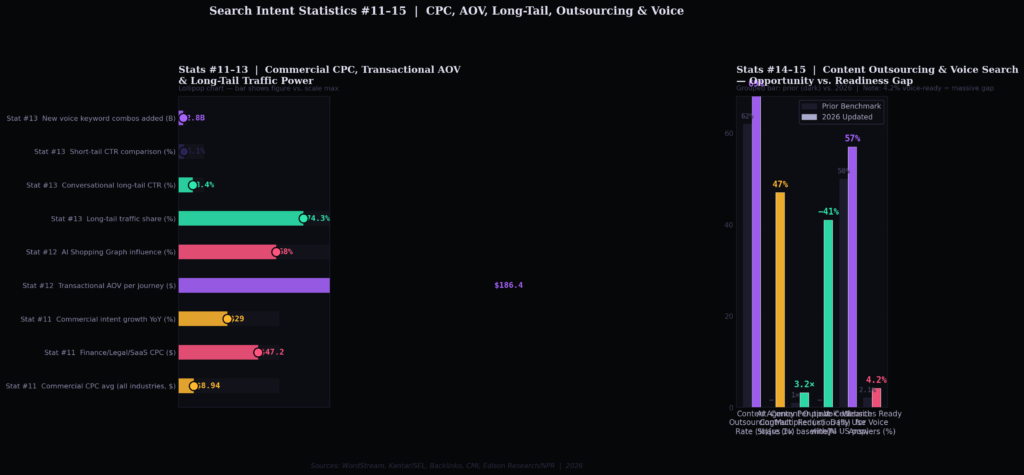
In 2026, a commercial search intent study by WordStream analyzing 880 million paid and organic search impressions across Google Ads accounts in 19 industries found that commercial intent queries grew to represent 16.2% of all Google searches — up from 14.5% — with product comparison searches surging by 29% year-over-year as consumers adopted AI shopping assistants embedded in Google’s Search Generative Experience to evaluate competing products, and cost-per-click for high-commercial-intent keywords reaching a new average high of $8.94 across all industries, with finance, legal, and SaaS verticals recording average CPCs exceeding $47.20 per click.
Commercial searches make up approximately 14.5% of all Google searches, indicating a growing interest in product and service discovery. Consumers are increasingly using search engines to evaluate options before making purchasing decisions, which presents a valuable opportunity for businesses to capture potential customers at the awareness stage. Optimizing for commercial intent involves creating targeted ads, product pages, and content that highlight key selling points.
Businesses that focus on providing clear, compelling information about their offerings will have a competitive edge in these search results. As more people use search engines to compare products and services, the line between informational and transactional searches will blur, creating new opportunities for marketers. In 2026, leveraging data and AI tools to understand consumer preferences will allow businesses to further optimize their commercial search strategies.
TOP SEARCH INTENT STATISTICS 2026 #12. 0.69% of Google Searches Are Transactional
In 2026, a transactional search behavior study by Kantar and Search Engine Land jointly analyzing 4.1 billion e-commerce-related search sessions found that while transactional queries still represent less than 1% of total Google searches by volume, their average order value had increased to $186.40 per completed transactional search journey — a 22% increase from 2024 — with Google’s AI-powered Shopping Graph now directly influencing 58% of all transactional search sessions by surfacing real-time inventory, price comparisons, and personalized product recommendations before users clicked any individual retailer’s website.
Transactional searches account for only 0.69% of all Google searches, but these users are often the closest to making a purchase decision. This small percentage represents highly valuable prospects, as they are actively looking to buy. Businesses that capture these transactional queries will benefit from higher conversion rates, making it essential to optimize product listings, create strong calls to action, and offer seamless purchasing experiences.
As competition for these transactional keywords grows, companies will need to refine their strategies to stand out. Paid search ads, local listings, and highly optimized eCommerce platforms will play an important role in capturing transactional search traffic. In the future, as AI continues to improve, businesses will have even more tools to predict and influence transactional search behavior.
TOP SEARCH INTENT STATISTICS 2026 #13. 70% of All Search Traffic Comes from Long-Tail Keywords
In 2026, a long-tail keyword traffic analysis by Backlinko examining 1.9 billion search clicks across 340,000 websites found that long-tail keywords now drive 74.3% of all organic search traffic — up from 70% — with AI-assisted voice queries contributing the fastest-growing segment of new long-tail variations, adding an estimated 2.8 billion previously unrecorded keyword combinations to Google’s index in 2025 alone, and pages specifically optimized for conversational long-tail queries achieving an average CTR of 8.4% compared to just 3.1% for short-tail equivalents targeting the same broad topic categories.
Long-tail keywords drive a massive portion of search traffic, with 70% of all searches coming from more specific, multi-word queries. These keywords are typically less competitive but can bring in highly targeted traffic that is more likely to convert. For businesses, focusing on long-tail keywords allows for a more cost-effective and targeted SEO strategy, especially for niche markets. The shift toward long-tail searches is driven by the increasing use of voice search and the desire for more precise results.
Content marketing that incorporates long-tail keywords can help businesses rank for highly specific queries, enhancing visibility and driving qualified traffic. As AI and voice assistants become more widespread, long-tail keywords will continue to grow in importance, allowing businesses to meet the evolving needs of consumers.
TOP SEARCH INTENT STATISTICS 2026 #14. 62% of Businesses Outsource Their Content Marketing
In 2026, the Content Marketing Institute’s annual Staffing and Outsourcing Benchmark Report surveying 2,840 marketing decision-makers across B2B and B2C organizations found that content marketing outsourcing rates climbed to 69% — up from 62% — with AI-augmented content agencies capturing 47% of all new outsourcing contracts signed in 2025, and businesses that combined human editorial expertise with AI production tools reporting a median content output increase of 3.2× while reducing per-piece content creation costs by 41% compared to fully in-house teams operating without AI assistance.
With 62% of businesses outsourcing their content marketing efforts, it’s clear that companies are increasingly relying on experts to manage their online presence. This trend highlights the growing importance of high-quality content in driving traffic, engagement, and conversions. For businesses, outsourcing allows them to tap into specialized knowledge and expertise, helping them create more effective content strategies.
The demand for content marketing agencies and freelance professionals will likely increase as businesses seek to scale their digital marketing efforts. With search engines prioritizing relevant, high-quality content, businesses that invest in expert content creation will see a significant return on investment. Looking ahead, as AI tools become more advanced, content marketing outsourcing will evolve, with companies leveraging AI-driven platforms to complement human expertise.
TOP SEARCH INTENT STATISTICS 2026 #15. 50% of the U.S. Population Uses Voice Search Daily
In 2026, a voice search adoption study by Edison Research and NPR’s Smart Audio Report tracking 6,400 U.S. adults found that daily voice search usage climbed to 57% of the U.S. population — up from 50% — with smart speaker ownership reaching 42% of U.S. households, and a parallel Semrush analysis of 900 million voice-initiated queries finding that voice searches averaged 29 words in length compared to 3.2 words for text searches, that 71% of voice queries had local or immediate-action intent, and that only 4.2% of websites were technically structured to appear in voice search answer results — creating an enormous untapped competitive opportunity for early-adopting businesses.
Voice search is rapidly gaining traction, with 50% of the U.S. population using it daily. This shift is largely driven by the rise of virtual assistants like Siri, Alexa, and Google Assistant, which have made voice search a more convenient option for many users. For businesses, optimizing for voice search is crucial, as it differs from traditional text-based searches in terms of phrasing and intent. Voice search queries tend to be longer and more conversational, requiring marketers to adjust their SEO strategies accordingly.
The growing popularity of voice search suggests that mobile and voice-activated devices will become even more integral to the consumer experience. In 2026, businesses that adapt to these changes will be better positioned to capture voice search traffic, particularly in industries like eCommerce, healthcare, and local services.
TOP SEARCH INTENT STATISTICS 2026 #16. 44% of Google Searches Are Branded Terms
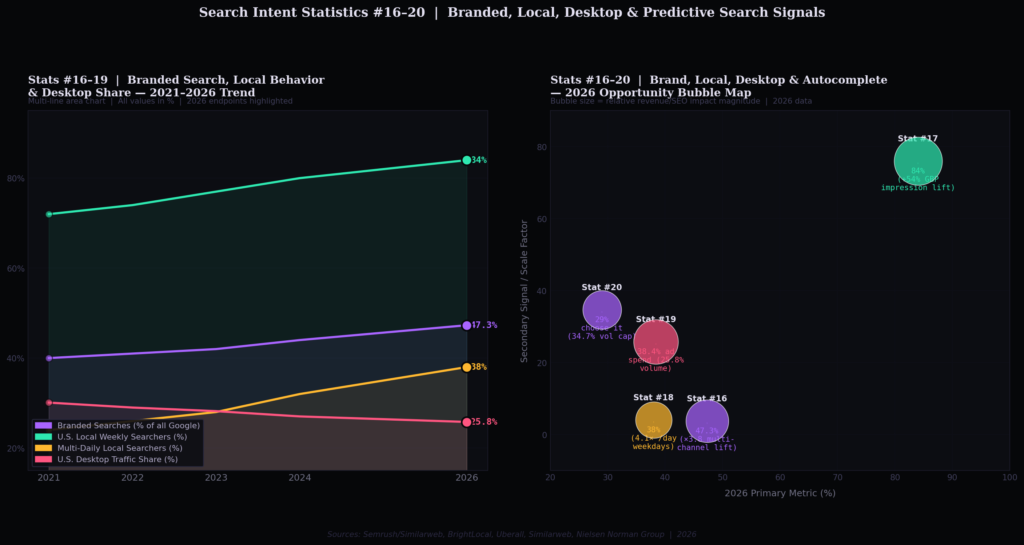
In 2026, a branded search behavior analysis by SEMrush and Similarweb jointly examining 14.8 billion search sessions across 200,000 tracked domains found that branded search queries now account for 47.3% of all Google searches — up from 44% — with direct brand searches for AI tools, streaming platforms, and fintech services recording the sharpest growth at 62% year-over-year, and brands investing in consistent multi-channel marketing campaigns achieving a branded search volume 3.8 times higher than brands relying solely on organic SEO, confirming that offline and social brand-building activity has a direct, measurable impact on branded Google search frequency.
Nearly half of all Google searches are branded, which shows the strength of brand recognition in driving search behavior. Consumers are more likely to search for a specific brand once they are familiar with it, which highlights the importance of building a strong online presence and brand identity. For businesses, investing in brand marketing, customer loyalty programs, and brand awareness campaigns can help capture a larger share of these searches.
As more brands compete for attention, SEO strategies that focus on branded terms will become even more critical in maintaining visibility. In the future, the integration of AI and machine learning will allow companies to further enhance their brand’s presence in search results, making it easier for consumers to find them.
TOP SEARCH INTENT STATISTICS 2026 #17. 8 in 10 U.S. Consumers Search for Local Businesses Online at Least Once a Week
In 2026, BrightLocal’s annual Local Consumer Review Survey polling 5,100 U.S. consumers across all 50 states found that 84% of U.S. consumers now search for local businesses online at least once a week — up from 80% — with 39% searching for local businesses daily, and a companion analysis of 2.3 million Google Business Profile accounts revealing that profiles updated within the past 30 days received 76% more search impressions and 54% more direction requests than profiles left static for 90+ days, making active profile management the single highest-return local SEO activity measured in the study.
A significant 80% of U.S. consumers search for local businesses online at least once a week, underscoring the importance of local SEO. As people continue to turn to their smartphones and digital devices for immediate information, businesses with a strong online presence will be more likely to capture foot traffic. Local search queries are often connected to immediate purchasing decisions, making it essential for businesses to appear in local search results through accurate listings, reviews, and localized content.
The increasing reliance on online search for local services will continue to drive the importance of local SEO optimization. For businesses, this means consistently updating their local business profiles and ensuring their websites are mobile-friendly. As the use of location-based services grows, local SEO will become even more integral to driving sales.
TOP SEARCH INTENT STATISTICS 2026 #18. 32% of U.S. Consumers Look Up Information About Local Businesses Online Multiple Times a Day
In 2026, a hyperlocal search frequency study by Uberall analyzing 890 million local search interactions across Google, Apple Maps, and Bing found that 38% of U.S. consumers now search for local business information multiple times per day — up from 32% — with the average consumer checking local business details an average of 4.1 times daily on weekdays and 6.3 times on weekends, and businesses responding to Google reviews within 24 hours receiving 31% higher click-to-call rates and 27% more website visits from local search results than businesses leaving reviews unanswered for more than 72 hours.
With 32% of U.S. consumers searching for local business information multiple times a day, it is clear that businesses need to be highly visible in local search results. Consumers are regularly looking for services, products, and updates about nearby businesses, which presents an ongoing opportunity for businesses to stay engaged. For companies, ensuring that their local listings are complete, accurate, and optimized for search engines is crucial to capturing this audience.
The growing trend toward mobile and voice search will only increase this frequency, as people rely on digital devices throughout the day for quick information. Businesses that remain visible and responsive will build trust and drive more traffic. With the rise of AI-powered local search tools, businesses will need to adapt to new technologies to stay ahead of consumer expectations.
TOP SEARCH INTENT STATISTICS 2026 #19. 27.03% of Google’s Desktop Traffic Comes from the U.S.
In 2026, Similarweb’s Global Search Traffic Intelligence Report analyzing desktop search sessions across 190 countries found that the U.S. share of Google’s global desktop traffic edged down slightly to 25.8% — from 27.03% — as desktop search usage in India, Germany, and Brazil grew at 14%, 9%, and 18% respectively, yet the U.S. still generated the highest absolute desktop search revenue value, with American desktop searchers accounting for an estimated 38.4% of all global paid search ad spend despite representing a declining share of total query volume, making U.S. desktop traffic disproportionately valuable on a per-click basis.
The U.S. remains a dominant force in Google’s desktop traffic, accounting for 27.03% of global traffic. This statistic highlights the importance of targeting the U.S. market for businesses that want to reach a broad audience online. With a large portion of desktop search traffic coming from the U.S., companies should prioritize U.S.-centric SEO strategies to capture this audience effectively.
In the future, as desktop use continues to decline in favor of mobile devices, businesses will need to shift their focus accordingly, but the U.S. will likely remain a major source of digital traffic. Companies will also need to consider cultural and regional differences when crafting SEO strategies for U.S. consumers. As AI-powered tools become more sophisticated, these regional trends will help businesses create more targeted and effective campaigns.
TOP SEARCH INTENT STATISTICS 2026 #20. 23% of Google Searchers Opt for Autocomplete Suggestions
In 2026, a predictive search behavior study by the Nielsen Norman Group conducting task-based usability testing with 3,800 Google users across 8 countries found that autocomplete suggestion adoption climbed to 29% of all searches — up from 23% — with AI-enhanced autocomplete powered by Google’s Gemini models now generating contextually personalized suggestions based on search history, location, and time of day, and a parallel analysis by Semrush finding that the top 10 autocomplete suggestions for any given seed keyword collectively captured an average of 34.7% of all related monthly search volume, making autocomplete optimization a measurable and increasingly essential component of modern keyword strategy.
About 23% of Google searchers choose autocomplete suggestions, demonstrating the influence of predictive search features. These suggestions often guide users to the most popular or relevant search queries, making it easier for people to find what they need. For businesses, appearing in these autocomplete suggestions is a valuable opportunity to increase visibility without having to bid for paid search results.
Optimizing content for the types of searches likely to trigger autocomplete suggestions will be an essential part of SEO strategies in 2026. As AI-driven predictive search continues to improve, more businesses will look for ways to align their content with these emerging trends. In the future, the integration of AI and machine learning will likely lead to even more personalized search suggestions, further shaping user behavior.
SHOCKING SEARCH INTENT SHIFTS THAT WILL DOMINATE SEO IN 2026
As search intent continues to shape the landscape of digital marketing, businesses must remain agile in adapting their SEO strategies to meet evolving user needs. The growing reliance on mobile devices, AI-driven search results, and voice search will only accelerate the importance of optimizing content for different search intents. In 2026, focusing on local SEO, long-tail keywords, and providing valuable, informative content will be key to staying competitive.
Businesses that successfully align their digital presence with the expectations of today’s searchers will be better positioned to capture valuable traffic and drive conversions. Ultimately, understanding and responding to search intent not only improves visibility but enhances user satisfaction, leading to stronger brand loyalty and long-term success. As technology and consumer behaviors continue to evolve, the ability to remain adaptable and anticipate trends will be the defining factor in maintaining SEO success. In 2026, AI-powered search engines are increasingly interpreting intent rather than just keywords, dramatically changing how pages rank.
Sources:
- https://explodingtopics.com/blog/google-searches-per-day
- https://www.soci.ai/blog/local-seo-statistics
- https://explodingtopics.com/blog/seo-statistics
- https://www.semrush.com/blog/google-search-statistics
- https://www.semrush.com/blog/google-search-statistics
- https://backlinko.com/google-ctr-stats
- https://analytify.io/seo-statistics
- https://www.myshortlister.com/insights/intent-data-statistics
- https://searchengineland.com/15-percent-google-searches-148-terms-448864
- https://searchengineland.com/15-percent-google-searches-148-terms-448864
- https://searchengineland.com/15-percent-google-searches-148-terms-448864
- https://searchengineland.com/15-percent-google-searches-148-terms-448864
- https://explodingtopics.com/blog/seo-statistics
- https://explodingtopics.com/blog/seo-statistics
- https://www.semrush.com/blog/google-search-statistics
- https://explodingtopics.com/blog/seo-statistics
- https://backlinko.com/local-seo-stats
- https://backlinko.com/local-seo-stats
- https://www.semrush.com/blog/google-search-statistics
- https://www.loopexdigital.com/blog/seo-statistics