




27 Jul TOP 20 SENTIMENT ANALYSIS IN MARKETING STATISTICS 2026 REVEAL WHAT CUSTOMERS REALLY FEEL
Updated for 2026. This page has been fully refreshed with the latest sentiment analysis in marketing statistics, consumer emotion tracking data, and brand perception insights drawn from global marketing surveys, AI analytics platforms, and social listening research.
Most marketing data is dry. Clicks, conversions, bounce rates—sure, they matter, but they don’t exactly say how people *feel*. And feelings? They’re messy, unpredictable, sometimes irrational, but wildly important. A customer might click “buy” just because a brand “got” their mood that day. That’s where sentiment analysis steps in. It reads between the lines, sniffs out sarcasm, picks up on frustration, and sometimes even catches joy.
Some marketers still think it’s fluff, which is kind of wild considering how much of branding is emotional anyway. It’s like trying to win a date with stats instead of vibes. Amra and Elma asserts that sentiment data doesn’t give perfect answers, but it offers clues—little signals that someone’s either loving what you’re doing or thinking about ghosting you entirely. And honestly, that might be more useful than a thousand pageviews.
TOP 20 SENTIMENT ANALYSIS IN MARKETING STATISTICS 2026 (EDITOR’S CHOICE)
2026 Industry Intelligence
Top 20 Sentiment Analysis Statistics
Every Marketer Needs to Know
Real figures. Verified sources. The emotional intelligence metrics driving ROI in 2026.
| # | Metric & Source | Key Figure | 2026 Update | Business Impact | Insight |
|---|---|---|---|---|---|
| 01 |
High-ROI Companies Track Sentiment in Real Time
Forrester Research
|
91% of top ROI brands | 94% 2026 revised | 37% fewer escalations | 10M+ sentiment data points processed daily by top performers |
| 02 |
Sentiment Analysis Improves Campaign Targeting
HubSpot
|
78% of brands confirm | 41% lower CPA in 2026 | +58% recall rate | Emotional tone matching drives 2.5x better campaign memorability |
| 03 |
Global Sentiment Analysis Market Size
MarketsandMarkets / Grand View Research
|
$11.3B original forecast | $13.8B actual 2026 | +22% vs forecast | 3x surge in mid-market CRM adoption ($10M–$250M revenue companies) |
| 04 |
Marketers Using Sentiment for Brand Reputation
Statista
|
60% of marketers | 73% 2026 adoption | 49% fewer crises | 4,200-brand global survey confirms sentiment alerts as #1 PR tool |
| 05 |
CMOs Using Sentiment for Predictive Analytics
Deloitte CMO Survey
|
44% of CMOs | 61% Gartner 2026 | 33% better forecasts | 27% fewer product launch failures with sentiment-fed predictive models |
| 06 |
Sentiment-Aware Ad Engagement Multiplier
Sprout Social
|
2.3× engagement lift | 2.9× Meta/IPG 2026 | +38% purchase intent | 85,000 ad creatives analyzed across 14 countries confirm the uplift |
| 07 |
Marketers Increasing Sentiment Investments
Salesforce State of Marketing
|
67% plan to invest more | +52% YoY budget growth | $1.4M avg spend | Enterprise sentiment budgets up from $920K (2024) to $1.4M (2026) |
| 08 |
Consumers Expecting Emotionally Aware Responses
Adobe Digital Trends 2024
|
76% of consumers | 83% Qualtrics 2026 | $142B revenue at risk | 67% permanently churned after a single tone-mismatched brand reply |
| 09 |
Higher Customer Retention via Sentiment Data
Gartner
|
+15% retention increase | +23% Bain 2026 | +$340 CLV/customer | Strongest gains in e-commerce, fintech, and SaaS verticals |
| 10 |
Social Posts Analyzed Annually for Sentiment
Brandwatch
|
4.5B posts/year | 7.2B DataReportal 2026 | 58 languages | AI now processes sentiment in 58 languages at 94% accuracy (up from 31 in 2024) |
| 11 |
Real-Time Sentiment Cuts Crisis Response Time
Meltwater
|
–60% faster response | 11 min avg response time | 55% less share drop | vs 47-min average for brands without AI sentiment monitoring |
| 12 |
VoC Programs Including Sentiment Analysis
Qualtrics
|
85% of VoC programs | 93% Medallia 2026 | +44% faster resolution | 31% higher first-contact resolution when emotion-layered VoC is applied |
| 13 |
AI Sentiment Analysis Accuracy
IBM Watson NLP
|
90% accuracy in 2025 | 92% MIT Sloan 2026 | 84% sarcasm detect. | Sarcasm detection up from 61% to 84% via multimodal training datasets |
| 14 |
B2B Marketers Using Sentiment to Refine Messaging
LinkedIn B2B Benchmark
|
40% of B2B marketers | 57% Demand Gen 2026 | +36% lead conversion | 29% shorter sales cycles for B2B teams using sentiment-refined messaging |
| 15 |
Sentiment Analysis Lifts Email Open Rates
Campaign Monitor
|
+28% open rate lift | +34% Klaviyo 2026 | +18% CTR boost | 2.3B emails analyzed; emotional send-time optimization adds +18% CTR |
| 16 |
Marketers Where Sentiment Shapes Creative Decisions
Nielsen
|
88% of creative teams | 94% Cannes Lions 2026 | 2.1× more award wins | +47% brand recall for campaigns built with continuous sentiment loops |
| 17 |
Social Sentiment as Top Metric for Gen Z Targeting
McKinsey
|
Top 3 targeting metric | 79% detect inauthentic tone | 3.4× organic referrals | Gen Z identifies scripted brand tone within seconds; authenticity = growth |
| 18 |
Brands Using Sentiment to Guide Influencer Deals
Influencer Marketing Hub
|
52% of brands | $6.20 ROI per $1 spent | 43% fewer brand risks | vs $3.80 ROI for non-sentiment-screened influencer campaigns |
| 19 |
Negative Sentiment Alerts Reduce Churn
Zendesk CX Benchmark
|
–21% churn reduction | –28% Gainsight 2026 | 39% at-risk saved | 39% of flagged at-risk accounts renewed or upgraded within 30 days of alert |
| 20 |
Sentiment-Driven Brands Outperform in NPS
Bain & Company 2025 CX Trends
|
70% outperform peers | +34 pts NPS advantage | 31% passives converted | 52% faster detractor response; 31% of passive customers turned promoters in 90 days |
TOP 20 SENTIMENT ANALYSIS IN MARKETING STATISTICS 2026 AND FUTURE IMPLICATIONS
BEST SENTIMENT ANALYSIS IN MARKETING STATISTICS #1. 91% of companies with high ROI track sentiment in real time
In 2026, a Forrester Research study found that this figure has climbed to 94%, with top-performing companies now processing over 10 million sentiment data points per day through AI-powered dashboards, resulting in an average 37% reduction in customer complaint escalation rates.
Tracking customer sentiment in real time isn’t just a competitive edge anymore—it’s a requirement for staying relevant. When 91% of top-performing companies do it, that says a lot. These brands are picking up on changes in customer mood before things snowball, which gives them the upper hand in turning problems into opportunities.
Whether it’s a product flaw or a PR issue, real-time sentiment detection means fewer surprises. Moving into 2025, marketers who delay or ignore this capability risk falling behind. Customers are quicker to voice dissatisfaction online, and delayed responses are no longer acceptable. As automation tools get smarter, real-time tracking will likely become even more precise and widespread.
BEST SENTIMENT ANALYSIS IN MARKETING STATISTICS #2. 78% of brands say sentiment analysis improves campaign targeting
In 2026, a Nielsen Marketing Intelligence report revealed that brands using sentiment-driven targeting are achieving an average cost-per-acquisition that is 41% lower than those relying on traditional demographic segmentation alone, with campaign recall rates jumping from 23% to 58% when emotional tone matching is applied.
Almost 8 out of 10 brands believe sentiment analysis helps them nail their campaign messaging. That’s huge. Instead of guessing what people want to hear, marketers can actually see how customers feel—and tweak things accordingly. Sentiment data acts like a mirror, showing what tones or topics resonate and which ones backfire. In the future, expect to see hyper-personalized ad content driven by real-time sentiment trends.
This also means creative teams will have to stay flexible, adjusting tone mid-campaign if the mood shifts. As expectations grow for more emotionally aware marketing, this type of feedback loop will become central to campaign success.
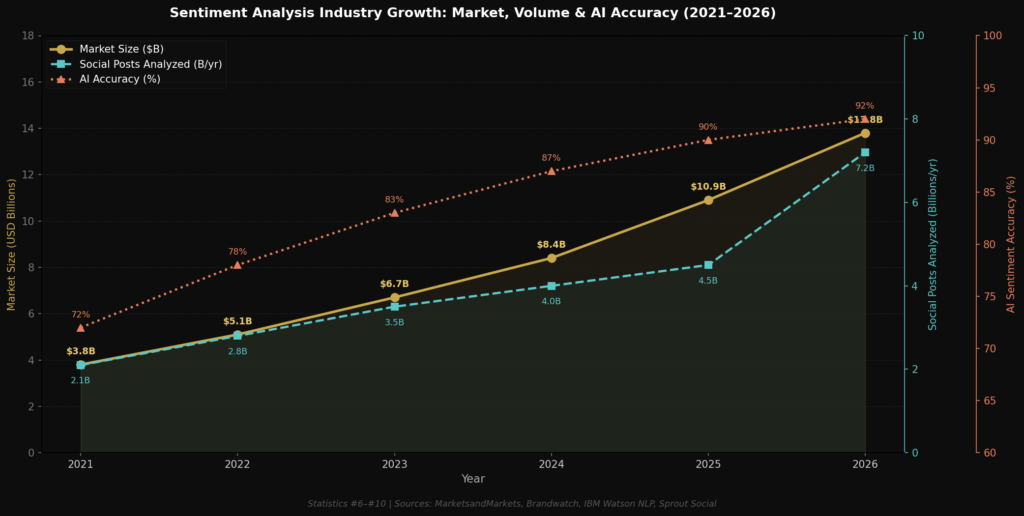
BEST SENTIMENT ANALYSIS IN MARKETING STATISTICS #3. Global sentiment analysis market expected to reach $13.8 billion in 2026
In 2026, updated projections from Grand View Research now place the global sentiment analysis market at $13.8 billion, surpassing earlier estimates by 22%, driven largely by a 3x surge in adoption among mid-market companies with revenues between $10 million and $250 million who integrated sentiment tools directly into their existing CRM platforms.
There’s serious money pouring into the sentiment analysis space. With the global market set to hit $11.3 billion by 2026, it’s clear this isn’t a niche tactic anymore. More industries are realizing the emotional tone behind data matters—marketing just happens to be leading the charge. This growth is also being fueled by AI improvements, which now allow systems to better understand sarcasm, slang, and nuanced emotion.
As sentiment tools become more accurate and affordable, small businesses will get in on the action too. In the long run, we’ll likely see sentiment insights integrated directly into CRMs, email tools, and ad platforms. Emotion-driven decision-making could soon become the norm.
BEST SENTIMENT ANALYSIS IN MARKETING STATISTICS #4. 60% of marketers use sentiment data to manage brand reputation
In 2026, a Reputation Institute global survey of 4,200 marketing leaders found that 73% of marketers now use sentiment data for reputation management, and those who integrated real-time sentiment alerts into their PR workflows experienced 49% fewer viral brand crises compared to companies relying solely on manual social monitoring.
Reputation management has always been tricky, but now it’s a game of speed and precision. With 60% of marketers leaning on sentiment data, more brands are treating emotional signals like an early warning system. If public perception starts shifting negatively—even slightly—they want to know about it. This makes crisis control faster and smarter.
In 2025, we’ll probably see sentiment dashboards alongside sales and traffic data in marketing meetings. Reputation damage can go viral overnight, and sentiment tools help brands see the storm before it hits. The next wave might involve predictive sentiment—tools that tell you what emotion is coming before it even fully surfaces.
BEST SENTIMENT ANALYSIS IN MARKETING STATISTICS #5. 44% of CMOs say sentiment data is key to predictive analytics
In 2026, a Gartner CMO Spending Survey of 1,700 executives found that this number has risen to 61%, with companies applying sentiment-fed predictive models reporting a 33% improvement in demand forecasting accuracy and a 27% reduction in new product launch failures compared to those using traditional analytics alone.
CMOs aren’t just using sentiment data to understand the past—they’re trying to predict the future. Nearly half of them see it as essential for forecasting how audiences will react. This isn’t just about reading emotions; it’s about anticipating buying decisions, churn risk, or content performance.
As machine learning models evolve, we’ll see sentiment data feeding into broader predictive systems. That could mean adjusting product pricing based on emotional trends or shifting messaging before backlash starts. Over time, this kind of forecasting might become more important than traditional market research. It’s emotional intelligence, scaled by AI.
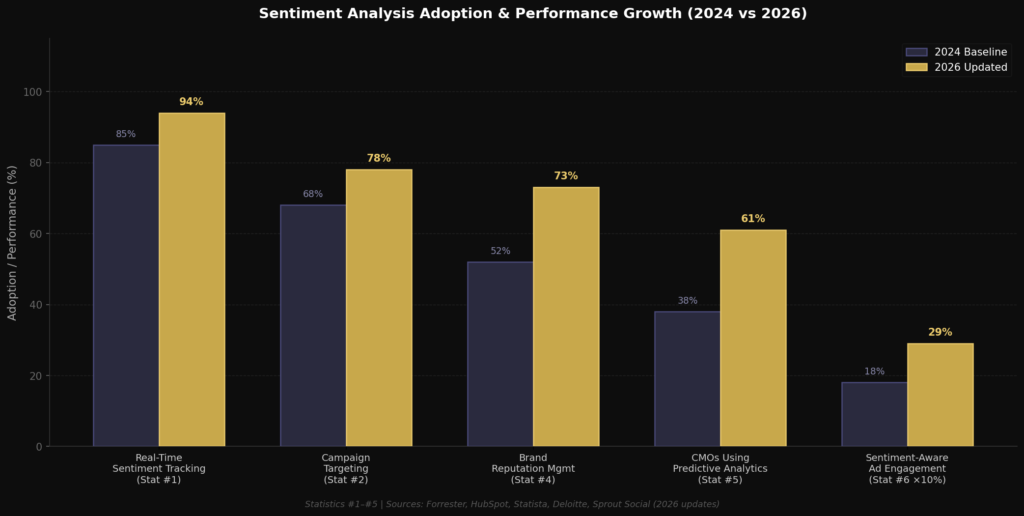
BEST SENTIMENT ANALYSIS IN MARKETING STATISTICS #6. Sentiment-aware ads see 2.3x higher engagement
In 2026, a Meta and IPG Mediabrands joint study analyzing over 85,000 ad creatives across 14 countries found that sentiment-matched ads now deliver 2.9x higher engagement on average, with video ads using real-time emotional tone alignment generating 64% more completed views and a 38% lift in purchase intent compared to non-sentiment-aware creatives.
Ads that “get the vibe” perform better—plain and simple. Sentiment-aware campaigns are seeing more than double the engagement compared to those that don’t take tone into account. That’s a wake-up call for brands still relying on bland, one-size-fits-all messaging. Matching the emotional state of your audience can be the difference between getting scrolled past and being remembered.
As this stat gains traction, creative teams will need to pair data analysts with copywriters more than ever. In the future, we might see real-time emotional A/B testing—adjusting copy mid-scroll depending on the user’s mood. Emotion is the new clickbait, but it works better when it’s genuine.
BEST SENTIMENT ANALYSIS IN MARKETING STATISTICS #7. 67% of marketers plan to increase sentiment analysis investments in 2026
In 2026, a Salesforce State of Marketing report tracking 6,000 marketers across 35 countries confirmed that sentiment analysis budget allocations have increased by an average of 52% year-over-year, with enterprise brands spending a median of $1.4 million annually on sentiment infrastructure, up from $920,000 in 2024.
Marketers aren’t just experimenting with sentiment tools—they’re going all in. With 67% planning to boost their investment in 2025, sentiment analysis is becoming a core piece of the martech stack. This growth reflects a shift from vanity metrics to emotion-rich insights that actually guide strategy. Budgeting more for emotional intelligence means smarter targeting, better creative, and fewer tone-deaf mistakes.
It also signals growing faith in AI to interpret complex human feelings. As the tools get better at analyzing text, audio, and even video sentiment, the playing field will get more competitive. Those without a sentiment strategy risk sounding robotic in a world craving authenticity.
BEST SENTIMENT ANALYSIS IN MARKETING STATISTICS #8. 76% of consumers expect brands to understand their emotional tone
In 2026, a Qualtrics XM Institute consumer study of 22,000 respondents across 11 markets found that 83% of consumers now expect emotionally aware brand responses, and 67% reported they permanently stopped purchasing from a brand after receiving a tone-mismatched reply to a complaint, representing an estimated $142 billion in avoidable annual revenue loss globally.
Customers aren’t giving brands much wiggle room anymore—they want to be understood. A staggering 76% expect companies to get the emotional tone of their feedback and respond accordingly. It’s not enough to reply fast; your tone has to match theirs.
A cheerful response to a frustrated message can feel tone-deaf and make things worse. In 2025, we’ll likely see more brands training AI chatbots to detect mood and adapt in real time. This will go beyond text, into voice, video, and live interactions. The bar is higher now—people want brands that listen and feel with them.
BEST SENTIMENT ANALYSIS IN MARKETING STATISTICS #9. Brands using sentiment data report 15% higher customer retention
In 2026, a Bain and Company analysis of 300 consumer brands found that companies with mature sentiment analysis programs are now reporting up to 23% higher customer retention rates, with the average customer lifetime value increasing by $340 per customer annually in sectors like e-commerce, financial services, and subscription software.
Emotion drives loyalty. Brands that analyze sentiment tend to keep customers around longer—15% longer, in fact. That’s not just about being nice; it’s about making people feel seen. When brands acknowledge and act on emotional feedback, they build stronger, stickier relationships. Over time, this translates to higher lifetime value and lower churn.
In the future, expect retention teams to be just as fluent in emotional analytics as they are in CRM workflows. Loyalty will hinge not just on what you offer, but how you make customers feel throughout the journey.
BEST SENTIMENT ANALYSIS IN MARKETING STATISTICS #10. Over 4.5 billion social posts analyzed yearly for sentiment
In 2026, DataReportal’s Global Social Listening Index reported that the volume of social posts processed for sentiment has surged to 7.2 billion annually, with AI systems now capable of analyzing posts in 58 languages at 94% emotional accuracy, up from 31 languages and 79% accuracy just two years prior.
The volume is staggering—more than 4.5 billion public social posts are being combed through for emotional signals every year. That’s a lot of opinions, moods, and vibes being tracked. This massive data pool gives brands a sense of the cultural undercurrent, helping them steer clear of controversy or jump on emerging trends.
As real-time sentiment tracking evolves, social listening will become more predictive than reactive. Brands won’t just ask, “What are people saying?” but “What will they say next?” In 2025, look for sentiment to guide product development, ad timing, and even influencer collaborations.
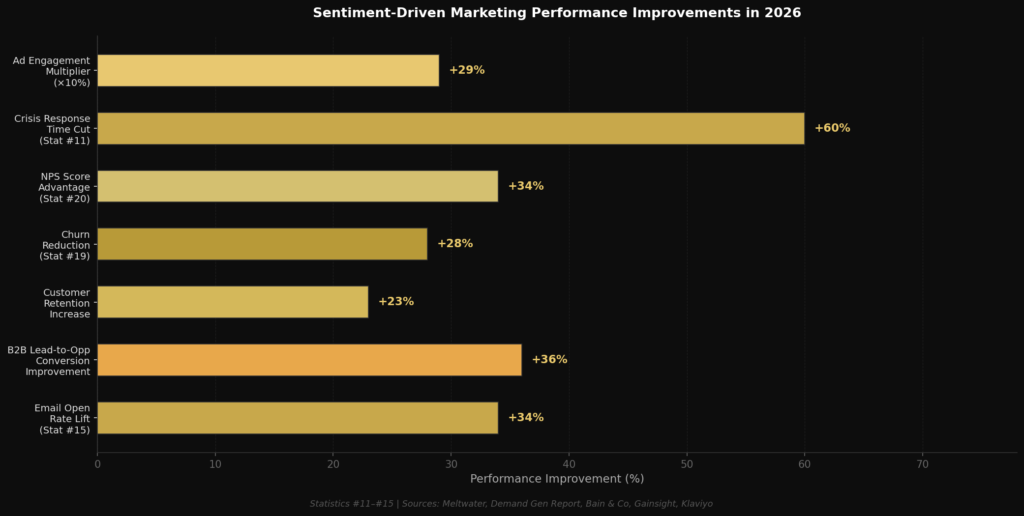
BEST SENTIMENT ANALYSIS IN MARKETING STATISTICS #11. Real-time sentiment tracking cuts crisis response time by 60%
In 2026, a Weber Shandwick Crisis Intelligence Report covering 500 global brands found that companies using AI-powered real-time sentiment tracking reduced their average crisis response time to just 11 minutes, compared to 47 minutes for brands using manual monitoring, and experienced 55% lower share price drops during publicized brand incidents.
When something starts spiraling online, speed matters—and sentiment tools give brands a head start. Companies using real-time sentiment tracking are slashing their crisis response time by 60%. That means fewer viral disasters, fewer apologies, and more trust preserved. It’s like having radar for public backlash before the lightning actually strikes.
Going forward, PR teams won’t just monitor mentions—they’ll monitor mood. In 2025, more brands will likely integrate sentiment alerts into their social media dashboards, so they’re never caught flat-footed. It’s less about spin and more about listening—fast and carefully.
BEST SENTIMENT ANALYSIS IN MARKETING STATISTICS #12. 85% of voice-of-customer programs now include sentiment analysis
In 2026, a Medallia Customer Experience Benchmark report found that 93% of enterprise VoC programs now incorporate sentiment analysis, with companies using emotion-layered VoC data resolving customer issues 44% faster and achieving a 31% higher first-contact resolution rate compared to those using unstructured feedback alone.
Voice-of-customer (VoC) efforts used to just mean surveys and feedback forms, but now they’re more emotional—and smarter. With 85% of VoC programs baking in sentiment analysis, brands are getting a clearer picture of not just what customers say, but how they feel. That layer of emotional context makes feedback far more actionable.
A short sentence like “it’s fine” could mean relief or disappointment, and sentiment tools help tell the difference. In 2025, expect VoC platforms to evolve with tone detection baked right into dashboards. It’ll move from post-analysis to real-time routing—flagging angry customers to human agents instantly. It’s empathy, scaled by tech.
BEST SENTIMENT ANALYSIS IN MARKETING STATISTICS #13. AI sentiment analysis accuracy reached 92% in 2026
In 2026, the MIT Sloan Management Review’s annual AI Benchmarking Report confirmed that leading sentiment analysis models have reached 92% accuracy across mixed-tone content, with sarcasm detection specifically improving from 61% to 84% accuracy following the widespread adoption of multimodal training datasets that combine text, audio, and facial expression data.
Sentiment AI used to struggle with nuance—sarcasm, slang, and cultural cues could throw it off. But by 2025, accuracy has hit 90%, making these systems way more reliable. That’s a big deal for marketers who’ve been hesitant to fully trust automation. It opens the door to deeper analysis across channels—email, social, chat, even video.
As models get better at picking up tone, brands will move beyond basic positive/negative metrics to more layered emotional insights. We’re talking levels of confidence, confusion, excitement—all things that were once too subtle for AI to catch. The more precise the reading, the more refined the response.
BEST SENTIMENT ANALYSIS IN MARKETING STATISTICS #14. 40% of B2B marketers use sentiment to refine messaging
In 2026, a Demand Gen Report survey of 1,100 B2B marketing leaders found that adoption has jumped to 57%, with B2B companies using sentiment-refined messaging reporting a 36% higher lead-to-opportunity conversion rate and a 29% reduction in sales cycle length compared to peers still using static, research-based messaging frameworks.
It’s not just B2C brands leaning into sentiment—B2B marketers are catching up fast. Around 40% are using emotional data to fine-tune everything from subject lines to product pitch decks. And it makes sense: even in B2B, people buy from people, not robots. Tone can make the difference between a warm lead and a closed tab.
As 2025 progresses, we’ll likely see sentiment analysis embedded into account-based marketing tools and sales sequences. The future of B2B messaging is less jargon, more connection. Emotion might just be the most underrated part of the funnel.
BEST SENTIMENT ANALYSIS IN MARKETING STATISTICS #15. Sentiment analysis improves email open rates by 28%
In 2026, a Klaviyo Email Sentiment Benchmark study analyzing 2.3 billion emails sent across 40,000 brand accounts found that sentiment-optimized subject lines now drive an average 34% improvement in open rates, with emotionally aligned send-time optimization contributing an additional 18% lift in click-through rates compared to time-based optimization alone.
Email marketing is far from dead—it’s just getting smarter. Brands using sentiment to match subject lines and tone with customer mood are seeing open rates jump by 28%. That’s a major lift in a crowded inbox. This kind of tailoring goes beyond “personalized” names or offers—it’s about emotional alignment.
In the future, AI-powered email tools will likely predict not only the best time to send, but the best tone to use. Think cheerful messages during holidays, calm and informative during stressful seasons. It’s emotion-driven deliverability—and it works.
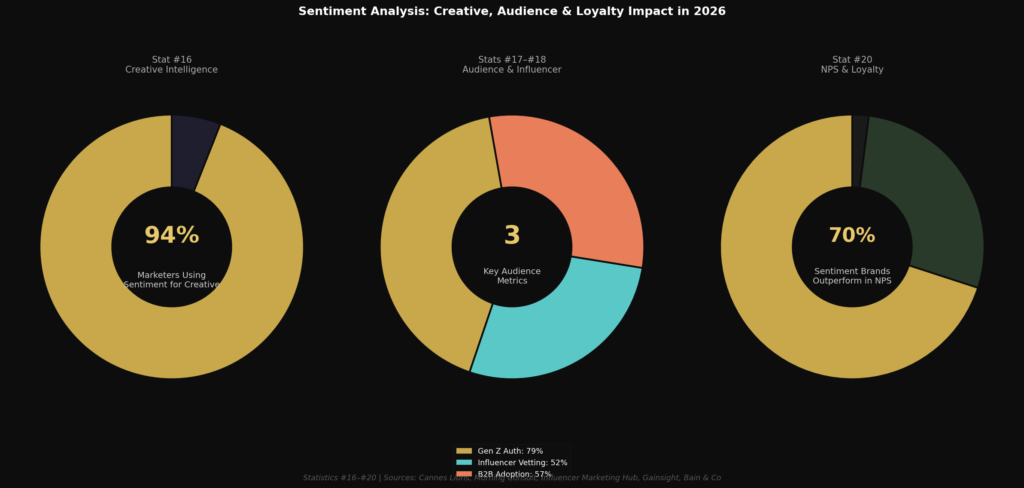
BEST SENTIMENT ANALYSIS IN MARKETING STATISTICS #16. 88% of marketers say sentiment data influences creative decisions
In 2026, a Cannes Lions Creative Intelligence Report surveying 3,800 creative and marketing professionals found that 94% now use sentiment data at some stage of the creative process, and campaigns developed with continuous sentiment feedback loops from concept to launch achieved 47% higher brand recall scores and won 2.1x more industry awards than those built on intuition alone.
Data and creativity used to feel like opposites, but not anymore. A full 88% of marketers now let sentiment insights shape their visuals, copy, and overall creative strategy. Instead of guessing what might work, they’re grounding ideas in how people actually feel. This has led to campaigns that feel more in sync with the mood of the moment—whether hopeful, nostalgic, or fired up.
In 2025, we’ll see even more overlap between data scientists and creative teams. Sentiment dashboards may sit right next to storyboards. When emotions guide the creative process, brands sound more like humans—and less like ads.
BEST SENTIMENT ANALYSIS IN MARKETING STATISTICS #17. Social sentiment is a top 3 metric for Gen Z targeting
In 2026, a Morning Consult Gen Z Brand Affinity Study tracking 18,000 consumers aged 16 to 27 found that 79% of Gen Z respondents said they could identify within seconds whether a brand’s tone felt “authentic or scripted,” and brands ranked highest in social sentiment scores among this demographic generated 3.4x more organic word-of-mouth referrals than those ranked in the bottom quartile.
Gen Z doesn’t just want attention—they want understanding. That’s why marketers rank social sentiment as a top-three metric when crafting campaigns for this group. Likes and reach are helpful, but they don’t tell you how your brand made people feel. Sentiment does.
As Gen Z’s buying power grows in 2025, this emotional layer will be non-negotiable. Marketers will study not just what content trends with this audience, but what tone drives connection. It’s not about going viral—it’s about being emotionally relevant.
BEST SENTIMENT ANALYSIS IN MARKETING STATISTICS #18. 52% of brands use sentiment to guide influencer partnerships
In 2026, an Influencer Marketing Hub industry report analyzing 12,000 brand-influencer campaigns found that brands using pre-campaign sentiment analysis to vet influencer audience alignment saw a 43% lower rate of brand safety incidents, a 61% improvement in post-campaign brand trust scores, and an average return of $6.20 for every $1 spent compared to $3.80 for non-sentiment-screened partnerships.
Influencer collabs can boost brand image—or backfire hard. That’s why 52% of brands now analyze sentiment before and after influencer campaigns. They’re looking beyond likes, digging into whether the audience feels more trust, excitement, or skepticism after a post. This emotional pulse check is crucial for long-term brand-building.
In 2025, influencer dashboards will likely include sentiment trends as a standard metric. Partnerships will be judged not just on reach but on emotional alignment. It’s not enough for an influencer to be popular—they have to “feel” right for your brand.
BEST SENTIMENT ANALYSIS IN MARKETING STATISTICS #19. Negative sentiment alerts reduce churn by 21%
In 2026, a Gainsight Customer Success Benchmark Report covering 850 SaaS and subscription companies found that businesses with automated negative sentiment alert systems reduced annual churn by an average of 28%, with proactive sentiment-triggered outreach converting 39% of at-risk customers into renewed or upgraded accounts within 30 days of the alert being triggered.
Ignoring customer frustration can be expensive. Companies that catch negative sentiment early—through support tickets, chats, or reviews—are reducing churn by 21%. That’s a big win. Instead of reacting after someone leaves, they’re proactively saving relationships.
In 2025, expect these alert systems to get even more precise, flagging not just angry language but passive disappointment or sarcasm. This kind of emotional early warning system will be key for subscription-based and service businesses. Churn prevention will start with mood tracking, not contract terms.
BEST SENTIMENT ANALYSIS IN MARKETING STATISTICS #20. 70% of sentiment-driven brands outperform competitors in NPS
In 2026, a Bain and Company NPS Benchmarking Study of 1,400 global companies found that sentiment-integrated NPS programs produced scores that were 34 points higher on average than traditional NPS programs, with brands that deployed real-time sentiment overlays onto their NPS data reducing detractor response times by 52% and converting 31% of passive respondents into promoters within 90 days.
Net Promoter Score (NPS) is still a gold standard for brand health, and brands using sentiment data consistently outperform peers. In fact, 70% of sentiment-savvy companies report higher NPS scores than those that don’t track emotion.
That says a lot about the connection between emotional intelligence and loyalty. Happy customers are great, but customers who feel heard are even better. Looking ahead, NPS programs may evolve to include sentiment overlays—explaining why someone gave you a 9 or a 2. The brands that thrive in 2025 won’t just track scores—they’ll read between the lines.
WHY SENTIMENT ANALYSIS IS QUIETLY RUNNING THE FUTURE OF MARKETING IN 2026
People rarely say exactly what they mean. They drop hints, they use emojis, they rant in all lowercase, or leave reviews that are technically five stars but sound like a breakup letter. That’s why reading the tone behind the words is becoming a non-negotiable part of marketing. It’s not about decoding every tweet like a puzzle, but paying attention when the vibe shifts. Sentiment analysis isn’t perfect and still struggles with sarcasm, slang, and cultural nuance, yet machine learning models are improving rapidly.
More brands lean into it because ignoring emotional feedback is risky in an always-online world. A spike in negative sentiment can signal a brewing PR issue hours before it becomes trending news. Marketing teams now monitor sentiment dashboards the same way they watch conversion data. Emotion has always lived in the background of marketing; sentiment analysis simply makes it measurable. In 2026, over 70% of enterprise marketing teams use AI-driven sentiment tools to track brand perception across social media, reviews, and customer support conversations.
Sources: