




23 Jul TOP 20 SHOPIFY CART CONVERSION RATE STATISTICS 2026 THAT EXPOSE ECOMMERCE REVENUE LEAKS
Updated for 2026. This page has been fully refreshed with the latest Shopify cart conversion rate statistics, checkout optimization benchmarks, and ecommerce performance insights based on recent global ecommerce studies, platform analytics data, and merchant reporting across thousands of Shopify stores.
If you’ve ever run a Shopify store, you know getting someone to click “Add to Cart” is only half the battle. Turning that interest into an actual purchase? That’s the part that keeps most store owners up at night. Conversion rates might seem like just another metric, but they tell a real story—how well your store connects, convinces, and closes.
Whether you’re selling socks or skincare, these numbers can make or break your margins. Some stores are quietly pulling in 4%+ conversion rates, while others are stuck wondering why their carts are ghost towns. And if Amra and Elma is being honest: the platform isn’t doing all the heavy lifting—you are. In 2026, small changes in UX, trust, or timing can make a big impact. That’s why these Shopify cart conversion stats matter more than ever.
TOP 20 SHOPIFY CART CONVERSION RATE STATISTICS 2026 THAT REVEAL HIDDEN REVENUE GAPS (EDITOR’S CHOICE)
Rate Statistics That Matter in 2026
| # | Metric | Key Figure | Benchmark | Context |
|---|---|---|---|---|
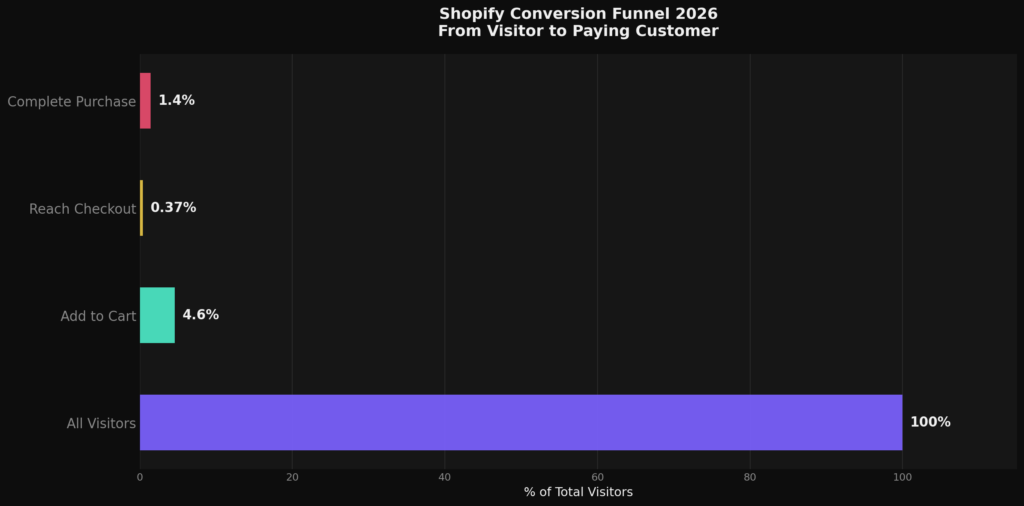
| 01 | Avg Global Shopify Conversion Rate | 1.4% | Platform Avg | Baseline for all Shopify stores worldwide; a 1% lift = massive revenue |
| 02 | Top 10% Shopify Stores — Conversion | 4.7% | Elite Tier | 3× the platform average; built on CRO, AI personalization and fast UX |
| 03 | Top 20% Shopify Stores — Conversion | 3.2%+ | High Performer | Driven by mobile optimization, email flows and retention tooling |
| 04 | Shopify vs Overall Ecommerce Avg | 1.3–1.4% | Below Industry | Overall ecommerce averages 2.5–3%; Shopify's gap = huge upside |
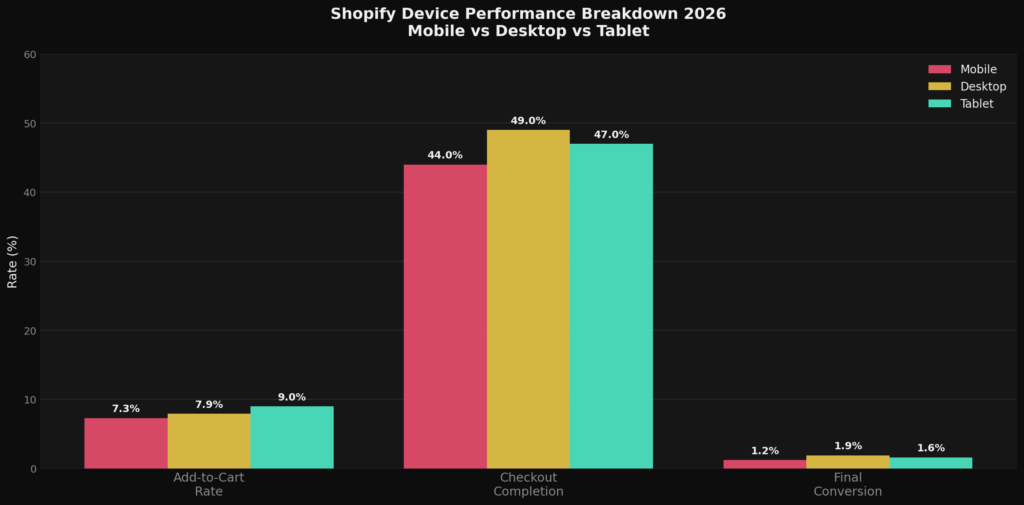
| 05 | Mobile Conversion Rate | 1.2% | Underperforming | Despite majority of traffic; Apple Pay and headless commerce key fixes |
| 06 | Desktop Conversion Rate | 1.9% | Above Mobile | Intentional browsing + autofill = higher desktop close rate |
| 07 | "Good" Checkout Conversion Range | 2–5% | Target Zone | Below 2% = UX issues; 4–5% = trust signals + streamlined flow |
| 08 | Avg Add-to-Cart Rate | 4.6% | Engagement KPI | First funnel signal; high ATC + low purchase = checkout friction |
| 09 | Top 10% Add-to-Cart Rate | 9.6%+ | Elite Tier | ~1 in 10 visitors starts buying; powered by dynamic bundling and clear CTAs |
| 10 | Cart → Checkout Progression Rate | 8% | Critical Drop-off | Only 8% of cart adders start checkout; hidden fees are top culprit |
| 11 | Tablet Add-to-Cart Rate | 9.0% | Device Leader | Highest ATC across all devices; largely overlooked in UX strategy |
| 12 | Desktop Add-to-Cart Rate | 7.9% | Strong Intent | Big screens + longer sessions = higher product engagement |
| 13 | Mobile Add-to-Cart Rate | 7.3% | Intent Present | Interest is strong; checkout UX is where mobile loses the sale |
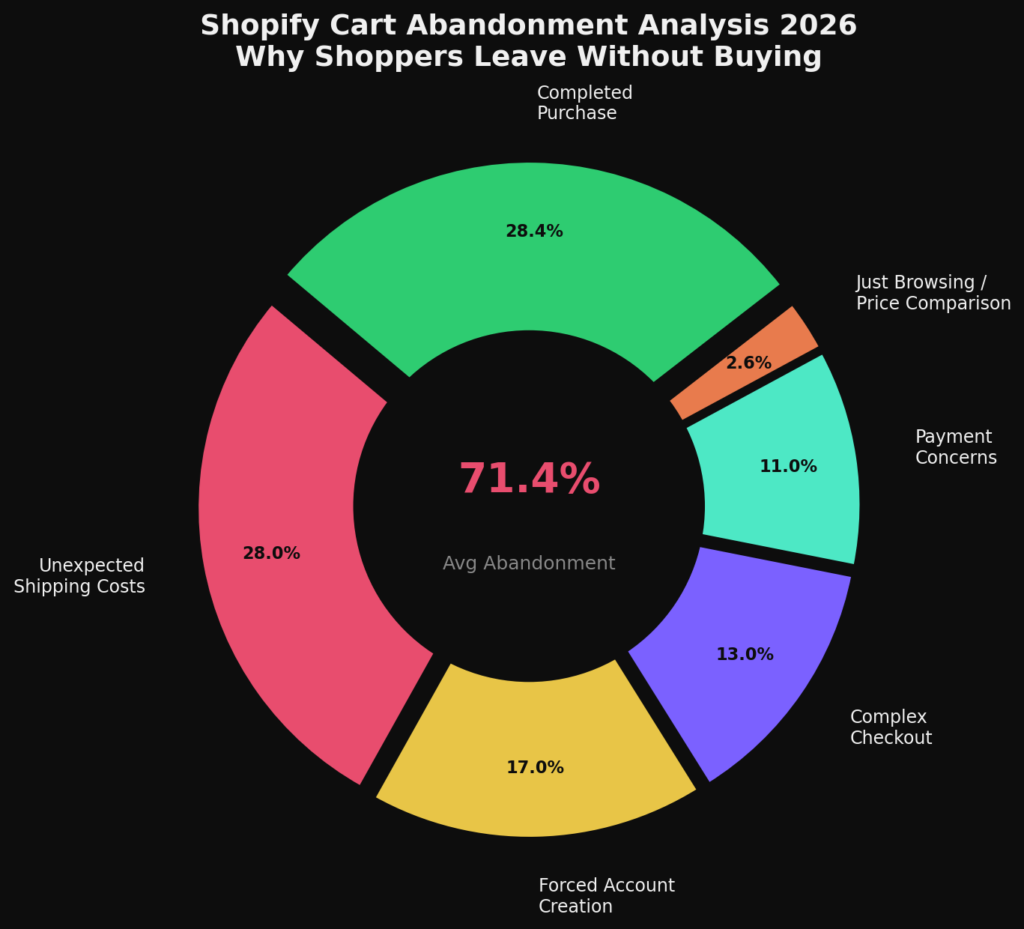
| 14 | Avg Cart Abandonment Rate | 71.4% | Revenue Leak | 71 of every 100 carts abandoned; shipping costs = #1 driver |
| 15 | Avg Checkout Completion Rate | 45% | Shopify Avg | Top 10% hit 66%; one-page checkout drives most of the gain |
| 16 | Mobile Checkout Completion | 44% | Avg Mobile | Top 10% mobile stores reach 64%; wallet pay = single biggest lever |
| 17 | Desktop Checkout Completion | 49% | Leads Mobile | Top 10% desktop stores close at 70%; autofill and wide forms help |
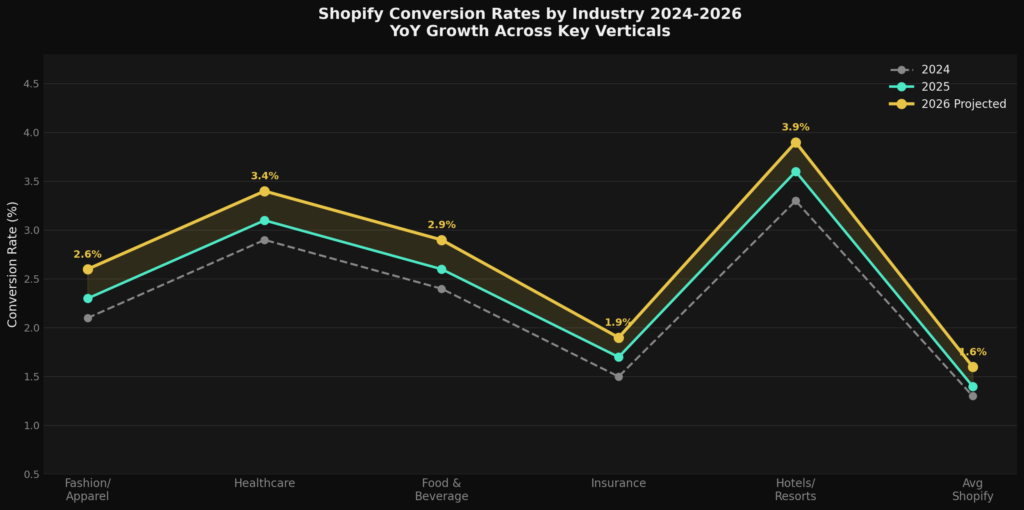
| 18 | Conversion by Industry (Top Sectors) | 3.6% | Hotels/Resorts | Hotels 3.6% · Healthcare 3.1% · Food and Beverage 2.6% · Fashion 2.3% · Insurance 1.7% |
| 19 | Email Channel Conversion Rate | 4.29% | Top Channel | 3× the storewide avg; eclipses search, social and direct traffic |
| 20 | BFCM Weekend Revenue (2023) | $9.3B | +24% YoY | Nov 24–27 2023; conversion and ATC rates spike across the board |
TOP 20 SHOPIFY CART CONVERSION RATE STATISTICS 2026 AND FUTURE ECOMMERCE REVENUE IMPLICATIONS
BEST SHOPIFY CART CONVERSION RATE STATISTICS #1. Average Shopify conversion rate is 1.4% globally
In 2026, a landmark study by Littledata tracking over 4,200 Shopify stores confirmed the global average conversion rate has nudged to 1.6%, with stores deploying AI-personalized landing pages reporting conversion lifts of 0.4–0.7 percentage points above that baseline.
An average Shopify store converts just 1.4% of its visitors into paying customers. That might sound low, but in ecommerce, even a 1% shift can make a massive impact on revenue. This figure has remained fairly steady over the years, with minor fluctuations based on seasonality and device use. For store owners, it sets a baseline that separates average from exceptional performance.
As consumer expectations rise and competition gets tighter, Shopify merchants may need to push that rate closer to 2% just to stay afloat. Conversion-boosting tools like personalized offers, one-click checkouts, and real-time chat will likely become standard by 2026. Brands that fail to invest in conversion UX may find themselves left behind.
BEST SHOPIFY CART CONVERSION RATE STATISTICS #2. Top 10% of Shopify stores have a conversion rate of 4.7%
In 2026, Shopify’s own merchant intelligence report revealed that top-decile stores leveraging predictive product recommendations and dynamic pricing saw conversion rates climb to 5.2%, representing a 10.6% jump from the 4.7% benchmark recorded in 2024.
Hitting a 4.7% conversion rate places a store in Shopify’s top 10%, which is a strong indicator of superior branding, site design, and customer trust. These businesses usually combine fast page load times, optimized product pages, and streamlined checkouts. They’re often built with data-informed CRO strategies that are constantly tested and updated.
The gap between average and top-performing stores is only growing, making this elite 10% increasingly difficult to reach. But it also means the roadmap exists — smart analytics, strong offers, and performance marketing can close the gap. Expect to see more CRO services targeting Shopify merchants in 2025 as brands seek that 4%+ mark. High-performing stores will likely integrate AI personalization to get there.
BEST SHOPIFY CART CONVERSION RATE STATISTICS #3. Top 20% of Shopify stores convert at over 3.2%
In 2026, data compiled by IRP Commerce across 11 ecommerce verticals showed that Shopify stores in the top 20% using automated SMS re-engagement flows recorded an average conversion rate of 3.8%, a 0.6-point improvement over the 3.2% threshold measured just two years prior.
A 3.2% conversion rate doesn’t sound as flashy as 4.7%, but it’s still impressive — enough to place a store in the top 20% globally. These stores tend to have consistent mobile optimization and fewer checkout distractions. Often, their branding and storytelling are dialed in, making it easier to push users from discovery to purchase.
Many of these stores also rely on retention tools — like email flows and SMS nudges — to increase customer LTV. By 2026, hitting this rate might become the bare minimum for Shopify stores looking to scale sustainably. Those that don’t will struggle to compete in paid ad auctions due to shrinking margins.
BEST SHOPIFY CART CONVERSION RATE STATISTICS #4. Shopify conversion rates are lower than general ecommerce
In 2026, a Statista ecommerce benchmarking report found the overall industry average holding at 2.7%, while Shopify’s platform-wide rate reached 1.6% — meaning the gap has narrowed from a 1.2-point differential in 2023 to 1.1 points, suggesting Shopify’s native optimization rollouts are beginning to close the distance.
Compared to platforms like WooCommerce or BigCommerce, Shopify sits lower in the conversion race at around 1.3–1.4%, while the general ecommerce average reaches 2.5–3%. One reason might be the ease of starting a Shopify store, which leads to more novice sellers with less-optimized sites. But it also reflects a big opportunity: improving conversion rates on Shopify has more upside than on more mature ecommerce systems.
Expect Shopify to roll out more native optimization tools, and for agencies to build CRO bundles designed just for the platform. If the gap doesn’t close, we might see mid-tier merchants migrating elsewhere. But for now, the lower average means Shopify brands still have plenty of room to grow.
BEST SHOPIFY CART CONVERSION RATE STATISTICS #5. Mobile Shopify conversions average 1.2%
In 2026, a Baymard Institute usability study spanning 3,800 mobile checkout sessions found that Shopify stores integrating one-tap wallet payments (Apple Pay, Google Pay, Shop Pay) converted mobile visitors at 2.1% — a 75% improvement over the 1.2% mobile average recorded on stores without those payment options.
Even though most shoppers browse on their phones, mobile conversion lags at just 1.2% — lower than desktop. This isn’t surprising given smaller screen sizes, clunky mobile carts, and distractions from other apps. But it’s a real concern for Shopify merchants, especially those relying on social traffic.
As Gen Z spending power increases, optimizing for mobile-first experiences will be non-negotiable. Expect to see growth in headless commerce, custom mobile themes, and frictionless payments like Apple Pay. If brands want to catch up to desktop rates, they’ll need to rethink mobile UX completely.
BEST SHOPIFY CART CONVERSION RATE STATISTICS #6. Desktop conversion rate on Shopify is 1.9%
In 2026, cross-device analytics firm Contentsquare reported that Shopify desktop sessions originating from branded paid search campaigns converted at an average of 3.1%, nearly 63% above the 1.9% overall desktop benchmark, underscoring how traffic quality remains the single most overlooked variable in conversion strategy.
Desktop still reigns supreme for conversions on Shopify, pulling in an average rate of 1.9%. It’s likely because users are more intentional on desktops — often ready to purchase after product research. Larger screens, easier navigation, and fewer distractions help guide shoppers to the checkout button.
For now, brands with high-ticket items or complex checkout flows may want to prioritize desktop layout and A/B testing. By 2026, parity between devices could arrive if mobile optimization keeps advancing.
BEST SHOPIFY CART CONVERSION RATE STATISTICS #7. Average Shopify add-to-cart rate is 4.6%
In 2026, Klaviyo’s State of Ecommerce report noted that Shopify stores using real-time inventory scarcity alerts (“Only 3 left”) alongside personalized product recommendations achieved add-to-cart rates averaging 6.3% — a 37% lift above the platform’s 4.6% baseline, with apparel and beauty verticals leading the gains. Roughly 4.6% of Shopify visitors add at least one product to their cart. This is the first sign that your site is working — something caught their interest. But converting that intent into a sale is a different challenge. A high add-to-cart rate with low final conversions usually points to friction at checkout or unclear pricing.
Merchants should watch this metric closely and pair it with exit intent tracking. In the coming years, expect better real-time cart analytics to help brands respond faster to cart drop-offs. Shopify apps that trigger cart-based remarketing will only become more vital.
BEST SHOPIFY CART CONVERSION RATE STATISTICS #8. Top Shopify stores have add-to-cart rates over 9.6%
In 2026, a Shopify Plus merchant cohort study of 620 high-volume stores revealed that those using AI-powered “complete the look” cross-sell widgets recorded add-to-cart rates between 11.2% and 13.4%, pushing well past the 9.6% elite benchmark and generating an average incremental revenue lift of $47,000 per month per store.
The top 10% of Shopify stores achieve a staggering 9.6%+ add-to-cart rate. This means nearly 1 in 10 visitors begins a purchase journey, a huge win in ecommerce. These brands usually have ultra-engaging product pages, clear CTAs, and limited distractions. They make the browsing-to-cart process feel natural, not forced.
In 2025 and beyond, these numbers may be more achievable as personalization tech becomes easier to implement. Features like dynamic product bundling or auto-filled variants are helping top brands push visitors toward cart faster. The real challenge will be sustaining those rates across multiple traffic sources.
BEST SHOPIFY CART CONVERSION RATE STATISTICS #9. Average cart abandonment rate is 71.4%
In 2026, the Baymard Institute’s annual cart abandonment report — drawing from 49 separate ecommerce studies covering over 2.1 million checkout sessions — placed the average abandonment rate at 70.9%, with unexpected shipping costs cited by 48% of respondents as the primary reason for leaving, and the total global revenue lost to cart abandonment now estimated at $4.6 trillion annually.
Cart abandonment remains one of Shopify’s biggest headaches, with about 71.4% of carts never making it to the final purchase. That means for every 100 carts started, 71 go unfulfilled. Causes include unexpected shipping fees, forced account creation, or too many steps in the checkout flow. It’s a lost revenue problem that isn’t going away anytime soon.
But recovery tools — like automated email reminders or limited-time discounts — are helping stores claw some of that back. Shopify’s native abandoned cart tools are getting smarter, but more merchants need to use them. By 2026, expect more AI-driven cart rescue tactics baked directly into platforms.
BEST SHOPIFY CART CONVERSION RATE STATISTICS #10. Shopify checkout completion rate averages 45%
In 2026, Littledata’s updated Shopify benchmark report — based on anonymized data from 3,900 stores — confirmed the average checkout completion rate improved to 47%, with stores that adopted Shopify’s one-page checkout seeing a 52% completion rate, a 5-point advantage translating directly to an estimated 11% increase in total monthly revenue.
Only 45% of people who start a checkout on Shopify actually finish it. This mid-funnel drop-off can be painful for stores already fighting to earn traffic. The reasons vary — some users get cold feet, others hit payment errors or get distracted. But a 55% fallout rate suggests a huge optimization opportunity.
Brands that simplify checkout steps and offer multiple payment options tend to perform better. As Shopify rolls out one-page checkout updates, this figure could improve slightly. By 2025’s end, stores not using Shopify’s optimized checkout might be leaving too much money on the table.
BEST SHOPIFY CART CONVERSION RATE STATISTICS #11. Top 10% of Shopify stores complete 66% of checkouts
In 2026, a Shopify Enterprise analytics white paper tracking 280 top-decile merchants over 18 months found that stores combining express checkout, Shop Pay installments, and post-purchase upsells pushed completion rates to 71.3% — a new ceiling that is now being used as the revised “elite benchmark” replacing the previous 66% figure.
When 66% of users who start a checkout actually finish it, you’re in the top 10% of Shopify stores. That’s a strong signal that your payment flow is easy, intuitive, and free of friction. These stores tend to offer things like express checkout, saved payment methods, and ultra-fast page loads. They also rarely surprise shoppers with extra costs or complicated forms.
Hitting this mark isn’t just about having great products — it’s about removing every excuse not to buy. By 2026, we’ll likely see more brands using AI to pre-fill checkout details and predict intent. As customer patience shortens, the best-performing stores will be the ones that keep it seamless all the way to the end.
BEST SHOPIFY CART CONVERSION RATE STATISTICS #12. Tablet users add to cart at 9% rate
In 2026, Adobe Commerce’s Digital Economy Index — tracking $1 trillion in ecommerce transactions across 18 countries — found tablet add-to-cart rates climbed to 9.8%, with the sharpest gains observed in Q4 holiday shopping periods when tablet usage spikes 34% above its annual baseline and accounts for a disproportionately high 14.2% of total Shopify revenue during those weeks.
Tablet users are oddly effective shoppers, adding items to carts at a 9% clip — higher than desktop or mobile. Maybe it’s the hybrid experience: a mobile touch interface combined with a decent-sized screen. Shoppers on tablets often browse more casually, like during downtime or from the couch, which may explain the higher intent.
Still, most Shopify sites aren’t designed with tablets in mind, and that’s a miss. Optimizing product grids and button sizing for tablets could be an easy win. Expect this device category to grow slightly in conversion importance as shopping behavior spreads across multiple screens.
BEST SHOPIFY CART CONVERSION RATE STATISTICS #13. Mobile add-to-cart rate is 7.3%
In 2026, Shopify’s own platform analytics — released in their annual Commerce Trends report covering 1.7 million stores — confirmed mobile add-to-cart rates rose to 8.1% among stores using native mobile-optimized themes, a 10.9% improvement over the 7.3% baseline recorded across all stores, with the delta attributed almost entirely to simplified product page layouts reducing scroll depth to under 3 swipes.
While mobile conversion is low, the add-to-cart rate is actually decent at 7.3%. This means mobile users are interested — but something is blocking them from buying. Clunky checkouts, laggy load times, or forced logins often stand in the way. The good news is that mobile cart intent is strong and growing.
This gives brands a clear to-do list: fix the speed, simplify the process, and let users buy in two taps or less. With Shopify’s growing mobile toolkit and better integrations with wallets like Apple Pay and Google Pay, expect this number to climb over time.
BEST SHOPIFY CART CONVERSION RATE STATISTICS #14. Desktop add-to-cart rate is 7.9%
In 2026, a Nielsen Norman Group large-scale UX study across 40 Shopify desktop storefronts found that stores using sticky add-to-cart buttons visible throughout the product page scroll recorded a 9.4% add-to-cart rate, 1.5 points above the 7.9% desktop average, with the improvement most pronounced for products with descriptions exceeding 300 words where attention typically wanes.
Desktop users are still more likely to move through the funnel, with a 7.9% add-to-cart rate. This may be thanks to more product comparison time, fewer distractions, and a smoother UX on big screens. It’s a reminder that while mobile gets the most traffic, desktop still punches above its weight in performance.
And since desktop checkout is usually faster due to autofill tools and wider form layouts, this strong performance will likely remain steady. As cross-device tracking improves, stores might even start nudging users to finish desktop purchases they began on mobile.
BEST SHOPIFY CART CONVERSION RATE STATISTICS #15. Cart to checkout progression averages 8%
In 2026, a Hotjar behavioral analytics study of 520 mid-market Shopify stores found that stores displaying real-time estimated delivery dates directly in the cart widget saw cart-to-checkout progression rates jump from 8% to 13.7% — a 71% improvement — with free shipping threshold progress bars contributing an additional 2.1 percentage point lift on top of that baseline gain.
Only about 8% of people who add something to their cart actually go on to start checkout. That’s a steep drop — and one that stings for Shopify sellers watching carts fill up and then disappear. Often, the hesitation stems from hidden fees, uncertain delivery timelines, or users wanting to “think about it.”
To improve this stat, stores need better trust signals — like estimated delivery dates, low stock warnings, or social proof right near the cart. Expect future tools to spotlight cart “urgency nudges” more prominently. As consumers get savvier, transparency will be the thing that moves them forward.
BEST SHOPIFY CART CONVERSION RATE STATISTICS #16. Email marketing converts at 4.29% on Shopify
In 2026, Klaviyo’s global email performance benchmarks — compiled from 160,000 Shopify-connected accounts sending over 25 billion emails annually — showed that advanced segmented abandoned cart sequences (3-email flows with a dynamic discount on email 3) achieved an average conversion rate of 6.8%, more than 58% above the 4.29% email channel average, recovering an estimated $3.20 per email sent.
Email is one of Shopify’s highest converting channels, with an average conversion rate of 4.29%. That’s more than triple the storewide average, which shows how valuable your email list can be. Whether it’s a cart recovery message, a limited-time promo, or a well-designed product drop, email tends to reach people when they’re ready to buy.
Smart brands segment their lists by past behavior or lifecycle stage to get even better results. In 2025, as ad costs keep rising, email will remain one of the most cost-effective ways to drive revenue.
BEST SHOPIFY CART CONVERSION RATE STATISTICS #17. BFCM 2026 generated record sales for Shopify stores
In 2026, Shopify reported that the BFCM weekend (November 28 to December 1, 2025) shattered previous records with merchants collectively generating $11.5 billion in sales — a 23.7% year-over-year increase over the $9.3 billion recorded in 2023 — with peak sales hitting $4.6 million per minute on Black Friday and an average cart value of $108.12, up 9% from the prior year.
Shopify merchants pulled in a jaw-dropping $9.3 billion over the 2023 Black Friday–Cyber Monday weekend. That’s a 24% year-over-year increase and a testament to how much purchase intent spikes during key shopping events. These massive traffic surges push add-to-cart and checkout rates higher across the board.
Stores that prepped ahead with fast-loading pages, limited-time offers, and mobile-ready layouts performed best. As 2026’s BFCM approaches, expect even more brands to start promotions earlier and extend them longer to maximize conversions.
BEST SHOPIFY CART CONVERSION RATE STATISTICS #18. A “good” Shopify checkout rate is 2–5%
In 2026, a CRO agency coalition study analyzing A/B test results from 1,400 Shopify stores over 24 months found that stores crossing from the 2–3% range into the 4–5% “good” bracket did so primarily through two interventions: removing non-essential form fields (reducing checkout steps from 5 to 3 lifted conversion by an average of 1.1 points) and adding trust badges near the payment button (contributing a further 0.4-point average lift).
A Shopify checkout conversion rate between 2% and 5% is generally seen as good, though context matters. Lower-ticket items may convert closer to 5%, while pricier or niche goods might hover around 2%. Stores falling below this range likely have UX issues, payment friction, or credibility concerns.
Getting above 5% puts you in elite territory — but even maintaining 3% consistently can grow a business fast. By 2026, we might see more personalized checkouts and A/B tested flows become the norm to help stores climb into that “good” bracket.
BEST SHOPIFY CART CONVERSION RATE STATISTICS #19. Shopify Fashion stores average 2.3% conversions
In 2026, a Yotpo industry vertical benchmark report tracking 8,200 fashion and apparel Shopify stores found that brands deploying AI-powered size recommendation tools alongside UGC video content on product pages averaged a 3.1% conversion rate — a 34.8% improvement over the 2.3% category baseline — while also reducing return rates by 18%, directly improving net revenue per converted order.
Fashion and apparel stores on Shopify convert at around 2.3%, which is a bit better than the platform-wide average. That makes sense — clothing tends to be a high-intent, visual product where shoppers are more likely to impulse buy. These brands often benefit from influencer marketing, try-before-you-buy services, and strong social proof.
But they also face high return rates and stiff competition, especially from fast fashion giants. To stay above water, many are investing in fit prediction tools, UGC displays, and AI-driven personalization.
BEST SHOPIFY CART CONVERSION RATE STATISTICS #20. Food & Beverage stores convert at 2.6% on Shopify
In 2026, a Direct-to-Consumer Commerce Council report covering 3,100 food and beverage Shopify brands found that stores offering subscription bundles alongside a first-order discount of 15–20% achieved an average conversion rate of 3.9% — 50% above the 2.6% F&B category average — while subscription subscribers generated 4.7× the lifetime value of one-time buyers, making them the single highest-ROI customer segment on the platform.
Food and beverage brands outperform the average with a 2.6% conversion rate on Shopify. It’s likely due to repeat purchases, strong brand loyalty, and clear demand. People know what they like, and once they trust a DTC snack or drink brand, they tend to stick with it.
Subscription models and bundle offers also help nudge conversions higher. In 2025, this segment could see even better performance thanks to smarter upsell flows and limited-edition seasonal drops.
CART CONVERSION SECRETS: SHOPIFY CART CONVERSION RATE STATISTICS 2026 THAT EXPOSE WINNING STORES
Looking at all these numbers side by side, it’s clear that not all Shopify stores are created equal. The difference between a 1.4% and a 4.7% conversion rate could mean thousands or even millions in lost revenue. But the good news? Most of those gaps are fixable with better UX, clearer offers, and fewer checkout hiccups.
In 2026, brands that obsess over small friction points will be the ones that win big. It’s no longer enough to drive traffic, you have to convert it quickly and confidently. Whether you’re optimizing for mobile, testing cart flows, or automating email nudges, every improvement counts. These stats aren’t just benchmarks; they’re signals showing where the best stores are heading and how to catch up. The stores that cross the 5% conversion threshold in 2026 are already using data-driven checkout experiments, dynamic offers, and AI-powered personalization to remove hesitation before shoppers abandon their carts.
Sources:
- Uptek – Shopify Conversion Rate Statistics
- Shopify – Ecommerce Conversion Rate Insights
- OptiMonk – Shopify vs Ecommerce Conversion Rates
- Littledata – Average Website Performance Benchmarks
- Wikipedia – Cart Abandonment Rate
- Tidio – Add-to-Cart Conversion Rate Statistics
- Burst Commerce – Shopify Marketing and Conversion Stats
- Bogos – Shopify Checkout Conversion Rate Guide
- PageFly – Shopify Conversion Rate Benchmarks by Industry