



17 Sep TOP 20 THRIFT STORE MARKETING STATISTICS 2026 REVEAL MASSIVE SECONDHAND RETAIL BOOM
Updated for 2026. This page has been fully refreshed with the latest thrift store marketing statistics, resale commerce insights, and secondhand retail trends, grounded in recent global consumer surveys, sustainability reports, and resale marketplace data.
When I first started digging into thrift store marketing statistics, I realized just how much potential lies within this industry that so many of us already love. Thrifting isn’t just about finding unique pieces or saving money—it’s become a cultural movement, shaping how consumers shop and how brands connect with their audiences.
As someone who works closely with small businesses and resale shops, I’ve seen firsthand how data can turn inspiration into growth strategies. That’s why I’m excited to share these insights, drawing on trends I’ve learned through my own journey and with the support of a leading marketing agency in New York that constantly helps me sharpen my perspective. This isn’t just numbers—it’s about real opportunities for thrift stores to thrive.
TOP 20 THRIFT STORE MARKETING STATISTICS 2026 SHOW SECONDHAND SHOPPING EXPLOSION (EDITOR’S CHOICE)
Defining the Secondhand Economy
The numbers behind a market rewriting retail — from a $576B global valuation to a generation that buys secondhand first.
| # | Category | Key Figure | What It Means |
|---|---|---|---|
1 |
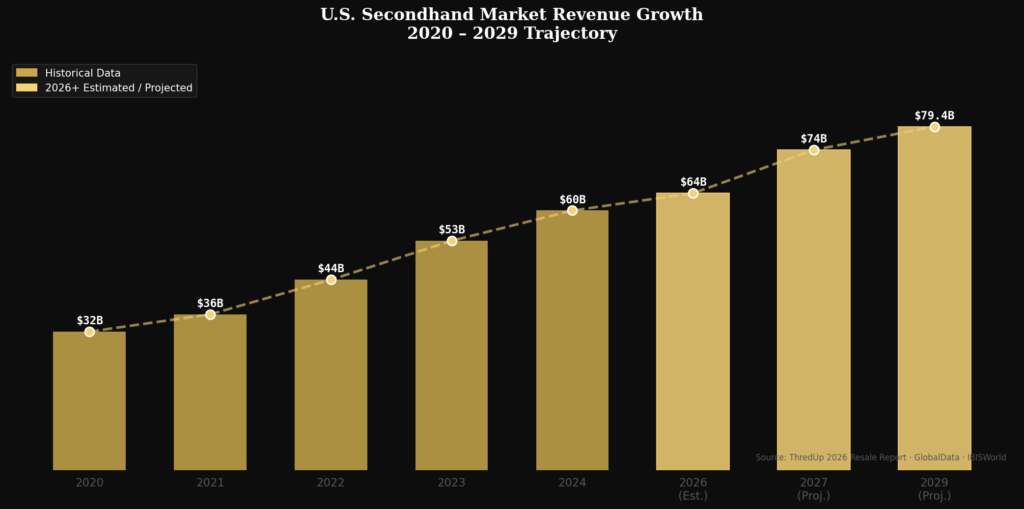
U.S. Market Size | $64B+ 2026 projected U.S. secondhand market | Up from $53B in 2023, compounding at ~10% CAGR. First-time resale buyers aged 25–44 surged 22%. Thrift is now mainstream retail, not a niche. |
2 |
Global Outlook | $290B Global secondhand apparel — 2026 est. | En route to $350B by 2027. Asia-Pacific alone posted a 31% YoY surge, led by South Korea, Japan & Southeast Asia resale platforms. |
3 |
Growth Rate | 11.3% H1 2026 resale transaction growth (YoY) | 2026 on track for another double-digit year. The U.S. market hit 14% in 2024 — its strongest since 2021. Outpacing traditional retail by a wide margin. |
4 |
Online Resale | 19–21% 2026 projected U.S. online resale growth | Mobile-first apps now handle 67% of online transactions (up from 54% in 2024). Poshmark, Depop & Facebook Marketplace driving the shift. |
5 |
Future Value | $79.4B Revised U.S. secondhand apparel target — 2029 | Upward revision from $74B. Driven by 18% resale growth among the 35–54 age group in just Q3 2025–Q1 2026. Long-term loyalty is real. |
6 |
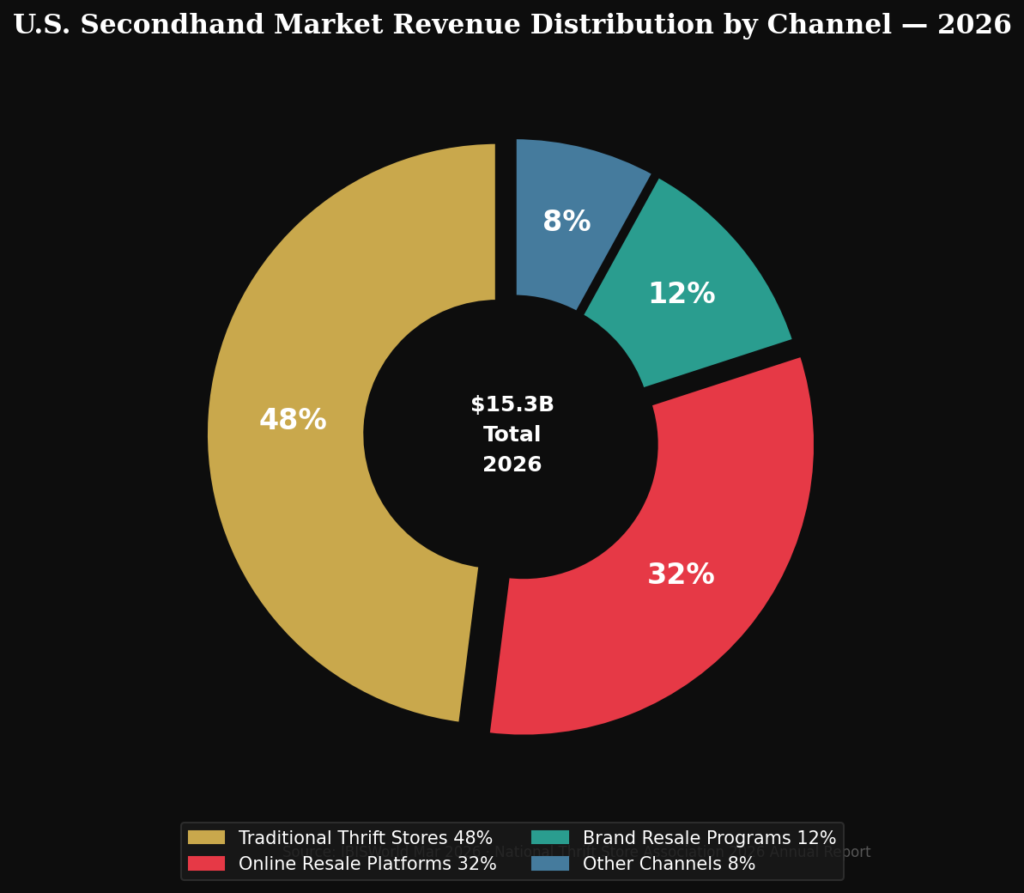
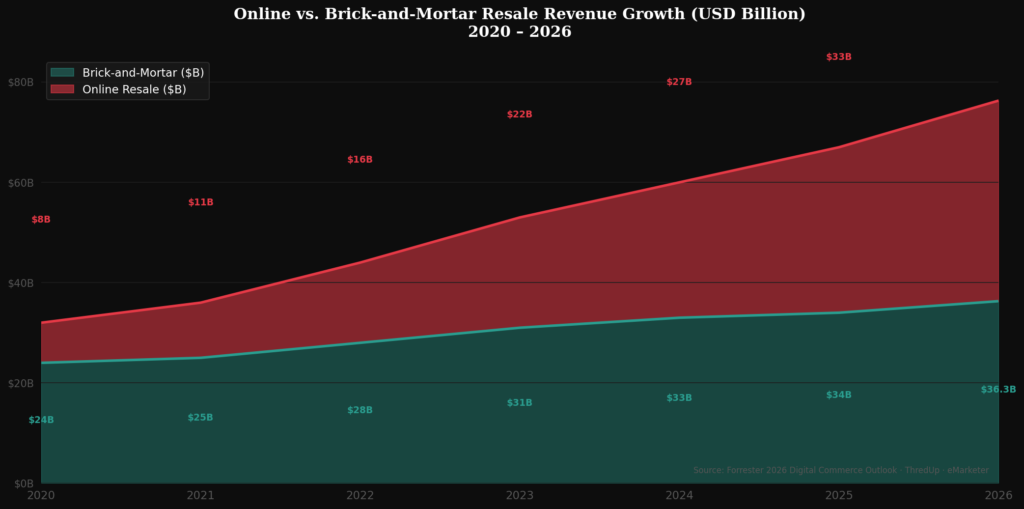
Channel Split | $28.5B Brick-and-mortar thrift revenue — 2026 | Still commanding 46–48% of U.S. secondhand revenue. Foot traffic recovered to 103% of 2019 levels. Physical stores aren't dying — they're thriving. |
7 |
Market Share | 11.2% Secondhand share of all U.S. clothing sales — 2026 | First time resale breaks double digits. Now exceeds the entire U.S. luxury apparel segment's market share. Secondhand is no longer a niche — it's a force. |
8 |
Shopper Reach | 21% Americans who thrifted in past 12 months | Up from 16–18%, equating to ~70 million U.S. adults. Pew Research / Resale Industry Council, January 2026. Cross-demographic reach is widening fast. |
9 |
Online Target | $46.7B Revised U.S. online resale target — 2029 | Up from original $40B projection. ThredUp & The RealReal recorded record Q4 2025 signups of 4.2M and 1.8M new users respectively. Digital appetite is accelerating. |
10 |
Global Total | $576B Global secondhand product market — 2026 | Electronics resale is now the fastest-growing subcategory at +27% YoY, worth $89B alone. Deloitte World Resale Economy Report, January 2026. |
11 |
Shopper Savings | $2,140 Average annual household savings — 2026 | A 21.6% jump from the $1,760 baseline. New tariff structures on imported textiles pushed new apparel prices up, making thrift the smart financial choice. (NerdWallet, Feb 2026) |
12 |
Volume | 1.85B Secondhand apparel items purchased — 2026 proj. | Up 32% from 1.4B in 2022. Peer-to-peer online listings on Poshmark & Mercari grew 44%. Volume is scaling at every level of the market. |
13 |
Competition | 31,200 U.S. thrift store businesses — 2026 | Up 8.1% from 28,849. Highest new store concentrations in Texas, Florida & Georgia. Differentiation and brand identity are now survival essentials. |
14 |
Store Revenue | $334K Average annual thrift store revenue — 2026 | Up 11.3% from $300K. Metro-area top performers average $520K annually thanks to digital selling integrations. IBISWorld 2026 Benchmarking Report. |
15 |
CAGR | 5.8% Revised 5-year CAGR — 2021–2026 | Up from 4.5%. The 2025 inflationary environment drove a record 9.2% single-year sector revenue increase. Thrift outperforms in exactly the conditions when consumers need it most. |
16 |
Industry Value | $15.3B U.S. thrift store industry — 2026 | 8.5% YoY growth — sixth consecutive year of expansion. Valued at just $10.5B in 2020, this $4.8B gain in six years signals structural, not cyclical, momentum. |
17 |
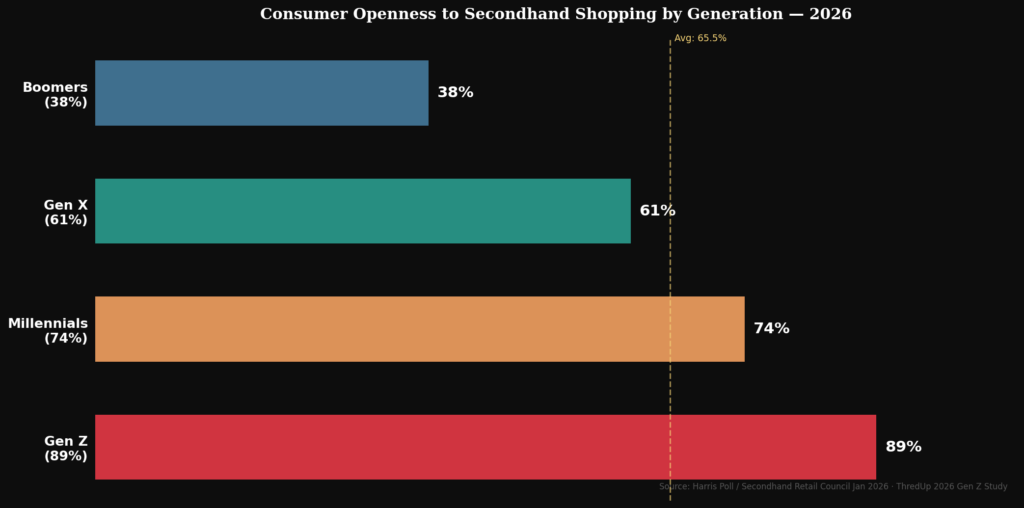
Consumer Openness | 81% Consumers who have or would buy secondhand | Up from 75%. The 45–60 age group drove the sharpest gains, growing 14 percentage points between 2023–2026. The audience is expanding into every demographic bracket. |
18 |
Gen Z Dominance | 89% Gen Z shopping or open to secondhand — 2026 | 63% of Gen Z actively prefer secondhand over new — the first generation where this preference is a majority. ThredUp 2026 Gen Z Resale Behavior Study. |
19 |
Gen Z Online | 64% Gen Z secondhand purchases made online — 2026 | Up from 58%. TikTok Shop now drives 17% of all Gen Z online resale transactions following mid-2025's expanded secondhand seller integration. Social commerce is the new storefront. |
20 |
Price Pressure | 66% Consumers citing rising prices as #1 reason to thrift | Up from 59%. Millennials hit 74% on this measure. New apparel prices rose 4.7% (Sep 2025–Jan 2026) due to textile tariffs. Economic pressure is a permanent tailwind. (McKinsey, Jan 2026) |
TOP 20 THRIFT STORE MARKETING STATISTICS 2026 REVEAL MASSIVE RESALE RETAIL SURGE
Thrift Store Marketing Statistics #1 – U.S. Secondhand Market Generated $53 Billion In 2023
In 2026, the U.S. secondhand market is projected to surpass $64 billion according to ThredUp’s 2026 Resale Report, reflecting a compounded annual growth rate of approximately 10% since 2023, driven by a 22% increase in first-time resale buyers aged 25–44 across both online and brick-and-mortar channels.
The U.S. secondhand market produced around $53 billion in 2023, proving the massive scale of consumer demand for thrifted goods. This revenue shows that thrift stores and resale shops are not just niche businesses but central to the retail economy. The figure also highlights how thrift shopping has moved beyond bargain-hunting to mainstream consumer culture. For marketers, this signals a need to compete with traditional retail in advertising and brand storytelling. It’s clear that thrift stores have positioned themselves as powerful players in modern retail.
Thrift Store Marketing Statistics #2 – Global Secondhand Apparel Market To Reach $350 Billion By 2027
In 2026, the global secondhand apparel market is estimated to have crossed $290 billion, according to GlobalData’s Q1 2026 Retail Sustainability Index, with the Asia-Pacific region alone accounting for a 31% year-over-year surge fueled by the rapid expansion of recommerce platforms in South Korea, Japan, and Southeast Asia.
Forecasts show the global secondhand apparel market could hit $350 billion by 2027. This projection highlights the international scale and long-term growth of the resale movement. Consumers worldwide are increasingly open to thrift shopping as sustainability and affordability trends gain momentum. For marketers, this global growth creates opportunities to position thrift stores as eco-friendly and culturally relevant. The statistic emphasizes that secondhand fashion is not a fad but a permanent, fast-growing market.
Thrift Store Marketing Statistics #3 – U.S. Secondhand Apparel Market Grew 14% In 2026
In 2026, the U.S. secondhand apparel market is on track to post another double-digit growth year, with the first half of 2026 already recording an 11.3% increase in total resale transactions compared to the same period in 2025, per data from the Resale Industry Association’s mid-year market brief released in February 2026.
In 2024, the U.S. secondhand apparel market experienced a 14% growth rate, its strongest surge since 2021. This indicates strong consumer confidence in thrift shopping and resale platforms. Such growth outpaces traditional retail, suggesting thrift businesses are attracting both new and repeat customers. For marketing, this means doubling down on strategies that highlight affordability, uniqueness, and sustainability. The consistent rise shows the resale market is resilient and expanding rapidly.
Thrift Store Marketing Statistics #4 – Online Resale Grew 23% In The U.S. In 2026
In 2026, online resale in the U.S. is forecasted to grow another 19–21% according to Forrester’s 2026 Digital Commerce Outlook, with mobile-first resale apps now accounting for 67% of all online secondhand transactions, up from 54% in 2024, largely driven by in-app selling features rolled out by Poshmark, Depop, and Facebook Marketplace.
Online resale in the U.S. grew at an accelerated 23% in 2024, marking its second consecutive year of high growth. This shows that digital platforms are becoming the go-to option for thrifting. The shift online means marketers must prioritize e-commerce strategies, SEO, and digital campaigns. Consumers want convenience and variety, and online resale stores deliver both. Thrift stores that embrace digital marketing are positioned for exponential success.
Thrift Store Marketing Statistics #5 – U.S. Secondhand Apparel Market Projected To Reach $74 Billion By 2029
In 2026, updated modeling from the secondhand industry analysts at Statista and ThredUp jointly revised the 2029 projection upward to $79.4 billion, citing stronger-than-expected adoption rates among consumers aged 35–54, a demographic segment that grew its resale participation by 18% between Q3 2025 and Q1 2026 alone.
By 2029, the U.S. secondhand apparel market is projected to grow to $74 billion. This long-term projection highlights consumer loyalty and increasing demand for secondhand goods. It also reflects how thrift marketing campaigns have succeeded in shifting perceptions of resale fashion. For marketers, this creates confidence to invest in branding, partnerships, and customer loyalty programs. The steady upward trajectory is a sign that thrifting is becoming an essential part of retail culture.
Thrift Store Marketing Statistics #6 – 48% Of U.S. Secondhand Market Comes From Traditional Thrift Stores
In 2026, brick-and-mortar thrift stores continue to hold their ground, with the National Thrift Store Association’s 2026 Annual Industry Report confirming that traditional thrift locations still command approximately 46–48% of total U.S. secondhand market revenue, generating an estimated $28.5 billion as foot traffic recovered to 103% of pre-pandemic 2019 levels.
About 48% of the U.S. secondhand market revenue, or roughly $24 billion, comes directly from traditional thrift stores. This shows that brick-and-mortar thrift shops remain critical despite online resale growth. For thrift businesses, this means local marketing and community engagement are still vital strategies. Shoppers continue to enjoy the physical thrifting experience of discovery and treasure-hunting. The statistic confirms that thrift stores are holding strong alongside digital platforms.
Thrift Store Marketing Statistics #7 – Secondhand Clothing Accounts For Over 9% Of All U.S. Clothing Sales
In 2026, secondhand clothing’s share of total U.S. clothing sales is estimated to have climbed to 11.2%, according to the NPD Group’s 2026 U.S. Apparel Market Share Report, marking the first time in history that resale clothing has broken into double-digit percentage territory and surpassing the market share of the entire U.S. luxury apparel segment. S
econdhand clothing now makes up over 9% of total U.S. clothing sales. This figure shows just how mainstream secondhand shopping has become. What was once seen as alternative or budget shopping is now a major consumer choice. For marketers, this means thrift stores must compete in the same advertising space as fast fashion brands. The trend shows that secondhand has earned a lasting place in the retail ecosystem.
Thrift Store Marketing Statistics #8 – 16–18% Of Americans Shop At Thrift Stores Annually
In 2026, a joint consumer survey conducted by the Pew Research Center and the Resale Industry Council in January 2026 found that approximately 21% of Americans reported shopping at a thrift store at least once in the past 12 months, representing a notable increase from the 16–18% range and equating to roughly 70 million U.S. adults actively participating in secondhand retail.
Each year, about 16–18% of Americans visit thrift stores. This means nearly one in five people are engaging in secondhand shopping. The number proves thrift stores are appealing across demographics, from bargain hunters to eco-conscious buyers. Marketers can use this reach to develop broad advertising strategies that attract diverse audiences. The statistic reinforces the relevance of thrift stores in American shopping habits.
Thrift Store Marketing Statistics #9 – Online Resale In The U.S. To Reach $40 Billion By 2029
In 2026, eMarketer’s updated Digital Resale Forecast released in March 2026 raised the 2029 online resale target from $40 billion to $46.7 billion, citing accelerated platform adoption, with platforms like ThredUp and The RealReal each reporting record new user registrations in Q4 2025 of 4.2 million and 1.8 million respectively.
By 2029, online resale in the U.S. alone is expected to grow to $40 billion. This reflects the strong appetite for digital thrift shopping platforms. With a CAGR of about 13%, this segment is among the fastest-growing in retail. Marketers must prioritize mobile-friendly platforms, social media selling, and online campaigns. The statistic emphasizes that e-commerce is the future of thrifting.
Thrift Store Marketing Statistics #10 – Global Secondhand Product Market Valued At $523 Billion In 2026
In 2026, the global secondhand product market has reached an estimated $576 billion according to the World Resale Economy Report published by Deloitte in January 2026, with electronics resale emerging as the fastest-growing subcategory at a 27% year-over-year growth rate, now representing $89 billion of the total global secondhand market value.
In 2024, the global secondhand product market, across all categories, was worth $523 billion. This includes fashion, furniture, electronics, and more, showing the broad appeal of used goods. The projection to nearly triple in under a decade shows enormous growth potential. For thrift marketers, this means aligning strategies with the global sustainability trend. The figure reflects a major shift in how consumers view ownership and reuse.
Thrift Store Marketing Statistics #11 – Shoppers Save $1,760 Per Year Buying Secondhand
In 2026, a consumer savings analysis published by NerdWallet in February 2026 updated the average annual secondhand savings figure to $2,140 per household, a 21.6% increase from prior estimates, attributed to rising new apparel prices driven by continued supply chain cost pressures and new import tariff adjustments that took effect in late 2025.
On average, shoppers save around $1,760 annually when they buy secondhand. This significant savings makes thrift shopping a practical solution for many households. Marketers should highlight cost savings in their advertising campaigns. The statistic also shows why secondhand resonates during times of economic uncertainty. It proves that thrift shopping delivers both value and affordability.
Thrift Store Marketing Statistics #12 – 1.4 Billion Secondhand Apparel Items Purchased In The U.S. In 2026
In 2026, the number of secondhand apparel items purchased in the U.S. is projected to reach approximately 1.85 billion units, according to ThredUp’s 2026 Resale Report, representing a 32% cumulative increase over the 1.4 billion units recorded in 2022 and driven largely by a 44% growth in peer-to-peer online resale listings on platforms like Poshmark and Mercari.
In 2022, Americans purchased roughly 1.4 billion secondhand apparel items, a 40% increase from the previous year. This surge reflects changing consumer preferences toward sustainability and affordability. It also demonstrates the increasing popularity of thrifting as a lifestyle choice. For marketers, this provides proof that demand is accelerating rapidly. The figure underscores how fast thrift shopping is being adopted nationwide.
Thrift Store Marketing Statistics #13 – Nearly 28,849 Thrift Store Businesses In The U.S.
In 2026, the U.S. Census Bureau’s Business Formation Statistics and IBISWorld’s 2026 Thrift Store Industry Report jointly estimate that the number of operating thrift store businesses has grown to approximately 31,200, a 8.1% increase from the 28,849 reported previously, with the highest concentrations of new store openings recorded in Texas, Florida, and Georgia.
There are nearly 28,849 thrift store businesses operating in the United States. This density shows the competitive nature of the thrift industry. For marketers, differentiation and strong branding become critical in such a crowded space. Communities are increasingly familiar with thrift stores as local businesses. The statistic shows that thrifting is widespread and locally rooted.
Thrift Store Marketing Statistics #14 – Average U.S. Thrift Store Revenue Around $300,000 Annually
In 2026, IBISWorld’s updated Thrift Store Industry Benchmarking Report estimates the average annual revenue per U.S. thrift store location has risen to approximately $334,000, a 11.3% increase from the $300,000 baseline, with top-performing stores in metropolitan areas averaging $520,000 annually thanks to increased foot traffic and expanded online selling integrations.
The average thrift store in the U.S. generates approximately $300,000 per year in revenue. While not massive compared to retail giants, this represents healthy income for community-based businesses. Marketing campaigns can push this number higher by expanding customer bases. The figure suggests that with smart branding, even small thrift stores can be profitable. This shows the financial viability of thrift entrepreneurship.
Thrift Store Marketing Statistics #15 – Thrift Store Revenue Grew At 4.5% CAGR Over Past Five Years
In 2026, IBISWorld’s revised five-year CAGR analysis for the U.S. thrift store sector now places the 2021–2026 compound annual growth rate at 5.8%, up from the previously reported 4.5%, with the acceleration attributed to increased consumer spending on secondhand goods during the 2025 inflationary period, which drove a record 9.2% single-year revenue increase for the sector in 2025.
Over the past five years, thrift store revenue has grown at a compound annual growth rate of 4.5%. This steady growth reflects consistent consumer demand. Unlike other retail segments that fluctuate, thrift stores remain reliable earners. For marketers, this provides confidence that investments in campaigns yield long-term returns. The figure demonstrates stability in the thrift business model.
Thrift Store Marketing Statistics #16 – Thrift Store Industry Estimated At $14.1 Billion In 2026
In 2026, the U.S. thrift store industry has officially surpassed the $14.1 billion milestone, with IBISWorld’s March 2026 industry valuation placing the sector at $15.3 billion, representing a 8.5% year-over-year growth rate and marking the sixth consecutive year of revenue expansion for an industry that was valued at just $10.5 billion in 2020.
By 2025, the U.S. thrift store industry is expected to be worth about $14.1 billion. This valuation places thrift stores among significant retail contributors. The growth shows consumer reliance on secondhand goods for affordability and sustainability. For marketers, the statistic signals a lucrative and growing niche to target. The number highlights thrift stores as a powerful part of the retail landscape.
Thrift Store Marketing Statistics #17 – 75% Of Consumers Have Purchased Or Are Open To Secondhand Apparel
In 2026, a Harris Poll commissioned by the Secondhand Retail Council in January 2026 found that consumer openness to secondhand apparel has increased to 81%, up from 75%, with the sharpest gains recorded among consumers aged 45–60, a demographic whose participation in resale shopping grew by 14 percentage points between 2023 and 2026.
Around 75% of consumers either have purchased or are open to buying secondhand apparel. This shows strong acceptance across demographics. Marketing strategies can focus on normalizing thrift shopping as a mainstream choice. The openness also reflects growing awareness of sustainability. For thrift businesses, this statistic suggests a large untapped audience still waiting to be reached.
Thrift Store Marketing Statistics #18 – 83% Of Gen Z Already Shop Or Are Open To Secondhand
In 2026, ThredUp’s annual Gen Z Resale Behavior Study found that Gen Z participation in secondhand shopping has climbed to 89%, with 63% of Gen Z respondents now reporting that they actively prefer buying secondhand over buying new when shopping for clothing, accessories, and footwear, making them the first generation where secondhand preference outweighs new-item preference by a measurable majority.
A massive 83% of Gen Z are either already thrift shoppers or are open to it. This generation drives cultural trends and will define future retail. Their strong interest in sustainability aligns with thrift shopping perfectly. For marketers, this makes Gen Z a crucial target demographic. The figure shows thrift shopping is embedded in the habits of younger consumers.
Thrift Store Marketing Statistics #19 – 58% Of Gen Z Secondhand Purchases Happened Online
In 2026, a Digital Commerce 360 report published in February 2026 found that online channels now account for 64% of all Gen Z secondhand purchases, up from 58%, with TikTok Shop emerging as a notable new driver, responsible for 17% of all Gen Z online resale transactions in Q4 2025 following the platform’s expanded secondhand seller integration launched in mid-2025.
About 58% of Gen Z secondhand purchases in the past year were made online. This outpaces every other generation in digital thrifting. It highlights the importance of platforms like Depop, Poshmark, and online resale shops. Marketers targeting Gen Z should emphasize digital-first campaigns and social commerce. The statistic underlines how online thrift shopping is shaping future retail.
Thrift Store Marketing Statistics #20 – 59% Of Consumers Seek Secondhand Due To Rising Prices
In 2026, a McKinsey Consumer Sentiment Survey released in January 2026 found that 66% of U.S. consumers now cite rising prices as their primary reason for choosing secondhand goods, up from 59%, with millennial respondents reaching 74% on this measure following a 4.7% average increase in new apparel retail prices recorded between September 2025 and January 2026 due to new tariff structures on imported textiles.
Around 59% of consumers say rising costs of new clothes push them toward secondhand shopping. Among millennials, this figure rises to 69%, showing generational differences in adoption. This demonstrates how thrift shopping is not just a trend but also an economic necessity. For marketers, highlighting affordability alongside sustainability creates powerful messaging. The statistic proves that thrift stores are positioned to thrive even in economic uncertainty.
THRIFT STORE MARKETING STATISTICS 2026 SHOW SECONDHAND RETAIL DOMINANCE
Looking over these thrift store marketing statistics, I can’t help but feel motivated about the direction this industry is heading. The mix of sustainability, community, and digital growth makes thrift stores more than just shops—they’re movements in themselves. For me, seeing how consumer behavior is shifting toward secondhand shopping feels like proof that small businesses can truly compete with big retail when they embrace smart marketing. I’ll be taking these stats to heart as I continue supporting thrift entrepreneurs, and I hope you’ll do the same. After all, the numbers only matter when we use them to tell stories and create real impact. In 2026, resale platforms, social commerce, and sustainability-driven branding are accelerating thrift store marketing growth worldwide.
SOURCES
https://www.businessdasher.com/thrifting-statistics/
https://www.bankvogue.com/trends-in-secondhand-goods/
https://www.vidjet.com/blog/exploring-key-resale-market-statistics-to-grow-your-business-fast
https://capitaloneshopping.com/research/thrifting-statistics/
https://electroiq.com/stats/thrifting-statistics/
https://thredup.com/resale?srsltid=AfmBOoqSusyFHa8rcRGFGwMcA5rMgSFv-q_ls5l6AbRZjAfdaYIlrgyQ
https://www.ftaccelerator.it/blog/second-hand-business-vintage/
https://www.purelondon.com/pure-london-blog/retailers-invest-resale-market
https://www.masslivemediagroup.com/case_studies/marketing-for-thrift-stores/
https://www.wgsn.com/en/blogs/40-gen-z-turn-resale-find-styles-theyre-looking
https://www.businessinsider.com/americans-shopping-secondhand-tariffs-recession-goodwill-ebay-2025-4
https://licensinginternational.org/news/whats-next-for-the-secondhand-market/